The best AI content writing tools in 2026 are platforms that combine advanced large language models, semantic SEO optimization, brand voice control, and workflow automation to produce structured, search-ready content at scale. AI tools for content writing function as probabilistic language systems that generate, refine, and optimize text using Natural Language Processing and machine learning models. These systems reduce drafting time, automate research, and enhance structural clarity, which makes content writing tools central to modern content marketing and search visibility strategies.
AI content writing tools are important for content creation because they increase production speed, enforce structural consistency, and align content with search intent and user engagement signals. High-performing platforms generate long-form articles exceeding 1,000 words while maintaining contextual continuity and formatting logic. AI tools for content writing differ from traditional SEO platforms because content writing tools generate drafts directly, whereas content writing tools for SEO focus on ranking diagnostics, keyword clustering, backlink evaluation, and technical audits. Effective workflows integrate both generation and optimization layers to maximize ranking probability.
The 42 best AI content writing tools in 2026 span multiple categories, including SEO-first platforms (Search Atlas Content Genius, Surfer SEO, Frase, MarketMuse), performance-driven marketing engines (Anyword, Copy.ai, Jasper AI), collaborative writing assistants (Lex, Chibi AI, Reword), and e-commerce automation systems (Describely, Hypotenuse). Each tool applies a distinct operational model: agentic orchestration, SERP-first drafting, predictive performance scoring, bulk generation, or proprietary AI engines. The strongest content writing tools for SEO integrate entity coverage, real-time SERP analysis, internal linking automation, and measurable performance tracking inside unified dashboards.
Selecting the best AI tools for content writing in 2026 requires evaluating model depth, contextual accuracy, SEO alignment, brand voice training capability, integration flexibility, and measurable efficiency gain. High-quality platforms minimize hallucinations, maintain semantic density, and reduce editing burden to under 30% of total production time. The best content writing tools for SEO connect generation with ranking validation, ensuring topical authority, structural optimization, and search intent fulfillment. In 2026, AI content writing tools operate not as standalone drafting assistants but as integrated strategic engines that combine generation, optimization, and performance intelligence into scalable content systems.
What Are AI Content Writing Tools?
AI content writing tools are AI-powered content generation tools that use artificial intelligence and natural language processing to generate written content based on user prompts. AI content writing tools function as software applications built on Large Language Models that predict the next most likely words in a sequence. AI content writing tools matter because they automate text production, increase content output, and integrate with SEO workflows.
What defines ai powered content generation tools at a technical level? AI-powered content generation tools rely on Large Language Models and Generative Pre-trained Transformers trained on billions of language parameters. Large Language Models process input prompts and generate new text instead of editing existing text. Generative Pre-trained Transformers use reinforcement learning from human feedback to refine output quality. Model scale directly influences coherence, factual consistency, and contextual accuracy.
What properties distinguish AI content writing tools from traditional writing software? AI content writing tools generate original text, while traditional writing software formats or edits existing text. AI content writing tools create blog posts, social media posts, ad copy, and outlines. Traditional tools focus on grammar correction or formatting. Generative capability defines the primary functional difference.
What core capabilities characterize AI content writing tools? AI content writing tools provide content generation versatility, speed improvements, and SEO support features. AI content writing tools generate long-form and short-form content, assist with outlining and research, and integrate keyword optimization. Organizations report 61% higher productivity when using AI. Writers produce up to 50% more content output compared to manual writing workflows.
Why did AI content writing tools gain widespread adoption after 2022? AI content writing tools gained mass adoption after the launch of ChatGPT on November 30, 2022. The public release increased accessibility and reduced barriers to AI-generated text usage. Market expansion accelerated, and dozens of AI writing platforms entered the ecosystem. ChatGPT reached 300 million weekly active users by the end of 2024.
What limitations define AI content writing tools? AI content writing tools do not understand topics and produce factual errors or hallucinations. AI content writing tools require human fact-checking and editorial oversight. Generated text often becomes detectable without human refinement. Human review remains necessary for brand voice consistency and factual validation.
Why Are AI Writing Tools Important for Content Creation?
AI writing tools are important for content creation because they increase efficiency, improve quality, overcome creative blocks, ensure consistency, strengthen SEO performance, enable scalability, and accelerate skill development. AI writing tools automate drafting, editing, and optimization processes. AI writing tools reduce production time, standardize output quality, and structure content for visibility. These seven functional advantages explain why AI writing tools influence modern content workflows.
How do AI writing tools enhance efficiency and speed in content creation? AI writing tools reduce content creation time by up to 40% and generate complete drafts within seconds. AI writing tools enable a freelance writer to complete an article in under 1 hour instead of 3-4 hours manually. Generative AI tools save from 25-49% of content production time, according to Databox research. Marketing automation reduces marketing overhead by 12.2%, and marketers save over 5 hours per week by automating repetitive writing tasks.
Why does improved content quality and clarity make AI writing tools important? AI writing tools improve content quality by identifying grammar, spelling, syntax, tone, and structural issues with high accuracy. AI writing tools refine sentence flow, adjust tone, and optimize readability. AI writing tools generate tone, engagement, and readability suggestions that produce polished and professional content. Human input guides optimization, which aligns output with audience expectations and accuracy standards.
What role do AI writing tools play in overcoming creative blocks? AI writing tools overcome creative blocks by generating multiple ideas, outlines, and headlines from simple prompts. AI writing tools function as brainstorming engines that produce hooks, topic variations, and alternative phrasing instantly. Brainstorming ranks among the top 3 use cases of generative AI according to Databox research. Writers use generated variations to explore angles and accelerate decision-making.
How do AI writing tools ensure consistency and professionalism across channels? AI writing tools maintain consistent tone and brand voice across 10 or more marketing channels. AI writing tools allow predefined tone settings (professional or casual). AI writing tools analyze brand guidelines and sample materials to align output with brand standards. Advanced quality control features flag inconsistencies and suggest adjustments, which protect brand compliance across blogs, emails, ads, and social platforms.
Why are AI writing tools important for SEO optimization and visibility? AI writing tools strengthen SEO performance by integrating keyword research, content structuring, and metadata generation. AI writing tools suggest relevant keywords, headings, meta descriptions, and FAQ sections. AI writing tools analyze competitor strategies and identify regional search trends. Real-time tracking of Google algorithm updates ensures content aligns with current ranking factors and improves visibility.
How do AI writing tools offer versatility and scalability for content creators? AI writing tools scale content production by repurposing one asset into multiple formats without increasing staff. AI writing tools transform 1 blog post into 10 social media posts or convert a podcast transcript into email newsletters. A solo course creator generates 20 LinkedIn post ideas in 1 session instead of spending over 10 hours manually. This scalability increases output without proportional cost expansion.
What impact do AI writing tools have on learning and skill development? AI writing tools improve writing skills by providing real-time corrections and structural suggestions. AI writing tools expose users to improved grammar patterns, clearer sentence structures, and optimized formatting. Continuous feedback refines natural writing ability over time. Additional time savings allow deeper evaluation of flow, readability, and performance metrics, which strengthens editorial competence.
What Is the Difference Between AI Content Writing Tools and SEO Content Writing Tools?
The difference between AI content writing tools and SEO content writing tools is that AI content writing tools generate draft text from prompts, while SEO content writing tools analyze search data to guide what content needs to be created. AI content writing tools focus on content production speed and structure. SEO content writing tools focus on keyword research, ranking analysis, and competitive evaluation before writing begins. This distinction determines workflow direction, search performance, and total production cost.
How do the core purposes of AI content writing tools and SEO content writing tools differ? AI content writing tools focus on content generation, while SEO content writing tools focus on search data analysis. AI content writing tools create outlines, summaries, and full drafts from prompts. SEO content writing tools evaluate keyword difficulty, search volume, ranking competitors, and backlink profiles before content creation. Production versus analysis defines the functional boundary.
How do AI content writing tools and SEO content writing tools differ in understanding human intent? AI content writing tools generate text based on pattern prediction, while SEO content writing tools interpret user search behavior through data signals. AI content writing tools do not evaluate why content exists or how users search. SEO content writing tools extract keyword trends, search intent clusters, and competitor positioning to guide strategic direction.
How do content structuring capabilities differ? AI content writing tools assist with headings and paragraph flow, while SEO content writing tools determine target topics and content gaps. AI content writing tools organize draft structure. SEO content writing tools identify which topics deserve coverage based on ranking opportunity.
| Feature / Aspect | AI Content Writing Tools | SEO Content Writing Tools |
|---|---|---|
| Core Purpose | Generate draft text (outlines, summaries, articles). | Analyze search data (keywords, rankings, competition). |
| Primary Function | Produce readable draft content from prompts. | Provide keyword metrics and performance insights. |
| Understanding Intent | Predict next-word patterns without search analysis. | Analyze search volume, intent clusters, and ranking trends. |
| Content Structuring | Suggest headings and paragraph flow. | Identify content gaps and topic opportunities. |
| Speed & Scalability | Generate large volumes of drafts quickly. | Require manual interpretation and strategic planning. |
| Originality & Engagement | Risk repetitive phrasing without editing. | Depend on human research for originality. |
| Accuracy & Reliability | Require manual fact-checking and revision. | Rely on data accuracy for decision-making. |
| E-E-A-T Alignment | Require editorial refinement for authority signals. | Enable a strategy aligned with authority and trust signals. |
| Cost Structure | Subscription pricing plus editing time. | Subscription pricing plus human strategic effort. |
How do performance and cost structures differ? AI content writing tools reduce drafting time but increase editing workload, while SEO content writing tools increase research time but improve ranking precision. An AI tool drafts a 2,000-word article in minutes under a $200 monthly subscription. Editorial correction often requires 2 or more hours per article, which adds 40 hours per month for 20 articles. SEO-guided human writing costs around $800 per 2,000-word article at $0.40 per word. The output demonstrates stronger accuracy, clearer authority signals, and long-term ranking stability.
Choose AI content writing tools when speed, volume, and draft generation take priority. The cases are listed below.
- Generate 50 or more templated pages rapidly.
- Produce outlines in minutes instead of 1-2 hours manually.
- Maintain uniform tone across repeated content formats.
Choose SEO content writing tools when ranking performance and strategic positioning take priority. The cases are listed below.
- Conduct keyword research (Search Atlas, Ahrefs, Semrush).
- Analyze competitor backlinks and ranking gaps.
- Monitor algorithm impact and ranking shifts.
Firstly, prioritize AI content writing tools for high-volume draft production. Secondly, prioritize SEO content writing tools for a data-driven topic strategy. Thirdly, combine both tools for hybrid workflows where SEO data defines topics and AI tools draft structured content.
AI content writing tools create content. SEO content writing tools decide what content deserves creation.

How Do AI Content Writing Tools Work?
AI content writing tools work by processing a user prompt through trained machine learning models that predict word sequences and assemble structured text using Natural Language Processing and deep learning systems. AI content writing tools convert instructions into human-like written content within seconds. AI content writing tools rely on statistical language prediction rather than human reasoning.
What components enable AI content writing tools to function? AI content writing tools require machine learning models, Natural Language Processing systems, deep learning architectures, and a structured user prompt. Machine learning models train on large datasets (websites, books, articles, code) to learn grammar, syntax, and word frequency patterns. Natural Language Processing interprets meaning, sentiment, and structure. Deep learning systems improve contextual coherence and the handling of complexity. A user prompt defines scope, tone, and intent.
What process do AI content writing tools follow after receiving a prompt? AI content writing tools analyze the prompt, retrieve learned language patterns, predict probable word sequences, and assemble formatted text. The system interprets intent through Natural Language Understanding. The model references internal training data to identify relevant linguistic structures. Predictive text generation selects the most statistically probable next tokens. The system organizes those tokens into paragraphs, headings, and transitions that match the requested format. A complete draft appears within seconds.
How do AI content writing tools improve over time? AI content writing tools refine output quality through user-interaction-based feedback loops. Edits, corrections, and prompt adjustments provide performance signals. Iterative refinement improves alignment, clarity, and contextual relevance across repeated use.
What technical mechanisms power AI content writing tools? Natural Language Processing, machine learning algorithms, and deep learning models form the core technical foundation. Natural Language Processing enables grammar analysis and contextual adaptation. Machine learning algorithms detect patterns and forecast word sequences. Deep learning models enhance linguistic nuance and structural consistency.
What Are the Best AI Content Writing Tools?
The 42 best AI content writing tools are platforms that generate, optimize, edit, and scale written content using artificial intelligence and natural language processing models. AI content writing tools automate drafting, improve clarity, integrate SEO features, and structure long-form and short-form content. AI content writing tools differ in specialization, pricing, workflow integration, and optimization depth.
The 42 best AI content writing tools are listed below.
- Search Atlas Content Genius.
- Claude.
- ChatGPT.
- Surfer SEO.
- Sudowrite.
- Jasper AI.
- Paperpal.
- Grammarly.
- Frase.
- Clearscope.
- Hypotenuse.
- Type AI.
- Rytr.
- Copy.ai.
- ProWritingAid.
- Ollama.
- Writesonic.
- Cuppa.ai.
- GravityWrite.
- Koala.
- Machined.
- Outranking.
- ScaleNut.
- Outrank.
- SEO.ai.
- Marketmuse.
- Neuron Writer.
- Anyword.
- Hyperwrite.
- Neuroflash.
- Peppertype (Pepper Content).
- Reword.
- HubSpot.
- Growthbar.
- Describely (formerly Copysmith).
- Chibi AI.
- ClosersCopy.
- NeuralText.
- Article Forge.
- INK For All.
- Notion.
- Lex.
Each AI content writing tool focuses on specific capabilities (long-form generation, SEO optimization, editing assistance, workflow integration, or research automation). Tools for SEO analysis (Ahrefs, Semrush) differ from AI content writing tools because SEO tools prioritize search metrics rather than draft generation. The feature for keyword research or content scoring varies by platform.
This list introduces the 42 best AI content writing tools ranked by market adoption, feature depth, and workflow specialization.
1. Search Atlas Content Genius
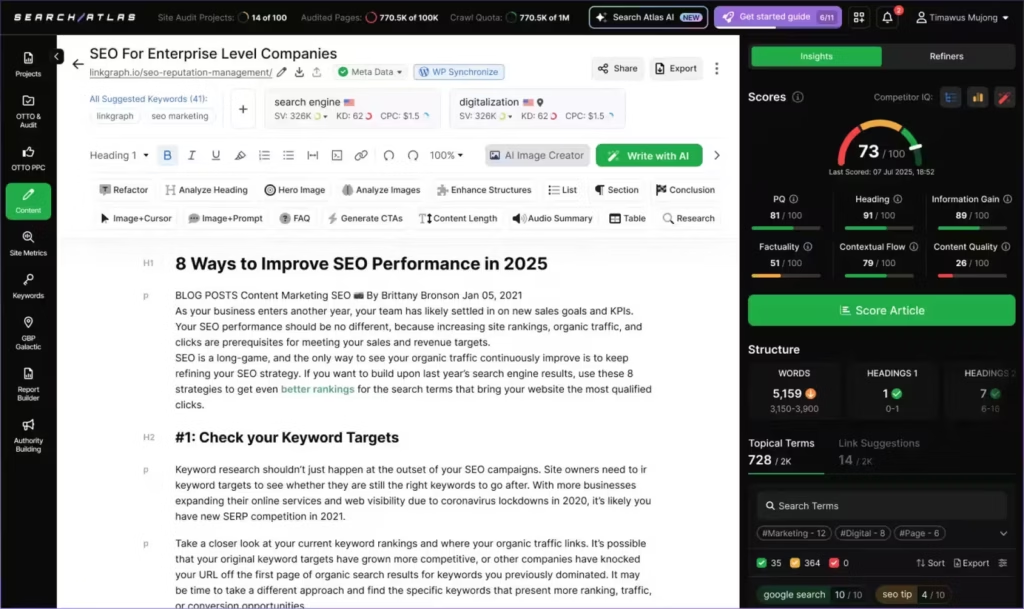
What is Search Atlas Content Genius? Search Atlas Content Genius is an agentic AI content intelligence platform that orchestrates research, drafting, optimization, publishing, and performance validation inside a unified marketing workflow. Search Atlas Content Genius functions as the execution layer within the broader Search Atlas ecosystem. Search Atlas Content Genius integrates semantic scoring, entity modeling, multi-channel deployment, and performance analytics into one operational system rather than operating as a standalone drafting tool.
What problem does Search Atlas Content Genius solve? Search Atlas Content Genius solves the fragmentation between SEO research, editorial production, cross-channel publishing, and performance measurement. Traditional workflows separate keyword research, SERP analysis, content drafting, internal linking, schema structuring, and analytics validation across multiple tools. Search Atlas Content Genius consolidates research, structure generation, semantic scoring, and deployment into one coordinated agentic system.
What core metrics does Search Atlas Content Genius measure? Search Atlas Content Genius measures SEO score consistency, topical gap coverage, entity relevance, passage-level optimization strength, and Generative Engine Optimization visibility. Search Atlas Content Genius evaluates semantic completeness using contextual vector mapping. Search Atlas Content Genius tracks brand presence across AI-driven environments (ChatGPT, Gemini, Perplexity, Claude) and validates performance using GSC, GA4, and GBP data. These metrics quantify ranking readiness and citation eligibility across channels.
How does Search Atlas Content Genius work? Search Atlas Content Genius orchestrates 15 or more specialized AI microagents that execute research, structuring, formatting, localization, internal linking, and optimization in coordinated phases. AI microagents analyze live SERP signals and entity relationships before generating structured drafts. Operational modes (Write Yourself, Write With AI, Write With AI in Bulk) determine automation depth. AI Folders embed brand tone, messaging standards, and structural rules across campaigns.
Does Search Atlas Content Genius only track performance? Search Atlas Content Genius both measures performance and provides direct optimization guidance inside the writing interface. Passage-level scoring identifies missing entities and weak semantic coverage. Real-time optimization overlays guide structural improvements without requiring external SEO editors.
Who is Search Atlas Content Genius best suited for? Search Atlas Content Genius is best suited for SEO teams, content marketing departments, agencies, growth teams, and enterprise publishers managing structured multi-channel content. Organizations standardize workflows across blogs, landing pages, product content, and informational assets using centralized optimization layers. Enterprise teams maintain brand governance and semantic consistency through AI Folders and microagent orchestration.
What strengths define Search Atlas Content Genius? Search Atlas Content Genius excels in agentic orchestration, semantic automation, cross-channel execution, and measurable efficiency gains. Search Atlas Content Genius produces publication-ready drafts in 9-15 minutes with 95% SEO score consistency. Teams create and optimize content up to 80% faster while reducing production costs by over 60%. Automated internal linking, schema suggestions, alt-text generation, and information gain prompts execute inside the workflow.
What limitations affect Search Atlas Content Genius? Search Atlas Content Genius requires structured input and strategic oversight for maximum performance. Complex industries require subject-matter validation before publication. Enterprise-level functionality assumes familiarity with SEO frameworks and semantic modeling.
When does Search Atlas Content Genius make the most sense? Search Atlas Content Genius makes the most sense when teams require high-volume, semantically structured, AI-ready content executed across search engines and AI assistants within one system. Search Atlas Content Genius replaces fragmented research stacks with coordinated execution that combines generation, optimization, automation, and performance intelligence. The Search Atlas Review highlights that it is a comprehensive tool with capabilities, workflow execution, and measurable ranking outcomes.
2. Claude
Claude is a large language model developed by Anthropic that generates long-form written content with advanced reasoning, ethical alignment, and extended context processing. Claude functions as an AI assistant for writing, research, coding, and structured content creation. Claude differentiates itself through Constitutional AI principles and high token capacity.
What problem does Claude solve? Claude solves the limitations of short context windows and inconsistent safety controls in AI-generated content. Many AI systems struggle with long documents, complex policy materials, or multi-source research. Claude processes up to 200K tokens in Opus 4.1 and up to 1 million tokens in Sonnet 4, which enables full-document analysis without truncation.
What core metrics does Claude measure? Claude does not measure AI traffic or search visibility metrics. Claude focuses on reasoning accuracy, contextual continuity, and output coherence. Claude evaluates prompt alignment, logical structure, and internal consistency rather than SEO scoring or ranking performance.
How does Claude work for content writing? Claude analyzes a user prompt, references learned linguistic patterns, and generates structured responses using deep learning and Constitutional AI principles. Claude uses predefined ethical guidelines derived from global human rights standards to shape output boundaries. Claude models (Opus 4.1, Sonnet 4, Haiku 3.5) process large inputs and generate coherent long-form responses with minimal fragmentation.
Does Claude provide optimization recommendations? Claude generates content and refines responses through iterative prompting but does not provide structured SEO scoring or automated optimization overlays. Claude improves drafts through conversational feedback cycles. Claude does not include built-in semantic gap scoring or ranking diagnostics.
Who is Claude best suited for? Claude is best suited for researchers, enterprise teams, policy analysts, technical writers, and long-form content strategists. Claude performs well in environments that require document-level synthesis, safety compliance, and structured reasoning across large data inputs.
What strengths define Claude? Claude excels at long-context processing, ethical alignment, and research-depth generation. Claude processes entire research papers, long PDFs, or extended documentation within a single prompt. Claude produces citation-backed analysis with minimal structural breakdown. Enterprise adoption increases due to predictable output and transparency in safety design.
What limitations affect Claude? Claude lacks built-in SEO scoring, search performance tracking, and ranking diagnostics. Claude requires external tools for keyword research and competitive analysis (Ahrefs, Semrush). Claude output still requires fact verification and editorial validation for industry-specific claims.
When does Claude make the most sense? Claude makes the most sense for complex long-form research, enterprise documentation, and high-context analytical writing. Claude fits workflows where contextual continuity and safety thresholds take priority over search ranking metrics. Claude stands as one of the strongest AI content writing tools for deep reasoning and extended content generation, while specialized SEO platforms remain necessary for ranking optimization.
3. ChatGPT
ChatGPT is a generative artificial intelligence tool developed by OpenAI that produces human-like written content through conversational Natural Language Processing. ChatGPT functions as a large language model that generates articles, emails, scripts, product descriptions, and structured long-form drafts based on user prompts.
What problem does ChatGPT solve? ChatGPT solves the difficulty of generating high-quality written content quickly and at scale. Manual drafting requires multiple hours per article. ChatGPT produces structured drafts in seconds, which reduces production time and removes writer’s block friction.
What core metrics does ChatGPT measure? ChatGPT does not measure SEO traffic, rankings, or AI share of voice metrics. ChatGPT evaluates prompt alignment, response coherence, reasoning accuracy, and contextual continuity. ChatGPT focuses on conversational relevance rather than search visibility diagnostics.
How does ChatGPT work for content writing? ChatGPT analyzes a user prompt, predicts probable word sequences using GPT models, and assembles structured responses through reinforcement learning from human feedback. ChatGPT relies on models (GPT-3.5, GPT-4, GPT-4o) trained on large datasets. The system interprets intent, generates token sequences, and formats output according to the requested tone and structure.
Does ChatGPT provide optimization recommendations? ChatGPT generates content and revises drafts through conversational refinement but does not provide built-in SEO scoring or ranking diagnostics. ChatGPT improves clarity, tone, and structure when prompted. Keyword research and search performance analysis require separate tools (Ahrefs, Semrush).
Who is ChatGPT best suited for? ChatGPT is best suited for marketers, freelancers, founders, students, and content teams that require rapid draft generation across multiple formats. ChatGPT supports emails, blog posts, landing pages, product descriptions, and research summaries.
What strengths define ChatGPT? ChatGPT excels in versatility, conversational adaptability, and speed. ChatGPT adjusts tone from formal to casual through prompting. ChatGPT generates long-form responses up to 25,000 words in GPT-4 environments. ChatGPT processes complex instructions and follow-up clarifications within a single conversation.
What limitations affect ChatGPT? ChatGPT lacks native SEO performance scoring, competitive analysis metrics, and guaranteed factual accuracy. ChatGPT requires external validation for industry-specific claims. Knowledge cutoff limitations affect non-search-enabled versions. Structured SEO optimization requires integration with dedicated SEO tools.
When does ChatGPT make the most sense? ChatGPT makes the most sense when rapid draft production, idea generation, and conversational content refinement take priority over search ranking diagnostics. ChatGPT fits hybrid workflows where external SEO tools define strategy, and ChatGPT executes structured drafts. ChatGPT remains one of the most widely adopted AI content writing tools due to accessibility, speed, and broad usability.
4. Surfer SEO
Surfer SEO is an AI-driven content optimization platform that analyzes search engine results and provides real-time on-page SEO recommendations based on competitor data. Surfer SEO functions as a content intelligence system that evaluates over 500 ranking indicators to structure and optimize articles for Google visibility.
What problem does Surfer SEO solve? Surfer SEO solves the difficulty of aligning written content with ranking factors and competitive search intent. Many writers publish content without structured SERP analysis. Surfer SEO reverse-engineers top-ranking pages and converts ranking patterns into actionable content guidelines.
What core metrics does Surfer SEO measure? Surfer SEO measures content score, keyword density, SERP similarity, word count benchmarks, backlink references, and NLP-driven topical coverage. Surfer SEO evaluates real-time competitor alignment. Surfer SEO identifies missing entities, related terms, and structural gaps that influence ranking performance.
How does Surfer SEO work for content writing? Surfer SEO analyzes the top-ranking pages for a target keyword and generates optimization guidelines inside its Content Editor. The SERP Analyzer examines competitor headings, term frequency, structure, and ranking volatility. The Content Editor overlays real-time recommendations while writing. Surfer AI generates structured drafts based on SERP-derived insights.
Does Surfer SEO provide optimization recommendations? Surfer SEO both tracks ranking indicators and provides direct improvement suggestions inside the writing interface. Content Editor flags missing keywords, under-optimized headings, and structural weaknesses. Auto-Optimize adjusts content automatically to reach target score thresholds.
Who is Surfer SEO best suited for? Surfer SEO is best suited for SEO specialists, content strategists, agencies, and growth marketing teams focused on ranking performance. Organizations managing keyword-driven editorial calendars benefit from competitor-based scoring systems.
What strengths define Surfer SEO? Surfer SEO excels in real-time on-page optimization, competitor-based benchmarking, and structured SEO scoring. Surfer SEO loads analysis results quickly and integrates with Google Docs and WordPress. Surfer SEO enables draft optimization within approximately 20 minutes using data-driven guidelines.
What limitations affect Surfer SEO? Surfer SEO focuses primarily on on-page ranking factors and does not provide a comprehensive backlink database depth compared to tools for backlink analysis. Surfer SEO relies heavily on competitor patterns, which reinforce existing SERP conventions rather than promote content differentiation.
When does Surfer SEO make the most sense? Surfer SEO makes the most sense when ranking improvement and structured on-page optimization take priority over purely generative drafting. The Surfer SEO Review highlights that it fits workflows where search data defines structure and AI drafting accelerates execution. Surfer SEO stands as one of the strongest AI content writing tools for performance-driven content teams that prioritize measurable ranking alignment.
5. Sudowrite
Sudowrite is an AI writing tool designed specifically for fiction authors that generates, expands, and refines creative prose using a proprietary language model fine-tuned for storytelling. Sudowrite functions as a creative writing assistant focused on narrative structure, emotional beats, and stylistic prose rather than SEO content generation.
What problem does Sudowrite solve? Sudowrite solves writer’s block and narrative inconsistency in long-form fiction projects. Fiction authors struggle with scene expansion, dialogue flow, pacing, and character continuity. Sudowrite provides structured drafting, brainstorming, and revision workflows tailored for novels and screenplays.
What core metrics does Sudowrite measure? Sudowrite does not measure AI traffic, SEO rankings, keyword visibility, or search performance metrics. Sudowrite evaluates narrative flow, descriptive depth, emotional tone, and structural consistency within a manuscript. Sudowrite focuses on prose quality rather than digital visibility.
How does Sudowrite work for content writing? Sudowrite uses its proprietary Muse 1.5 large language model to generate prose based on outlines, beats, and scene instructions. Muse 1.5 is fine-tuned for dialogue rhythm, humor, blocking, and emotional structure. Draft tools generate passages from structured outlines. Rewrite tools adjust tone, intensity, and description. Story Bible and Series Folder features maintain character and world consistency across manuscripts up to 80,000 words.
Does Sudowrite provide optimization recommendations? Sudowrite generates and refines creative content but does not provide SEO scoring, ranking diagnostics, or competitive keyword analysis. Sudowrite offers revision suggestions for prose enhancement and narrative improvement. Search optimization requires external tools.
Who is Sudowrite best suited for? Sudowrite is best suited for fiction authors, novelists, screenwriters, and creative storytellers. Writers managing multi-book series benefit from Story Bible and Series Folder features. Creative professionals focused on narrative depth gain the highest value.
What strengths define Sudowrite? Sudowrite excels in creative prose generation, emotional scene construction, and stylistic consistency. Sudowrite adapts to voice, pacing, and dialogue style. Sudowrite generates descriptive expansions and character-driven interactions with high narrative coherence. Over 300,000 fiction writers use Sudowrite globally.
What limitations affect Sudowrite? Sudowrite does not provide built-in SEO analysis, traffic metrics, or marketing content optimization features. Sudowrite requires human editorial judgment to refine originality and avoid repetitive phrasing. Sudowrite focuses exclusively on fiction writing rather than commercial content marketing.
When does Sudowrite make the most sense? Sudowrite makes the most sense for long-form fiction drafting, scene expansion, and structured narrative development. Sudowrite fits workflows where storytelling quality and manuscript continuity take priority over search performance. Sudowrite stands as one of the strongest AI content writing tools for fiction authors due to its specialized creative focus and narrative optimization capabilities.
6. Jasper AI
Jasper AI is an artificial intelligence content platform built for marketing teams that generates branded copy and manages campaign workflows within a structured workspace. Jasper AI focuses on marketing execution rather than general conversation. Jasper AI centralizes drafting, brand governance, and campaign coordination inside one interface.
What problem does Jasper AI solve? Jasper AI solves the challenge of maintaining brand consistency and campaign coordination across high-volume marketing content. Marketing teams struggle with fragmented tools, inconsistent tone, and disconnected assets. Jasper AI organizes drafts, brand guidelines, and campaign messaging in a shared environment.
What core metrics does Jasper AI measure? Jasper AI tracks engagement metrics, conversion-related performance indicators, and internal content usage analytics rather than organic ranking metrics. Jasper AI provides campaign-level visibility through its analytics dashboard. Jasper AI does not natively measure keyword rankings or backlink performance without external integrations.
How does Jasper AI work for content writing? Jasper AI integrates multiple large language models (Gemini, ChatGPT, Anthropic) and applies brand-specific context layers to generate marketing content. Jasper IQ blends company documents, brand voice inputs, and marketing best practices to shape output. Jasper Canvas organizes assets inside an infinite marketing workspace. Jasper Studio enables no-code customization for marketing workflows.
Does Jasper AI provide optimization recommendations? Jasper AI generates branded content and suggests improvements aligned with marketing tone and structure, but SEO scoring requires integration with Surfer SEO. Jasper AI focuses on messaging alignment rather than standalone ranking diagnostics. The feature for SEO optimization relies on Surfer SEO integration.
Who is Jasper AI best suited for? Jasper AI is best suited for marketing teams, brand managers, PR departments, product marketers, and agencies managing multi-channel campaigns. Organizations handling large content volumes across landing pages, product descriptions, newsletters, and ads benefit from its structured workspace.
What strengths define Jasper AI? Jasper AI excels in brand voice control, campaign coordination, and collaborative content production. Jasper AI stores multiple brand voices per account. Jasper AI enables real-time collaboration within shared canvases. Over 100,000 teams use Jasper AI for structured marketing workflows.
What limitations affect Jasper AI? Jasper AI requires detailed brand inputs to avoid generic output and lacks native backlink or ranking analytics. Brand Voice automation produces repetitive phrasing. Advanced SEO optimization depends on external tools for keyword research and backlink analysis.
When does Jasper AI make the most sense? Jasper AI makes the most sense for marketing organizations that require structured campaign management and consistent brand messaging across multiple channels. Jasper AI fits environments where collaboration, tone governance, and marketing workflow control outweigh standalone SEO scoring. Jasper AI stands as one of the strongest AI content writing tools for coordinated marketing execution.
7. Paperpal
Paperpal is an AI-powered academic writing assistant that improves scholarly manuscripts through specialized language editing, citation verification, and research integration. Paperpal focuses on scientific, technical, and medical writing rather than general marketing content. Paperpal uses proprietary AI models trained on millions of scholarly articles and editorial corrections.
What problem does Paperpal solve? Paperpal solves the challenge of producing publication-ready academic writing that meets journal language, formatting, and citation standards. Researchers face grammar inconsistencies, structural issues, citation formatting errors, and unintended plagiarism risks. Paperpal streamlines academic editing and reduces revision cycles.
What core metrics does Paperpal measure? Paperpal measures grammar accuracy, academic tone compliance, citation validity, plagiarism similarity score, manuscript completeness, and structural adherence. Paperpal scans manuscripts against 99 billion web pages for similarity detection. Paperpal verifies references against a repository of over 250 million scholarly articles. Paperpal checks approximately 30 submission compliance criteria in its Submission Check feature.
How does Paperpal work for content writing? Paperpal analyzes uploaded manuscripts using proprietary AI models trained on scholarly datasets and professional editor feedback. The system evaluates grammar, structure, terminology precision, and citation formatting. Targeted Editing generates contextual suggestions inside an integrated interface.
Does Paperpal provide optimization recommendations? Paperpal provides direct improvement suggestions for grammar, clarity, academic tone, citation accuracy, and submission compliance. Paperpal does not track SEO rankings or organic traffic metrics. Paperpal focuses on manuscript refinement rather than search performance diagnostics.
Who is Paperpal best suited for? Paperpal is best suited for academic researchers, PhD candidates, journal authors, and scientific writers. Universities, research institutions, and medical publishers benefit from structured editing workflows aligned with academic standards.
What strengths define Paperpal? Paperpal excels in academic language precision, citation verification, and plagiarism detection. Paperpal delivers over 2 times more academic editing suggestions than Grammarly in benchmarking tests. Paperpal integrates with Microsoft Word, Google Docs, Chrome, and Overleaf. Paperpal relies on proprietary models instead of general OpenAI-based systems, which strengthens data security and subject alignment.
What limitations affect Paperpal? Paperpal does not provide marketing-focused content generation, SEO scoring, or commercial copywriting optimization. Paperpal overformalizes language in certain contexts. AI humanization features fail AI-detection tools. Manuscripts still require subject-matter validation for research accuracy.
When does Paperpal make the most sense? Paperpal makes the most sense for researchers preparing manuscripts for journal submission or academic publishing. Paperpal fits workflows where citation accuracy, structural compliance, and scholarly tone take priority over marketing metrics. Paperpal stands as one of the strongest AI content writing tools for academic and research environments due to its specialized training and editorial alignment.
8. Grammarly

Grammarly is an AI writing assistant that improves written communication through real-time grammar correction, clarity enhancement, and tone adjustment across digital platforms. Grammarly functions as a Natural Language Processing system that evaluates text for correctness, style, and consistency inside browsers, documents, and applications.
What problem does Grammarly solve? Grammarly solves the problem of unclear, incorrect, and inconsistent written communication in professional and academic environments. Writers often miss grammar errors, punctuation mistakes, tone mismatches, and structural weaknesses. Grammarly reduces revision cycles and increases communication accuracy across teams.
What core metrics does Grammarly measure? Grammarly measures grammar accuracy, spelling correctness, clarity score, tone alignment, engagement level, and writing style consistency. Grammarly evaluates over 400 grammar checks in Premium mode. Grammarly analyzes wordiness, sentence structure, and tone appropriateness. Grammarly does not measure organic traffic or SEO rankings.
How does Grammarly work for content writing? Grammarly analyzes text using Natural Language Processing, machine learning models, deep learning systems, and reinforcement learning feedback loops. The system detects grammar patterns, contextual errors, and tone inconsistencies. Grammarly Go generates rewritten or expanded text using context-aware AI. User acceptance or rejection of suggestions refines model recommendations over time.
Does Grammarly provide optimization recommendations? Grammarly provides direct improvement suggestions for grammar, clarity, tone, and conciseness rather than SEO optimization diagnostics. Grammarly flags unclear phrasing and proposes revised alternatives instantly. Grammarly does not provide keyword tracking, ranking analysis, or backlink monitoring.
Who is Grammarly best suited for? Grammarly is best suited for professionals, students, freelancers, content marketers, and organizations requiring polished written communication. Over 40 million individuals and 50,000 organizations use Grammarly daily. Teams managing brand communication benefit from centralized tone and style guidance.
What strengths define Grammarly? Grammarly excels in real-time editing accuracy, cross-platform integration, and tone detection. Grammarly integrates across over 1 million websites and applications. Grammarly operates on Windows, macOS, Chrome, Safari, Firefox, iOS, and Android. Organizations report saving an average of $5,000 per employee annually due to efficiency improvements.
What limitations affect Grammarly? Grammarly does not specialize in long-form content generation, SEO scoring, or deep research-based drafting. Grammarly primarily refines existing text rather than creating fully structured long-form drafts. Grammarly suggestions occasionally oversimplify stylistic nuance in creative writing contexts.
When does Grammarly make the most sense? Grammarly makes the most sense when clarity, professionalism, and grammar precision take priority over search ranking or high-volume content generation. Grammarly fits workflows where text refinement and communication quality drive performance. Grammarly stands as one of the strongest AI content writing tools for real-time editing and structured language correction across digital environments.
9. Frase

Frase is an AI-powered content creation and optimization platform that combines keyword research, competitor analysis, AI drafting, and SEO scoring inside one unified workflow. Frase functions as a research-to-publication system that structures content around real-time SERP analysis and AI-driven optimization.
What problem does Frase solve? Frase solves the fragmentation between keyword research, content briefing, drafting, and SEO optimization. Many teams switch between multiple tools for research, outlining, writing, and scoring. Frase consolidates these steps into one platform, which reduces workflow inefficiency and accelerates content production.
What core metrics does Frase measure? Frase measures Topic Score, Content Score, keyword coverage, competitor alignment, and AI platform visibility metrics. Frase evaluates how well a page matches top-ranking competitor structures. Frase tracks optimization progress from initial draft to high alignment benchmarks (60-95+ content score). Frase monitors visibility across Google and AI platforms (ChatGPT, Perplexity).
How does Frase work for content writing? Frase analyzes the top 10 competitors for a target keyword and generates a structured content brief with headings, questions, and topical gaps. The AI Agent produces competitive briefs within 30 seconds. The Content Editor overlays real-time scoring while drafting. GEO Content Optimization adjusts structure and formatting for AI search citation readiness.
Does Frase provide optimization recommendations? Frase both measures performance and provides actionable improvement recommendations in real time. The editor highlights missing terms, weak topical coverage, and structural inconsistencies. Frase suggests revisions that increase Content Score and Topic Score without requiring separate SEO platforms.
Who is Frase best suited for? Frase is best suited for SEO managers, content strategists, marketing teams, bloggers, and agencies managing structured search-driven content. Lean teams benefit from unified research and drafting capabilities. 88% of Frase customers are marketers and content creators.
What strengths define Frase? Frase excels in workflow automation, competitive research speed, and integrated SEO plus GEO scoring. Frase consolidates research, briefing, drafting, and optimization in one interface. Teams increase publishing frequency from 1 post per week to 3-4 posts per week using automated brief generation. Programmatic SEO features enable thousands of structured pages at scale.
When does Frase make the most sense? Frase makes the most sense when a team requires fast competitor-based briefs, real-time scoring, and AI-ready content optimization inside one workflow. The Frase Review highlights that it fits structured SEO environments where ranking alignment and AI citation readiness drive performance. Frase stands as one of the strongest AI content writing tools for search-focused content teams that prioritize automation and measurable optimization outcomes.
10. Clearscope
Clearscope is a content optimization platform that uses Natural Language Processing models to analyze search results and provide data-driven recommendations for ranking-focused content. Clearscope functions as a discoverability platform that aligns written content with Google search expectations through structured term analysis and competitive benchmarking.
What problem does Clearscope solve? Clearscope solves the challenge of publishing content that lacks semantic depth and alignment with top-ranking competitors. Writers often miss critical subtopics, entity coverage, and structural signals that influence rankings. Clearscope bridges the gap between keyword research and publish-ready content optimization.
What core metrics does Clearscope measure? Clearscope measures Content Grade (F to A++), recommended term coverage, keyword search volume, competition level, cost-per-click, clicks, impressions, and average position. Clearscope evaluates term frequency against top-ranking competitors. Clearscope tracks performance data through Google Search Console integration and flags Content Decay and Striking Distance Queries.
How does Clearscope work for content writing? Clearscope analyzes top-ranking search results for a target keyword and generates a structured content report with recommended terms and topic coverage. The Draft with AI feature produces structured outlines and introductions. The real-time editor updates Content Grade dynamically as writers adjust text. Topic Explorations pull keyword ideas from Google Autocomplete and competitor patterns.
Does Clearscope provide optimization recommendations? Clearscope both measures content performance and provides direct optimization guidance inside the editor. The platform highlights missing terms, structural gaps, and competitor-aligned improvements. Clearscope does not function as a full backlink or technical SEO suite.
Who is Clearscope best suited for? Clearscope is best suited for content marketers, SEO managers, in-house editorial teams, and agencies focused on search-aligned content production. Enterprise clients (Intuit, Adobe, Shopify, YouTube) rely on Clearscope for structured optimization workflows.
What strengths define Clearscope? Clearscope excels in semantic content grading, competitor-based analysis, and real-time optimization clarity. Clients report 83.7% click growth in English blogs and 721% organic click growth in the German strategy after implementation. Clearscope integrates with Google Docs, WordPress, and Microsoft Word, which streamlines workflow adoption.
What limitations affect Clearscope? Clearscope lacks backlink analysis, deep technical SEO auditing, and advanced rank tracking compared to tools for these tasks. Clearscope focuses primarily on on-page optimization. Draft with AI accelerates content creation but does not replace editorial oversight.
When does Clearscope make the most sense? Clearscope makes the most sense when semantic completeness, competitive alignment, and measurable content grading drive ranking performance. The Clearscope Review highlights that it fits structured SEO teams that prioritize optimization precision over automated bulk drafting. Clearscope stands as one of the strongest AI content writing tools for search-focused content refinement and semantic scoring.
11. Hypotenuse
Hypotenuse is an AI content generation platform designed primarily for marketers and e-commerce businesses to produce product descriptions, blog posts, and marketing copy at scale. Hypotenuse focuses on high-volume content automation with structured templates, product data enhancement, and marketplace-ready formatting.
What problem does Hypotenuse solve? Hypotenuse addresses the challenge of generating large volumes of product and marketing content quickly, while staying within time and budget constraints. E-commerce teams managing thousands of SKUs require structured descriptions, consistent formatting, and optimized listings. Hypotenuse automates repetitive drafting and product data enrichment.
What core metrics does Hypotenuse measure? Hypotenuse measures keyword inclusion, SEO alignment, content volume output, product data completeness, and internal plagiarism checks. Hypotenuse integrates SEO AI Agent monitoring for search trends and metadata adjustments. Hypotenuse does not provide deep backlink analysis or advanced ranking tracking.
How does Hypotenuse work for content writing? Hypotenuse analyzes structured input data and generates formatted content using Natural Language Processing and specialized AI agents. Product Data AI Agent cleans spreadsheets and structures attributes. Product Content AI Agent generates SEO-optimized titles and bullet points. Bulk generation occurs through CSV uploads or PIM integration. AI Article Writer produces blog drafts supported by Content Detective research scanning.
Does Hypotenuse provide optimization recommendations? Hypotenuse both generates content and provides SEO suggestions for keyword placement and metadata improvements. The SEO AI Agent suggests content tweaks based on search trends. Optimization remains surface-level compared to the tools for deep SEO analytics.
Who is Hypotenuse best suited for? Hypotenuse is best suited for e-commerce businesses, digital marketers, agencies, and freelancers managing high-volume catalogs. Companies with thousands of products benefit from bulk generation and Shopify integration.
What strengths define Hypotenuse? Hypotenuse excels in bulk content production, multilingual support, and e-commerce workflow automation. The platform supports over 25 languages and 25 templates. Hypotenuse enables the generation of hundreds of product descriptions in one session. Ease of use receives a 9 out of 10 rating from Originality.ai. Bulk scalability reduces production time significantly.
What limitations affect Hypotenuse? Hypotenuse requires human editing for tone precision and factual accuracy. AI-generated descriptions convert 21% lower than human-written descriptions in reported A/B testing. 31% of descriptions required significant rewrites before publication. Long-form articles over 1,500 words show repetition and focus loss. Customer support response averages 72 hours for technical issues.
When does Hypotenuse make the most sense? Hypotenuse makes the most sense for e-commerce teams that prioritize speed, scale, and structured catalog automation over deep strategic SEO analysis. Hypotenuse fits workflows where product volume and operational efficiency drive content requirements. Hypotenuse stands as one of the strongest AI content writing tools for catalog-scale content automation in e-commerce environments.
12. Type AI
Type AI is an AI writing assistant that integrates large language models directly into a structured writing interface to generate, edit, and refine professional content. Type AI functions as an all-in-one drafting and editing environment built specifically for writers rather than conversational chat use.
What problem does Type AI solve? Type AI solves the friction between drafting, editing, and AI generation across multiple disconnected tools. Writers often switch between chat tools, word processors, and editing software. Type AI centralizes drafting, rewriting, and document review into one structured workspace.
What core metrics does Type AI measure? Type AI measures readability, grammar accuracy, tone consistency, structural clarity, and document coherence. Type AI does not measure keyword rankings, organic traffic, backlink metrics, or AI visibility scores. Type AI focuses on writing quality metrics rather than search performance diagnostics.
How does Type AI work for content writing? Type AI generates drafts through integrated large language models (ChatGPT, Claude) and refines content through built-in editing tools. Draft Generator produces structured first drafts from briefs. Text Transformer adjusts tone, style, and phrasing. Document Review analyzes grammar, clichés, and transitions. A 128K token context window maintains coherence across long documents.
Does Type AI provide optimization recommendations? Type AI provides writing improvement suggestions for clarity, tone, and structure, but does not provide SEO ranking diagnostics or competitive keyword analysis. Optimization focuses on writing quality rather than search alignment. The tool for keyword research and ranking analytics remains external (Ahrefs, Semrush).
Who is Type AI best suited for? Type AI is best suited for professional writers, marketing teams, content agencies, and businesses with recurring content workflows. Organizations requiring structured drafting and consistent editorial control benefit from its writing-focused interface.
What strengths define Type AI? Type AI excels in structured drafting, long-document consistency, and integrated editing workflows. Type AI allows model switching between GPT-4o and Claude 3.7. Type AI reduces application switching and eliminates copy-paste friction. Type AI provides reusable templates and saved prompts for standardized output.
What limitations affect Type AI? Type AI does not provide built-in SEO scoring, backlink analysis, or advanced competitor benchmarking. Type AI depends on external models for generative capability. Content still requires human validation for factual accuracy and strategic positioning.
When does Type AI make the most sense? Type AI makes the most sense for professional writers and content teams that prioritize structured drafting and integrated editing over standalone chat-based generation. Type AI fits environments where editorial workflow control, long-form document coherence, and brand-aligned writing take priority over SEO analytics. Type AI stands as one of the strongest AI content writing tools for structured professional writing workflows.
13. Rytr

Rytr is an AI writing assistant that generates short-form marketing and business content quickly using machine learning and Natural Language Processing. Rytr focuses on simplicity, affordability, and rapid content drafting for everyday writing tasks.
What problem does Rytr solve? Rytr solves the challenge of producing short-form content quickly without complex setup or high subscription costs. Freelancers and small businesses often require ads, emails, captions, and product blurbs under tight deadlines. Rytr reduces drafting time and removes workflow friction.
What core metrics does Rytr measure? Rytr measures character usage limits, plagiarism checks, and basic content variation output rather than SEO traffic or ranking metrics. Rytr includes plagiarism detection powered by Copyscape. Rytr does not provide keyword ranking analytics, backlink metrics, or search visibility scoring.
How does Rytr work for content writing? Rytr analyzes a user prompt using GPT-3-based language modeling and generates structured short-form content across predefined use cases. Users select content type, tone, and language. Rytr produces multiple variations for A/B testing. Editing tools refine phrasing, expand text, or shorten passages inside the same interface.
Does Rytr provide optimization recommendations? Rytr provides rewriting and improvement suggestions for clarity and tone, but does not provide structured SEO optimization diagnostics. Optimization focuses on language refinement rather than search engine performance. A tool for keyword research and ranking analytics requires external platforms (Ahrefs, Semrush).
Who is Rytr best suited for? Rytr is best suited for freelancers, solopreneurs, bloggers, and small business owners who require fast, short-form content. Individuals producing social posts, emails, ads, and product snippets benefit from low-cost access and fast output.
What strengths define Rytr? Rytr excels in affordability, ease of use, and short-form efficiency. Rytr offers a free plan with 10,000 characters per month. Paid plans start at $9 per month. The interface remains simple and intuitive. Over 40 content use cases and 20 tones increase flexibility.
What limitations affect Rytr? Rytr struggles with long-form depth, structured article coherence, and advanced SEO alignment. Generated long-form drafts often lack originality and detailed insight. Plagiarism checks remain limited per plan. Advanced competitive analysis remains unavailable inside the platform.
When does Rytr make the most sense? Rytr makes the most sense when short-form content speed and affordability outweigh long-form strategy or SEO performance needs. Rytr fits daily marketing tasks where simplicity drives productivity. Rytr stands as one of the strongest AI content writing tools for budget-conscious creators who prioritize fast, short-form output.
14. Copy.ai

Copy.ai is an AI-native Go-To-Market platform that generates, automates, and manages sales and marketing content workflows using integrated large language models. Copy.ai functions as a unified GTM engine that connects content creation, personalization, and campaign execution inside one system.
What problem does Copy.ai solve? Copy.ai solves the fragmentation between content creation, sales messaging, and GTM execution across disconnected tools. Marketing and sales teams often rely on multiple copilots and narrow AI tools. Copy.ai consolidates ideation, drafting, personalization, and automation into a centralized workflow.
What core metrics does Copy.ai measure? Copy.ai measures campaign engagement metrics, productivity impact, pipeline growth, and workflow efficiency rather than organic ranking metrics. Copy.ai tracks performance across marketing and sales pipelines. Copy.ai does not natively measure backlink authority, SERP position, or keyword difficulty without integration.
How does Copy.ai work for content writing? Copy.ai integrates multiple AI models (GPT-3, GPT-4, GPT-4o, Claude 3.5, Gemini) and applies brand-specific inputs to generate structured marketing and sales content. Content Agent Studio creates reusable AI agents from sample brand content. Infobase stores voice and messaging guidelines. AI Marketing OS and AI Sales OS automate personalization, prospecting, and pipeline workflows.
Does Copy.ai provide optimization recommendations? Copy.ai generates content and workflow automation recommendations, but does not provide standalone SEO ranking diagnostics. SEO-focused content engines exist inside the platform. The tool for advanced SEO keyword and backlink research remains external (Ahrefs, Semrush).
Who is Copy.ai best suited for? Copy.ai is best suited for marketing teams, sales teams, agencies, and GTM-focused organizations managing high-volume campaigns. Enterprises requiring cross-team automation and structured campaign coordination benefit most. Over 17 million users globally rely on Copy.ai for GTM execution.
What strengths define Copy.ai? Copy.ai excels in GTM workflow consolidation, brand-consistent automation, and model-agnostic flexibility. Copy.ai integrates with over 2,000 applications (Salesforce, HubSpot, Slack). Copy.ai reduces editing time by up to 80% through Content Agent Studio. Lenovo reported $16 million in annual savings through automation deployment.
What limitations affect Copy.ai? Copy.ai focuses heavily on GTM automation rather than deep technical SEO diagnostics or backlink analytics. Advanced ranking optimization requires a specialized Tool for backlink analysis and keyword tracking. Smaller teams find the platform structured for enterprise-scale workflows.
When does Copy.ai make the most sense? Copy.ai makes the most sense when a business requires coordinated marketing and sales automation across campaigns, personalization layers, and messaging workflows. Copy.ai fits organizations that prioritize unified GTM execution over standalone writing tools. Copy.ai stands as one of the strongest AI content writing tools for marketing automation and enterprise-level content scalability.
15. ProWritingAid

ProWritingAid is an AI-powered writing enhancement toolkit that analyzes grammar, style, structure, and storytelling elements through detailed reports and real-time editing feedback. ProWritingAid functions as an in-depth writing analysis platform designed to refine and elevate written content across creative and professional contexts.
What problem does ProWritingAid solve? ProWritingAid solves the problem of shallow editing that overlooks structural, stylistic, and narrative weaknesses. Many writers rely on basic grammar correction tools that miss pacing issues, repeated phrasing, passive constructions, and stylistic inconsistencies. ProWritingAid provides deeper analytical insight to strengthen clarity and storytelling quality.
What core metrics does ProWritingAid measure? ProWritingAid measures grammar accuracy, readability score, pacing analysis, overused word frequency, sentence variation, passive voice usage, sticky sentence ratio, and structural balance. ProWritingAid does not measure keyword rankings, organic traffic, or backlink metrics. ProWritingAid focuses on writing quality diagnostics rather than SEO visibility tracking.
How does ProWritingAid work for content writing? ProWritingAid scans user text through advanced AI algorithms and structured editorial checks, then generates over 25 analytical reports covering different writing dimensions. The Grammar and Style Checker flags punctuation and clarity issues. Writing Reports analyzes structure, repetition, pacing, and readability. AI-powered features (Rephrase, Chapter Critiques, Virtual Beta Reader, Manuscript Analysis) refine tone and narrative flow.
Does ProWritingAid provide optimization recommendations? ProWritingAid both identifies writing weaknesses and provides specific improvement suggestions within each report. Suggestions include sentence restructuring, word replacement, tone refinement, and pacing adjustments. ProWritingAid does not provide keyword optimization scoring or competitive search analysis.
Who is ProWritingAid best suited for? ProWritingAid is best suited for authors, novelists, editors, bloggers, and long-form content writers who require deep structural feedback. Over 3 million active users rely on ProWritingAid globally. Bestselling authors use ProWritingAid for manuscript refinement.
What strengths define ProWritingAid? ProWritingAid excels in depth of analysis, educational feedback, and storytelling-focused reports. ProWritingAid offers over 25 writing reports, exceeding typical grammar check tools. 88% of long-term users report improved writing quality after extended use. The platform integrates with Microsoft Word, Google Docs, Scrivener, WordPress, and browser environments.
What limitations affect ProWritingAid? ProWritingAid does not generate full long-form drafts at scale and does not provide SEO traffic diagnostics. AI rewriting features require human judgment to maintain voice authenticity. Processing large manuscripts has slow performance compared to lightweight grammar tools.
When does ProWritingAid make the most sense? ProWritingAid makes the most sense for writers who prioritize deep editing, storytelling refinement, and long-term writing skill development. ProWritingAid fits workflows where structural analysis and stylistic precision outweigh automated bulk drafting. ProWritingAid stands as one of the strongest AI content writing tools for comprehensive editing and narrative enhancement.
16. Ollama

Ollama is an open-source framework that enables users to run large language models locally on their own devices for private and customizable AI content generation. Ollama functions as a local LLM runtime and model manager that eliminates reliance on cloud-based AI services and subscription-based APIs.
What problem does Ollama solve? Ollama solves the challenge of data privacy, recurring API costs, and dependency on cloud-based AI infrastructure. Organizations handling sensitive information require full control over data processing. Ollama enables secure, offline AI content generation without transmitting data to external servers.
What core metrics does Ollama measure? Ollama does not measure SEO rankings, traffic metrics, or AI visibility indicators. Ollama focuses on local model performance metrics (response speed, hardware efficiency, and processing latency). Ollama does not include built-in analytics for keyword tracking or content ranking.
How does Ollama work for content writing? Ollama runs large language models locally through a command-line interface, REST API, or programming libraries, enabling users to generate and customize content directly on their machines. Users install compatible models (Llama, Mistral, Gemma) and execute prompts via local processing. Developers integrate AI generation into applications using OpenAI-compatible APIs. Third-party web interfaces provide a conversational writing experience.
Does Ollama provide optimization recommendations? Ollama generates and refines content through locally deployed models but does not provide built-in SEO scoring or optimization diagnostics. Content improvement depends on prompt engineering and model customization. The tool for keyword analysis and ranking performance remains external (Ahrefs, Semrush).
Who is Ollama best suited for? Ollama is best suited for developers, AI engineers, privacy-focused organizations, and technical content creators requiring local AI deployment. Regulated industries (healthcare, finance, and legal sectors) benefit from secure offline processing and data ownership.
What strengths define Ollama? Ollama excels in data privacy, cost efficiency, offline capability, and customization flexibility. Ollama ensures complete data ownership through local execution. Ollama eliminates recurring API costs once hardware is deployed. Local processing reduces latency and supports air-gapped environments.
What limitations affect Ollama? Ollama requires strong hardware resources and technical expertise for optimal performance. Users need sufficient RAM, storage, and GPU acceleration for large models. Native multimodal capabilities remain limited compared to cloud-based platforms. Non-technical users require additional interfaces for usability.
When does Ollama make the most sense? Ollama makes the most sense when data security, offline AI deployment, and cost control take priority over cloud-based convenience and built-in SEO analytics. Ollama fits technical workflows where customization and privacy define content generation strategy. Ollama stands as one of the most powerful AI content writing tools for local AI deployment and privacy-centric environments.
17. Writesonic

Writesonic is an AI-powered content creation and marketing platform that generates, optimizes, and tracks written content for both traditional search engines and AI-driven search environments. Writesonic functions as an all-in-one content generation and optimization system designed to improve digital visibility and streamline content workflows.
What problem does Writesonic solve? Writesonic solves the challenge of producing SEO-optimized and AI-citation-ready content within a unified workflow. Marketing teams often rely on multiple tools for research, drafting, optimization, and performance tracking. Writesonic consolidates these functions into a single platform, reducing operational complexity and improving production efficiency.
What core metrics does Writesonic measure? Writesonic measures SEO performance metrics, AI visibility indicators, citation frequency, sentiment analysis, and competitor benchmarking across search and AI platforms. Writesonic tracks brand presence in AI-generated answers across platforms (ChatGPT, Gemini, Perplexity, Claude). Writesonic monitors search trends, ranking signals, and citation performance through integrated data sources.
How does Writesonic work for content writing? Writesonic generates content by integrating advanced AI models with live SEO data and real-time web research. The AI Article Writer produces structured long-form drafts using keyword inputs and reference content. Chatsonic provides real-time web access for research and fact validation. SEO and GEO modules align content with ranking requirements and AI citation standards.
Does Writesonic provide optimization recommendations? Writesonic tracks performance and delivers actionable optimization recommendations for SEO and AI visibility. The platform identifies citation gaps, keyword opportunities, and structural improvements. Writesonic provides real-time guidance to refine content for search ranking and AI-driven discoverability.
Who is Writesonic best suited for? Writesonic is best suited for marketing teams, SEO managers, content strategists, agencies, and enterprises managing large-scale content production and AI search visibility. Organizations requiring integrated SEO and GEO optimization benefit most from Writesonic’s unified workflow.
What strengths define Writesonic? Writesonic excels in combining SEO optimization, AI search visibility tracking, and automated content generation within a single platform. The platform generates long-form articles rapidly and tracks brand performance across over ten AI search platforms. Writesonic integrates with SEO data providers and supports compliance with enterprise security standards.
What limitations affect Writesonic? Writesonic requires structured keyword input and editorial oversight to ensure factual accuracy and brand alignment. Advanced SEO insights depend on integrated third-party data sources. The platform’s broad functionality requires onboarding time for new users unfamiliar with AI-driven SEO workflows.
When does Writesonic make the most sense? Writesonic makes the most sense for organizations seeking to dominate both traditional search rankings and AI-generated search visibility through a unified content strategy. The Writesonic Review highlights that it fits environments where scalable content production, real-time optimization, and AI citation tracking define competitive advantage. Writesonic stands as one of the strongest AI content writing tools for integrated SEO and generative search optimization workflows.
18. Cuppa.ai
Cuppa.ai is an AI-powered content marketing suite that generates, optimizes, publishes, and scales written content using a Bring Your Own Key model for cost-efficient AI execution. Cuppa.ai functions as a full content lifecycle operating system that manages research, drafting, optimization, distribution, and performance tracking inside one platform.
What problem does Cuppa.ai solve? Cuppa.ai solves the problem of expensive AI token markups and fragmented content production workflows. Many AI platforms charge inflated per-token costs and require separate tools for research, linking, grading, and publishing. Cuppa.ai consolidates these processes and allows direct API usage to reduce operational costs.
What core metrics does Cuppa.ai measure? Cuppa.ai measures content grade, internal link coverage, SERP alignment, Google Search Console performance signals, and cluster-level topical coverage. Cuppa.ai tracks ranking signals through GSC integration. Cuppa.ai evaluates optimization strength through its 6-module Content Grader and SERP analysis tools. Cuppa.ai does not provide a standalone backlink database depth.
How does Cuppa.ai work for content writing? Cuppa.ai connects user-provided API keys from major language model providers and generates content through bulk, programmatic, or single-article workflows. The Content Generation Engine produces up to 600 articles at once. SERP Analysis integrates research modules. Link Engine applies automatic internal linking. SEO Clusters organize content by topical mapping. Humanizer and Slop Detection refine output quality.
Does Cuppa.ai provide optimization recommendations? Cuppa.ai both tracks performance and provides automated optimization recommendations across the content lifecycle. Content Grader identifies structural gaps. Link Engine improves internal linking patterns. SERP modules suggest alignment improvements based on ranking analysis. Automation extends to publishing and social distribution scheduling.
Who is Cuppa.ai best suited for? Cuppa.ai is best suited for SEO professionals, content engineers, solopreneurs, agencies, and publishers managing high-volume or programmatic SEO strategies. Agencies handling multiple brands benefit from bulk generation and white-label functionality. Publishers building 10,000 programmatic pages gain operational leverage.
What strengths define Cuppa.ai? Cuppa.ai excels in cost efficiency, bulk scalability, and full-stack automation. Users pay direct AI token costs without platform markup. Solo operators generate 10-50 optimized articles per month under a low monthly AI cost. Agencies scale output from 8-80 articles per month without increasing team size. Programmatic workflows enable 24,000 articles per day on Enterprise plans.
What limitations affect Cuppa.ai? Cuppa.ai requires API key management and technical familiarity for optimal performance. Content quality depends on model selection and configuration. The platform lacks integrated backlink intelligence comparable to the tools for backlink analysis. Non-technical users require onboarding time.
When does Cuppa.ai make the most sense? Cuppa.ai makes the most sense for organizations prioritizing large-scale SEO content production with strict cost control and automation depth. Cuppa.ai fits environments where programmatic SEO, internal linking automation, and lifecycle management define competitive advantage. Cuppa.ai stands as one of the strongest AI content writing tools for scalable and cost-efficient content engineering workflows.
19. GravityWrite

GravityWrite is an all-in-one AI content creation platform that generates blog posts, images, videos, and marketing assets from simple prompts inside a unified dashboard. GravityWrite focuses on consolidating multiple content production tasks into one structured system for digital creators.
What problem does GravityWrite solve? GravityWrite solves the fragmentation of using separate tools for writing, image generation, video creation, and website publishing. Many creators switch between AI writers, design tools, video tools, and CMS platforms. GravityWrite centralizes these functions to streamline workflow.
What core metrics does GravityWrite measure? GravityWrite measures word output limits, content generation volume, AI humanization score, and basic SEO alignment signals rather than advanced traffic analytics. GravityWrite does not provide deep backlink metrics or keyword ranking dashboards. GravityWrite focuses on content creation performance rather than detailed SERP tracking.
How does GravityWrite work for content writing? GravityWrite processes user prompts through integrated AI models to generate structured blog posts, outlines, and marketing content in minutes. AI Blog Writer produces full articles and competitor-based outlines. AI Text Humanizer refines output to increase natural tone. Direct WordPress publishing accelerates deployment.
Does GravityWrite provide optimization recommendations? GravityWrite generates content and suggests structural SEO improvements, but does not offer enterprise-grade ranking diagnostics. The AI Blog Writer incorporates competitor-inspired outlines. Advanced keyword tracking requires an external Tool for keyword research and backlink analysis (Ahrefs, Semrush).
Who is GravityWrite best suited for? GravityWrite is best suited for bloggers, small business owners, social media managers, agencies, and content marketers requiring multi-format production. Solo creators benefit from bundled tools under one subscription.
What strengths define GravityWrite? GravityWrite excels in versatility, affordability, and built-in AI Humanizer functionality. The platform provides over 80 AI tools and 250 templates. Support for 50 languages expands global usability. The Free plan offers 1,000 words per month. The Plus plan costs $8 per month annually for up to 100,000 words. The AI Humanizer consistently produces natural-sounding text.
What limitations affect GravityWrite? GravityWrite does not provide advanced backlink analytics, deep technical SEO auditing, or enterprise-level performance dashboards. AI image generation quality does not match specialized platforms. Long-form content still requires editorial oversight for authority and factual precision.
When does GravityWrite make the most sense? GravityWrite makes the most sense for creators and small teams that prioritize speed, multi-format content production, and affordability over deep SEO analytics. GravityWrite fits workflows where blog writing, social content, and basic optimization operate inside one unified interface. GravityWrite stands as one of the strongest AI content writing tools for bundled creative production at scale.
20. Koala
Koala is an AI content writing platform that generates SEO-optimized articles using real-time SERP analysis and deep research mode. Koala functions as a search-focused AI writer built specifically for ranking-driven content production.
What problem does Koala solve? Koala solves the problem of generating AI content that lacks factual depth and real-time search alignment. Many AI writers rely on outdated training data and surface-level keyword inclusion. Koala integrates live SERP data and deep contextual research to produce ranking-ready drafts.
What core metrics does Koala measure? Koala measures page optimizer score alignment, semantic keyword coverage, entity inclusion, and SERP-based structural relevance. Koala evaluates competitor headings and topical coverage during draft creation. Koala does not provide a backlink database depth comparable to the tools for backlink analysis (Ahrefs, Semrush).
How does Koala work for content writing? Koala analyzes the live SERP for a target keyword, extracts entity and semantic signals, and generates structured content using advanced large language models (GPT-5, Claude 4, GPT-4o, Gemini 1.5). Deep Research Mode processes expanded contextual inputs before article generation. KoalaWriter produces SEO-focused drafts. KoalaLinks adds contextual internal links automatically. Direct publishing integrations deploy formatted articles to CMS platforms.
Does Koala provide optimization recommendations? Koala both generates SEO-aligned drafts and provides structural optimization signals inside its workflow. Real-time SERP analysis identifies missing entities and competitor-aligned subtopics. Koala emphasizes ranking readiness during draft creation rather than post-publication auditing.
Who is Koala best suited for? Koala is best suited for affiliate marketers, niche site owners, SEO specialists, and publishers producing 10 or more articles per month. Users scaling content across multiple sites benefit from bulk generation and automatic internal linking.
What strengths define Koala? Koala excels in SEO-focused drafting, deep research mode, bulk scalability, and cost efficiency. Deep Research Mode ingests significantly expanded contextual inputs compared to standard AI prompts. Koala supports 28 writing style combinations across tone and perspective. Bulk generation accelerates scaling. Cost per 2,000-word article ranges from $0.70-$6.00, depending on model selection.
What limitations affect the Koala? Koala depends on model selection quality and still requires editorial validation for nuanced authority topics. The platform prioritizes SEO structure over creative differentiation. Advanced technical SEO auditing and backlink analytics remain external functions.
When does Koala make the most sense? Koala makes the most sense for SEO-driven publishers who prioritize ranking performance, cost efficiency, and scalable article generation. Koala fits workflows where live SERP alignment and entity coverage determine success. Koala stands as one of the strongest AI content writing tools for search-focused content production at scale.
21. Machined

Machined is an AI content generation platform designed to create and publish programmatic SEO article clusters automatically from a single topic input. Machined focuses on building interlinked content hubs at scale rather than generating isolated blog posts.
What problem does Machined solve? Machined solves the challenge of scaling topical authority through structured article clusters without manual planning and linking. Traditional SEO workflows require topic research, outline creation, article drafting, and internal linking across dozens of pages. Machined automates this cluster-building process.
What core metrics does Machined measure? Machined measures cluster structure integrity, internal linking consistency, topical coverage depth, and content deployment volume. Machined evaluates article relationships inside a cluster and ensures logical linking between pages. Machined does not provide deep backlink analytics or advanced rank tracking dashboards.
How does Machined work for content writing? Machined generates multiple interrelated articles from one primary topic using large language models and automated topical mapping. The platform builds a central pillar page and multiple supporting pages. Internal links are inserted automatically to reinforce semantic relationships. CMS publishing occurs directly through WordPress integration.
Does Machined provide optimization recommendations? Machined generates structured clusters and embeds internal linking automatically, but does not provide standalone competitor keyword gap reports or backlink diagnostics. Optimization focuses on topical authority architecture rather than granular ranking metrics. The tool for backlink research remains external.
Who is Machined best suited for? Machined is best suited for niche site builders, affiliate marketers, SEO-focused publishers, and agencies deploying programmatic SEO strategies. Teams building authority in defined verticals benefit from automated cluster generation.
What strengths define Machined? Machined excels in automated topical clustering, internal link automation, and bulk publishing efficiency. The system builds structured authority hubs instead of disconnected posts. One topic input produces an entire cluster network. Automated linking strengthens semantic cohesion.
What limitations affect Machined? Machined prioritizes scale over nuanced editorial depth and brand differentiation. Human editing remains necessary for expertise-driven industries. Advanced technical SEO auditing and backlink tracking remain outside the platform.
When does Machined make the most sense? Machined makes the most sense for publishers focused on scaling programmatic SEO clusters quickly with minimal manual structuring. Machined fits workflows where topical authority architecture drives organic visibility. Machined stands as one of the strongest AI content writing tools for structured, cluster-based SEO scaling strategies.
22. Outranking
Outranking is an AI-powered SEO content strategy and writing platform that analyzes live SERP data before drafting content to increase ranking predictability. Outranking functions as a SERP-first content intelligence system that integrates keyword clustering, drafting, and optimization into one structured workflow.
What problem does Outranking solve? Outranking solves the challenge of creating content without aligning it to real-time search behavior and ranking factors. Many AI writers generate text without a competitive context. Outranking analyzes top-ranking pages first, then structures content around verified SERP patterns.
What core metrics does Outranking measure? Outranking measures real-time SEO score, keyword density alignment, heading structure accuracy, originality signals, readability score, internal linking strength, and SERP-based clustering integrity. Outranking evaluates over 10-40 on-page SEO factors. Outranking clusters keywords based on shared ranking pages to reflect actual search behavior.
How does Outranking work for content writing? Outranking analyzes the top 20 ranking pages for a keyword, extracts factual concepts and entity signals, then generates structured drafts using GPT-4 and Google NLP frameworks. The Concepts feature pulls arguments and data points directly from ranking competitors. Real-time scoring overlays guide structural refinement during drafting. Automatic internal linking strengthens site architecture.
Does Outranking provide optimization recommendations? Outranking both measures, SEO performance provides direct improvement recommendations inside the editor. The system flags structural weaknesses, missing entities, and insufficient originality signals. Originality Suggestions guide E-E-A-T alignment by encouraging experience-driven additions.
Who is Outranking best suited for? Outranking is best suited for SEO managers, content marketing teams, affiliate marketers, eCommerce brands, and agencies managing ranking-focused strategies. Specialized industries (medical, legal, financial services, real estate) benefit from data-backed drafting and factual alignment.
What strengths define Outranking? Outranking excels in SERP-first planning, factual draft construction, keyword clustering, and E-E-A-T alignment. Hub-and-spoke content structures that previously required 6 weeks now generate in minutes. One reported case achieved a 1000% increase in traffic and clicks after implementation.
What limitations affect Outranking? Outranking focuses primarily on on-page optimization and does not provide full-scale backlink analytics or deep technical SEO auditing. The tool for backlink analysis and domain authority research remains external (Ahrefs, Semrush). Content still requires subject-matter validation for nuanced authority topics.
When does Outranking make the most sense? Outranking makes the most sense for teams prioritizing predictable ranking performance through structured SERP analysis and entity-based optimization. Outranking fits workflows where strategic keyword clustering and E-E-A-T alignment drive competitive advantage. Outranking stands as one of the strongest AI content writing tools for data-backed SEO content production.
23. ScaleNut

ScaleNut is an AI-powered SEO and content marketing platform that automates keyword research, content planning, drafting, and optimization inside a unified interface. ScaleNut functions as an all-in-one SEO writing system that integrates research, structuring, and real-time scoring into a single workflow.
What problem does ScaleNut solve? ScaleNut solves the inefficiency of switching between keyword research tools, content writers, and SEO optimization platforms. Many teams use separate systems for keyword planning, competitor analysis, drafting, and scoring. ScaleNut consolidates these functions to streamline ranking-focused content production.
What core metrics does ScaleNut measure? ScaleNut measures keyword search volume, competition level, NLP term coverage, content score, readability metrics, and competitor alignment signals. ScaleNut evaluates content against top-ranking pages using Natural Language Processing analysis. ScaleNut tracks optimization progress through structured content grading rather than backlink metrics.
How does ScaleNut work for content writing? ScaleNut analyzes target keywords, extracts competitor insights, generates structured outlines, and produces SEO-aligned drafts using Cruise Mode and AI Copywriter tools. Cruise Mode automates research and generates blog posts in under five minutes. NLP Analysis identifies essential terms and semantic signals. Content Optimizer refines drafts against ranking benchmarks.
Does ScaleNut provide optimization recommendations? ScaleNut both tracks SEO alignment and provides direct optimization suggestions during drafting. The Content Optimizer highlights missing keywords, structural gaps, and readability weaknesses. ScaleNut integrates with Copyscape, Semrush, and WordPress to strengthen workflow coverage.
Who is ScaleNut best suited for? ScaleNut is best suited for small to medium-sized businesses, SEO managers, content marketers, and agencies prioritizing ranking growth. Organizations focused on organic traffic expansion benefit from integrated keyword research and draft automation.
What strengths define ScaleNut? ScaleNut excels in workflow consolidation, Cruise Mode speed, and integrated keyword-driven drafting. Cruise Mode reduces content creation time from multiple days to minutes. ScaleNut combines research, outlining, writing, and scoring in one interface. Case studies report significant traffic growth following structured implementation.
What limitations affect ScaleNut? ScaleNut focuses primarily on on-page SEO optimization and does not provide advanced backlink analytics or enterprise-grade technical audits. The tool for backlink analysis and domain authority research remains external. Draft output requires human editing for subject-matter precision.
When does ScaleNut make the most sense? ScaleNut makes the most sense for SEO-focused teams seeking rapid blog production with built-in keyword research and real-time optimization guidance. ScaleNut fits workflows where ranking alignment and content velocity drive growth strategy. ScaleNut stands as one of the strongest AI content writing tools for integrated SEO-driven content production.
24. Outrank

Outrank is an AI-powered SEO content strategy and optimization platform that uses a SERP-first method to generate fact-based, ranking-focused articles. Outrank functions as an end-to-end SEO assistant that combines keyword clustering, structured briefing, AI drafting, and optimization into one unified workflow.
What core metrics does Outrank measure? Outrank measures real-time SEO score, keyword density alignment, heading structure quality, originality signals, readability level, internal linking opportunities, and SERP-based keyword clustering integrity. Outrank connects with Google Search Console to analyze clicks, impressions, average position, and content inventory gaps.
How does Outrank work for content writing? Outrank analyzes the top-ranking pages for a target keyword, extracts structured concepts and semantic signals, and generates data-backed drafts using GPT-4 and Google NLP. The Concepts feature pulls factual points from ranking articles to minimize hallucinations. SERP-based clustering groups keywords that share ranking overlap. Automatic internal linking strengthens contextual authority.
Does Outrank provide optimization recommendations? Outrank both tracks’ SEO performance and provides direct optimization suggestions within the writing interface. Real-time scoring identifies missing entities, structural weaknesses, and insufficient topical depth. Automatic optimization suggests keyword additions and internal link improvements.
Who is Outrank best suited for? Outrank is best suited for experienced SEO professionals, content marketing teams, affiliate marketers, agencies, and eCommerce brands executing structured ranking strategies. Organizations managing complex SEO campaigns benefit most from its data-driven approach.
What strengths define Outrank? Outrank excels in SERP-first planning, fact-based drafting, E-E-A-T alignment, and workflow consolidation. One reported implementation achieved a 1000% increase in traffic and clicks. Users report 30-50% reductions in editing time due to higher-quality initial drafts.
What limitations affect Outrank? Outrank requires SEO experience and structured strategy familiarity for effective use. Beginners find the feature set complex. Advanced backlink auditing and domain authority metrics remain outside the platform’s primary scope. The tool for backlink analysis remains external.
When does Outrank make the most sense? Outrank makes the most sense when predictable ranking performance, factual content generation, and SERP-aligned strategy define content goals. Outrank fits workflows where SEO precision outweighs casual drafting speed. Outrank stands as one of the strongest AI content writing tools for data-driven ranking execution and structured SEO authority building.
25. SEO.ai

SEO.ai is an AI-powered SEO automation platform that plans, writes, optimizes, and publishes search-focused content using proprietary algorithms built for Google SERP performance. SEO.ai functions as an end-to-end SEO content system rather than a standalone AI drafting tool.
What problem does SEO.ai solve? SEO.ai solves the difficulty of managing keyword research, structured content creation, and continuous optimization across multiple websites manually. Many businesses rely on separate tools and consultants for keyword discovery, drafting, optimization, and publishing. SEO.ai automates these processes within a single system.
What core metrics does SEO.ai measure? SEO.ai measures keyword rankings, impressions, clicks, search performance benchmarks, internal linking strength, and competitor comparison metrics. SEO.ai integrates Google Search data to track visibility changes. SEO.ai benchmarks content against competing pages to evaluate ranking alignment.
How does SEO.ai work for content writing? SEO.ai identifies target keywords, generates structured outlines using NLP-driven semantic analysis, writes optimized drafts, and publishes directly to connected CMS platforms. Automated SEO workflows include keyword discovery, internal linking, metadata generation, and scheduled publishing. The AI Article Editor provides real-time semantic feedback inside a Google Docs–style interface.
Does SEO.ai provide optimization recommendations? SEO.ai both tracks SEO performance and provides automated improvement recommendations based on SERP benchmarking. The system suggests keyword refinements, structural adjustments, and metadata updates. SEO.ai continuously optimizes content after publication rather than limiting optimization to the drafting stage.
Who is SEO.ai best suited for? SEO.ai is best suited for small to medium-sized businesses, SEO managers, agencies, and growth-focused organizations seeking automated SEO execution. Businesses managing multiple sites benefit from autopilot workflows and multilingual support across 50 or more languages.
What strengths define SEO.ai? SEO.ai excels in automation depth, SERP benchmarking, multilingual publishing, and CMS integration. SEO.ai connects directly to WordPress, Shopify, Webflow, Wix, Squarespace, and Magento. Users often see traffic growth within 1-2 months, depending on competition. Annual pricing reduces subscription cost by 25%.
What limitations affect SEO.ai? SEO.ai requires strategic oversight and cannot replace domain expertise in highly regulated or technical industries. Backlink acquisition automation remains limited compared to tools for backlink analysis and outreach. Effectiveness depends on prompt clarity and a competitive landscape.
When does SEO.ai make the most sense? SEO.ai makes the most sense when a business requires consistent, automated SEO content production with integrated publishing and performance tracking. SEO.ai fits environments where ongoing optimization, structured keyword planning, and multilingual expansion drive an organic growth strategy. SEO.ai stands as one of the strongest AI content writing tools for full-cycle SEO automation and ranking-focused scalability.
26. MarketMuse
MarketMuse is an AI-powered content intelligence platform that analyzes topical authority, competitor coverage, and content gaps to guide strategic SEO-driven content creation. MarketMuse functions as a planning and optimization system that evaluates entire content inventories rather than generating isolated blog posts.
What problem does MarketMuse solve? MarketMuse solves the challenge of building topical authority and prioritizing content strategy without relying on surface-level keyword research. Many SEO teams create content keyword by keyword without understanding the overall authority depth. MarketMuse analyzes hundreds to thousands of pages to identify content gaps, weak spots, and ranking difficulty based on existing authority.
What core metrics does MarketMuse measure? MarketMuse measures Topic Authority Score, Content Score, Competitive Difficulty Score, coverage depth, subtopic completeness, and internal content inventory strength. MarketMuse evaluates how well content aligns with top-ranking competitors. MarketMuse calculates ranking difficulty based on domain authority within specific topics rather than generic keyword difficulty.
How does MarketMuse work for content writing? MarketMuse analyzes top-ranking content using proprietary topic modeling and Natural Language Processing, then generates structured briefs and draft frameworks aligned with ranking requirements. The Research module clusters related subtopics. The Optimize application provides scoring guidance. The First Draft feature generates structured paragraphs aligned with topic models.
Does MarketMuse provide optimization recommendations? MarketMuse both evaluates content performance and provides structured improvement recommendations. Optimize highlights missing topics, insufficient depth, and weak subheading coverage. Internal linking suggestions strengthen semantic relationships across content clusters.
Who is MarketMuse best suited for? MarketMuse is best suited for enterprise SEO teams, content strategists, publishers, and organizations building long-term topical authority. SaaS companies, financial brands, and media publishers benefit from its inventory-level analysis.
What strengths define MarketMuse? MarketMuse excels in deep topic modeling, content inventory analysis, and authority-based ranking prediction. The platform analyzes entire domains instead of single pages. Case studies report traffic increases of 150% within six months and 400% on niche sites. MarketMuse provides comprehensive 10-element content briefs that guide structure, word count, and subtopics.
What limitations affect MarketMuse? MarketMuse requires strategic SEO experience and carries a higher price point compared to lightweight optimization tools. Keyword research speed remains slower than dedicated tools for keyword analysis. AI-generated drafts require editorial refinement. Beginners find data volume overwhelming.
When does MarketMuse make the most sense? MarketMuse makes the most sense when a team prioritizes long-term topical authority, structured content planning, and enterprise-grade SEO strategy. MarketMuse fits workflows where authority modeling and competitive depth analysis drive content decisions. MarketMuse stands as one of the strongest AI content writing tools for strategic SEO planning and authority-building execution.
27. Neuron Writer

Neuron Writer is an AI-powered content optimization platform that uses semantic SEO and Natural Language Processing to analyze top-ranking pages and guide content creation for higher search visibility. Neuron Writer functions as a data-driven writing assistant that evaluates competitor content before and during drafting.
What problem does Neuron Writer solve? Neuron Writer solves the difficulty of aligning content with semantic search intent and competitor benchmarks. Many writers publish content without understanding which entities, phrases, and structural elements influence rankings. Neuron Writer extracts competitor patterns and converts them into optimization guidance.
What core metrics does Neuron Writer measure? Neuron Writer measures Content Score, NLP term coverage, word count benchmarks, Moz domain authority, page authority, external link count, and internal linking opportunities. Neuron Writer analyzes up to 100 top-ranking competitors for a target keyword. Neuron Writer updates Content Score in real time as edits occur.
How does Neuron Writer work for content writing? Neuron Writer performs SERP analysis for a target keyword, identifies semantic terms and entities, and overlays optimization suggestions inside its content editor. The TOP Analysis module evaluates ranking competitors. AI Writing Assistance integrates models (GPT-4o, Claude Sonnet 3.5, GPT-4) for draft generation. The Autoinsert feature inserts recommended NLP phrases directly into the text.
Does Neuron Writer provide optimization recommendations? Neuron Writer both measures SEO alignment and provides actionable recommendations for improving ranking performance. The platform suggests missing NLP terms, structural adjustments, and internal linking improvements. Internal linking recommendations often outperform competing optimization tools in user reports.
Who is Neuron Writer best suited for? Neuron Writer is best suited for freelance writers, bloggers, small SEO agencies, and businesses optimizing blog posts and landing pages for organic growth. Users seeking cost-effective semantic SEO tools benefit from its lifetime pricing options.
What strengths define Neuron Writer? Neuron Writer excels in semantic term analysis, internal linking suggestions, cost efficiency, and real-time scoring clarity. One user reported achieving a Page 1 Google ranking within days. Organic search represents 53% of all trackable website traffic, and Neuron Writer aligns content with this opportunity.
What limitations affect Neuron Writer? Neuron Writer focuses primarily on on-page semantic optimization and does not provide advanced backlink analysis or enterprise-grade technical audits. The tool for backlink tracking and deep competitor domain analysis remains external. Long-form content still requires editorial oversight for depth and authority.
When does Neuron Writer make the most sense? Neuron Writer makes the most sense for content creators prioritizing semantic SEO alignment, competitor benchmarking, and affordable optimization tooling. Neuron Writer fits workflows where search visibility and structured term coverage determine ranking success. Neuron Writer stands as one of the strongest AI content writing tools for semantic SEO-driven content refinement and cost-efficient optimization.
28. Anyword

Anyword is an AI copywriting platform that generates marketing content and predicts performance outcomes before publication using proprietary predictive scoring models. Anyword functions as a performance-driven content system designed to improve conversion rates and engagement metrics through data-backed copy optimization.
What problem does Anyword solve? Anyword solves the uncertainty of publishing marketing copy without knowing which version will convert best. Traditional A/B testing consumes time and advertising budget. Anyword predicts performance outcomes in advance, which reduces guesswork in campaign execution.
What core metrics does Anyword measure? Anyword measures Predictive Performance Score (1-100), conversion probability, engagement potential, click-through likelihood, brand voice alignment accuracy, and SEO keyword optimization signals. Predictive models achieve 82% accuracy in determining higher-performing content variations compared to 52% baseline for generic models. SEO modules analyze keyword trends and visibility improvements.
How does Anyword work for content writing? Anyword analyzes historical performance data and large-scale A/B-tested datasets to generate multiple content variations with predicted outcome scores. The system applies machine learning algorithms trained on real-world marketing campaigns. Copy Intelligence learns from past successful assets. Brand Voice modules enforce tone and style consistency across content outputs.
Does Anyword provide optimization recommendations? Anyword both predicts performance and provides actionable optimization recommendations before deployment. The platform suggests structural refinements, tone adjustments, and keyword improvements to increase predicted engagement. SEO recommendations include meta title and description guidance.
Who is Anyword best suited for? Anyword is best suited for performance marketers, demand generation teams, paid media specialists, and growth-focused marketing organizations. Teams managing ad campaigns across Facebook, LinkedIn, Google, and email channels benefit from predictive performance modeling.
What strengths define Anyword? Anyword excels in predictive accuracy, conversion optimization, and brand voice enforcement. Marketers report 30% increases in conversion rates and 23% higher click-through rates. Brand Voice tools achieve 95% tone alignment accuracy across 10 writing styles. Email campaigns increased click-through rates from 2.5% to 8% after predictive optimization.
What limitations affect Anyword? Anyword focuses heavily on short-form marketing performance and does not provide advanced backlink analysis or technical SEO auditing. Long-form editorial strategy requires additional platforms. The tool for backlink tracking and keyword research remains external.
When does Anyword make the most sense? Anyword makes the most sense when conversion rate optimization and campaign-level performance prediction drive content strategy. Anyword fits marketing teams seeking measurable ROI improvements before launching ads or landing pages. Anyword stands as one of the strongest AI content writing tools for predictive, performance-driven marketing copy execution.
29. Hyperwrite

Hyperwrite is an AI writing assistant that generates, edits, and completes text in real time using personalized language models and integrated research capabilities. Hyperwrite functions as a writing partner that embeds predictive text and research tools directly into browser-based workflows.
What problem does Hyperwrite solve? Hyperwrite solves the challenge of drafting and refining content quickly without switching between multiple research and writing tools. Many writers struggle with blank-page friction, repetitive drafting tasks, and scattered research processes. Hyperwrite consolidates drafting, sentence prediction, and research assistance into a single interface.
What core metrics does Hyperwrite measure? Hyperwrite measures contextual relevance, sentence completion accuracy, writing flow consistency, and research citation alignment rather than SEO ranking or backlink metrics. Hyperwrite does not provide keyword difficulty analysis, organic traffic tracking, or SERP position dashboards.
How does Hyperwrite work for content writing? Hyperwrite uses integrated large language models and predictive text algorithms to generate sentences, paragraphs, and research-backed drafts based on user input. Core tools (AutoWrite, Flexible AutoWrite) produce structured text. TypeAhead predicts context-aware sentence completions. Real-time research scans academic and web sources to provide citation-backed information.
Does Hyperwrite provide optimization recommendations? Hyperwrite provides writing refinement suggestions and contextual improvements, but does not deliver structured SEO scoring or competitive keyword analysis. Optimization focuses on clarity, flow, and personalization. The tool for keyword research and backlink tracking remains external.
Who is Hyperwrite best suited for? Hyperwrite is best suited for solopreneurs, marketers, beginner content creators, and professionals seeking a personal AI writing assistant. Users focused on short-form content, emails, blog drafts, summaries, and productivity workflows gain the highest value.
What strengths define Hyperwrite? Hyperwrite excels in predictive sentence completion, personalization, and integrated real-time research. The TypeAhead feature accelerates mechanical writing tasks. Custom Tools allow tailored AI workflows. The system adapts to the user’s writing style within approximately one week of usage.
What limitations affect Hyperwrite? Hyperwrite does not provide deep SEO optimization, backlink analysis, or enterprise-level content scoring. Academic and highly analytical writing requires manual revision for depth and originality. Generated content remains detectable by AI detection systems.
When does Hyperwrite make the most sense? Hyperwrite makes the most sense for writers who prioritize speed, personalization, and integrated research assistance over technical SEO diagnostics. Hyperwrite fits workflows centered on productivity and rapid drafting rather than ranking strategy. Hyperwrite stands as one of the strongest AI content writing tools for personalized writing support and daily content productivity.
30. Neuroflash

Neuroflash is an AI content platform that generates brand-consistent text and images using advanced language models while operating under strict European GDPR compliance standards. Neuroflash functions as a marketing-focused AI suite that combines content generation, brand control, SEO guidance, and performance prediction inside one platform.
What problem does Neuroflash solve? Neuroflash solves the challenge of creating brand-aligned marketing content efficiently while maintaining data compliance and performance predictability. Marketing teams often struggle with inconsistent tone, scattered tools, and regulatory concerns regarding data processing. Neuroflash centralizes content generation and enforces brand standards within a compliant infrastructure.
What core metrics does Neuroflash measure? Neuroflash measures SEO score alignment, readability level, plagiarism risk, brand voice consistency, and predictive performance score for short-form copy. PerformanceFlash evaluates emotional appeal and conversion potential before publication. Neuroflash does not provide deep backlink analytics or enterprise-grade rank tracking dashboards.
How does Neuroflash work for content writing? Neuroflash processes prompts through integrated large language models (GPT-4, Gemini, Claude, Mistral) and generates structured content guided by saved brand settings. ContentFlash provides over 100 templates for marketing copy. Real-time SEO analysis overlays keyword and structure suggestions. ChatFlash allows model switching and live web research. Brand Hub stores tone and messaging rules for consistency.
Does Neuroflash provide optimization recommendations? Neuroflash both generates content and provides real-time improvement suggestions through SEO analysis and performance scoring. The platform recommends keyword adjustments and structural refinements. PerformanceFlash predicts short-copy effectiveness and guides revisions before deployment.
Who is Neuroflash best suited for? Neuroflash is best suited for marketing teams, brand managers, European businesses, agencies, and multilingual content teams requiring GDPR-compliant AI workflows. Organizations operating in regulated markets benefit from its German-hosted infrastructure and data security standards.
What strengths define Neuroflash? Neuroflash excels in GDPR compliance, brand voice enforcement, multilingual support, and predictive marketing scoring. The platform supports 14 or more languages. Users report 30% time savings and improved email click-through rates. Brand Hub maintains unified messaging across campaigns.
What limitations affect Neuroflash? Neuroflash does not provide advanced backlink intelligence or deep technical SEO auditing comparable to the tools for backlink analysis. Image generation quality does not match specialized image platforms. A long-form SEO strategy requires additional external tools.
When does Neuroflash make the most sense? Neuroflash makes the most sense for marketing teams prioritizing brand consistency, European data compliance, and predictive copy performance within one platform. Neuroflash fits workflows where GDPR compliance and tone governance carry strategic importance. Neuroflash stands as one of the strongest AI content writing tools for compliant, brand-aligned marketing execution.
31. Peppertype (Pepper Content)
Peppertype (Pepper Content) is an AI-powered content marketing platform that manages the full content lifecycle from ideation and creation to distribution and performance tracking. Peppertype combines AI content generation with a human talent marketplace to produce scalable, brand-aligned marketing content.
What problem does Peppertype solve? Peppertype solves the challenge of scaling high-quality content production while maintaining strategic oversight and measurable ROI. Many organizations struggle to balance AI speed with editorial quality and distribution efficiency. Peppertype integrates AI drafting, SEO analytics, and human expertise into one structured system.
What core metrics does Peppertype measure? Peppertype measures traffic growth, clicks, impressions, engagement metrics, SEO performance indicators, and ROI-based analytics through integration with Google Analytics and Google Search Console. The platform evaluates high-traffic potential pages and identifies optimization opportunities aligned with visibility performance.
How does Peppertype work for content writing? Peppertype generates content using advanced AI models (GPT, Llama, Anthropic) and supplements output through its human talent marketplace for quality assurance. The AI engine produces blogs, social posts, emails, and ad copy in seconds. Atlas AI-Search Platform extends optimization into Generative Engine Optimization and AI-driven search environments.
Does Peppertype provide optimization recommendations? Peppertype both tracks performance metrics and provides optimization guidance across SEO and AI-search workflows. The platform integrates analytics dashboards and recommends structural improvements. Human-in-the-loop workflows refine AI drafts and improve authority alignment.
Who is Peppertype best suited for? Peppertype is best suited for enterprise marketing leaders, agencies, and content-driven organizations requiring scalable production with editorial oversight. Businesses managing large content operations benefit from its integrated AI and human hybrid model.
What strengths define Peppertype? Peppertype excels in full lifecycle management, hybrid AI-human workflows, and enterprise-grade content scalability. The platform connects over 100,000 writers and experts. Organizations report up to 300% improvement in content output and 60% time savings. Atlas positions Peppertype for AI-search visibility.
What limitations affect Peppertype? Peppertype requires enterprise-level investment and exceeds the needs of small creators seeking lightweight drafting tools. Premium subscriptions reach $399 per month. Smaller teams do not utilize the full content lifecycle stack.
When does Peppertype make the most sense? Peppertype makes the most sense for organizations prioritizing scalable, AI-assisted content production with measurable performance tracking and human editorial oversight. Peppertype fits enterprise environments where ROI accountability, SEO visibility, and AI-search alignment define strategic growth. Peppertype stands as one of the strongest AI content writing tools for content-led growth execution at scale.
32. Reword
Reword is an AI writing platform that generates long-form content while training its model to replicate a specific brand’s voice and editorial style. Reword functions as a collaborative AI assistant that adapts to a writer’s tone rather than producing generic output.
What problem does Reword solve? Reword solves the problem of generic AI-generated content that lacks brand identity and authentic voice. Many AI writing tools produce standardized phrasing that feels impersonal. Reword trains its AI on existing published content to create output that aligns closely with a brand’s vocabulary, tone, and stylistic patterns.
What core metrics does Reword measure? Reword measures content performance indicators (reader intent alignment, structural depth, word count benchmarks, heading quality, and SEO optimization signals). The Performance tab evaluates how well content answers core reader questions. Reword does not provide deep backlink analytics or standalone rank-tracking dashboards.
How does Reword work for content writing? Reword ingests published content from Google Search Console or WordPress to train a custom AI voice model, then generates structured drafts through a collaborative editor. The VOICES feature retrain daily to improve stylistic alignment. The editor allows section-by-section drafting. The Research tab suggests subtopics, statistics, and FAQs based on search data.
Does Reword provide optimization recommendations? Reword both analyzes content structure and provides actionable SEO improvement suggestions. The platform highlights reader intent gaps, structural weaknesses, and missing subtopics. Optimization focuses on user-centric alignment rather than keyword density alone.
Who is Reword best suited for? Reword is best suited for professional bloggers, SEO consultants, editorial teams, and content strategists managing long-form content production. Teams seeking AI assistance without sacrificing brand identity benefit most from its collaborative workflow.
What strengths define Reword? Reword excels in personalized AI voice training, granular editorial control, and reader-intent-focused optimization. The AI can train on hundreds of thousands of words from existing content. The collaborative editor preserves human oversight. The system reduces editing time while maintaining authenticity.
What limitations affect Reword? Reword requires existing published content to train effectively and does not provide advanced backlinks or technical SEO diagnostics. AI-generated content remains detectable by AI detection tools. Drafts still require human refinement for nuanced authority topics.
When does Reword make the most sense? Reword makes the most sense when maintaining brand voice consistency and producing authentic long-form content takes priority over rapid bulk drafting. Reword fits workflows where collaboration between AI and human editors defines quality. Reword stands as one of the strongest AI content writing tools for voice-trained, SEO-aligned content production.
33. HubSpot
HubSpot is an AI-powered customer platform that integrates content creation, marketing automation, CRM data, and performance analytics into a unified growth system. HubSpot functions as a full-stack marketing and sales platform with embedded AI tools across its hubs (Marketing Hub, Content Hub, Sales Hub, Service Hub).
What problem does HubSpot solve? HubSpot solves the fragmentation between content creation, customer data, campaign automation, and performance measurement. Many businesses use disconnected tools for blogging, email marketing, CRM management, and analytics. HubSpot centralizes these processes inside one CRM-driven ecosystem.
What core metrics does HubSpot measure? HubSpot measures traffic growth, lead generation, conversion rate, engagement rate, email performance, deal velocity, clicks, impressions, and CRM-driven revenue attribution. HubSpot integrates analytics directly from campaign performance. HubSpot evaluates content impact using CRM-linked attribution rather than standalone keyword scoring.
How does HubSpot work for content writing? HubSpot generates content using integrated AI tools (Breeze Assistant, Content Assistant, Breeze Agents) that leverage CRM data and marketing workflows. The AI drafts blog posts, landing pages, emails, and ad copy directly inside the platform. ChatSpot enables conversational CRM queries. Content creation aligns automatically with stored customer data and campaign objectives.
Does HubSpot provide optimization recommendations? HubSpot tracks performance metrics and provides AI-driven improvement recommendations based on CRM data and engagement analytics. The platform suggests personalization enhancements, workflow automations, and campaign adjustments. HubSpot does not function as a standalone deep backlink analysis platform.
Who is HubSpot best suited for? HubSpot is best suited for marketing teams, sales organizations, growth-stage companies, SaaS businesses, and enterprises managing full-funnel inbound strategies. Teams requiring unified CRM and content automation benefit most from its integrated ecosystem.
What strengths define HubSpot? HubSpot excels in CRM-driven personalization, cross-team automation, and unified analytics visibility. Marketers using AI and automation inside HubSpot report improved engagement and faster deal velocity. Agicap saved 750 hours per week and increased deal velocity by 20% using Breeze. Sandler generated 25% more engagement and 4x sales leads through AI personalization.
What limitations affect HubSpot? HubSpot requires a higher investment compared to standalone AI writing tools and exceeds the needs of small creators seeking simple drafting assistance. Advanced technical SEO and backlink tracking remain outside its core strength compared to tools for backlink research (Ahrefs, Semrush).
When does HubSpot make the most sense? HubSpot makes the most sense when a business requires AI-driven content creation tightly integrated with CRM, automation, and performance tracking. HubSpot fits organizations prioritizing full-funnel growth, personalization, and measurable ROI over standalone content drafting tools. HubSpot stands as one of the strongest AI content writing tools for integrated marketing, CRM alignment, and enterprise-level growth automation.
34. Growthbar

Growthbar is an AI-powered SEO and content writing tool that combines keyword research, competitor analysis, and AI-generated drafting into a single lightweight platform. Growthbar functions as a two-in-one SEO and AI writing system designed for fast content production with embedded search data.
What problem does Growthbar solve? Growthbar solves the difficulty of researching keywords and generating SEO-aligned blog posts without using multiple complex SEO tools. Many solo bloggers and small teams lack access to enterprise SEO platforms. Growthbar provides keyword suggestions, difficulty scores, and AI drafting in one simplified interface.
What core metrics does Growthbar measure? Growthbar measures keyword difficulty, search volume, estimated traffic, backlink counts, domain authority, rank tracking positions, and on-page SEO audit indicators. Growthbar provides 7 billion keyword suggestions with difficulty scoring. The platform tracks ranking movement and competitor backlink data.
How does Growthbar work for content writing? Growthbar scans Google SERP results for a target keyword and generates SEO-optimized outlines and drafts using GPT-4-powered AI. The 2-Minute Blog Builder produces structured articles around 1,500 words quickly. The Chrome extension overlays keyword data and competitor insights directly inside Google search and WordPress environments.
Does Growthbar provide optimization recommendations? Growthbar tracks SEO metrics and provides actionable recommendations for improving content ranking. The platform suggests keyword additions, structural improvements, and backlink insights. On-page audit tools identify optimization gaps.
Who is Growthbar best suited for? Growthbar is best suited for solo bloggers, small marketing teams, content creators, startups, and agencies needing accessible SEO data and fast AI drafting. Growthbar operates in 20 languages across 25 countries, which supports regional optimization strategies.
What strengths define Growthbar? Growthbar excels in simplicity, affordability, Chrome extension integration, and rapid SEO-aligned draft generation. The Standard plan starts around $20.30 per month. The Chrome extension holds a 5-star rating. Users report significant traffic growth, including a 580% traffic increase over 18 months.
What limitations affect Growthbar? Growthbar does not provide deep technical SEO audits or enterprise-level backlink intelligence comparable to the tools for advanced SEO analysis (Ahrefs, Semrush). AI-generated content requires manual editing and fact verification. Detection tools flag content as AI-generated without human refinement.
When does Growthbar make the most sense? Growthbar makes the most sense for creators who need quick SEO insights and AI drafting without the complexity of full enterprise SEO suites. Growthbar fits lean teams prioritizing speed, cost efficiency, and lightweight keyword research. Growthbar stands as one of the strongest AI content writing tools for accessible SEO-driven blog production and small-team scalability.
35. Describely (formerly Copysmith)
Describely (formerly Copysmith) is an AI-driven e-commerce content platform that generates, enriches, and optimizes product descriptions, titles, and metadata at scale. Describely functions as a specialized product content infrastructure built specifically for online retailers and large catalogs.
What problem does Describely solve? Describely solves the difficulty of producing high-quality, SEO-optimized product content across large e-commerce catalogs efficiently. Online stores often manage hundreds or thousands of SKUs that require unique descriptions, consistent tone, and optimized metadata. Describely automates this process while maintaining brand alignment and product accuracy.
What core metrics does Describely measure? Describely measures SEO keyword inclusion, meta description length compliance, product attribute completeness, bulk consistency rate, and brand guideline adherence. Describely improves product visibility in search results by an average of 30%. Describely reduces manual content errors by up to 90% through structured data enrichment.
How does Describely work for content writing? Describely analyzes structured product data and generates optimized product descriptions using proprietary algorithms designed for e-commerce. The Data Enrichment tool extracts product attributes from minimal inputs. Bulk Generation produces multiple product descriptions simultaneously. Meta tags and titles are created automatically with optimized formatting.
Does Describely provide optimization recommendations? Describely both generate optimized product content and embed SEO improvements directly into the output. The system aligns descriptions with recommended keyword structures and scannable formatting. Describely does not provide advanced backlink analytics or technical SEO auditing.
Who is Describely best suited for? Describely is best suited for e-commerce businesses, marketplace sellers, retail brands, and agencies managing high-volume product catalogs. Businesses using Shopify, Wix, WooCommerce, Akeneo PIM, Squarespace, Google Sheets, or Microsoft Excel benefit from direct integrations.
What strengths define Describely? Describely excels in bulk product content generation, data enrichment, brand voice consistency, and e-commerce workflow integration. Target Australia processed over 1,000 product descriptions weekly with 98% accuracy, reducing production time from 2 weeks to 2 hours. Describely supports 12 major languages and enables 80% faster localization.
What limitations affect Describely? Describely focuses exclusively on product content and does not function as a full long-form editorial or backlink strategy platform. Complex storytelling content requires separate tools. The tool for backlink analysis and keyword difficulty tracking remains external.
When does Describely make the most sense? Describely makes the most sense for online retailers and agencies managing extensive product catalogs requiring scalable, SEO-aligned product descriptions. Describely fits workflows where structured product data, bulk generation, and brand consistency define operational efficiency. Describely stands as one of the strongest AI content writing tools for specialized e-commerce content automation and catalog optimization.
36. Chibi AI
Chibi AI is an AI writing platform that integrates large language models directly into a document-style editor to assist with idea development, drafting, and collaborative content creation. Chibi AI functions as a creative writing partner that enhances human input rather than fully automating content production.
What problem does Chibi AI solve? Chibi AI solves the friction of switching between chat-based AI tools and document editors while maintaining contextual awareness across long-form writing projects. Many writers lose flow when moving between AI chat interfaces and writing software. Chibi AI embeds AI directly inside a structured editor and maintains awareness of the entire document.
What core metrics does Chibi AI measure? Chibi AI measures contextual continuity, writing flow coherence, stylistic consistency, and draft completion efficiency rather than SEO ranking or backlink metrics. Chibi AI does not provide keyword difficulty analysis, traffic dashboards, or SERP tracking.
How does Chibi AI work for content writing? Chibi AI processes user prompts inside a live document editor and uses integrated large language models to generate, continue, or refine text with full-document awareness. The Write Button generates the next sentences to maintain flow. The Finish Button completes incomplete passages concisely. TOXICITY enables editing, optimizing, and repurposing text. Custom AI Personas replicate user voice and expertise.
Does Chibi AI provide optimization recommendations? Chibi AI provides contextual rewriting and style optimization suggestions but does not deliver structured SEO scoring or competitive keyword diagnostics. Optimization focuses on tone, structure, and clarity. The tool for backlink tracking and SEO analysis remains external.
Who is Chibi AI best suited for? Chibi AI is best suited for professional writers, educators, content strategists, and creators who prioritize voice control and document-level context awareness. Teams building structured workflows benefit from custom AI Personas and Global Memory features.
What strengths define Chibi AI? Chibi AI excels in contextual document awareness, customization flexibility, and collaborative drafting flow. The platform maintains awareness across entire documents rather than isolated prompts. Users report saving approximately 40 hours per month through custom workflows. Non-native English writers increase output to tens of thousands of words monthly.
What limitations affect Chibi AI? Chibi AI does not provide advanced SEO analytics, backlink intelligence, or enterprise-level ranking dashboards. Market adoption remains smaller compared to mainstream AI platforms. Content still requires editorial validation for authoritative accuracy.
When does Chibi AI make the most sense? Chibi AI makes the most sense for writers who require creative collaboration, document-level awareness, and deep voice customization rather than bulk SEO automation. Chibi AI fits workflows centered on drafting refinement and stylistic precision. Chibi AI stands as one of the strongest AI content writing tools for collaborative, voice-controlled writing environments.
37. ClosersCopy
ClosersCopy is an AI writing platform that generates persuasive marketing copy, SEO blogs, and long-form content using proprietary AI models built specifically for sales and conversion-focused writing. ClosersCopy functions as a long-form AI editor and conversion-driven content engine rather than a generic chatbot writer.
What problem does ClosersCopy solve? ClosersCopy solves the difficulty of creating high-converting marketing copy and SEO-focused content without relying on generic AI outputs. Many AI tools generate neutral content that lacks persuasion structure. ClosersCopy embeds direct-response frameworks and conversion psychology into its algorithms.
What core metrics does ClosersCopy measure? ClosersCopy measures SEO Auditor score (0-100), keyword coverage, heading optimization alignment, conversion structure strength, and SERP-based keyword density. The SEO Auditor evaluates content against top-ranking pages. The Megathron feature extracts keywords and search insights across multiple search engines.
How does ClosersCopy work for content writing? ClosersCopy generates content using three proprietary AI engines (SalesAI, BlogAI, StoryAI) designed for distinct content goals. SalesAI focuses on persuasion frameworks (AIDA and direct-response psychology). BlogAI optimizes informational density and SEO structure. StoryAI enhances narrative flow for creative content. Users input frameworks and rules to train customized outputs.
Does ClosersCopy provide optimization recommendations? ClosersCopy both evaluates SEO alignment and provides actionable suggestions during drafting. The SEO Auditor highlights missing keywords and structural gaps. Real-time editing allows direct score improvement inside the interface.
Who is ClosersCopy best suited for? ClosersCopy is best suited for marketers, small businesses, affiliate marketers, SEO professionals, and conversion-focused copywriters. Entrepreneurs creating landing pages, ads, and sales funnels benefit from persuasion-optimized AI engines.
What strengths define ClosersCopy? ClosersCopy excels in proprietary conversion-focused AI models, deep customization frameworks, and multilingual scalability. SalesAI embeds persuasion triggers into output. Custom Frameworks allow users to train the AI on their best-performing copy. The platform supports over 120 languages. Small businesses report up to 60% faster drafting time.
What limitations affect ClosersCopy? ClosersCopy requires structured input and marketing knowledge to fully leverage its persuasion engines. The interface appears complex to beginners. Backlink tracking and advanced technical SEO analysis remain external functions compared to the tools for backlink research.
When does ClosersCopy make the most sense? ClosersCopy makes the most sense when conversion-driven copy and SEO-aligned long-form content take priority over conversational drafting simplicity. ClosersCopy fits marketers building funnels, sales pages, and ranking blogs with persuasive intent. ClosersCopy stands as one of the strongest AI content writing tools for sales-focused and SEO-structured content creation.
38. NeuralText

NeuralText is an AI-powered content intelligence platform that combines keyword research, SERP analysis, AI writing, and SEO optimization inside a unified workflow. NeuralText functions as a research-to-publishing system that integrates Natural Language Processing and machine learning to align content with Google search intent.
What problem does NeuralText solve? NeuralText solves the inefficiency of separating keyword research, content briefs, AI drafting, and SEO scoring across multiple tools. Content teams often switch between research platforms and AI writers. NeuralText centralizes ideation, clustering, drafting, and optimization into one interface.
What core metrics does NeuralText measure? NeuralText measures proprietary SEO Score, keyword coverage alignment, SERP entity inclusion, search intent coverage, keyword clustering integrity, and Google Search Console performance signals. NeuralText analyzes the top 20 Google results for target keywords and extracts essential topics and questions. GSC integration tracks impressions, clicks, and ranking movement.
How does NeuralText work for content writing? NeuralText analyzes SERP results, generates structured content briefs, clusters keywords by topical similarity, and produces drafts using GPT-based AI models. The Keyword Clustering tool processes up to 3,000-15,000 keywords, depending on the plan. AI Templates generate blog posts, reports, and briefs. SEO Content Grader updates the optimization score in real time.
Does NeuralText provide optimization recommendations? NeuralText both evaluates SEO alignment and provides actionable optimization suggestions during drafting. The SEO Content Grader identifies missing entities and structural gaps. SERP Analysis highlights competitor topics and frequently asked questions.
Who is NeuralText best suited for? NeuralText is best suited for SEO specialists, digital marketing agencies, freelance writers, in-house marketing teams, and small businesses focused on search-driven growth. Teams seeking affordable integrated SEO research and AI drafting benefit from its pricing structure.
What strengths define NeuralText? NeuralText excels in cost-effectiveness, integrated keyword clustering, rapid brief generation, and research automation. Plans start around $19 per month. The platform claims to reduce research time by up to 90%. AI generation is included without requiring expensive add-ons.
What limitations affect NeuralText? NeuralText does not provide advanced backlink analytics or enterprise-grade technical SEO audits comparable to the tool for backlink research. On-page optimization depth remains lighter than specialized optimization platforms. AI drafts require human refinement for authority-driven topics.
When does NeuralText make the most sense? NeuralText makes the most sense for SEO-driven teams that require affordable keyword clustering, content briefs, and AI-assisted drafting inside one streamlined workflow. NeuralText fits environments where integrated research and structured scoring improve publishing velocity. NeuralText stands as one of the strongest AI content writing tools for efficient, research-driven SEO content production.
39. Article Forge
Article Forge is an AI content generator that automatically creates long-form articles from a single keyword using deep learning and Natural Language Processing. Article Forge focuses on full automation, producing structured blog posts without manual outlining or research.
What problem does Article Forge solve? Article Forge solves the challenge of producing large volumes of long-form SEO content quickly and at low cost. Content teams and affiliate marketers often require hundreds of foundational articles. Article Forge automates research, structuring, and drafting to reduce manual effort.
What core metrics does Article Forge measure? Article Forge measures word count output, plagiarism compliance, LSI keyword usage, and content deployment volume rather than advanced ranking dashboards. Articles pass Copyscape plagiarism checks. The system integrates LSI keyword relevance signals into drafts. Article Forge does not provide deep backlink tracking or competitor difficulty scoring.
How does Article Forge work for content writing? Article Forge generates articles from scratch by analyzing a single keyword, conducting automated research, structuring headings, and composing paragraphs through deep learning models. The system produces up to 1,500+ word articles in approximately 60 seconds. Bulk generation allows hundreds of articles at once. WordPress auto-posting and API integrations enable automated publishing.
Does Article Forge provide optimization recommendations? Article Forge generates SEO-aligned drafts with built-in keyword relevance but does not provide granular competitor benchmarking or advanced SEO scoring overlays. Optimization centers on keyword relevance and structural completeness. The tool for backlink analysis and ranking diagnostics remains external.
Who is Article Forge best suited for? Article Forge is best suited for SEOs building affiliate sites, marketers operating Private Blog Networks, entrepreneurs scaling foundational blog content, and businesses targeting international SEO markets. The platform supports 7 languages for localized content expansion.
What strengths define Article Forge? Article Forge excels in speed, bulk automation, WordPress integration, and cost efficiency. The platform generates articles in approximately 60 seconds. Annual plans reduce the cost to $27 per month for 250,000 words. Bulk scheduling automates publishing workflows.
What limitations affect Article Forge? Article Forge prioritizes automation over nuanced editorial quality and brand differentiation. Long-form authority content requires manual editing for depth and expertise. Advanced on-page scoring, competitor clustering, and backlink intelligence remain outside the core feature set.
When does Article Forge make the most sense? Article Forge makes the most sense for publishers prioritizing scale, automation, and low-cost foundational content over detailed strategic SEO refinement. Article Forge fits high-volume SEO environments where speed and deployment efficiency define growth strategy. Article Forge stands as one of the strongest AI content writing tools for automated long-form article generation at scale.
40. INK For All

INK For All is an AI content marketing platform that combines long-form AI writing, built-in SEO optimization, keyword research, and plagiarism detection into a single integrated editor. INK For All functions as an all-in-one AI writer and SEO optimizer designed to generate search-ready content without relying on multiple external tools.
What problem does INK For All solve? INK For All solves the fragmentation between content drafting, SEO optimization, keyword research, and plagiarism checking. Many AI writers require separate SEO tools and plagiarism integrations. INK For All consolidates drafting and optimization into one workflow, reducing tool switching and manual adjustments.
What core metrics does INK For All measure? INK For All measures SEO Score, keyword density alignment, readability score, grammar accuracy, plagiarism similarity percentage, and ranking improvement indicators. Users report up to 450% higher ranking improvements after optimization. A freelance writer reported a 25% increase in organic traffic after optimizing posts with INK.
How does INK For All work for content writing? INK For All generates content through proprietary Natural Language Processing and machine learning algorithms inside a real-time editing interface. The AI Writer produces long-form drafts. The SEO Optimizer analyzes structure and keyword placement during writing. AI KW Research identifies long-tail keyword opportunities and search volume data.
Does INK For All provide optimization recommendations? INK For All both evaluates SEO alignment and provides direct improvement recommendations inside the editor. The SEO Optimizer suggests keyword additions and structural refinements. AI Content Shield analyzes potential AI-generated content risks. Plagiarism Detection verifies originality without third-party tools.
Who is INK For All best suited for? INK For All is best suited for content marketers, bloggers, SEO specialists, copywriters, agencies, and small to mid-sized businesses prioritizing SEO-aligned publishing. Teams requiring structured keyword optimization and built-in plagiarism checking benefit most.
What strengths define INK For All? INK For All excels in integrated SEO scoring, proprietary AI optimization technology, and all-in-one workflow simplicity. The platform includes over 130 marketing skills and optimization features. It integrates with WordPress, HubSpot, and Google Docs. Users rate it 4.9 out of 5 on Findstack based on 168 reviews.
What limitations affect INK For All? INK For All requires active SEO understanding to fully leverage scoring insights and does not provide advanced backlink intelligence comparable to the tool for backlink analysis. Pricing exceeds the needs of casual creators. AI-generated drafts still require human editorial refinement.
When does INK For All make the most sense? INK For All makes the most sense for creators and marketing teams seeking a unified AI writing and SEO optimization system without relying on multiple subscriptions. INK For All fits workflows where ranking alignment, plagiarism control, and structured keyword research operate inside one editor. INK For All stands as one of the strongest AI content writing tools for integrated SEO-focused content production and optimization.
41. Notion
Notion is an AI-powered workspace that combines document creation, knowledge management, project organization, and AI-assisted writing inside a customizable block-based system. Notion functions as a unified productivity and content creation platform that integrates AI drafting directly within its collaborative environment.
What problem does Notion solve? Notion solves the fragmentation between content drafting, task management, documentation, and team collaboration tools. Many teams rely on separate writing editors, project boards, and knowledge bases. Notion consolidates documents, databases, workflows, and AI assistance into a single structured workspace.
What core metrics does Notion measure? Notion measures document engagement, task progress tracking, database completion rates, workspace search accuracy, and AI-assisted productivity metrics rather than SEO traffic or backlink data. Notion AI does not provide keyword ranking dashboards or SERP position tracking. Notion focuses on operational productivity metrics within a content workflow.
How does Notion work for content writing? Notion AI generates and refines content directly inside pages using large language models integrated into its block-based editor. The “Help Me Write” feature creates first drafts from prompts. AI Blocks summarize content, rewrite sections, and expand ideas. Research Mode generates detailed reports. AI Search retrieves contextual information across the entire workspace.
Does Notion provide optimization recommendations? Notion provides writing refinement and structural suggestions but does not deliver built-in SEO ranking diagnostics. AI improves clarity, tone, and structure inside documents. Advanced SEO keyword research and backlink analysis require an external Tool for SEO intelligence.
Who is Notion best suited for? Notion is best suited for startups, product teams, marketing teams, agencies, founders, and enterprises managing knowledge-intensive workflows. 62% of Fortune 100 companies and over 50% of YC companies use Notion to centralize documentation and collaboration.
What strengths define Notion? Notion excels in workspace flexibility, AI-integrated drafting, database management, and team collaboration. The block system enables modular content creation. AI Search retrieves answers across connected apps. Custom Agents automate recurring workflows. Over 100 million users rely on Notion globally.
What limitations affect Notion? Notion does not function as a specialized SEO optimization suite and lacks deep backlink analytics or ranking dashboards. The AI operates as a generalist writing assistant rather than a niche SEO engine. Offline functionality remains limited.
When does Notion make the most sense? Notion makes the most sense for teams that require AI-assisted writing integrated with documentation, project management, and knowledge systems inside one platform. Notion fits workflows where collaboration, automation, and centralized information management drive productivity. Notion stands as one of the strongest AI content writing tools for integrated workspace-driven content creation and operational efficiency.
42. Lex
Lex is an AI-powered word processor that combines a distraction-free writing environment with integrated AI feedback for drafting, revising, and refining content. Lex functions as a browser-based writing workspace that embeds advanced language models directly into the document editor.
What problem does Lex solve? Lex solves the friction between drafting in traditional editors and switching to external AI tools for feedback and rewriting. Writers often move between chatbots and documents to refine content. Lex keeps AI suggestions, rewriting tools, and editorial feedback inside the writing interface.
What core metrics does Lex measure? Lex measures grammar accuracy, passive voice usage, brevity indicators, clarity signals, and stylistic consistency rather than SEO rankings or backlink metrics. The Checks feature highlights clichés, weak arguments, and verbose phrasing. Lex does not provide keyword difficulty tracking or SERP performance dashboards.
How does Lex work for content writing? Lex integrates advanced AI models (GPT-4o, Claude 3.5 Sonnet for Pro users) directly into a focused writing editor that maintains contextual awareness of the full document. The AI generates drafts, rewrites passages, summarizes sections, and provides targeted critique through Ask Lex. Focus Mode and Revision History streamline workflow management.
Does Lex provide optimization recommendations? Lex provides contextual writing improvement suggestions and editorial feedback but does not deliver structured SEO scoring or competitive keyword diagnostics. Optimization centers on clarity, tone, and structural improvement. The tool for backlink research and ranking analysis remains external.
Who is Lex best suited for? Lex is best suited for writers, founders, content creators, journalists, and professionals who prioritize focused drafting with intelligent feedback. Individuals seeking an AI-enhanced word processor rather than a marketing automation suite benefit most.
What strengths define Lex? Lex excels in honest editorial feedback, low-distraction design, and seamless AI integration. The interface has a minimal learning curve. Ask Lex provides constructive critique comparable to a professional editor. Focus Mode improves concentration. Users gain instant title suggestions and structured revision insights.
What limitations affect Lex? Lex does not provide advanced SEO analytics, backlink intelligence, or enterprise-scale marketing dashboards. The tool focuses on writing refinement rather than large-scale automation. Offline functionality remains limited due to browser-based operation.
When does Lex make the most sense? Lex makes the most sense for writers who value focused drafting, AI-assisted editing, and document-level contextual feedback over SEO-heavy automation. Lex fits workflows centered on clarity, voice improvement, and structured revision. Lex stands as one of the strongest AI content writing tools for distraction-free writing enhanced by intelligent editorial assistance.
What to Look for in AI Content Writing Tools?
AI content writing tools are evaluated based on model quality, contextual accuracy, SEO capability, brand voice control, workflow integration, and human-editing compatibility. AI content writing tools must generate structured, factually grounded, and context-aware content while maintaining tone consistency across long-form drafts. AI content writing tools deliver measurable value when they reduce production time without increasing editorial correction workload.
What core capabilities define high-performing AI content writing tools? High-performing AI content writing tools utilize advanced large language models, interpret complex prompts accurately, and maintain contextual coherence across long-form content exceeding 1,000 words. AI content writing tools must mimic diverse tones across specialized domains. AI content writing tools must avoid repetition and hallucination while producing structured sections with logical transitions, subheadings, and calls to action.
What SEO capabilities do AI content writing tools need to include? Effective AI content writing tools incorporate search intent alignment, keyword analysis, content grading, and SERP-based structuring features. AI content writing tools must move beyond keyword stuffing and analyze the ranking of competitors. Some tools integrate real keyword data, while others rely on estimated signals. Real-time SEO scoring and content brief generation improve ranking readiness.
How important is prompt control and human editing? Prompt quality and human editing determine final content performance more than tool branding. AI content writing tools respond directly to input specificity (target audience, tone, word count, exclusions, and formatting). Raw AI output requires 30% to 50% human editing to remove generic phrasing, validate facts, inject brand voice, and perform SEO validation.
What role do brand voice and customization play? AI content writing tools must support brand voice control and stylistic customization to avoid a generic corporate tone. Effective tools allow tone presets, custom style guides, or trained voice models. Brand consistency increases audience trust and prevents repetitive AI language patterns.
What workflow and integration features matter? AI content writing tools must integrate with content management systems, SEO platforms, and productivity tools to reduce operational friction. Compatibility with Google Docs, WordPress, Chrome extensions, and analytics platforms strengthens workflow continuity. Collaboration features enhance team-based publishing.
What technical and ethical safeguards need to be considered? AI content writing tools must minimize hallucinations, provide plagiarism detection, and protect user data privacy. Users must verify factual accuracy manually because AI cannot independently judge truth. Uploading sensitive information requires caution because most generative systems store input data for training purposes.
What common pitfalls need to be avoided? Users must avoid publishing raw AI output, ignoring brand voice alignment, skipping fact-checking, and purchasing expensive tools before mastering free versions. AI content writing tools augment human creativity rather than replace editorial judgment. Tool selection must align with specific goals (SEO blogs, marketing copy, fiction writing, or bulk product descriptions).
What final criteria determine the best choice? The best AI content writing tools balance generation speed, contextual accuracy, SEO alignment, customization control, integration depth, and measurable productivity gain. AI content writing tools provide real value when they enhance clarity, structure, and search performance without sacrificing originality or authority.
What Are the Limitations of AI Content Writing Tools?
AI content writing tools are limited by structural, technical, ethical, and strategic constraints that affect accuracy, originality, SEO performance, and long-term content quality. AI content writing tools rely on probabilistic language prediction rather than human reasoning, which creates measurable weaknesses in factual reliability, brand alignment, and creative depth.
What bias and accuracy issues affect AI content writing tools? AI content writing tools reflect biases present in their training data and generate factual errors known as hallucinations. AI content writing tools cannot independently verify the truth. AI content writing tools produce incorrect statistics, fabricated citations, or outdated claims when prompts lack precision. Human verification remains mandatory for authoritative publishing.
What privacy and security risks exist? AI content writing tools process user input through cloud-based systems, which introduces data exposure risks. Uploaded proprietary data, customer information, or confidential business insights are stored for model training. Regulated industries require a strict review of platform data policies before deployment.
What copyright and plagiarism concerns arise? AI content writing tools generate text based on learned patterns, which creates potential copyright ambiguity and accidental similarity. AI-generated content lacks clear copyright protection in some jurisdictions. Paraphrased outputs resemble existing content. Plagiarism detection and manual source verification remain necessary safeguards.
What human qualities do AI tools lack? AI content writing tools lack lived experience, emotional nuance, and authentic perspective. AI content writing tools generate structurally coherent text but struggle with original insight and narrative depth. Human creativity, cultural sensitivity, and ethical judgment cannot be automated.
What SEO disadvantages exist? AI content writing tools produce generic content that lacks semantic differentiation and strategic authority. Over-optimized or templated content risks search engine devaluation. AI tools that rely on estimated keyword signals without real competitor analysis reduce ranking precision.
What brand voice and authenticity challenges occur? AI content writing tools default to a neutral corporate tone unless heavily guided. Brand-specific nuance requires structured prompts and manual editing. Unedited AI content often produces repetitive phrasing and generic structure.
What collaboration and workflow limitations appear? AI content writing tools cannot independently manage complex multi-stakeholder editorial workflows. AI tools generate drafts but do not replace strategic planning, stakeholder review, or subject-matter validation. Project-level alignment requires human coordination.
What time and editing burdens remain? AI content writing tools reduce drafting time but increase editing requirements. Raw output requires 30% to 50% of total production time for editing, fact-checking, restructuring, and brand alignment. Publishing without review increases reputational risk.
What technical and contextual limitations exist? AI content writing tools operate within token limits and contextual windows, which restrict depth in complex projects. Long-form technical documentation loses coherence across sections. AI cannot fully interpret ambiguous prompts or unstated assumptions.
What cost and timeliness considerations apply? AI content writing tools require subscription investment and include usage caps. Premium plans impose monthly limits on prompts or word generation. Models trained on static datasets lack real-time accuracy unless connected to live search systems.
AI content writing tools augment human creativity but do not replace editorial judgment, factual verification, SEO strategy, or brand governance. Effective use depends on structured prompting, disciplined editing, and strategic oversight.
Why Is Search Atlas Content Genius the Best AI Content Writing Tool?
Search Atlas Content Genius is the best AI content writing tool because it combines agentic AI orchestration, real-time SERP analysis, semantic automation, and measurable SEO performance improvements inside one unified workflow. Search Atlas Content Genius functions as a structured SEO intelligence system rather than a generic drafting engine.
Why does its pioneering agentic AI functionality matter? Search Atlas Content Genius launched on December 18, 2025, as the first conversational, agentic AI built specifically for SEO-driven content planning and optimization. Search Atlas Content Genius integrates Large Language Model Optimization for ranking across traditional search engines and AI assistants (ChatGPT, Gemini, Alexa). This architecture positions Search Atlas Content Genius as a ranking-focused platform rather than a general-purpose AI writer.
How does microagent orchestration create a competitive advantage? Search Atlas Content Genius orchestrates 15 or more specialized AI microagents to perform research, SEO analysis, formatting, localization, and structural refinement simultaneously. Unlike single-model systems, Search Atlas Content Genius builds a live topical knowledge graph through real-time browsing. This layered orchestration increases semantic coverage depth and reduces informational gaps.
What performance metrics demonstrate superiority? Search Atlas Content Genius generates complete, SEO-optimized articles in 9-15 minutes with 95% SEO score consistency. DigitalMarketer increased publishing from 8 articles per month to over 25 while replacing 3 writers. An auto glass company increased ranking keywords 185-1,571 and achieved $18,500 per month in estimated traffic value after automation deployment. These outcomes demonstrate measurable ranking impact.
How does Search Atlas Content Genius automate core on-page SEO? Search Atlas Content Genius automates semantic entity coverage, heading structure alignment, internal linking suggestions, schema recommendations, and information gain signals. The platform injects entity-relevant terms extracted from top-performing SERP results. Internal linking suggestions are based on entity relationships and site structure, strengthening topical authority.
How does Search Atlas Content Genius deliver strategist-level guidance? Search Atlas Content Genius embeds contextual awareness and strategic alignment directly into the drafting workflow. The system remembers session history and adapts recommendations for brand voice consistency. Search intent alignment occurs before drafting begins, which reduces rewrites and improves structural coherence.
How does it improve efficiency and reduce cost? Search Atlas Content Genius enables content creation and optimization up to 80% faster while reducing production costs by over 60%. Ranking improvements occur within 14-30 days after deployment. Automated alt-text and filename generation occur in under 10 seconds, which streamlines accessibility compliance and SEO metadata alignment.
Search Atlas Content Genius stands as the most advanced AI content writing tool because it integrates agentic intelligence, semantic automation, and ranking-focused execution into one measurable SEO system.
Do AI Content Writing Tools Produce High-Quality Content?
No, AI content writing tools do not consistently produce high-quality content without human editing. AI content writing tools generate structured drafts quickly, but raw output often lacks depth, emotional nuance, originality, and factual precision.
What evidence shows AI content quality limitations? Independent tests from 2022, 2024, 2025, and 2026 consistently reported that AI-generated content required substantial revision before publication. Reviewers described AI drafts as generic, repetitive, and emotionally flat. In SEO testing scenarios, AI-generated content received low optimization scores and failed to demonstrate strong organic ranking potential without manual refinement.
Why does AI-generated content struggle with depth and originality? AI content writing tools rely on probabilistic language prediction rather than lived experience or critical reasoning. AI systems replicate patterns from training data, which produces safe but unremarkable phrasing. Without strong prompts and human editing, output lacks connection, storytelling nuance, and differentiated insights.
Can AI tools ever produce strong drafts? Yes, AI content writing tools can produce polished first drafts when guided by precise prompts and followed by structured human editing. Some 2025 evaluations found AI-generated drafts increasingly difficult to distinguish from human writing after refinement. AI tools detect grammar issues, suggest structural improvements, and generate alternative phrasings that enhance clarity and engagement.
What determines final content quality? Final content quality depends on prompt specificity, editorial oversight, SEO validation, and fact-checking. Human editors typically spend 30% to 50% of total production time refining AI drafts. High-quality outcomes occur when AI accelerates drafting while humans control originality, authority, and strategic positioning.
AI content writing tools accelerate production and improve baseline structure, but human expertise determines whether the final output meets professional quality standards.
Can AI Content Rank in Search Engines?
Yes, AI content can rank in search engines when it meets quality, relevance, and authority standards. AI-generated content performs almost as well as human-written content in overall ranking distribution when structured, edited, and optimized properly.
What data supports AI content ranking performance? Approximately 57% of AI-generated content and 58% of human-written content appear in the top 10 search results. Around 19% of top-ranking Google content is now AI-generated, and that share continues to grow. In one documented case, AI-assisted pages ranked in positions 1 and 2 and generated 30,000 clicks per month after human refinement.
Does AI content perform equally well in top positions? No, AI content performs slightly weaker in the highest ranking tiers compared to human-written content. Human-written content outperforms AI content by 6.2 percentage points in the top 3 positions and 4.6 percentage points in the top 5 positions. The gap reflects differences in originality, expertise depth, and authority signals.
What conditions cause AI content to fail in rankings? Generic AI content fails to rank when it lacks originality, authority, and competitive differentiation. Fully AI-generated articles on new domains saw top 100 rankings drop from 28-3% around month 3 in one analysis. Competitive, high-intent queries require expertise signals, unique insight, and structured SEO alignment.
What determines whether AI content ranks successfully? AI content ranks successfully when it combines structured optimization, entity coverage, search intent alignment, and human editorial oversight. AI accelerates drafting, but human validation strengthens authority, factual accuracy, and differentiation.
AI content can rank effectively, but ranking performance depends on quality control, authority building, and strategic SEO execution rather than automation alone.