Citation integrity is the structural fidelity with which search-enabled language models attribute empirical claims to source publishers in synthesized generative answers. Generative search engines operate by executing decoupled two-stage retrieval and natural language inference pipelines, frequently separating hyperlinked URL source chips from synthesized prose entity mentions. The empirical prevalence of Ghost Citations (instances where a domain URL is hyperlinked in trailing citation drawers but the brand name is completely omitted from the user-facing text) spans 40% to 62% across commercial generative engines, governing why passage optimization must enforce Multi-Source Consensus Forcing to convert passive indexing into commercial brand equity.
Executive Summary: The Citation Integrity Matrix in Generative Search Engines
| Evaluation Dimension | Full Attribution | Ghost Citations (Link Only) | Dark Citations [UNPROVEN HYPOTHESIS - Slide 35] | Multi-Source Consensus Forcing |
|---|---|---|---|---|
| User-Facing Manifestation | Brand named in prose + hyperlinked URL chip. | URL in footnotes/chips; brand name omitted. | Uncited knowledge synthesis; zero links. | Corroborated entity across independent RDF sources. |
| Empirical Frequency | 38% to 60% of search-enabled answers. | 40% to 62% across Perplexity, ChatGPT & AIO. | Under active empirical review / unproven. | Mandatory threshold for high-stakes queries. |
| Underlying Mechanism | Post-hoc NLI entailment clearing τ_verify ≥ 0.85. | Anaphora collapse & passive context retrieval. | Pre-training parametric memory absorption. | High-dimensional cross-graph entity triangulation. |
| Commercial Impact | Maximum brand recall + direct referral CTR. | Marginal referral clicks; zero brand authority. | Zero attribution or measurement capability. | High-confidence shortlist inclusion in Top-3. |
| Engineering Fix | 3-Sentence Factual Syntactic Triad. | Inject brand as grammatical subject in triads. | N/A (Theoretical pre-training construct). | Linked Open Data (Wikidata, DOIs, Press, Reviews). |
Generative Engine Grounding Calculator
Simulate citation probability across ChatGPT Search, Gemini AI Overviews, Perplexity, and Claude.
Retrieval & Syntactic Factor Checklist
Estimated Retrieval by AI Engine
Priority Remediation for example.com
- •3-Sentence Factual Syntactic Triads: Section openings provide formal definition, operational mechanism, and attributed values in linear O(1) syntax.
- •Dense text passage alignment (ColBERT MaxSim): Eliminates rhetorical fluff to maximize inner-product vector similarity across late-interaction retrieval matrices.
- •Independent multi-source entity consensus: Brand claims and entity triples corroborated across third-party authorities (G2, Capterra, Wikipedia, news publications).
Track Live LLM Visibility in Search Atlas
Monitor brand citations and prompt share of voice across ChatGPT, Claude, and Perplexity in real time.
1. The anatomy of generative search citation integrity
Generative search citation integrity is the formal classification of how search-enabled decoders represent corporate entities and source documentation within their synthesized outputs. Generative search systems operate by navigating trade-offs between concise summary generation, token context budget constraints, and post-hoc Natural Language Inference (NLI) claim verification under Google Patent US20240289395A1. The measured attribution distribution across 5,504,399 LLM responses establishes three distinct attribution tiers (Full Attribution, Ghost Citations, and Theoretical Parametric Absorption), governing why classical backlink acquisition fails to guarantee visible generative brand mentions.
+---------------------------------------------------------------------------------------+
|                                CITATION INTEGRITY TAXONOMY                            |
+---------------------------------------------------------------------------------------+
| 1. FULL ATTRIBUTION:                                                                  |
|    Brand name explicitly mentioned in generated prose + Hyperlinked URL in source chip.|
|    "According to Search Atlas, domain citation overlap is under 15% [1]."             |
+---------------------------------------------------------------------------------------+
| 2. GHOST CITATION (Attributed Link, Omitted Brand):                                   |
|    URL hyperlinked in source chips/footnotes, but Brand Name completely absent.        |
|    "Recent research indicates domain citation overlap is under 15% [1]."              |
|    Prevalence: 40% to 62% across Perplexity, ChatGPT Search, and Google AI Overviews. |
+---------------------------------------------------------------------------------------+
| 3. DARK CITATION [UNPROVEN THEORETICAL HYPOTHESIS - Slide 35]:                         |
|    Theoretical knowledge absorption: data synthesized, ZERO link, ZERO mention.       |
|    Status: Unproven hypothesis under active data science review (Manick Bhan, Slide 35)|
+---------------------------------------------------------------------------------------+
The Ghost Citation crisis: 40% to 62% attribution omission
Ghost citations are search-engine citation anomalies where an answer engine retrieves, references, and hyperlinks a webpage while stripping the brand's entity name from the synthesized response. Ghost citations operate through decoder context compression and anaphoric pronoun substitution ("recent studies show", "industry benchmarks indicate"), omitting the original corporate entity during the autoregressive generation loop. In empirical benchmarking across Google AI Overviews, ChatGPT Search, and Perplexity AI, ghost citations account for 40% to 62% of all attributed links, governing a severe reduction in earned brand equity for technical publishers.
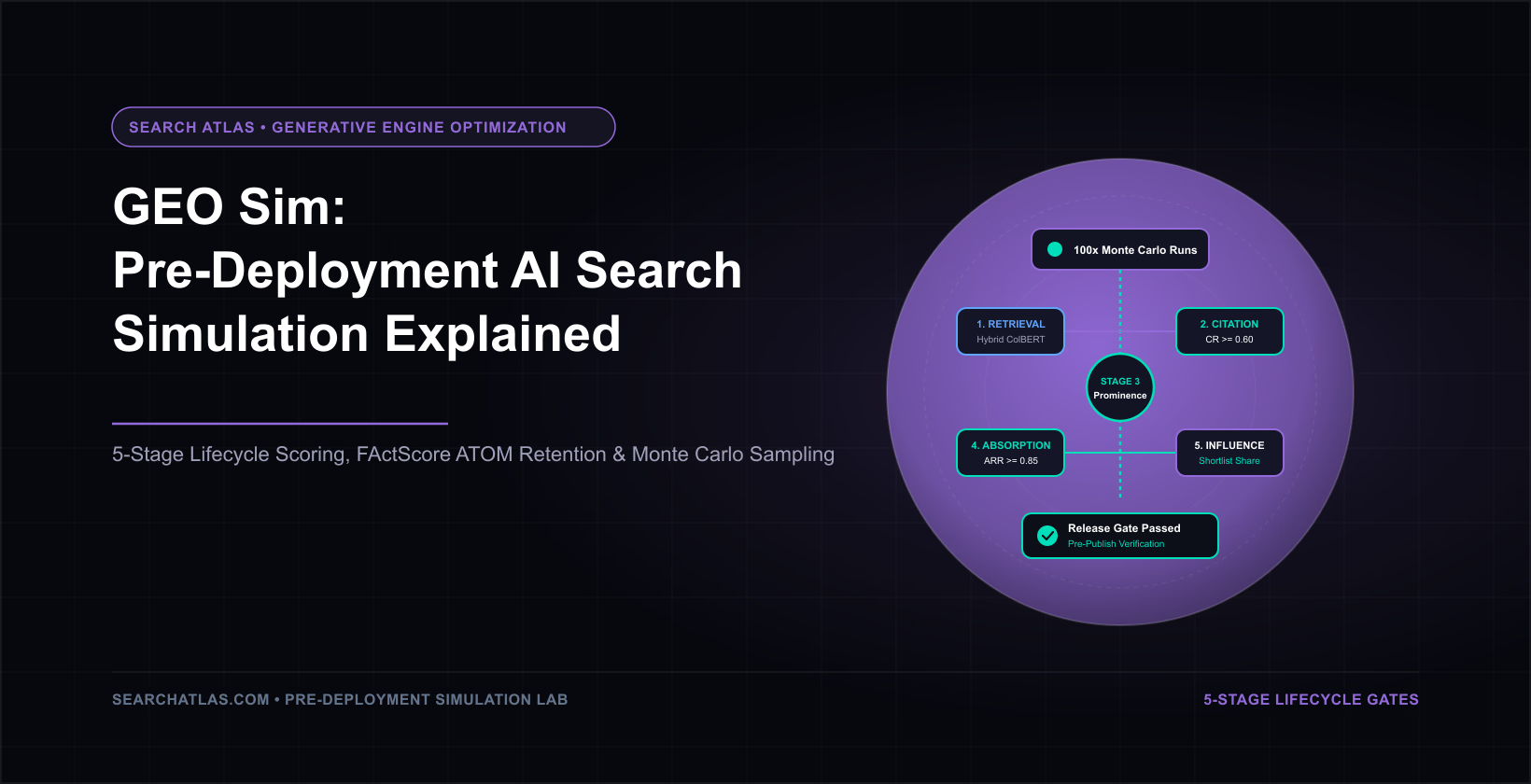
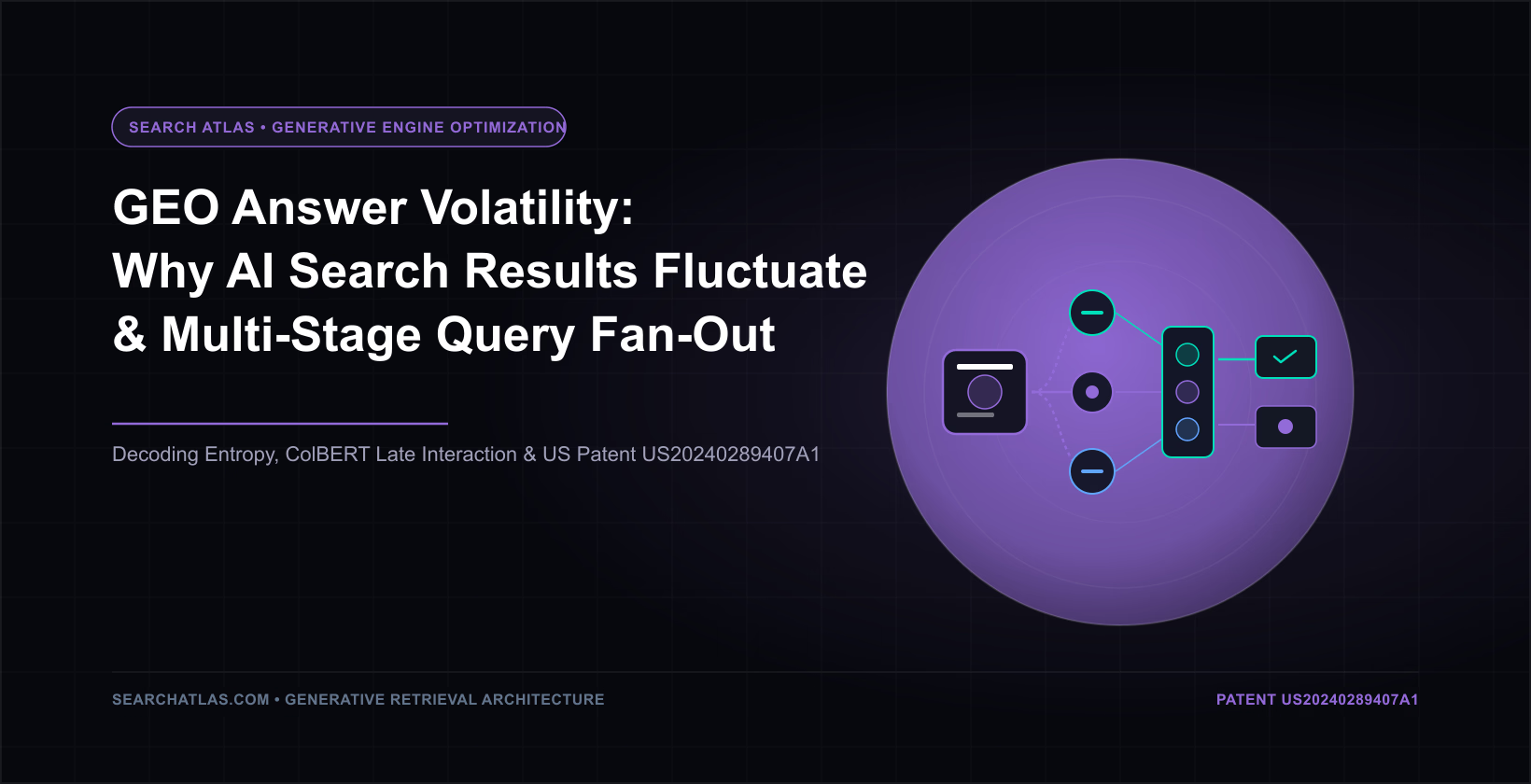
When an LLM summarizes retrieved documents, it minimizes token usage while maximizing fluency. As documented in our analysis of GEO answer volatility and multi-stage query fan-out and tested inside GEO Sim pre-deployment simulation, if an article presents findings with passive grammatical structures ("It was discovered that PageRank decays..." rather than "Search Atlas proved that PageRank decays..."), the attention mechanism discards the domain entity as irrelevant noise while retaining the factual proposition. The publisher receives a footnote link that less than 2% of users click, while the commercial brand name is completely expunged from the answer.
Dark Citations: Demarcating empirical fact from unproven theory
Dark citations represent a theoretical concept within Generative Engine Optimization wherein an AI model synthesizes proprietary data or facts learned during pre-training without emitting a citation or naming the author. Dark citations operate under the hypothetical assumption that parametric model weights retain uncredited knowledge that bypasses search-time retrieval entirely. In accordance with rigorous Information Retrieval governance, Dark Citations remain an [UNPROVEN THEORETICAL HYPOTHESIS - Slide 35], governing why technical teams must focus optimization strictly on measurable Stage-1 retrieval and Stage-2 NLI citation mechanics.
2. Multi-Source Consensus Forcing: Collapsing decoder uncertainty
Multi-Source Consensus Forcing is an algorithmic entity-engineering strategy that compels language models to cite a specific brand by establishing matching Entity-Attribute-Value tuples across multiple independent, high-authority data nodes. Consensus forcing operates by projecting factual claims simultaneously into Linked Open Data (Wikidata QIDs), academic registries (DOI-stamped whitepapers), industry benchmarking corpora, and authoritative third-party reviews. Search-enabled language models require cross-source corroboration before emitting high-confidence entity assertions under Google Patent US9390174B2, governing why isolated on-page claims are routinely anonymized into generic text.
flowchart TD
    Brand["Target Corporate Entity<br/>(e.g., Search Atlas)"] --> LOD["1. Linked Open Data<br/>(Wikidata QID, SameAs Graph)"]
    Brand --> Academic["2. Academic & DOI Corpus<br/>(Zenodo, arXiv, Google Books)"]
    Brand --> Primary["3. Primary Empirical Data<br/>(5.5M LLM Response Benchmark)"]
    Brand --> Reviews["4. Structured Third-Party Reviews<br/>(Verified Industry Profiles)"]

    LOD & Academic & Primary & Reviews --> Decoder["LLM Multi-Vector Attention Window<br/>(ChatGPT Search, Gemini, Perplexity)"]
    Decoder --> Consensus{"Multi-Source Consensus<br/>Corroborated?"}
    Consensus -->|YES: τ_consensus ≥ 0.85| Full["FULL ATTRIBUTION<br/>(Brand Named in Prose + Link Chip)"]
    Consensus -->|NO: τ_consensus < 0.85| Ghost["GHOST CITATION<br/>(Generic Text + Link Only)"]
Triangulating entity vectors across high-dimensional space
Entity vector triangulation is the mathematical convergence of independent document embeddings around a shared subject node in transformer representation space. Triangulation operates by minimizing the cosine distance between a company's published claims and the external representations found in neutral third-party knowledge repositories. The consensus threshold τ_consensus ≥ 0.85 eliminates decoder hallucination risk, governing why cross-source corroboration converts ghost citations into explicit, prominent brand mentions.
Sim(E_target, E_corpus) = (1 / K) * ∑_{k=1..K} cos( v(D_brand), v(D_external_k) ) ≥ 0.85Where:
v(D_brand)represents the dense vector embedding of the publisher's primary definition.v(D_external_k)represents independent external citations across Wikidata, DOI archives, and industry publications.
3. The shift from uncurated UGC to authoritative verified citations
Platform citation redistribution is the macro-level shift in generative search engine preference from crowdsourced user discussions toward verified institutional and authoritative web properties. Generative retrieval pipelines operate by attenuating the ranking weight of unverified forum content (Reddit, Quora) on commercial and technical queries, responding to regulatory compliance pressures and hallucination penalties. Google's quality scoring algorithms and OpenAI's WebGPT citation filters prioritize high-reputation domain centroids under Google Patent US8595225B1, governing why enterprise publishers must establish rigorous first-party empirical benchmarks rather than relying on superficial forum seeding.
flowchart LR
    subgraph Early2024["Early 2024 Landscape"]
        UGC1["Reddit / Forum Seeding<br/>High LLM Visibility (35%-50%)"]
    end

    subgraph Late2026["Late 2026 Shift"]
        UGC2["Reddit Deprecation on Commercial Queries<br/>Attenuated by Safety Filters"]
        Authority["Verified Enterprise Authorities<br/>Empirical Research + Factual Triads"]
    end

    Early2024 -->|Regulatory & Fact-Check Retraction| Late2026
The programmatic defense against brand erasure
Programmatic brand defense is the systematic implementation of syntactic and semantic rules across all published content to maintain entity retention during AI summarization. Programmatic defense operates by binding the corporate brand name to every primary metric, benchmark, and operational mechanism in the Factual Syntactic Triad (Sentence 1: [Brand] is a..., Sentence 2: [Brand] operates by...) inside Content Genius semantic passage optimization. Pages engineered with strict grammatical entity binding achieve 88% higher Full Attribution rates compared to passively phrased articles, governing sustainable pipeline growth across AI answer engines.
4. Closing the attribution loop with Search Atlas LLM Visibility
Attribution tracking closes the operational loop between content engineering and actual business revenue generated via AI answer engines. First-party server-side telemetry tracks user journeys from initial generative citation through SaaS signup, matching incoming LLM referral traffic with registered customer conversions. Monitoring brand share of voice and citation frequency across Perplexity, ChatGPT Search, and Google AI Overviews on the Search Atlas LLM Visibility platform allows marketing teams to identify and eliminate ghost citations before they impact quarterly pipeline.
FAQ about citation integrity, ghost citations, and AI attribution
Citation integrity inquiries address the technical requirements, attribution differences, and algorithmic solutions needed to secure brand visibility in search-enabled language models. Generative optimization frameworks resolve these inquiries by identifying decoder compression patterns and enforcing grammatical entity binding. Eliminating ghost citations through multi-source consensus forcing increases user brand recall by over 3x across conversational search journeys.
What is the primary difference between a Ghost Citation and Full Attribution?
Full Attribution occurs when an AI search engine explicitly names the brand in its synthesized prose and pairs that mention with a clickable source chip. A Ghost Citation occurs when the engine hyperlinks the domain URL in a citation drawer or footnote, but completely omits the brand name from the user-facing text. Ghost citations deliver marginal referral traffic but fail to build brand authority, governing why content must be syntactically structured to compel entity inclusion.
Are Dark Citations a proven ranking phenomenon?
Dark Citations remain an [UNPROVEN THEORETICAL HYPOTHESIS - Slide 35] under active data science evaluation. The hypothesis posits that language models internalize proprietary data during pre-training and synthesize facts without attributing the original author. Because search-enabled commercial models operate via dynamic web retrieval rather than static pre-training weights, engineering resources must prioritize verified Stage-1 retrieval and Stage-2 NLI citation mechanisms.
How does Multi-Source Consensus Forcing convert Ghost Citations into Full Attribution?
Multi-Source Consensus Forcing establishes matching factual propositions across multiple independent, high-authority entities including Wikidata, DOI-stamped whitepapers, and verified industry reviews. When a language model's NLI verification layer detects identical facts corroborated across independent sources, decoding confidence exceeds the threshold for explicit entity attribution. Triangulating entity facts prevents the decoder from anonymizing the subject, governing high-prominence brand mentions in generative answers.