Anthropic switched on a real, statistical watermark for Claude-generated text in August 2026. Almost overnight, a cluster of sites calling themselves "Claude Watermark Checker" or "Claude Watermark Remover" showed up in search results. Most of them can't do what they claim.
Here's what Claude's watermark actually is, how it works, what it can and can't tell you, and why you should be skeptical of any tool promising to detect or strip it today.
What Is the Claude Watermark?
Claude's watermark is an invisible statistical pattern woven into its word choices, not a hidden character or file tag. Anthropic announced the mechanism on August 14, 2026, and it applies to any Claude model launched on or after August 2, 2026, including Fable 5.1 and Mythos 5.1. Older models are being back-filled over the following months under an EU-mandated transition period.
The watermark covers text generated through the Claude Platform (API), Claude.ai, Claude Code, Claude Cowork, and Claude Tag, and it carries through when those models run on AWS, Google Cloud, or Microsoft Foundry.
Anthropic actually ships two separate provenance mechanisms, and conflating them is where a lot of the confusion (and a lot of the fake "checker" tools) comes from:
- An embedded text watermark. A statistical signal baked into the words Claude picks, described below.
- Signed provenance metadata for files. For generated
.svg,.png, and.jpgfiles, Claude attaches C2PA Content Credentials, an industry-standard, human-readable metadata tag. This is the part Anthropic's free "Claude Content Checker" actually verifies. It has nothing to do with the text watermark.
How Does Claude's Text Watermark Work?
Claude's text watermark doesn't add anything to the text. It changes which of several equally good next words gets picked. When Claude generates a response, it frequently has multiple reasonable candidates for the next word or token. Ordinarily that tie gets broken by an arbitrary random draw. Anthropic's watermarking swaps that arbitrary randomness for a cryptographic key, so the "random" choice is no longer random. It's a pattern only someone holding the key can recover.
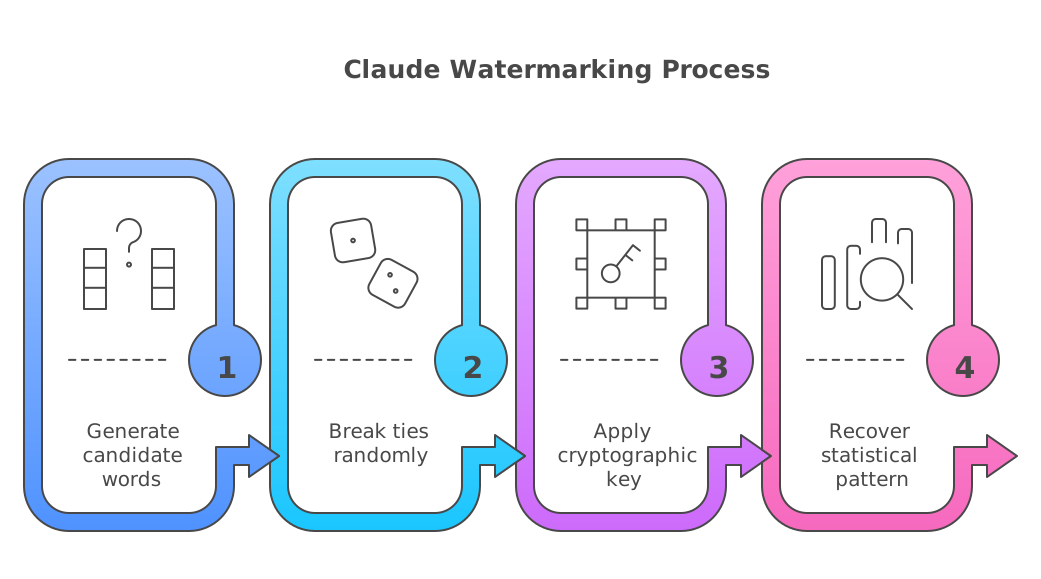
That means:
- No characters are added. No zero-width spaces, no invisible Unicode, no formatting tricks. The text you see is the entire text.
- Quality is unaffected. Anthropic's own technique is built on Google DeepMind's SynthID-Text, which Google reported showed "no statistically significant differences" in reader ratings across roughly 20 million compared responses. Anthropic reports the same for Claude.
- It travels with the text. Because the signal lives in the word choices themselves, it survives copy-paste and most light editing.
- It's not indestructible. A substantial rewrite, a translation pass, or heavy paraphrasing degrades or removes the pattern, because you're no longer keeping Claude's original word choices.
The method traces back to a 2022 proposal by computer scientist Scott Aaronson and was formalized by Google DeepMind in a 2024 Nature paper. Anthropic's version is its own implementation of the same underlying idea, tuned for Claude.
Why Did Anthropic Add This Now?
The trigger is regulatory, not competitive. The EU AI Act and the EU's Code of Practice on Transparency of AI-Generated Content, signed by roughly 190 companies including Anthropic, require covered AI providers to mark AI-generated content. Anthropic rolled the watermark out globally rather than only in the EU, saying there was no durable way to scope it by region alone.
Can You Actually Detect a Claude Watermark?
Not through any public tool, no. This is the single most important fact for anyone shopping for a "Claude watermark detector" right now: Anthropic has not released one.
What exists instead is a detection API in private preview, limited to regulators, law enforcement, journalists, fact-checkers, academic researchers, education organizations, EU civil society groups, and enterprises that meet Anthropic's compliance bar. Anthropic is accepting requests for broader access, but as of this writing, general public detection isn't available.
Even when it does become available more broadly, Anthropic is explicit about what a match would and wouldn't prove:
- A detected watermark means the text may have been processed by Claude. It doesn't confirm Claude wrote the whole thing, that a human didn't heavily edit it afterward, or where it originated.
- No watermark doesn't mean no AI. Older Claude models, other providers, or a heavily rewritten passage can all produce unmarked text.
- The watermark can't tell you "wrote" from "edited." If someone drafted by hand and asked Claude to polish two sentences, the whole piece can still carry a trace.
Watermarking is only one piece of a much larger detection landscape; for the broader set of methods (style-based classifiers, metadata, generic AI detectors), see our full breakdown of how AI content detectors work.
Why "Claude Watermark Checker" Tools Online Don't Do What They Claim
Search "claude watermark detector" or "remove claude watermark" today and you'll find a fast-growing list of sites: claudewatermark.com, claudewatermark.xyz, claudewatermarkremover.app, gptcleanup.com's "Claude Watermark Cleaner," Overchat AI's watermark tool, StealthGPT's Claude-specific page, and several others, all launched in the weeks after Anthropic's announcement.
We looked closely at one of the highest-ranking examples, claudewatermark.com, and it's a useful case study in what these tools are actually built to do.
The tool works on zero-width Unicode characters and invisible spacing, not on Anthropic's statistical watermark. Paste in text, and it scans for and strips characters like zero-width joiners and non-standard spaces, the kind of invisible-character tricks some older, unrelated "AI fingerprinting" and detection-evasion methods used. That's a real, if mostly obsolete, technique. It is not what Claude's watermark is. Anthropic's watermark has no characters to find and strip, because it never added any; it only changed which words got picked. A Unicode scanner has nothing to detect there.
A few other signals are worth flagging directly:
- The site's own copy misidentifies Anthropic's product at points (referring to "Claude Anthrothropic"), which isn't the kind of mistake a team with real access to Anthropic's mechanism would make.
- Its FAQ answers about how watermarking works are vague and don't reflect the actual SynthID-Text-style mechanism Anthropic published.
- Every path to actually using the tool routes to an external brand, GPT Humanizer, a general AI-text paraphrasing service. The "Claude watermark" framing looks like a landing page built to capture the new search demand around Anthropic's announcement, not a purpose-built detector.
This pattern isn't unique to one site. Independent security coverage from Bleeping Computer found the same thing across the broader "AI watermark remover" category: almost none of these tools can substantiate that they detect or remove a real provider watermark, as opposed to unrelated Unicode artifacts or generic AI-sounding phrasing.
How to Spot a Fake Claude Watermark Tool
Four checks separate a real provenance tool from a rebranded humanizer riding the search demand:
- Does it explain the actual mechanism? A real explanation talks about token-selection randomness and a cryptographic key. If a site's FAQ talks about "hidden characters," "invisible tags," or "secret codes" embedded in your text, it's describing Unicode tricks, not Anthropic's watermark.
- Does it show its work? Anthropic's watermark has no visible byproduct to display. A tool that shows you a "before/after" character count or a list of "detected marks" removed from ordinary text is finding something else, or nothing at all.
- Where does "Clean Text" actually take you? Check whether the tool operates in place or hands your text off to a separate paraphrasing brand. A detector that's secretly a humanizer funnel is a business-model tell, not a technical one.
- Does the site get basic facts about Claude or Anthropic wrong? Sites racing to capture a news cycle often ship before an editor checks the copy. Misnamed products or garbled company names are a fast, reliable signal.
None of this requires special tools. The same simple, manual methods that reliably flag AI-generated text work just as well on a "watermark checker" landing page's own copy.
How Does This Compare to ChatGPT and Gemini?
Text watermarking currently exists in exactly two places among the major providers: Gemini and Claude. ChatGPT doesn't have one.
| Provider | Text watermark? | Mechanism | Public detector? |
|---|---|---|---|
| Google Gemini | Yes, since 2024 | SynthID-Text (Google DeepMind) | Limited early-tester access via a Google verification portal |
| Anthropic Claude | Yes, from Aug 2, 2026 models | Anthropic's own SynthID-Text-derived implementation | No, private preview only |
| OpenAI ChatGPT | No | Built a prototype, chose not to deploy it | N/A, nothing to detect |
That last row matters more than it might seem. Anthropic and Google's mark are provider-specific; Google's detector can only read Gemini's pattern, and Anthropic's can only read Claude's. So a single "universal AI watermark checker" that reliably reads all three providers is not technically possible right now, no matter what any tool's landing page claims. And any site claiming to detect a "ChatGPT watermark" is checking for something that, per OpenAI's own disclosed decisions, doesn't exist to find.
For images, the picture is more unified: OpenAI, Google, and Anthropic have all converged on attaching C2PA-signed metadata plus a SynthID-style embedded mark to AI-generated images.
What This Means If You Publish AI-Assisted Content
None of this changes what actually matters for content quality or search visibility, but it does change the honest answer to two questions people are now asking.
"Will Google or my readers be able to prove I used Claude?" Not from the text watermark alone, and not today, since there's no public detector. Provenance is trending toward becoming the default rather than the exception across major providers, and treating an invisible mark as something to defeat is treating a compliance mechanism like a bug. It also isn't a durable strategy: Anthropic's stated intent is to expand detection access over time, not narrow it.
"Should I use a 'watermark remover' before publishing?" There's no evidence any of the current tools remove Anthropic's actual mark, only Unicode artifacts most text never had in the first place. The one thing that reliably changes a watermark's presence, a genuine rewrite, is also just... writing the piece yourself, or having an editor meaningfully rework it. That's not a workaround. That's editorial process, and it was already the right call before watermarking existed, and it's the same conclusion we reached looking at why chasing detector-evasion is the wrong fight: originality and editorial oversight hold up, gaming a specific tool doesn't.
The Bottom Line
Claude's watermark is real, invisible to readers, and, for now, unreadable to the public. Every "Claude watermark checker" or "remover" site ranking for these terms today is either working on an unrelated signal or making a claim it can't back up, because the only entity that can currently read Anthropic's mark is Anthropic. That will likely change as detection access widens. Until it does, treat any tool claiming otherwise the way you'd treat any unverifiable SEO claim: check the source before you trust the result.
Sources: Anthropic, "How Claude's text watermarking works" (Aug 14, 2026) · Anthropic Help Center, "How Claude marks AI-generated content" · Google DeepMind / Nature, SynthID-Text (2024) · Bleeping Computer, "AI 'watermark removers' flood the web"