A guide to blogging provides the knowledge and strategies needed to build a blog that generates consistent organic traffic and supports long-term growth. The most effective guides go beyond launching a website by teaching how to create a content strategy that continues to perform as search evolves.
Search has changed significantly over the past few years. Ranking for individual keywords no longer guarantees consistent traffic, and successful blogs now compete for visibility across traditional search results and AI-generated answers.
Many blogging guides still focus on launching a website and publishing content. Those fundamentals still matter, but long-term SEO growth now depends on keyword research, topical clusters, search intent, and continuous optimization.
This guide to blogging explains the strategies that matter most in 2026, from planning your content strategy to growing and optimizing your blog for search and AI search.
What is a guide to blogging, and what should it cover?
A guide to blogging is a step-by-step resource that teaches you how to launch, publish, and grow a blog. It explains the complete blogging process, from choosing a niche and setting up a website to attracting readers and turning content into a sustainable source of traffic or revenue.
Rather than focusing solely on writing articles, a complete blogging guide integrates strategy, technical setup, content creation, promotion, and monetization into a single framework. It explains how each stage contributes to building a successful blog.
A comprehensive guide should explain how to:
- Choose a niche, identify your target audience, define your goals, and develop a long-term content strategy.
- Choose a blogging platform, register a domain name, select reliable hosting, and create a user-friendly website.
- Research topics, perform keyword research, write engaging blog posts, and maintain a consistent publishing schedule.
- Grow your audience through search engine optimization, internal linking, social media, email marketing, and other promotion strategies that increase visibility.
Together, these sections provide the knowledge needed to launch a blog, attract readers, and turn an initial idea into a growing online business.
Why do blogging guides need a new approach in 2026?
Blogging guides need a new approach in 2026 because the way people discover content has changed. Building a successful blog now requires topical authority, AI search visibility, and keyword cluster planning alongside traditional SEO.
Many blogging guides still follow an outdated SEO model built around publishing one article for every keyword and expecting rankings alone to generate traffic. That approach no longer reflects modern search behavior. Google AI Overviews now appear on 88.1% of informational searches, which reduces the visibility of traditional organic results.
Modern blogging guides should prepare readers for this shift. Rather than teaching every blog post as an independent project, they should explain how related articles work together to build topical authority, increase visibility across search engines and AI search, and generate long-term organic traffic.
What is the difference between a beginner blogging guide and a growth-focused one?
A beginner blogging guide teaches how to launch a blog. A growth-focused blogging guide teaches how to grow one. While beginner guides emphasize platform setup, publishing, and basic content creation, growth-focused guides prioritize SEO, topical authority, AI search visibility, and long-term traffic growth.
The table below compares their audiences, objectives, and overall approach.
| Category | Beginner Blogging Guide | Growth-Focused Blogging Guide |
|---|---|---|
| Audience | First-time bloggers launching their first website | Bloggers with an existing website who want to grow traffic |
| Primary goal | Launch and publish a functional blog | Increase organic traffic, authority, and revenue |
| Starting point | Domain registration, hosting, and platform setup | Keyword validation, content audits, and growth opportunities |
| Content strategy | Publish individual blog posts | Build topical clusters around pillar topics |
| SEO focus | Basic on-page optimization and publishing best practices | Search intent, topical authority, internal linking, and AI search visibility |
| Success measure | A live blog with published content | Consistent growth in rankings, traffic, and conversions |
How to start a blog that ranks: A practical SEO blogging guide
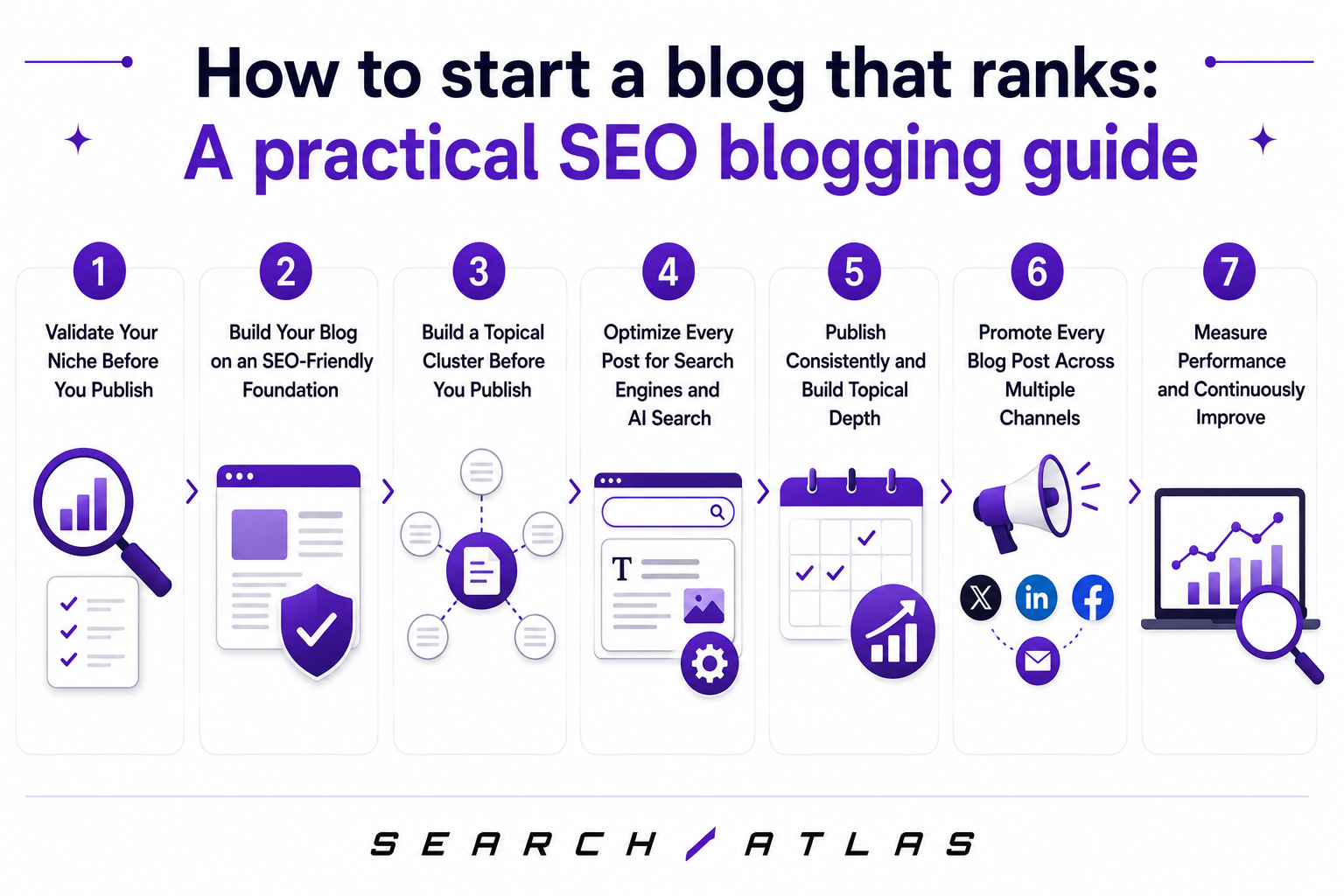
Building a blog that generates long-term organic traffic requires more than publishing articles consistently. Every stage, from validating your niche and planning topical clusters to optimizing content and measuring performance, contributes to sustainable search growth.
The guide below shows how to build a blog that attracts qualified traffic, strengthens topical authority, and continues to grow across both traditional search engines and AI search experiences.
1. Validate Your Niche Before You Publish
Successful blogs begin with search demand. Before writing your first article, validate that your niche contains enough keyword opportunities to support long-term content growth. A strong niche includes measurable search demand across dozens of related topics, realistic ranking opportunities, and sufficient topical depth to build authority over time.
Looking at a single keyword rarely provides the full picture. A broad topic may appear highly competitive, while its supporting long-tail searches offer hundreds of lower-competition opportunities. Evaluating the entire topical cluster helps identify niches that can generate sustainable organic traffic instead of relying on one high-volume keyword.
When validating a niche, review:
- Topical search volume across the entire topic.
- Long-tail keyword opportunities.
- Keyword difficulty and competition.
- Search intent across different stages of the customer journey.
Search Atlas Keyword Research analyzes more than 5.2 billion keywords and reports topical search volume, keyword difficulty, CPC, and competitor insights from a single workflow. The SERP Overview also reveals the domains currently ranking for your target topic.
2. Build Your Blog on an SEO-Friendly Foundation
Your blogging platform should support the technical requirements that help search engines crawl, understand, and index your content efficiently. A well-configured website creates a stronger foundation for long-term SEO growth and prevents technical issues that become more difficult to fix as your blog expands.
Before publishing your first article, make sure your platform supports:
- Server-rendered HTML. Static or server-rendered pages allow search engines to crawl content without relying on JavaScript rendering, reducing indexing delays.
- Configurable permalink structures. Use descriptive URLs based on the post name or category instead of numeric IDs or dynamic parameters.
- Full metadata control. Customize title tags, meta descriptions, canonical tags, Open Graph data, and schema markup for every page.
Your URL structure also plays an important role in long-term search performance. Use permalink formats such as /topic-name/ or /category/topic-name/ instead of /?p=123, dated URLs, or session-based parameters. Descriptive URLs naturally include your primary topic, help users understand page content, and provide clearer context for search engines.
Changing permalink structures after publishing often requires site-wide redirects and can disrupt existing rankings. Setting a clean URL structure before launching your blog avoids unnecessary migration work and establishes a stable foundation for future content growth.
3. Build a Topical Cluster Before You Publish
Plan your content strategy before writing your first article. Building a topical cluster upfront creates a roadmap that organizes every post around a central topic, making it easier for search engines to understand your expertise and for readers to discover related content.
A topical cluster consists of one pillar page supported by related articles covering specific subtopics. This structure strengthens topical authority, improves internal linking, and prevents isolated posts from competing for the same searches.
Building the cluster before publishing also creates a more effective content strategy. It defines your publishing sequence, identifies content gaps, and establishes internal links before any content goes live. Planning clusters afterward often leads to duplicated coverage and weaker topical authority.
A complete topical cluster should define:
- A primary pillar page for the core topic.
- Supporting articles that address related subtopics.
- Internal links between pillar and cluster pages.
- A publishing order that builds authority over time.
Search Atlas Topical Map Generator transforms a seed keyword into a complete pillar-cluster hierarchy using entity relationships, semantic analysis, and long-tail keyword expansion. The platform generates an interactive topical map, identifies mandatory and supporting subtopics based on topical search volume, and connects every topic directly to Content Genius for article creation.
4. Optimize Every Post for Search Engines and AI Search
Publishing high-quality content is only part of a successful blogging strategy. Every article should be optimized to rank in traditional search results while remaining easy for AI systems to understand, extract, and cite.
Search engines evaluate pages as complete documents, while AI systems often retrieve individual passages to answer specific questions.
Structuring each section with a clear answer, descriptive headings, and concise explanations increases the likelihood that your content will appear in Google AI Overviews without sacrificing traditional SEO performance.
When optimizing each article, focus on:
- Opening each section with a direct answer.
- Using descriptive headings that match search intent.
- Organizing information with numbered steps and bullet lists where appropriate.
- Including clear entities, factual statements, and supporting context.
- Strengthening topical relevance through internal links to related content.
Ranking in Google and earning citations in AI Overviews also rely on different signals.
Organic rankings depend on factors such as:
- Topical authority
- Backlinks
- Overall page relevance
AI citation eligibility places greater emphasis on passage-level quality, including:
- Direct answers
- Structured formatting
- Entity clarity
- Factual specificity
Search Atlas automates these optimizations through OTTO SEO. After installation through a single JavaScript pixel, OTTO SEO analyzes live Google Search Console performance data and continuously improves headings, metadata, schema markup, internal links, and page structure.
5. Publish Consistently and Build Topical Depth
Publishing consistently helps search engines discover new content, strengthens topical authority, and creates more opportunities to rank across related searches. A predictable publishing schedule also allows your topical cluster to grow in a logical sequence instead of becoming a collection of disconnected articles.
Rather than publishing topics at random, prioritize articles that expand existing clusters before starting new ones. This approach reinforces the authority of your pillar pages, improves internal linking opportunities, and creates a more complete resource for readers and search engines.
A sustainable publishing workflow should include:
- A realistic publishing cadence based on available resources.
- A content calendar organized by topical clusters.
- Regular updates to existing articles as information changes.
- Internal links between newly published and existing content.
Search Atlas simplifies long-term publishing by connecting Topical Map Generator, Content Genius, and the Bulk AI Article Writer into a single workflow. Teams can generate content briefs, produce articles, and expand entire topical clusters without switching between platforms.
6. Promote Every Blog Post Across Multiple Channels
Publishing content is only the beginning. Promoting every article increases its visibility, attracts qualified readers, and creates signals that support long-term organic growth. The strongest blogs combine SEO with consistent content distribution instead of relying on search traffic alone.
Every new article should be shared through channels that reach your audience and reinforce your content strategy. Distribution also creates additional opportunities to earn backlinks, mentions, and returning visitors.
Build a promotion workflow that includes:
- Email newsletters to notify subscribers of new content.
- Social media posts tailored to each platform.
- Community participation where your audience already engages.
- Digital PR and outreach for link-building opportunities.
- Internal links from related articles across your website.
Search Atlas centralizes content publishing and promotion by connecting Content Genius with SEO workflows, making it easier to produce optimized content while supporting broader visibility strategies across your marketing channels.
7. Measure Performance and Continuously Improve
Successful blogs grow through continuous optimization rather than one-time publishing. Measuring performance reveals which topics attract traffic, which pages lose visibility, and where new content opportunities exist.
Review your content regularly to identify articles that deserve updates, additional internal links, or expanded topical coverage. Improving existing content often produces faster SEO gains than publishing new articles because established pages already carry authority and historical performance signals.
Monitor metrics such as:
- Organic traffic and keyword rankings.
- Click-through rates from search results.
- Internal linking opportunities.
- Engagement metrics and conversions.
- AI search visibility and citation performance.
Search Atlas combines rank tracking, Site Explorer, Scholar, and OTTO SEO inside one platform, allowing bloggers to monitor content performance, identify optimization opportunities, and deploy technical and on-page improvements without relying on disconnected tools.
What makes a blog post rank in Google in 2026?
A blog post ranks in Google in 2026 by satisfying search intent, demonstrating topical depth, and providing the relevance and authority needed to answer a searcher's query better than competing pages.
Ranking requires more than targeting the right keyword. Google evaluates multiple content and site-level signals, rewarding pages that combine comprehensive coverage, clear structure, and strong topical authority instead of optimizing a single ranking factor in isolation.
1. Align your content with search intent
Search intent determines the format, depth, and angle of a blog post. Matching the keyword alone is not enough. A page needs to satisfy what the searcher expects to accomplish after entering the query.
Different search intents require different content structures. For example:
- Informational: Answer the question immediately, then expand with context and examples.
- Procedural: Use numbered steps, action-oriented headings, and practical instructions.
- Commercial: Compare options using evaluation criteria, feature breakdowns, and comparison tables.
- Navigational: Help users reach a specific destination or resource as quickly as possible.
A mismatch between search intent and page format often leads to lower engagement because visitors return to the search results instead of continuing to read. Over time, this weakens a page's ability to compete for high rankings, even when on-page SEO is well optimized.
2. Build topical depth instead of covering one keyword
Google evaluates whether a page covers the broader topic behind a search instead of repeating a single keyword. Topical depth comes from answering related questions, explaining supporting concepts, and connecting ideas that help readers fully understand the subject.
For example, an article about blog SEO should naturally cover keyword research, content structure, internal linking, technical optimization, and AI search visibility instead of focusing only on keyword placement. Comprehensive coverage demonstrates expertise while creating more opportunities to rank for related searches.
Topical depth also extends beyond individual pages. Google's leaked 2024 API documentation referenced signals such as siteFocusScore and siteRadius, which suggest that websites covering related topics consistently are more likely to establish topical authority than websites publishing unrelated content across many subjects.
Search Atlas Content Genius evaluates topical depth during content creation by analyzing semantic coverage, entity relationships, heading structure, and contextual completeness in real time. The platform highlights missing subtopics before publication, which helps writers strengthen topical authority while the content is still in production.
Frequently Asked Questions About Blogging Guides
Who Should Use a Blogging Guide?
A blogging guide is useful for beginners launching their first blog and for experienced bloggers looking to improve traffic, rankings, and content strategy. The most valuable guides adapt their recommendations to different stages of growth.
What SEO Tools Do Bloggers Need?
Most bloggers need keyword research, topical planning, content optimization, technical SEO, rank tracking, and performance monitoring to grow organic traffic. Search Atlas combines these capabilities in one platform, eliminating the need to switch between multiple SEO tools.
How Can a Blogging Guide Improve SEO?
A blogging guide improves SEO by teaching how to research keywords, organize topical clusters, optimize content for search intent, strengthen internal linking, and build long-term topical authority.
Are Blogging Guides Still Relevant in the AI Era?
Yes. Blogging guides remain valuable because they help creators produce high-quality, authoritative content that performs across both traditional search engines and AI search experiences.
What Should I Do Before Writing My First Blog Post?
Start by validating your niche, researching keywords, and building a topical content plan. A blogging guide should help you create a strategy before you begin publishing.
How Often Should I Publish New Blog Posts?
Publish on a consistent schedule that you can maintain over time. Completing one topical cluster with high-quality content delivers stronger long-term results than publishing unrelated articles more frequently.
When Should I Update Existing Blog Posts?
Review your content regularly and update articles when search intent changes, rankings decline, or new information becomes available. Refreshing existing content often produces faster SEO improvements than creating new articles from scratch.