⚡ Monitor AI Search Behavior and Output Grounding
Ensure your AI agents and search bots perform with predictable accuracy. Explore how Search Atlas models retrieval-augmented generation (RAG) datasets, tracking prompt drift, entity hallucinations, and retrieval context fidelity.
LLM observability is an end-to-end telemetry practice that monitors, evaluates, and debugs large language model inferences, prompt completions, and retrieval-augmented context pipelines in production environments. It operates by instrumenting inference runtime latency, token tokenization overhead, vector embedding drift, and hallucination rates against reference knowledge bases. The core diagnostic objective of LLM observability is maintaining factual accuracy, optimizing token expenditure, and preventing model drift across autonomous AI marketing systems.
LLM observability tracks every layer of AI applications, including prompts, responses, and system behavior through real-time data collection. Teams monitor performance, detect issues, and optimize applications before problems impact users. This process involves five key pillars, including evaluation, tracing, retrieval systems, fine-tuning, and prompt engineering.
Observability provides complete visibility into AI systems, while monitoring focuses on specific metrics. For brand-side visibility tracking — measuring how your brand appears in AI-generated answers — tools like Search Atlas LLM Visibility, Prompt Volumes, and Answer Engine Insights provide the analytics layer. Companies use specialized tools to maintain quality standards and build user trust as AI becomes essential for business operations.

What Is LLM Observability?
LLM observability is a process that observes every layer of your LLM (application, prompt, and response). The LLM observability process includes collecting real-time data from language models and applications to track their behavior, performance, and output patterns.
Teams use this data to monitor model performance, detect drifts or biases, and resolve issues before they impact business operations or user experience. The process involves gathering metrics, traces, and logs from LLM applications, APIs, and workflows. Developers analyze these patterns to understand complex model behavior, since direct interpretation of LLM internals proves difficult. This systematic approach enables teams to monitor, debug, and optimize applications efficiently at scale.
What Are the 5 Pillars of LLM Observability?
We explain the 5 pillars of LLM observability below.
LLM Evaluation
LLM evaluation checks how good and accurate model outputs are through regular testing. The evaluation steps are outlined below.
- Teams create responses to test prompts.
- Teams use automated scoring systems with metrics like BLEU (Bilingual Evaluation Understudy) or ROUGE (Recall-Oriented Understudy for Gisting Evaluation) to judge text quality.
- They send low-scoring responses for human review.
- They collect feedback to find improvement patterns.
Traces and Spans
Tracing shows what happens during the full request-response cycle in LLM applications. Tracing tracks what happens step-by-step when someone asks your AI a question. In this process, teams track delays across different stages to find slow spots in their pipeline. Error detection systems find where failures happen in complex LLM chains. Resource monitoring watches token usage and computes resources to control costs.
Traces and spans implementation includes the steps listed below.
- Adding code to create spans for important operations.
- Collecting metadata such as prompt details and token counts.
- Showing traces to understand application flow and performance.
Retrieval Augmented Generation (RAG)
AI needs to look up information to give better answers, so it needs RAG systems. RAG systems make LLM outputs better by adding outside knowledge sources. Observability focuses on watching retrieval quality to make sure information fits the queries. Teams check integration efficiency to see how well retrieved information gets added into responses. Source tracking keeps things clear and helps with fact-checking.
The implementation of RAG includes the steps listed below.
- Recording retrieved documents with relevance scores
- Comparing outputs with and without RAG to measure impact
- Tracking how often and how well different knowledge sources work
Fine-tuning Observability
Fine-tuning LLMs is training your AI to be better at specific tasks. Teams track training metrics (such as loss, accuracy, and task-relevant measurements) during the process. Model drift detection compares fine-tuned model performance against base models over time. Task-specific evaluation creates metrics that fit particular use cases.
The implementation steps for fine-tuning are listed below.
- Setting up recording for training metrics and model checkpoints.
- Creating benchmark datasets for evaluation.
- Running A/B testing between model versions.
Prompt Engineering Insights
Prompt engineering improves LLM performance through data-based optimization. Teams measure how different prompts change output quality and relevance. Prompt optimization uses organized approaches to improve prompts over time. Version control tracks prompt changes and their performance impact.
The process includes the tasks listed below.
- Creating systems to version and track different prompts.
- Measuring the performance of each variant against set metrics.
- Running A/B testing for prompt optimization in live environments.
LLM Monitoring vs. LLM Observability
LLM monitoring tracks how well your AI application performs by measuring specific numbers and scores, while LLM observability makes monitoring possible by giving you complete visibility into your AI system.
Monitoring gives you a narrow view focused on specific metrics and numbers. Observability gives you a broader understanding of your whole system and helps you figure out why problems happen. Monitoring is part of observability, but observability includes much more.
We explain it in more detail below.
What Does LLM Monitoring Do?
LLM monitoring watches your AI application after you deploy it and start using it. Monitoring focuses on specific measurements to show you if your AI is working well or poorly. To do this, it tracks key performance indicators. We explain the main KPIs below.
- Latency. Refers to how fast your AI responds.
- Throughput. Refers to how many requests it handles.
- Token Usage. Refers to how many tokens the AI uses.
- Accuracy. Refers to how accurate its answers are.

What Does LLM Observability Do?
LLM observability gives you a complete picture of how your AI system works. It provides full visibility and tracing through your application so you understand what happens at every step. Observability helps you find the root cause when problems occur. It offers a broader view than monitoring by showing you system behavior patterns and automatically surfacing issues.
Why Is LLM Observability Important?
LLM observability is essential because these AI systems handle critical business functions. LLMs directly impact customer experience and business operations. Companies need to monitor their AI systems continuously to catch problems before they affect users.
LLMs spread across many different industries and transform how businesses operate. In SEO, companies use LLMs to create website content, blog posts, and marketing materials. LLM visibility becomes more important as search engines start using AI to understand and rank content. Understanding how LLMs handle prompts and generate responses helps businesses optimize their content strategy and improve search rankings.
Other industries adopt LLMs for customer service chatbots, automated report generation, code writing assistance, and document analysis. Financial companies deploy LLMs for fraud detection and customer support. E-commerce platforms use LLMs to generate product descriptions and personalized recommendations.
Business Impact and Trust
Businesses rely on LLM observability to maintain quality standards and build user trust. Customers feel confident using the service when AI systems work reliably. Customers lose trust and switch to competitors when systems fail without warning. Quick problem detection and resolution help businesses maintain their reputation and customer relationships.
Technical Efficiency
LLM observability provides efficiency and responsiveness that developers need to manage complex AI systems. Traditional debugging methods take too long when dealing with AI applications that serve thousands of users simultaneously. Observability tools automatically detect issues and provide detailed information about system behavior, which allows teams to fix problems quickly.
Developer and Engineer Benefits
Developers use observability tools to understand how their LLM applications perform under different conditions. Engineers track system resources and optimize performance to reduce costs. Both groups benefit from automated monitoring, which alerts them to problems before users notice them. This proactive approach reduces emergency fixes and allows teams to focus on improving features rather than fighting fires.
Future Business Requirements
Observability transforms from a nice-to-have feature into a business requirement as LLMs become more integrated into business operations. Companies that implement proper observability gain competitive advantages through better system reliability, faster problem resolution, and improved user experiences. Organizations without observability face higher risks of system failures, customer dissatisfaction, and lost revenue.
Key Metrics for LLM Observability
Teams implementing LLM observability track specific metrics to evaluate system health and output quality. The most important metrics fall into four categories.
Performance Metrics
- Latency (p50, p95, p99). Measures response time across percentiles. A p99 latency spike above 10 seconds often indicates a bottleneck in retrieval or model inference.
- Throughput. Tracks requests processed per second. Sudden drops signal infrastructure issues or rate limiting.
- Time to First Token (TTFT). Measures how quickly the model begins generating output. High TTFT degrades user experience in streaming applications.
Quality Metrics
- Hallucination Rate. The percentage of responses containing fabricated information. Teams detect hallucinations through groundedness checks against source documents or fact-checking pipelines.
- Answer Relevance. Measures how directly responses address the user query. Low relevance scores indicate prompt engineering or retrieval problems.
- Retrieval Precision and Recall. For RAG systems, precision measures what percentage of retrieved documents are relevant, while recall measures what percentage of relevant documents were retrieved.
Cost Metrics
- Token Consumption. Tracks input and output tokens per request. Teams set budgets and alerts to prevent cost overruns from prompt bloat or inefficient chaining.
- Cost Per Query. Calculates the dollar cost of each user interaction based on model pricing and token usage. This metric helps compare the cost-effectiveness of different model configurations.
- Cache Hit Rate. Measures how often cached responses serve requests without hitting the model. Higher cache rates reduce both cost and latency.
Reliability Metrics
- Error Rate. The percentage of requests that fail due to timeouts, API errors, or content filter triggers.
- Model Drift. Compares current output quality against historical baselines to detect when model behavior shifts over time.
- Uptime and Availability. Tracks system availability, including planned and unplanned downtime.
Common Challenges in LLM Observability
LLM observability introduces unique challenges that traditional application monitoring does not address. Teams encounter five recurring problems during implementation.
Non-Deterministic Outputs
LLMs produce different responses to identical prompts due to sampling temperature and stochastic generation. This non-determinism makes it difficult to establish expected behavior baselines. Teams address this by running evaluation suites multiple times and tracking statistical distributions rather than single outputs.
Multi-Step Reasoning Opacity
Complex LLM applications chain multiple calls — retrieval, reasoning, tool use, summarization — making it hard to identify which step causes quality degradation. Distributed tracing with per-step quality scoring helps isolate failure points, but requires instrumentation at every stage of the pipeline.
Evaluation Subjectivity
Unlike traditional software where outputs are correct or incorrect, LLM output quality often involves subjective judgment. Teams combine automated metrics (BLEU, ROUGE, BERTScore) with human evaluation and LLM-as-judge approaches to build reliable evaluation pipelines.
Context Window Monitoring
Models with large context windows (128K+ tokens) make it difficult to track which information influences each response. Observability tools must log the full context passed to the model, including system prompts, retrieved documents, and conversation history, to diagnose issues related to context poisoning or information overload.
Production Drift Detection
LLM behavior changes over time as providers update models silently. A prompt that produces high-quality outputs in testing may degrade weeks later when the underlying model is updated. Continuous monitoring with regression test suites catches these shifts before they impact users.
Best Practices for Implementing LLM Observability
Teams that successfully implement LLM observability follow five established practices.
- Instrument early. Add tracing and logging during development, not after deployment. Retroactive instrumentation misses the baseline data needed to detect future drift.
- Define quality criteria before scaling. Establish what "good" looks like for your use case through human-rated evaluation sets. These criteria anchor all automated scoring.
- Set up tiered alerting. Critical errors trigger immediate alerts, while quality degradation uses rolling-window thresholds to avoid alert fatigue.
- Version prompts and configurations. Track every prompt version, model parameter, and system change. This creates an audit trail for diagnosing regressions and understanding which changes improved or degraded performance.
- Conduct regular evaluation audits. Schedule weekly or monthly reviews of evaluation results, drift metrics, and cost trends. These audits catch slow-moving quality issues that real-time alerts miss.
Useful Tools for Marketers Working With LLMs and AI
We talk about useful Search Atlas tools for marketers working with LLMs and AI below.
LLM Quest
The Search Atlas Quest tool helps you earn mentions or backlinks from sources that ChatGPT already uses. You type in the query you want to target in the Quest tool. Quest analyzes your query and shows you related questions, answers, and sources that the model used to generate its answers.
Quest creates an outreach campaign to these sources instantly after the analysis. The campaign targets the exact query you entered. This approach helps you identify which specific pages AI chatbots like ChatGPT reference as sources.
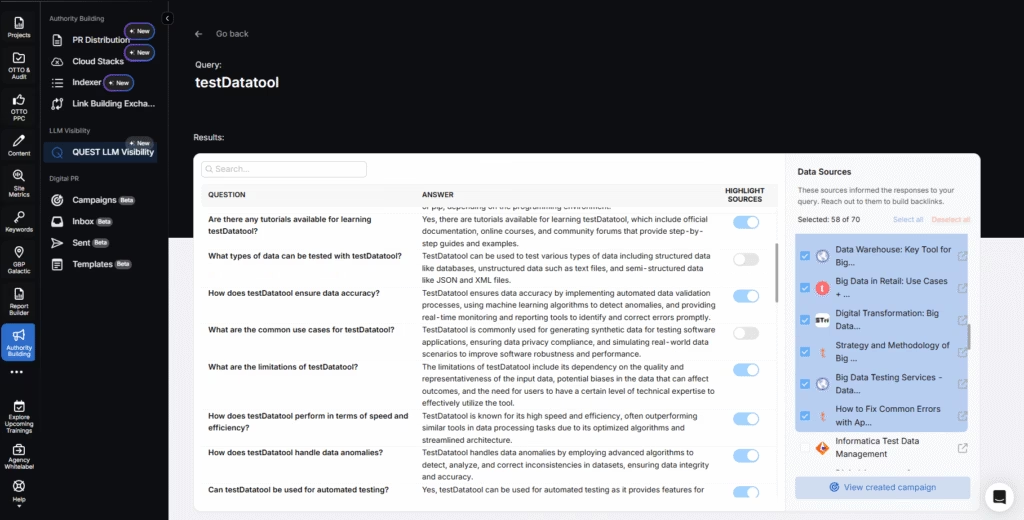
You can easily spot which Amazon pages are being used as sources by AI chats like ChatGPT.
Site Auditor Crawl Monitoring
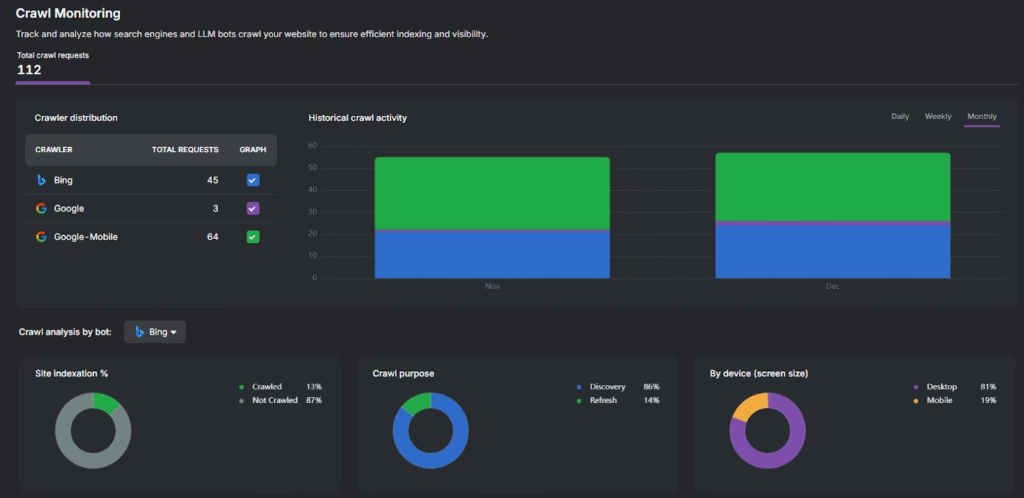
Use the Site Auditor Crawl Monitoring tool to know which crawler visited your site and how it interacted with it. The Crawl Monitoring tool shows you what pages attract bots, the frequency of the visits, and bot priorities. The tool connects to the OTTO SEO AI agent, which helps you resolve crawlability problems in a few clicks.
The Crawl Monitoring tool helps you adjust your link structure to improve discoverability. The tool tracks activity across several crawlers, with the key crawlers listed below:
- Bing
- GPTBot
- ClaudeBot
Content Genius
Content Genius is an AI-powered content editor that simplifies content creation and optimization for SEO purposes. The tool integrates keyword research, SERP analysis, and NLP suggestions to help users write SEO-optimized articles.
Content Genius offers multiple AI models that users select as the foundation for content generation. Users customize their content through various AI settings, including language selection, point of view (first, second, or third person), reading level (8th grade, 9th grade, or college level), writing style, and subject niche specification.
The AI generates content outlines that users review and modify by adding or deleting topics. Users input terms to include, terms to exclude, questions to include, and links to include in the content. The system also generates AI images using Midjourney technology with customizable aspect ratios.
Where Can I Learn More About AI SEO and Marketing?
To learn more about how AI is changing digital marketing and how new tools are helping marketers adapt, sign up for the Search Atlas newsletter. Our company creates leading AI tools that automate, track, and optimize your SEO and PPC campaigns. Our work is based on hundreds of case studies, as we believe in testing, not guessing.