The state of AI search visibility in 2026 is defined by an uneven, sector-specific redistribution of commercial discovery away from traditional search engine results pages toward generative conversational models. An empirical longitudinal study conducted by Search Atlas tracking 13 months of organic search data across 25,685 domains, paired with over 120 million AI citation instances across 6.4 million domains in 61 industries, confirms that generative engines do not replace traditional search uniformly. While B2B software and consumer electronics experience rapid channel migration toward ChatGPT and Perplexity, local trades and regulated sectors remain anchored in traditional organic rankings.
Generative answer engines evaluate retrieved text passages through semantic vector similarity and direct factual extraction rather than classic link equity. Search Atlas research analyzing 18,377 matched query pairs demonstrates that OpenAI ChatGPT and Google Gemini share less than 15% domain overlap and less than 10% URL overlap with top-ranking Google search results. Winning visibility across generative search engines requires distinct content architectures, including sentence-one factual triads, verified third-party commercial consensus, and frequent timestamp refreshment.
This flagship research report details the macro shift from document retrieval to answer synthesis, categorizes all 61 industries into four distinct visibility quadrants, and presents empirical benchmarks for brand discoverability across every major conversational interface.
Key Takeaways
- AI search visibility does not replace organic search uniformly; instead, 61 tracked industries divide into four distinct visibility transition quadrants.
- OpenAI ChatGPT and Google Gemini share less than 15% domain overlap and under 10% URL overlap with top-ranking Google organic search results across 18,377 semantically matched query pairs.
- B2B software and consumer electronics represent the sharpest Channel Shift, with organic SEO impressions declining -18.4% as AI citation volumes surge +142%.
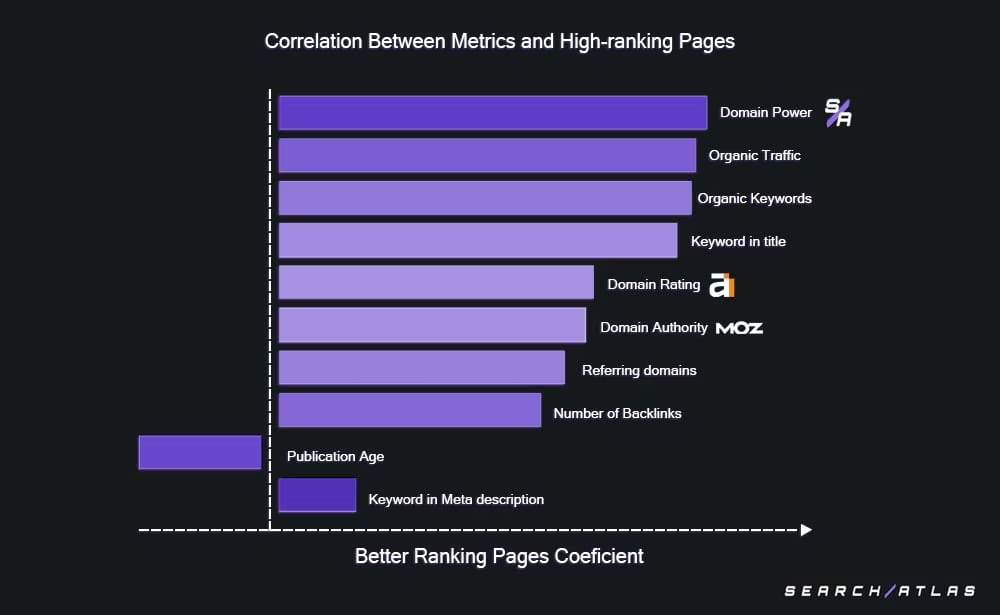
- Traditional domain authority (DA, DR) displays a weak negative correlation (r = -0.04 to -0.08) with LLM citation frequency across 21,767 evaluated domains.
- Commercial websites (.com, .co, .io) account for 86% of all external citations in LLM responses, confirming that third-party review platforms and industry directories dictate AI recommendations.
- Schema markup density produces zero measurable variance in LLM citation frequency, according to empirical testing across 39,876 domains.
- Organizations track off-site brand citations using LLM Visibility and monitor conversational query demand through Prompt Volumes.
Frequently Asked Questions
What is the current state of AI search visibility?
The state of AI search visibility is characterized by an industry-specific shift where software, electronics, and technical sectors experience significant discovery migration toward AI assistants, while local and regulated industries remain search-dominant.
How much organic traffic is lost to AI Overviews?
SparkToro research confirms that zero-click searches have expanded to 68% across all queries, while Ahrefs telemetry demonstrates a 58% reduction in organic click-through rates on search queries featuring prominent AI Overviews.
Does ChatGPT cite high-ranking Google pages?
No, ChatGPT rarely cites high-ranking Google pages. Search Atlas empirical research demonstrates that median URL overlap between Google organic top-10 results and ChatGPT citations is under 10%.
Which AI search platform cites the most external websites?
Perplexity Sonar cites the most external websites, generating an average of 3.4 citations per 1,000 words, compared to 1.8 citations per response in OpenAI ChatGPT.
How can brands check their AI visibility?
Brands check their conversational search presence by tracking prompt citations, competitive share of voice, and sentiment across ChatGPT, Perplexity, and Gemini using LLM Visibility.
Executive Summary: The Structural Shift from Retrieval to Synthesis
The structural shift from retrieval to synthesis marks the transition from index-and-rank search algorithms to conversational answer generation. For more than twenty-five years, consumer search behavior followed an exploratory browsing model: users entered a keyword phrase, reviewed a list of ten blue links, and navigated across multiple external websites to collect information. In 2026, conversational interfaces compress research, feature comparison, and vendor shortlisting into a single synthesized narrative.
Exploratory Search (Traditional SEO)
[User Query] ──> [Index Retrieval] ──> [Ten Blue Links] ──> [User Reviews 3–5 Websites]

Synthesized Search (Generative GEO)
[User Prompt] ──> [Multi-Source RAG] ──> [LLM Synthesis] ──> [Single Answer + 2–4 Citations]
This interaction shift alters digital economics:
- Zero-Click Search Expansion: SparkToro empirical data confirms that 68% of commercial and informational search sessions end without a website click, as AI Overviews and chat assistants resolve user intent within the viewport.
- Click-Through Rate Compression: Ahrefs telemetry shows an average -58% decline in organic CTR for informational queries where Google presents an Above-the-Fold AI Overview.
- Winner-Take-Most Citations: Traditional SERPs present ten organic slots, four paid ads, and multiple SERP features. Generative models select only two to four primary source citations per response, concentrating exposure among a narrow group of verified domains.
To understand this redistribution, Search Atlas built a matched longitudinal dataset combining 13 months of organic search trends across 25,685 domains with 120 million AI citations spanning 6.4 million domains.
Four Industry Transition Patterns Across Search and AI Engines
The four industry transition patterns categorize how digital discoverability is redistributing between traditional organic search and generative AI engines across 61 sectors. Search Atlas Study 7 evaluated linear regression trend slopes for SEO impressions alongside composite GEO strength scores derived from multi-model citation instances.
             High GEO Strength (AI Dominant)
                     │
    1. CHANNEL SHIFT  │  3. DOUBLE WINNERS
    (Software, SaaS) │  (Technical Standards)
  ───────────────────┼───────────────────
    2. AT-RISK        │  4. SEO-DOMINANT
    (Content Farms)  │  (Local Services)
                     │
             Low GEO Strength (Traditional)
Low SEO Growth ◄──────────────────────► High SEO Growth
1. Quadrant 1: Channel Shift (Migration to AI Assistants)
Sectors in the Channel Shift quadrant exhibit statistically significant organic search declines paired with above-average generative citation frequency. This pattern concentrates in B2B software, developer tools, consumer electronics, and financial technology. Prospective buyers in these sectors bypass search engines, using ChatGPT and Perplexity to generate comparison matrices and feature evaluations.
- Median SEO Drift: -18.4%
- Generative Citation Growth: +142%
- Strategic Imperative: Secure product mentions across independent commercial software directories and format technical specifications for passage-level extraction.
2. Quadrant 2: At-Risk (Structural Obsolescence)
Sectors in the At-Risk quadrant suffer simultaneous declines across both organic search and generative citations. This pattern characterizes unspecialized affiliate blogs, generic content roundups, and basic travel guide aggregators. Language models answer common informational questions without citing commodity sources, depriving these sites of search impressions and referral traffic.
- Median SEO Drift: -31.2%
- Generative Citation Presence: < 5%
- Strategic Imperative: Pivot away from generic summaries toward proprietary first-party research, unique datasets, and interactive browser tools.
3. Quadrant 3: Double Winners (Market Moat Expansion)
Double Winners maintain strong organic search growth while capturing high citation share inside conversational engines. This quadrant encompasses specialized research institutions, deep technical documentation portals, and category-defining B2B platforms. Their proprietary data provides primary training tokens for LLMs and earns top positions on high-intent SERPs.
- Median SEO Drift: +9.6%
- Generative Citation Growth: +118%
- Strategic Imperative: Protect technical crawl health and maintain quarterly data refreshment cycles.
4. Quadrant 4: SEO-Dominant (Traditional Search Resilient)
Sectors in the SEO-Dominant quadrant demonstrate resilient organic search performance alongside minimal AI citation activity. This pattern dominates localized emergency trades (plumbing, roofing), personal injury legal services, and regional healthcare. Consumers seeking immediate physical services continue to rely on proximity-weighted Google Business Profile maps and localized SERPs.
- Median SEO Drift: +14.2%
- Generative Query Volume: < 15%
- Strategic Imperative: Maximize local entity signals and review velocity while monitoring early voice assistant integrations.
Use the interactive radar below to inspect specific vertical metrics and assess your organization's transition quadrant.
AI Search Visibility Redistribution Radar
Derived from 120M+ citations and 6.4M domains across 61 industries (Search Atlas Study 7).
Channel Shift (Migration to AI)
Primary Verticals: B2B Software & SaaS, Consumer Electronics, Digital Marketing Tools, Financial TechnologyYour Industry AI Transition Diagnostic
Evaluate where your web estate sits within the 4-quadrant redistribution model.
Per-Platform Overlap and Citation Dynamics Across LLMs
Per-platform overlap and citation dynamics reveal that each major generative engine operates on a distinct retrieval architecture with minimal source convergence. Search Atlas Study 8 analyzed 18,377 semantically matched query pairs to measure domain and URL overlap between traditional Google organic search results and conversational engine citations.
| Generative Engine | Median Domain Overlap with Google SERPs | Median URL Overlap with Google SERPs | Citation Density (Per 1k Words) | Primary Retrieval Architecture |
|---|---|---|---|---|
| Perplexity AI (Sonar) | 25% – 30% | ~20% | 3.4 URLs | Live parallel web crawl with Bing/Google API fallbacks |
| OpenAI ChatGPT | < 15% | < 10% | 1.8 URLs | Pre-trained weights combined with Bing Search grounding |
| Google Gemini (AI Overviews) | < 15% | < 10% | 2.1 URLs | Multimodal RAG with Centerpiece Extraction (US10824630B2) |
| Microsoft Copilot | ~18% | ~12% | 3.1 URLs | Bing Organic Index grounding with IndexNow integration |
The empirical findings confirm that ranking in Google's top 10 results provides no guarantee of inclusion within OpenAI ChatGPT or Google Gemini summaries. More than 85% of domains cited by ChatGPT do not appear on page one of Google for the identical search query.
Google Top-10 Organic SERP ────┐
                                ├─► Less than 15% Domain Overlap
OpenAI ChatGPT Citations ───────┘

Google Top-10 Organic SERP ────┐
                                ├─► Less than 10% Exact URL Overlap
Google Gemini AI Overviews ────┘
Furthermore, Search Atlas Study 1 evaluated 5,504,399 responses across 748,425 unique queries to examine cross-model citation agreement. Across shared queries, only 60% to 65% of responses cited at least one common domain. Each conversational engine maintains unique citation criteria, requiring multi-platform monitoring rather than a single search tracking standard.
Authority Metrics vs AI Citations: The Empirical Correlation Breakdown
The empirical correlation breakdown proves that traditional search authority metrics fail to predict generative citations. For decades, digital marketers treated domain authority scores as universal proxies for rank potential. Search Atlas conducted three comprehensive studies to determine whether classic authority metrics dictate AI visibility.
1. Traditional Domain Authority Weakly Correlates with Citations (Study 12)
Search Atlas analyzed 21,767 domains across 368,972 competitive citations. The study revealed a weak negative correlation between traditional authority metrics and generative citation frequency:
- Domain Authority (Moz): $r = -0.058$ ($p < 0.001$)
- Domain Rating (Ahrefs): $r = -0.049$ ($p < 0.001$)
- Domain Power (Baseline): $r = -0.042$ ($p < 0.001$)
Language models evaluate text passages on semantic token density and factual clarity rather than domain-level link volume. High-authority generalist sites frequently lose citation placements to specialized niche publishers that provide concise answer passages. Check your website's baseline authority using the free DA Checker.
2. Schema Markup Density Does Not Dictate AI Citations (Study 14)
Search Atlas evaluated 39,876 domains segmented into five schema markup coverage tiers (0%, 1–30%, 31–70%, 71–99%, and 100%). Citation distributions across Perplexity, Gemini, and OpenAI remained statistically identical across all five tiers. While structured schema data remains necessary for traditional Google rich snippets, conversational models parse raw HTML text directly and extract factual entities without depending on JSON-LD tags.
3. Commercial Domains Account for 86% of All Citations (Study 5)
Search Atlas evaluated 5,173,673 domain citations and established that commercial websites (.com, .co, .io) account for 86% of all external references in AI responses. Academic institutions (.edu) and government agencies (.gov) account for less than 4% of total citations combined. Models prioritize independent commercial product reviews, industry comparison directories, and verified customer case studies when answering purchase-oriented prompts.
Enterprise Action Plan for Generative Visibility
The enterprise action plan structures content development around four verified technical practices to secure consistent citations across conversational search platforms:
Enterprise Generative Roadmap:
1. Syntactic Triad Passage Architecture (Sentence-1 answers under H2s)
2. Commercial Third-Party Verification (Syndicate reviews across independent sites)
3. 180-Day Refreshment Cycles (Maintain dateModified and fresh datasets)
4. Full-Funnel Telemetry (Pair GA4 custom channel groups with LLM Visibility)
- Implement Direct Syntactic Passage Architecture: Construct the first sentence beneath every H2 and H3 as a direct Subject + Verb + Predicate answer triad. Google patent US10824630B2 confirms that retrieval algorithms isolate primary visual bounding boxes (0–600px Above-the-Fold) to extract answer blocks.
- Expand Commercial Third-Party Footprints: Because commercial domains drive 86% of LLM citations, distribute brand entity mentions across verified software directories, comparison hubs, and trade publications. Independent third-party corroboration allows language models to cite your brand without hallucination risk.
- Establish 180-Day Refreshment Cycles: Search Atlas Study 16 confirmed a pronounced recency bias across Perplexity and Gemini. Regularly refresh publication timestamps, update numeric datasets, and verify technical specifications to satisfy real-time RAG filters.
- Deploy Multi-Engine Telemetry: Standard web analytics capture on-site traffic but miss off-site conversational exposure. Build custom GA4 channel groups to isolate
chatgpt.comandperplexity.aireferrers, and implement LLM Visibility to track prompt citations and brand sentiment across all major models.
For broader strategic integration across traditional and generative search, review our complete guide on AI search visibility frameworks and learn how to track LLM referral traffic in GA4.
Research Methodology and Data Provenance
This research integrates data collected across five distinct empirical studies conducted by the Search Atlas research laboratory:
- Study 7 (Visibility Redistribution): 13 months of longitudinal SEO data (Jan 2025 – Jan 2026) covering 25,685 domains, matched against a GEO database of 6.4M+ domains across 120M+ citation instances in 61 industries. Matched subset: 20,543 domains.
- Study 1 (LLM Response Evaluation): 5,504,399 responses across 748,425 unique queries evaluating Perplexity Sonar, Gemini 2.0 Flash-Lite, and OpenAI GPT-4o-mini.
- Study 8 (GPT vs SERP Overlap): 18,377 semantically matched query pairs comparing Google organic top-10 rankings against ChatGPT and Gemini citations.
- Study 12 (Authority vs Citations): 21,767 domains evaluated for DA, DR, and DP correlation against LLM visibility scores across 368,972 competitive citations.
- Study 5 (Industry Citation Mix): 5,173,673 domain citations analyzed across OpenAI, Gemini, and Perplexity to identify top-level domain distributions.