Yext is a digital knowledge management platform that distributes business information across search engines, maps, and voice assistants through a centralized Knowledge Graph. Yext integrates listing synchronization, review monitoring, and analytics for multi-location brands managing hundreds of business profiles. Yext reviews highlight its extensive publisher network and voice search optimization, but point out high costs, complex implementation, and limited SEO depth compared to specialized platforms.
Many companies look for alternatives to Yext because of pricing opacity and feature limitations. Yext pricing requires custom quotes for most features. Users report slow implementation cycles, limited automation for content creation, and a lack of technical SEO tools for organic visibility optimization beyond basic listing management.
The 3 best Yext alternatives in 2025 are Search Atlas, Uberall, and BrightLocal.
What are the Best Yext Alternatives?
The 42 best Yext alternatives are listed below.
| # | Yext Alternative | Best For | Price |
|---|---|---|---|
| 1 | Search Atlas | Best Yext Alternative | From $99/month |
| 2 | Uberall | Multi-Location Brands | Custom pricing |
| 3 | BrightLocal | Affordable Local SEO | From $39/month |
| 4 | GeoRanker | Local Rank Tracking | From $99/month |
| 5 | LocalClarity | Franchise Review Management | From $10/location/month |
| 6 | RenderSEO | Enterprise Web Listings | Custom pricing |
| 7 | LocalViking | Google Business Profile Scheduling | From $39/month |
| 8 | Synup | Resellers & White Label Solutions | From $99/month |
| 9 | SE Ranking | SMB SEO Management | From $65/month |
| 10 | Moz Local | Cost-Effective Listings Management | From $20/month |
| 11 | Birdeye | Customer Experience & Reviews | Custom pricing |
| 12 | Reputation.com | Enterprise ORM | Custom pricing |
| 13 | SOCi | Social + Local Listings at Scale | Custom pricing |
| 14 | Semrush | SEO & Competitive Insights | From $139.95/month |
| 15 | Chatmeter | Local Brand Visibility Analytics | Custom pricing |
| 16 | Podium | Local Lead Generation & Messaging | From $289/month |
| 17 | Vendasta | Agencies & White Label Growth | From $99/month |
| 18 | AccuRanker | SERP Rank Tracking | From 245EUR/month |
| 19 | Algolia | AI-Powered Site Search | Custom pricing |
| 20 | Bloomreach | Digital Commerce Personalization | Custom pricing |
| 21 | Brand24 | Social Media Listening | From $199/month |
| 22 | Unbxd | Ecommerce Product Discovery | Custom pricing |
| 23 | NiceJob | Review Generation Campaigns | From $75/month |
| 24 | ReviewTrackers | Multi-Site Review Management | From $89/location/month |
| 25 | The HOTH | Link Building + SEO Services | From $175/order |
| 26 | Swiftype | Website Search Integration | From $79/month |
| 27 | Luigi’s Box | Ecommerce Search UX | Custom pricing |
| 28 | Clerk.io | Personalization in Online Stores | From $119/month |
| 29 | Prefixbox | Enterprise Ecommerce Search | Custom pricing |
| 30 | Searchspring | Merchandising + Onsite Search | Custom pricing |
| 31 | Magnolia | Enterprise DXP + Content | Custom pricing |
| 32 | Broadly | SMB Review Requests | From $299/month |
| 33 | Cloutly | Video Testimonials & Reviews | From $29/month |
| 34 | SurveySparrow | Customer Feedback Surveys | From $19/month |
| 35 | Rannko | Local Listings + Reputation Mix | From $49/location/month |
| 36 | Thryv | Small Business CRM + Listings | From $299/month |
| 37 | Statusbrew | Social Media Scheduling & Analytics | From $69/month |
| 38 | Retailtune | Retail Location Analytics | Custom pricing |
| 39 | Whitespark | Citation Building Services | From $14/month |
| 40 | Rio SEO | Enterprise Local SEO | Custom pricing |
| 41 | Forsta | Customer Experience Research | Custom pricing |
| 42 | Brandwatch | Social Listening & Analytics | Custom pricing |
1. Search Atlas: Best Yext Alternative
Search Atlas ranks as the number 1 Yext alternative in 2025 and beyond. Search Atlas is an AI-powered SEO and local marketing platform best for agencies and multi-location brands that require automated optimization, citation building, and Google Business Profile management without manual workflows.
Search Atlas integrates technical SEO audits, content creation, backlink intelligence, and local visibility tracking into one unified dashboard. Search Atlas uses OTTO SEO to automate listing distribution, review responses, GBP posts, and citation synchronization across major data aggregators (Neustar Localeze, Data Axle, Factual, Foursquare, Acxiom).
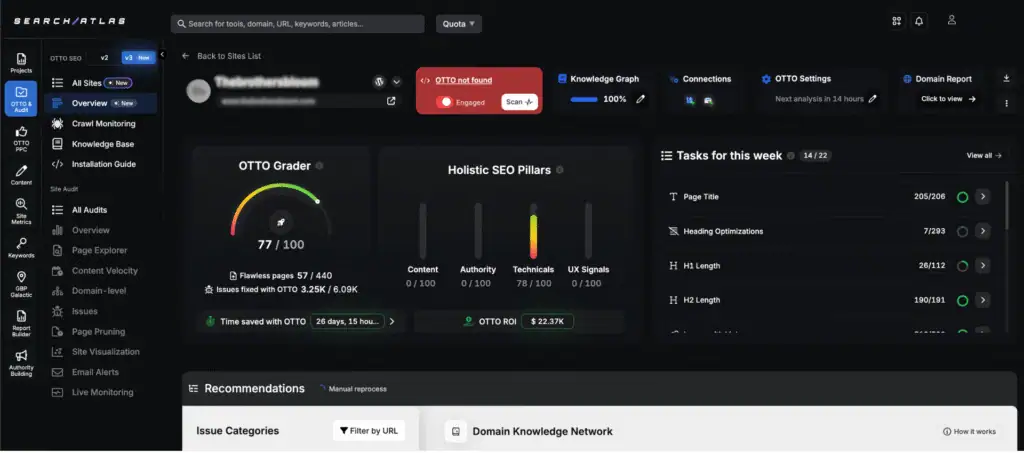
Key features of Search Atlas include AI-powered automation, real-time local rank tracking, comprehensive SEO tools, and citation distribution without recurring fees. The platform connects directly to Google Search Console (GSC), Google Analytics 4 (GA4), and Google Business Profile (GBP) data to ensure accuracy and eliminate reporting delays. Search Atlas OTTO SEO automates keyword tracking, on-page optimization, content generation, and local visibility improvements.
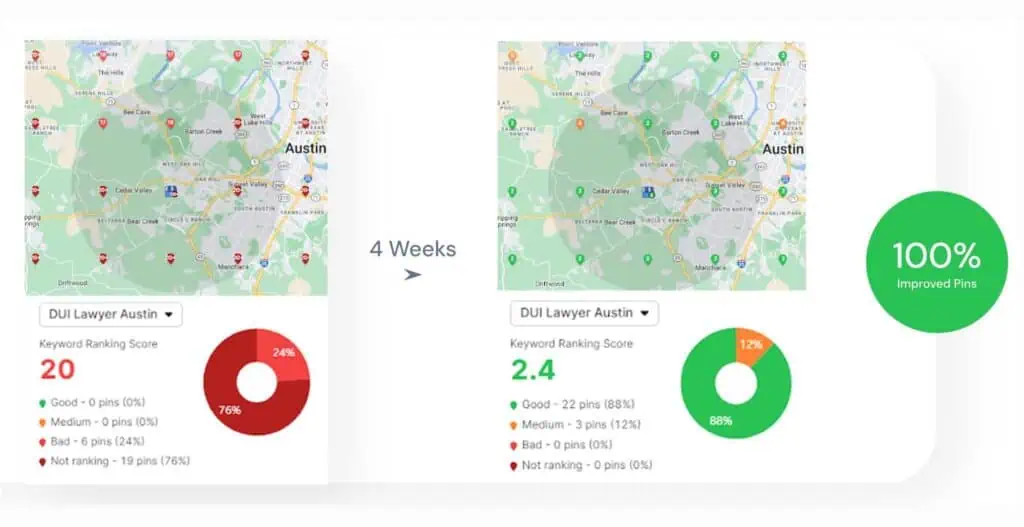
Search Atlas Content Genius creates AI-assisted blog posts, landing pages, and optimized content at scale. SCHOLAR evaluates topical authority and entity coverage. Local SEO tools include geo-grid heatmaps, citation audits, location-specific keyword clustering, and GBP Galactic for multi-profile management across unlimited locations.
Compared to Yext, Search Atlas provides deeper technical SEO capabilities, automated content creation, and integrated backlink intelligence. Yext focuses on Knowledge Graph distribution and voice search optimization, while Search Atlas improves organic visibility through comprehensive SEO automation, citation permanence, and AI-driven content workflows.
Search Atlas is a stronger Yext alternative for agencies and enterprises that prioritize SEO performance, automated workflows, and transparent pricing without annual lock-in contracts.
Search Atlas pricing begins at $99/month for the Starter plan with one OTTO SEO activation and 2,000 tracked keywords. Growth costs $199 monthly for two OTTO activations and 3,500 keywords. Pro reaches $399 monthly with four OTTO activations and 6,000 keywords. Enterprise requires custom quotes based on API access, white-label features, and expanded automation quotas.
Compared to Yext packages starting at $199 to $999 annually per location, Search Atlas provides more comprehensive SEO automation, content tools, and citation permanence at lower monthly costs with flexible cancellation.
Pros mentioned in the Search Atlas review include advanced AI automation, real-time Google integrations, unified workflows for local SEO and content, citation building without monthly fees, and white-label agency features.
Cons of Search Atlas as an alternative to Yext include a steeper learning curve for users unfamiliar with technical SEO workflows and interface complexity for teams that only need basic listing management without broader optimization tools.
2. Uberall: Best Yext Alternative for Multi-Location Brands
Uberall is a location marketing platform that synchronizes business data across 150+ directories, search engines, and AI platforms globally through direct API integrations. Uberall specializes in maintaining accurate location information for international brands operating across multiple markets.
Uberall emphasizes real-time updates through direct publisher connections that propagate changes within 24 to 48 hours.
Uberall provides centralized listings management with automated updates (Google, Apple Maps, Facebook, Bing, regional directories). AI-powered review management includes sentiment analysis and suggested responses in 40+ languages. Social media publishing offers location-specific content customization with approval workflows. Unified messaging consolidates customer inquiries from Google, Facebook, and Instagram into one inbox.
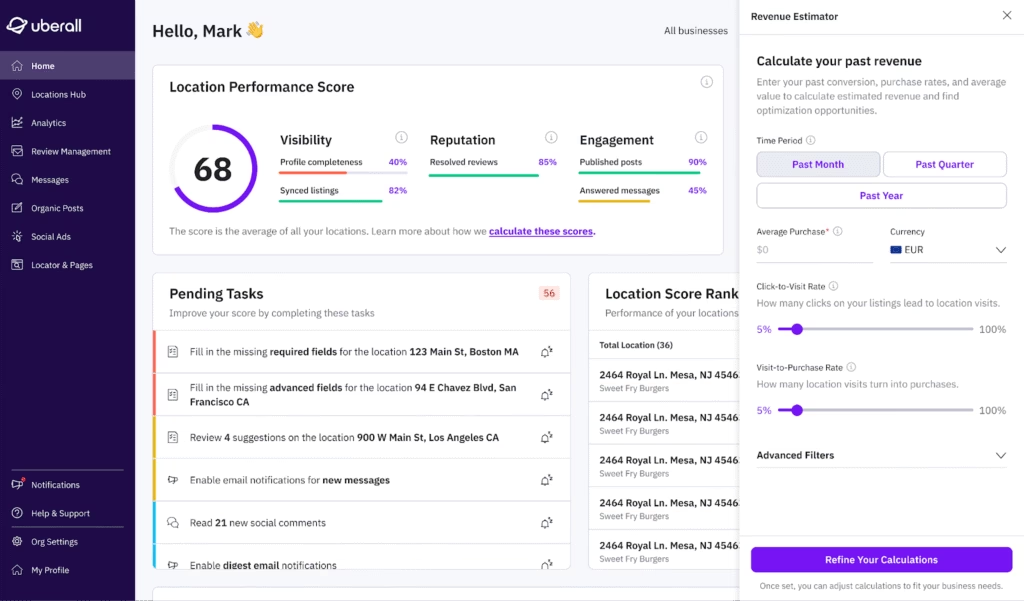
Analytics dashboards track visibility across traditional search and AI platforms (ChatGPT, Alexa, Siri). Store locator page generation optimizes for conversion and mobile experience. Competitive intelligence modules benchmark performance against local and regional competitors.
Enterprises use Uberall to ensure consistent brand presentation across international markets. The platform adapts content to local requirements and regulatory compliance across regions (GDPR, data residency, language localization).
Uberall serves as an alternative to Yext because it prioritizes global directory coverage and AI platform optimization with superior international scalability. Yext focuses on US-centric Knowledge Graph distribution, while Uberall delivers broader international directory reach with multi-language support and regional compliance features.
Uberall offers broader directory reach and faster update propagation. Global brands choose Uberall for a consistent worldwide presence across voice assistants and AI search. Domestic franchises select Yext for simpler Knowledge Graph management without complex international requirements.
Uberall pricing requires custom quotes based on location count, market coverage, and selected modules (Listings, Reviews, Social, Pages). Industry reports indicate enterprise packages starting from $1,000 to $5,000 monthly for comprehensive deployments across hundreds of locations with full feature access.
Compared to Yext packages starting around $199 to $999 per location annually, Uberall costs comparably but delivers international capabilities, faster propagation, and AI platform optimization unavailable in standard Yext plans.
Advantages highlighted in the Uberall review include an industry-leading directory network comprising over 150 publishers, an AI-first architecture optimized for voice search and generative AI, multilingual support across 40+ languages, real-time update propagation faster than competitors, and proven ROI (Return on Investment) for location performance campaigns.
Disadvantages of Uberall include premium pricing prohibitive for small businesses with fewer than 10 locations, complexity requiring dedicated implementation resources, and feature depth overwhelming teams that need basic listings management without advanced analytics modules.
3. BrightLocal: Best Yext Alternative for Affordable Local SEO
BrightLocal is a local SEO toolkit that centralizes rank tracking, citation management, and review monitoring for precise visibility measurement. BrightLocal tracks keywords across geo-specific grids and directories (Google, Bing, Yelp), which reveal location-based performance gaps and optimization priorities. Tool matters for small to medium businesses and agencies that require accuracy, affordability, and ownership in local SEO reporting.
BrightLocal processes and analyzes ranking data with high geographic resolution through the Local Rank Tracker, Local Search Grid, and Citation Builder modules. The tool verifies business data manually or through an API, which ensures Name, Address, and Phone (NAP) consistency across structured data platforms.
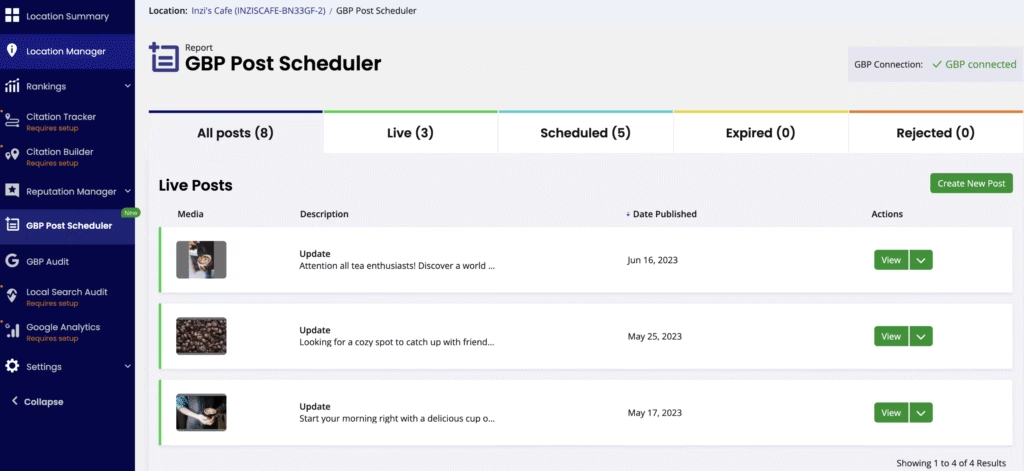
BrightLocal manages review acquisition, sentiment categorization, and Google Business Profile (GBP) audits that identify visibility issues within a defined service area.
BrightLocal integrates white-label dashboards, which enable agencies to present local performance analytics across multiple locations. The platform applies structured citation data, NAP audits, and keyword-level metrics within unified dashboards that standardize location intelligence.
BrightLocal differs from Yext because it uses manual control and verifiable submissions rather than automated sync networks. Yext automates updates through publisher APIs (TripAdvisor, Apple Maps, Facebook) while BrightLocal enables full data retention under user management systems.
BrightLocal pricing starts at $39/month for the Track plan with basic rank tracking, $49/month for the Manage plan with citation builder, and $59/month for the Grow plan with review monitoring and reporting. Citation submissions cost $2 per directory for manual placement beyond included credits.
According to the BrightLocal review, the strengths include transparent pricing models, detailed geo-rank analytics, and full listing ownership that prevents data loss after subscription termination.
Weaknesses of BrightLocal include limited automation capacity, delayed report generation on larger datasets, and the absence of advanced keyword research or technical crawling features.
BrightLocal operates as the best Yext alternative for agencies and small businesses that require manual oversight, structured data control, and affordability across localized SEO functions. Tool excels in scenarios that depend on precise grid ranking visualization, multi-location reporting, and verified directory citation maintenance.
4. GeoRanker: Best Yext Alternative for Local Rank Tracking
GeoRanker is a local SEO rank tracking platform best for businesses and agencies that require precise geo-specific keyword monitoring across neighborhoods, cities, and regions.
GeoRanker specializes in hyperlocal rank tracking with a grid-based visualization that shows ranking variations across service areas. GeoRanker provides insights into how rankings differ by location, which helps businesses optimize for specific geographic targets.
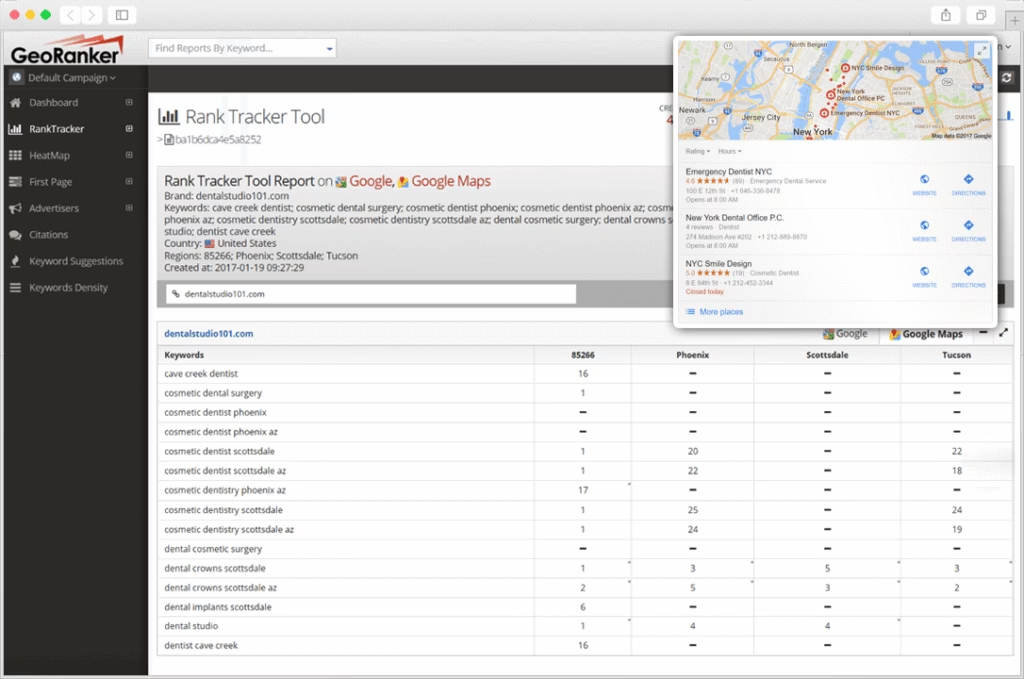
GeoRanker features include geo-grid rank tracking, local keyword research, competitor analysis, and GBP performance monitoring. The geo-grid visualization displays rankings across multiple coordinates within a city or region, revealing ranking patterns and geographic opportunities. Local keyword research identifies search terms with location modifiers and intent signals.
Competitor tracking compares rankings against local businesses across service areas. GBP insights monitor profile views, actions, and search queries that drive discovery. Automated reporting sends weekly summaries with ranking changes, visibility metrics, and performance trends.
Compared to Yext, GeoRanker provides specialized hyperlocal rank tracking and geographic SEO insights rather than broad directory distribution. Yext manages business listings and Knowledge Graph syndication, while GeoRanker focuses exclusively on tracking ranking performance across precise locations.
GeoRanker is a more specialized alternative than Yext for businesses that prioritize understanding local search visibility patterns, identifying geographic ranking opportunities, and optimizing for neighborhood-level search performance.
GeoRanker pricing starts at $99/month for the Pro plan with 10,000 monthly credits, $249/month for the Agency plan with 50,000 monthly credits, and $490/month for the Enterprise plan with 120,000 monthly credits.
Compared to Yext pricing, which ranges from $199 to $999 per location annually, GeoRanker costs less for businesses focused on rank tracking rather than comprehensive listing management and Knowledge Graph distribution.
Pros included in the GeoRanker review are highly accurate hyperlocal rank tracking, intuitive geo-grid visualization, useful competitor comparison tools, and affordable pricing for specialized rank monitoring needs.
Cons of GeoRanker include a narrow feature set limited to rank tracking without listing management, no review monitoring or citation building capabilities, and smaller directory coverage compared to comprehensive local marketing platforms (Yext, Search Atlas, Uberall).
5. LocalClarity: Best Yext Alternative for Franchise Review Management
LocalClarity is an AI-driven local SEO and review management platform best for enterprise teams that manage hundreds of business locations across multiple regions and platforms.
LocalClarity integrates listings, reviews, local social content, and analytics into a single interface designed for global scalability. LocalClarity uses Liia™ AI to automate response management, sentiment analysis, and local content updates for multilingual audiences across 90+ countries.
The main LocalClarity features are review management, local listings optimization, automation workflows, and competitive intelligence. LocalClarity enables teams to track reviews from over 50 sources (Google, Facebook, TripAdvisor, Trustpilot, Yelp).
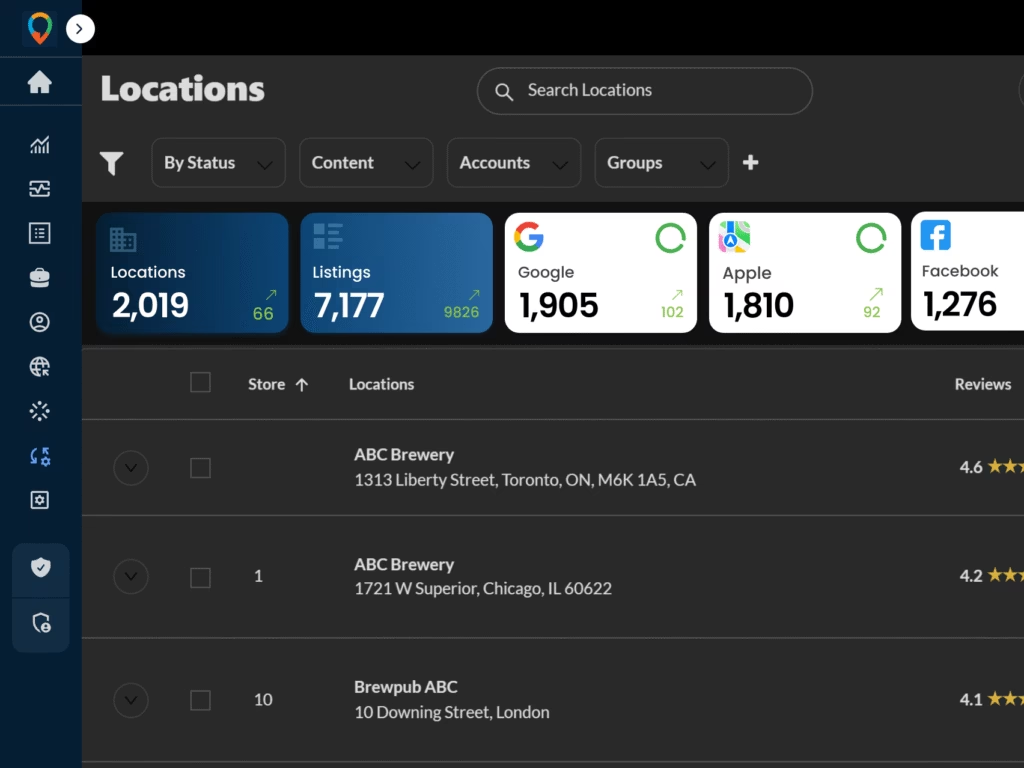
The LocalClarity Automation Engine allows unlimited workflows for listing updates, customer response triggers, and team assignments. Generative AI replies and multilingual sentiment analysis streamline communication across large networks. Businesses gain deep visibility through local keyword tracking, image management, and listing health scoring across all locations.
Compared to Yext, LocalClarity provides more advanced automation and international scalability with franchise-specific reporting tools. Yext focuses on Knowledge Graph distribution and voice search optimization, while LocalClarity delivers AI-powered control for global reputation and local search visibility across diverse markets.
LocalClarity is a stronger alternative than Yext for enterprises that need multi-region reporting, advanced analytics, unified listing management with security compliance, and API synchronization across international franchise networks.
LocalClarity pricing starts at $10 per location per month for Google-only coverage, $20 per location for the Professional plan with expanded directories, and custom enterprise pricing for agencies managing hundreds of locations. Each tier includes unlimited users, unlimited reports, and automation access without activation fees.
Compared to Yext packages starting around $199 to $999 per location annually, LocalClarity offers significantly lower cost per location with greater flexibility for international multi-brand operations and franchise networks.
The main pros highlighted in the LocalClarity review include unlimited automation workflows, multilingual AI response capabilities, competitive pricing for enterprise scale, franchise-optimized dashboards enabling location-level self-service, and strong API integration for custom implementations.
Cons of LocalClarity are a steeper learning curve for non-technical users, a complex setup for advanced API integrations and custom workflows, and a limited focus on social media publishing compared to engagement-oriented tools.
6. RenderSEO: Best Yext Alternative for Enterprise Web Listings
RenderSEO is an enterprise listings and local presence management platform best for large organizations that require structured data optimization, location page generation, and centralized listing control.
RenderSEO specializes in creating and managing location-specific landing pages at scale while maintaining consistent NAP data across hundreds of directories. RenderSEO focuses on technical implementation and schema markup for improved search visibility.
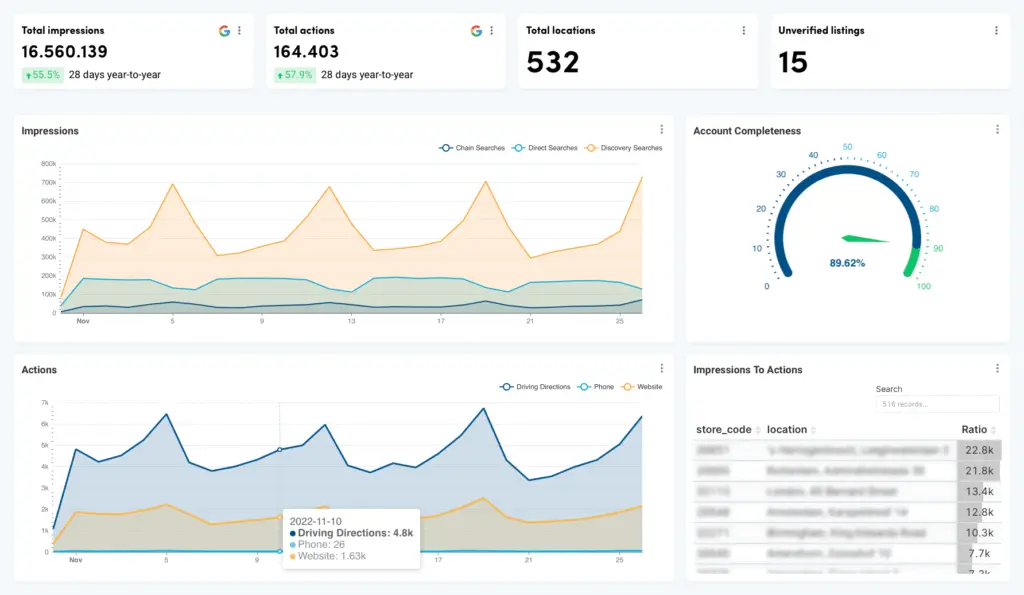
RenderSEO provides automated location page creation, listings distribution, schema markup optimization, and duplicate suppression. The platform generates location pages with customizable templates, local content, maps, reviews, and schema markup. Listings management pushes business data to major directories and aggregators with automated updates.
Duplicate suppression identifies and resolves conflicting listings that dilute brand presence. Schema markup implementation ensures proper structured data for search engines and rich results. Analytics dashboards track page performance, listing accuracy, and search visibility across locations.
Compared to Yext, RenderSEO emphasizes location page creation and on-site optimization rather than Knowledge Graph distribution. Yext distributes business information to external directories and voice platforms, while RenderSEO builds optimized location pages on owned properties with a technical SEO focus.
RenderSEO is a better alternative than Yext for enterprises that prioritize creating high-quality location landing pages with proper schema markup, maintaining control over on-site content, and implementing technical SEO best practices across hundreds of locations.
RenderSEO pricing requires custom quotes based on location count, page generation volume, and integration complexity. Industry reports indicate enterprise packages starting from $500 to $2,000 monthly, depending on features, locations, and technical implementation requirements.
Compared to Yext pricing starting around $199 to $999 per location annually, RenderSEO costs comparably for enterprises but focuses the budget on location page quality and technical optimization rather than broad directory distribution.
Strengths mentioned in the RenderSEO review include robust location page generation capabilities, strong technical SEO implementation with schema markup, centralized control over location content and data, and scalability for enterprise multi-location management.
Weaknesses of RenderSEO involve technical complexity requiring developer resources for implementation, limited review management features compared to reputation platforms, and narrower directory coverage focusing on major aggregators rather than comprehensive distribution networks.
7. LocalViking: Best Yext Alternative for Google Business Profile Scheduling
LocalViking is a Google Business Profile management platform best for automating GBP posts, Q&A, and local performance tracking across multiple locations. LocalViking provides bulk scheduling, spintax post-generation, and GeoGrid rank tracking to monitor local visibility. LocalViking consolidates all GBP data in a single dashboard that incorporates Offer, Event, and Standard post types with automated publishing workflows.
Key LocalViking modules include Post Scheduling, Rank Tracking, and Review Management. The Post Scheduler automates recurring posts across hundreds of listings using daisy chaining for continuous publishing without manual intervention. The Rank Tracker visualizes keyword performance within local map packs through heatmap-based GeoGrid data with ZIP code granularity.
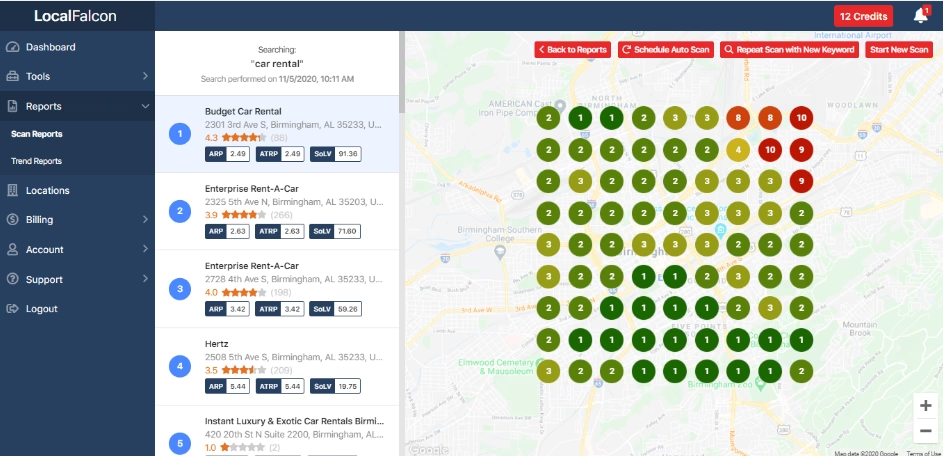
The Review Management feature aggregates customer feedback from Google and enables bulk responses. GBP Q&A automation monitors questions and suggests or publishes answers. Performance analytics track post engagement, profile views, and customer actions across all locations.
LocalViking differs from Yext in that it focuses exclusively on GBP automation rather than broader directory distribution and Knowledge Graph management. Yext covers listings, voice search, and multi-platform distribution, while LocalViking specializes in automating content and analytics inside the Google local ecosystem.
LocalViking is a more focused alternative than Yext for businesses that prioritize Google Business Profile optimization, automated post scheduling, and hyperlocal rank tracking without needing comprehensive directory distribution across hundreds of platforms.
LocalViking pricing begins at $39/month for a single location with basic features and scales up to $200/month based on the number of managed GBPs. Enterprise clients receive custom pricing for unlimited users, API access, and white-label options with agency branding.
The upsides mentioned in the LocalViking review are advanced post automation with Spintax and daisy chaining, granular rank tracking with GeoGrid visualization, simplified local SEO management focused on Google, and affordable pricing for single-platform optimization.
The downsides of LocalViking include limited social integrations beyond Google, no built-in advertising management or paid campaign tools, and dependency on Google API stability, which affects feature availability during platform changes.
8. Synup: Best Yext Alternative for Resellers & White Label Solutions
Synup is a listings, review, and SEO management platform best for agencies and resellers that require real-time visibility tracking, white-label tools, and scalable client reporting.
Synup centralizes data automation, review monitoring, and AI-powered marketing across client portfolios. Synup operates through Synup OS (operating system), which functions as a white-labeled operating system for agencies managing sales pipelines, invoicing, and local SEO analytics.
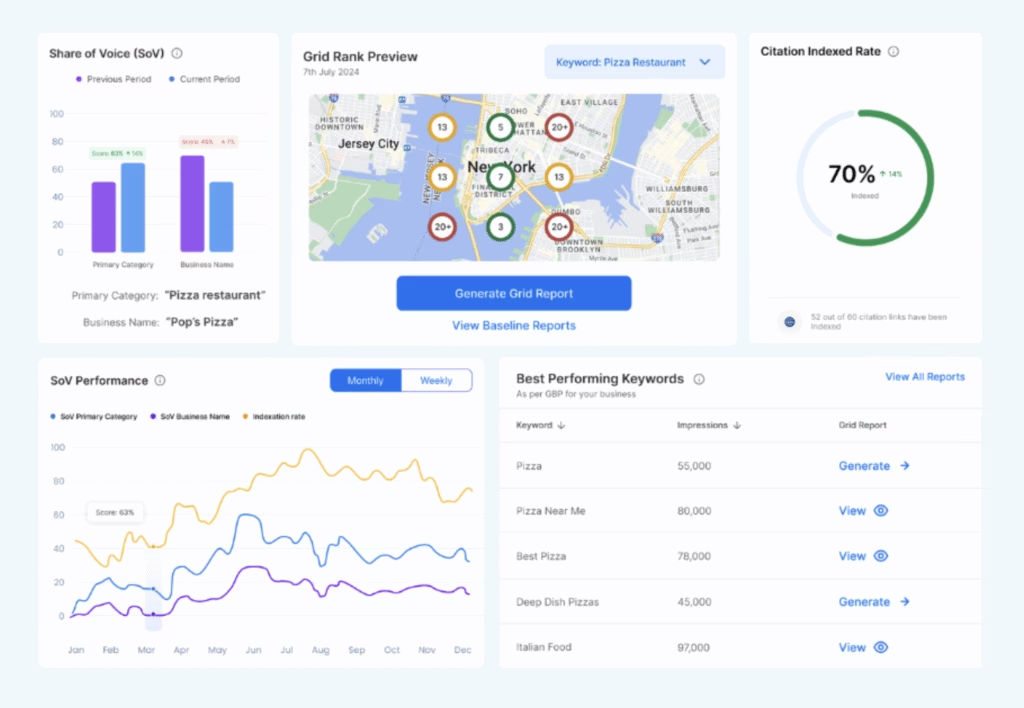
Key features of Synup include real-time listings synchronization, automated review monitoring, AI-driven marketing tools, and SEO rank tracking. The platform integrates directly with Google, Bing, Facebook, Apple Maps, and 70+ directories. It provides AI-assisted content suggestions, grid-based keyword tracking, and performance analytics across all locations.
White-label functionality enables agencies to create branded portals, custom dashboards, and client-facing reports. AI marketing tools automate social posts, review responses, and listing updates. Synup Reseller Program offers revenue sharing and partner support for agencies building managed services.
Compared to Yext, Synup provides stronger automation for listings management and technical SEO with agency-focused white-label tools. Yext focuses on Knowledge Graph distribution and enterprise-scale implementations, while Synup focuses on data accuracy, local SEO metrics, and automation designed for agencies managing 10 to 500 client locations.
Synup is a more precise alternative than Yext for agencies and resellers that prioritize multi-location visibility tracking, white-label client portals, and automated workflows without enterprise complexity or high per-location costs.
Synup pricing starts at $99/month for the Startup plan with basic features, $249 per month for the Agency plan with white-label access, and $999 per month for the Scale plan supporting up to 500 clients. Custom enterprise pricing is available for larger implementations.
The pricing structure is more transparent than the Yext quote-based models, which often exceed $199 to $999 per location annually. Synup provides predictable costs for small and mid-sized agencies managing multiple clients without per-location pricing complexity.
Pros mentioned in the Synup review are advanced listing automation with real-time updates, scalable white-label tools for agency branding, accurate rank tracking with geo-specific data, AI-powered content and response suggestions, and transparent agency pricing without hidden fees.
Cons of Synup include limited social post scheduling compared to dedicated social platforms, simplified analytics lacking deep competitive intelligence, and a complex interface for non-technical users compared to platforms specialized in social media workflows.
9. SE Ranking: Best Yext Alternative for SMB SEO Management
SE Ranking is an all-in-one SEO and digital marketing platform suited for small and mid-sized businesses that require affordable local rank tracking, Google Business Profile post scheduling, and comprehensive SEO tools.
SE Ranking provides keyword tracking, on-page SEO checks, technical audits, backlink monitoring, and a Local Marketing module designed to manage GBP listings, customer reviews, and map-based rankings. SE Ranking suits agencies and small businesses, combining core SEO workflows with basic local visibility tools.
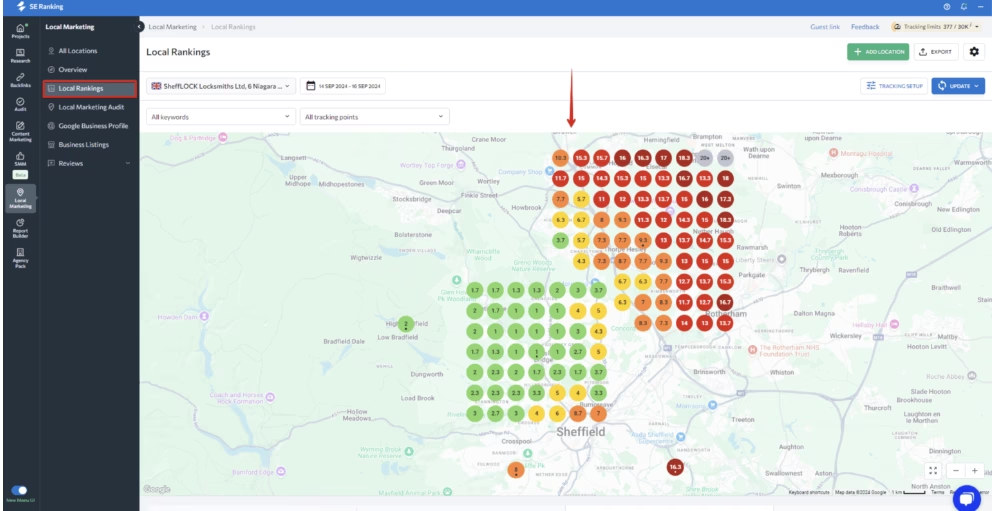
Key features of SE Ranking include the Rank Tracker, Local Marketing Tool, and GBP scheduling interface. SE Ranking tracks local keyword rankings across multiple search engines and devices with geo-specific data by ZIP code or neighborhood. The Local Marketing Tool audits directory listings, detects NAP inconsistencies, and allows review responses from a single dashboard.
GBP scheduling enables post automation and performance tracking across multiple business profiles. The on-page SEO checker analyzes content optimization opportunities. Site auditor identifies technical issues affecting rankings. Backlink checker monitors link profiles and toxic links.
Compared to Yext, SE Ranking offers simpler automation and a more affordable entry point for local SEO, combined with broader SEO capabilities. Yext provides multi-location listing management and Knowledge Graph distribution without deeper SEO tools, while SE Ranking focuses on visibility tracking, GBP publishing, and comprehensive SEO workflows.
SE Ranking suits teams that prioritize keyword accuracy, map-pack visibility, and full-spectrum SEO tools over advanced directory distribution or voice search optimization.
SE Ranking pricing starts at $65/month for the Essential plan with rank tracking and audits, $119 for the Pro plan with content marketing tools, and $259 for the Business plan with API access and team collaboration. The Local Marketing Tool is available as an add-on, and pricing scales with keyword volume and tracking frequency.
All SE Ranking plans include a 14-day free trial with access to keyword tracking, technical audits, and backlink tools, but local features require upgrade or add-on activation. SE Ranking is much more affordable than Yext, but focuses more on the general SEO aspects.
According to the SE Ranking review, the advantages include a clear interface design, cost-effective local tracking combined with broader SEO tools, useful GBP automation for multi-profile management, and comprehensive rank tracking across geo-specific locations.
The disadvantages of SE Ranking are inconsistent rank accuracy compared to specialized tools, limited review management depth without advanced sentiment analysis, and extra costs for essential add-ons that increase total monthly expenses beyond base pricing.
10. Moz Local: Best Yext Alternative for Cost-Effective Listings Management
Moz Local is a local SEO management platform best for maintaining accurate business listings and managing basic review insights across major directories without enterprise complexity.
Moz Local centralizes citation management, review monitoring, and social integrations inside one dashboard designed for small to mid-sized businesses. Moz Local focuses on visibility consistency and simplified reputation workflows rather than full-scale automation or advanced reporting.
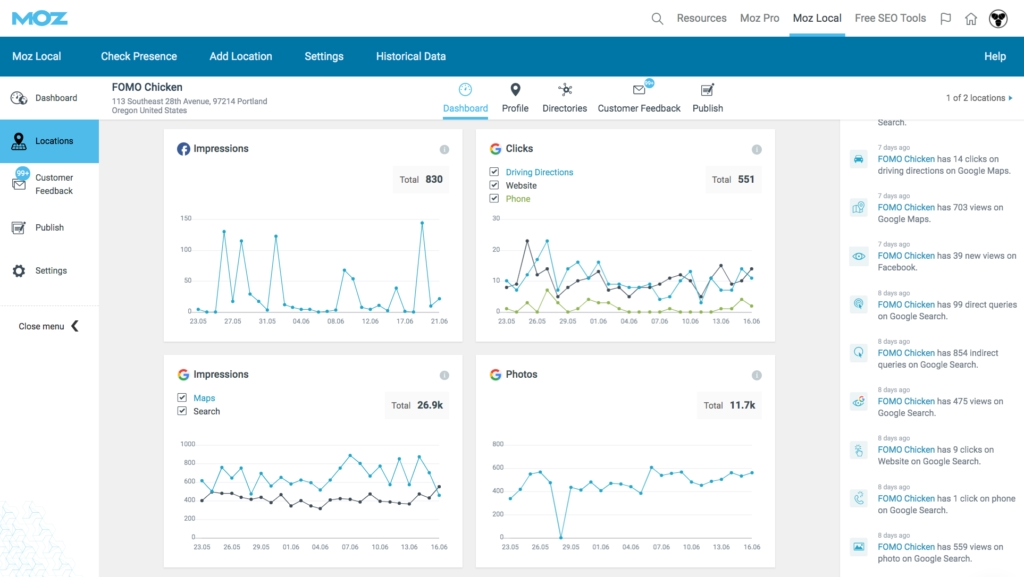
Core Moz Local functions include listing synchronization, review tracking, GeoRank visibility reporting, and AI-assisted review responses. Moz Local updates listings across more than 90 directories (Google, Facebook, Yelp, Apple Maps) and ensures accuracy on major platforms. The dashboard provides sentiment analytics, review alerts, and social post scheduling capabilities.
GeoRank visualizes map-pack performance by location to show ranking differences between cities or neighborhoods. Listing distribution pushes NAP data to aggregators (Neustar Localeze, Factual, Foursquare). Review monitoring aggregates feedback from major platforms with automated alerts.
Compared to Yext, Moz Local delivers a simpler interface for citation control and entry-level reputation insights at significantly lower costs. Yext offers multi-location Knowledge Graph distribution, voice search optimization, and enterprise workflows, while Moz Local emphasizes listing accuracy and basic review response automation.
Businesses using Moz Local improve data health across directories but rely on external tools for deeper analytics, comprehensive SEO capabilities, and marketing automation beyond basic listing management.
Moz Local pricing includes 4 tiers that include Lite ($20 per month) with basic listing management, Preferred ($30 per month) with review responses and sentiment analysis, Elite ($40 per month) with AI-driven listings and expanded social integrations, and Enterprise (custom pricing) with account management and advanced reporting for 50+ locations.
Compared to Yext packages starting around $199 to $999 per location annually, Moz Local costs 80% to 90% less but lacks enterprise features, voice search optimization, and Knowledge Graph distribution required by large franchises.
Advantages included in the Moz review are strong citation accuracy across major directories, an intuitive interface requiring minimal training, affordable pricing for small businesses and startups, and Moz ecosystem integration, reducing tool sprawl for existing Moz Pro users.
Disadvantages of Moz Local are minimal automation compared to enterprise platforms, limited competitor analysis without deep benchmarking, restricted review generation capabilities, and a smaller directory network focusing on major platforms rather than comprehensive coverage.
11. Birdeye: Best Yext Alternative for Customer Experience & Reviews
Birdeye is an AI-powered reputation and customer engagement platform best for local service businesses that automate review management, customer feedback collection, and reputation analytics across multi-location brands.
The Birdeye platform uses BirdAI agents that manage listings, request and respond to reviews, and analyze customer sentiment automatically.
Birdeye centralizes reputation monitoring, feedback reporting, and social interaction within one interface, serving industries dependent on customer experience (healthcare, retail, real estate, automotive).
Main Birdeye features include Reviews AI, Listings AI, and Insights AI. Reviews AI automates review acquisition, response generation, and feedback categorization to streamline communication workflows across Google, Facebook, Yelp, and 50+ platforms. Listings AI maintains NAP consistency across directories and improves local visibility through structured listing optimization.
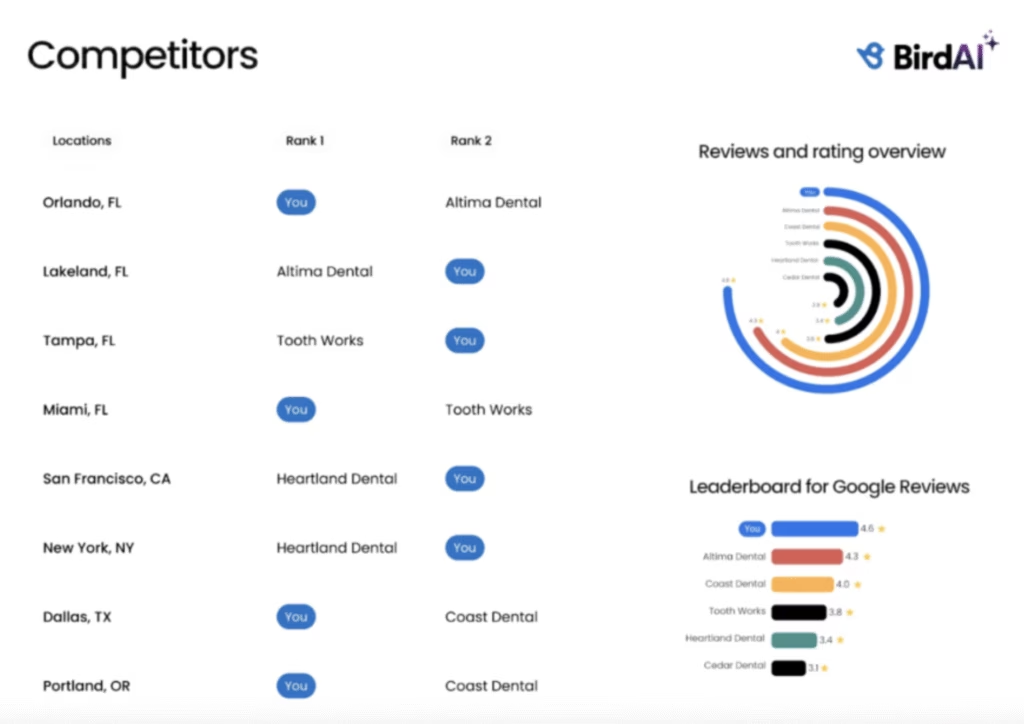
Insights AI measures sentiment across locations and identifies emerging trends influencing brand reputation. Surveys AI collects structured feedback through customizable forms. Unified inbox consolidates messages from review sites, social media, and webchat.
Birdeye focuses on customer experience automation rather than content scheduling or social campaign orchestration. Yext provides Knowledge Graph distribution and directory management, while Birdeye concentrates on review-based feedback loops that close the gap between user sentiment and brand response.
Birdeye is ideal for service businesses that prioritize automated review generation, sentiment analysis, real-time reputation tracking, and customer communication workflows over broad directory distribution or voice search optimization.
Birdeye pricing is custom and scales by the number of locations and AI modules selected. Enterprise pricing includes additional systems for Surveys AI, Competitors AI, and Reports AI. Managed and professional service add-ons are available for teams requiring setup assistance or full oversight.
Industry reports indicate pricing starting from $300 to $500 monthly per location, depending on features, with enterprise implementations reaching several thousand dollars monthly for comprehensive multi-location deployments.
The main pros listed in the Birdeye review include automated review workflows reducing manual response time, comprehensive sentiment analytics across platforms, real-time reputation tracking with instant alerts, unified customer communication across channels, and strong integration with industry-specific tools (healthcare EMR, automotive DMS, retail POS).
The cons of Birdeye are higher per-location pricing compared to basic listing platforms, limited campaign customization for complex marketing workflows, complex onboarding requiring dedicated training for smaller organizations, and a focus on reviews rather than broader SEO capabilities.
12. Reputation (Reputation.com): Best Yext Alternative for Enterprise ORM
Reputation.com is an enterprise reputation management platform that centralizes review generation, sentiment analysis, and customer experience workflows at scale through AI-powered automation.
Reputation.com processes millions of customer interactions annually through automated review requests, response suggestions, and survey distribution across industries with regulatory requirements (healthcare, finance, automotive, hospitality).
Reputation.com provides AI-driven review generation across 100+ sites, natural language processing for sentiment analysis, competitive benchmarking against local and national competitors, business listing management across major directories, and social listening across owned and competitor channels. Customizable survey tools track NPS (Net Promoter Score) and CSAT (Customer Satisfaction Score) metrics.
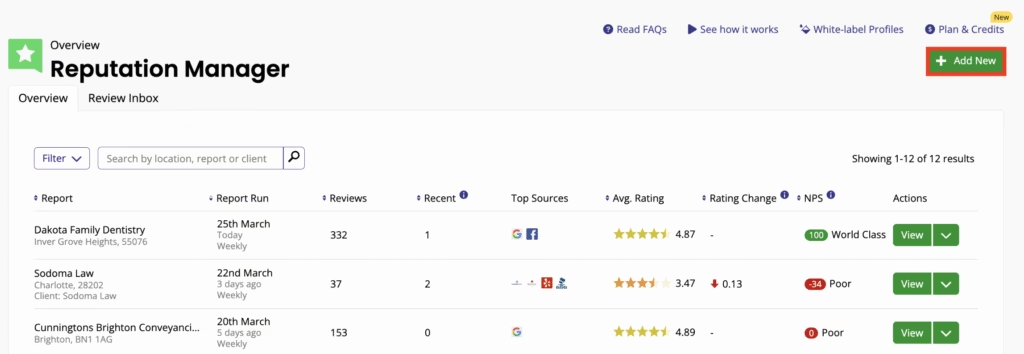
Enterprises use Reputation.com to unify customer feedback streams and automate response workflows across thousands of locations (hospitals, car dealerships, restaurant chains, hotel networks). Integration with CRM (Customer Relationship Management) and business intelligence platforms connects reputation data to revenue outcomes.
Reputation.com differs from Yext because it concentrates on reputation intelligence and customer experience analytics rather than directory distribution and Knowledge Graph management. Reputation.com delivers advanced AI agents for review response automation and deep sentiment insights, while Yext focuses on listing accuracy and voice search visibility.
Enterprises choose Reputation.com for measurable reputation-to-revenue correlation and advanced customer feedback analysis, whereas Yext users prioritize directory syndication and search visibility optimization.
Reputation.com pricing requires custom enterprise quotes based on location count, feature modules, and contract length. Industry reports indicate starting costs from $500 monthly for basic review management across limited locations, scaling to tens of thousands annually for comprehensive enterprise deployments with full analytics and integration capabilities.
Compared to Yext enterprise packages in similar ranges ($199 to $999+ per location annually), Reputation.com invests more heavily in AI automation, business intelligence integration, and customer experience measurement.
Strengths highlighted in the Reputation.com review include proven ROI through reputation-linked revenue tracking, AI reducing manual review response time by 80%, enterprise-grade security meeting compliance standards (HIPAA, GDPR, SOC 2), dedicated customer success teams for onboarding, and comprehensive sentiment analysis across feedback channels.
Weaknesses of Reputation.com involve complex implementation requiring 60 to 90 days for full deployment, high costs prohibitive for small businesses with fewer than 10 locations, and feature depth overwhelming teams needing simple review monitoring without extensive analytics.
13. SOCi: Best Yext Alternative for Social + Local Listings at Scale
SOCi is a localized marketing platform that helps multi-location brands manage social media, listings, and reputation at scale through centralized publishing and analytics dashboards. SOCi integrates scheduling, review monitoring, and performance reporting for dozens or hundreds of business locations across social networks and directories. SOCi emphasizes scalable social publishing workflows and centralized governance.
Key SOCi features include social media scheduling across major platforms, review management from Google and Facebook, listings distribution to directories, localized content customization, approval workflows, and performance analytics. The platform enables corporate teams to manage brand consistency while empowering individual locations to engage locally.

Social campaigns distribute approved content to multiple locations with location-specific customization. Paid social management coordinates advertising across markets. Review monitoring aggregates feedback with bulk response tools. Listings management ensures NAP consistency across directories.
Compared to Yext, SOCi emphasizes social media publishing and campaign orchestration over Knowledge Graph distribution. Yext focuses on directory accuracy, voice search optimization, and structured data management, while SOCi provides deeper social content workflows, approval chains, and engagement tracking.
SOCi is a stronger alternative than Yext for brands prioritizing coordinated social campaigns, location-based publishing governance, and unified social and reputation management over pure directory distribution and voice search capabilities.
SOCi pricing requires custom quotes based on location count and feature modules. Customer reports indicate starting costs around $400 to $600 monthly for basic social and listings management across 50 locations, scaling with additional features, networks, and analytics modules.
Compared to Yext packages starting around $199 to $999 per location annually, SOCi provides comparable pricing with greater emphasis on social publishing automation rather than comprehensive directory distribution networks.
Advantages included in the SOCi review are robust social publishing workflows at scale, centralized approval and governance tools, a unified dashboard for social and listings, multi-location campaign coordination, and strong franchise management features.
Disadvantages of SOCi involve limited technical SEO capabilities compared to comprehensive platforms, high costs that scale steeply with location count, a complex interface requiring training, and gaps in automation for content creation and backlink intelligence.
14. Semrush: Best Yext Alternative for SEO & Competitive Insights
Semrush is an all-in-one digital marketing platform best for SEO, competitive research, and PPC management, with a Local module for GBP optimization and listings distribution. Semrush integrates keyword research, rank tracking, technical audits, backlink analysis, content marketing, and advertising tools into one ecosystem.
Semrush Local handles GBP listings, local rankings, and review management as part of broader SEO campaigns.
Features of Semrush Local include GBP optimization, listing automation, review management, and map rank tracking. Semrush Local automates listing distribution to over 70 directories and removes duplicate data across networks. Its AI Review Response system generates personalized replies and content for GBP posts automatically.
The Map Rank Tracker measures visibility at the street or neighborhood level with location-specific ranking data and competitor insights. Broader Semrush tools provide domain analysis, traffic analytics, keyword gap analysis, position tracking, site audits, backlink intelligence, and content optimization.
Compared to Yext, Semrush Local provides deeper integration with keyword and ranking data across Google Search and Maps, combined with comprehensive SEO tools. Yext specializes in directory distribution and Knowledge Graph management without broader SEO capabilities, while Semrush Local focuses on structured data consistency, GBP performance, and full-spectrum digital marketing.
Businesses using Semrush Local gain unified visibility metrics, control over directory presence, and access to competitive intelligence unavailable in pure listing platforms.
Semrush pricing starts at $139.95/month for the Pro plan with limited features, $249.95/month for the Guru plan with content tools, and $499.95/month for the Business plan with extended limits and API access. Semrush Local is available as an add-on module priced separately based on location count.
Industry reports indicate Semrush Local costs approximately $30 to $60 per location monthly, depending on directory coverage and feature selections, comparable to Yext per-location pricing but bundled within comprehensive SEO subscriptions.
The pros mentioned in the Semrush review include direct GBP integration with automated posting, AI-based review responses reducing manual work, precise location tracking with neighborhood-level data,a comprehensive SEO toolkit beyond local features, and strong competitive intelligence across organic and paid channels.
The cons of Semrush Local are limited social publishing capabilities, higher dependency on base Semrush subscriptions, increasing total costs, fewer brand reputation tools compared to specialized ORM (Object-Relational Mapping) platforms, and local features being secondary to core SEO focus rather than primary capabilities.
15. Chatmeter: Best Yext Alternative for Local Brand Visibility Analytics
Chatmeter is a multi-location reputation management platform that centralizes reviews, listings, and social monitoring for franchises operating dozens to thousands of locations.
Chatmeter specializes in franchise-specific workflows by aggregating location-level performance data, enabling regional comparisons, and providing franchisee-accessible dashboards. The platform emphasizes scalable reputation control through automated alerts, bulk response tools, and competitive benchmarking.
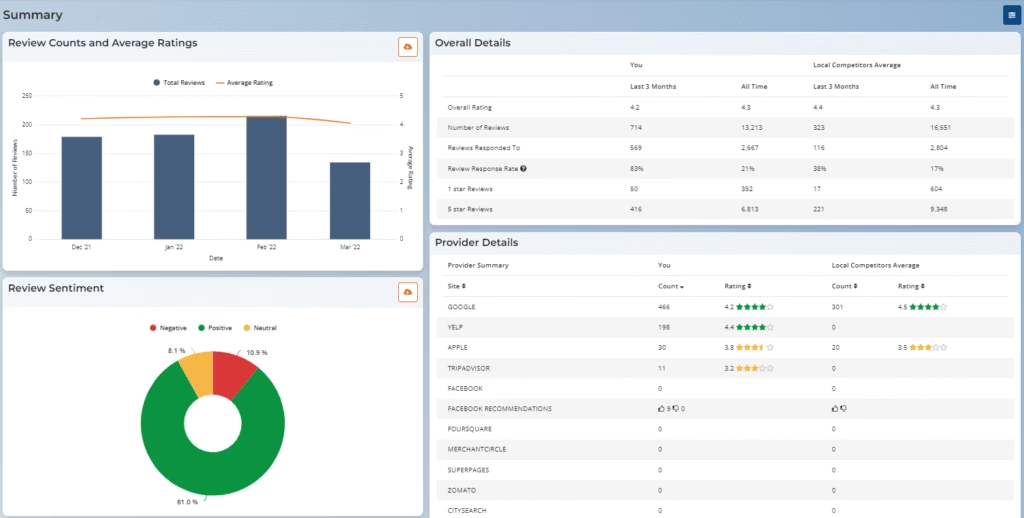
Chatmeter provides unified review monitoring across Google, Facebook, Yelp, and 100+ sites. Listings management ensures NAP consistency across directories and detects duplicate listings. AI-powered sentiment analysis identifies trending topics and emerging issues. Social media monitoring tracks brand mentions and engagement across networks.
Customizable alerts notify teams of negative reviews, listing errors, or competitive movements. Location comparison reports enable franchisees to benchmark against corporate averages and regional peers. Competitive intelligence modules track competitors’ review volume, ratings, and sentiment trends.
Franchises use Chatmeter to maintain brand consistency while empowering individual locations to manage local reputation (automotive dealerships, restaurant chains, healthcare networks, retail franchises).
Chatmeter differs from Yext because it emphasizes reputation intelligence and location analytics over Knowledge Graph distribution. Chatmeter delivers deeper insights into review sentiment trends and competitive positioning with franchise-specific reporting, while Yext focuses on directory accuracy and voice search optimization.
Franchises choose Chatmeter for granular location performance tracking and competitive benchmarking, whereas Yext users prioritize comprehensive directory distribution and search visibility across voice assistants.
Chatmeter pricing requires custom quotes determined by location count and feature selections. Customer reports indicate pricing structures similar to Yext, starting around $400 to $600 monthly for 50 locations and scaling with additional directories, social channels, and analytics modules.
Compared to Yext packages in equivalent ranges, Chatmeter invests more in franchise-specific reporting, competitive intelligence, and reputation analytics with less emphasis on broad directory distribution or voice search optimization.
Strengths mentioned in the Chatmeter review include franchise-optimized dashboards enabling franchisee self-service, competitive benchmarking revealing market positioning, automated alerts preventing reputation crises, scalability across hundreds of locations, and location-level performance insights supporting regional management.
Weaknesses of Chatmeter involve limited social content scheduling compared to SOCi or Hootsuite, a complex interface requiring training for non-technical users, and pricing becoming expensive when bundling all feature modules for comprehensive coverage.
16. Podium: Best Yext Alternative for Local Lead Generation & Messaging
Podium is a customer engagement and AI automation platform best for businesses that collect and convert leads through text-based interactions. Podium integrates SMS messaging, AI-driven review requests, and lead follow-up tools into one centralized interface connecting with CRM and payment systems.
Podium replaces manual communication workflows with automated sequences, transforming inbound messages into confirmed appointments and sales.
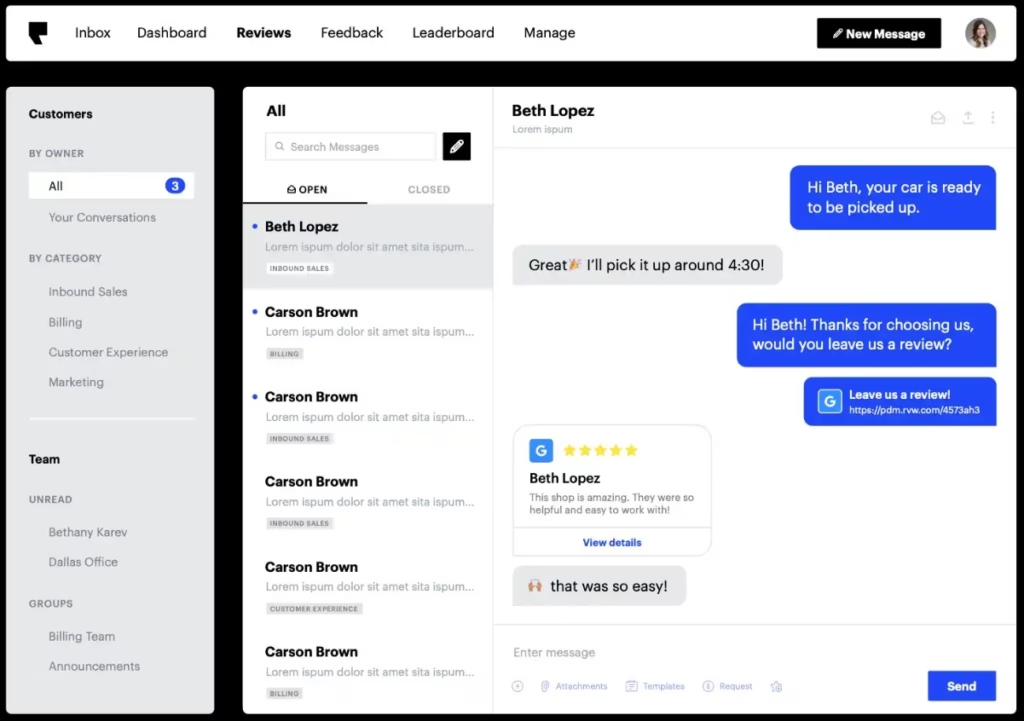
The main Podium functions include AI review automation, text marketing, AI lead routing, and integrated payment processing. Podium AI Employee handles review requests, appointment scheduling, and lead qualification through automated text threads. Unified inbox consolidates customer messages from multiple channels.
Podium integrates with industry systems for automotive, home services, and medical sectors to maintain fast response times and consistent communication. Review management suite automates feedback collection and response workflows. Payment integration enables text-to-pay functionality.
Compared to Yext, Podium emphasizes direct engagement and real-time response through SMS workflows rather than directory distribution. Yext manages local listings and Knowledge Graph syndication across platforms, while Podium increases review volume and lead conversions with automation rooted in customer communication.
Businesses using Podium achieve faster interaction cycles and higher review frequency through AI-assisted outreach and personalized conversation flows without focusing on comprehensive directory coverage.
Podium pricing depends on 3 structured plans, which include Core, Pro, and Signature. Core includes an essential AI response system and messaging features starting at around $289 monthly. Pro adds instant AI replies, advanced automation, and text-based campaigns with multimedia content. Signature extends capabilities for multi-location enterprises with custom branding, reporting, and dedicated account management.
Compared to Yext pricing starting around $199 to $999 per location annually, Podium provides comparable monthly costs but focuses entirely on communication automation and review generation rather than directory distribution.
The advantages mentioned in the Podium review include real-time communication, measurable review generation, advanced AI automation, SMS-based workflows, and payment integration that streamlines transactions.
Disadvantages of Podium are higher entry costs for small businesses with limited budgets, limited SEO analytics without rank tracking or keyword tools, fewer tools for multi-channel publishing compared to broader marketing systems (Search Atlas, SOCi, Birdeye), and a focus on communication rather than comprehensive local visibility optimization.
17. Vendasta: Best Yext Alternative for Agencies & White Label Growth
Vendasta is a white-label platform best for agencies and resellers building managed services for local businesses through branded tools and automation.
Vendasta provides a marketplace of digital products (listings, reputation, SEO, websites, advertising) that agencies resell under their own brand. Vendasta emphasizes agency scalability through client management dashboards, branded reporting, and revenue-sharing partnerships.
Vendasta features include white-label reputation management, listings distribution, website builder, social media tools, SEO reporting, advertising management, and CRM integration. The platform enables agencies to deliver comprehensive digital services without building individual tools from scratch.
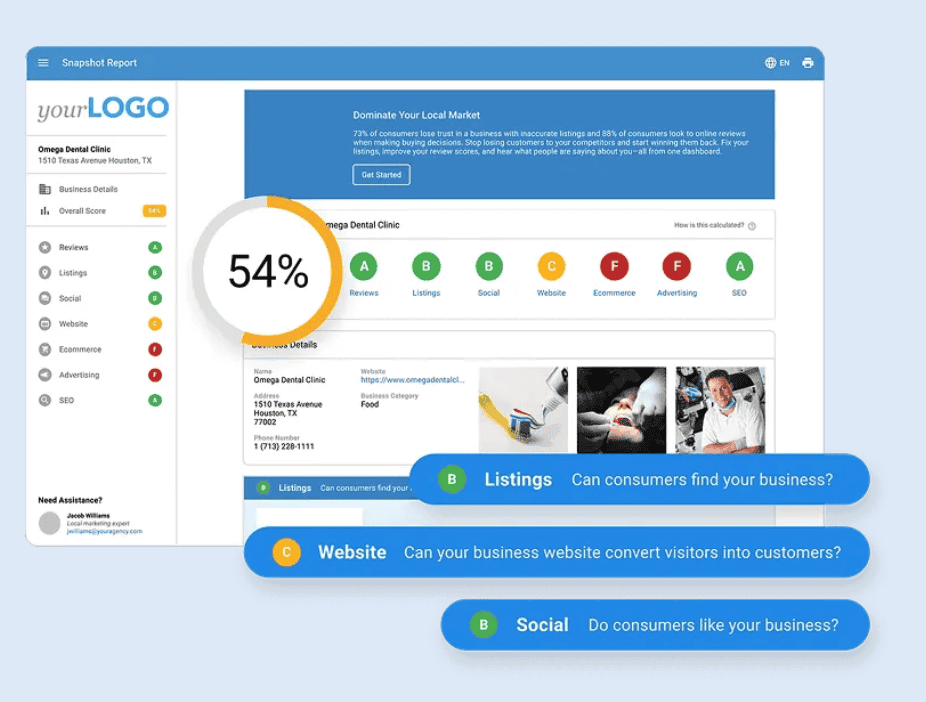
Reputation management aggregates reviews from major platforms with automated response workflows. Listings distribution syncs business data to directories. Website builder creates responsive sites with SEO optimization. Social media tools schedule posts and track engagement. Automated reporting generates branded client reports.
Agencies use Vendasta to deliver comprehensive digital marketing services while maintaining branded client interfaces and streamlined workflows (marketing agencies, MSPs, media companies).
Vendasta differs from Yext because it prioritizes agency-client relationships and white-label capabilities over direct listings management. Vendasta delivers a complete reseller platform with revenue sharing, while Yext provides enterprise-scale directory distribution and Knowledge Graph management.
Agencies serving diverse clients choose Vendasta for flexible white-label services and centralized client management, whereas enterprises managing their own locations select Yext for direct Knowledge Graph control and voice search optimization.
Vendasta pricing starts at $99/month for basic access to the platform, with individual products priced separately based on client needs. Agencies typically pay wholesale prices for services and mark up to clients. Revenue sharing arrangements vary based on partnership tiers and volume commitments.
Compared to Yext packages starting around $199 to $999 per location annually, Vendasta provides different economics focused on agency margins and client markup rather than per-location costs for direct management.
Pros noted in the Vendasta review include comprehensive white-label capabilities enabling complete agency branding, a broad product marketplace offering diverse services, centralized client management streamlining operations, revenue-sharing opportunities supporting agency growth, and scalable infrastructure for managing hundreds of clients.
Cons of Vendasta involve a complex pricing structure requiring careful margin calculations, limited listings management compared to specialized platforms, a learning curve for agencies new to white-label reselling, and product quality variations across marketplace offerings.
18. AccuRanker: Best Yext Alternative for SERP Rank Tracking
AccuRanker is a rank tracking platform best for SEO professionals requiring fast, accurate, and on-demand keyword position monitoring. AccuRanker specializes in daily rank tracking with unlimited on-demand updates across desktop, mobile, and local search.
AccuRanker provides precise ranking data without the broader directory management or listing distribution features found in local marketing platforms.
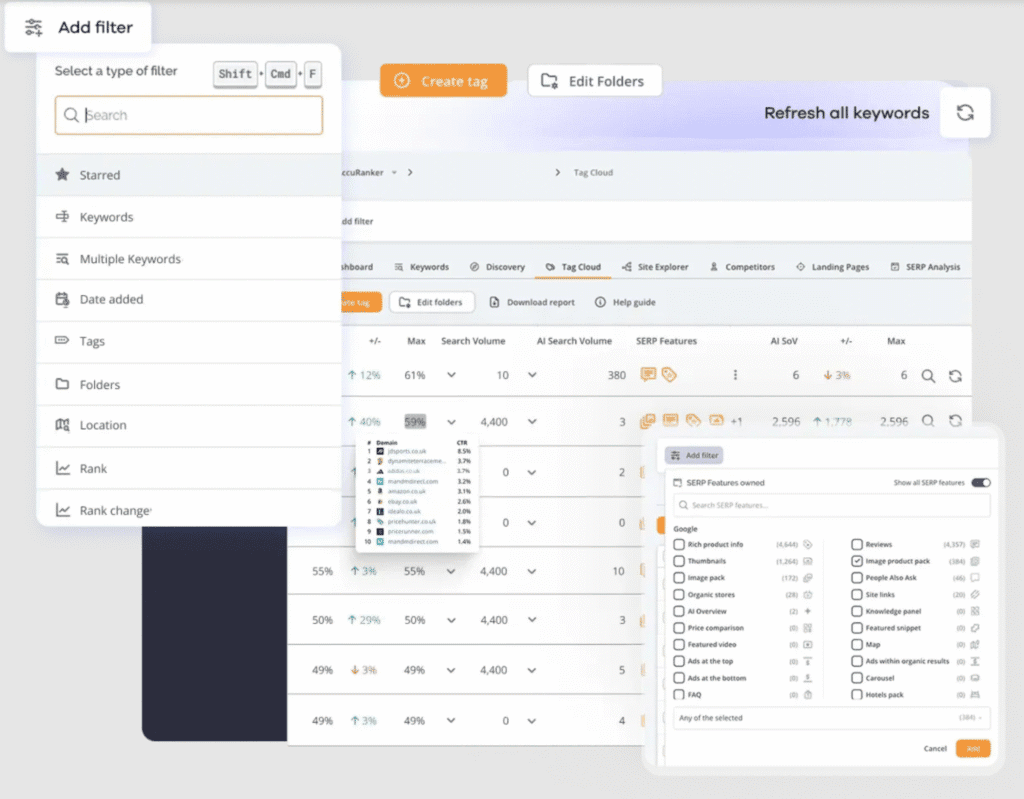
AccuRanker features include daily rank tracking, unlimited on-demand updates, local rank tracking, competitor tracking, and integration with Google Analytics and Search Console. The platform tracks rankings across Google, Bing, and Yahoo with device-specific and location-specific granularity.
Tag-based organization groups keywords by category, location, or campaign. Share of voice metrics compare visibility against competitors. Historical data visualization shows ranking trends over time. API access enables custom integrations and automated reporting.
Compared to Yext, AccuRanker provides specialized rank tracking capabilities without listings management or directory distribution. Yext manages business information across directories and the Knowledge Graph, while AccuRanker focuses exclusively on tracking ranking performance with maximum speed and accuracy.
AccuRanker is a specialized Yext alternative for SEO professionals prioritizing precise rank data, on-demand updates, and deep ranking analytics without needing comprehensive local listings management or reputation tools.
AccuRanker pricing starts at 245EUR/month for 2,000 keywords with daily updates, scaling to higher tiers based on keyword count. Enterprise pricing offers custom limits, dedicated support, and white-label options for agencies. All plans include unlimited on-demand updates and competitor tracking.
Compared to Yext pricing starting around $199 to $999 per location annually, AccuRanker costs less for businesses focused purely on rank tracking rather than comprehensive listing management and directory distribution.
Advantages noted in the AccuRanker review are exceptional ranking accuracy and speed, unlimited on-demand updates enabling real-time monitoring, a clean interface designed for SEO professionals, a robust API for custom integrations, and precise local rank tracking capabilities.
Disadvantages of AccuRanker include a narrow feature set limited to rank tracking without broader SEO tools, no listing management or citation building, absence of review monitoring or reputation features, and a higher cost per keyword compared to all-in-one platforms bundling rank tracking with other capabilities.
19. Algolia: Best Yext Alternative for AI-Powered Site Search
Algolia is an AI-powered search and discovery platform best for websites and applications requiring fast, relevant, and personalized search experiences. Algolia provides search-as-a-service infrastructure, optimizing speed, relevance, and user experience through machine learning. Algolia focuses on on-site search functionality rather than local listings or directory management.
Algolia features include typo tolerance, synonym handling, faceted search, personalization, A/B testing, analytics, and multi-language support. The platform indexes content and returns results in milliseconds with relevance tuning based on business rules and user behavior.

AI-powered ranking optimizes result order based on conversion data. Personalization adapts results to individual user preferences. Analytics dashboards track search performance, popular queries, and conversion metrics. Federated search aggregates results from multiple sources.
Compared to Yext, Algolia serves completely different needs focused on on-site search optimization rather than business listings distribution. Yext distributes business information to external directories and search engines, while Algolia improves search functionality within owned digital properties.
Algolia is relevant as a Yext alternative only for businesses evaluating search infrastructure needs across both internal site search and external visibility, recognizing these represent distinct solutions addressing separate challenges.
Algolia pricing follows usage-based models with custom quotes based on search volume, records indexed, and feature requirements. Starter plans begin around $1 per 1,000 searches, scaling with volume and advanced features (AI ranking, personalization, analytics).
Compared to Yext, which is focused on per-location costs for directory distribution, Algolia costs vary significantly based on search traffic volume and implementation complexity, serving fundamentally different use cases.
Strengths highlighted in the Algolia review include exceptional search speed with sub-50ms response times, sophisticated relevance tuning capabilities, robust personalization features, comprehensive analytics for optimization, and reliable infrastructure supporting high-scale implementations.
Weaknesses of Algolia involve complexity requiring developer resources for implementation, usage-based pricing becoming expensive at scale, a learning curve for advanced relevance tuning, and a focus on site search rather than local visibility or directory management.
20. Bloomreach: Best Yext Alternative for Digital Commerce Personalization
Bloomreach is a digital commerce platform best for ecommerce businesses requiring personalized search, recommendations, and content optimization. Bloomreach combines search, merchandising, content management, and customer data into one system, optimizing digital commerce experiences. Bloomreach focuses on conversion optimization rather than local listings or directory distribution.
Bloomreach features include AI-powered search, product recommendations, content personalization, customer segmentation, A/B testing, and analytics. The platform analyzes customer behavior and inventory data to deliver personalized experiences, increasing conversion and revenue.

Search optimization handles product discovery with relevance tuning and merchandising rules. Recommendations engine suggests products based on behavior and preferences. Content management personalizes messaging and offers. Customer data platform unifies profiles across touchpoints.
Compared to Yext, Bloomreach addresses entirely different needs focused on ecommerce optimization rather than local business visibility. Yext distributes business listings to directories and search engines, while Bloomreach optimizes on-site commerce experiences for online retailers.
Bloomreach is only tangentially relevant as a Yext alternative, as it serves distinct audiences focused on digital commerce rather than local business marketing and directory presence.
Bloomreach pricing requires custom quotes based on traffic volume, revenue, and selected modules (Discovery, Engagement, Content). Enterprise contracts typically start at several thousand dollars monthly based on ecommerce scale and implementation complexity.
Compared to Yext pricing for local listings management, Bloomreach represents a different budget allocation focused on ecommerce revenue optimization rather than directory visibility.
Advantages mentioned in the Bloomreach review include powerful personalization capabilities increasing conversion, robust search and merchandising tools, a unified customer data platform, comprehensive analytics and insights, and proven ROI for mid-market and enterprise retailers.
Disadvantages of Bloomreach involve high implementation costs requiring significant resources, complexity necessitating dedicated teams, premium pricing prohibitive for small businesses, and a focus on ecommerce rather than local business visibility or directory management.
21. Brand24: Best Yext Alternative for Social Media Listening
Brand24 is an AI-based social listening tool best for monitoring brand mentions, sentiment trends, and online reputation across digital sources. Brand24 collects and analyzes data from over 25 million active domains in real time, covering social media, news sites, blogs, forums, and video platforms (Reddit, TikTok, YouTube). Its AI-powered analysis segments mentions by sentiment and intent.
Core Brand24 features are sentiment analysis, emotion analysis, and AI insights. Sentiment analysis categorizes brand mentions as positive, negative, or neutral to identify reputation shifts. Emotion analysis tracks specific emotional tones (trust, anger, joy) within user discussions. AI Insights aggregates contextual data from topics, mentions, and engagement metrics.


Alert systems notify teams of mention spikes, sentiment changes, or competitive movements. Historical data tracking enables trend analysis over time. Multi-user collaboration supports team-based monitoring and response coordination.
Brand24 differs from Yext by focusing on external perception tracking rather than direct listings management or directory distribution. Yext operates as a listings and Knowledge Graph platform, while Brand24 measures how users, media, and competitors discuss a brand online.
Brand24 is relevant as an alternative only for businesses evaluating reputation monitoring needs alongside directory presence, recognizing these serve complementary rather than overlapping functions.
Brand24 pricing starts at $199/month for the Individual plan that tracks limited mentions and keywords, and scales to $999/month for the Enterprise tier with higher limits, advanced features (AI Emotion Analysis, AI Insights, custom reports), and priority support.
Compared to Yext, with pricing focused on per-location directory distribution, Brand24 costs comparably but serves distinct monitoring and listening needs rather than listings management.
Advantages noted in the Brand24 review are accurate sentiment segmentation across platforms, multilingual detection supporting global monitoring, real-time alerts enabling rapid response, comprehensive coverage of social and web sources, and useful competitive intelligence.
The disadvantages of Brand24 include limited posting capabilities without direct social publishing, high cost for large-scale tracking requirements, restricted integrations within lower pricing tiers, and a focus on monitoring rather than directory management or local visibility optimization.
22. Unbxd: Best Yext Alternative for Ecommerce Product Discovery
Netcore Unbxd is an ecommerce product discovery platform that integrates AI-powered search, recommendation, and catalog enrichment to accelerate product findability.
Netcore Unbxd processes real-time shopper data across retail categories (apparel, home, electronics), which identifies intent and connects buyers with relevant products. Tool matters for enterprise retailers that require adaptive, scalable, and conversion-optimized product discovery workflows.

Netcore Unbxd analyzes behavioral signals, search queries, and catalog data through its Agentic AI engine. The platform executes real-time ranking, tagging, and contextual recommendation tasks that refine relevance across dynamic inventories.
Netcore Unbxd operates a composable, API-first infrastructure that enables elastic scaling, instant indexing, and sub-10-millisecond response times. It integrates catalog enrichment, visual search, and intent-based discovery, which aligns ecommerce KPIs with measurable revenue uplift.
Netcore Unbxd delivers explainable AI, autonomous product reasoning, and full override control for merchandisers who manage complex catalogs. Platform functions differ from Yext because it focuses on search precision and catalog intelligence rather than directory-level data synchronization.
Yext automates NAP (Name, Address, Phone) updates across publisher networks, while Netcore Unbxd enables AI reasoning across catalog structures, shopper intent signals, and session-level personalization.
Netcore Unbxd pricing follows enterprise-tier licensing. Firstly, pricing scales with catalog size and query volume. Secondly, implementation cost depends on infrastructure load and integration complexity. Thirdly, analytics and automation modules add incremental fees under enterprise contracts.
Yext pricing remains location-based with 199 to 999 USD per location annually, while Netcore Unbxd operates on transaction and volume-based structures aligned with ecommerce performance.
Strengths highlighted in the Netcore Unbxd review include measurable revenue growth, up to 35 percent conversion rate increase, and an 80 percent reduction in zero-result searches. Tool delivers composable APIs, visual-first search, and low-latency infrastructure that sustain enterprise traffic loads across millions of queries per second. Weaknesses involve longer onboarding cycles for enterprise-scale catalogs, the complexity of AI model calibration, and higher initial cost compared with lightweight local SEO solutions.
Netcore Unbxd functions as the best Yext alternative for ecommerce product discovery that requires autonomous, explainable, and intent-driven AI systems.
23. NiceJob: Best Yext Alternative for Review Generation Campaigns
NiceJob is a reputation marketing platform best for small businesses automating review collection, referrals, and social proof without heavy setup or enterprise costs. NiceJob streamlines how service-based businesses gather and showcase customer feedback to boost visibility and conversions. The software automates review requests, follow-ups, and social sharing.
The core modules of NiceJob include Reviews, Referrals, Social Proof, and Insights. The Reviews module automates review requests after service completion and shares them on Google and Facebook. The Referrals feature turns satisfied customers into advocates through incentive campaigns.
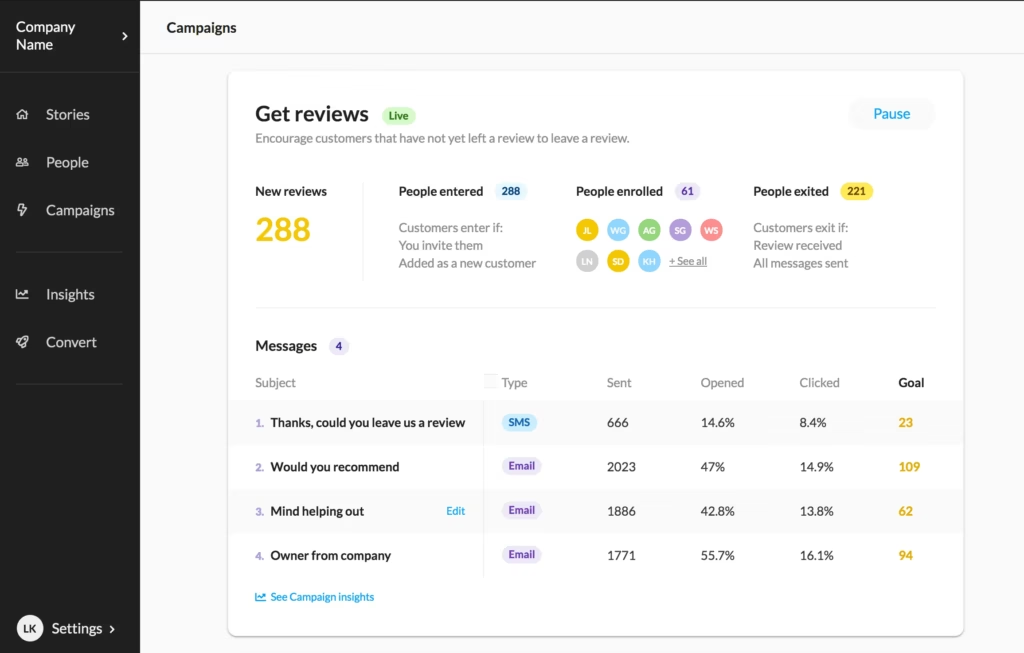
Social Proof tools display top reviews on websites through customizable widgets. Insights track SEO performance, review volume, and competitor benchmarks. Pro tier adds AI-powered review replies, repeat business automation, and loyalty gifting.
NiceJob differs from Yext by focusing on small business owners who need fast, low-cost review growth instead of enterprise-level listing management. Yext targets multi-location brands with complex directory networks and Knowledge Graph distribution, while NiceJob prioritizes simplicity, affordability, and immediate results.
NiceJob is ideal for service businesses (contractors, dentists, salons) prioritizing automated review generation and referral programs over comprehensive directory distribution and voice search optimization.
NiceJob pricing starts at $75 per month for the Reviews plan with basic automation and $125 per month for the Pro plan with AI tools, repeat business features, and advanced analytics. Both plans include unlimited review requests and social sharing.
Compared to Yext enterprise plans starting around $199 to $999 per location annually, NiceJob provides significantly more affordable options for solopreneurs and SMBs focused on organic reputation growth without complex directory needs.
According to the NiceJob review, the advantages include intuitive automation requiring minimal setup, low entry cost accessible to small businesses, high ROI on review generation improving local rankings, a simple interface designed for non-technical users, and an effective referral system that generates new leads.
Disadvantages of NiceJob include limited listing management beyond major platforms, fewer analytics capabilities compared to enterprise solutions, no in-depth social scheduling beyond review sharing, and a narrow feature set focused specifically on reviews and referrals without broader SEO tools.
24. ReviewTrackers: Best Yext Alternative for Multi-Site Review Management
ReviewTrackers is an enterprise-grade platform that focuses on collecting, analyzing, and improving customer feedback across local branches and franchises. ReviewTrackers aggregates reviews from major platforms and converts customer sentiment into measurable insights supporting acquisition, retention, and compliance workflows.
Core components of ReviewTrackers include Review Monitoring, Local Listings, Customer Experience Analytics, and Competitor Benchmarking. Review Monitoring gathers and classifies feedback from multiple review sites (Google, Facebook, Yelp, TripAdvisor). Local Listings maintain consistent business data across directories.
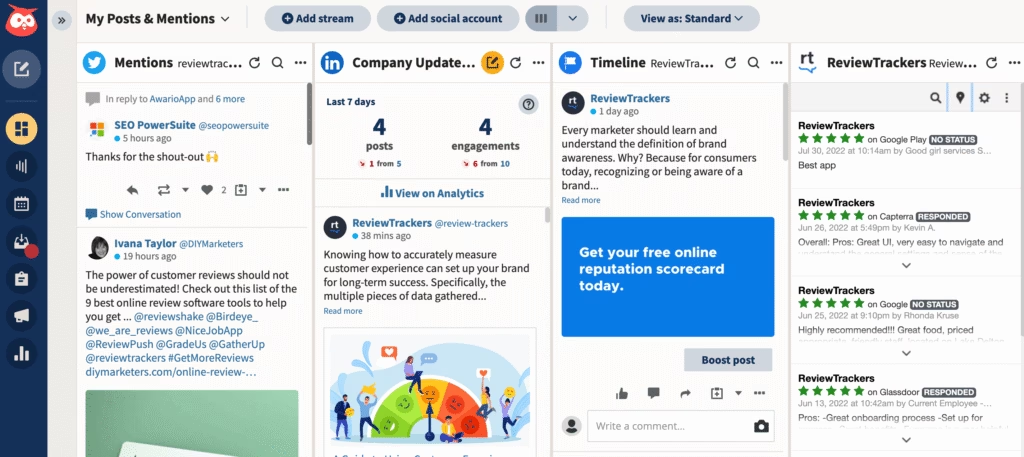
Customer Experience Analytics identifies recurring service patterns and satisfaction trends through sentiment analysis. Competitor Benchmarking quantifies local brand perception and highlights ranking gaps against competitors. Integration with CRM systems connects feedback to customer profiles.
ReviewTrackers differs from Yext in its analytical depth and focus on review intelligence. Yext manages comprehensive listings and Knowledge Graph syndication, while ReviewTrackers refines review data to improve local search visibility and customer lifetime value.
ReviewTrackers is better suited than Yext for organizations prioritizing review-driven insights, compliance monitoring, and customer experience measurement over broad directory coverage or voice search optimization.
ReviewTrackers pricing starts $89 per location per month. Compared to Yext pricing, which ranges from $199 to $999 per location annually, ReviewTrackers costs less and provides deeper analytical capabilities and customer experience insights unavailable in standard listing platforms.
Strengths noted in the ReviewTrackers review include high-accuracy sentiment detection, customizable reporting for executive presentations, data aggregation across multi-location networks revealing patterns, compliance monitoring for regulated industries, and strong integration capabilities with enterprise systems.
The weaknesses of ReviewTrackers include limited scheduling capabilities beyond review management, reduced automation for smaller teams compared to all-in-one platforms, no built-in social advertising system, and premium pricing potentially prohibitive for businesses with fewer than 20 locations.
25. The HOTH: Best Yext Alternative for Link Building + SEO Services
The HOTH is a full-service SEO and AI visibility platform that centralizes link building, managed SEO, content creation, and reputation workflows for businesses that require scalable acquisition across search and AI systems.
The HOTH executes thousands of monthly campaigns through managed link outreach, AI visibility programs, and long-form content production for brands across ecommerce, legal, home services, and national franchises. The platform delivers multi-channel SEO output through fully managed services, white-label reporting, and integrated AI visibility systems that position brands inside Google AI Overviews, conversational AI tools, and high-intent editorial placements.

The HOTH provides link outreach, blogger outreach, digital PR, review and reputation management, content refresh frameworks, and technical SEO auditing across hundreds of campaigns per day. Its proprietary AI Discover program optimizes content for LLM (Large Language Model) training sources, identifies gaps in AI visibility, and accelerates inclusion in AI-generated answers.
The platform offers backlink acquisition through manual outreach, ranking content through HOTH Blogger and Web Copy, and fully managed SEO campaigns that combine authority building, reputation signals, and structured site improvements.
The HOTH differs from Yext because it focuses on link acquisition, authority building, and AI visibility. Yext centers on automated directory listings, NAP uniformity, and enterprise publisher synchronization.
The HOTH strengthens ranking signals through backlinks, content authority, and digital PR, whereas Yext provides automated data syndication across directories. Brands choose The HOTH for organic ranking growth and link-driven authority signals, while Yext users prioritize structured business listings, local accuracy, and enterprise-scale data distribution.
The HOTH pricing spans DIY and fully managed models. Managed SEO (HOTH X) ranges from $1,000 monthly for starter campaigns to $10,000 monthly for enterprise programs with dedicated SEO managers. AI Discover starts at $5,000 monthly under a 3-month commitment and includes AI visibility, digital PR, reputation signals, and LLM strategy sessions. Individual link outreach orders begin at $175 for DR 20 links and scale to $405 for DR 50 placements.
While Yext cost scales by location count, The HOTH cost scales by link volume, authority building, and strategic SEO management.
Strengths highlighted in the HOTH review include link acquisition delivered through manual outreach, transparent reporting dashboards, AI Discover strategies that place brands in AI Overviews, content frameworks that build topical authority, and dedicated SEO managers who execute multi-layer strategy across content, links, and reputation signals.
Weaknesses include higher long-term costs for brands that require intensive link velocity, extended ramp-up periods for competitive industries, and program complexity that exceeds the needs of small local businesses that only require directory synchronization.
26. Swiftype: Best Yext Alternative for Website Search Integration
Swiftype is a site search platform that delivers configurable relevance models for website-level retrieval precision, which matters for teams requiring structured, fast, and scalable search experiences.
Swiftype processes indexed content through cloud-hosted infrastructure that outputs deterministic ranking signals for document sets (pages, files, metadata). Swiftype applies algorithmic relevance rules that filter, boost, and rank entries inside web properties.

Swiftype executes faceted filtering, autocomplete logic, language-specific ranking, and analytics pipelines that reveal query patterns. Swiftype analyzes user interactions through clickstream data, which refines result-ordering functions across domains. It integrates API-driven ingestion pipelines that enable multi-domain content unification for enterprise websites.
Swiftype differs from Yext because Swiftype manages search retrieval within owned digital environments, while Yext manages external directory distribution across publisher networks.
Yext synchronizes NAP data across Knowledge Graph ecosystems, while Swiftype performs high-speed document indexing, relevance tuning, and federated retrieval across internal repositories.
Swiftype pricing ranges from $79 to $199/month for fixed tiers and extends to custom enterprise pricing for advanced deployments. Volume-based add-ons apply across documents, queries, engines, and domains with increments of $25 per 5k documents, $25 per 50k queries, $50 to $100 for each additional engine, and $30 for each additional domain.
Pros mentioned in the Swiftype review include deterministic relevance tuning, low-latency retrieval pipelines, stable indexing performance across multi-domain environments, configurable filtering parameters, and clear analytics revealing query-level behavior.
Cons of Swiftype are usage-driven cost escalation under heavy traffic, limited AI enrichment compared with newer engines, restricted merchandising functions for ecommerce architectures, and a focus on internal retrieval rather than local visibility.
27. Luigi’s Box: Best Yext Alternative for Ecommerce Search UX
Luigi’s Box is an ecommerce search and product discovery platform best for online stores that need intelligent search, personalization, and analytics. Luigi’s Box optimizes product finding experiences through AI that analyzes customer behavior and catalogs data. Luigi’s Box focuses specifically on ecommerce search rather than local business visibility.
Luigi’s Box features include AI-powered search, autocomplete, product recommendations, analytics, and A/B testing. The platform improves search relevance through learning from customer interactions and purchase patterns.
Synonym detection handles alternative product names. Query analytics identify optimization opportunities. Personalization adapts results to user preferences. Merchandising rules control product visibility and promotions.

Compared to Yext, Luigi’s Box serves different needs focused on ecommerce product search rather than local listings management. Yext distributes business information to external directories, while Luigi’s Box optimizes on-site product discovery for online retailers.
Luigi’s Box is relevant as a Yext alternative only for businesses evaluating both ecommerce search infrastructure and local directory presence as distinct solutions addressing separate channels.
Luigi’s Box pricing requires custom quotes based on catalog size, search volume, and selected features. Pricing typically scales with monthly visitors and products indexed, starting at several hundred dollars monthly for small to mid-sized stores.
Advantages noted in the Luigi’s Box review include effective search relevance improving product discovery, a user-friendly admin interface for non-technical users, good customer support, and a positive impact on ecommerce metrics.
Disadvantages of Luigi’s Box involve limited advanced features compared to enterprise platforms, a smaller customer base and ecosystem, pricing becoming significant for high-traffic stores, and a focus on ecommerce rather than local business marketing.
28. Clerk.io: Best Yext Alternative for Personalization in Online Stores
Clerk.io is an ecommerce personalization platform best for online stores requiring personalized search, recommendations, and email marketing. Clerk.io combines product discovery, behavioral targeting, and automated campaigns to increase conversion and revenue. Clerk.io focuses on ecommerce personalization.
Clerk.io features include personalized search, product recommendations, email automation, audience segmentation, and analytics. The platform analyzes customer behavior to deliver individualized experiences across search, category pages, and marketing channels.

Clerk.io differs from Yext because it focuses on internal personalization and AI reasoning across ecommerce catalogs rather than directory distribution and NAP (name, address, phone number) synchronization. Clerk.io executes ranking, recommendation, and behavioral modeling across owned properties, while Yext distributes structured business data across publisher networks. Ecommerce teams choose Clerk.io for unified personalization across products, sessions, and audiences, while Yext users prioritize consistent location data distribution across external platforms.
Clerk.io pricing uses modular usage-based billing with incremental tiers that scale with product volume and monthly activity. Standard pricing begins with $119 monthly for 10000 searches and an equivalent $119 monthly for 100000 recommendation calls with predictable per-1000 usage rates.
Chat, email, and audience modules follow identical $119 entry points with usage-based increments. Enterprise pricing introduces custom SLAs, advanced configuration, and dedicated infrastructure that scale with catalog size and real-time request volume.
Advantages noted in the Clerk.io review include unified AI logic that governs search, recommendations, chat, and email, real-time behavioral adaptation across all touchpoints, and rapid deployment through platform integrations (Shopify, Magento, BigCommerce).
Clerk.io imitations involve usage-based costs that rise with traffic volume, AI calibration complexity for large catalogs, and reduced suitability for businesses that require external directory distribution rather than internal ecommerce personalization.
29. Prefixbox: Best Yext Alternative for Enterprise Ecommerce Search
Prefixbox is an enterprise ecommerce search platform that delivers AI-driven product discovery, query interpretation, and catalog-level relevance optimization across large retail inventories.
Prefixbox processes behavioral signals, catalog attributes, and real-time interaction data (queries, clicks, conversions), which improves conversion rate and revenue across product-heavy environments. Tool matters for enterprise retailers that require advanced ranking logic, next-generation AI interpretation, and scalable search infrastructure.

Prefixbox analyzes catalog metadata, linguistic patterns, and shopper behavior through a multi-suite architecture that includes AI Search, AI Navigation, AI Recommend, and AI Agent.
Prefixbox executes real-time ranking, autocomplete expansion, semantic interpretation, and conversational product retrieval that adapts to complex catalogs. The platform integrates search analytics, A/B testing systems, and data-mining modules, which refine query handling, reduce abandonment, and accelerate product discovery.
Prefixbox offers language-specific processing, visual recommendations, and enterprise-grade indexing workflows that operate across diverse regional markets.
Prefixbox differs from Yext because it focuses on on-site search, semantic retrieval, and product-level intelligence rather than directory distribution and NAP synchronization. Prefixbox delivers ranking engines, recommendation logic, and AI-assisted navigation across owned ecommerce properties, while Yext distributes structured business data across publisher networks.
Enterprise retailers choose Prefixbox for its ability to interpret complex product queries and optimize on-site discovery, while Yext users prioritize structured listing accuracy across external directories.
Prefixbox pricing follows API-based billing where cost scales with query volume, recommendation requests, and selected suites. Retailers purchase AI Search, AI Navigation, AI Recommend, and Insights as modular components that calculate usage in API calls. Pricing ranges from mid-tier usage plans that suit growing retailers to enterprise-tier contracts that include custom infrastructure, advanced analytics, and dedicated integration engineering.
Advantages highlighted in the Prefixbox review include high relevancy gains driven by AI Search, measurable revenue increases within 3 to 4 weeks, native integration with major ecommerce platforms (Shopify, Salesforce, Magento), and strong performance across multilingual markets.
Limitations of Prefixbox involve API cost growth with high-volume catalogs, integration complexity for non-standard architectures, and a limited role in external visibility channels that Yext handles through directory distribution.
30. Searchspring: Best Yext Alternative for Merchandising + Onsite Search
Searchspring (now part of Athos Commerce) is an ecommerce search, merchandising, and personalization platform built for retailers that require structured control over onsite discovery instead of external directory distribution.
Searchspring powers search results, category pages, filters, and merchandising rules across large product catalogs while improving relevance, conversion rate, and revenue. The platform specializes in on-site optimization through indexable search infrastructure, dynamic product ranking, and visual merchandising workflows.

Searchspring provides AI-driven product discovery, faceted navigation, real-time indexing, and merchandising control panels for placement rules, boosting, pinning, and campaign scheduling. Advanced plans include geo-merchandising, landing page creation, A/B testing environments, and personalization models for category results and product recommendations. Searchspring processes behavioral data, session signals, and product attributes to optimize relevance and improve conversion across retail stores operating at scale.
Searchspring (Athos Commerce) differs from Yext because it optimizes internal ecommerce environments, not external listings or knowledge graph distribution. Yext manages NAP data, multi-location updates, and publisher network distribution, while Searchspring focuses entirely on boosting on-site conversions through search relevance, merchandising automation, and personalization.
Retailers choose Searchspring when they need deep control over on-site product visibility rather than external local discovery.
Searchspring (Athos Commerce) pricing follows a plan-based structure (Essential, Advanced, Expert) with usage fees linked to domains, sessions, and SKU counts. Essential includes core search features, boost rules, and scheduled campaigns. Advanced adds geo-merchandising, landing pages, and A/B testing. Expert introduces full personalization, real-time indexing, and 200+ active merchandising campaigns.
Strengths highlighted in Searchspring reviews include powerful merchandising capabilities, effective search relevance, proven ROI for ecommerce revenue, intuitive visual interface, and comprehensive analytics for optimization.
Weaknesses of Searchspring involve premium pricing limiting accessibility to mid-market and enterprise retailers, implementation complexity requiring planning, focus on specific ecommerce platforms, and emphasis on online retail rather than local business marketing.
31. Magnolia: Best Yext Alternative for Enterprise DXP + Content

Magnolia is an enterprise Digital Experience Platform (DXP) that unifies content, data, and channel delivery with a governed AI layer and streamlines multi-site orchestration for global ecosystems.
Magnolia provides CMS native AI that embeds generative models into page editing, metadata enrichment, and translation workflows, which creates deterministic content production for large organizations.
Magnolia integrates AI image processing that automates background removal, restoration, and style adaptation for media libraries, which removes manual asset handling across distributed teams.
Magnolia executes AI-driven personalization that classifies text, images, and components into structured pools (segments, taxonomies, variants), which drive targeted rendering at scale. Magnolia operates governed AI search and agent systems for consumer interfaces, regulated environments, and internal knowledge bases, which deploy the correct model family for each operational context.
Magnolia pricing requires custom enterprise quotes based on deployment scope, user count, and infrastructure requirements. Enterprise contracts typically start at tens of thousands of dollars annually for comprehensive DXP implementations.
Compared to Yext pricing for directory management, Magnolia represents a significant investment in content infrastructure rather than local business visibility.
Advantages noted in Magnolia reviews include powerful enterprise capabilities, flexible headless architecture, robust integration framework, strong security and governance, and proven scalability for large implementations.
Disadvantages of Magnolia involve high costs limiting accessibility to large enterprises, significant complexity requiring technical resources, long implementation timelines, and a focus on content management rather than local marketing or directory distribution.
32. Broadly: Best Yext Alternative for SMB Review Requests
Broadly is an AI-driven reputation and customer engagement platform best for local service businesses, automating review collection, web chat, and customer communication.
Broadly combines AI assistants, review management, web chat, and local SEO tools to help small businesses grow visibility and streamline client communication without hiring additional staff.
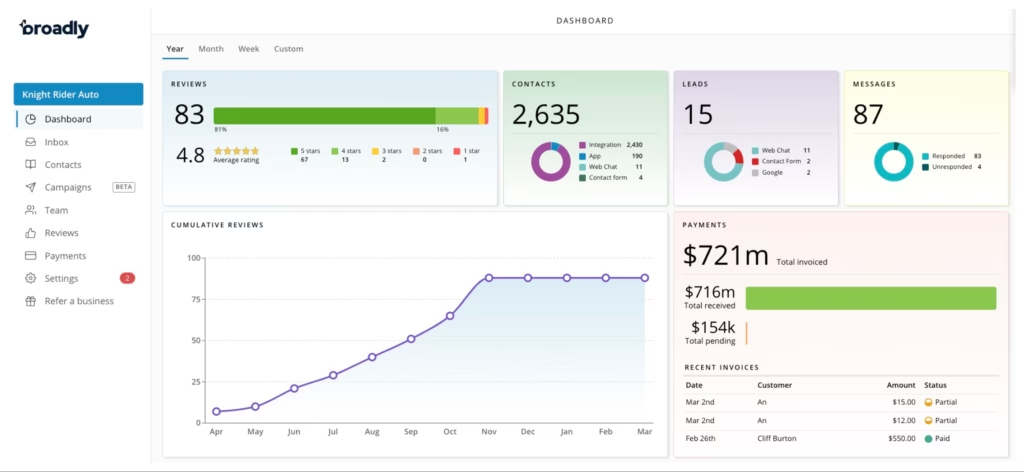
Broadly includes features like Conversations AI, Reviews, Local SEO, and Campaigns. Conversations AI acts as a 24/7 receptionist answering chats, messages, and calls. The Reviews suite manages Google and Facebook feedback and automates AI-written replies.
The Local SEO grid monitors search rankings and updates business listings across directories. Campaigns Pro adds automated SMS and email marketing to re-engage existing customers. Payment integration enables text-to-pay functionality.
Broadly differs from Yext by focusing on AI automation for lead capture and customer interaction rather than multi-location enterprise control. Yext is built for franchise brands managing hundreds of locations with Knowledge Graph distribution, while Broadly suits single-location businesses automating reputation growth and communication without extra staff.
Broadly is ideal for service businesses (salons, contractors, legal practices) that prioritize automated customer communication, review generation, and lead capture over comprehensive directory distribution or voice search optimization.
Broadly pricing starts at $299/month for the Standard plan with basic features, $499 for Pro with AI social posting and text engagement, and $699 for Premium with AI phone receptionist and advanced SEO services.
Compared to Yext pricing, which ranges from $199 to $999 per location annually, Broadly costs more monthly but includes AI-powered communication tools that are unavailable in standard listing platforms focused purely on directory distribution.
The pros highlighted in the Broadly review include extremely high SMS response rates exceeding 90%, a simple interface designed for non-technical service businesses, integrated payments streamlining transactions, missed call text-back recovering lost leads, and industry-specific integrations matching service business workflows.
The cons of Broadly are a single-location focus limiting franchise applicability, limited social publishing compared to multi-channel platforms, a narrow feature set excluding broader SEO tools, and monthly costs potentially expensive for basic reputation needs without AI communication features.
33. Cloutly: Best Yext Alternative for Video Testimonials & Reviews
Cloutly is a reputation and lead management platform designed for service-based and franchise businesses that automates review collection, video testimonials, and local competitor benchmarking. Cloutly provides tools for managing reviews, video testimonials, AI-driven responses, and customer messages across multiple channels.

Cloutly includes Review Campaigns, Omnichannel Messaging, Competitor Insights, and Team Leaderboards. The Review Campaigns tool uses SMS, video prompts, and email sequences to double response rates. The Messaging suite unifies chat, WhatsApp, Messenger, and Instagram conversations into one inbox.
Competitor Insights provides benchmarking and keyword-based visibility tracking. Team Leaderboards motivate staff performance with review-driven recognition. Video review collection captures authentic testimonials for marketing use.
Cloutly differs from Yext by offering review-first automation for SMBs and multi-location franchises. Yext focuses on comprehensive directory syndication and voice search, while Cloutly enables direct engagement through conversational AI and flexible review campaigns adapted to smaller business workflows.
Cloutly is suited for businesses prioritizing video testimonial collection, automated review generation, competitive intelligence, and team gamification over broad directory distribution or voice assistant optimization.
Cloutly starts at $29/month for the Starter plan with basic SMS campaigns, $55/month for the Essentials plan, $69/month for the Growth plan with AI lead capture and competitor analysis, and custom white-label packages for large networks requiring agency branding.
Compared to Yext pricing, Cloutly provides significantly lower entry costs with a focus on review automation rather than comprehensive directory management.
The Cloutly review shows pros like fast setup requiring minimal configuration, AI-assisted review responses reducing manual work, competitive insights revealing local positioning, video review capabilities enhancing authenticity, and affordable pricing for small businesses.
The cons of Cloutly include limited social scheduling beyond reviews, fewer integrations for enterprise CRM systems compared to platforms like Salesforce-connected solutions, SMS costs scaling with usage, potentially increasing expenses, and focus on reviews rather than comprehensive SEO or content capabilities
34. SurveySparrow: Best Yext Alternative for Customer Feedback Surveys
SurveySparrow is a customer feedback and survey platform best for businesses requiring conversational surveys, NPS tracking, and customer experience insights.
SurveySparrow provides tools for creating engaging surveys, distributing them across channels, and analyzing feedback to improve customer satisfaction. SurveySparrow focuses on structured feedback collection rather than listing management.

SurveySparrow features include conversational surveys, NPS and CSAT tracking, multi-channel distribution, automation, and analytics. The platform creates survey experiences resembling conversations rather than traditional forms, increasing response rates.
Survey builder includes templates, logic branching, and customization. Distribution channels include email, SMS, web embed, and QR codes. Automation triggers surveys based on customer actions. The analytics dashboard visualizes trends and sentiment.
Compared to Yext, SurveySparrow addresses a different scope of work that is based on on structured feedback collection rather than business listing distribution. Yext centers directory presence and Knowledge Graph, while SurveySparrow gathers customer insights through surveys.
SurveySparrow is relevant as a Yext alternative only for businesses evaluating both customer feedback measurement and directory visibility as complementary tools supporting different aspects of customer experience and local marketing.
SurveySparrow pricing starts at $19/month for the Basic plan with limited responses, $49/month for the Starter plan, $99/month for the Business plan, and custom Enterprise pricing. Higher tiers include white-labeling, advanced features, and dedicated support.
Compared to Yext pricing for directory management, SurveySparrow represents a different investment in customer feedback infrastructure rather than local visibility optimization.
Advantages noted in the SurveySparrow review include engaging conversational survey format, intuitive survey builder, useful automation capabilities, comprehensive analytics, and affordable pricing for small teams.
Disadvantages of SurveySparrow involve limited advanced features in lower tiers, response limits potentially requiring upgrades, focus on surveys rather than comprehensive customer experience management, and emphasis on feedback collection rather than local marketing or directory distribution.
35. Rannko: Best Yext Alternative for Local Listings + Reputation Mix
Rannko is a review operations platform that manages reviews, listings data, and location-level performance across small and multi-unit businesses.
Rannko delivers features such as review monitoring, SMS and email review generation, review publishing automation, sentiment analytics, and a listings engine called PowerSync, which synchronizes structured business data across major directories.

Rannko functions as a Yext alternative for review-centric businesses because it prioritizes review intelligence, structured review generation, and reputation workflows, while Yext centers its value around knowledge graph publishing and enterprise directory sync.
Rannko operates as a paid platform with plans that start at $69/month per location for Review Manager, $49/month per location for PowerSync, and $99/month per location for the combined Pro Deluxe plan, which makes Rannko significantly cheaper than Yext for small and medium businesses that want review generation and listings sync without enterprise graph overhead.
Strengths mentioned in the Rannko review include consolidated local marketing tools in one platform, a straightforward interface for managing multiple locations, decent integration with major platforms, and competitive pricing for mid-sized businesses.
Weaknesses of Rannko involve limited advanced features compared to specialized platforms, a smaller directory network than comprehensive solutions, and less sophisticated automation than AI-powered Yext alternatives.
36. Thryv: Best Yext Alternative for Small Business CRM + Listings
Thryv is a small business management platform combining CRM, payment processing, marketing automation, and listings management into one system. Thryv provides tools for managing customer relationships, appointments, invoices, payments, and local presence through a unified interface. Thryv emphasizes all-in-one small business operations.
Thryv features include CRM, appointment scheduling, payment processing, invoicing, marketing automation, listings management, and review monitoring. The platform consolidates business operations from customer acquisition through payment collection.
CRM tracks customer interactions and history. Appointment scheduling enables online booking. Payment processing handles transactions. Marketing automation sends campaigns. Listings management distributes business information to directories.
Compared to Yext, Thryv provides broader business management capabilities beyond listing distribution. Yext focuses specifically on directory syndication and Knowledge Graph management, while Thryv integrates listings as one component within comprehensive small business software.
Thryv pricing starts at $299/month for the Thryv plan, including CRM, scheduling, payments, and basic marketing. Higher tiers add advanced features, more users, and expanded capabilities. Custom quotes available for specific business needs.
Thryv represents a different value proposition than Yext, bundling listings with broader business management rather than specializing in comprehensive directory distribution.
Advantages noted in the Thryv review include the all-in-one platform reducing tool sprawl, integrated payments streamlining transactions, decent CRM functionality for small businesses, appointment scheduling improving operations, and consolidated billing for multiple capabilities.
Disadvantages of Thryv involve limited depth in individual features compared to specialized tools, listings management being basic compared to dedicated platforms, a higher total cost when only needing directory tools, and interface complexity in managing many features simultaneously.
37. Statusbrew: Best Yext Alternative for Social Media Scheduling & Analytics
Statusbrew is a social media scheduling and analytics platform that centralizes publishing, engagement, reporting, and review data across major social networks.
Statusbrew delivers post queues, bulk scheduling, cross-network publishing, unified inbox routing, automated moderation rules, social listening, CRM integrations, and custom analytics dashboards, which aggregate data from organic channels, paid channels, and review sources.

Statusbrew functions as a Yext alternative for social media scheduling and analytics because it controls outbound communication, audience interaction, and performance measurement across networks, while Yext focuses on directory synchronization, structured data distribution, and location accuracy.
Statusbrew operates as a paid product with Lite priced at $69/month, Standard priced at $129/month, Premium priced at $229/month, and an Enterprise plan offered through custom pricing. Agency clients pay $49/mo per client.
Statusbrew remains cheaper than Sprout Social and Hootsuite for the same channel access while remaining more expensive than Yext for listings only, which positions Statusbrew as a suitable choice for brands that prioritize publishing workflows and analytics over directory management.
According to the Statusbrew review, it provides advantages such as multi-network scheduling, inbox consolidation, scalable approval flows, and extended data retention, while limitations include the absence of deep directory controls, limited local listing functions, and workflows that focus on social content rather than NAP accuracy or structured data governance.
38. Retailtune: Best Yext Alternative for Retail Location Analytics
Retailtune is a local digital marketing and retail location analytics platform that connects product-level demand data with store-level visibility in search. It focuses on mobile local search, in-store product discovery, and accurate store information for retailers with large physical networks.

Key features of Retailtune cover store data management, Google Business Profile optimization, and product-level availability analytics. The platform geolocates users, shows the nearest stores, surfaces product availability in specific locations, and enriches listings with opening hours, photos, promotions, services, reviews, and directions.
Retailtune provides analytics for buying and merchandising teams, including stock distribution by local taste, and supports programmatic campaigns that use local consideration data to prioritize stores that need more demand.
Retailtune is a strong Yext alternative for retail location analytics because it focuses on product availability and local demand signals, not only store listings. Yext excels at global listings synchronization, structured location data, and directory coverage across industries.
Retailtune adds product-centric drive to store capabilities, such as informing users where a specific item is available, feeding this data into Google Business Profile, and giving merchandising teams concrete feedback about which products resonate in each geography. For retailers that care about stock to demand fit,
Retailtune acts as a better Yext alternative for retail location analytics, product availability intelligence, and drive-to-store measurement.
Retailtune is a paid enterprise solution with custom pricing for multi-store brands and wholesalers. The site does not display public plan tiers or monthly list prices, which suggests sales-driven quotes based on store count, data scope, and service level.
Compared with Yext, which publishes structured packages for listings and review management, Retailtune positions its offering closer to consultative retail analytics and omnichannel support rather than self-serve SMB software.
The pros mentioned in the Retailtune review are a deep focus on retail, product-level geolocation, Google Business Profile expertise, and strong analytics for buying and merchandising decisions. The platform supports omnichannel journeys, protects dealer networks by driving users to nearby stockists, and increases store visits by closing the gap between online search and offline purchase.
Cons of Retailtune include opaque pricing, a narrower focus on retail and wholesale use cases than Yext, and dependency on data quality from retailers, which demands ongoing operational discipline.
39. Whitespark: Best Yext Alternative for Citation Building Services
Whitespark is a local SEO platform known for its citation building services, directory cleanup, and Google Business Profile optimization. Whitespark focuses on structured listings, local rank tracking, review management, and manual citation work for multi-location brands.
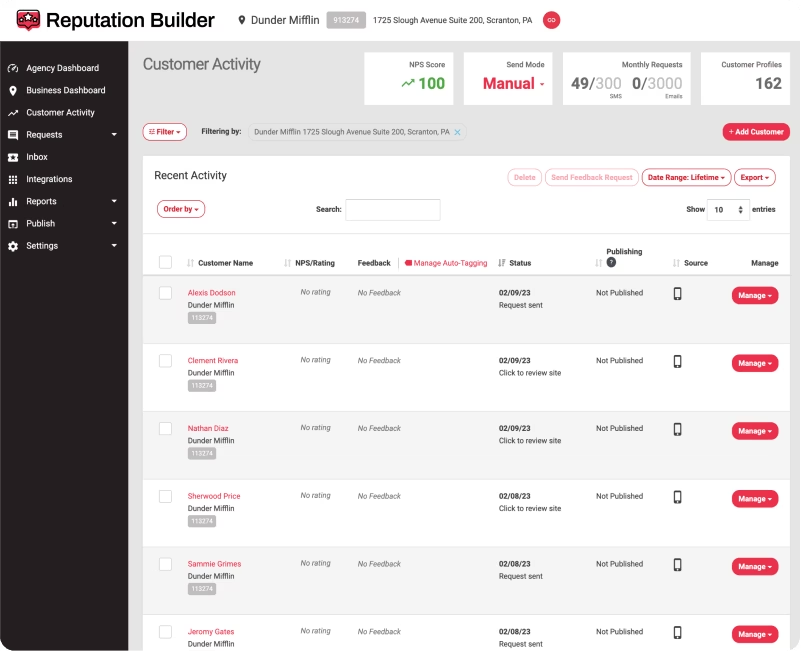
Whitespark stands out as a Yext alternative because it offers human-built citations rather than automated directory feeds. Yext pushes data through API-based sync and charges recurring subscription fees. Whitespark builds and cleans listings manually, provides login ownership, and charges one-time fees. This makes Whitespark a better choice for businesses that want permanent citation ownership without ongoing renewal costs.
Whitespark pricing varies by tool. Local Citation Finder costs $33–$149/mo. Local Rank Tracker costs $14–$200/mo. Google Business Profile management costs $1/mo per location. Review management costs $79/mo per location. Citation building services use one-time payments, generally between $4–$5 per citation, depending on volume. Multi-location discounts lower the cost for agencies.
The main pros included in the Whitespark review are strong citation discovery, accurate local rank tracking, clean reporting, and fully manual directory work that avoids data lock-in. Whitespark delivers stronger NAP cleanup accuracy than automated systems and gives customers full access to credentials.
Cons of Whitespark include a narrow scope, dated UI, no technical SEO features, no backlink tools, and slower delivery times due to manual processes. Agencies that need general SEO features require additional tools.
40. Rio SEO: Best Yext Alternative for Enterprise Local SEO
Rio SEO is an enterprise-grade Local SEO and Local Experience (LX) platform designed for brands that manage hundreds or thousands of locations. Rio SEO is a Forsta company.
Rio SEO centralizes local listings, store pages, reviews, ratings, and Voice of Customer (VoC) feedback into one system that enables large organizations to control visibility, compliance, and customer experience across every location.
Rio SEO focuses on delivering Local Experience Management, which combines search visibility with qualitative and quantitative experience insights.

Rio SEO includes features such as enterprise local listing management, automated distribution to Google, Apple, Bing, Yelp, Facebook, and other directories, dynamic local landing pages, online review and reputation management, survey and feedback workflows, store locators, business photo optimization, and local SEO reporting.
The LX platform offers integrations with mapping platforms, voice assistants, online ordering systems, and ordering marketplaces, making it suitable for multi-location retail, banking, hospitality, and service brands.
Rio SEO is a strong alternative to Yext because it goes beyond listing distribution by pairing local SEO with review analytics, location-level reporting, and customer experience intelligence. Compared to Yext, Rio SEO is better suited for brands that prioritize enterprise local SEO performance rather than broad structured data publishing.
Yext excels in automated data distribution, schema control, and large directory coverage. Rio SEO excels in enterprise local ranking improvements, local page optimization, review operations, location reporting, and VOC insights.
Rio SEO does not specialize in backlinks, on-page audits, or keyword research, but instead focuses entirely on large-scale location optimization.
Rio SEO pricing is not publicly listed, but industry estimates place it in the upper-enterprise range, often comparable to or slightly more expensive than Yext for large deployments. Enterprise buyers typically see pricing in the $8,000 to $40,000 per year range depending on the number of locations, integrations, and modules selected.
Unlike Yext, Rio SEO does not offer low-tier or small business packages, which makes it a premium, fully custom-priced solution.
According to the Rio SEO review, the tool offers advantages such as a unified LX platform, advanced location analytics, robust local landing page technology, strong review and ratings management, and an extensive integration network across major search and mapping platforms.
The limitations of Rio SEO include higher pricing, no small-business entry tier, a heavier enterprise onboarding process, and a focus on local experience rather than traditional SEO tools like backlink analysis or keyword research.
For organizations that manage large location footprints and prioritize enterprise-level local search performance, Rio SEO stands out as a top Yext alternative.
41. Forsta: Best Yext Alternative for Customer Experience Research
Forsta is a Human Experience (HX) and customer research platform that unifies market research, customer experience (CX), employee experience (EX), and data visualization into one integrated system.
Forsta enables enterprises to collect, analyze, and operationalize experience data from any audience, across any touchpoint, and in any format. Its focus on Human Experience positions Forsta as a deep analytical and insight-driven solution for organizations that rely on advanced research, surveying, and experience intelligence.
Forsta includes features such as customizable survey tools, sample management, panel management, qualitative and quantitative research workflows, advanced analytics, dashboards, visualization tools, passive listening, unstructured data ingestion, local landing pages, and Voice of the Customer (VoC) program support.
The HX Platform connects with major data sources, CRMs, and experience platforms, creating a unified view of customer, employee, and brand insights across global organizations. Retail HX and enterprise-level integrations make the platform effective for businesses that need multi-source research and real-time experience monitoring.
Forsta is a strong alternative to Yext because it provides deeper experience research, insight analysis, and VoC capabilities rather than focusing on listing management.
Compared to Yext, which specializes in listing distribution, directory publishing, and location data accuracy, Forsta excels in customer experience measurement, survey science, research management, and unstructured data analytics.

Forsta is better suited for brands that prioritize advanced consumer research, experience modeling, feedback interpretation, and insight operations rather than rank tracking, competitive analysis, backlink data, or local listing accuracy.
Forsta does not function as a traditional SEO suite. It strengthens customer journey intelligence, sentiment modeling, and decision-support analytics.
Forsta uses custom enterprise pricing. While pricing is not publicly disclosed, industry benchmarks place Forsta in the premium research platform category, often in the $20,000 to $200,000 per year range, depending on the scope, the number of modules, and global deployment needs.
This makes Forsta generally more expensive than Yext by $10,000–$150,000+ per year, depending on the number of users, integrations, and research volume. The platform is built for enterprise research teams rather than small-business local SEO users.
The Forsta review mentions pros such as advanced research capabilities, flexible survey tooling, strong data visualization, enterprise VoC workflows, and a unified HX approach that consolidates customer, employee, patient, and consumer insights. These strengths make it highly valuable for brands that rely on deep feedback analysis and structured research operations.
The cons of Forsta include higher cost, a steeper learning curve, and a focus on research rather than local search visibility or SEO metrics.
Forsta stands out as the top Yext alternative for customer experience research.
42. Brandwatch: Best Yext Alternative for Social Listening & Analytics
Brandwatch is a social intelligence platform best for enterprises requiring comprehensive social listening, audience analysis, and brand monitoring across digital channels. Brandwatch collects and analyzes social media conversations, news, blogs, forums, and review sites on a massive scale.
Brandwatch features include social listening, sentiment analysis, influencer identification, audience insights, image recognition, and competitive intelligence. The platform monitors billions of conversations to identify trends, measure sentiment, and understand audiences.
Social listening tracks mentions across platforms. Sentiment analysis classifies conversation tone. Influencer identification finds key voices. Audience insights reveal demographics and interests. Competitive intelligence benchmarks against competitors.
Compared to Yext, Brandwatch serves entirely different needs, focused on social intelligence and brand monitoring rather than business listings distribution. Yext manages directory presence and Knowledge Graph, while Brandwatch analyzes online conversations and social dynamics.
Brandwatch is relevant as a Yext alternative for enterprises that are evaluating both brand monitoring and directory visibility as separate tools supporting different aspects of digital presence strategy.
Brandwatch pricing requires custom enterprise quotes based on mention volume, features, and user count. Enterprise contracts typically start at tens of thousands of dollars annually for comprehensive social intelligence capabilities.
Compared to Yext pricing for directory management, Brandwatch represents a significant investment in social intelligence rather than listings optimization.
Strengths highlighted in the Brandwatch review include comprehensive data coverage, powerful analytical capabilities, sophisticated audience insights, useful competitive intelligence, and robust enterprise features supporting large organizations.
Disadvantages of Brandwatch involve premium pricing limiting accessibility to large enterprises, complexity requiring dedicated analytical resources, a learning curve for advanced features, and a focus on social intelligence rather than local marketing or directory distribution.
Why do People Seek Alternatives to Yext Tool?
People seek alternatives to the Yext tool because the platform focuses heavily on directory listings, local citations, and location data accuracy, yet does not provide the full depth of SEO, analytics, or reputation tools that modern brands expect.
Users often report that the recurring subscription model in Yext feels restrictive. Once you stop paying, listings revert or lose enhancements, which creates long-term dependency without long-term value.
Yext reviews highlight limitations around SEO insights, backlink data, rank tracking, keyword research, review sentiment depth, and competitive analytics. Others point to usability concerns, high pricing, limited configurability for multi-location brands, and a lack of advanced content optimization tools.
For companies seeking more transparency, deeper SEO features, stronger analytics, or more cost-efficient local marketing workflows, exploring Yext alternatives becomes a natural next step.
What to Look for in a Yext Alternative?
A strong Yext SEO tool alternative offers integrated keyword research, rank tracking, competitor analysis, backlink evaluation, site audits, structured data optimization, and content performance insights, alongside traditional local SEO essentials like citation accuracy and review management.
Look for Yext competitors that maintain ownership of your listings without locking you into perpetual subscriptions, support automated optimization, and offer more transparent reporting. Scalability, pricing flexibility, and access to broader SEO capabilities are important, especially for brands wanting a single system that strengthens both local visibility and overall search performance.
What is the Difference Between Yext vs Semrush?
The difference between Yext vs Semrush lies in focus and feature depth. Yext centers on business listings distribution, Knowledge Graph management, and voice search optimization across 150+ directories. Semrush concentrates on comprehensive SEO tools, including keyword research, competitive analysis, technical audits, backlink tracking, and content optimization with local capabilities as an add-on module.
In the Yext vs Semrush comparison, Yext suits enterprises managing multi-location directory distribution and voice assistant visibility, while Semrush supports full-spectrum SEO campaigns combining local optimization with broader organic search strategies, competitive intelligence, and content marketing capabilities.
Why is Search Atlas the Best Yext Alternative?
Search Atlas is the best Yext alternative because it integrates local SEO, content creation, technical audits, and backlink intelligence inside one AI-driven platform without annual contracts or per-location pricing complexity. Search Atlas provides real-time optimization across listings, citations, content, and rankings through unified automation unavailable in directory-focused platforms.
Search Atlas unifies reputation management, local ranking analytics, automated SEO, and AI-powered content through tools like OTTO SEO, Content Genius, and GBP Galactic. It runs technical audits, monitors brand visibility, creates optimized content, builds permanent citations, and automates GBP management from one dashboard without recurring citation fees.
Unlike Yext, Search Atlas provides transparent monthly pricing starting at $99 with feature parity across tiers. Every plan includes content optimization, keyword tracking, local heatmaps, and citation building through 5 major aggregators with 12-month permanence. OTTO SEO automates listing distribution, review responses, GBP posts, and technical optimizations without manual workflows.
Search Atlas eliminates tool fragmentation and annual lock-in while offering automation for agencies, franchises, and enterprise teams at predictable monthly costs with flexible cancellation.
Migrate to Search Atlas from Yext today and experience a complete AI-powered SEO and local visibility system built for scalability.