Google's June 2026 spam update started rolling out on June 24 and is still in progress. It applies globally, across every language, and Google expects it to take a few days to finish. This is the second spam update of the year, after March.
The headline change isn't in the announcement, which named no new policies. It's in what SpamBrain now enforces. In May 2026, Google folded efforts to manipulate AI answers into its spam policies, including buying or altering the citations that feed AI Overviews and AI Mode. This rollout is the first spam update to carry that language into live enforcement.
Key points
- The update began on June 24, 2026, runs globally across all languages, and takes a few days to complete.
- It improves SpamBrain, Google's spam-detection system. No new policies launched alongside it.
- Gaming AI Overviews or AI Mode citations now sits under the same spam policies as link schemes and cloaked content, a clarification Google added in May 2026.
- Recovery is slow by design. Google says corrected sites improve "over a period of months" as its systems re-verify.
What actually changed
SpamBrain got better at spotting spam. Google improves the system periodically and ships those gains as a spam update, so there is no checklist of new rules to read this time. The behaviors that put a site at risk are the ones already written in the spam policies.
What's new is the reach. Tactics built to influence AI-generated answers now count, specifically buying or altering citations to get a brand named in AI Overviews or AI Mode. Until May, the AI surfaces felt to many operators like an unpoliced frontier. They aren't anymore. A paid placement engineered to win an AI citation carries the same penalty exposure as a paid link engineered to win a ranking.
What agencies should do this week
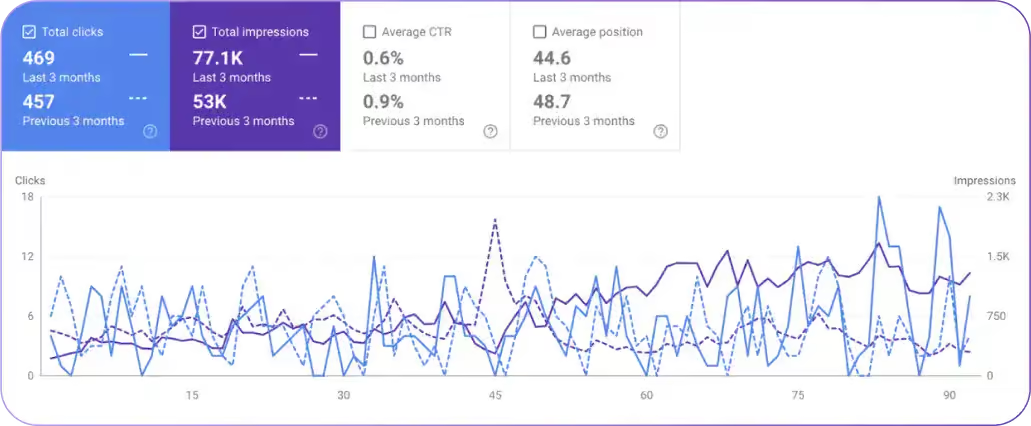
Watch Search Console, but read it carefully. A traffic drop during an active rollout is a signal to diagnose, not a verdict on content quality. Find which page types, queries, and directories moved, then look for a pattern before drawing a conclusion. Borderline-quality pages and thin programmatic directories are where movement shows up first.
Audit any tactic aimed at AI answers. If a client has been paying for citations, sponsoring placements written to seed AI Overviews, or running services that promise AI Mode mentions, treat that as live penalty risk and stop it. The same scrutiny you apply to a backlink profile now applies to how a brand earns its AI citations.
Don't rush a recovery story. Google ties re-verification to a months-long window, so a site cleaned up today won't bounce back tomorrow. Document the fixes, set client expectations against that timeline, and resist the urge to read daily Search Console noise as cause and effect while the update settles.
Where this leaves AI visibility work
Earning AI citations the durable way matters more after this update, because the shortcut is now a liability. Brands get named in AI answers by being genuinely citable: clear, accurate, well-structured pages that answer the question a model is summarizing. Paying to jump the line is the behavior Google just put in scope.
This is also why watching your AI-answer presence is no longer optional. You need to know which queries cite your brand, which cite a competitor, and when a citation you held disappears, so you can respond to a real loss instead of guessing.
Search Atlas runs that watch and acts on it. It tracks where a brand shows up across AI Overviews, AI Mode, and the major assistants, and through its self-healing loop it notices a lost citation or a ranking that slipped and proposes the fix on its own. The Search Atlas Coworker surfaces the change in Slack before you go looking for it, with a drafted response waiting for your approval. That turns AI visibility from a dashboard you remember to check into work that gets done while you sleep.
Bottom line
The June 2026 spam update is an enforcement step more than a policy one. SpamBrain got sharper, and the AI surfaces are now inside its remit. Audit how your clients earn AI citations, diagnose any Search Console movement before reacting, and plan recovery in months, not days.