The evaluation of Moz Local alternatives reveals a diverse ecosystem of 30+ tools and services, with Search Atlas emerging as the leading alternative due to its integrated local SEO automation, broader feature set, and more advanced data infrastructure. While Moz Local focuses primarily on citation distribution and business listing management, modern alternatives combine listing management with rank tracking, competitor analysis, AI-driven optimization, and full SEO campaign capabilities. Search Atlas stands out by integrating local SEO tools with a complete SEO platform that includes technical audits, backlink analysis powered by a live database of 100 trillion links, keyword research, and AI-powered automation, with plans starting at $99 per month.
Several other platforms address specific limitations that users report with Moz Local. These limitations include the loss of dashboard functionality following the 2016 GetListed transition, limited directory coverage for markets such as Canada, and a perceived high cost of $129 per year for basic listing management. Tools such as BrightLocal offer more customization options and broader international directory coverage across regions such as Australia and New Zealand, with pricing starting at $29 per month. Yext targets enterprise and multi-location businesses with a publisher network of more than 200 directories and direct API integrations that update listings almost instantly, compared to Moz Local’s slower update cycles that often rely on aggregator distribution.
Additional alternatives expand local SEO capabilities through specialized approaches. Semrush Local provides listing management through its integration with Yext, while GMBapi offers lower-cost listing management for businesses managing anywhere from one to 10,000 locations. WhiteSpark emphasizes manual citation cleanup services that accelerate listing corrections and improve citation accuracy. Merchynt’s Paige platform focuses on automated Google Business Profile optimization, using AI to manage updates and content for local listings. These alternatives demonstrate how the local SEO landscape has evolved beyond simple citation distribution toward platforms that combine automation, analytics, and full digital marketing functionality.
What are the Moz Local Alternatives?
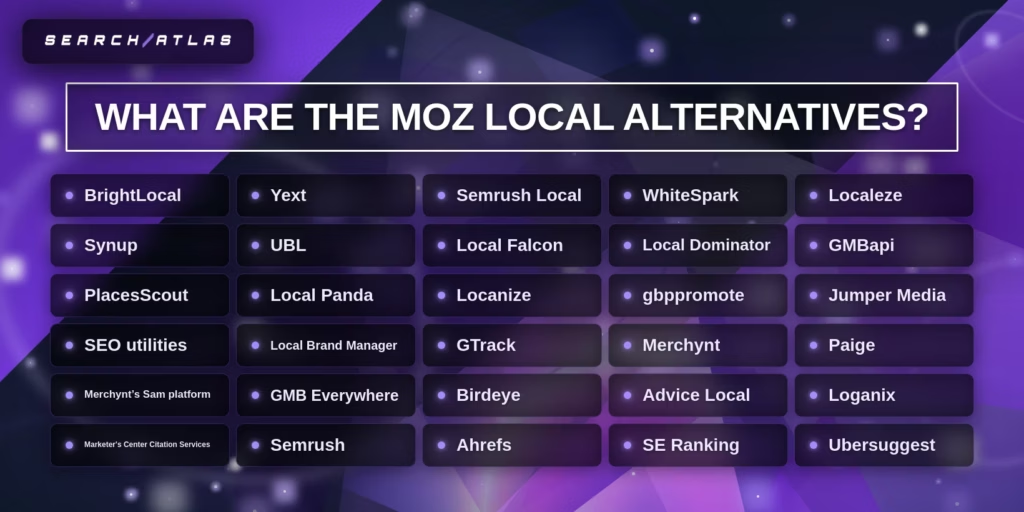
Moz Local alternatives are below.
- Search Atlas (All-in-one SEO Platfrom and Local SEO Tool)
- BrightLocal (Local SEO Tool)
- Yext (Local SEO Tool)
- Semrush Local (Local SEO Tool)
- WhiteSpark (Local SEO Tool)
- Localeze (Local SEO Tool)
- Synup (Local SEO Tool)
- UBL (Local SEO Tool)
- Local Falcon (Local SEO Tool)
- Local Dominator (Local SEO Tool)
- GMBapi (Local SEO Tool)
- PlacesScout (Local SEO Tool)
- Local Panda (Local SEO Tool)
- Locanize (Local SEO Tool)
- gbppromote (Local SEO Tool)
- Jumper Media (Local SEO Tool)
- Local Brand Manager (Local SEO Tool)
- GTrack (Local SEO Tool)
- Merchynt (Local SEO Tool)
- Paige (Local SEO Tool)
- Merchynt’s Sam platform (Local SEO Tool)
- GMB Everywhere (Local SEO Tool)
- Birdeye (Local SEO Tool)
- Advice Local (Local SEO Service)
- Loganix (Local SEO Service)
- Marketer’s Center Citation Services (Local SEO Service)
- Semrush (General SEO Tool)
- Ahrefs (General SEO Tool)
- SE Ranking (General SEO Tool)
- Ubersuggest (General SEO Tool)
1. Search Atlas
Search Atlas is the leading alternative to Moz Local. Search Atlas combines local SEO with a full SEO platform, provides advanced local rank tracking and competitor analysis, integrates AI automation for local optimization, delivers deeper backlink and keyword data, connects local SEO performance with technical and content optimization, and supports agencies and multi-location businesses with scalable workflows.
How does Search Atlas expand beyond Moz Local’s listing management? Search Atlas functions as a complete SEO platform with a dedicated listing management tool. The platform integrates local SEO features with keyword research, backlink analysis, technical site auditing, and AI-powered content optimization. This structure allows marketers to connect local listing performance with broader SEO signals such as domain authority, keyword visibility, and technical website health. Moz Local primarily focuses on citation distribution and listing accuracy, while Search Atlas supports full local search optimization across rankings, authority signals, and website performance.
Why are Search Atlas local rank tracking capabilities more advanced? Search Atlas includes granular rank tracking for local keywords across locations and devices. The platform monitors keyword rankings in local SERPs, including map pack positions and localized search queries. This allows businesses to track how individual locations perform in search results and identify ranking gaps compared to local competitors. Moz Local focuses mainly on listing health and visibility rather than detailed keyword ranking performance.
What makes Search Atlas local SEO automation unique? Search Atlas integrates AI-driven automation that analyzes local SEO signals, recommends, and executes optimization actions. The platform evaluates local keyword opportunities, backlink authority, and on-page signals that influence local rankings. These insights translate into actionable recommendations that help businesses improve local visibility without relying solely on citation distribution. Moz Local primarily distributes business data across directories and does not provide the same level of automated SEO analysis.
How does Search Atlas provide deeper data for local SEO analysis? Search Atlas combines local SEO insights with a broader data infrastructure that includes backlink intelligence, keyword databases, and technical audit diagnostics. The platform analyzes authority signals using a live database of over 100 trillion backlinks, which helps businesses evaluate how link authority influences local rankings. Moz Local focuses on citation consistency and directory listings but does not provide backlink or technical SEO insights.
Why is Search Atlas better suited for agencies and multi-location businesses? Search Atlas supports agencies and businesses that manage multiple locations by integrating reporting, rank tracking, and optimization tools in one platform. Agencies can monitor location-level rankings, analyze competitors, and generate reports that combine local SEO performance with broader organic search metrics. Moz Local works well for simple listing management, but agencies often require deeper analytics and campaign-level optimization capabilities.
How does Search Atlas’ platform approach differ from Moz Local’s automation model? The Search Atlas review shows focus on strategic optimization rather than only automated listing distribution. The platform analyzes search performance, competitor rankings, content signals, and backlink authority to guide local SEO strategies. Moz Local prioritizes automated directory distribution and citation management, which simplifies listing updates but limits broader SEO insights. Businesses seeking a platform that connects local SEO with overall search strategy often choose Search Atlas as a more comprehensive alternative.
2. BrightLocal
BrightLocal is an alternative to Moz Local because BrightLocal offers a higher level of customization and hands-on control over local SEO strategy, provides comprehensive local rank tracking across Google, Bing, and local directories, features a more in-depth review management system with AI-powered responses, supports more countries including Australia and New Zealand, offers flexible pricing plans starting at $29/month, and is better suited for agencies managing multiple clients.
How does BrightLocal’s customization and control differentiate it? BrightLocal provides manual claiming and updating of citations, which ensures accuracy and consistency across multiple online directories. While Moz Local offers automated syncing, this automation can sometimes lead to errors requiring manual intervention. BrightLocal is considered the winner for businesses prioritizing accuracy and control in their business listings management.
Why is BrightLocal’s rank tracking more comprehensive? BrightLocal offers detailed local rank tracking for Google, Bing, and various local directories. This includes insights into keyword rankings across multiple locations and devices. In contrast, Moz Local’s rank tracking primarily focuses on business listing health and visibility rather than granular keyword performance, making BrightLocal the winner for detailed rank tracking.
What makes BrightLocal’s review management superior? BrightLocal’s Reputation Manager provides a centralized dashboard for monitoring, responding to, and analyzing reviews across multiple platforms. It offers greater depth of reporting and response features, including advanced sentiment analysis and AI-powered responses. Moz Local offers review monitoring but lacks this same depth, positioning BrightLocal as the winner for its ability to track and manage reviews from a single dashboard.
How does geographic coverage impact the choice? BrightLocal supports more countries, including Australia (AU) and New Zealand (NZ). Moz Local is not available in the UK, and users from New Zealand are “compelled to use BrightLocal” because Moz Local is “useless” to them. This broader international support makes BrightLocal a viable option for businesses operating in these regions.
Why is BrightLocal considered more cost-effective? BrightLocal offers flexible pricing with plans like Track ($29/month), Manage ($36/month), and Grow ($44/month), alongside a pay-as-you-go Citation Builder starting at $2 per site. While Moz Local has lower starting costs at $16/month, BrightLocal is considered more cost-effective for businesses of all sizes due to its flexible pricing and pay-as-you-go services, offering more features per dollar for active local SEO management.
How does BrightLocal’s target audience differ? The BrightLocal review mentions positioning as a comprehensive local SEO platform for agencies and businesses that want to enhance their digital marketing and local search presence while maintaining control over their SEO strategy. Moz Local, with its focus on automation and integration, is better suited for small businesses and freelancers desiring an easy-to-use, hands-off approach to local SEO.
3. Yext
Yext is an alternative to Moz Local because Yext offers a more comprehensive feature set with automated AI responses and social media management, provides superior listing control with direct agreements ensuring almost-instant updates, is highly scalable for enterprises managing 200+ locations globally, takes more responsibility for update efficacy, delivers excellent SEO and listing analytics tailored for enterprise needs, and boasts a wider publisher network of over 200 directories including exclusive deals.
How does Yext’s comprehensive feature set differentiate it? Yext provides a more extensive suite of review management features, including automated AI review responses and AI-powered automated SMS and email campaigns, which Moz Local does not offer. Yext also includes social media management capabilities, allowing users to leverage AI to generate, schedule, and publish content, as well as monitor and respond to customer feedback. Moz Local lacks these social media management features. Yext’s “all-in-one reputation management system” tracks over 80 platforms, while Moz Local provides basic monitoring on major platforms.
Why is Yext’s listing control superior? Yext has direct agreements with listing aggregators, which directly pushes its data over the top of everyone else’s, implying more reliable acceptance and implementation of updates. This ensures updates, especially substantial changes like business addresses, are pushed effectively. For example, Moz Local “failed to update our business address” when a company moved offices. Yext’s direct API allows for almost-instant updates and changes to listings, whereas Moz Local continuously re-submits listings and takes 2-3 months for new listings to appear via data aggregators. Yext also “locks the listing so it isn’t overwritten during publisher data compilations.”
What makes Yext highly scalable for enterprises? Yext is designed for larger enterprises and non-profits that need to manage their online presence across different channels, particularly for clients with 200+ locations. Its dashboard accommodates over 100 listings in one place, making it incredibly useful for updating opening hours or closures across many locations. Yext supports operations in 50+ countries, while Moz Local is limited to the United States, Canada, and the UK. Automated solutions like Yext scale to dozens, hundreds, or thousands of locations.
How does Yext take more responsibility for updates? Yext “take[s] more responsibility and really try to make sure that their updates ‘actually’ end up live in aggregator databases.” If a solution didn’t work, clients would have “recourse to push them to get things sorted out.” This contrasts with Moz Local, where agreements with aggregators are not legally binding, and they are not required to accept Moz’s updates.
Why are Yext’s analytics capabilities better for enterprise needs? Yext offers excellent SEO and listing analytics capabilities tailored for enterprise needs, providing “straight-forward and clear reports” on business performance. This is crucial for showing quick results and reports to clients. In contrast, Moz Local “doesn’t provide any location-level analytics” and only offers “basic listing and review analytics.”
What is the advantage of Yext’s wider publisher network? Yext boasts a wider publisher network of over 200 directories, search engines, and more, including voice search and AI integrations. Moz Local supports 90+ directories in the US, UK, and Canada. Yext also has exclusive deals with nearly half of the sources a company was previously listed under, covering the most important local directories. Some Yext-partnered directories are proprietary or locked, requiring Yext’s service for submission.
4. Semrush Local
Semrush Local is an alternative to Moz Local because Semrush offers a more comprehensive suite of marketing tools beyond local SEO, it is built for larger workflows and agencies managing multiple clients, it provides a significantly larger keyword database and more complete backlink index, it demonstrates content performance across AI platforms like ChatGPT (a critical SEO building block for 2025 and beyond), and user feedback consistently rates Moz Local as “pretty awful” and “not worth it at all” due to its limited features and slow updates.
How does Semrush’s comprehensive suite of tools position it as an alternative? Semrush is an all-in-one marketing tool that expanded into a full marketing platform, including content marketing, social media, and advertising, in addition to SEO. It excels in competitor analysis, site audits, and content tools. This broad capability contrasts with Moz Local’s limited feature set compared to newer platforms, making Semrush a more robust option for businesses seeking integrated marketing solutions.
Why is Semrush better suited for larger workflows and agencies? Semrush is built for bigger workflows, agencies, marketers, and full-time SEO operators capable of managing multiple brands or clients. Its plans start at approximately $130 per month, reflecting its advanced capabilities. In contrast, Moz Local incurs higher per-location costs as businesses scale and lacks bulk editing or real-time syncing, making it less efficient for managing numerous locations or clients.
What makes Semrush’s data superiority a key differentiator? Semrush offers a huge database of keywords and a more complete backlink index compared to Moz. User feedback indicates Moz has “less data than SEMrush or Ahrefs,” with one user reporting Moz showing no ranking keywords for a site while Semrush showed several for the same site. This data richness provides more thorough insights for local and broader SEO strategies.
How does Semrush’s AI platform performance tracking enhance its value? Semrush is highlighted as the only keyword research tool currently on the market that demonstrates content performance across AI platforms like ChatGPT and traditional search. This feature is an important SEO building block for 2025 and beyond, offering forward-looking insights that Moz Local does not provide.
Why does user feedback strongly favor Semrush over Moz Local? User feedback describes Moz Local as “pretty awful,” “slow for sure,” and “takes a while to update all of their listings.” Many users have “not heard of anyone actually using it,” and its software was considered weak as far back as 2014. Moz is generally “not recommended” and considered “terrible” and a “bad value,” pricing itself similarly to Semrush while offering “far less capability and data.” This strong negative sentiment, updated as recently as October 28, 2025, positions Semrush as a superior alternative.
5. WhiteSpark
Whitespark is an alternative to Moz Local because Whitespark offers a more thorough manual methodology for 94% of citation clean-up, provides greater user control over listing management, has a more flexible cost structure with a one-time fee of $750, covers 100% of important secondary citation sources, and receives higher user satisfaction with 3.2x faster updates compared to Moz Local.
How does Whitespark’s manual methodology provide a competitive edge? Whitespark employs a manual process for citation audits and clean-up, which leads to more exact and higher-quality listings. Citations are built by hand, ensuring a thorough approach to finding and fixing duplicates and incorrect information. This contrasts with Moz Local’s uni-linear, automation-based system, which often requires additional manual work from the user to find duplicates, even with add-ons.
Why does Whitespark offer greater user control? Whitespark allows users to specify which sites to claim, and its team performs the manual claiming. This approach hands control back to the user regarding listing management. In contrast, Moz Local automates listings and pushes data to aggregates without direct user control, carrying a risk of errors and not manually claiming listings.
What makes Whitespark’s cost structure more flexible? Whitespark charges a one-time fee of $750 for its services, with an approximate cost of $4 or $5 per citation. This transactional model allows users to pay per tool, avoiding charges for unneeded extras and offering more control over expenses. While Moz Local is cheaper upfront at $84/year, users often find they “get what you pay for” and may incur higher overall costs due to unneeded features in packages.
How does Whitespark’s citation coverage compare? According to the Whitespark review, the tool covers all most important secondary citation sources, such as MerchantCircle, MojoPages, and Kudzu. It also covers all data aggregators (ExpressUpdate, Acxiom, Localeze, Factual) and top-level search platforms (Google, Bing, Yahoo, Apple Maps). Moz Local, while covering data aggregators and some top-level platforms, covers basically none of the secondary citation sources.
Why do users perceive Whitespark as more effective? User feedback indicates that Whitespark’s staff responds with care, offering human support and providing accurate results. While the initial work takes approximately 1 month due to the manual process, user involvement is only about 30 minutes overall. Moz Local, conversely, is described as “slow for sure” and “usually takes a while to update all of their listings,” with users often outgrowing its feature set or finding better value elsewhere.
6. Localeze
Localeze is an alternative to Moz Local for three because Localeze functions as a primary data aggregator pushing data to hundreds of sites, it offers a “pseudo claim” process for listing control without payment, and its historical pricing included a free plan or started around $50, contrasting with Moz Local’s $84 yearly fee.
How does Localeze’s role as a data aggregator make it an alternative? Localeze is identified as one of the “main aggregators/managers of local citation listings,” alongside InfoGroup and Factual. It operates as a “Data Aggregate” that “Pushes/sells data to hundreds of sites,” making it a foundational source for local business information. This contrasts with Moz Local, which is described as an “aggregation service” that “Pushes Data to Aggregates & Other Sites,” including Localeze itself.
Why is Localeze’s listing control significant? Localeze allows for a “pseudo claim” process, enabling users to edit listings and correct outdated directory information without paying for an official claim. This offers a degree of control over the business profile, even if it remains “Unclaimed.” Localeze is also “definitely worth correcting” for outdated information and allows management of duplicates by claiming and then choosing “Close Listing.”
What makes Localeze’s pricing an alternative? Historically, Localeze offered a free plan or started around $50, with a paid package at $297 per year. While new free listings were later disallowed, existing ones could still be claimed for free. This contrasts with Moz Local’s pricing, which is “$84 Yearly” or “Starting at $20 per month,” positioning Localeze as a potentially more cost-effective or accessible option for initial listing management.
7. Synup
Synup is an alternative to Moz Local because Synup offers a more cost-effective pricing model at “$30 per location” compared to Moz Local’s “$99 per location.” Synup provides automated ongoing updates via APIs across approximately 69 sites while Moz Local is “slow for sure” with only 10 sites, Synup offers a “more well-rounded” suite of SEO tools including AI-enhanced engagement and custom reporting, Synup provides “stellar customer support” with 24/7 availability as a newer service, and Synup is suitable for smaller segments and industries like computer software, aligning with smaller-scale operations focused on customer engagement.
How does Synup’s pricing model offer a cost-effective alternative? Synup’s “per location price” model is described as “relatively cheap (a couple bucks per site?)” and specifically “$30 per location.” In contrast, Moz Local is priced at “$99 per location annually,” with plans starting around “$14–$33/month per location.” This difference suggests Synup can be significantly cheaper, especially for businesses with multiple locations, potentially saving over 60% annually per location compared to Moz Local’s yearly rate.
Why are Synup’s automation and update capabilities a strong alternative? Synup provides automated ongoing updates due to its use of APIs, allowing updates across approximately 69 sites with minimal manual entry. This contrasts with Moz Local, which is noted as being “slow for sure” and “takes a while to update all of their listings” across its merely 10 sites. Synup also allows editing from its dashboard and offers manual citation claiming, providing direct control over individual citation updates, whereas Moz Local “Pushes Data to Aggregates & Other Sites – Does not manually claim” and offers “No control over data.”
What makes Synup’s features and capabilities a comprehensive alternative? Synup is described as “more well-rounded” and offers a “whole gamut of SEO tools that track business profiles and monitor interactions along with automated marketing and business and SEO insights.” Synup excels in engagement and reputation management with AI-enhanced features, offering content and review management tools, and recently launched an AI Listing Solution to boost visibility on ChatGPT, Google Gemini, and leading AI platforms. Synup also allows users to claim listings and offers instant monitoring of reviews, enabling replies to reviews if the publisher is supported.
How does Synup’s vendor support compare as an alternative? Synup offers phone, email, chat, and 24/7 support, described as “stellar customer support” as a newer service. Moz Local also offers diverse support through chat, phone, email, and continuous 24/7 assistance, described as “well-established” customer support. The availability of comprehensive, round-the-clock support from Synup ensures that users receive timely assistance, which is crucial for businesses managing their online presence.
Why is Synup’s target audience and operational alignment a suitable alternative? Synup is suitable for smaller segments and industries like computer software, and large enterprises in marketing and advertising, computer software, and internet sectors. It suits smaller-scale operations focused on customer engagement and reputation. While Moz Local is popular with large enterprises and marketing firms, Synup’s focus on customer engagement and AI-powered tools makes it a strong alternative for businesses prioritizing direct interaction and advanced insights, especially those with 5+ different websites needing to correct outdated directory information.
8. UBL
UBL is an alternative to Moz Local for four because UBL is positioned as a major player in the local SEO market alongside Yext, it offers bulk upload functionality similar to Moz Local’s spreadsheet-based system, it likely provides international listing support beyond Canada, and it pushes data to aggregates and other sites.
How is UBL positioned as a major player in the local SEO market? UBL is considered a competitor in the “self-service location data management software” market, with Moz Local aiming for a lower cost. UBL is listed in the “Local SEO Vendor Matrix” as a citation tool, alongside Moz Local, Yext, and Bright Local. The author suggests Moz Local needs to “compete with the major players of local SEO,” implying UBL is one of these major players.
Why is UBL’s bulk upload functionality a key alternative? Moz Local allows users to add multiple listings and locations via a spreadsheet with formatting similar to UBL’s upload spreadsheets, suggesting UBL also offers similar bulk upload functionality. While Moz Local requires a CSV file upload that can be “cumbersome” for single listings, UBL permits users to complete a set of fields for individual listings, offering flexibility.
What makes UBL’s international listing support a significant alternative? The text notes that “the vast majority of their competitors already offer international listings far beyond Canada.” This strongly suggests UBL likely offers international listing support, a feature that Moz Local 1.0 lacks, making UBL a more comprehensive option for businesses with global reach.
How does UBL’s data pushing functionality compare? UBL is described as pushing or selling data to other sites. Similarly, Moz Local pushes data to aggregates and other sites, helping to feed data to the right locations. Services like UBL “do have gradual processes” and “aggregate gradually,” implying a sustained approach to data distribution rather than an instant solution.
9. Local Falcon
Local Falcon is an alternative to Moz Local because Local Falcon specializes in ranking data visualization with geogrid visualization (pioneered by Local Falcon), its pricing model is credit-based starting at $24.99/month (beneficial for agencies scaling from 10 to 500+ locations), it offers advanced AI Reviews Analysis to assess sentiment and staff performance, it provides specific Apple Maps Scans for alternative search engines, and it tracks Share of Local Voice (SOLV), which measures the percentage of time a business appears in the top 3 local pack positions.
How does Local Falcon’s specialization in ranking data visualization differentiate it? Local Falcon primarily focuses on ranking data visualization and heatmaps, specifically excelling in geogrid visualization to make “the invisible world of local rankings visually clear and easy to understand.” This contrasts with Moz Local’s primary focus on data synchronization, listing management, and online reputation management. Local Falcon’s Geogrid Map visualizes rankings on a map with customizable grid sizes, simulating 100+ people searching across a service area, providing proximity-based ranking from multiple geographic locations, unlike traditional tools that provide a single data point.
Why is Local Falcon’s credit-based pricing model an advantage? Local Falcon operates on a credit system, with monthly plans starting at $24.99 for 7,500 credits, avoiding “per location” fees. This model is beneficial for agencies scaling from 10 to 500+ locations, offering rollover capabilities. In contrast, Moz Local uses a “per location” fee model, starting at $14/month per location (Lite plan, billed yearly), which can become expensive for agencies with numerous clients and is identified as a “tax on growth.”
What makes Local Falcon’s AI Reviews Analysis a key differentiator? Local Falcon’s AI Reviews Analysis assesses sentiment, identifies strengths and weaknesses, evaluates staff performance, and provides strategic advice based on review content for a business and its top 3 competitors. This feature calculates Review Quality Score (RQS), Review Volume Score (RVS), and Review Strength Score. Moz Local offers Reputation Management to track and respond to reviews, but it lacks the advanced AI-driven sentiment and performance analysis provided by Local Falcon.
How do Apple Maps Scans and Share of Local Voice (SOLV) enhance Local Falcon’s offering? Local Falcon offers specific tracking for Apple Maps results, a feature not explicitly mentioned for Moz Local. Additionally, Local Falcon provides Share of Local Voice (SOLV), which measures the percentage of time a business appears in the top 3 local pack positions and is considered the “money metric.” While Moz Local provides Accurate Ranking Data and a GeoRank Tracker, it does not offer the granular, visual, and specialized metrics like SOLV or Apple Maps tracking that Local Falcon provides.
Why is Local Falcon recommended for specific analytical needs? Local Falcon is suited for analysts needing raw ranking data and visual insights, and businesses prioritizing real-time, visual insights into geographical ranking performance and Map Pack visibility. It is consistently recommended for “grid tracking” by users like Better-Height6979 and Outrageous-Bet7650. Moz Local, conversely, is suited for small businesses looking for a way to sync their hours and address across common platforms and is recommended for auditing business listings to ensure Name, Address, and Phone Number (NAP) consistency.
10. Local Dominator
Local Dominator is an alternative to Moz Local for six because Local Dominator offers comprehensive local SEO functionality beyond basic listing management, provides advanced AI-powered tracking and optimization capabilities, features a more accurate and granular rank tracking system, includes integrated Google Business Profile (GBP) management and SEO auditing tools, utilizes a cost-effective credit pool pricing model, and is engineered for future search trends like “Search Everywhere” by 2026.
How does comprehensive functionality differentiate Local Dominator? Local Dominator is an all-encompassing platform for local SEO, designed for agencies, local enterprises, and multi-location brands. It focuses on precise local rank tracking with geo-grid maps, competitor comparisons, in-depth performance analytics, and Citation Finder. Moz Local primarily focuses on managing local business listings and online reputation across Google, Facebook, and other sites, automating listing management and data synchronization.
Why are AI-powered capabilities significant? Local Dominator includes AI Tracking that monitors “Share of Voice” in AI models like ChatGPT, Gemini, and Google AI Overviews. It also detects AI Hallucinations and provides immediate alerts to fix data sources. Moz Local does not mention any AI tracking capabilities, focusing instead on data synchronization and duplicate checks. Local Dominator also offers “Intelligent SEO Recommendations Powered by AI.”
What makes Local Dominator’s rank tracking more accurate? Local Dominator provides “Precise Local Rank Tracking with GeoGrid Maps” and “High-Fidelity GeoGrids” that visualize ranking decay block-by-block. It is considered the most accurate for local rank tracking due to hyper-accurate, street-level tracking with precise geocoordinates, reflecting a true customer’s perspective. Moz Local has limited geo-grid visualization and is more focused on listings than ranking.
How do integrated management and auditing tools enhance Local Dominator? Local Dominator offers automated GBP management, allowing users to manage multiple GBP listings, create/schedule posts, upload media, and answer Q&As from a single dashboard. It also includes a “Scan Analyzer” for comprehensive evaluations of both Google Business Profile and websites, and a “Citations Builder” that scans the web for old/incorrect data. Moz Local’s features are primarily for data syncing and auditing, not direct action on AI-driven issues or real-time ranking drops.
Why is Local Dominator’s pricing model more advantageous for agencies? Local Dominator uses a credit pool model, not per-location charges, with “Rollover Credit” making it a profitable choice for agencies scaling from 10 to 500+ locations. Pricing tiers range from $39/month to $399/month. Moz Local charges “per location,” with plans starting at $14/month per location, which can become expensive for agencies with numerous clients and is described as a “tax on growth.”
How is Local Dominator engineered for future search trends? Local Dominator is engineered for 2026 “Search Everywhere,” integrating AI Tracking, SERP Tracking, and Citations Management into a single command center. This approach aims to control the brand narrative across Google Maps, Organic Search, and Generative AI simultaneously. Moz Local’s primary function is data synchronization, which does not explicitly address future AI-driven search environments.
11. GMBapi
GMBapi is an alternative to Moz Local because GMBapi offers a Google-centric approach using GBP as the “source of truth” unlike other platforms, provides full GBP control and automation for multi-location brands managing 50–1000+ listings, includes all-inclusive functionality such as AI review replies in any language and unlimited users, demonstrates superior scalability managing 1 to 10,000 locations with customizable AI recommendations, offers more competitive pricing starting at €4/location/month compared to Moz Local’s $14.00, and provides a free 3-week trial with no credit card required, which Moz Local does not offer.
How does GMBapi’s Google-centric approach differentiate it? GMBapi specializes in Google Business Profile (GBP) management, uniquely using GBP as the “source of truth” for all networks. This contrasts with other platforms, including Moz Local, which typically host the source of truth on their own servers. This approach ensures real-time Google Business Profile integration and extensive coverage across local directories for improved visibility.
Why is full GBP control and automation significant for multi-location brands? GMBapi is built for bulk GBP management and automations that streamline the optimization process, making it ideal for agencies and multi-location brands managing dozens or hundreds of locations. This includes features like bulk editing, AI-powered category suggestions, bulk service uploads, and A/B testing capabilities, which address Moz Local’s reported limitations in bulk editing and minimal GBP support.
What makes GMBapi’s all-inclusive functionality a strong alternative? GMBapi provides unlimited access to features such as content posting, competitor tracking, AI review replies in any language, and unlimited users. This comprehensive suite of tools, including sentiment analysis and location-specific reporting for reviews, directly addresses user feedback regarding Moz Local’s limited feature set and review monitoring capabilities.
How does GMBapi offer superior scalability? GMBapi easily manages 1 to 10,000 locations with a user-friendly dashboard and customizable AI recommendations. It has been recognized as ‘Best Value Local SEO Software’ by Gartner and G2, securing ‘Best! Estimated ROI’ in ‘Local SEO’ for four consecutive quarters by G2.com. This contrasts with Moz Local, which, while described as “great for scalability” by some users, has also been criticized for slow updates and limited features as businesses scale.
Why is GMBapi’s pricing more competitive? GMBapi’s pricing starts at €4/location/month, with volume-based pricing and partner discounts available, and custom pricing for 500+ locations. This is significantly lower than Moz Local, which starts from $14.00, billed yearly. This cost efficiency directly addresses the concern of higher per-location costs as businesses scale with Moz Local.
What is the benefit of GMBapi’s free trial? GMBapi offers a 3-week free trial with full access, no credit card required, and no long-term contracts, allowing users to cancel anytime. Moz Local does not offer a free trial. This trial allows potential users to experience GMBapi’s features, such as real-time Google Business Profile integration and bulk review replies, firsthand, as recommended by users like Welldander (11/16/2025).
12. PlacesScout
Places Scout is an alternative to Moz Local because it offers a powerful suite of SEO tools including comprehensive rank tracking, provides advanced competitive citation analysis, serves as a primary auditing tool for lead generation, integrates with Yext for enhanced listing syndication, and offers unique AI-related features for brand sentiment analysis.
How does Places Scout’s comprehensive rank tracking compare? Places Scout provides powerful and accurate local and organic search rank tracking across major search engines. User Joshua Mackens states, “As far as the rank tracker goes, it blows any other tool I’ve ever used out of the water.” This contrasts with Moz Local’s primary focus on automated listing management and reputation. Places Scout starts at $29/month, offering robust tracking capabilities.
Why is competitive citation analysis a key differentiator? Places Scout specifically highlights its ability to provide a complete picture of competitor citations, enabling users to “easily identify competitors’ citations.” James Watt identifies Places Scout as his “favorite tool for competitive research.” While Moz Local focuses on managing a business’s own citations and aggregators, Places Scout offers a distinct advantage in analyzing competitor strategies.
What makes Places Scout a primary auditing tool for lead generation? Places Scout is primarily an auditing tool, often used by lead generation agencies for bulk audits on potential clients and generating PDF audit reports for prospects. This functionality is not a primary focus for Moz Local, which is described as “Great for showing you what the main citation providers have on your business and what needs to be fixed” for existing businesses.
How does Places Scout’s integration with Yext enhance its offering? Yext acquired Places Scout in February 2025 and is developing “Yext Scout,” which will incorporate Places Scout’s benefits with a new UI and include reporting on AI placements. Places Scout has also partnered with Yext to integrate Yext’s listing syndication data directly into its platform, potentially offering a more robust or different approach to listing management compared to Moz Local’s continuous syncing to its partner network.
What unique AI-related features does Places Scout offer? The current UX of Places Scout offers “AI data,” specifically “AI brand sentiment info,” with positive brand sentiment correlating with better visibility in AI, validated by data by location. Yext Scout is expected to feature new AI capabilities and include reporting on AI placements, providing advanced insights beyond Moz Local’s current reporting and analytics, which include Visibility Index and online presence scores.
13. Local Panda
Local Panda is an alternative to Moz Local because Local Panda offers a significantly lower price point at $19/month compared to Moz Local’s $33/month, it integrates advanced generative AI capabilities like “Weekly AI Tasks” and “AI Copilot,” it provides unique features such as social media posting not found in Moz Local, and historical user sentiment indicates Moz Local experienced performance issues as early as 2016.
How does Local Panda’s cost-effectiveness make it an alternative? Local Panda is priced at $19/month, which is 42% less expensive than Moz Local’s $33/month. Local Panda is explicitly labeled “Value for money!” and serves as a “good entry point” solution, particularly for small businesses or those with budget constraints. Moz Local’s pricing becomes significantly more expensive for businesses with multiple physical locations, as its advertised pricing is per location.
Why are Local Panda’s AI capabilities a differentiator? Local Panda leverages generative AI for local SEO, offering “Weekly AI Tasks” and an “AI Copilot” to streamline optimization efforts. These AI-driven features are not listed among Moz Local’s offerings in the provided comparison, positioning Local Panda as a more modern and technologically advanced solution in the evolving local SEO landscape.
What unique features does Local Panda offer? Beyond core local SEO features like Rank Tracker and Google Business Profile management, Local Panda uniquely provides “Publish posts on Social Media,” “AI Tasks,” and “AI Copilot.” These additional functionalities contribute to Local Panda’s overall value proposition, helping businesses “rank higher on Google, attract more customers, and grow your business” through a more comprehensive toolset.
How does historical user sentiment impact Moz Local’s standing? One user explicitly stated they “stopped using MozLocal in 2016 as it stopped working,” indicating past performance issues. This user found alternatives like Yext “fixed all of our citations within minutes,” suggesting a historical reliability concern with Moz Local that prompted users to seek more effective solutions. Local Panda, as one of the “new solutions popping each new day,” represents a more recent and potentially more reliable option.
14. Locanize
Locanize is an alternative to Moz Local because Locanize is positioned as a Local SEO tool with a free trial, and its creator, Ezhan-29-1-32, explicitly states its purpose for Local Tracking in competition with tools like Local Falcon.
How is Locanize positioned as a Local SEO tool? Locanize is introduced as a “Local SEO tool” that offers a free trial, making it accessible for users to evaluate its capabilities. This direct self-identification as a Local SEO tool places it in the same category as Moz Local, which is also described as a “potent local SEO and reputation management tool” designed for boosting online presence and visibility.
Why is Locanize’s focus on Local Tracking significant? Ezhan-29-1-32, Locanize’s creator, specifically highlights its function for “Local Tracking,” stating, “If it’s only Local Tracking, LF [Local Falcon] is good. Nonetheless, if you are open, I have recently launched a Local SEO tool by the name of Locanize.” This indicates Locanize’s core functionality directly addresses a key aspect of local SEO that Moz Local also covers, such as tracking local citations and optimizing local search presence.
15. gbppromote
GBPPromote is an alternative to Moz Local because it offers full Google Business Profile (GBP) automation through ProfilePilot, provides advanced AI-powered review management with a 4.9 out of 5-star user rating, includes comprehensive GBP optimization beyond basic listings, features local rank tracking for up to 10 keywords, automates image and video uploads with geotagging, and offers free AI tools like Category Finder.
How does GBPPromote’s GBP automation differentiate it? GBPPromote’s ProfilePilot is an intelligent automation engine that manages key optimization tasks automatically, including creating and scheduling posts, photos, events, and updates. This goes beyond Moz Local’s listings management, which lacks AI automation for GBP activity. Users highlight ProfilePilot’s efficiency for multi-location management and daily posting automation, leading to improved rankings.
Why is advanced review management a key differentiator? GBPPromote offers AI-powered review workflows, sending requests via SMS, email, and Magic QR codes. It routes low ratings to private feedback and positive ratings to public, drafts AI replies matching brand tone, and includes patented fake review detection and clean-up with a high success rate. Users report doubled monthly review counts via smart QR codes and effective fake review cleanup, contrasting with Moz Local’s basic review monitoring that lacks AI replies or automated requests.
What makes GBPPromote’s comprehensive optimization superior? GBPPromote optimizes descriptions, categories, and Q&A sections based on search behavior, suggests categories based on local competitors, and automatically generates Q&A content. Industry experts recommend GBPPromote for category optimization and content accuracy, leading to steady ranking improvements. Moz Local, conversely, manages and syncs business listings but lacks these advanced optimization features.
How does local rank tracking enhance GBPPromote’s value? GBPPromote includes a Local Rank Tracker for up to 10 keywords, offering competitor comparisons, alerts, grid-based tracking, and scheduled scans. This provides detailed insights into local search visibility that Moz Local lacks, as Moz Local does not offer advanced rank tracking like geo-grids.
Why is image and video automation important? GBPPromote offers image and video upload automation with geotagging and scheduled uploads. This feature is not mentioned as part of Moz Local’s offerings, providing an additional layer of GBP optimization that enhances profile engagement and visibility.
What value do GBPPromote’s free AI tools provide? GBPPromote offers free AI tools such as a Category Finder, Description Generator, Q&A Generator, and Review Response Generator. These tools simplify and enhance GBP management tasks, providing capabilities that Moz Local does not offer.
16. Jumper Media
Jumper Media is an alternative to Moz Local because it employs a distinctive “map optimization” method that does not require Google Business Profile (GBP) or website access, it focuses on simulating real customer behavior through targeted GPS drives, it offers specific guarantees like top-three Google Places ranking within 90 days, and it positions itself as a specialized amplifier rather than a holistic replacement for broader SEO efforts.
How does Jumper Media’s distinctive method differentiate it? Jumper Media explicitly states its method is “not traditional on-page/off-page SEO” and does not require access to a client’s GBP or website, a fundamental requirement for traditional tools like Moz Local. Instead, Jumper Media uses “map optimization” by driving human activity to GBPs, claiming to send signals to Google that boost rankings without direct access. This approach is criticized by AKA-Yash, who suggests it “is basically admitting they’re trying to game signals instead of improving the business’s actual relevance or trust.”
Why is simulating real customer behavior through targeted GPS drives significant? Jumper Media employs a network of third-party partners for targeted GPS drives to businesses based on specific keywords, simulating real customer behavior. These daily drives occur from within a specific radius of a business, aiming to boost search relevance by tying a business to local search traffic and generating signals Google prioritizes, such as GPS navigation to physical locations. ColtBoll, Jumper Media’s CEO, emphasizes “20–30 second GPS drive-bys by real humans” using proprietary mobile technology.
What specific guarantees does Jumper Media offer? Jumper Media guarantees clients a top-three position on Google Places and provides ongoing maintenance. The service also guarantees 2-4 detailed, relevant reviews monthly from “local guides,” locates the GMB listing in the 3-pack, visits the website organically, and creates quality backlinks on major cloud providers weekly. Jumper Media markets itself as a Google partner and promises top-3 placement on Google Maps within 90 days.
How does Jumper Media’s positioning as a specialized amplifier make it an alternative? ColtBoll clarifies that Jumper Media is “just one piece of that stack, not a replacement for a holistic provider.” He states, “It works best as an amplifier on top of proper optimization, reviews, and a solid site,” and that “most of our best results come when agencies plug us in alongside proper gbp optimization, reviews, and solid onsite work.” This suggests Jumper Media complements, rather than directly replaces, comprehensive solutions like Moz Local, which focuses on profile optimization, citation management, and on-site SEO.
17. Local Brand Manager
Local Brand Manager is an alternative to Moz Local because it offers unique features like GeoBooster not found in Moz Local, it provides a more positive user experience compared to Moz Local’s reported limitations, and it is specifically recommended for agencies.
How does GeoBooster differentiate Local Brand Manager? QueenofMaidsPhoenix (9/19/2024) specifically inquired about tools with a feature similar to Local Brand Manager’s GeoBooster, which takes an image, geotags it, and posts it on Google Business Profile (GMB). This indicates a highly valued and potentially unique capability, as dhruvbhatia7 (9/21/2024) stated their current tools lack this functionality and they are “looking into automating content creation with a different approach.” Moz Local’s feature set is often described as limited, falling short in enhancing local search performance and improving visibility compared to newer platforms.
Why does Local Brand Manager offer a more positive user experience? Users like masterkevk (1/14/2024) express satisfaction with Local Brand Manager (aka Local Viking), stating it is “used and liked.” While ZilvinasBartkus (4/30/2024) reported a negative experience with its Looker connector, this is a specific integration issue rather than a general platform deficiency. In contrast, Moz Local has received significant negative feedback, with u/SEOPub calling it “pretty awful” and u/JohnCarcutt noting it is “slow for sure.” One user even stopped using Moz Local in 2016 because “it stopped working,” and others mention it “takes a while to update all of their listings.”
What makes Local Brand Manager a suitable alternative for agencies? Local Brand Manager is explicitly recommended by the user “yashneharkar” specifically “if you are an agency.” This suggests it offers features or pricing structures beneficial for managing multiple client locations. Moz Local, while having attractive pricing for single locations, becomes “expensive for multiple physical locations” and “can get expensive if you are not using them to their full potential,” according to Ezhan-29-1-32. This cost inefficiency for scaling businesses, coupled with Moz Local’s lack of bulk editing or real-time syncing, makes Local Brand Manager a more viable option for agencies.
18. GTrack
GTrack is an alternative to Moz Local because GTrack is recommended for local rank tracking, specifically for tracking both Google Maps and Local Pack results.
How does GTrack’s focus on local rank tracking make it an alternative? GTrack is explicitly recommended for monitoring local search performance, a core function often associated with tools like Moz Local. While the provided information does not directly compare GTrack to Moz Local or explicitly state it as an alternative, GTrack’s specific recommendation for tracking Google Maps and Local Pack results positions it as a tool addressing a key aspect of local SEO that Moz Local also targets. Moz Local, for instance, is considered a “good option” for local SEO but can “get expensive if you are not using them to their full potential.”
19. Merchynt
Merchynt is an alternative to Moz Local for six because Merchynt offers a fully automated AI-powered local SEO management platform compared to Moz Local’s listing management focus, Merchynt provides deep, ongoing Google Business Profile (GBP) optimization that Moz Local lacks, Merchynt delivers automated AI-powered review responses at scale while Moz Local offers basic review management, Merchynt integrates advanced ranking and visibility tools like the Heatmap Audit Tool, Merchynt’s ProfilePro premium plan is significantly more cost-effective at $9.00/month compared to Moz Local’s cheapest tier at $16/month, and Merchynt is designed as a hands-off solution saving users 10+ hours monthly versus Moz Local’s more manual approach.
How does Merchynt’s automation and AI integration differentiate it? Merchynt (Paige) is described as the “only truly fully automated AI SEO solution on the market” and the “world’s first fully automated local SEO platform.” It actively manages GBP with AI-generated posts, AI-powered review responses, and automatic spam fighting. Moz Local, conversely, handles basic listing syndication but does not offer deep, ongoing GBP optimization or AI-driven engagement, making it less comprehensive for active GBP management.
Why is Merchynt’s Google Business Profile (GBP) optimization superior? Merchynt (Paige) provides advanced GBP management, continuously analyzing the GBP, identifying ranking opportunities, and implementing changes to improve local search rankings. This includes AI-powered posts, Q&A management, photo uploads, and service/product updates. Its free AI-powered GBP Audit Tool by Paige runs an in-depth analysis and automatically fixes and optimizes flagged issues. Moz Local only handles the basic aspect of consistent listings and does not offer the deep, ongoing GBP optimization that directly impacts rankings today.
What makes Merchynt’s review management more effective? Merchynt (Paige) offers automated review responses using AI to craft prompt, personalized responses at scale, supports review generation campaigns, and provides sentiment analysis. The ProfilePro Chrome extension can fine-tune individual replies. This contrasts with Moz Local, which includes basic reputation management features and centralized review management (view and respond) without the advanced AI automation. Merchynt helps businesses get more 5-star customer reviews on Google & Yelp, which helps business profiles rank higher and convert more visitors to customers, as 87% of people pick a local business based on their reviews.
How do Merchynt’s ranking and visibility tools provide an advantage? Merchynt (Paige) integrates with the Heatmap Audit Tool, providing a visual representation of local search performance across a geo-grid. Paige then drives continuous, automated optimization based on these insights. While Moz Local offers GeoRank for hyper-local map pack ranking tracking, the provided information does not specify advanced ranking or visibility tracking features beyond basic listing consistency for Moz Local.
Why is Merchynt more cost-effective? ProfilePro by Merchynt offers a free version with limited monthly credits, and a Premium Plan at $9.00/month for unlimited optimizations, posts, and responses. Moz Local’s annual billing starts at $16/month for its Lite plan, $24/month for Preferred, and $33/month for Elite. This makes ProfilePro by Merchynt’s premium plan significantly more cost-effective, being less than half the price of Moz Local’s cheapest tier. Merchynt also offers a free trial and plans starting at $55 per month (SourceForge).
How does Merchynt save users more time? Paige by Merchynt is designed to save users “10+ hours every month” by handling tasks automatically. It is positioned as a hands-off solution that delivers top local rankings by leveraging AI to learn and adapt. The text implies Moz Local requires a more “hands-on” approach, which typically requires “10+ hours per week and genuine SEO expertise to be effective” for DIY tools. Merchynt is ideal for busy business owners and agencies, and for users who “aren’t SEO experts.”
20. Paige
Paige is an alternative to Moz Local because its fully automated, AI-powered approach to Google Business Profile (GBP) management, its comprehensive feature set beyond basic listing management, its agency-focused pricing model with no hidden fees, its superior focus on modern AI SEO ranking factors, and its more recent development and continuous updates.
How does Paige’s automated, AI-powered approach differentiate it? Paige by Merchynt fully automates GBP management, including AI-powered posts, reviews, and content, offering a “hands-off approach.” It automates the optimization of the most critical listing—the Google Business Profile—with AI-powered content and engagement. This contrasts with Moz Local, which offers listing and citation management but is not described with the same level of comprehensive, AI-driven automation. Paige is designed to “do the work for you” and “improves rankings without any manual work.”
Why is Paige’s comprehensive feature set significant? Paige offers a broader range of advanced capabilities compared to Moz Local’s core listing and citation management. Paige includes automated multi-platform video posting to GBP, YouTube, Facebook, and Instagram, Q&A automation, review management workflows with tone training, and “Set-and-Forget” Citations Power-Up. It also provides real-time ranking reports, transparent AI activity logs, hyper-personalized review requests, and smarter bad review removal that detects Google policy violations. Moz Local’s features are not detailed to this extent, implying a less extensive offering.
What makes Paige’s agency-focused pricing model an alternative? Paige offers an “unbeatable price for the level of comprehensive, AI-driven automation it provides, with no hidden fees or per-location surprises,” starting with a $1 for a 3-day trial. It features “Minute-Level Billing & Proration Explained.” In contrast, Moz Local costs $129/year per location, which “starts to get expensive as the advertised pricing is per location” for multiple physical locations, making Paige a more scalable and transparent option for agencies.
How does Paige’s focus on modern AI SEO ranking factors provide an alternative? Paige is built to “dominate” all critical ranking factors in a “Post-AI Google” environment, emphasizing AI-powered content and engagement. It is positioned as a “Game-Changer” that addresses modern local SEO challenges, particularly in the context of Google’s AI advancements. Moz Local, while a reputable tool, is not described with this specific emphasis on AI-driven optimization for contemporary search algorithms.
Why is Paige’s recent development and continuous updates relevant? Paige was introduced on May 20, 2024, and received its “biggest set of updates yet” in May 2025, indicating active development and responsiveness to market needs. This contrasts with a user report of stopping Moz Local use in 2016 because “it stopped working,” suggesting potential historical performance issues or a slower pace of updates compared to Paige’s rapid evolution.
21. Merchynt’s SAM (Sales Acceleration Manager) platform
Merchynt’s SAM (Sales Acceleration Manager) platform is an alternative to Moz Local because it focuses on getting local SEO clients, which is a distinct function from Moz Local’s core offerings of pricing, citation management, and general local SEO.
How does Merchynt’s Sam platform’s focus on client acquisition differentiate it? Original-Slip-7420 (10/19/2025, 1:59:47 AM) directly mentions “Merchynt’s Sam platform for getting local SEO clients.” This contrasts with Moz Local, which primarily offers tools for managing existing local SEO efforts, such as listing management and basic reputation features. The text does not provide direct feature or pricing comparisons between Merchynt’s Sam platform and Moz Local, reinforcing their differing primary functions.
22. GMB Everywhere
GMB Everywhere is an alternative to Moz Local because its primary focus on economical local rank tracking and competitive analysis, its emphasis on fresh and accurate ranking data from exact locations, its cost-effectiveness with free credits, and its ability to provide white-label reports for clients.
How does GMB Everywhere’s focus on rank tracking and competitive analysis make it an alternative? GMB Everywhere, particularly its GMB Radar functionality, is designed as the most economical and precise local rank tracking tool. It helps users “spy on competitor categories and audit their GMBs quickly” as a Chrome extension. In contrast, Moz Local offers broader listing and reputation management, which can become expensive for multiple locations. GMB Radar’s scan reports include top competitors and their rankings, aiding in improving search visibility and ranking.
Why is GMB Everywhere’s emphasis on fresh and accurate data significant? GMB Radar tracks local search rankings from the exact location using location coordinates at a chosen time. Rankings are accurate and fresh, not delivered from a database. Scans can be performed once or repeated daily, weekly, or monthly, ensuring up-to-date performance tracking. Moz Local, while focused on data quality, emphasizes continuous syncing and cleaning of location data across its partner network rather than real-time rank tracking.
What makes GMB Everywhere a cost-effective alternative? GMB Radar is described as the “most economical local rank tracker” and offers 300 free credits upon signing up. This contrasts with Moz Local, where the cost is highlighted as a potential issue for businesses with multiple locations due to its per-location pricing structure. One user noted Moz Local “starts to get expensive as the advertised pricing is per location.”
How do GMB Everywhere’s reporting capabilities serve as an alternative? GMB Radar provides white-label reports that can be customized with company information and logos for sharing with clients. While Moz Local also offers analytics and reports, GMB Radar’s specific mention of white-label client reports caters directly to agencies or consultants managing multiple client accounts, offering a distinct reporting advantage for specific use cases.
23. Birdeye
Birdeye is an alternative to Moz Local because Birdeye offers advanced AI capabilities for hyperlocal marketing, provides real-time sync to over 100 directories, delivers comprehensive multi-channel communication features, includes extensive competitive intelligence and customer experience tools, optimizes for voice search with structured data, and demonstrates greater efficiency at scale for over 150,000 businesses.
How do Birdeye’s AI capabilities differentiate it? Birdeye is the “#1 AI platform for Hyperlocal Marketing®,” utilizing intelligent AI agents to run marketing and drive business outcomes. Birdeye features AI-powered Listings Optimization Agents that continuously scan profiles and competitors for gaps, AI-generated review responses, Birdeye Search AI, and AI-assisted social content generation. Moz Local does not mention AI-driven features.
Why is Birdeye’s directory coverage more comprehensive? Birdeye provides real-time sync to 100+ directories, including Google, Apple Maps, Yelp, and Facebook. This extensive coverage ensures consistent online presence across a broader network. Moz Local offers directory sync to major platforms but with limited coverage, potentially leaving businesses less visible on niche or emerging directories.
What makes Birdeye’s multi-channel communication superior? Birdeye offers a robust suite of communication tools, including Conversational Marketing, Multi-Channel Communication, Live Chat, SMS Marketing, and Survey Features that support offline response collection, audio, images, and video. Moz Local’s focus is primarily on listing management and basic review responses, lacking these advanced engagement capabilities.
How do Birdeye’s additional features enhance its offering? Birdeye includes Competitive Intelligence with competing product analysis, Payment Processing, Referral Features (including employee referral management), Google Analytics Integration, Brand Protection, Social Media Monitoring, and comprehensive Customer Engagement, Experience, and Satisfaction Features. It also provides Web Chat, Video Chat, Virtual Receptionists, and Mass Communications, which are not mentioned for Moz Local.
Why is Birdeye better equipped for voice search optimization? Birdeye explicitly optimizes listings with structured data compatible with Alexa, Siri, and Google Assistant. This ensures businesses are discoverable through voice search, a growing channel for local queries. Moz Local makes no mention of voice search optimization, potentially leaving businesses at a disadvantage in this evolving search landscape.
How does Birdeye achieve greater efficiency at scale? Birdeye delivers greater efficiency and accuracy at scale, cutting manual listing updates by 90% for some clients. The platform drives over 3 billion listing impressions and 200 million website visits annually. Moz Local is less efficient for larger scales due to limitations in AI and advanced reporting, making Birdeye a more suitable solution for multi-location brands and enterprises like Nissan, Harley-Davidson, and Marriott International, which are among Birdeye’s 150,000+ clients.
24. Advice Local
Advice Local is an alternative to Moz Local because Advice Local offers voice application creation with approvals in 3 days or less, provides full ownership and access to citations, employs a hybrid submission approach with real-time data syndication, receives superior user sentiment with “amazing” support, offers custom pricing starting at $300 annually, and focuses on niche local listing submissions beyond standard aggregators.
How does voice application creation differentiate Advice Local? Advice Local specializes in creating voice applications for Amazon Alexa, Google Assistant, and Google Home, a core functionality not offered by Moz Local. Advice Local can approve and launch these voice apps in 3 days or less, allowing for real-time edits and customization of voice app content. This capability enhances local business visibility on voice platforms, addressing a growing market segment.
Why is full ownership and access to citations important? Advice Local retains full ownership and access to all created citations, providing clients with all login information. In contrast, Moz Local’s service primarily focuses on listing management via subscription, implying less direct ownership control if the subscription ceases. This difference ensures clients maintain control over their digital assets with Advice Local.
What makes Advice Local’s hybrid submission approach effective? Advice Local utilizes a hybrid approach combining manual submissions with API integration and a Real Time Data Syndication Engine for immediate submission and modification. Its network includes four aggregators (Infogroup, Localeze, Factual, Foursquare) and direct submissions to major platforms like Google Business, Yelp, and Bing. This contrasts with Moz Local’s primary reliance on Uberall’s resold service and fewer direct submissions.
How does user sentiment reflect Advice Local’s quality? Users consistently report having “the best luck with AdviceLocal,” describing their support as “pretty amazing” and consistently helpful, even for agencies. Direct interaction with Advice Local’s CEO was also positive. Moz Local, however, is often criticized as “pretty awful” and “slow for sure,” with users feeling “you get what you pay for” due to its cheaper price.
Why is custom pricing a key differentiator? Advice Local offers custom pricing starting from $300 annually, with good overall pricing for agencies. This requires direct contact for specific pricing and subscription options. Moz Local, conversely, offers fixed subscription plans: Basic ($129/year), Plus ($199/year), and Complete ($299/year) per location, with additional fees for optional aggregators, and no one-off price option.
What is the significance of niche local listing submissions? Advice Local focuses on niche local listing submissions and its proprietary Data Amplifier Network, launched in 2017, for faster and wider distribution. While both services submit to aggregators, Advice Local emphasizes a broader approach to enhancing local business visibility, including social media management, lead generation, and advertisement, beyond just listing management.
25. Loganix
Loganix is an alternative to Moz Local because it offers manual citation building focused on quality over Moz Local’s automated listing management, provides global coverage across 33 countries compared to Moz Local’s three, guarantees 100% live citations with ownership retention, offers flexible pricing including one-off packages starting at $249, delivers faster turnaround times for new citations in around five days, and is specifically designed for white-label reselling where Moz Local was dismissed early.
How does Loganix’s service approach differ from Moz Local? Loganix focuses on manual citation building, creating high-quality, permanent listings on niche and geo-relevant sites. This contrasts with Moz Local’s primary offering of listing management services with a subscription, which automates distribution and syncing. Loganix’s approach builds permanent assets for the business, providing login information via spreadsheet, ensuring users retain ownership of their listings.
Why is Loganix’s country coverage a significant differentiator? Loganix has worked with clients in 33 countries, including the USA, and is happy to work with businesses worldwide. Moz Local, in contrast, is limited to the USA, UK, and Canada. This broader reach makes Loganix a more viable option for businesses operating internationally or agencies with a global client base.
What makes Loganix’s guarantees and ownership model appealing? Loganix guarantees 100% of citations will go live, replacing any that do not. It also provides login information for listings via spreadsheet, ensuring clients retain full ownership of their citations. Moz Local’s subscription model implies data is managed through its platform, and listings can revert or become inconsistent if the subscription is canceled.
How does Loganix’s pricing structure offer more flexibility? Loganix offers both one-off packages starting from $249 for 60 local business directory submissions, as well as a recurring monthly fee of $79 for 20 submissions. Moz Local only offers monthly subscriptions, with annual plans starting at a lower entry price point, but no one-off options. This flexibility caters to different budget and project needs.
Why are Loganix’s turnaround times an advantage? Loganix boasts fast turnaround, with new citations built in around five days. While Moz Local offers automated syncing, listing changes managed through aggregators can take 2-3 months to update on main sites. This speed is crucial for businesses needing quick establishment or updates to their citation profiles.
How does Loganix align with white-label reselling needs? Loganix is positioned as a strong contender for white-label citation solutions, with Moz Local dismissed early in user evaluations for this purpose. Loganix’s manual, ownership-retaining approach and flexible services are more suitable for agencies looking to provide citation services under their own brand.
26. Marketer’s Center Citation Services
Marketer’s Center Citation Services are an alternative to Moz Local because Marketer’s Center directly positions its “Big Citations” service as a competitor, it addresses perceived limitations in Moz Local’s automation and tracking, it offers AI-driven insights and advanced rank tracking beyond basic visibility, its AI-powered review management provides deeper analysis, the pricing model is designed to be affordable and scalable for multiple locations, and it guarantees new citations and voice search optimization for key platforms.
How does Marketer’s Center directly compete with Moz Local? Marketer’s Center explicitly positions its “Big Citations” service as a direct alternative, using comparisons like “Big Citations vs Yext vs Moz Local.” This direct marketing strategy highlights its intent to capture market share from existing solutions by offering a distinct set of features and benefits.
Why does Marketer’s Center address Moz Local’s perceived limitations? Marketer’s Center describes Moz Local as “too automated,” which can lead to errors requiring manual intervention. It also claims Moz Local’s rank tracking “primarily focuses on business listing health and visibility rather than keyword performance” and offers only “basic rank tracking.” Furthermore, Moz Local’s review monitoring “lacks the same depth of reporting and response features that BrightLocal provides,” and its subscription model “can be more expensive for businesses with multiple locations.”
What makes Marketer’s Center’s AI-driven insights and advanced rank tracking superior? Marketer’s Center offers “real-time updates and AI-driven insights” for smarter local listings management, ensuring accuracy “without the manual effort of BrightLocal.” It uses AI to refine local SEO and content marketing strategies beyond just listings. Its advanced rank tracking provides “deep keyword research, backlink analytics, and local SEO recommendations,” unlike Moz Local’s basic tracking.
How does AI-powered review and reputation management differentiate Marketer’s Center? Through OTTO (Search Atlas), Marketer’s Center offers “automated sentiment analysis, competitor benchmarking, and engagement insights” to track customer reviews across multiple platforms. This provides a more comprehensive and automated approach to reputation management compared to Moz Local’s review monitoring.
Why is Marketer’s Center’s pricing model an advantage? Marketer’s Center’s services are “designed to be affordable and scalable,” offering “enterprise-level local SEO features at a fraction of the cost.” It claims to provide “more value for your investment compared to BrightLocal or Moz Local,” particularly benefiting businesses with multiple locations where Moz Local’s automated updates can be more expensive.
What specific guarantees and optimizations does Marketer’s Center offer? Marketer’s Center provides a “100% SATISFACTION GUARANTEE” with a full refund or service correction. It guarantees “at least 20 new citations per service” and submission to the “big 3 data aggregators” if needed. Additionally, it offers voice search optimization by tapping into sites used by Siri (Apple Maps, Yelp), Alexa (Bing Places, Yelp), Cortana (Bing, Yelp), and Google Assistant (Google My Business), covering the “TOP 22 BUSINESS LISTINGS FOR EVERY LOCAL BUSINESS” based on WhiteSpark data.
27. Semrush
Semrush is an alternative to Moz Local for six because Semrush offers a complete digital marketing platform beyond core SEO, provides a more extensive keyword database of 25.5 billion keywords, includes advanced backlink analysis with over 43 trillion links, features a comprehensive site audit tool with 140+ checks, supports customizable and automated reporting, and offers a local rank tracker for specific geographic performance.
How does Semrush’s complete digital marketing platform differentiate it? Semrush extends beyond core SEO to encompass PPC tools, social media analytics, and content marketing. This allows users to track campaigns and manage social media content, whereas Moz primarily focuses on core SEO functionalities. Semrush’s integrated approach provides a holistic view of digital marketing efforts, unlike Moz’s dedicated SEO focus.
Why is Semrush’s extensive keyword database significant? Semrush boasts the largest keyword database with 25.5 billion keywords, significantly more than Moz’s 1.25 billion. This enables more detailed search intent analysis, keyword clustering, and search volume trend graphs through its Keyword Magic Tool. Moz’s Keyword Explorer offers a unique priority score, but Semrush provides a richer, more data-dense experience for keyword research.
What makes Semrush’s advanced backlink analysis superior? Semrush’s backlink database contains over 43 trillion links, offering advanced features like the Backlink Gap Tool and a CRM-style system for outreach. While Moz’s Link Explorer evaluates backlink quality and spam score, it lacks automated outreach capabilities. Semrush’s extensive database and tools provide a more robust solution for link building and competitive backlink analysis.
How does Semrush’s comprehensive site audit tool provide an alternative? Semrush’s Site Audit tool scans for over 130 technical and on-page SEO issues, providing actionable recommendations and integrating with project management software. Moz’s Site Crawl tool is effective for identifying issues, but Semrush offers more extensive metrics and an integrated approach to technical SEO, making its audits more thorough and actionable.
Why are Semrush’s customizable and automated reports beneficial? The Semrush review shows it supports customizable, automated SEO reports and integrates with project management tools. This allows agencies and larger teams to streamline reporting workflows and tailor insights to specific client needs. Moz provides unlimited PDF reports but lacks the same level of customization or integration, which can be crucial for detailed client communication and project management.
How does Semrush’s local rank tracker serve as an alternative? Semrush offers a local rank tracker, a feature directly relevant to local SEO specialists. While Moz Local specializes in local SEO with comprehensive citation management across 15+ directories, Semrush’s inclusion of a local rank tracker provides a direct tool for monitoring local search performance, making it a viable option for businesses and agencies focused on local visibility.
28. Ahrefs
Ahrefs is an alternative to Moz Local for four because its superior backlink analysis identifies 80-100 more linking domains than Moz, extensive keyword research tracks 5 times more keywords (billions vs. 500 million) across 171 countries, robust site auditing ensures strong technical SEO, and accurate traffic estimations correlate with Google Search Console 99% of the time.
How does Ahrefs’ backlink analysis contribute to its alternative status? Ahrefs is renowned for comprehensive backlink analysis, often identifying new or lost backlinks days or weeks ahead of competitors. Its massive index of live backlinks crawls over 8 billion pages daily, with major backlink changes appearing within 15-20 minutes. For the same analysis, Ahrefs sometimes showed over 80-100 more linking domains than Moz, providing a more complete picture of a site’s authority.
Why is Ahrefs’ extensive keyword research significant? Ahrefs tracks billions of keywords, five times more than Moz’s approximately 500 million. This broader coverage means Ahrefs is more likely to track lower-volume keywords, including local, long-tail, or niche keywords that Moz might miss. The Ahrefs review mentions in-depth insights into keyword difficulty, search volume, and clicks data, covering over 10 billion keywords across 171 countries.
What makes Ahrefs’ robust site auditing effective? Ahrefs offers comprehensive site audits that identify SEO issues hindering performance and ensure strong technical SEO. This functionality helps local businesses maintain a healthy website, which is crucial for overall organic visibility, even without dedicated local SEO features. A strong technical foundation can indirectly support local search performance by improving crawlability and indexability.
How do Ahrefs’ accurate traffic estimations support its use as an alternative? Ahrefs claims its traffic estimations correlate with Google Search Console 99% of the time. This high level of data accuracy provides businesses with reliable insights into their website’s performance and competitive landscape. Understanding traffic patterns and estimations helps local businesses make informed decisions about their general SEO strategy, complementing any local efforts.
29. SE Ranking
SE Ranking is an alternative to Moz Local because it offers a Local Marketing Module as part of its comprehensive SEO platform, provides a dedicated Agency Pack for client management at $50/month, integrates with essential Google tools for local SEO tracking, includes new tools for analyzing AI overviews and local SEO marketing software, and offers more relaxed tool usage limits compared to Moz Pro’s restrictive single-site tracking.
How does SE Ranking’s Local Marketing Module serve as an alternative? SE Ranking explicitly positions its Local Marketing Module as a popular option for managing local SEO, alongside BrightLocal. This module is part of a comprehensive SEO platform, providing a unified solution for various SEO needs, including local strategies. While specific features for citation management or business listing audits are not detailed, the module’s existence confirms its role in local SEO.
Why is the Agency Pack beneficial for local SEO clients? The Agency Pack, priced at $50/month, includes unlimited branded reporting, a lead generation tool, White Label capabilities, and 10 extra client seats. These features are highly beneficial for agencies managing multiple local clients, allowing them to scale their local SEO services efficiently and present professional, branded reports.
What makes SE Ranking’s integrations relevant for local SEO tracking? All SE Ranking plans include integrations with Google Analytics, Search Console, and Looker Studio. These integrations are crucial for tracking and reporting on local SEO performance, providing comprehensive data insights directly within the platform. Moz also integrates with GA and GSC, but SE Ranking’s inclusion of Looker Studio offers additional reporting flexibility.
How do new tools enhance SE Ranking’s local SEO capabilities? The SE Ranking review notes new tools specifically designed for analyzing AI overviews and local SEO marketing software. This demonstrates SE Ranking’s commitment to staying current with evolving search trends and providing advanced functionalities relevant to the modern local search landscape.
Why are SE Ranking’s tool usage limits a differentiating factor? SE Ranking’s tool usage limits are more relaxed than Moz’s. For instance, SE Ranking’s base plan allows managing a minimum of 5 projects and 500 keyword tracking monthly. In contrast, Moz Pro’s $49/month plan allows only 1 site tracking, which can be a critical differentiating factor for users managing multiple local businesses or client sites.
30. Ubersuggest
Ubersuggest is an alternative to Moz Local because it offers a significantly lower starting price of $12 per month compared to Moz Local’s $14 per month, provides a free version with three daily searches, and integrates Moz data for specific metrics like domain and page authority.
How does Ubersuggest’s pricing compare to Moz Local? Ubersuggest offers plans starting from $12 per month, with a lifetime plan available for a one-time payment of $120. This makes Ubersuggest over 240% cheaper than Moz’s general offerings, and its entry-level monthly cost is slightly lower than Moz Local’s $14 per month. Moz Local is presented as a cost-effective solution for small businesses, but Ubersuggest aims to be accessible for “every business, regardless of size or budget.”
Why is the free version a significant alternative feature? Ubersuggest provides a free version that allows one daily search, or three daily searches with an account (no credit card required). This free access includes keyword suggestions, domain analysis, personalized SEO recommendations, three months of historical data, and use of its Chrome extension. In contrast, Moz Local only offers a free check of a Moz Local Listing score, providing less comprehensive free functionality.
What role does Moz data integration play in Ubersuggest’s functionality? Ubersuggest utilizes Moz data for specific information, including Moz-based metrics like domain and page authority and spam score for backlink analysis. This integration is possible because Moz makes its API available, allowing Ubersuggest to leverage established Moz metrics within its platform, despite not being a dedicated local SEO tool itself.
Why do Users Search Alternatives to Moz Local?
Users search for alternatives to Moz Local because dashboard functionality was lost after a platform transition, the tool lacks Canadian directory support for 50+ directories per client, listings disappear upon membership discontinuation, cost and pricing models are perceived as high ($129 per year for basic), the user interface is often described as confusing and outdated, and the tool has limited impact on key local ranking factors.
How did dashboard functionality loss impact users? After the transition from GetListed, users lost direct dashboard functionality, necessitating manual CSV uploads for managing multiple client locations, such as 60 client locations. This significantly increased the administrative burden for agencies and businesses.
Why is the lack of Canadian support a significant issue? Moz Local does not support Canadian directories, requiring users to manually enter data for over 50 directories per client. While Moz has stated Canada is part of their future plans, current limitations force extensive manual work for Canadian businesses.
What happens to listings when a Moz membership ends? Listings created through Moz Local disappear if a user discontinues their Moz membership. This risk of losing citations leads some users to prefer manual listing management to maintain control over their online presence.
Why are cost and pricing concerns a driver for seeking alternatives? Subscriptions for Moz Local start at $129 per year for the basic package, which users describe as “not the cheapest.” Many question the value of recurring fees for what they perceive as a one-time service, especially when alternatives offer similar services at a lower price and without recurring fees.
How does the user interface contribute to dissatisfaction? Users often find Moz’s interface less intuitive and user-friendly, with insufficient graphical representations and challenging customization. It is also perceived as “outdated and clunky,” leading to a “very confusing” experience despite “great support.”
What are the perceived limitations regarding local ranking factors? Research suggests that “Local Scores” from tools like Moz and Yext are not crucial ranking factors, as businesses consistently ranking high did not always have the highest scores. Furthermore, traditional local ranking checklists, which Moz Local supports, have limited effectiveness because local rankings depend heavily on searcher-dictated factors like precise location and device. Some studies even found that website content amount and domain age matter more to Google than the number of reviews or business information accuracy, which Moz Local primarily helps manage.
What to Look for in an Moz Local Alternative?
Moz Local alternatives offer comprehensive local SEO features, including advanced citation management, robust review management, and detailed local rank tracking. These alternatives provide broader geographic coverage for citation building, more flexible pricing models, and often feature more modern, intuitive user interfaces compared to Moz Local’s perceived outdated interface.
What are the key considerations for Moz Local alternatives?
The key considerations for Moz Local alternatives include comprehensive local SEO features, citation building and management, review management, local search audits, local rank tracking, integration with other platforms, ease of use, customer support, pricing, and additional services. Users also evaluate overall platform scope, data reliability, general SEO feature sets, and user experience level. Automated listing management and duplicate detection are also important considerations for Moz Local alternatives.
What comprehensive local SEO features do Moz Local alternatives offer?
Comprehensive local SEO features offered by Moz Local alternatives extend beyond basic citation management to include a full suite of local SEO capabilities. These capabilities encompass review management, local search audits, and local rank tracking. Tools like BrightLocal provide a Local Search Audit tool and a Local Rank Tracker, while WhiteSpark offers rank tracking starting at $14 per month.
How do Moz Local alternatives handle citation building and management?
Moz Local alternatives handle citation building and management with broader geographic coverage and diverse service options. WhiteSpark covers the USA, Canada, South Africa, Brazil, Singapore, New Zealand, and many European countries, providing resources for local citation sources by country. BrightLocal supports over 100 sites in the U.S., U.K., Australia, and Canada, while Moz Local focuses on the U.S., U.K., and Canada.
Citation persistence varies among providers; Yext’s citations are claimed by some users to be temporary, potentially disappearing upon service discontinuation. Moz Local does not actively remove listings upon subscription cancellation, but their disappearance after a few months is not guaranteed. Services like Marketer’s Center’s “Citations Cleanup & Boost” and WhiteSpark’s “Citation audit and cleanup” are crucial for maintaining data accuracy.
Citation building variety is also a key differentiator, with Marketer’s Center offering “Big Citations” for a one-time payment of $29, “Hyper-local citations” (handmade, niche-specific), and “Rich Media Citations.” DIY citation building is not recommended due to significant time commitment; delegating to experienced service providers is generally more efficient for businesses.
What review management capabilities do Moz Local alternatives provide?
Review management capabilities provided by Moz Local alternatives include dedicated features to encourage user reviews, which are crucial for reputation management. Platforms like Yext, BrightLocal, and Birdeye offer robust review management tools. PlacesScout provides review exports, and GMBapi offers direct integration for Google My Business reviews. Moz Local’s 2019 updates also included review management functionalities.
What local rank tracking features are available in Moz Local alternatives?
Local rank tracking features available in Moz Local alternatives are essential for monitoring local performance. BrightLocal offers a Local Rank Tracker, and WhiteSpark provides rank tracking services starting at $14 per month. Local Falcon offers grid tracking and heatmap visualizations, while PlacesScout also provides heatmap data. GTrack specifically tracks Google Maps and Local Pack results, and SERP robot monitors website keyword performance.
How do Moz Local alternatives integrate with other platforms?
Moz Local alternatives integrate with other platforms by controlling business information across various online listings, search engines, maps, social media, and business directories. Yext offers extensive integration capabilities for broad data distribution. SEOtoolbox integrates with Google Search Console, Meta Ads, Instagram, and Facebook, streamlining multi-platform management for businesses.
What is the ease of use and user interface experience with Moz Local alternatives?
The ease of use and user interface experience with Moz Local alternatives varies significantly among providers. WhiteSpark is described as intuitive and easy to navigate, though some users found setting up new projects or running citation searches confusing. BrightLocal is considered “intuitive” and a “top pick,” but some users reported clunky graphs, overwhelming visuals, and UI issues affecting dashboard usability.
Some users on Reddit complained about Yext being non-user-friendly, and Moz’s interface is perceived as outdated and clunky. Marketer’s Center is highlighted for its “impressive order dashboard,” which includes features like pre-loaded client data, an optimal interface, downloadable old reports, virtual assistant friendliness, and a built-in order comment system.
What customer support do Moz Local alternatives offer?
Customer support offered by Moz Local alternatives varies, with some users reporting poor customer service with Yext. Loganix is noted for very positive customer feedback and a strong focus on client satisfaction. This emphasis on client satisfaction contributes to a more reliable support experience for users.
What are the pricing and flexibility options for Moz Local alternatives?
The pricing and flexibility options for Moz Local alternatives include various free trials, subscription models, and citation builder service costs. BrightLocal offers a 14-day free trial without requiring a credit card, while Semrush provides a free plan with 10 searches per day or a 14-day free trial. Search Atlas offers 7 days free, requiring a credit card, and SERanking provides a 14-day free trial without a free plan.
SEOtoolbox offers a 7-day free trial and a limited free plan, and Ubersuggest provides a 7-day free trial and a limited free plan. Advice Local allows users to request a free demo and run a free visibility report. Jumper Media offers a free 1-week trial for its services.
Subscription models vary widely; BrightLocal plans start at $39 per month for one location. WhiteSpark offers flexible pricing, such as $1 per month for managing a single Google Business Profile or $33 per month for local citation monitoring. Yext requires a full year upfront commitment, with costs varying by package and number of locations. Moz Local subscriptions start at $129 per year.
Semrush starts at $139 per month for its Pro plan, and Search Atlas begins at $99 per month for its Starter plan. Ahrefs starts at $129 per month for its Lite plan, with a Starter Plan at $29 per month offering 100 credits per month. SERanking starts at $65 per month for its Essential plan, with a Pro plan at $119 per month. SEOtoolbox starts at $59 per month, and Ubersuggest starts at $29 per month or $290 lifetime for one domain. SEMrush Local, which uses Yext, is cited at $60 per location, with one user seeing $20 per month for a basic Yext plan and $40 for an enhanced plan, while another user claims to get Yext directly for $9.00 per month. BrightLocal’s Citation Builder service starts at $3.20 per site.
What additional services do Moz Local alternatives provide?
Additional services provided by Moz Local alternatives extend beyond core local SEO functionalities. WhiteSpark offers local SEO services and tools for campaign creation and optimization. Marketer’s Center provides Google Cloud Links, Local Mini Sites, Infographic creation and distribution, GBM premium posts, GBM optimization, Authority link building, and PR marketing. Loganix offers guest posts, authority links, content marketing, Google Ads Management, and White Label PPC. Advice Local provides listing distribution, locator pages, GPS mapping, and a data aggregator scan tool.
How does data reliability compare among Moz Local alternatives?
Data reliability compares among Moz Local alternatives with varying levels of accuracy and comprehensiveness. Moz is perceived to have outdated data, showing keyword volume ranges instead of exact numbers, and “way off” organic traffic estimates compared to Google Search Console. Moz’s keyword database contains 1.25 billion keywords, and its backlink database holds 44.8 trillion backlinks and 1 billion referring domains, but it “missed a bunch of referring domains and backlinks” in testing.
Semrush’s data “feels more accurate,” with a keyword database of 26.7 billion keywords across 142 locations as of May 2025. Semrush’s backlink database contains 43 trillion backlinks and 390 million referring domains, proving more accurate in testing despite Moz’s larger “on paper” database. Search Atlas’s numbers are “pretty close” to Google Search Console data. Ahrefs’ organic traffic numbers “aren’t quite accurate,” and SEOtoolbox’s keyword volume numbers “seem off.” Ubersuggest’s keyword volume numbers “aren’t accurate,” though some data is “even more accurate than Moz” for top-performing keywords.
What general SEO feature sets do Moz Local alternatives offer?
General SEO feature sets offered by Moz Local alternatives include robust keyword research, competitor analysis, backlink analysis, and site audits. Semrush’s Keyword Magic Tool, Ahrefs’ Keyword Explorer, and SERanking’s Keyword Generator provide strong keyword research capabilities. Moz’s Keyword Suggestions tool “didn’t really work” in testing.
Competitor analysis is essential for monitoring competitor performance, with tools like Semrush’s Domain Overview, Ahrefs’ Domain overview reports, and SERanking’s Competitor Analysis Tool. Cora and GMB Everywhere assist with competitor category analysis. Ahrefs is known for robust backlink checkers, while Moz’s backlink database “missed a bunch” of links.
Site audits are available through tools like Search Atlas, which offers AI for site audits, and SERanking’s Website Audit. SEOtoolbox’s Site Audit feature did not work in testing. Content optimization tools include SEOtoolbox’s Content Optimizer and Surfer for keyword optimization. Moz is perceived to be missing important reports like Top Performing Pages and sufficient information in its Domain Overview report.
What automated listing management and distribution capabilities do Moz Local alternatives offer?
Automated listing management and distribution capabilities in Moz Local alternatives should offer similar or enhanced distribution compared to Moz Local’s automated listing management. Moz Local distributes to platforms like Hotfrog, Foursquare, Factual, Infogroup, and Bing. Alternatives provide robust distribution to ensure business information consistency across various online directories and search engines.
What duplicate detection features are available in Moz Local alternatives?
Duplicate detection features available in Moz Local alternatives include automated duplicate detection, which is a time-saving feature. Moz Local implemented automated duplicate detection post-2019, helping users identify and resolve conflicting business listings across the web. This functionality is crucial for maintaining accurate and consistent online presence.
Why is Search Atlas the Best Moz Local Alternative?
Search Atlas is the best Moz Local alternative for six because it offers comprehensive local SEO functionality without separate subscriptions, provides integrated automation and execution directly on websites, utilizes superior data and metrics for more accurate insights, includes advanced content optimization advantages with AI tools, delivers greater value and simplified pricing by consolidating features, and offers strong overall performance for diverse SEO workflows.
How does comprehensive local SEO functionality make Search Atlas a superior alternative? Search Atlas provides full-stack local SEO without requiring a separate subscription, unlike Moz Local which charges separately and for add-ons. Users can track Google Business Profile (GBP) visibility by zip code, schedule AI responses to reviews, and automate citation building. Search Atlas covers global heatmaps across all tiers, whereas Moz Local supports only three countries (US, UK, Canada). It also includes AI-assisted GBP management, automated review replies, aggregator-level citation submission (Foursquare, Data Axle, YP Network), and live rank heatmaps.
Why is integrated automation and execution a key advantage? Search Atlas connects directly to Google Search Console (GSC), Google Business Profile (GBP), and Google Ads to deliver real-time data, while Moz relies on internal estimates and third-party crawlers. OTTO SEO, an AI assistant included in every Search Atlas plan, fixes on-page issues, improves internal linking, deploys schema, resolves technical problems, and optimizes GBP profiles. OTTO SEO executes changes directly on the site through a pixel or plugin, allowing full task execution without switching platforms, whereas Moz only surfaces errors without resolving them.
What makes Search Atlas’s data and metrics superior? The Search Atlas Domain Power (DP) metric replaces Moz’s Domain Authority (DA) by incorporating actual GSC performance data instead of estimating based on backlinks alone. Search Atlas includes a live database of over 100 trillion links with filters for anchor type, domain power, keyword context, and velocity, which is more extensive and fresher than Moz Link Explorer. It also uses real-time keyword data pulled directly from GSC.
How do content optimization advantages contribute to its superiority? The Search Atlas Content Genius tool provides SERP-based outlines, entity scoring, and internal link suggestions while writing, in addition to AI-powered drafts. Moz does not include NLP-based optimization or SERP content guidance. SCHOLAR, Search Atlas’s built-in content scorer, evaluates factuality, clarity, and human effort using Page Quality principles, a feature missing entirely in Moz Pro.
Why does Search Atlas offer greater value and simplified pricing? Search Atlas is a paid platform with pricing starting at $99/month and offers a free 7-day trial. Unlike Moz, which splits features between Moz Pro and Moz Local, Search Atlas includes everything (local tracking, content optimization, AI automation, and white-label reports) in every plan without gated upgrades. This approach replaces multiple Moz subscriptions with a single plan covering the entire SEO workflow.
What aspects of overall performance make Search Atlas the best alternative? Search Atlas is highlighted as the strongest alternative for automation, content optimization, local SEO, rank tracking, link building, and technical audits among all listed tools. It is best for SEO teams that need automation, deeper data, and unified control over content, links, and local rankings without needing separate logins or paying for add-ons. Search Atlas also supports PPC automation through its OTTO Google Ads tool, adding another dimension of usefulness.