Google ended FAQ rich results on May 7, 2026, removing a search feature it once promoted as a visibility win for publishers. Google offered almost no public explanation. No blog post. No Search Central Live segment. No public discussion. Just a quiet documentation update.
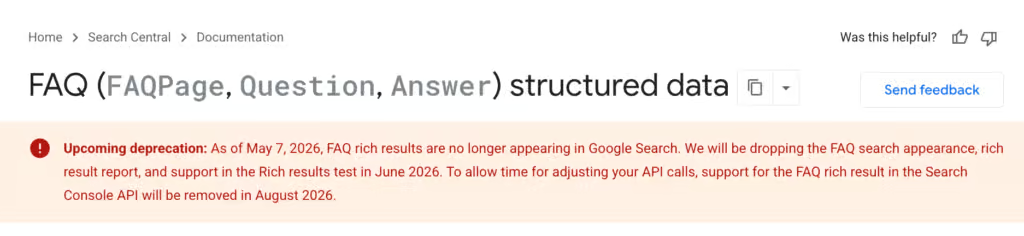
The shutdown continues over the next few months. FAQ reporting disappears from Search Console in June 2026 alongside Rich Results Test support. Search Console API support ends in August. FAQPage itself still exists as valid Schema.org markup. What disappeared was the search visibility attached to it.
Google Did Not Remove FAQ Rich Results Overnight. The Rollback Started in 2023.
Google’s May 2026 closed a process that had already been unfolding years ago.
The first major visibility reduction appeared in early 2023 as SEO teams noticed collapsing FAQ impressions inside Search Console without a formal announcement. The real cutoff arrived in August 2023, whe nGoogle officially restricted FAQ rich results primarily to authoritative government and health domains.
For most websites, the feature effectively died at that point. FAQ rich result visibility dropped from 53.94% of eligible pages to just 17.04% after Google’s August 2023 restriction. More than 82% of pages carrying FAQ schema stopped receiving FAQ rich results entirely.
The confusing part was that the schema itself never disappeared.
- Pages still validated correctly.
- The Rich Results Test still confirmed eligibility.
- Search Console continued reporting FAQ performance.
- SEO teams kept the markup active because Google never fully deprecated the feature publicly.
The FAQ schema still looked operational inside Google tooling, even though the actual SERP visibility attached to it had already collapsed for most publishers. Generative Engine Optimization (GEO) and AI search discussions extended that confusion further, as many teams reframed the FAQ schema as a possible AI retrieval signal instead of a traditional rich result tactic.
At the same time, Google was already shrinking other publisher-controlled rich result formats across Search.
Google removed HowTo rich results from mobile during the same 2023 update cycle and completed desktop deprecation shortly afterward. Both features followed the same path: reduced visibility, restricted eligibility, and then quiet removal.
Why Google Removed FAQ Rich Results in 2026?
FAQ rich results stopped functioning as simple structured data years ago. They became a SERP expansion tactic.
Publishers used FAQ accordions to make listings larger, push competing results further down mobile search, add extra messaging, and increase click-through rates without improving rankings. One page could suddenly control much more space inside Google Search through a relatively small schema implementation.
Google removed FAQ rich results because that model no longer fits the direction of Search.
AI Overviews now competes for the same above-the-fold territory that FAQ accordions once occupied. Google gains far more control through AI-generated answer interfaces than through publisher-managed expansion blocks. AI Overviews control the layout, the interaction flow, the citations, and eventually the monetization layer.
FAQ rich results became redundant inside that system. The formats that survived mostly reinforce e-commerce workflows, transactional search behavior, or Google’s own AI infrastructure.
Removing the FAQ Schema Will Not Change Your Traffic
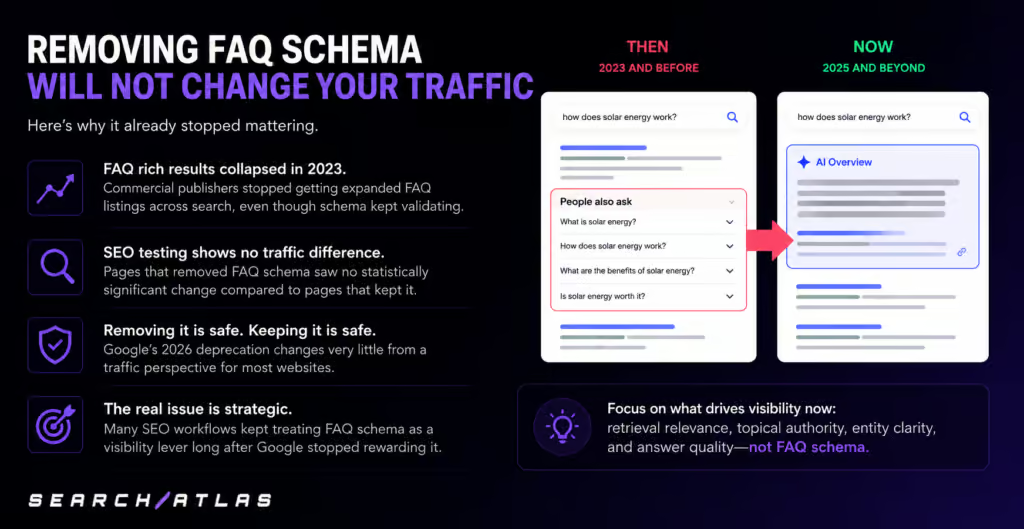
Many SEO teams still assume that removing the FAQ schema will reduce organic traffic after Google’s deprecation announcement, for most websites, which already happened years ago.
For most websites, FAQ rich results effectively disappeared in 2023. Commercial publishers stopped receiving expanded FAQ listings across large portions of search visibility, even though the underlying schema continued validating correctly inside Search Console and Rich Results tooling.
SEO testing on pages where the FAQ markup was removed found no statistically significant traffic difference between pages that kept the schema and pages that removed it entirely. That result matches what most publishers had already experienced operationally after the 2023 restriction.
This is why Google’s 2026 deprecation changes very little from a traffic perspective for most websites. Removing FAQPage markup is safe. Keeping it active is safe too. The larger issue is strategic.
Many SEO workflows continued treating FAQ schema as a visibility lever long after Google stopped rewarding it meaningfully. This older SEO model, where the FAQ schema reliably expanded publisher-controlled search visibility, no longer exists.
FAQ Schema Never Became an AI Visibility Signal
The FAQ schema survived inside many SEO workflows because the industry started treating structured data as an AI citation tactic after Google reduced FAQ rich result visibility.
The theory sounded logical. FAQ rich results disappeared from Google Search, but schema markup still influenced retrieval and citations across AI systems.
The technical evidence tells a different story.
The Search Atlas study, “The Limits of Schema Markup for AI Search: LLM Citation Analysis,” analyzed schema coverage against LLM visibility across OpenAI, Gemini, and Perplexity. The study found no meaningful relationship between higher schema adoption and higher citation frequency across AI-generated responses.
That changes how SEO teams think about AI visibility.
Structured data still contributes to entity understanding, Knowledge Graph relationships, and machine-readable context across search systems. The evidence simply does not support the idea that the FAQ schema alone functions as a major citation trigger for AI Overviews, ChatGPT, Perplexity, or similar AI retrieval systems.
The optimization target remains visible content.
Clear question-and-answer formatting still performs well because retrieval systems naturally extract concise, well-structured answers directly from pages. The Q&A structure matters far more than the FAQPage wrapper attached to it.
What Does This Say About Google’s Next Five Years?
Google’s FAQ decision signals a larger shift in how search visibility works.
For years, SEO teams expanded visibility through rich results, structured data enhancements, and a larger SERP footprint. That model is shrinking as Google moves more search interactions into AI-generated answer interfaces.
The transition has already been happening across Search.
FAQ visibility collapsed in 2023. HowTo rich results disappeared during the same period. Multiple structured result types quietly lost visibility throughout 2025 while AI Overviews expanded aggressively across informational queries.
Structured data still matters for entity understanding, retrieval systems, and machine-readable context. The part disappearing is the older SEO model where schema markup directly expanded publisher-controlled SERP visibility.
That shift changes what drives SEO performance over the next five years. Visibility growth increasingly depends on retrieval relevance, topical authority, entity clarity, and answer quality across AI-driven search environments.
What to Do After Google’s FAQ Removal?
Google’s FAQ removal does not require a massive schema cleanup project.
Most websites do not need to rush into removing FAQPage markup. The more important shift is changing how content gets optimized for AI-driven search environments.
- Keep visible Q&A content on pages where it improves clarity and user experience.
- Replace schema-first workflows with visible answer blocks targeting high-intent search questions directly inside the page.
- Audit content templates, GEO recommendations, and AI search playbooks are still positioning FAQ schema as a ranking tactic.
- Invest more heavily in structured data tied to entities, authorship, products, organizations, and machine-readable trust signals.
- Structure answers clearly enough for extraction inside AI-generated responses.
The optimization target now is answer retrieval, not rich result expansion. That means answering questions directly, creating scannable content structure, reinforcing entities clearly, and publishing concise passages that AI systems can confidently extract and cite.
The measurement layer changes completely after June 2026. Search Console FAQ reporting disappears, which removes one of the last remaining visibility indicators tied to FAQ rich results. The new visibility layer shifts toward AI citation share, branded prompt coverage, AI Overview appearances, and LLM mention frequency across AI-driven search interfaces.