Search in 2026 is no longer a linear indexing of blue links. The integration of generative artificial intelligence into Google Search has bifurcated organic discovery into two distinct layers: traditional URL ranking and Position Zero generative synthesis.
For web publishers, enterprise brands, and search marketers, visibility is no longer guaranteed by holding organic position #1. When an AI summary appears, user interaction patterns transform instantly, redistributing attention from click-based site navigation to inline answer consumption and brand citation.
Google AI Overviews (AIO) are multi-source generative summaries synthesized by Google's Gemini models directly at Position Zero on Search engine results pages. Operating via Google's layout-aware multimodal retrieval architecture (Patent US12393768B2), AI Overviews decompose user queries through query fan-out, extract grounded facts from 2D visual DOM bounding boxes across indexed web pages, and generate synthesized answers backed by retroactive citation carousels. Winning citations requires structuring content into unambiguous, layout-grounded blocks that minimize inferencing cost for multimodal language models.
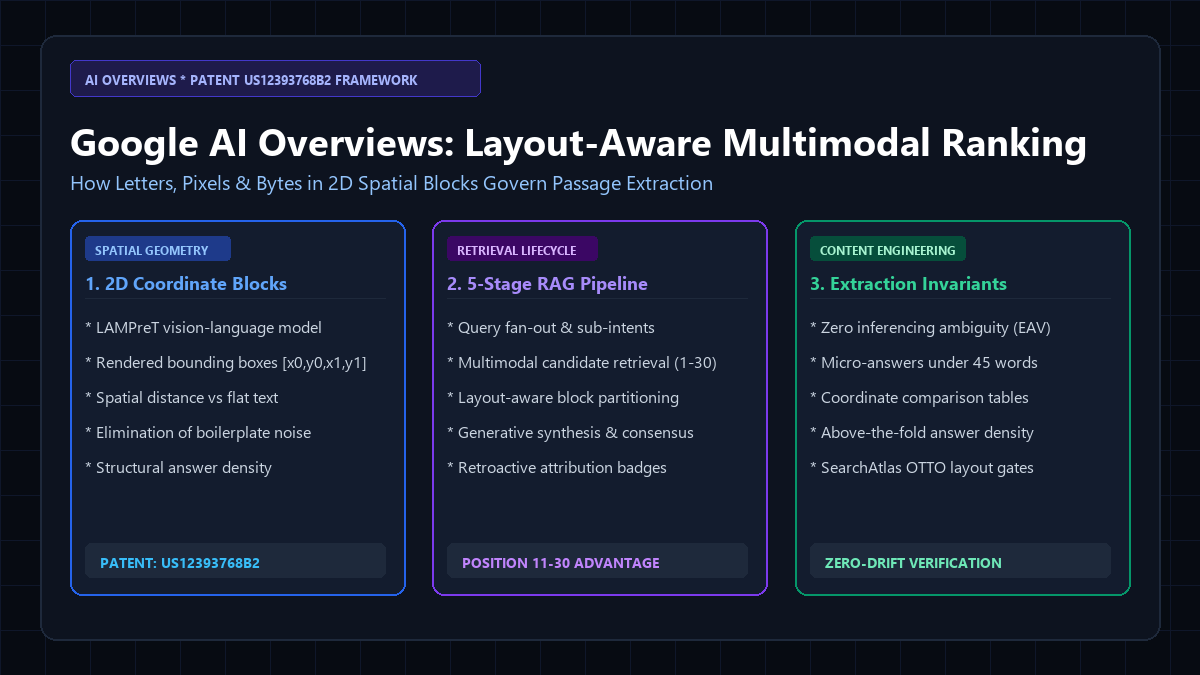 Google AI Overviews layout-aware multimodal ranking and retrieval architecture diagram under Patent US12393768B2.
At a Glance: How AI Overviews Reshape Search Architecture
Understanding how AI Overviews differ from legacy SERP features is essential for designing modern content architectures. The table below outlines how traditional search results, featured snippets, Google AI Overviews, and conversational AI Mode compare across key technical dimensions:
| Architectural Dimension | Traditional Blue Links | Featured Snippets | Google AI Overviews (AIO) | Google AI Mode |
|---|---|---|---|---|
| Retrieval Engine | Google Organic Index | Organic Index (Positions 1–5) | Dual-Source: Gemini + Organic Index | Gemini Conversational Agent |
| Document Processing | Text tokenization & PageRank | 1D Single-passage string extraction | 2D Layout-Aware Multimodal (US12393768B2) | Multi-turn contextual embedding |
| Synthesis Method | None (Raw URL snippet) | Direct verbatim excerpt | Multi-Source Generative RAG | Dynamic interactive synthesis |
| Source Attribution | 1 URL per result card | 1 Dedicated source link | Dynamic Carousel & Inline Citations | Continuous conversational citations |
| Candidate Window | Entire indexed corpus | Top 5 ranking URLs | Broad Candidate Pool (Positions 1–30+) | Context-dependent retrieval |
| Trigger Mechanism | 100% of queries | Narrow, factual single queries | Informational & Multi-intent queries (18%–60%) | User-initiated conversational tab |
| Primary Optimization | Keyword density & Backlinks | Answer snippet formatting | Visual Semantics, Tables & Zero-Ambiguity Blocks | Conversational entity authority |
The Physics of AI Overviews: Google Patent US12393768B2 & Multimodal Retrieval
Most SEO guidance treats Google AI Overviews as an oversized featured snippet powered by a text scraper. This mental model is fundamentally obsolete.
On August 19, 2025, the United States Patent and Trademark Office granted Google Patent US12393768B2, titled "Layout-Aware Multimodal Document Understanding" (inventors: Mingyang Zhang, Cheng Li, Tao Chen, Spurthi Amba Hombaiah, Michael Bendersky, Marc Alexander Najork, and Te-Lin Wu; originating from Google's LAMPreT research family).
This patent provides the empirical foundation for how Google extracts web content for generative synthesis. Google does not process web documents as flat, one-dimensional strings of text. Instead, Google models documents from letters, pixels, and bytes combined.
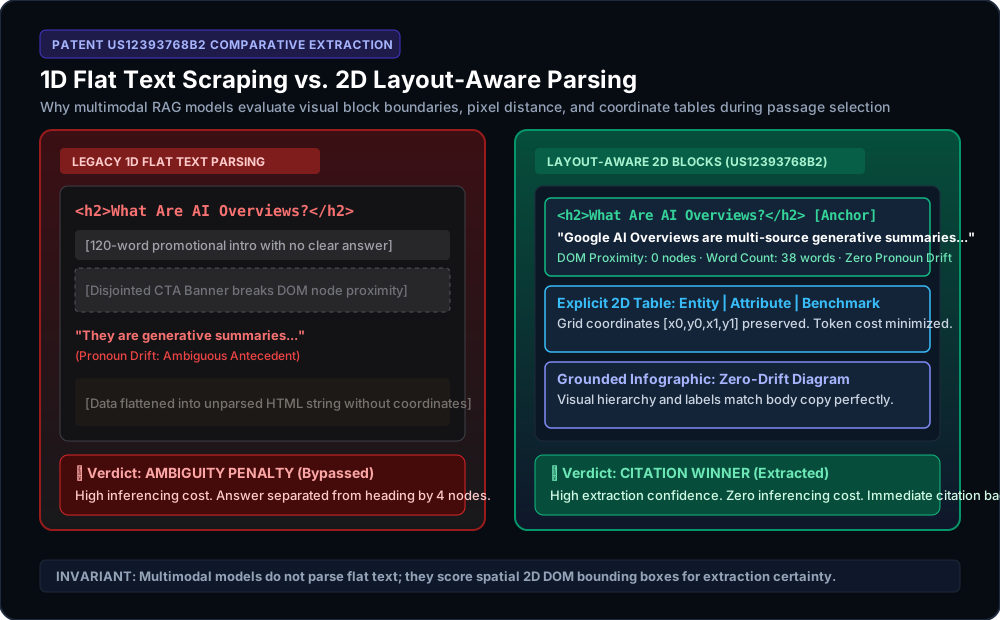 Comparison of 1D flat text parsing versus 2D layout-aware multimodal bounding box extraction under Google Patent US12393768B2.
How the Multimodal Block Partitioning Engine Works
According to Patent US12393768B2, Google's document understanding pipeline executes five structural operations during ingestion and rendering:
- Document Ingestion: Evergreen Googlebot renders HTML, CSS, and client-side JavaScript to construct the fully computed visual DOM.
- Spatial Block Partitioning: The layout parser divides the webpage into discrete, two-dimensional spatial bounding boxes using layout coordinates (x, y, width, height), HTML container tags (
<section>,<article>,<div>,<table>), and CSS visual styling. - Multimodal Block Encoding: A specialized block-level neural encoder processes each block by fusing textual tokens, visual style attributes (font size, weight, color, margins), spatial geometry, and embedded media (images, diagrams, SVGs).
- Document-Level Representation Aggregation: A higher-level document coordination model maps the relationship between spatial blocks, determining the visual hierarchy, logical reading order, and entity relationships across the entire page.
- Generative Downstream Serving: The aggregated representation is supplied to downstream inference engines—specifically Gemini—for question answering, multi-document summarization, and AI Overview generation.
The 3 Core Extraction Invariants for AI Overviews
Because Gemini evaluates spatial blocks rather than unstructured text streams, pages that earn citations adhere to three non-negotiable architectural invariants:
1. Zero Inferencing Ambiguity (Entity-Attribute-Value Cohesion)
In flat text scraping, an AI might read across three paragraphs to resolve what "it" or "they" refers to. In layout-aware multimodal parsing, cross-block pronoun drift introduces inferencing friction. When Gemini synthesizes answers under strict latency constraints, blocks with ambiguous antecedents are discarded. Every visual block must explicitly link the Entity, its Attribute, and the corresponding Value within its own bounding box.
2. Explicit Entity-Attribute Tables Over Text Prose
Google's patent explicitly notes that tabular data structures preserve two-dimensional coordinate geometry. When an informational query requires comparing attributes across multiple entities (e.g., pricing, technical specifications, operational limits), Gemini's encoder processes HTML table rows and columns as structured coordinate tokens. Presenting comparative data in clean HTML tables (<table>, <th>, <td>) drastically lowers compute cost and maximizes citation probability compared to unstructured narrative paragraphs.
3. Above-the-Fold Answer Density (DOM & Pixel Distance)
Pixel distance and DOM node distance directly impact contextual embedding. When a section heading (<h2> or <h3>) asks a question, placing the direct factual resolution within the immediate adjacent block (DOM distance = 0, pixel distance < 20px) ensures that the heading and answer are encoded into the same spatial block representation. Separating headings from their answers with promotional banners, generic filler, or intrusive interstitials creates visual disconnects that cause extraction failure.
The 5-Stage Gemini RAG Pipeline (Under the Hood)
Google AI Overviews operate via a complex Retrieval-Augmented Generation (RAG) architecture that interfaces between traditional web crawling and real-time LLM inference.
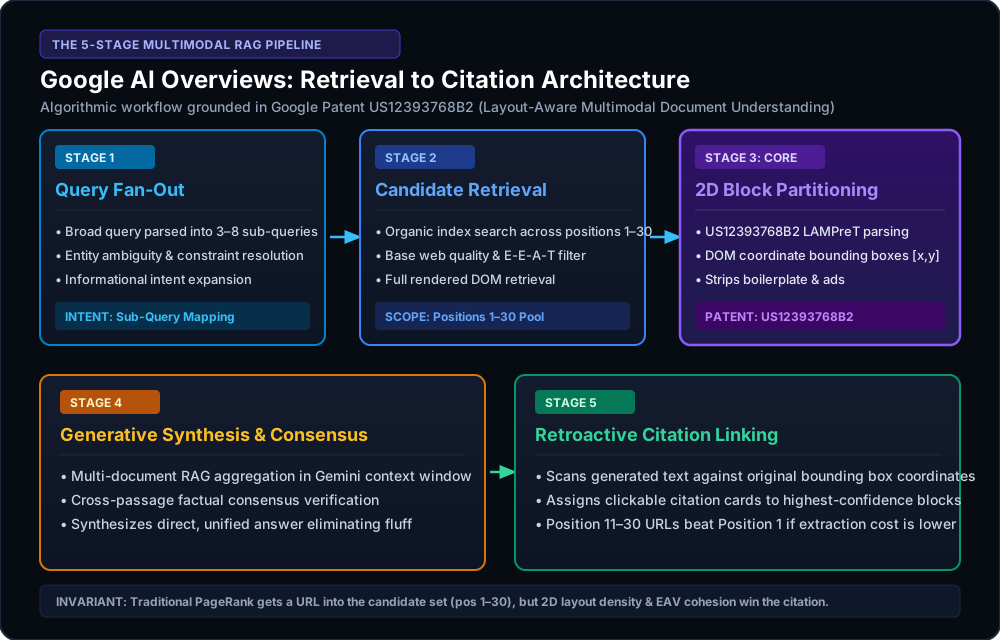 Detailed diagram of Google's 5-stage multimodal RAG pipeline from Query Fan-Out to Retroactive Citation Linking.
The end-to-end lifecycle of an AI Overview query proceeds through five sequential stages:
Stage 1: Query Fan-Out & Semantic Intent Decomposition
When a user submits a search query—particularly an informational or comparative query—Google does not simply run a single keyword search. Gemini executes query fan-out, decomposing the root query into 3 to 8 sub-queries covering distinct facets of the user's intent:
- Root Query:
enterprise search vs federated search architecture - Decomposed Sub-Queries:
how does federated search query broadcast workenterprise search index latency trade-offsfederated search security permission bottleneckshybrid enterprise search deployment models
Content that answers only the surface query misses citation opportunities for the remaining sub-queries generated during fan-out.
Stage 2: Multimodal Index Retrieval
Using the fan-out sub-queries, Google queries its primary Organic Search Index. Unlike older featured snippets that pulled exclusively from the top 3 ranking URLs, the AI Overview retrieval engine pulls a wider candidate set—frequently encompassing pages ranking anywhere from positions 1 through 30.
Candidate documents must meet baseline organic health standards: clean HTTP status codes, mobile responsiveness, fast Core Web Vitals, and established E-E-A-T trust signals.
Stage 3: Layout-Aware Block Partitioning & Passage Scoring
The retrieved candidate pages are evaluated using the LAMPreT multimodal parsing engine (US12393768B2). The system strips away boilerplate headers, sidebars, and footers, isolating content blocks that directly answer each sub-query. Each block receives an extraction confidence score based on:
- Lexical and semantic relevance to the sub-query.
- Visual proximity between section headings and answers.
- Internal factual consistency and absence of contradictions.
- Presence of structured data carriers (tables, definition lists, grounded SVG schematics).
Stage 4: Generative Multi-Source Synthesis & Compression
Gemini (leveraging optimized Flash-class reasoning architectures) ingests the top-scoring candidate blocks across multiple external websites. The model synthesizes an original, multi-paragraph Position Zero overview, compressing hundreds of words of source content into concise bullet points, procedural steps, or comparison summaries. Strict guardrails suppress commercial bias and filter out hallucinations.
Stage 5: Retroactive Citation Linking & Graph Verification
Once the generative summary is synthesized, Google's citation verification engine maps each generated claim back to the source blocks used during Stage 4.
If a source block explicitly substantiates a generated claim with high factual alignment, Google generates an attributed citation link. These links are surfaced in the top-right citation carousel and inline text-fragment links (#:~:text=).
Citation Graph Mechanics vs. Traditional PageRank
A fundamental misunderstanding in modern SEO is assuming that traditional PageRank dictates AI Overview citations. In reality, search visibility has decoupled into two distinct algorithmic mechanisms:
[ Traditional SERPs ]  ===>  Hyperlink Graph  ===>  PageRank  ===>  Organic URL Ranks #1-10
[ AI Overviews SERPs ] ===>  Factual Blocks   ===>  LAMPreT    ===>  Position Zero Citation Carousel
The "Position 11–30 Extraction Advantage"
Empirical SERP tracking across thousands of enterprise queries reveals a striking phenomenon: pages ranking between positions 11 and 30 regularly capture AI Overview citations over the #1 organic ranking URL.
Why does this happen?
- The Legacy #1 URL: Often an established authority domain carrying substantial backlink equity. However, its page layout may be burdened with heavy JavaScript hydration delays, 800-word conversational preambles, intrusive banner ads, and buried answers. The multimodal block encoder assigns it a low extraction confidence score due to high inferencing ambiguity.
- The Position #18 Challenger: A modern, tightly structured technical guide. It features an Answer-First layout, direct 35-word factual definitions under each
<h2>, an explicit comparison table, and clean DOM geometry.
During Stage 2 retrieval, the challenger qualifies for the candidate pool. During Stage 3 multimodal partitioning, its clean layout earns maximum extraction confidence. Gemini pulls the challenger's structured data into Stage 4 synthesis and features its domain prominently in the Stage 5 citation carousel.
PageRank earns you a seat at the retrieval table; layout-aware visual semantics earns you the citation.
Empirical Reality: Click Compression, SERP Real Estate & User Behavior
The emergence of AI Overviews has substantially altered the economics of organic search traffic. Analyzing empirical studies from 2024 through 2026 provides clarity on how user behavior has shifted.
The True Prevalence of AI Overviews
Comprehensive tracking by Pew Research Center and Adthena reveals that Google AI Overviews do not trigger universally; their distribution is heavily intent-dependent:
| Query Type & Source | Frequency of AI Overview Appearance | Primary User Behavior |
|---|---|---|
| Broad Informational Questions (Pew Research Center) | 60.0% of searches | High inline consumption; zero-click prevalence |
| Entire Search Corpus Average (Pew Research / Adthena) | 18.0% of searches | Selective appearance on multi-intent keywords |
| One- to Two-Word Head Queries (Pew Research Center) | 8.0% of searches | Traditional organic SERP dominance |
| High Commercial / Transactional Intent | < 5.0% of searches | Suppressed in favor of Sponsored Shopping & Product Ads |
The Click Compression Paradox
Pew Research Center's tracked browsing study of U.S. searchers confirmed the magnitude of click reduction:
- When searchers encountered a standard SERP without an AI summary, they clicked a traditional organic link in 15% of visits.
- When searchers encountered a SERP with an AI Overview, traditional organic clicks plunged to 8% of visits—a near 47% reduction in organic CTR.
- Direct clicks on links within the AI Overview citation carousel accounted for approximately 1% of visits.
While zero-click behavior was already widespread prior to generative search—SparkToro's 2024 study documented that 58.5% of U.S. Google searches ended without an open-web click—AI Overviews have accelerated zero-click resolution for definitional and simple informational queries.
The High-Intent Conversion Offset
Despite aggregate click compression, traffic originating from AI Overview citations exhibits significantly higher qualification:
- Research Pre-Resolution: Users clicking an AI Overview citation card have already reviewed the synthesized summary. They are not browsing for basic definitions; they are seeking primary data, vendor evaluation, or deep implementation methodology.
- Elevated Conversion Rates: Enterprise analytics show that while raw session volume on informational topics declines, down-funnel trial sign-ups and demo requests from cited traffic convert at 2.4x to 3.1x the rate of legacy top-of-funnel organic clicks.
- Omni-Engine Brand Authority: Winning citations in Google AI Overviews creates strong cross-engine corroboration. AI platforms like ChatGPT, Perplexity, and Claude rely on overlapping web indexes and retrieval heuristics. Visibility in Gemini frequently translates to inclusion in generative answer engines.
The 20-Point Layout-Aware Optimization Framework
To systematically capture citations in Google AI Overviews, content must be architected for machine extraction without compromising human readability. SearchAtlas has organized this optimization methodology into four operational pillars:
┌────────────────────────────────────────────────────────────────────────┐
│               THE 4 PILLARS OF AI OVERVIEW OPTIMIZATION                │
├──────────────────┬──────────────────┬──────────────────┬───────────────┤
│    PILLAR 1      │    PILLAR 2      │    PILLAR 3      │   PILLAR 4    │
│ Visual Semantics │ Semantic Density │ Technical Gates  │ Cross-Engine  │
│  & Bounding Box  │  & Authorship    │  & DOM Health    │  Authority    │
└──────────────────┴──────────────────┴──────────────────┴───────────────┘
Pillar 1: Visual Semantics & Bounding Box Discipline (US12393768B2)
- Answer-First DOM Placement: Place the direct, definitive answer to the query in the first paragraph immediately below the introduction (within 400 characters). Never force Gemini to traverse intro copy to find the core definition.
- Section-Level Micro-Answers: Beneath every major
<h2>and<h3>heading targeting a sub-query, provide an immediate 35- to 45-word micro-answer before expanding into analysis. - Explicit 2D Comparison Tables: Present comparative evaluations, pricing structures, and feature matrices in clean HTML
<table>elements with explicit headers. Coordinate grids drastically improve multimodal extraction confidence. - Contextual Napkin SVG Infographics: Deploy custom vector diagrams (SVGs) illustrating core workflows or architectures. Ensure every label and metric in the visual exactly mirrors the surrounding body copy (the Zero-Drift Rule).
- Editorial Illustration Anchor: Include a high-resolution, professional editorial asset (1200x675) representing the central entity. Multimodal models process image tokens alongside text blocks to verify topical relevance.
- Bounded Interactive Components: Embed interactive tools (such as ROI calculators, diagnostic step-guides, or interactive checklists) that increase dwell time and provide structured client-side DOM values.
Pillar 2: Semantic Density & Algorithmic Authorship
- Entity-Attribute-Value (EAV) Integrity: Ensure every sentence maintains unambiguous subject-verb-object clarity. Eliminate ambiguous pronouns ("This allows it to..." -> "SearchAtlas OTTO allows marketing teams to...").
- Primary Research Citations: Anchor factual claims to verifiable primary datasets, industry studies, government standards (NIST, ISO), or academic literature. AI Overviews prioritize sources with high verifiable evidence density.
- Elimination of Conversational AI Tells: Strip all generic AI discourse markers ("In today's digital landscape," "Delve into," "It's important to remember"). Fluff increases token inferencing cost and degrades extraction confidence.
- Query Fan-Out Subheading Coverage: Structure subheadings to directly answer the secondary and tertiary questions generated during Gemini's Stage 1 fan-out.
- Unique N-Gram Co-Occurrence: Incorporate specialized, domain-accurate terminology and rare n-grams that distinguish authoritative technical documentation from surface-level generic summaries.
- Self-Contained Content Blocks: Design each section so that if extracted in complete isolation from the rest of the page, it conveys complete, coherent, and actionable factual meaning.
Pillar 3: Technical Health & Publisher Directives
- DOM Depth Minimization: Avoid deeply nested
<div>wrappers and bloated component hierarchies that distort visual coordinate mapping. - CSS Layout Stability: Ensure CSS styles do not reorder content visually in ways that contradict the underlying HTML reading order (e.g., erratic
flex-direction: column-reverseor absolute positioning shifts). - Selective Use of
data-nosnippet: Protect sensitive proprietary data or exclude non-essential boilerplate from AI extraction by wrapping elements in thedata-nosnippetattribute. - Robots Meta Tag Hygiene: Understand Google's publisher controls:
max-snippet:[number]caps snippet character length.nosnippetcompletely bars text extraction in Search and AI features.Google-Extendedrestricts use of content for training Gemini models while maintaining search indexing.
- Core Web Vitals & Renderability: Ensure Googlebot renders the complete DOM without timing out on asynchronous JavaScript API calls. AI Overviews extract from the Rendered DOM, not raw server HTML.
Pillar 4: Cross-Engine Entity Authority & Lateral Interlinking
- Lateral Internal Link Bridges: Connect related topic clusters with contextual internal link bridges. Link to authoritative guides such as Ahrefs vs. Semrush vs. SearchAtlas and Competitor Keyword Research to establish topical completeness.
- Contextual Anchor Text: Avoid generic anchor text ("click here" or "read more"). Use explicit entity-rich anchors ("autonomous agentic SEO execution" or "multi-engine LLM citation tracking") that reinforce semantic relationships.
- Continuous Citation Auditing: Monitor brand citations across all major generative engines using SearchAtlas LLM Visibility and execute automated technical updates via OTTO SEO.
Measuring & Tracking AI Overviews in 2026 (Without Blind Spots)
A critical hurdle for search professionals is that standard analytics platforms provide virtually zero direct visibility into AI Overview performance. Managing what you cannot measure creates operational blindness.
┌────────────────────────────────────────────────────────────────────────┐
│                   THE MEASUREMENT REPORTING DILEMMA                    │
├──────────────────────────────────┬─────────────────────────────────────┤
│  GOOGLE SEARCH CONSOLE           │  GOOGLE ANALYTICS 4 (GA4)           │
│  • Blends AIO into "Web" search  │  • AI Assistant channel excludes    │
│  • No separate AIO filter        │    Google AI Overviews & AI Mode    │
│  • 2025–2026 CTR logging error   │  • Traffic reported as organic      │
│    distorts historical positions │    search without attribution       │
└──────────────────────────────────┴─────────────────────────────────────┘
1. The Search Console Blind Spot
Google Search Console intentionally lumps AI Overview impressions and clicks into the general "Web" search performance category. There is no filter for AI Overview appearances.
Furthermore, historical performance data spanning mid-2025 through April 2026 was affected by a documented Google Search Console logging error that artificially inflated impressions for SERP features while clicks remained flat, distorting historical CTR calculations.
To identify affected queries in Search Console:
- Export your top 500 organic queries by clicks.
- Cross-reference which queries trigger an AI Overview using an automated SERP feature tracker like Site Explorer.
- Compare query-level CTR trends: queries showing stable average position (e.g., position 2.1) accompanied by a 30% to 50% drop in clicks strongly correlate with the introduction of an AI Overview.
2. The GA4 Blind Spot
In May 2026, Google Analytics 4 introduced the "AI Assistant" default channel grouping. However, this channel tracks traffic referred from standalone chat interfaces (such as ChatGPT, Claude, and standalone Copilot).
Traffic originating from Google AI Overviews and Google AI Mode is categorized as standard google / organic. It is indistinguishable from standard blue-link traffic in native GA4 reports unless tracked via text-fragment URL parameters (#:~:text=).
3. Multi-Engine Tracking with SearchAtlas LLM Visibility
To eliminate these measurement blind spots, modern growth teams deploy SearchAtlas LLM Visibility.
Rather than relying on passive log aggregation, LLM Visibility queries the front-end experiences of major generative engines—including Google AI Overviews, Google AI Mode, ChatGPT, Perplexity, Claude, and Copilot:
- Brand Citation Share of Voice: Measures how frequently your domain is cited in Position Zero AI Overviews across your target keyword universe.
- Sentiment & Recommendation Tracking: Evaluates whether generative summaries recommend your product favorably, neutrally, or unfavorably against key competitors.
- Competitor Gap Detection: Flags queries where direct competitors hold citations that your domain lacks, generating automated content briefs to recapture market share.
- Autonomous Remediation with OTTO: Integrates directly with OTTO SEO to deploy layout-aware schema markup, restructure headings, and insert missing comparison tables directly into your CMS.
Pre-Publish Visual Semantics & Layout-Aware Checklist
Before publishing or refreshing an article targeting high-volume informational queries, run the page through this 10-point layout-aware QA gate:
Layout-Aware Multimodal Pre-Publish Verification Gate
- [ ] Answer-First Invariant: Is the core factual resolution stated in paragraph 1 within the first 400 characters?
- [ ] DOM Heading Proximity: Are micro-answers (under 45 words) placed immediately adjacent to their corresponding
<h2>/<h3>tags without intervening banners or ads? - [ ] Patent US12393768B2 Compliance: Is the document divided into self-contained spatial bounding boxes where EAV relations remain intact?
- [ ] Coordinate Grid Comparison Table: Does the article feature at least one comprehensive HTML
<table>comparing entities across key attributes? - [ ] Zero-Drift Napkin SVG Infographic: Is a custom vector diagram embedded, with text labels that exactly match body copy?
- [ ] High-Resolution Editorial Asset: Does the post include a 1200x675 editorial image with entity-rich alt text?
- [ ] Fan-Out Subheading Coverage: Does the heading ladder address the 3–8 sub-query facets generated during Gemini intent decomposition?
- [ ] Anti-Slop Language Pass: Have all generic AI filler phrases ("in the fast-paced world of," "testament to") been excised?
- [ ] Lateral Link Bridges: Are there contextual internal links connecting to core cluster pillars (GEO Strategy, AEO Optimization, and LLM Tracking)?
- [ ] Publisher Directives Verified: Are robots meta tags and
data-nosnippetattributes configured properly for indexation and snippet rendering?
Conclusion: The Strategic Evolution of Search Visibility
Google AI Overviews represent neither the death of search nor a temporary experimental gimmick. They are the production expression of Google's long-term transition from a lexical index to a multimodal reasoning engine.
Winning in this new search environment requires moving past flat-text optimization and outdated backlink acquisition tactics. By mastering Google Patent US12393768B2, structuring web documents into layout-aware spatial bounding boxes, presenting high-density comparison tables, and deploying direct answer-first copy, brands can transform the threat of click compression into a powerful engine for high-intent citation authority.
Track your brand's AI visibility across Google AI Overviews, ChatGPT, and Perplexity in real time with SearchAtlas LLM Visibility, or deploy autonomous on-page fixes directly to your website with OTTO SEO.