Competitor keywords are the organic search queries and paid terms that drive qualified traffic and revenue to rival websites in your industry. Conducting a competitor keyword analysis reveals proven commercial intent, isolates high-opportunity keyword gaps, and exposes exactly which topics outrank your domain.
To check competitors’ keywords, (1) run a keyword gap analysis across 3 to 5 rival domains, (2) inspect their top-traffic organic pages in Site Explorer, and (3) validate search volume, difficulty (0–100 KD), and intent in a keyword research tool. Free starting data: Google Search Console and Google Ads Auction Insights.
Let’s explore a practical 5-step plan to find competitors' keywords and use proven SEO tools to transform their top terms into high-ranking content.
What Are Competitor Keywords?
Competitor keywords are organic and paid search queries that rival websites rank for or bid on within target search engine result pages. These queries operate by intercepting qualified demand across commercial, informational, and transactional intents, channeling high-intent buyers into competing content hubs and conversion funnels. The core attributes of competitor keywords comprise monthly search volume, keyword difficulty (KD on a 0–100 scale), cost-per-click (CPC), and topical authority alignment, governing how effectively an organic content gap analysis can capture market share.
 The keyword gap view splits rival terms into segments: keywords competitors rank for that your site does not, shared keywords, and keywords unique to your site.
This information reveals the competitive landscape and highlights the language companies use to connect with their audience. Competitor keywords serve as a key indicator of market focus and priorities within an industry.
Competitor keyword research is the repeatable method behind that definition: build a list of 3 to 5 real rivals, extract the terms they rank for, filter them by intent and difficulty, act on the gaps, and re-check the list on a schedule. It runs as a continuous cycle, not a one-off project, because rankings and rival strategies keep moving.
The words find, check, and analyze mark three moments of that cycle: you find competitor keywords once to build the initial list, check them on a schedule to confirm what rivals rank for right now, and analyze them to score each term and decide what to do with it.
 Search Atlas customers describe traffic and ranking outcomes from their SEO programs.
What Do You Gain by Finding Competitor Keywords?
You uncover what drives traffic in your niche by finding competitor keywords. This insight highlights ranking opportunities others miss. See the biggest benefits below.
- Spot market shifts early. Track rising topics and behavior changes in your industry. Adjust your strategy before the trend becomes crowded.
- Understand real search intent. See what your audience actually types into Google. Create content that matches their goals and answers their questions.
- Skip the guesswork. Use proven keywords that already work for others. Save time and focus on what moves the needle faster.
- Sharpen your strategy. Find content gaps, refine your SEO and ad campaigns, and build a smarter keyword plan with fewer blind spots.
- Outrank the competition. Look where competitors rank, identify weak spots, and position your content to take the lead in search results.
How to Find Competitors Keywords in 5 Easy SEO Steps
Step by step
Find competitors’ keywords in five steps
Step through the sequence here. Each step is explained in the sections below.
Traditional keyword research targets your own site, while competitor keyword analysis examines the full competitive landscape. Follow these 5 steps to gain insights that boost your advantage in rankings.
1. Find Main Keywords to Guide SEO Steps
Before analyzing competitors, identify the core terms that represent your business. These keywords define your niche and guide every step of your SEO research. Without them, it’s impossible to know which competitors actually matter.
Start with what you know about your product, service, and audience. Review homepage, product descriptions, and blog headlines for repeated phrases. Google’s own guidance points in the same direction: “Think about the words that a user might search for to find a piece of your content” (“Search Engine Optimization (SEO) Starter Guide”, Google Search Central). To expand your list, use the tips below.
- Type your main terms on Google and note what autocomplete suggests.
- Scroll to the bottom of the results page to review related searches.
- Use Google Search Console to see which keywords already drive traffic.
- Analyze Google top results to understand the content type and user intent behind each keyword.
 Keyword Magic expands a main term into similar and related keywords.
For easier discovery, use a keyword research tool with a keyword magic feature. Enter your main term to quickly generate a list of similar and related keywords that expand your possibilities.
2. Identify Primary Competitors for Targeted Analysis
Use your seed keywords to search Google and track which businesses appear most on page one. Run several searches with different variations from your list. Focus on sites with commercial content like product pages or service descriptions.
From those results, select 3 to 5 businesses that offer similar solutions to the same audience. Avoid directories, news sites, or general blogs unless they compete directly for buying-keyword traffic. To refine your list, add insights from your team and customers.
- Ask your sales reps which brands mention your business most often.
- Review customer feedback to learn which alternatives they considered.
- Scan social media for businesses with large, active followings in your space.
3. Explore Competitor Keywords That Match Your SEO Strategy
Use your competitor list to analyze which keywords drive their traffic. Focus on terms where they outperform your site and target the same audience. Run a keyword gap analysis to compare your site with each competitor. Pay attention to the 4 segments below.
- Keywords all competitors rank for, but your site does not. Priority opportunities: the whole market agrees these terms matter, so plan a dedicated page for each one that fits your offer.
- Keywords where both your site and competitors rank. Improve the existing page: refresh its depth, structure, and freshness to climb past the rival instead of creating a near-duplicate.
- Keywords only your site ranks for. Defend and expand: you already own this demand, so keep the page current and build supporting content that deepens your coverage.
- Keywords competitors rank for individually. Evaluate niche fit: a single ranking rival can signal a specialized audience, so pursue these terms only when they match your products and intent.
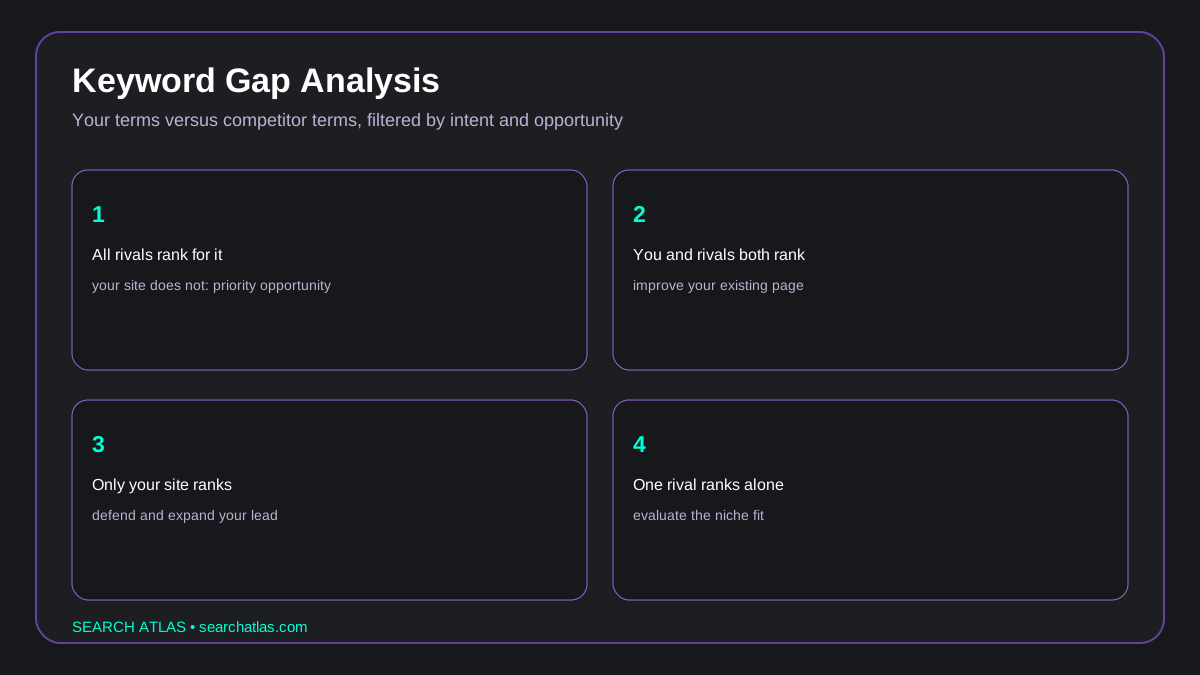 Infographic: the four keyword gap segments, from terms all rivals rank for to terms unique to your site.
For deeper competitor analysis, use Site Explorer to examine backlink profiles, keyword rankings, and traffic trends. It highlights top-performing content, paid search efforts, and keyword strategies.
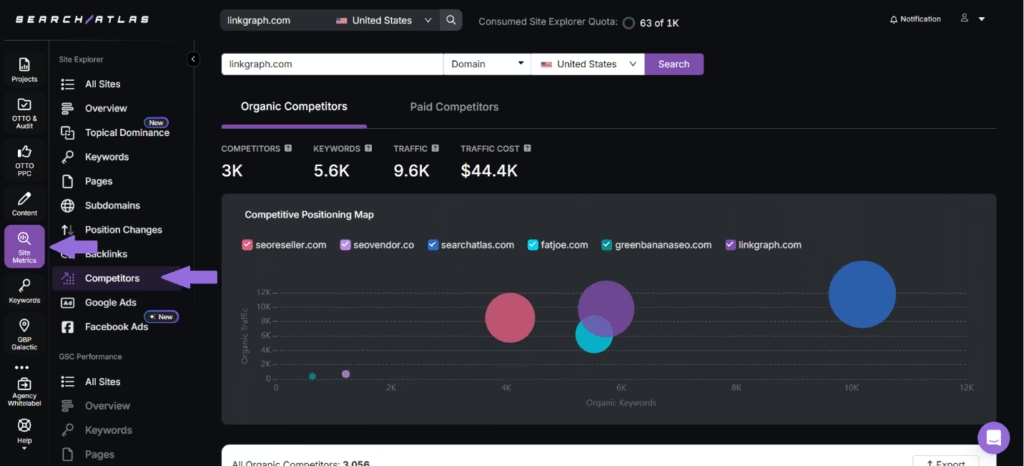 The competitor tab in Site Explorer shows which domains rank for the same terms.
The tool uncovers the highest-traffic pages, keywords bringing visitors to competitors, and offers actionable insights to refine your targeting and uncover missed opportunities.
Looking for a budget-friendly way to explore these tools? Try Search Atlas free for 7 days. No commitment required, cancel anytime.
4. Filter Competitor Keywords to Capture Relevant Traffic
Once you find competitors keywords, remove keywords that don’t match your products or audience and then enter them into a keyword research tool to gather essential data.
- Search intent: What users want when they type the keyword.
- Search volume: The average monthly number of searches.
- Keyword difficulty: How hard it is to rank organically (scale 0 to 100).
- Cost per click (CPC): Indicates keyword value based on paid ads.
 Get a keyword overview of search volume, difficulty, intent, and CPC while using the Keyword Magic Tool to browse related keywords and variations.
Focus on keywords with low difficulty and high search volume. These terms let you target relevant traffic without competing against sites dominating highly competitive words.
For example, if your seed keyword is “dog training,” look for related terms competitors rank for that share the same intent. Prioritize what aligns well with your offerings and content. This ensures your SEO efforts attract the right audience and improve your chances to rank.
Before any keyword earns a place in your plan, score it against five signals:
| Prioritization signal | What to check | How it changes your action |
|---|---|---|
| Intent fit | The term matches your products, services, and audience | Poor fit: drop the term, whatever its volume |
| Ranking position | You sit just outside the top 10, positions 11 to 30, or the rival holds a weak spot | Close to ranking: improve the page you already have |
| Search volume | Enough monthly searches to repay the effort | Higher volume raises the ceiling of the win |
| Keyword difficulty | A 0 to 100 score your domain can realistically beat | High difficulty: sequence the term later in your plan |
| Existing-page ownership | You already have a page that can absorb the term | Owned: update that page; not owned: create one dedicated page |
5. Track Your Competition’s Performance to Stay Ahead
Stay visible by monitoring how competitors evolve. Watch shifts in keyword rankings, backlink growth, and new content targeting to understand their SEO moves.
Track monthly search volume on top keywords, new terms they add, and backlinks that boost authority. These insights uncover trends, missed opportunities, and emerging threats.
 Rank Tracker reports daily ranking changes and sends alerts when positions shift.
Use rank tracking tools that offer daily updates, alerts for ranking changes, and side-by-side comparisons with your own data. Search Atlas Keyword Rank Tracker updates daily, highlights keyword performance, and sends alerts when rankings shift.
With this approach, you stay informed about keyword trends and competitor movements which allows you to adjust your SEO strategy with precision and act before others do.
| Step | What you get | Tool |
|---|---|---|
| 1. Find main keywords | Seed keywords expanded with autocomplete suggestions, related searches, and terms that already drive traffic | Google Search Console; Keyword Magic in a keyword research tool |
| 2. Identify primary competitors | A shortlist of 3 to 5 businesses that sell similar solutions to the same audience | Google search results; input from sales reps, customer feedback, and social media |
| 3. Explore competitor keywords | The four keyword gap segments and the highest-traffic pages of every rival domain | Keyword Gap Analysis; Site Explorer |
| 4. Filter competitor keywords | Keywords scored by search intent, monthly search volume, difficulty (0 to 100), and CPC | Keyword research tool metrics |
| 5. Track performance | Daily ranking movements, new competitor terms, and alerts when rankings shift | Search Atlas Keyword Rank Tracker |
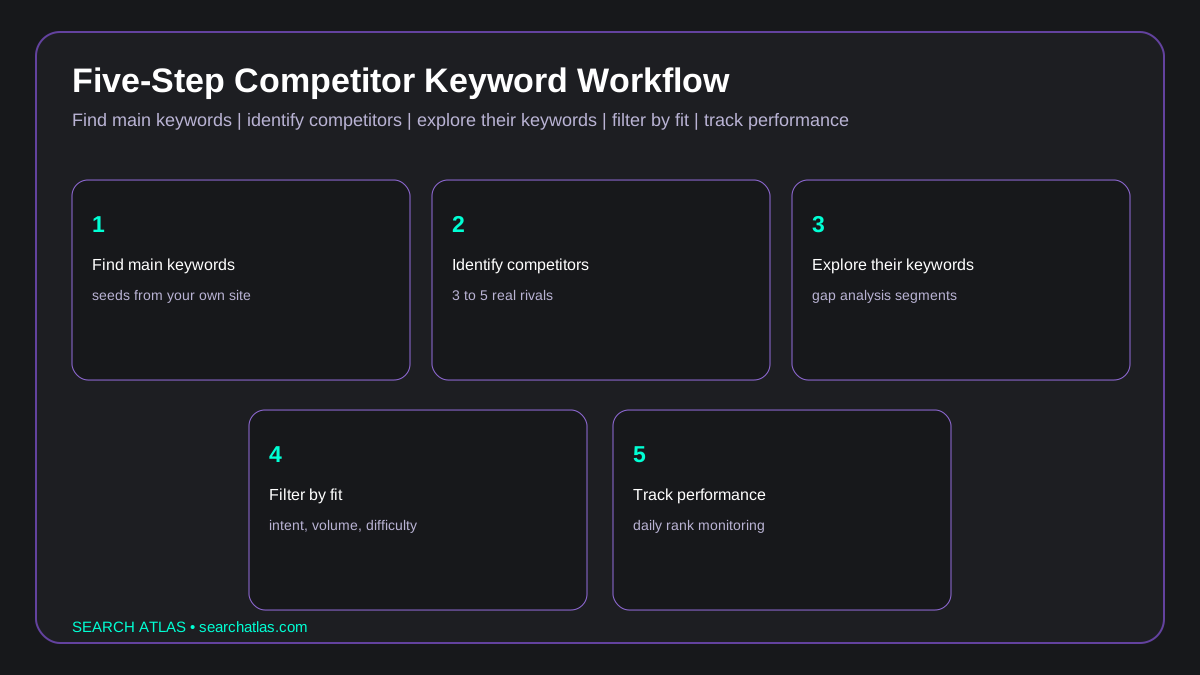 Infographic of the five competitor keyword steps: find main keywords, identify competitors, explore their keywords, filter by fit, and track performance.
How to Use Competitor Keywords in Your SEO Strategy
With all the competitor keyword insights in hand, it’s time to turn them into action. Below, you’ll find the most effective tips to use those keywords strategically and build content that ranks and drives real results.
1. Build Targeted Content Around Competitor Keywords
Competitor keywords show what your audience already searches for. Use them to shape content that ranks and engages. Start by identifying terms that fit your niche and reflect your expertise.
Spot gaps in your content or topics where you target more depth than competitors. Choose formats based on search intent, such as examples below.
- Blog posts
- Landing pages
- Product pages
- Ebooks
- Case studies
Add keywords naturally in headlines, subheadings, and key sections. Use related terms to broaden reach without repeating yourself. Prioritize clarity and useful detail.
Focus on mid-volume, low-competition keywords that match your strengths. These often slip past larger sites and give you a better shot at ranking.
 The Content Planner connects keyword research, topic clustering, and drafting in one workflow.
Use a Content Planner to simplify the entire process by connecting keyword research, topic clustering, and drafting in one organized workflow. Then, run each draft through SCHOLAR, the Search Atlas content auditor.
SCHOLAR uses AI to evaluate structure, accuracy, keyword placement, and alignment with search intent. You boost its chance to rank higher, engage readers longer, and outperform competitors from day one by improving your content before it goes live.
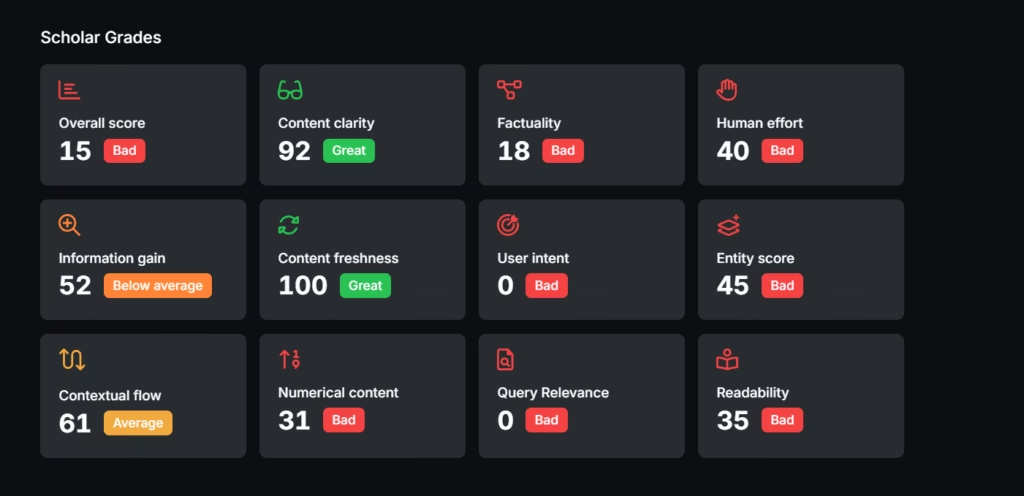 SCHOLAR grades drafts on structure, accuracy, keyword placement, and intent alignment.
2. Improve Existing Content to Compete More Effectively
Once you identify valuable competitor keywords, apply those insights strategically. Optimize existing pages rather than creating new ones for every keyword variation to avoid keyword cannibalization, which happens when multiple pages compete for the same search intent.
For example, if a competitor ranks well for “cheap art prints,” don’t create a new page from scratch. Instead, update a related article or product page to target that keyword more effectively.
- Add sections that go deeper into the topic, such as product comparisons, pricing breakdowns, or customer reviews
- Include high-traffic competitor keywords naturally in headings, subheadings, and body text
- Update or expand existing visuals to better reflect the topic
- Refresh metadata to align with the new keyword focus
 Topical Dominance compares how thoroughly each site covers a topic.
Within Site Explorer, the Topical Dominance feature shows how thoroughly your site covers a subject compared to others in your niche. It measures content depth and breadth by topic, which helps you find gaps or opportunities to expand coverage and boost your authority and relevance.
 Content Genius reviews writing in real time against competitor pages.
For sharper optimization, use Content Genius. This AI assistant reviews your writing in real time, compares it to top-ranking pages, and recommends keyword placement, section flow, natural phrasing, and internal linking.
5 Tools That Help You Find Competitors Keywords (Without the Guesswork)
Most SEO tools support competitor keyword analysis, though some require a paid plan. This cost often offsets the time saved compared to manual work. Choose one that aligns with your workflow and budget to keep your process efficient.
1. Search Atlas
 Site Explorer lists organic competitors and the keywords each domain shares with yours.
Search Atlas offers dedicated competitor analysis tools to find keyword overlaps, ranking gaps, and traffic sources across rival domains. Compare up to five competitors in Keyword Gap Analysis to uncover how rival sites earn visibility, what keywords support their rankings, and where opportunities exist.
- Keyword Gap: Displays keywords all competitors rank for that your site currently does not.
- Keywords in Common: Lists terms shared across all selected domains, which includes your own.
- Keyword Opportunities: Highlights keywords with competitive presence but missing from your rankings.
- Unique Keywords: Shows the keywords your domain ranks for that none of the competitors do.
- All Keywords: Compiles every keyword any compared domain ranks for, creating a complete keyword universe.
Search Atlas organizes these insights in an accessible layout, which makes competitor analysis actionable for both experts and less technical users.
Search Atlas Pricing
| Starter plan | Growth plan | Pro plan | |
|---|---|---|---|
| Price: | $99 monthly | $199 monthly | $399 monthly |
| Free OTTO Activation | 1 | 2 | 4 |
| User Seats | 2 | 3 | 5 |
| GSC Sites | 5 | 15 | Unlimited |
| GBP Accounts | 3 | 10 | 25 |
| Regular AI Quota | 100 | 250 | Unlimited |
| Keywords per Site | Top 10K | Top 100K | Top 1M |
| Keyword Explorer, Keyword Magic, Rank Tracker, and Keyword Gap Analysis | ✔️ | ✔️ | ✔️ |
| GSC Unlimited Keyword Rank Tracking | ✔️ | ✔️ | ✔️ |
| Site Explorer | ✔️ | ✔️ | ✔️ |
| Report Builder | ✔️ | ✔️ | ✔️ |
| Backlink Analyzer Projects | 2 | 5 | 5 |
| Site Auditor Projects | 5 | 10 | 100 |
2. Semrush
 Via Semrush
SEMrush Keyword Gap tool compares up to five domains, subfolders, or URLs to reveal keyword overlaps, gaps, and exclusive terms. The tool examines both SEO and PPC performance, tracks SERP feature visibility, and delivers customizable reports to study how competitors drive traffic.
Semrush Pricing
Semrush competitor analysis is available in Pro plan.
- Free. $0 limited to 10 searches/day and 100 URL crawls
- Pro. $139.95/month. 5 projects, 500 keywords
- Guru. $249.95/month. 15 projects, 1,500 keywords, content tools
- Business. $449.95/month. 40 projects, 5,000 keywords, API access
3. Ahrefs
 Via Ahrefs
Ahrefs offers a Competing Domains tool that reveals keyword overlap across SERP rivals and tracks how they gain visibility. With combined SEO and PPC data, Ahrefs shows how domains perform across keywords, backlinks, and traffic sources at both page and site levels.
Ahrefs Pricing
The competitive analysis tool is included in the Lite plan.
- Lite. $129/month. 5 projects, 750 keywords, 100K crawl credits
- Standard. $249/month. 20 projects, 2,000 keywords, 500K crawl credits
- Advanced. $499/month. 50 projects, 5,000 keywords, 1.5M crawl credits
4. SE Ranking
 Via SE Ranking
SE Ranking includes a competitive research tool that shows top keywords, ranking pages, and traffic distribution across SEO and PPC. The dashboard compares shared and unique keywords to pinpoint visibility gaps between your site and competitors.
SE Ranking Pros
- Offers competitor content analysis and suggests creating content around specific keywords.
- Provides flexible subscription plans with generous data limits.
SE Ranking Limitations
- Bulk processing capabilities are limited for enterprise-level projects.
- Feature depth falls short when compared to specialized SEO platforms.
SE Ranking Pricing
The competitor analysis per project varies depending on the plan.
- Essential. $65/month. 1 seat, 5 projects, 500 keywords
- Pro. $119/month. 3 seats, 30 projects, 2,000 keywords
- Business. $259/month. 5 seats, unlimited projects, 5,000 keywords
5. Spyfu
The SpyFu screenshot asset is withheld until a verified first-party SpyFu capture is available; no unrelated vendor image is presented as SpyFu evidence.
SpyFu offers competitor analysis tools focused on uncovering long-term SEO and PPC strategies through historical keyword and ad performance data. It reveals which keywords competitors target, ad copy they’ve used, and estimated costs over time.
SpyFu Popular Pros
- Provides unlimited searches, removing restrictions on data exploration.
- Allows access to years of historical data to analyze trends and refine long-term strategies.
SpyFu Limitations
- Lacks real-time visibility into active campaigns and does not include advanced technical site reporting.
- Keyword data accuracy decreases in niche or low-volume segments.
SpyFu Pricing
- Basic Plan. $39/month. 10k search results, 10k exports, 100 PDFs, 6 months history, 250 leads, 5k weekly keywords
- Pro Plan. $79/mo. unlimited search results, exports, PDFs, 10+ years history, 500 leads, 15k weekly keywords, API access
Find Your Competitors Keywords and Outshine Them with Great Content
Competitor keywords reveal what your audience is already searching for. Use these insights to create sharper content, target more relevant terms, and improve your rankings.
To move faster, rely on tools that simplify the process.
Search Atlas brings all your SEO research into one place. It tracks competitor keywords, uncovers content gaps, and identifies strategies that actually work.
Make smarter decisions, outrank your competitors, and grow your visibility. Start with a FREE trial of Search Atlas today!