Data bias in AI and machine learning is the systematic distortion that causes models to produce unfair, inaccurate, or unrepresentative predictions across different populations and deployment environments. Data bias appears when training datasets fail to reflect real-world conditions accurately, which causes machine learning systems to learn skewed statistical patterns instead of balanced representations.
Data bias matters because AI systems now influence hiring, healthcare, finance, search, recommendations, and public decision making at large scale. Machine learning models inherit the patterns embedded inside training data, which means biased datasets create biased outputs automatically. Small distortions inside datasets scale into larger operational, legal, and ethical risks once deployed across production systems.
Data bias affects prediction accuracy, fairness, reliability, and trust across AI systems. Generative AI models, ranking systems, recommendation engines, and autonomous agents reproduce the representation gaps, stereotypes, and unequal patterns present inside training corpora. These distortions influence how AI systems classify information, generate outputs, and make automated decisions.
Data bias requires continuous detection, testing, and mitigation across the full AI lifecycle. Effective prevention combines diverse datasets, stronger labeling standards, fairness monitoring, and governance workflows that reduce bias before deployment failures occur.
What Is Data Bias?
Data bias is a systematic distortion within a dataset that causes machine learning models to generate inaccurate, unfair, or skewed predictions. Data bias creates a mismatch between training data and real-world conditions, which pushes models toward distorted outputs and unreliable decisions.
The distortion enters through collection methods, sampling boundaries, labeling standards, or measurement systems, and the distortion propagates into every prediction the trained model generates. Data bias matters because machine learning models encode bias as learned behavior instead of correcting the distortion automatically.
Where does data bias appear in the machine learning pipeline? Data bias appears across every major stage of the machine learning pipeline, from data collection to post-deployment feedback loops. The pipeline embeds assumptions through source selection, sampling logic, feature encoding, labeling rules, model training, evaluation benchmarks, and automated feedback systems. Each stage passes earlier distortions into downstream stages because later processes treat previous outputs as ground truth.
Why is data bias a structural problem instead of a technical bug? Data bias functions as a structural problem because the distortion originates from representation choices instead of mathematical failure. A machine learning model produces statistically accurate outputs while still generating biased decisions because the dataset itself contains distorted assumptions. The error exists inside the dataset definition layer, governance layer, and collection process rather than inside the algorithm logic. Effective mitigation requires intervention across dataset design, evaluation standards, governance policies, and organizational decision frameworks.
What Makes a Dataset Biased?
A dataset becomes biased when its samples, labels, or feature distributions do not match the population the model will serve. The mismatch comes from missing groups, overrepresented groups, mislabeled examples, outdated examples, or features that act as proxies for protected attributes. Each condition shifts the statistical patterns the model learns. Bias arises whenever the internal distribution of the datasets diverges from the deployment distribution.
How does sample composition affect dataset bias? Sample composition determines which groups, contexts, and behaviors a model learns to recognize, and unbalanced composition produces blind spots. A dataset weighted heavily toward one demographic, geography, language, or time period encodes that subset as the default case. The model then performs well on the overrepresented group and poorly on others. Sample composition is one of the most common and most preventable sources of bias.
How do labels contribute to dataset bias? Labels contribute to bias when annotators apply inconsistent criteria, encode personal judgments, or work from definitions that reflect a narrow worldview. Labels are the supervised signal the model treats as truth, so any subjective drift in labeling becomes a learned target. Disagreement between annotators, ambiguous instructions, and culturally specific definitions all corrupt the label set. Label bias is harder to detect than sample bias because the errors look like the ground truth.
How do features and proxies create hidden bias? Features and proxies create hidden bias when a non-protected variable correlates with a protected attribute and carries the same predictive pattern. Postal code, name, device type, or browsing history act as proxies for race, gender, age, or income. The model uses the proxy to recreate a banned distinction without naming the protected attribute. Hidden bias through proxies is a frequent failure mode in fairness audits.
How Does Data Bias Enter AI Systems?
Data bias enters AI systems through collection processes, historical records, deployment conditions, and annotation workflows that distort how models interpret reality. Data bias shapes what an AI system learns before training begins because datasets define the boundaries of model knowledge and prediction behavior. Every dataset contains inclusion rules, exclusion rules, and measurement assumptions that influence how the trained system classifies information and generates outputs.
How does collection methodology introduce data bias? Collection methodology introduces data bias when sourcing processes overrepresent certain channels, populations, languages, or devices while excluding others. Web scraping systems, sensor networks, survey distribution methods, and third-party datasets contain built-in coverage limits that restrict dataset diversity and representation quality. The model inherits those limits as its understanding of the world, which means collection decisions shape model perception before training starts.
How does historical data carry bias into modern AI systems? Historical data carries bias into AI systems when records contain discrimination, exclusion, or unequal access patterns that models learn as valid signals. Hiring databases, lending histories, policing datasets, and medical records frequently reflect decades of structural inequality across institutions and decision systems. Machine learning models reproduce those inequalities during prediction because the training process treats historical patterns as indicators of correctness and relevance.
How do deployment environments inject new bias after launch? Deployment environments inject new bias when real-world operating conditions diverge from the original training environment and dataset assumptions. Models trained on one demographic group, geographic region, or behavioral pattern often generate distorted outputs after deployment into different populations or changing environments. Feedback loops intensify the distortion because model predictions influence future data collection, which reinforces earlier prediction errors over time.
How do annotation pipelines introduce bias into AI systems? Annotation pipelines introduce bias when human labelers apply inconsistent standards, incomplete guidelines, or narrow cultural assumptions during labeling tasks. Labelers make subjective decisions under time pressure and ambiguity because annotation rules do not define every possible edge case or interpretation scenario. Narrow labeler demographics create clustered judgments around shared assumptions, and those clustered judgments become the model-learned definition of correctness.
Why Does Data Bias Matter in AI and Machine Learning?
Data bias matters because biased AI systems generate unfair decisions, unreliable predictions, legal exposure, and long-term trust failure across deployed products. Data bias transforms small dataset distortions into large-scale operational harm because machine learning systems apply learned patterns across millions of predictions and automated decisions.
The impact extends beyond technical accuracy because biased outputs influence healthcare, finance, hiring, policing, education, and digital platform access.
What harm does data bias cause in production AI systems? Data bias causes measurable harm through unfair denials, missed diagnoses, distorted recommendations, and unequal access to essential services and opportunities. Machine learning systems generate lower accuracy rates for affected populations, which creates direct real-world consequences during automated decision-making processes. Harm severity increases with deployment scale because widely distributed systems apply the same distorted patterns across millions of users and transactions.
How does data bias affect model accuracy and reliability? Data bias reduces prediction accuracy for underrepresented groups while inflating aggregate performance metrics that conceal subgroup-level failures and disparities. Standard evaluation scores average results across entire datasets, which masks systematic failure patterns inside minority populations and edge case scenarios. Reliability collapses after deployment because models encounter real-world populations that differ from the narrow distributions represented during training.
Why does data bias create legal and reputational exposure? Data bias creates legal and reputational exposure because regulators, courts, and customers increasingly classify biased automated outcomes as discriminatory practices. Anti-discrimination laws, financial regulations, healthcare compliance standards, and emerging AI governance rules apply directly to algorithmic decision systems and automated predictions. Public exposure intensifies the damage because biased systems erode customer confidence, attract media scrutiny, and trigger expensive compliance investigations.
How does data bias undermine trust in AI systems? Data bias undermines trust because inconsistent, unfair, or visibly inaccurate outputs destroy confidence across affected user groups and stakeholders. Trust depends on predictable behavior across diverse populations, and biased outputs violate that expectation through unequal treatment and unreliable performance patterns. Adoption rates decline, manual overrides increase, and long-term system credibility deteriorates after users perceive the model as unfair or discriminatory.
What Is the Difference Between Data Bias vs Algorithmic Bias vs Cognitive Bias?
The difference between data bias, algorithmic bias, and cognitive bias lies in where the distortion originates inside AI system development workflows. Data bias originates inside datasets, algorithmic bias originates inside model design and optimization logic, and cognitive bias originates inside human judgment and decision making.
Data bias distorts what the model learns from datasets, while algorithmic bias distorts how the model processes and prioritizes information during prediction generation. Cognitive bias shapes the assumptions behind data collection, feature selection, annotation standards, and evaluation criteria, which embed human judgment into technical systems.
The core differences between data bias, algorithmic bias, and cognitive bias are below.
| Aspect | Data Bias | Algorithmic Bias | Cognitive Bias |
| Origin | Emerges from distorted or unrepresentative datasets. | Emerges from model architecture, optimization, or objective functions. | Emerges from human judgment and reasoning shortcuts. |
| Primary source | Sampling, labeling, collection, and measurement decisions. | Loss functions, regularization, ranking logic, optimization constraints. | Human assumptions, heuristics, interpretation patterns. |
| System location | Exists inside the training dataset. | Exists inside the model design layer. | Exists inside human decision-making processes. |
| Persistence | Persists even after changing algorithms. | Persists even with clean datasets. | Persists across organizational workflows and review processes. |
| Main effect | Distorts learned patterns and predictions. | Distorts prediction prioritization and optimization behavior. | Distorts dataset creation and evaluation standards. |
| Example | Underrepresentation of minority populations in training data. | Recommendation systems favoring engagement over fairness. | Annotators apply subjective assumptions during labeling. |
| Mitigation focus | Data collection, balancing, labeling, and sampling corrections. | Fairness constraints, architecture changes, and objective adjustments. | Team diversity, governance, and review protocol improvements. |
| Relationship to AI systems | Shapes what the model learns. | Shapes how the model behaves. | Shapes how humans build the system. |
| Risk outcome | Skewed outputs and subgroup disparities. | Amplified unfairness during prediction generation. | Embedded assumptions across the entire pipeline. |
| long-term impact | Reduces accuracy and reliability. | Reduces fairness and system stability. | Reproduces structural assumptions in AI development. |
How is cognitive bias different from data bias in AI contexts? Cognitive bias functions as a human reasoning shortcut, while data bias functions as a measurable statistical distortion inside datasets and training pipelines. Human assumptions influence feature selection, annotation standards, evaluation criteria, and interpretation decisions throughout AI system development workflows. Data bias becomes the downstream artifact after cognitive bias shapes how datasets are collected, labeled, and validated.
Why are the three bias categories often confused? The 3 bias categories create confusion because they interact continuously and generate similar biased outcomes during production, deployment,t and evaluation. Human assumptions create cognitive bias, cognitive bias shapes distorted datasets, and distorted datasets combine with optimization logic to amplify unfair predictions. Many organizations classify every stage as general AI bias, which obscures the actual origin point and correction pathway.
How does separating bias categories improve mitigation? Separating bias categories improves mitigation because each bias category requires a different correction strategy and governance intervention process. Data bias requires changes to sampling, collection, and labeling systems, while algorithmic bias requires architectural and optimization adjustments inside the model itself. Cognitive bias requires organizational corrections through review standards, team diversity, oversight structures, and structured evaluation protocols.
What Causes Data Bias?
Data bias originates from distortions introduced during collection, sampling, labeling, measurement, deployment, and retraining stages inside AI development pipelines. These distortions shape how machine learning systems interpret reality, which means biased inputs create biased outputs across predictions and automated decisions.
Bias enters through coverage gaps, measurement failures, subjective judgments, feedback loops, and population mismatches that compound over time.
The 4 main causes of data bias are listed below.
- Collection Stage Causes.
- Sampling Stage Causes.
- Labeling and Measurement Causes.
- Deployment and Feedback Loop Causes.
1. Collection Stage Causes
The collection stage creates data bias by limiting what information enters the dataset during initial acquisition and sourcing workflows. Collection decisions define population coverage, temporal scope, device accuracy, and participation patterns, which shape the model’s world representation before training begins.
How does source selection cause data bias at the collection stage? Source selection causes data bias when chosen datasets overrepresent specific languages, regions, platforms, or user groups while excluding others. Web crawls, public repositories, and partner datasets contain demographic and topical skews inherited from their origin environments and collection priorities. Machine learning models inherit those coverage gaps directly, which makes source selection the earliest point where systemic distortion enters AI systems.
How does opt-in data collection produce bias? Opt-in data collection produces bias because consenting participants differ systematically from non-participating populations across engagement, literacy, privacy preferences, and behavior patterns. Participants who agree to share information frequently represent narrower demographic or behavioral segments compared to the broader target population. Models trained on opt-in datasets learn patterns tied to consent behavior instead of learning patterns tied to the full population distribution.
How does temporal coverage influence collection bias? Temporal coverage influences collection bias when datasets capture narrow time periods that fail to represent long-term behavioral or environmental variation. Seasonal behavior, regulatory shifts, demographic changes, and language evolution alter real-world distributions continuously across time. Datasets collected during restricted periods encode temporary conditions as permanent norms, which causes deployed models to degrade rapidly after environmental change.
2. Sampling Stage Causes
Sampling stage causes create data bias through uneven population representation during dataset construction and training preparation processes. Sampling distortions determine which groups dominate the dataset and which groups remain underrepresented or excluded entirely.
How does non-random sampling create data bias? Non-random sampling creates data bias when datasets overrepresent certain groups through convenience, voluntary participation, or referral-based selection methods. Convenience sampling, snowball sampling, and voluntary response sampling generate statistical skews that distort the dataset away from the true population structure. Models trained on non-random samples reproduce those skews consistently during prediction and classification tasks.
How does class imbalance contribute to sampling bias? Class imbalance contributes to sampling bias when dominant classes overwhelm minority classes in training datasets and optimization processes. Loss functions minimize total prediction error by prioritizing majority categories because majority classes generate stronger optimization signals during training. Minority classes receive weaker representation and weaker gradient updates, which produce lower prediction accuracy across underrepresented populations and rare outcomes.
How does geographic and demographic skew bias the sample? Geographic and demographic skew biases the sample when data collection concentrates around narrow regions, languages, cultures, or age groups instead of broad population diversity. English language internet datasets frequently overrepresent Western countries while excluding low-resource regions and non-English speaking populations. Models trained on skewed datasets generate stronger performance for represented groups and weaker performance for excluded populations.
How does the exclusion of edge cases bias the sample? Exclusion of edge cases biases the sample when rare scenarios or outliers are removed during cleaning, filtering, or quality control procedures. Edge cases frequently represent high-stakes conditions, vulnerable populations, failure states, and unusual deployment environments that production systems eventually encounter. Removing those examples creates artificially simplified datasets that fail to prepare models for real-world complexity and operational risk.
3. Labeling and Measurement Causes
Labeling and measurement causes create data bias through subjective judgments, inconsistent annotation standards, and distorted proxy variables during dataset preparation workflows. These distortions define what the model treats as truth, correctness, or relevance during training.
How does annotator disagreement cause labeling bias? Annotator disagreement causes labeling bias when different labelers apply conflicting standards to identical examples during annotation tasks. Subjective tasks, toxicity detection, sentiment analysis, and content moderation frequently generate inconsistent labels because interpretation varies across individuals and contexts. The dataset records those inconsistencies as authoritative ground truth, which trains the model on unstable and conflicting definitions.
How do labeling guidelines introduce measurement bias? Labeling guidelines introduce measurement bias when annotation instructions reflect narrow assumptions or omit relevant categories and contexts. Guidelines define what counts as harmful, relevant, accurate, or positive, which means the guideline authors embed their worldview directly into the dataset. Labelers follow those instructions systematically, which scales hidden assumptions across every annotated training example.
How does subjective ground truth cause measurement bias? Subjective ground truth causes measurement bias when target variables depend on human interpretation instead of objective measurement standards. Concepts (quality content, high-risk behavior, or relevant recommendations) lack universally measurable definitions and rely on judgment thresholds. Individual labelers apply different interpretations during annotation, which means aggregated labels reflect collective subjectivity instead of objective reality.
How does proxy measurement embed bias in the dataset? Proxy measurement embeds bias when simplified substitute metrics replace the actual variable that organizations intend to measure or optimize. Healthcare costs often replace medical need, arrest records frequently replace criminal activity, and engagement metrics replace long-term value or satisfaction. Each proxy variable carries embedded systemic distortions, which transfer those distortions directly into the training dataset and prediction logic.
4. Deployment and Feedback Loop Causes
Deployment and feedback loop causes create data bias after launch through changing environments, behavioral adaptation, and recursive retraining systems. These deployment distortions intensify bias continuously because live systems influence the next generation of training data.
How do feedback loops amplify data bias after deployment? Feedback loops amplify data bias when model outputs influence future data collection, and the collected data reinforces earlier prediction patterns repeatedly. Recommendation systems surface certain products, videos, or posts more frequently, which increases clicks and future exposure for those same items. The system trains on interaction data generated by its own outputs, which strengthens the original bias over time.
How does the distribution shift introduce bias post-deployment? Distribution shift introduces bias when production data diverges from the conditions, populations, and assumptions represented during original model training. Markets evolve, user behavior changes, regulations shift, and language patterns adapt continuously after deployment environments mature. Models continue applying outdated learned patterns to new conditions, which generates systematic prediction errors and declining fairness across affected populations.
How do user interactions create bias in deployed AI? User interactions create bias when model outputs influence human behavior, and the influenced behavior becomes future training data and optimization signals. Users engage with surfaced recommendations, ignore hidden content, and adapt behavior around model-generated suggestions and rankings. The system interprets influenced behavior as authentic demand, which creates recursive distortion inside retraining and recommendation cycles.
How does retraining propagate bias across model versions? Retraining propagates bias when new model versions inherit datasets, logs, and labels generated by earlier biased systems and prediction workflows. Prior recommendations, prior automated labels, and prior filtering decisions become embedded directly into the next training dataset and optimization cycle. Bias compounds across generations instead of resetting, which locks production systems into deteriorating fairness and reliability trajectories.
What Are the Main Types of Data Bias?
The main types of data bias are selection bias, historical bias, confirmation bias, survivorship bias, reporting bias, automation bias, implicit bias, labeler bias, group attribution bias, representation bias, and measurement bias. Each type describes a specific way datasets distort the population, behavior, or task they claim to represent. These categories matter because each bias type requires a different detection method, mitigation plan, and governance control.
Data bias types often overlap in real AI systems. Selection bias creates missing populations, historical bias preserves unequal outcomes, and measurement bias records distorted variables as reliable facts. Separating the types clarifies where bias enters the pipeline and which correction method fits the actual problem.
The 10 main types of data bias are listed below.
1. Selection Bias. Selection bias occurs when the process used to choose training examples favors certain groups, sources, or conditions over others. Selection bias creates an unrepresentative dataset because the included records reflect the selection rule instead of the target population. This bias causes models to perform well on included groups and fail on excluded groups after deployment.
2. Historical Bias. Historical bias occurs when datasets accurately record past discrimination, exclusion, or unequal access patterns. Historical bias creates a problem because the data reflects reality, but that reality contains unfair outcomes. Models trained on hiring records, lending records, policing records, or medical records reproduce those old patterns as predictive signals. The same dynamic shows up in AI content moderation, where classifiers trained on unbalanced review data flag certain dialects and demographics at disproportionately higher rates.
3. Confirmation Bias. Confirmation bias occurs when data collection, labeling, or feature selection favors evidence that confirms an existing belief. Confirmation bias narrows the dataset because contradictory examples receive less attention or disappear from the pipeline. This bias causes models to learn the version of reality the team expected instead of the full data domain.
4. Survivorship Bias. Survivorship bias occurs when datasets include only records that passed a filter and exclude failed or missing cases. Survivorship bias gives the model a one-sided view of outcomes because failures never enter training. Business success models, churn models, and product quality models often overestimate success because failed examples disappear first.
5. Reporting Bias. Reporting bias occurs when recorded events differ from real-world event frequency. Reporting bias appears because people document unusual, extreme, or noteworthy events more often than routine events. Text-based AI systems inherit this imbalance because internet content overrepresents what people choose to report, discuss, and publish.
6. Automation Bias. Automation bias occurs when people overtrust automated outputs and treat system suggestions as correct. Automation bias becomes data bias when those accepted outputs return as labels, logs, or training signals. Human-in-the-loop systems become risky because reviewers stop challenging errors, and the model treats approval as validation.
7. Implicit Bias and Labeler Bias. Implicit bias and labeler bias occur when annotators apply unconscious assumptions, personal judgments, or inconsistent standards during labeling. Labeler bias shapes the supervised signal that teaches the model what counts as correct. Narrow labeler groups create clustered judgments, which embed shared blind spots across the labeled dataset.
8. Group Attribution Bias. Group attribution bias occurs when datasets or models assign traits from individuals to entire groups. Group attribution bias creates stereotype patterns because group membership receives too much predictive weight. This bias reduces individual accuracy and increases unfair treatment across demographic, cultural, geographic, or behavioral groups.
9. Representation Bias. Representation bias occurs when certain groups, contexts, or categories appear too rarely or disappear from training data. Representation bias creates coverage gaps because the model lacks enough examples to learn those populations accurately. Computer vision and language models often show this bias across skin tones, regions, languages, and cultural contexts.
10. Measurement Bias. Measurement bias occurs when instruments, definitions, surveys, proxies, or sensors distort the variable they record. Measurement bias creates a translation error between reality and the dataset. A model trained on biased measurements learns the instrument’s distortion as part of the signal, which weakens accuracy and fairness.
How Does Data Bias Affect AI and Machine Learning Systems?
Data bias affects AI and machine learning systems by reducing prediction accuracy, distorting generative outputs, reinforcing ranking inequalities, and increasing business and compliance risks. Biased datasets train models on distorted representations of reality, which causes systematic errors across predictions, recommendations, classifications, and automated decisions.
These distortions propagate into production systems and scale across millions of interactions, which transforms small dataset imbalances into large operational failures.
Data bias damages AI performance because machine learning systems optimize for the patterns present inside training data instead of optimizing for objective reality. Models reproduce those learned distortions during prediction generation, ranking decisions, content creation, and behavioral analysis. This reproduction weakens fairness, reliability, trust, and compliance across every deployment environment.
The 5 main ways data bias affects AI and machine learning systems are listed below.
- Reduced Prediction Accuracy.
- Biased Generative AI and LLM Outputs.
- Search Ranking and Recommendation Distortion.
- Bias in Healthcare, Finance, and Hiring Systems.
- Business and Compliance Risks.
1. Reduced Prediction Accuracy
Reduced prediction accuracy is a major effect of data bias because biased datasets fail to represent real deployment environments accurately. Machine learning models optimize around distorted training distributions, which weakens reliability across underrepresented populations and edge case scenarios.
How does data bias reduce overall prediction accuracy? Data bias reduces prediction accuracy by training the model on distributions that differ from real-world operating conditions and deployment populations. Models learn patterns tied to biased training examples, which creates systematic prediction errors after deployment into broader environments. Accuracy degradation concentrates heavily across underrepresented groups because those groups receive weaker representation during training.
Why does aggregate accuracy hide subgroup performance gaps? Aggregate accuracy hides subgroup performance gaps because overall evaluation metrics average results across dominant and minority populations together. The majority groups contribute most prediction examples, which allows high majority performance to conceal severe minority group failure. Separate subgroup reporting is necessary because aggregate metrics alone fail to expose unequal accuracy distributions.
How does data bias affect calibration and confidence scores? Data bias affects calibration by producing overconfident predictions for overrepresented populations and unstable confidence scores for underrepresented populations. Confidence estimates stop matching actual prediction reliability because the model learns certainty from uneven exposure frequencies. Systems that rely on confidence thresholds then apply inconsistent effective standards across different demographic groups and prediction scenarios.
2. Biased Generative AI and LLM Outputs
Biased generative AI and LLM outputs emerge because generative systems reproduce the statistical patterns embedded inside training corpora and internet-scale datasets. Large language models and image generators inherit stereotypes, omissions, framing patterns, and demographic skews directly from training distributions.
How does data bias affect generative AI outputs? Data bias affects generative AI outputs by producing text, images, and responses that reflect skewed associations, stereotypes, and representation gaps from training datasets. Generative models predict outputs through probabilistic pattern continuation, which means biased correlations resurface during content generation automatically. These outputs often appear fluent and authoritative, even while carrying distorted assumptions and demographic imbalance.
Why do large language models produce biased associations? Large language models (LLMs) produce biased associations because training corpora repeatedly connect demographic terms with occupations, behaviors, geographic regions, and social characteristics. Repeated statistical co-occurrence patterns become embedded inside model parameters during training optimization. The LLM later reproduces those associations automatically during text generation, summarization, and conversational interaction.
How does data bias affect AI-generated images? Data bias affects AI-generated images by overrepresenting specific demographics, aesthetics, professions, and cultural patterns tied to dominant training examples. Image generation systems trained on internet-scale image caption datasets inherit demographic skews from the underlying visual corpus. Generic prompts frequently produce majority group outputs because majority examples dominate the training distribution.
How does data bias appear in tone, framing, and style? Data bias appears in tone, framing, and style when models default toward dominant cultural registers, dialects, and communication patterns from training corpora. Alternative styles require explicit prompting because the model treats the majority of linguistic patterns as normative defaults. Framing bias influences perceived authority, readability, cultural alignment, and audience fit across generated outputs.
3. Search Ranking and Recommendation Distortion
Search ranking and recommendation distortion occur because engagement-driven systems train on historical interaction patterns that already contain unequal visibility and popularity effects. Recommendation engines and ranking systems reinforce earlier exposure advantages continuously through feedback loops.
How does data bias distort search ranking systems? Data bias distorts search ranking systems when click logs, engagement metrics, and relevance labels favor results that previously received more visibility and interaction. Search systems learn from historical engagement behavior, which reinforces existing ranking positions regardless of actual quality or relevance. This recursive reinforcement locks dominant results into persistent visibility advantages over less exposed content.
Why are recommendation systems vulnerable to data bias? Recommendation systems are vulnerable to data bias because models learn only from items users have already encountered through earlier recommendations and surfaced results. Items hidden from recommendation surfaces generate little engagement data, which causes the system to interpret invisibility as low value. Recommendation systems gradually narrow discovery diversity because the training signal depends on prior recommendation decisions.
How does popularity bias affect AI-driven discovery? Popularity bias affects AI-driven discovery when models overweight content with strong historical engagement and underweight new, niche, or low-exposure items. Popular content accumulates more interaction data, which strengthens model confidence and increases recommendation frequency further. New content struggles against cold start disadvantages because limited interaction history weakens ranking opportunities.
4. Bias in Healthcare, Finance, and Hiring Systems
Bias in healthcare, finance, and hiring systems creates severe operational and social consequences because these domains control access to essential services and opportunities. Small prediction distortions generate large real-world harm when automated systems influence diagnosis, lending, employment, or risk assessment.
How does data bias affect AI in healthcare? Data bias affects healthcare AI by generating uneven diagnostic accuracy, treatment recommendations, and patient risk scores across demographic populations. Medical datasets frequently underrepresent minority populations and encode historical disparities in care access, diagnosis quality, and treatment pathways. Healthcare models then reproduce those disparities as predictive patterns during clinical decision support and automated risk evaluation.
How does data bias affect AI in financial services? Data bias affects financial AI by distorting credit scoring, underwriting, fraud detection, and lending recommendations through historically unequal financial records and access patterns. Historical denials, geographic segregation, and proxy variables correlated with protected attributes become embedded in training datasets. Financial systems reproduce those historical inequalities during automated approval, scoring, and fraud analysis workflows.
How does data bias affect AI in hiring systems? Data bias affects hiring AI by reproducing preferences from prior hiring decisions across education, career history, demographics, and institutional backgrounds. Models trained on historical applicant outcomes learn the preferences of previous recruiters and hiring managers instead of learning objective capability signals. Resume language, extracurricular patterns, and employment histories frequently encode demographic correlations that propagate bias during candidate evaluation.
Why are high-stakes domains especially exposed to data bias? High-stakes domains face greater exposure because automated decisions affect health outcomes, financial access, employment opportunities, legal treatment, and public safety directly. Historical records inside these industries already contain strong structural inequalities, which increase the probability of biased model behavior. Regulators and advocacy organizations focus heavily on these sectors because even small prediction distortions create measurable social harm.
5. Business and Compliance Risks
Business and compliance risks increase when biased AI systems create operational failures, regulatory exposure, customer distrust, and contractual liability across commercial deployments. Organizations now treat data bias as an enterprise risk category because biased systems generate measurable legal and financial consequences.
What business risks does data bias create? Data bias creates business risks through product failures, customer attrition, regulatory penalties, litigation exposure, and reputational damage across deployed AI systems. High-volume products amplify biased predictions because millions of interactions propagate the same underlying distortion repeatedly. Enterprise risk management programs increasingly classify AI bias as a core operational and governance threat.
What compliance obligations apply to biased AI systems? Compliance obligations for biased AI systems include anti-discrimination law, sector-specific regulations, and emerging AI governance frameworks requiring audits, fairness assessments, and documentation. Automated decisions increasingly receive the same regulatory treatment as human decisions across finance, healthcare, employment, and public systems. Organizations need to document bias testing, mitigation procedures, and monitoring standards to satisfy compliance expectations.
How does data bias affect insurance and indemnification? Data bias affects insurance and indemnification because insurers and enterprise customers increasingly require evidence of fairness controls before accepting AI-related liability exposure. Policies often exclude biased AI outcomes without documented mitigation programs and fairness testing procedures. Vendor contracts now depend heavily on governance documentation, audit evidence, and continuous monitoring standards.
How does data bias affect enterprise AI procurement? Data bias affects enterprise AI procurement because buyers require fairness documentation, audit rights, evaluation metrics, and governance controls during vendor selection processes. Procurement reviews now evaluate subgroup testing, monitoring standards, and compliance readiness alongside model performance claims. Vendors that fail to provide detailed bias governance evidence increasingly lose enterprise contracts and partnership opportunities.
What Are Examples of data bias in Real AI Systems?
Data bias appears in real AI systems when models generate unequal accuracy, distorted predictions, or unfair outcomes across demographic groups and deployment environments. These failures emerge because machine learning systems inherit the statistical distortions, representation gaps, and historical inequalities embedded in training datasets. Real-world examples show how biased data propagates into production systems and creates measurable operational, legal, and social consequences.
The 6 main examples of data bias in real AI systems are listed below.
- Facial recognition systems. Data bias in facial recognition systems has appeared through significantly lower accuracy rates for darker-skinned individuals and women compared to lighter-skinned men. Training datasets historically overrepresented lighter skinned male faces, which created representation gaps during model training. Independent audits across commercial systems documented consistent subgroup disparities, which established facial recognition bias as a major example of representation bias combined with measurement bias from imaging hardware.
- Hiring AI tools. Data bias in hiring AI tools has appeared through systematic downranking of resumes associated with specific genders, educational backgrounds, or demographic groups. Hiring models trained on historical recruitment outcomes learned the preferences and discrimination patterns of previous hiring managers automatically. Proxy features (university names, language style, and extracurricular activities) carried demographic correlations into prediction systems, which reproduced historical hiring inequalities during candidate evaluation.
- Healthcare risk scoring systems. Data bias in healthcare risk scoring systems has appeared when models used historical healthcare spending as a substitute for actual medical need. Spending patterns reflected healthcare access differences instead of clinical severity, which caused underserved populations to receive artificially low risk scores despite equal or greater medical need. The models encoded access inequality as predictive health logic, which created a documented example of proxy-driven measurement bias in production healthcare SEO.
- Predictive policing and criminal justice AI. Data bias in predictive policing and criminal justice AI has appeared through higher predicted risk scores in heavily policed communities, regardless of underlying crime rates. Models trained on arrest records learned enforcement patterns instead of learning objective criminal activity patterns because arrest data reflected policing intensity directly. The systems reinforced the original enforcement skew through recursive feedback loops, which made criminal justice AI a widely studied example of historical bias and deployment amplification bias.
- Generative language models. Data bias in generative language models has appeared through gendered occupational associations, cultural defaults in tone and framing, and inconsistent output quality across languages. Internet-scale training corpora contained repeated demographic associations and dominant linguistic patterns, which became embedded inside model parameters during optimization. LLMs reproduced those statistical patterns during generation tasks unless explicit prompts redirected the output style or perspective.
- Image generation systems. Data bias in image generation systems has appeared through demographic skews in generated outputs and poorer quality for underrepresented populations and visual categories. Training datasets built from internet-scale image caption pairs inherited the demographic imbalance of online visual content and media distribution. Generic prompts frequently generated majority demographic outputs because majority examples dominated the training corpus, which forced providers to introduce prompt rewriting systems and curated dataset interventions.
How Do You Detect Data Bias in a Dataset?
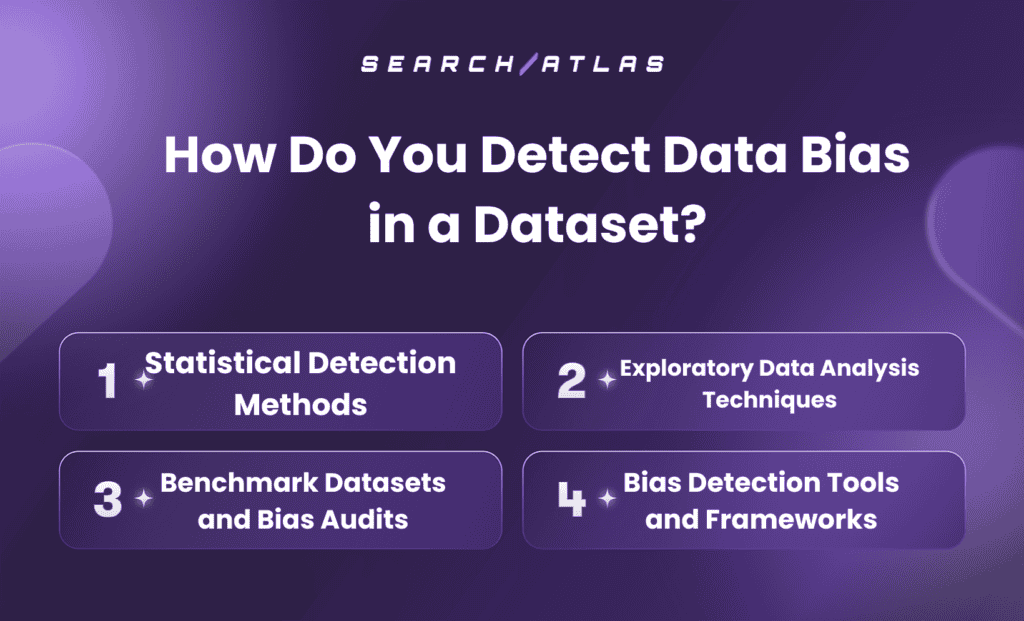
Detecting data bias in a dataset means identifying subgroup imbalances, distorted measurements, and unfair outcome patterns before model deployment. Bias detection matters because machine learning systems inherit the statistical patterns embedded inside training data, which affects fairness, accuracy, and reliability across production environments.
The 4 main ways to detect data bias in a dataset are listed below.
- Statistical Detection Methods.
- Exploratory Data Analysis Techniques.
- Benchmark Datasets and Bias Audits.
- Bias Detection Tools and Frameworks.
1. Statistical Detection Methods
Statistical detection methods identify bias through quantitative comparison of subgroup distributions, correlations, and performance gaps. These methods reveal whether the dataset represents groups unevenly or produces inconsistent outcomes across populations.
Distribution comparison tests detect bias by measuring divergence between subgroup feature distributions and label distributions. Statistical tests (chi-squared analysis and Kolmogorov-Smirnov) testing identify representation and measurement imbalances across demographic groups.
Fairness metrics detect bias by measuring outcome disparities across protected groups. Metrics (demographic parity, equal opportunity, and equalized odds) quantify whether predictions remain balanced across populations. Correlation audits detect proxy variables by measuring how strongly non-protected features predict protected demographic attributes. High correlation signals hidden bias channels inside the dataset.
Subgroup performance audits detect bias by calculating accuracy, precision, recall, and calibration separately across demographic groups. Separate subgroup evaluation exposes disparities that aggregate metrics hide.
2. Exploratory Data Analysis Techniques
Exploratory data analysis techniques reveal bias through visual inspection and statistical summaries of dataset structure and subgroup composition. These methods identify imbalances before formal model training begins.
Exploratory analysis reveals bias through histograms, scatter plots, and contingency tables that expose representation gaps and unusual subgroup patterns. Visual inspection often surfaces distortions before statistical testing confirms them.
Summary statistics detect bias by measuring differences in means, medians, counts, and variation across subgroups. Large subgroup differences frequently indicate uneven representation or inconsistent measurement. Missing data analysis detects bias when missing values correlate with demographic or contextual variables systematically. Structured missingness often reflects reporting gaps or unequal collection coverage.
Feature distribution analysis detects measurement bias when variables behave differently across demographic groups or deployment contexts. Distribution shifts often reveal sensor distortion or proxy measurement problems.
3. Benchmark Datasets and Bias Audits
Benchmark datasets and bias audits detect bias through standardized evaluation against predefined fairness criteria and controlled test environments. These methods create repeatable bias evaluation workflows across models and organizations.
Benchmark datasets detect bias by testing models against demographic-balanced datasets, stereotype probes, and counterfactual examples. Standardized benchmarks expose subgroup disparities and biased associations consistently.
Bias audits detect bias through structured review of datasets, models, subgroup metrics, and governance processes. Audit reports document risks, fairness gaps, and mitigation requirements before deployment. External audits differ from internal audits because independent reviewers apply standardized evaluation methods without organizational pressure. Independent verification improves trust and regulatory credibility. An AI audit checklist organizes this review into the broader set of governance domains, fairness and bias mitigation among them, that a full AI audit needs to cover.
4. Bias Detection Tools and Frameworks
Bias detection tools and frameworks automate fairness analysis, documentation, auditing, and monitoring across AI development pipelines. These systems scale bias governance across production environments.
Fairness metric libraries detect bias by implementing standardized subgroup evaluation and reporting utilities inside reusable software packages. Standardized tooling improves consistency across teams and projects.
Dataset documentation frameworks detect bias by recording dataset composition, collection methods, subgroup coverage, and known limitations systematically. Documentation exposes risks before downstream deployment. Model audit platforms detect bias by running automated fairness and robustness tests against trained models. Integrated audits prevent biased systems from reaching production without review.
Continuous monitoring tools detect bias after deployment by tracking subgroup performance, distribution drift, and outcome disparities across live production data. Monitoring systems identify degradation caused by feedback loops and changing environments.
How Do You Reduce or Prevent Data Bias?
Reducing or preventing data bias means improving dataset quality, refining labeling systems, testing fairness continuously, and monitoring models after deployment. Bias prevention matters because machine learning systems inherit the statistical patterns embedded inside training data, which affects fairness, reliability, and prediction accuracy across production environments.
The 4 main ways to reduce or prevent data bias are listed below.
- Improve Dataset Diversity and Representation.
- Refine Labeling and Annotation Processes.
- Apply Fairness Testing and Continuous Monitoring.
- Use Synthetic Data and Data Augmentation Carefully.
1. Improve Dataset Diversity and Representation.
Improve dataset diversity and representation by collecting data from multiple populations, regions, languages, demographic groups, and deployment conditions instead of relying on narrow sources. Diverse datasets reduce representation gaps because broader sourcing exposes the model to more real-world variation during training. Organizations improve representation through targeted collection plans, oversampling underrepresented groups, weighted training methods, and expanded edge case coverage. Better representation improves subgroup accuracy and reduces deployment failures across populations missing from the original dataset. Representation improvements alone do not eliminate bias because labeling quality, measurement distortion, and historical inequalities still influence model behavior.
2. Refine Labeling and Annotation Processes.
Refine labeling and annotation processes by creating clearer guidelines, improving reviewer consistency, and expanding the diversity of annotation teams. Strong annotation standards reduce subjective interpretation drift because labelers follow shared criteria across ambiguous examples and edge cases. Organizations reduce annotation bias through calibration sessions, adjudication workflows, disagreement review systems, and detailed documentation for difficult scenarios. Diverse labeler groups expose hidden assumptions that homogeneous annotation teams frequently overlook during supervised training workflows. Better labeling processes improve fairness because machine learning systems learn directly from labeled examples and encoded human judgments.
3. Apply Fairness Testing and Continuous Monitoring.
Apply fairness testing and continuous monitoring by evaluating subgroup performance before deployment and tracking model behavior continuously after launch. Pre-deployment fairness testing identifies calibration gaps, proxy variables, representation failures, and subgroup disparities before biased systems reach production environments. Continuous monitoring detects distribution drift, feedback loop amplification, and operational changes that introduce new bias after deployment. Organizations strengthen monitoring through subgroup-specific metrics, counterfactual testing, alert systems, and scheduled retraining cycles using audited datasets. Continuous evaluation matters because fairness degrades over time as user behavior, populations, and deployment conditions evolve.
4. Use Synthetic Data and Data Augmentation Carefully.
Use synthetic data and data augmentation carefully by expanding representation for underrepresented groups, rare deployment scenarios, and difficult edge cases without introducing artificial distortions. Synthetic generation improves dataset balance because organizations create additional training examples where real-world collection remains expensive, limited, or inaccessible. Data augmentation strengthens robustness through controlled transformations (paraphrasing, cropping, rotation, and counterfactual rewriting) across different modalities. Synthetic mitigation requires strict validation because generative systems trained on biased corpora reproduce the same statistical distortions inside artificial samples. Real-world subgroup testing remains necessary because balanced synthetic performance does not guarantee balanced production performance across deployment populations.
Why Are Large Language Models Vulnerable to Data Bias?
Large language models are vulnerable to data bias because they train on massive text corpora that contain historical inequalities, representation gaps, stereotypes, and uneven cultural patterns. This vulnerability matters because LLMs learn statistical relationships directly from training data, which means biased patterns become embedded inside generated outputs, recommendations, and reasoning behavior across production systems.
LLMs are vulnerable to data bias because the training process compresses billions of language patterns into model parameters without separating factual signal from harmful distortion. Training corpora contain internet text, books, articles, forums, and public datasets that reflect the biases of the populations that produced them. The model absorbs those statistical patterns during optimization, which causes biased associations and uneven performance to appear during generation.
LLMs are vulnerable to data bias because scale makes biased patterns difficult to isolate and remove cleanly. Modern LLMs train on trillions of tokens distributed across billions of parameters, which spreads biased relationships throughout the model architecture. Direct removal of individual patterns risks damaging general language capability, reasoning quality, or fluency. This challenge forces mitigation strategies to operate through dataset curation, instruction tuning, filtering systems, and inference controls instead of direct parameter editing.
LLMs are vulnerable to data bias because pretraining design decisions shape which populations, languages, and viewpoints dominate the final training corpus. Source selection, deduplication rules, quality filtering, and language weighting determine which content enters the optimization process and which content remains excluded. Each design decision strengthens some statistical patterns while weakening others, which means the final model inherits the cumulative effect of those tradeoffs.
LLMs are vulnerable to data bias because instruction tuning modifies surface behavior without fully replacing the deeper statistical patterns learned during pretraining. Instruction datasets improve alignment and reduce obviously harmful outputs, but the underlying pretrained associations remain embedded inside the model weights. This layered structure creates multiple levels of bias, where visible behavior improves while deeper correlations and latent stereotypes persist underneath the aligned response style.
How Does Internet-Scale Training Data Amplify Bias?
Internet-scale training data amplifies bias by exposing large language models to massive volumes of uneven, unbalanced, and statistically distorted content. Bias appears because internet datasets overrepresent dominant languages, active online communities, popular platforms, and highly discussed topics while underrepresenting less visible populations and viewpoints. LLMs learn those imbalances during pretraining, which causes biased associations, uneven output quality, and distorted framing across generated responses.
Internet-scale training data amplifies bias because language models optimize for the statistical frequency of patterns across the training corpus. Frequently repeated associations receive stronger representation inside model weights, while underrepresented concepts receive weaker representation and lower quality generation. This imbalance reinforces dominant cultural, linguistic, and platform-level patterns across production outputs.
How does web crawl composition affect LLM bias? Web crawl composition affects LLM bias because public internet content overrepresents certain languages, regions, industries, and online communities while excluding others. English language websites, technically literate populations, and large publishing platforms dominate web crawl datasets used during model pretraining. The resulting corpus reflects who publishes content online instead of reflecting the actual diversity of global populations and experiences.
Why does internet text contain reporting bias at scale? Internet text contains reporting bias because people publish content about unusual, controversial, emotional, or noteworthy events more frequently than ordinary daily reality. Common situations receive limited documentation while extreme situations generate repeated discussion and amplification across websites and platforms. LLMs inherit those distorted frequency patterns during training, which causes generated outputs to overweight dramatic or atypical cases.
How does dominant language data crowd out other languages? Dominant language data crowds out other languages because the majority of training tokens originate from high-resource languages with stronger internet presence and larger digital ecosystems. English and other dominant languages occupy most pretraining data, which gives them stronger representation inside learned model associations and generation behavior. Low-resource languages receive weaker training signals, which reduces output quality, translation accuracy, and reasoning consistency across multilingual tasks.
How do platform-specific patterns enter LLM behavior? Platform-specific patterns enter LLM behavior when training datasets overweight websites and platforms with distinctive communication styles, moderation norms, and content structures. Social platforms, forums, technical communities, and publishing sites each introduce characteristic framing patterns, tone preferences, and topic priorities into the training corpus. LLMs absorb those patterns statistically, which causes generated outputs to reflect platform-specific defaults even during neutral or general-purpose interactions.
What Biases Commonly Appear in Generative AI Outputs?
The most common biases in generative AI outputs include demographic stereotyping, cultural defaulting, factual skew, and viewpoint imbalance. These biases appear because LLMs learn statistical patterns directly from internet-scale training corpora that contain unequal representation and repeated associations. The distortions affect summarization, dialogue, translation, recommendation, and content generation tasks across AI systems.
Generative AI outputs reflect training data bias because language models optimize for high probability patterns instead of objective neutrality. Repeated associations inside the corpus become reinforced during generation, which causes certain groups, viewpoints, and cultural assumptions to appear more frequently than others.
The 4 main biases that commonly appear in generative AI outputs are listed below.
- Demographic stereotyping. Demographic stereotyping associates specific groups with certain traits, professions, or behaviors more strongly than reality supports. These associations emerge from repeated co-occurrence patterns inside training corpora. Stereotyping bias appears across dialogue systems, summarization tools, and recommendation systems.
- Cultural defaulting. Cultural defaulting treats one cultural perspective, communication style, or worldview as the implicit standard inside generated outputs. Models trained primarily on dominant language datasets generate responses aligned with the majority cultural patterns automatically. This bias reduces relevance for non-dominant audiences and multilingual users.
- Factual skew. Factual skew occurs when generated outputs overrepresent dramatic, controversial, or frequently discussed information while underrepresenting ordinary realities. Internet-scale corpora amplify reporting bias because online content focuses heavily on unusual events. This distortion creates misleading impressions about prevalence and importance.
- Viewpoint imbalance. Viewpoint imbalance appears when generated responses favor one perspective on contested topics while minimizing alternative viewpoints. Training corpora overrepresent certain publishers and ideological framings, which shape default response behavior. This bias influences how AI systems summarize and frame sensitive topics.
How Does Data Bias Affect AI Search and AI Overviews?
Data bias affects AI search and AI Overviews when retrieval systems, ranking models, and generative summaries inherit distortions from training data and indexed sources. These systems amplify dominant languages, dominant publishers, and dominant viewpoints while reducing visibility for underrepresented perspectives. AI search bias combines retrieval bias and generation bias into a single synthesized answer experience.
How does data bias affect AI search results? Data bias affects AI search results when retrieval systems prioritize sources that match the dominant patterns inside indexed corpora and training datasets. Search systems surface answers shaped by the same language, geographic, and publisher imbalances present in the underlying data sources. Users receive responses influenced by both biased retrieval and biased generation systems.
How does AI Overview generation introduce bias? AI Overview generation introduces bias when summarization models emphasize certain sources, framings, and viewpoints over others available inside the retrieved document set. Generation systems assign more weight to content patterns that align closely with the model’s training distribution. This weighting allows the generation stage bias to reshape the final answer even after diverse retrieval.
Why does AI search reduce viewpoint diversity? AI search reduces viewpoint diversity by compressing multiple sources into one synthesized response instead of exposing users to many independent links. Traditional search results allow comparison across publishers and perspectives, while AI Overviews present one dominant framing directly. Single-answer formats strengthen whichever viewpoints the model favors during summarization.
How does indexing bias compound LLM bias in AI search? Indexing bias compounds LLM bias when retrieval systems overrepresent certain publishers, languages, and regions before generation begins. Retrieval systems return only the content available inside the search index, which means missing sources become missing viewpoints. The language model then generates answers from an already biased retrieval pool, which amplifies the distortion further.
Can Retrieval-Augmented Generation Reduce LLM Bias?
Retrieval augmented generation (RAG) interacts with data bias because both the retrieval system and the language model contribute independently to the final output. RAG reduces some forms of bias by grounding responses in external sources instead of relying only on parametric model knowledge. RAG introduces new bias risks when the retrieval corpus, ranking logic, or source selection process remains skewed. The final fairness profile depends on both retrieval quality and generation behavior.
How does retrieval augmented generation interact with data bias? Retrieval augmented generation interacts with data bias by combining the biases of retrieved documents with the biases already embedded inside the language model. Retrieved sources shape what information enters the answer, while the model shapes how that information becomes summarized and framed. The interaction creates a layered bias system across the retrieval and generation stages.
How can retrieval reduce LLM bias? Retrieval reduces LLM bias by grounding outputs in current, citable, and externally verified documents instead of relying entirely on pretrained statistical associations. Grounded generation limits the influence of latent stereotypes and unsupported assumptions because the model needs to align outputs with retrieved evidence. This grounding shifts more control toward the retrieval corpus and source quality. That grounding only works as well as the source material allows, which is why unambiguous, entity-organized content built with a framework like SEO Topical Maps gives retrieval systems cleaner signal to pull from than scattered, overlapping pages.
How can retrieval introduce new bias? Retrieval introduces new bias when the indexed corpus, ranking algorithms, or query rewriting systems favor certain publishers, viewpoints, languages, or demographic perspectives over others. Biased retrieval limits what information reaches the generator, which shapes the final answer regardless of model neutrality. The retrieval stage bias becomes the output stage bias because the generator depends directly on the retrieved context.
How is bias measured in RAG systems? Bias in RAG systems is measured by evaluating retrieval fairness, source diversity, demographic coverage, and generation fidelity together and separately. Retrieval evaluation measures which sources appear and which perspectives remain excluded from the retrieved set. Generation evaluation measures whether the final output introduces stereotypes, framing distortion, or unsupported assumptions beyond the retrieved evidence.
What Are Common Challenges in Preventing Data Bias?
The main challenges in preventing data bias include difficult detection, conflicting fairness goals, organizational limitations, and persistent bias inside legacy and third-party systems. These challenges exist because bias appears across datasets, models, workflows, and deployment environments simultaneously. Preventing bias requires continuous evaluation, governance, and cross-functional coordination instead of one-time technical fixes.
Preventing data bias remains difficult because mitigation methods often shift distortions instead of removing them completely. Bias reduction requires balancing fairness, accuracy, operational constraints, and regulatory expectations across changing production systems. This complexity makes bias prevention an ongoing governance process rather than a single engineering task.
The 6 main challenges in preventing data bias are listed below.
- Difficult bias detection. Detecting all forms of data bias remains difficult because bias hides inside proxies, subgroup interactions, and contextual patterns that no single metric captures completely. Comprehensive detection requires multiple evaluation methods across many populations and deployment scenarios.
- Conflicting fairness criteria. Conflicting fairness criteria create challenges because different fairness definitions cannot always be satisfied simultaneously under real-world conditions. Improving one fairness metric frequently introduces tradeoffs in calibration, subgroup accuracy, or prediction consistency.
- Organizational constraints. Organizational constraints limit mitigation because bias reduction requires budget, expertise, governance processes, and long-term investment that compete against deployment pressure and delivery timelines. Weak executive support often reduces fair investment across development teams.
- Third-party AI limitations. Third-party AI systems create challenges because buyers lack direct control over training data, model architecture, and evaluation procedures used by external vendors. Bias mitigation depends heavily on vendor transparency, documentation quality, and audit access.
- Persistent legacy system bias. Legacy systems carry persistent bias because retraining, redesign, or replacement becomes expensive after models integrate deeply into production workflows. Historical distortions remain embedded across later versions unless organizations address them explicitly.
- Compounding mitigation effects. Bias mitigation introduces additional complexity because removing one distortion frequently exposes another hidden distortion elsewhere inside the system. Reweighting, feature removal, and subgroup balancing often shift error patterns instead of eliminating unfairness.
What Are the Ethical and Regulatory Concerns Around Data Bias?
Ethical and regulatory concerns around data bias focus on fairness, accountability, transparency, discrimination risk, and legal compliance across AI systems. Biased AI systems create concern because automated decisions affect employment, healthcare, lending, housing, education, and public services on a large scale. Governments, regulators, and industry organizations increasingly treat data bias as both an ethical problem and a regulated operational risk.
What ethical principles apply to data bias in AI? Ethical principles applied to data bias include fairness, accountability, transparency, and non-discrimination across protected groups and deployment populations. These principles define how organizations design, evaluate, document, and govern AI systems responsibly. Ethical frameworks translate those principles into requirements for fairness testing, explainability, and disclosure across high-impact systems.
How do anti-discrimination laws apply to biased AI systems? Anti-discrimination laws apply to biased AI systems because legal standards prohibit unequal treatment and disparate impact, regardless of whether decisions come from humans or algorithms. Employment, lending, housing, and public accommodation laws increasingly apply directly to automated decision systems. Regulators treat biased algorithmic outcomes as enforceable discrimination risks across many sectors.
What AI-specific regulations target data bias? AI-specific regulations target data bias through transparency obligations, risk classification systems, conformity assessments, and mandatory impact reporting requirements. Frameworks (EU AI Act) impose stricter obligations on high-risk AI systems used in sensitive domains. These regulations expand compliance requirements beyond traditional discrimination law into continuous governance and documentation standards.
What disclosure obligations apply to biased AI outcomes? Disclosure obligations require organizations to inform users, regulators, or affected individuals when AI systems influence decisions or recommendations. Many jurisdictions require organizations to explain how automated systems operate and how decisions affect individuals. Disclosure rules increase external scrutiny and create stronger pressure for documented bias mitigation practices.
How does data protection law interact with bias mitigation? Data protection law interacts with bias mitigation because fairness testing often requires demographic data that privacy regulations restrict or classify as sensitive information. Organizations need to balance fairness evaluation with consent requirements, data minimization rules, and security obligations. This interaction creates operational complexity across regulated AI deployment environments.
How are independent audits used as accountability mechanisms? Independent audits function as accountability mechanisms because external reviewers evaluate fairness claims without the conflicts of interest present in internal assessments. Auditors apply standardized testing methods, review documentation, and publish findings for regulators, procurement teams, or public oversight processes. Independent verification strengthens trust and improves governance credibility for high-risk AI systems.
What enforcement risks do biased AI systems face? Biased AI systems face enforcement risks through regulatory fines, litigation, mandatory redesign orders, public reporting obligations, and reputational damage. Enforcement actions increasingly target the full AI lifecycle from dataset collection through deployment, monitoring, and governance documentation. Growing regulatory pressure makes bias mitigation a major compliance and enterprise risk management priority.
What Is the Future of Data Bias and AI Governance?
The future of data bias and AI governance is shifting toward continuous monitoring, automated fairness evaluation, and stricter regulatory oversight across the full AI lifecycle. Organizations increasingly treat bias mitigation as a governance requirement because AI systems now influence hiring, healthcare, finance, search, and public decision-making on a global scale.
Current trends show that AI governance frameworks now prioritize transparency, subgroup evaluation, documentation standards, and ongoing fairness audits instead of one-time compliance reviews. Regulators and enterprise buyers increasingly require explainability, auditability, and measurable bias mitigation before approving high-risk AI deployments.
AI governance is expanding toward embedded and proactive oversight that integrates fairness testing directly into development, deployment, and monitoring workflows. Organizations increasingly use AI-driven audit systems, synthetic data validation, and automated monitoring platforms to detect emerging bias patterns before those patterns create operational, legal, or reputational harm.
How Will Real-Time Monitoring Improve Bias Detection?
Real-time monitoring improves bias detection by shifting AI governance from periodic audits to continuous evaluation of live production behavior. Continuous monitoring matters because bias often emerges after deployment through distribution shift, feedback loops, and changing user behavior patterns that static testing cannot predict.
Real-time monitoring improves bias detection because automated systems evaluate subgroup performance, fairness metrics, and outcome disparities continuously across live production data. Continuous evaluation identifies emerging bias patterns immediately instead of waiting for scheduled audits or external complaints. This approach reduces the duration and scale of biased behavior inside deployed AI systems.
Real-time monitoring improves bias detection because modern monitoring infrastructure integrates directly with model serving pipelines, observability systems, and operational dashboards. Streaming data pipelines, subgroup metric engines, alert systems, and governance dashboards process fairness metrics continuously across production environments. This infrastructure allows organizations to detect and investigate fairness failures as they occur.
Real-time monitoring improves bias detection because automated alert thresholds identify subgroup performance deviations before those deviations escalate into major operational or compliance failures. Organizations define acceptable fairness ranges using historical baselines, risk tolerance, and regulatory requirements. Alert systems trigger investigation workflows automatically whenever live metrics cross those thresholds.
Real-time monitoring improves bias detection because continuous evaluation creates faster retraining and remediation cycles across production AI systems. Monitoring systems generate diagnostic data, escalation signals, and automated review triggers that route detected bias directly to engineering and governance teams. Faster response cycles reduce long-term exposure to biased outputs, recommendations, and automated decisions.