Fact-grounding optimization in brief
Verdict: Fact-grounding optimization raises a page’s citation eligibility inside AI answers. It does not guarantee a citation, and it does not replace traditional ranking work.
Fact-grounding optimization is a publisher-side content standard. It turns broad explanations into standalone evidence units by naming the entity, stating one verifiable claim, attaching the qualifier or source, and placing the claim in a clear semantic structure. The standard complements what makes content citable and differs from RAG, which is the system-side retrieval architecture.
Fact-grounding optimization is the discipline of structuring written content so that AI systems attach specific claims to verifiable source passages during answer generation. The practice sits between traditional SEO and generative engine optimization. Fact-grounding optimization targets the moment a large language model decides whether a passage is reliable enough to cite. Grounding refers to the link between a model’s output and the retrieved source that supports it. Grounded systems produce more accurate, citation-friendly responses than systems generated from parametric memory alone.
Public benchmarks for grounding LLMs (Google DeepMind’s FACTS Grounding evaluation) now measure how often LLM outputs stay tethered to provided source documents instead of drifting into hallucination. The benchmark scores systems on the proportion of responses where every factual claim is supported by the source. The methodology illustrates the standard production AI search systems target. Pages that read well to grounding evaluators read well to retrieval-augmented generation pipelines used inside ChatGPT Search, Google AI Overviews, Perplexity, and Gemini grounding modes. Fact grounding in AI search means an answer references a retrieved source that confirms the specific claim.
Fact-grounding optimization differs from GEO and traditional SEO because it targets passage-level factual extractability rather than document-level retrieval and ranking. Fact-grounding optimization differs from RAG because RAG describes the system architecture, and fact-grounding optimization describes the content design. AI systems ground answers in source content through 3 sequential stages (retrieve candidate passages, evaluate semantic and factual fit, assemble the response with citations attached). LLM grounding in AI search combines 3 sub-mechanisms (retrieval-augmented generation, semantic matching with entity resolution, and grounded-versus-hallucinated response selection).
There are 7 best practices for fact-grounding optimization (verifiable claims, self-contained facts, entity clarity, structured formatting, evidence attribution, content freshness, and ambiguity reduction). 4 schema types support fact grounding (entity schema, FAQ/Article/QAPage schema, sameAs with Knowledge Graph alignment, and structured data for content relationships).
Measurement combines prompt-based testing, citation tracking, and structural audits. 5 common mistakes prevent AI grounding (long paragraphs without extractable facts, vague or unsupported claims, missing attribution, weak semantic structure, and inconsistent entity references). Implementation work spans writing, structure, and markup. Writers convert long paragraphs into single-idea blocks.
What is fact-grounding optimization?
Fact-grounding optimization is the content design practice that makes specific claims on a page directly retrievable, verifiable, and citable by AI systems. The discipline focuses on writing units small enough for passage-level retrieval. The discipline anchors each unit with entities and sources, so a language model confirms the claim against the underlying text. Fact-grounding optimization produces content that retrieval-augmented generation pipelines lift into responses without distortion, which is the precondition for AI citations.
What problem does fact-grounding optimization solve for publishers? Fact-grounding optimization solves the problem of pages that index but never get cited in AI answers. Indexing only proves a page is reachable. Grounding proves a page is usable. The fix is structural. Writers rewrite paragraphs into atomic answer units, expose specific numbers and named entities, and attach evidence to every non-trivial claim. The work converts an indexable document into a retrievable evidence base.
How does fact-grounding optimization relate to grounding LLMs at the system level? Grounding LLMs is the system-side work of forcing a model to base outputs on retrieved sources, and fact-grounding optimization is the publisher-side work of making those sources easy to use. The 2 sides converge inside a retrieval pipeline. Strong grounding requires both a well-tuned retrieval system and well-structured source content. Publishers influence only the second half. The publisher’s job is to remove ambiguity, repetition, and unsupported claims that a grounded model would reject.
Why is fact-grounding optimization treated as a distinct discipline rather than a subset of SEO? Fact-grounding optimization is distinct because it targets passage-level factual extractability, while SEO targets document-level retrieval and ranking. A page ranks in Google’s blue links while remaining unusable to an AI search answer. A page gets cited by ChatGPT Search without ranking in traditional results. Different measurement, different writing decisions, different optimization signals. The disciplines complement each other, but no longer overlap completely.
What does fact-grounding mean in AI search?
Fact-grounding in AI search means an answer references a retrieved source that confirms the specific claim, rather than relying on the model’s pre-trained parameters. A grounded answer traces back to a passage. An ungrounded answer does not. Production AI search systems prefer grounded outputs because grounded responses are easier to cite, easier to audit, and less likely to hallucinate against the source.
How does grounding LLM behavior differ from open-ended generation? A grounding LLM is constrained to produce output that is supported by retrieved evidence, while an open-ended generator is free to produce any plausible-sounding response. The constraint changes both what the model writes and what content it needs to write well. Open generation rewards stylistic fluency. Grounded generation rewards source compatibility. Pages optimized for grounding feed the second mode, not the first.
Why does grounding behavior depend on the publisher’s content? Grounding behavior depends on the publisher’s content because the model cannot ground itself in a passage that does not exist on the page. A page that hedges, generalizes, or buries facts inside long paragraphs offers nothing to retrieve. The model defaults back to parametric memory and produces an answer that the citation pipeline downgrades. Specific, extractable language inverts the default and turns the page into a usable grounding source.
Why does fact-grounding matter for AI visibility and citations?
Fact-grounding matters for AI visibility because AI systems cite the pages they confirm, and they confirm pages that contain specific, retrievable claims. Visibility inside generative answers is a function of citation probability. Citation probability is a function of grounding fitness. AI citation behavior treats pages with vague phrasing and few entities as structurally invisible inside AI Overviews and ChatGPT Search responses, regardless of their backlink profile. A page’s citation potential rises in direct proportion to its grounding fitness across the AI search pipeline.
What role does fact grounding play in citation behavior across AI search engines? Fact grounding determines whether an AI system attributes a claim to your page or substitutes a generic statement that goes uncited. Each major AI search engine (Perplexity, Google AI Overviews, ChatGPT Search, Gemini) uses grounded generation to control hallucination risk. Pages that cleanly support specific claims become preferred sources. Pages that fail grounding get skipped even when they rank for the underlying query.
Why does grounding affect long-term content discoverability inside AI search? Grounding affects long-term discoverability because AI systems remember which pages produced reliable citations and adjust retrieval accordingly. A page that gets selected as a grounding source for one query gains compounding selection probability for related queries. The system’s confidence in the source rises. The reverse holds. Pages that fail grounding repeatedly drop out of the candidate set. AI citation behavior is path-dependent, and grounding fitness is the input.
Fact-grounding optimization vs GEO vs traditional SEO
Fact-grounding optimization is a subset of GEO focused specifically on factual extractability, while GEO is the broader discipline of optimizing for AI-generated answers. GEO addresses tone, formatting, prompt compatibility, and visibility across multiple AI answer environments. Fact-grounding optimization narrows to one task. Each claim on a page becomes individually verifiable against the page itself. The first explains how the AI engine sees the content; the second explains why the AI engine cites a claim.
The 4 disciplines answer different questions. Use the following boundary when deciding what to change on a page:
| Discipline | Primary unit | Main question | Typical page change |
|---|---|---|---|
| Traditional SEO | Document | Can search engines discover and rank this page? | Improve intent match, crawlability, links, and metadata. |
| GEO | Answer environment | Can an AI system retrieve and reuse this page in an answer? | Improve answer structure, entity coverage, and citation readiness. |
| Fact-grounding optimization | Claim or passage | Can the system verify this specific claim against the source? | Make claims atomic, sourced, qualified, and extractable. |
| RAG | Retrieval pipeline | Can an AI application retrieve useful context before generation? | Improve indexing, chunking, retrieval, reranking, and generation controls. |
Fact-grounding optimization is therefore a content-side standard, not a promise about an AI platform's ranking or citation behavior. A page can satisfy SEO and GEO requirements while still failing the grounding check because its strongest claims are vague, unsupported, or impossible to verify in isolation.
What separates fact-grounding optimization from traditional SEO? Traditional SEO targets document-level ranking signals such as backlinks, page experience, and keyword relevance, while fact-grounding optimization targets passage-level retrieval and citation eligibility. A page can carry strong titles, metadata, and backlinks and still bury every load-bearing fact inside narrative paragraphs. The 2 disciplines reward different writing patterns, even on an identical topic. Rankings report discovery, while citations report usability.
How does benchmarking LLMs inform the difference between these 3 layers? Benchmarking LLMs on grounding tasks (the FACTS Grounding benchmark) exposes how content properties influence answer accuracy independently of ranking signals. The benchmark scores models on factual fidelity to the source, not the source’s domain authority or backlink profile. Results show that source content with explicit claims, named entities, and clear numeric values produces higher grounding scores, regardless of where the source ranks in traditional search. The implication is direct. Benchmark performance and SEO performance now diverge.
Where do SEO, GEO, and fact-grounding optimization overlap in practice? The 3 disciplines overlap in quality and topical depth but diverge on writing structure, entity treatment, and evidence placement. SEO best practices (internal linking, schema, topical clusters) still apply. GEO adds formatting for extraction. Fact-grounding optimization adds atomic claim structure, sourcing within passages, and entity disambiguation. A page meets all 3 sets of requirements simultaneously only if the writing is designed for grounding from the start rather than retrofitted from a ranking-first draft.
What is the difference between fact-grounding optimization vs RAG?
RAG is one of several knowledge injection in AI methods: a system architecture that retrieves passages and injects them into a model prompt, while fact-grounding optimization is the content design that determines which passages get retrieved and how well they support the answer. RAG is a pipeline. Fact-grounding optimization is a writing standard. The first sits inside the AI system. The second sits inside the publisher’s content. Both contribute to grounded outputs. Only the second is controllable from the outside.
What role does RAG play in grounding outcomes? RAG provides the retrieval mechanism that turns a publisher’s page into evidence for an AI answer, but RAG cannot fix poorly written source content. When RAG retrieves a passage that does not directly support the query, the model either skips the citation, hallucinates a connection, or downgrades the source. The retrieval system is only as good as the corpus it draws from. The corpus is shaped by publisher writing decisions. RAG amplifies content quality. RAG does not substitute for it.
What does the LLM benchmark news suggest about RAG’s accuracy ceiling? Recent LLM benchmark news shows that RAG systems consistently outperform non-retrieval LLMs on factual tasks, but the gap depends on the quality of the retrieved corpus. Benchmarks (FACTS Grounding, FreshQA, HaluEval) report that grounded responses produce higher factuality scores when the source documents are clean, specific, and structurally clear. The same systems perform poorly when forced to retrieve from vague or promotional text. The lesson for publishers is that RAG raises the ceiling, but content sets the floor.
Where do fact-grounding optimization and RAG overlap as practices? The 2 overlap on retrieval design because both treat passages, not documents, as the unit of evaluation. RAG splits documents into chunks for embedding and retrieval. Fact-grounding optimization writes those chunks intentionally instead of letting them emerge from prose. RAG retrieval improves when publishers structure content as discrete claim units with explicit context, because the chunks already match how the system consumes the text. The 2 practices converge on the same underlying primitive (the standalone, extractable passage).
How do AI systems ground answers in source content?
AI systems ground answers by retrieving passages, embedding them alongside the query, and scoring whether each retrieved passage supports the proposed response before emitting it to the user. The process happens in 3 stages. Firstly, the system retrieves candidate passages. Secondly, the system evaluates semantic and factual fit. Thirdly, the system assembles the response with citations attached to the supporting passages. Each stage filters out passages that fail the grounding check. Poorly structured pages drop out of the citation pool even after being retrieved.
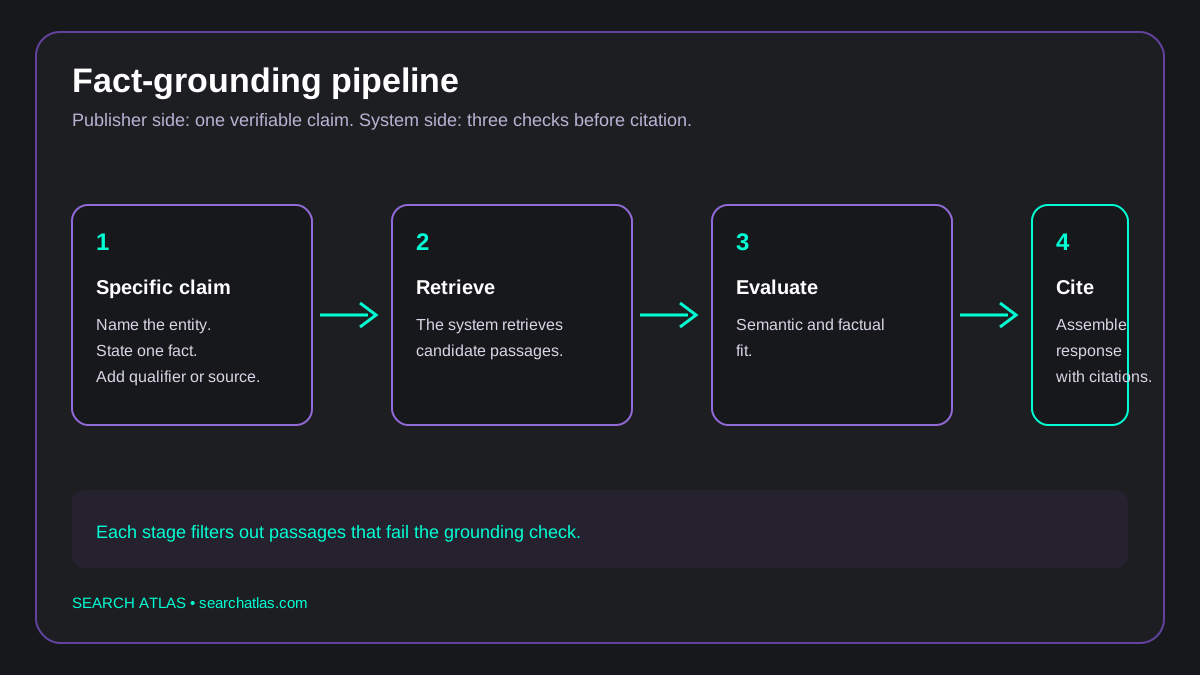 Fact-grounding pipeline
What signals do AI systems use to bind facts to source content? AI systems use entity matches, numerical alignment, temporal consistency, and semantic similarity to bind each claim in the response to a passage in the source. The proposed answer says “rose 12 percent in 2024.” The grounding check searches for a passage containing that exact figure attached to the same entity and timeframe. Pages that paraphrase loosely or omit specifics produce weak binding scores. The binding step separates a citation-worthy page from a topically relevant page.
Why does the source’s structural clarity affect grounding more than its domain authority? Source clarity affects grounding more than domain authority because the grounding check operates at the passage level, where authority signals are not visible. The model sees only the retrieved text, not the URL’s PageRank or domain age. A high-authority page with vague claims loses the binding check to a low-authority page with specific, extractable claims. Domain authority influences whether a page is retrieved. Structural clarity influences whether a page is cited.
How do LLM grounding pipelines decide which source to favor when multiple pages cover the same fact? LLM grounding pipelines favor the source with the most direct, unambiguous statement of the fact, with entity references and numeric specificity weighing heavily in the ranking. When 2 pages claim the same fact, the model picks the one whose passage requires the least inference to confirm. Pages that state the fact in a single sentence near a relevant entity reference outrank pages that imply the fact through context. Grounding is a competition for directness, not just topical coverage.
How does LLM grounding work in AI search?
LLM grounding in AI search combines 3 sub-mechanisms that work together inside the answer pipeline. Each sub-mechanism has separate failure modes and separate content requirements. Publishers optimize for grounding by understanding which mechanism most likely drops their content and addressing the corresponding writing or structural gap. There are 3 sub-mechanisms of LLM grounding listed below.
- Retrieval-Augmented Generation (RAG) and Grounding.
- Semantic Matching and Entity Resolution.
- Grounded vs Hallucinated AI Responses.
What do the 3 sub-mechanisms have in common? The 3 sub-mechanisms share a passage-level evaluation step where the model checks whether a retrieved chunk actually supports the proposed response. RAG handles retrieval. Semantic matching handles concept alignment. The grounded-versus-hallucinated check handles factual confirmation. The same passage passes one stage and fails another. Content optimized only for retrieval often still fails to produce citations. Full grounding requires passing all 3.
1. Retrieval-augmented generation (RAG) and grounding
Retrieval-augmented generation works inside LLM grounding by embedding both the user query and a corpus of passages into a vector space, retrieving the top-k semantically similar passages, and supplying those passages to the model as context for response generation. The model receives instructions to base its answer on the retrieved passages rather than its pre-trained parameters. The retrieval step uses dense vector similarity, not keyword match. Semantic phrasing matters more than exact-string repetition. The accuracy of LLM models on factual tasks rises substantially under RAG compared to no-retrieval baselines.
What makes a passage a strong retrieval candidate inside a RAG pipeline? A passage is a strong retrieval candidate when its embedding sits close to the query embedding in vector space, and its content directly addresses the query topic. Strong candidates use clear topical language, name the relevant entities, and state the fact in a single self-contained block. Weak candidates drift across multiple topics or hide the relevant fact inside a surrounding context that dilutes the embedding signal. The optimization target is to align each passage’s embedding tightly with the queries it answers.
Why does RAG raise the accuracy of LLM models on factual queries? RAG raises accuracy because retrieved passages give the model evidence it does not have to reconstruct from pre-trained parameters, which eliminates the most common hallucination source. Pre-trained parameters drift, age, and confabulate on long-tail facts. A retrieved passage from a freshly published source short-circuits the drift by handing the model the answer directly. The gain shows up most strongly on time-sensitive, entity-specific, and numeric queries, which are the categories most relevant to AI search.
2. Semantic matching and entity resolution
Semantic matching works in LLM grounding by comparing the embedding of the query with the embeddings of candidate passages and selecting the passages whose meaning, not just wording, best aligns with the query. Embedding models capture topical and conceptual similarity. Passages that use synonyms, paraphrases, or related terminology still match a query that uses different vocabulary at the literal word level. The match score determines retrieval order and influences which passage the grounded response cites.
How does entity resolution support grounding accuracy? Entity resolution supports grounding by identifying which real-world entity a passage refers to and reconciling that entity across the query, the passage, and the knowledge graph. When a query asks about “Search Atlas,” the system confirms the page refers to Search Atlas and not a similarly named entity. Disambiguation cues (sameAs schema, knowledge panel alignment, explicit naming in surrounding text) raise the entity resolution score. The mechanism resembles how Google quality raters evaluate entity clarity in human-rated retrieval samples, though here the evaluator is a model.
Why does entity resolution determine grounding eligibility? Entity resolution determines eligibility because a passage that fails to bind to the right entity cannot support the query, even if the topic is correct. A page about a different product with the same name loses the binding check and drops out of the candidate set. Strong entity references inside the page (full names, definitional sentences, references to related entities) reduce the resolution risk. Weak entity treatment (pronoun-heavy writing, inconsistent naming) raises the risk of filtering before the grounding step.
3. Grounded vs hallucinated AI responses
Grounded vs hallucinated AI responses work in LLM grounding through a binding check that compares each generated claim against the retrieved passages. A grounded response is one where each factual claim in the answer is supported by a retrieved passage. A hallucinated response includes claims that the retrieved passages do not support. Grounded responses carry citations that match specific sentences in the source. Hallucinated responses carry citations that look authoritative but cover only the broader topic, not the precise claim. Production AI search systems run a grounding check before publishing the response and downgrade or remove unsupported claims.
| Signal | Grounded response | Ungrounded response |
|---|---|---|
| Claim support | Every factual claim is supported by a retrieved passage. | Claims extend beyond what the passages support. |
| Citation behavior | Citations match specific sentences in the source. | Citations cover the broader topic, not the precise claim. |
| System handling | The response passes the grounding check and ships. | Unsupported claims get regenerated, hedged, or suppressed. |
How do AI systems detect AI hallucination inside grounded pipelines? AI systems detect AI hallucination by comparing each generated claim against the retrieved passages and flagging claims with no direct textual support. The check uses entailment models, similarity scoring, or rule-based extraction depending on the system. Flagged claims either trigger a regeneration attempt, get rewritten into hedged language, or get suppressed entirely. The reliability of the check has improved across recent LLM benchmark news, especially for systems trained explicitly on grounding tasks.
Why do well-grounded pages reduce hallucination risk for the system that cites them? Well-grounded pages reduce hallucination risk because they hand the model an explicit, unambiguous source to anchor each claim, which removes the model’s incentive to fall back on parametric memory. The model lifts the claim with high confidence and attaches the citation when the page already contains the claim in a clean form. The model reconstructs the claim when the page implies it through inference. The reconstruction step is where hallucination enters. The Google ground check at the response-assembly stage rewards pages that minimize the reconstruction step.
What techniques improve fact-grounding in AI systems?
4 techniques improve fact grounding in AI systems. Each technique addresses a different failure mode along the grounding pipeline. Modern AI search systems combine all 4. Publishers who understand the techniques predict which content properties earn citations and which do not. The 4 techniques are listed below.
- Supervised Fine-Tuning (SFT) for Domain Accuracy.
- Synthetic Data Generation for Fact Verification.
- In-Context Learning and Instruction Grounding.
- Post-Processing and Validation Filters.
Why do these techniques matter for publisher-side optimization? The techniques matter for publishers because they define what AI systems are trained to recognize as a high-quality grounding source. Content that aligns with the patterns these techniques reinforce gets retrieved, cited, and preserved across answer revisions. Content that contradicts the patterns gets suppressed even when it ranks. The techniques are upstream of every citation outcome.
1. Supervised fine-tuning (SFT) for domain accuracy
Supervised fine-tuning improves fact grounding by training the model on labeled examples that pair queries with verified, source-supported answers, which teaches the model to prefer source-anchored output patterns. The training signal explicitly rewards responses where each claim ties back to the supplied source. After fine-tuning, the model biases toward citing rather than inventing. The system’s grounding accuracy on held-out evaluations rises.
What does the measuring what matters construct validity in large language model benchmarks research reveal about fine-tuned grounding? The measuring what matters construct validity in large language model benchmarks research shows that fine-tuned grounding behavior generalizes only when the training examples mirror the structural properties of real source content. A training dataset uses well-structured passages with clear entity references and specific numbers. The model learns to expect those properties in real retrieval sources. Pages that match the training distribution earn citations more reliably than pages that do not. The implication is that grounding-friendly writing aligns with the patterns the model was rewarded for during fine-tuning.
Why does fine-tuning for domain accuracy raise publisher citation rates? Fine-tuning raises publisher citation rates because the model becomes more discriminating about which sources count as reliable evidence and shifts citations toward sources that match the fine-tuning distribution. Generic, vague, or promotional content moves down the candidate ranking. Specific, evidence-backed content moves up. The effect is most visible in vertical-specific AI search, where domain fine-tuning is heaviest. Publishers in high-fine-tuning verticals see citation rates respond directly to grounding-fit improvements.
2. Synthetic data generation for fact verification
Synthetic data generation improves fact grounding by producing controlled query-source-answer triples that the model uses to learn fact verification patterns under known conditions. The synthetic pipeline manipulates exactly which facts are supported, partially supported, or contradicted, which gives the model a clear signal about how to handle each case. The technique has become standard in benchmarking for LLMs development because real-world data does not cover all the edge cases needed for robust grounding.
What types of synthetic examples are most useful for grounding training? The most useful synthetic examples include cases where the answer is supported, cases where the answer is partially hedged, and cases where the model refuses to answer due to insufficient evidence. Training across the full distribution teaches the model when grounding is possible and when it is not. The same lesson applies to publisher content. Pages that explicitly state the limits of their evidence give the model a clean signal to handle the claim correctly rather than overstating support.
Why does synthetic data generation increase verification reliability? Synthetic data increases reliability because it removes ambiguity from the training set and exposes the model to verification patterns at a higher volume than naturally occurring data allows. The model converges faster on the desired behavior and develops sharper rejection of unsupported claims. The downstream effect for publishers is that AI systems become better at distinguishing strong sources from weak ones. The competitive gap between grounding-optimized pages and the rest sharpens.
3. In-context learning and instruction grounding
In-context learning improves fact grounding at inference time by supplying the model with example query-source-answer patterns inside the prompt itself, which teaches the model the desired grounding behavior without retraining. The technique works because large language models generalize from a few in-context examples to similar tasks. Production AI search systems use system prompts that include grounding instructions and sometimes a small set of in-context grounding examples to bias outputs toward source-anchored answers.
What role does instruction grounding play in modern AI search systems? Instruction grounding plays the role of constraining the model to follow explicit rules about how to use retrieved sources (when to cite, when to hedge, when to refuse). The instructions are either issued as system prompts or as part of the model’s training distribution. Public evaluations such as the IFEval benchmark measure how reliably models follow grounding-style instructions across a wide range of tasks. Stronger instruction-following correlates with higher grounding scores.
Why does instruction grounding affect which content gets cited? Instruction grounding affects citations because the instructions push the model toward sources that satisfy the cited rules (clear claims, named entities, explicit evidence). Pages that match the instruction’s implicit definition of a good source rise in the candidate ranking. Pages that force the model to bend the rules or hedge the citation fall in the ranking. The effect is structural. Writing for the instruction set that the model follows is a direct lever on visibility.
4. Post-processing and validation filters
Post-processing filters improve fact grounding by checking each candidate response after generation and rejecting or rewriting claims that are not supported by the retrieved passages. The filters run as a second pass over the model’s output, often using a separate entailment model or rule-based extractor. Responses that fail the check get sent back for regeneration, hedging, or stripped of the unsupported claim entirely. The filter is the last defense against hallucinated citations reaching the user.
What kinds of validation filters appear in production AI search systems? Production validation filters include entailment checks, citation alignment checks, entity consistency checks, and recency checks against the retrieved sources. Each filter targets a specific failure mode. Coverage of these filters has expanded through recent LLM evaluation news across 2026. Many AI search vendors publish details about their filter stacks. The trend points toward stricter filtering, which raises the bar for the underlying source content.
Why do validation filters raise the importance of clean source content? Validation filters raise the importance of clean content because the filter passes only claims that are clearly supported by the source, and clarity comes from the publisher’s writing. A source that supports a claim implicitly passes a loose filter but fails a strict one. As filters tighten, only sources with explicit, extractable support survive into the final response. The publishing implication is direct. Implicit support is increasingly insufficient. Explicit support is the new minimum for grounded systems.
What makes content easy for AI systems to ground?
5 characteristics make content easy for AI systems to ground. Each characteristic removes a specific class of ambiguity that would trigger filtering inside the grounding pipeline. The combined effect produces a page whose passages get lifted as evidence with minimal reconstruction. The 5 characteristics are listed below.
- Standalone Clarity at the Sentence Level.
- Numeric Specificity and Named Entities.
- Source Attribution Within Claims.
- Entity Clarity and Disambiguation.
- Structured Formatting and Semantic Hierarchy.
1. Standalone clarity at the sentence level
Standalone clarity at the sentence level makes content easy to ground because each sentence gets lifted from the page without losing meaning, which is exactly what a retrieval-augmented generation pipeline needs. A standalone sentence names its subject, states its claim, and supplies the context required to verify it. The model retrieves the sentence and uses it directly, without pulling in the surrounding context that dilutes the embedding or introduces noise.
What does sentence-level clarity look like in practice? Sentence-level clarity is achieved by using full noun phrases instead of pronouns, complete verb constructions instead of fragments, and one fact per sentence instead of compound claims. A sentence that begins with “the platform supports it” depends on previous context to make sense and fails standalone retrieval. A sentence that begins with “Search Atlas supports schema markup for FAQ, Article, and QAPage types” stands alone and gets lifted intact. The rewrite cost is small. The grounding gain is large.
Why does standalone clarity improve performance on ground truth dataset evaluations? Standalone clarity improves performance on ground truth dataset evaluations because the datasets score whether a single passage supports a single claim, and clarity at the sentence level produces exactly that one-to-one mapping. Evaluation pipelines for grounding benchmarks rely on passage-level scoring. Pages with clear sentences score consistently across diverse evaluation sets. Pages with tangled sentences score variably depending on which surrounding context comes along, which raises evaluation noise and lowers reliability.
2. Numeric specificity and named entities
Numeric specificity and named entities make content easy to ground because they create unambiguous anchors that the grounding pipeline matches against the query without inference. A passage that says “42 percent of pages with schema markup earned rich result eligibility” gets verified directly. A passage that says “many pages benefit from schema” does not. The first carries facts that AI systems lift. The second carries claims they reconstruct, and reconstruction is where citations break down.
What kinds of specificity matter most for grounding? The most important kinds of specificity are exact numbers, dates, proper nouns, product names, version numbers, and quantified comparisons. Each removes a degree of ambiguity. A page that names “Google AI Overviews” rather than “AI search results” passes more grounding checks because the entity reference is exact. A page that says “doubled in the last year” loses to a page that says “rose from 14 percent to 28 percent between Q1 2024 and Q1 2025.” Specificity scales with grounding eligibility.
Why does the absence of specificity lower citation rates? The absence of specificity lowers citation rates because vague claims cannot be verified, and unverifiable claims get filtered out of grounded responses. The model has nothing to bind the answer to. The model either skips the source or hedges the citation until the result is too weak to publish. The publisher loses the citation regardless of how well the page ranks in traditional search. Specificity is the price of entry to the citation pool.
3. Source attribution within claims
Source attribution within claims makes content easy to ground because the attribution travels with the claim into the retrieved passage and gives the AI system independent evidence of the claim’s validity. A page that attributes a statistic to its source, with the source named inside the same sentence or the next, hands the AI system a completely grounded unit. The system cites the page and the underlying source simultaneously, which raises confidence and selection probability.
What does in-line attribution look like at the sentence level? In-line attribution is a claim followed immediately by the source name, publication date, and ideally a link, all within the same paragraph as the claim. The pattern resembles academic citation but stays written for retrieval rather than scholarship. The attribution does not need a full citation block. A phrase like “according to Google DeepMind’s FACTS Grounding benchmark released in 2024” inside the sentence works. The proximity is what matters.
Why does proximate attribution outperform endnote-style citation for grounding? Proximate attribution outperforms endnote-style citation because retrieval-augmented generation pipelines work at the passage level, and a passage that contains the attribution travels as a complete evidence unit. Endnotes detach the source from the claim. The attribution is left behind when the passage gets retrieved, and the system cannot evaluate the claim’s grounding. Tools focused on ground truth in machine learning have made the same point about training data. Claims and their attributions travel together to remain usable.
4. Entity clarity and disambiguation
Entity clarity and disambiguation make content easy to ground because the AI system confirms which real-world thing the page refers to and rejects ambiguous matches before they reach the citation step. Entity clarity comes from full names, definitional sentences, and explicit references to related entities that disambiguate the subject. A page about Search Atlas that mentions “the SEO platform Search Atlas, headquartered in Austin, Texas” passes the entity resolution check cleanly. A page that uses pronouns and partial names fails.
What entity practices reduce disambiguation risk? Practices that reduce disambiguation risk include using the full entity name on first reference in every section, adding category or descriptor phrases when the entity gets confused with another, and linking to canonical entity definitions via entity schema modeling and sameAs. The Entity Clarity pattern reduces the probability that a retrieval system pulls the passage and then drops it during the entity check. Consistent naming aligns the page with the knowledge graph during Google grounding, which strengthens long-term citation behavior.
Why does entity clarity affect grounding more than topical clarity? Entity clarity affects grounding more than topical clarity because grounding pipelines resolve entities before evaluating topical fit, and an unresolved entity collapses the whole evaluation. Topical signals survive moderate ambiguity. Entity signals do not. A page that is clearly about SEO but unclear about which SEO platform it discusses loses every entity-specific citation opportunity. The optimization sequence is entity first, topic second.
5. Structured formatting and semantic hierarchy
Structured formatting and semantic hierarchy make content easy to ground because headings, lists, and short paragraphs map cleanly onto the chunking strategies retrieval-augmented generation systems use to split content into retrievable units. The system splits content along structural boundaries when possible. Pages with clean H2 and H3 hierarchy produce predictable, semantically coherent chunks. Pages without structure produce chunks that span unrelated topics, which dilutes the embedding and lowers retrieval scores.
What does semantic hierarchy add beyond visual structure? Semantic hierarchy adds the signal that nested sections relate to their parents, which lets the AI system carry context from a heading into the passages beneath it. A passage that lives under a clearly named H2 inherits the topical framing of that H2. Short passages get evaluated correctly. Without hierarchy, each passage carries its full context internally, which wastes space and often fails. Hierarchy is a compression mechanism for grounding context.
Why does poor formatting lower grounding scores even on otherwise good content? Poor formatting lowers grounding scores because the chunking step produces ragged, multi-topic chunks that fail downstream evaluation regardless of the underlying writing quality. A well-written page with no headings still gets chopped into arbitrary chunks. The chunks lose coherence, embeddings degrade, retrieval slips, and grounding fails. The fix is structural. Writers convert long sections into hierarchical units before optimizing the writing inside them.
How do these characteristics interact across a single page?
The characteristics interact by reinforcing each other inside every paragraph because a sentence that names the entity, supplies the number, attaches the source, and stands alone in a clear structure passes all grounding checks at once. Optimizing for one without the others produces partial gains. A page with strong entity references but weak numeric specificity retrieves well but cites poorly. Optimization works best when applied as a complete pattern, rather than as isolated fixes.
What types of content are easier for AI systems to ground?
5 content types ground more reliably than narrative prose. Each type has the structural properties grounding the pipeline reward. Publishers who include these types inside topical pages raise the page’s overall grounding fitness without rewriting every paragraph. The 5 content types are listed below.
- Tables and Structured Comparisons.
- Lists and Step-by-Step Explanations.
- FAQ Content and Direct Answers.
- Definitions and Summary Blocks.
- Research Findings and Statistical Claims.
Why do these types outperform standard prose for AI citations? The types outperform prose because each presents its information in passage-sized units with explicit relationships between elements, which removes the inference cost that prose imposes on retrieval systems. Prose forces the model to extract structure from flowing text. Structured formats hand the structure to the model directly. The result is faster, more reliable retrieval and a higher citation rate per topical coverage unit.
1. Tables and structured comparisons
Tables and structured comparisons are easier for AI systems to ground because each cell is a self-contained data point with explicit row-and-column context, which lets the model bind the value to the right entity and attribute without inference. A table comparing schema types across rich result eligibility presents each pairing as a discrete fact. The model lifts any cell as evidence and cites the page with confidence. Prose containing the same data forces the model to track which value belongs to which entity across sentences.
How do structured comparisons support grounding accuracy? Structured comparisons support grounding accuracy by presenting the differences between entities in parallel form, which makes contrast claims easy to verify against the table. When a user query asks about the difference between 2 tools, the model retrieves the comparison row and cites both columns simultaneously. Pages with prose-only comparisons frequently lose this query type because the contrast splits across paragraphs.
Why do tables raise the visibility of surrounding prose? Tables raise the visibility of surrounding prose because the page’s structural signals improve overall, and the retrieval system reads the prose with a clearer topical frame. A page that includes a strong comparison table near a topic introduction gives the model a clear anchor. The model reads the surrounding prose more accurately and retrieves prose passages from the same page for related queries. The table is both a citation magnet and a context booster.
2. Lists and step-by-step explanations
Lists and step-by-step explanations are easier for AI systems to ground because each item is a discrete unit with explicit ordering, which matches how retrieval pipelines chunk content for embedding. An ordered list of steps presents each step as its own passage. The model retrieves and cites a single step without ambiguity. Bullet lists perform the same function for unordered collections. Both formats give the chunker clean boundaries to split on.
How do step-by-step explanations align with how AI systems handle procedural queries? Step-by-step explanations align with procedural queries because the user asks for a sequence and the page presents the sequence in matched form. When a user asks “how do I do X,” the model retrieves a list-structured page and cites the relevant steps directly. Pages that bury the steps inside narrative prose lose to pages that present the steps explicitly. The grounding penalty is structural, not stylistic.
Why does list structure outperform paragraph structure for procedural content? List structure outperforms paragraph structure for procedural content because the retrieval system scores each step independently against the query, and the model cites specific steps without overreaching. Paragraph structure forces the model to extract the steps before citing them, which raises the chance of misordering, omission, or partial citation. List the steps for the model in the right order with no extraction step required.
3. FAQ content and direct answers
FAQ content and direct answers are easier for AI systems to ground because each question-answer pair is a self-contained unit with the query and the answer already aligned, which matches how the grounding pipeline evaluates retrieved passages. The model retrieves the answer block, confirms it addresses the query, and cites the page. Pages structured as FAQs satisfy the retrieval format the system was trained to expect, which raises the selection probability above prose pages on the same topic.
How do direct answers inside the body of an article behave as mini-FAQs? Direct answers inside the body behave as mini-FAQs when each subsection opens with the answer to a specific question and expands afterward. The pattern preserves the FAQ retrieval benefit even inside long-form content. Subsections that bury the answer behind context lose the benefit, even when the answer eventually arrives. The optimization is to lead each subsection with the conclusion and treat the rest of the paragraph as evidence.
Why does the FAQPage schema amplify the grounding benefit? The FAQPage schema amplifies the benefit by labeling each question-answer pair explicitly so the retrieval system identifies the structure without parsing the HTML. The schema removes ambiguity about which spans are questions and which are answers. The schema raises the page’s selection probability for direct-answer queries across AI search engines when combined with well-written content. The combination is more effective than either signal alone.
4. Definitions and summary blocks
Definitions and summary blocks are easier for AI systems to ground because a definitional sentence presents a complete claim about an entity in a fixed grammatical form that the retrieval system recognizes. A sentence, “Fact-grounding optimization is the discipline of structuring content for AI citation eligibility,” is a definition. The model lifts the sentence directly for any “what is fact-grounding optimization” query and cites the page with high confidence.
How do summary blocks support grounding for broader queries? Summary blocks support grounding for broader queries by compressing the page’s central claims into a short, dense unit that the retrieval system matches against high-level questions. A summary at the top of a page acts as an abstract that contains the most cite-worthy passages in one place. Pages with strong summaries earn citations on top-of-funnel queries even when deeper passages cover the same material.
Why does definition placement affect grounding probability? Definition placement affects grounding probability because retrieval systems give slight priority to passages near the top of the page and treat definitional sentences as canonical references. A definition placed in the first paragraph signals to the system that the page intends to define the term. A definition buried near the bottom signals less intent and earns lower selection priority. The placement is a structural commitment to be the canonical source.
5. Research findings and statistical claims
Research findings and statistical claims are easier for AI systems to ground because they typically include the methodology, the result, and the source in one passage, which is a complete grounding unit by construction. A sentence reporting “Google DeepMind’s FACTS Grounding benchmark, released in 2024, scores models on whether each factual claim is supported by the provided source” carries the entity, the date, the methodology, and the implication. The model lifts the passage with confidence.
How do statistical claims behave inside grounded pipelines? Statistical claims behave well inside grounded pipelines when the number is paired with its source, timeframe, and the entity it describes. A claim “44% of AI Overviews cite at least one source on the first results page” is groundable when accompanied by the data source and the period. Without those anchors, the claim fails the binding check because the number cannot be tied to a specific measurement. Statistics without context are functionally indistinguishable from invented numbers.
Why does in-line citation of research raise the page’s grounding ceiling? In-line citation of research raises the grounding ceiling because the page becomes a second-order source that the AI system trusts as a relay to primary evidence. When the page cites primary research correctly, the model either cites the page directly or cites the primary source via the page. Either path produces a successful grounding outcome. Pages that cite poorly force the model to choose between an unreliable relay and no citation at all.
How recent does content need to be for AI grounding?
Content recency matters most for queries about time-sensitive topics, but evergreen topics ground from older content as long as the facts remain accurate. The freshness threshold depends on the topic’s volatility. For AI search itself, recency under twelve months is generally expected because the underlying systems change frequently. For stable topics such as schema syntax or HTML structure, content from several years ago remains reliable if the facts have not changed.
What signals do AI systems use to assess content recency? AI systems use the page’s publication date, the last-modified date, the freshness of cited sources, and the recency of mentioned entities and events to assess content recency. A page that mentions current model versions, current platform names, and recent benchmarks signals freshness even without a visible date. A page that mentions outdated tools or retired features signals staleness regardless of its publication date. The signals are content-based, not just metadata-based.
Why do AI systems prefer recent content for time-sensitive queries? AI systems prefer recent content for time-sensitive queries because outdated information would produce inaccurate answers, and the grounding check would catch the mismatch against the model’s most recent knowledge. When recent training data conflicts with an older retrieval source, the system either drops the source or hedges the citation. Publishers who want to ground time-sensitive queries update content on a schedule that matches the topic’s natural drift rate.
How does content freshness interact with citation persistence? Content freshness interacts with citation persistence by determining how long a page remains in the active candidate pool for grounding. A page that ages without updates gradually falls out of the candidate set as newer pages cover the same topic with more current facts. Refreshing the page with new data, new entity references, and updated source citations resets the freshness signal and restores selection probability.
How to optimize content for fact-grounding?
Checklist
Fact-grounding optimization checklist
Tick off each content change. Every item is explained in the sections below.
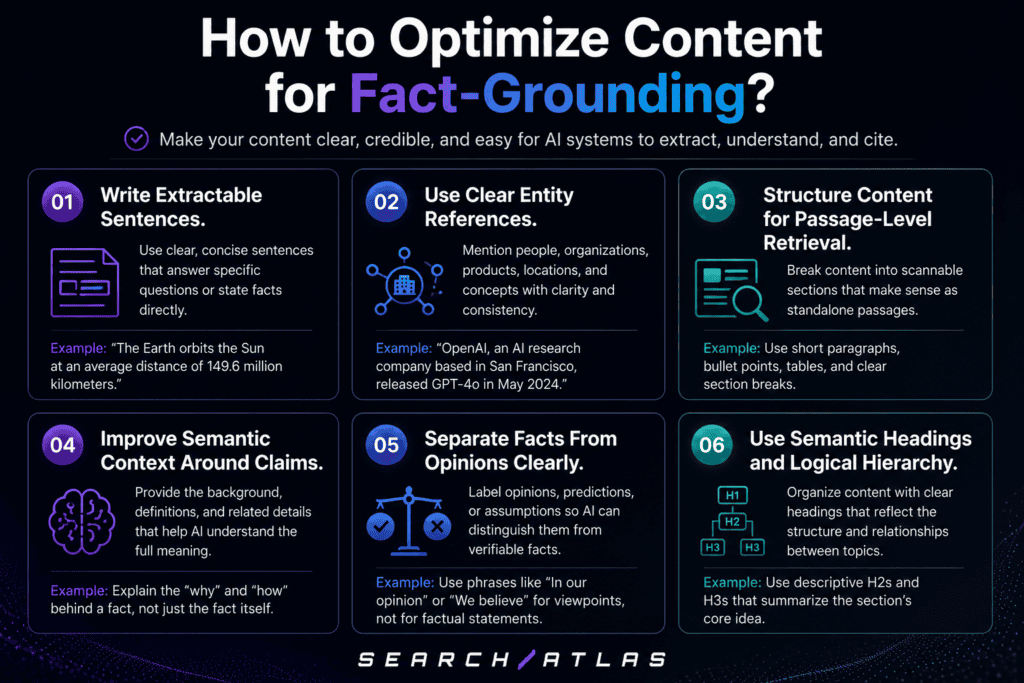
There are 6 writing and structural changes that optimize content for fact grounding. Each change targets a specific point in the grounding pipeline where a page fails. Applied together, the changes raise the page’s grounding fitness without changing the underlying topical coverage. The 6 changes are listed below.
- Write Extractable Sentences.
- Use Clear Entity References.
- Structure Content for Passage-Level Retrieval.
- Improve Semantic Context Around Claims.
- Separate Facts From Opinions Clearly.
- Use Semantic Headings and Logical Hierarchy.
Why do these optimizations need to be applied as a system rather than individually? The optimizations need to be applied as a system because grounding pipelines run several checks in sequence, and a failure at any check drops the page from the citation pool. A page with extractable sentences but unclear entities passes the chunking step and fails the entity resolution step. A page with strong entities but vague claims passes entity resolution and fails the binding check. Each piece needs to be in place for the citation to land.
1. Write extractable sentences
Write extractable sentences for fact grounding as complete claims that stand alone without relying on the surrounding context to make sense. Each sentence names its subject, states its predicate, and includes any qualifier needed to interpret the claim. The test is simple. A reader who has not seen the rest of the page must understand the sentence. If the sentence depends on surrounding context to make sense, the retrieval system cannot ground it, because the system sees only the extracted passage.
What patterns produce extractable writing reliably? Patterns lead with the subject, avoid pronouns that refer outside the sentence, and include the relevant timeframe or qualifier in the same sentence as the claim. A sentence “the system handles it well” fails on all 3 counts. A sentence “Google AI Overviews handles passage-level retrieval reliably for queries with strong entity references” passes all 3. The rewrite reduces ambiguity at no cost to length.
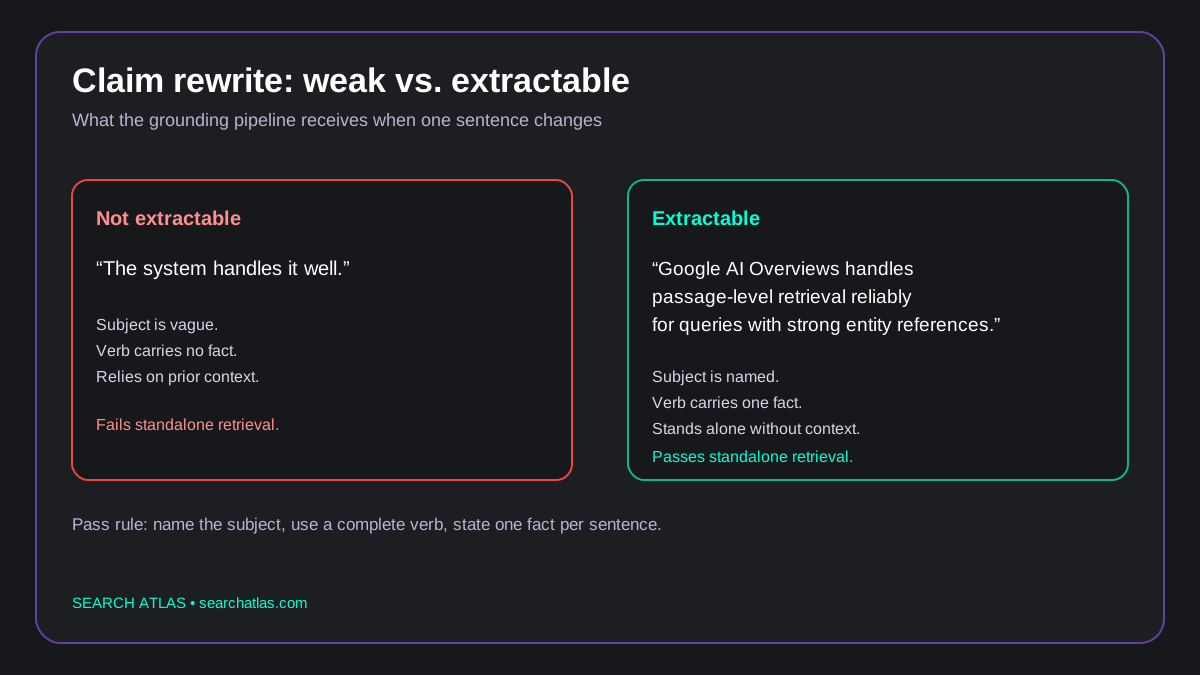 Claim rewrite example
Why do extractable sentences compound across a page? Extractable sentences compound because each one becomes a candidate citation unit, and pages with many such candidates earn citations across a wider range of queries. A page with 3 extractable sentences grounds 3 distinct claims. A page with thirty extractable sentences grounds thirty. The compound effect explains why grounding-optimized pages outperform comparable pages on citation volume even when topical coverage is similar.
2. Use clear entity references
Use clear entity references for fact grounding by stating the full entity name on first mention in every section and adding disambiguation cues whenever ambiguity is possible. The pattern overrides natural style preferences for pronoun economy. Pronouns are efficient for readers who have the full context. Retrieval systems often lack full context because they see only the retrieved passage. Explicit naming is the cost of grounding reliability.
What disambiguation cues raise entity resolution scores? Cues include category descriptors, geographic identifiers, founder or owner names, and product line distinctions. A reference to “Search Atlas, the AI-first SEO platform” disambiguates from any other entity named Search Atlas. A reference to “GPT-5, OpenAI’s flagship model released in 2025” disambiguates from earlier GPT versions. Each cue is short and adds grounding fitness disproportionate to its length.
Why does entity reference clarity matter most in the first sentence of a section? Entity reference clarity matters most in the first sentence because retrieval systems often chunk pages on heading boundaries, and the first sentence of each chunk anchors the entity for the rest of the chunk. A first sentence that names the entity fully gives every subsequent sentence in the chunk a working reference. A first sentence that uses a pronoun forces the chunker to either pull in the earlier context or leave the entity unresolved.
3. Structure content for passage-level retrieval
Structure content for passage-level retrieval by splitting content into short, topical paragraphs that each cover one idea and stand alone semantically. The structure mirrors how retrieval systems chunk pages. Paragraphs of 3 to 5 sentences, each centered on a single claim, produce clean chunks. Longer paragraphs produce chunks that span multiple topics and lose coherence after embedding.
What heading patterns support passage-level retrieval? Heading patterns that support retrieval include descriptive H2 and H3 phrases that signal the topic of the section, with each section covering a coherent sub-topic. Headings give the chunker explicit split points and let the embedding model carry the heading context into the passage. Pages with shallow heading structure produce long, mixed chunks that perform poorly. Pages with deep heading structure produce focused chunks that perform well.
Why does passage-level structure outperform whole-document optimization? Passage-level structure outperforms whole-document optimization because grounding evaluates passages, not documents, and a strong passage from a weaker page often beats a weak passage from a stronger page. The implication is that citation outcomes are driven by the best passage on the page, not the page’s overall quality. Optimizing for the best passages produces more citations per page than optimizing for average quality.
4. Improve the semantic context around claims
Improve semantic context around claims for fact grounding by surrounding each fact with the entities, timeframe, and qualifier needed to interpret it correctly. A bare fact, “engagement rose 24 percent,” lacks the entity, the timeframe, and the source. The same fact, written as “user engagement on AI Overviews rose 24 percent between Q1 and Q3 2025, per Similarweb data,” carries all 4 anchors. The expanded version grounds reliably. The bare version does not.
What kinds of context anchors are most useful for grounding? The most useful anchors are entities, dates, sources, methodologies, and comparison baselines. Each anchor reduces a specific class of inference that the model would otherwise make. Together, they convert a vague claim into a verifiable one. The cost is a few extra words per claim. The benefit is grounding eligibility.
Why does semantic context lower the risk of citation suppression? Semantic context lowers suppression risk because the grounding check passes more cleanly when the claim is fully specified and there is no room for the model to second-guess the binding. Claims with thin context get hedged or dropped. Claims with rich context get cited. The suppression behavior stays consistent across major AI search engines, which makes context discipline a high-impact optimization across the board.
5. Separate facts from opinions clearly
Separate facts from opinions clearly for fact grounding by signaling the category explicitly, where factual claims include sources, numbers, or named events, and opinions get introduced with framing “in our view” or “we recommend.” The signaling tells the AI system which claims to ground against sources and which to treat as editorial commentary. Pages that mix the 2 without signals confuse the grounding pipeline and lose both citation types.
Why does mixing facts and opinions reduce grounding accuracy? Mixing facts and opinions reduces accuracy because the model cannot tell which claims are evidence-backed and which are stylistic, so it either grounds everything inaccurately or hedges everything cautiously. The mix forces the binding check to evaluate opinions as if they were facts, which fails. Or it forces the system to skip fact-like sentences because they read as an opinion. Either failure mode lowers citation rates.
How does explicit category framing let AI systems use both types? Explicit framing lets AI systems use both types because opinions get cited as opinions when the framing is clear, and facts get cited as facts when the support is clear. An AI answer quotes an opinion as expert commentary and cites a fact as evidence. Both citation types carry value. Pages that frame both clearly earn citations across query types where opinion is appropriate and where evidence is required.
6. Use semantic headings and logical hierarchy
Use semantic headings and logical hierarchy for fact grounding by naming the topic of each section in noun-phrase form and nesting H3 under H2 only when the H3 covers a sub-topic of the H2. The pattern produces a tree that the retrieval system traverses. Sections with strong heading-to-content alignment produce coherent chunks. Sections with mismatched headings produce chunks that the chunker mislabels.
What heading mistakes break the semantic hierarchy? Heading mistakes that break hierarchy include using H3 as visual styling rather than topical nesting, repeating H2 phrases as H3 starters, and writing headings that describe writing intent instead of topical content. Each mistake creates a structural inconsistency that the chunker propagates into the embeddings. Pages that fix these mistakes recover grounding fitness without rewriting any prose.
Why does logical hierarchy reinforce passage-level grounding? Logical hierarchy reinforces passage-level grounding because each chunk inherits its parent heading’s context and gets evaluated with that frame attached. A passage under “Schema Markup for Entity Clarity” carries the schema-and-entity frame into the binding check even when the passage itself is short. Without the hierarchy, the passage stands alone and fails the check. Hierarchy is a context multiplier.
What are the best practices for fact-grounding optimization?
There are 7 best practices for fact-grounding optimization that cover writing, structure, sourcing, and content maintenance. Each practice addresses a specific point along the grounding pipeline where pages fail. The 7 best practices are listed below.
- Use Verifiable and Specific Claims.
- Keep Facts Self-Contained and Extractable.
- Strengthen Entity Clarity Around Key Claims.
- Use Structured Formatting for Retrieval.
- Support Claims With Evidence and Attribution.
- Maintain Content Freshness and Accuracy.
- Reduce Ambiguity Across Pages and Entities.
How do these best practices compound across a content library? The practices compound across a library because grounding fitness gets evaluated per page, but trust gets evaluated per site, and a site with consistent grounding habits earns higher trust than one with mixed practices. AI search systems memorize which sites produce reliable citations and adjust retrieval accordingly. A library-wide application of the 7 habits raises the entire site’s selection probability, not just the pages most recently optimized.
1. Use verifiable and specific claims
Using verifiable and specific claims is the best practice for fact-grounding optimization because the binding check at the end of the grounding pipeline requires each cited claim to be confirmable against the source, and specificity is what makes confirmation possible. A claim that says “many publishers report citation gains” cannot be confirmed. A claim that says “publishers in the Search Atlas content base report citation gains of 18 percent on average after grounding optimization” gets confirmed. The first fails the binding check. The second passes.
How do verifiable claims interact with citation persistence? Verifiable claims interact with citation persistence by holding up under repeated checking across model updates, while vague claims fail differently across versions. A specific, sourced claim grounds consistently regardless of which model version evaluates it. A vague claim grounded in one model version fails in another, producing unpredictable citation behavior. Specificity is what makes citation persistence reliable.
Why does claim specificity matter more than claim volume? Specificity matters more than volume because a single specific, sourced claim outperforms a paragraph of vague claims on every grounding metric. Pages that produce dense, verifiable claims rank above pages that produce many unverifiable claims in the candidate pool. The optimization target is claim quality, not claim count. Removing weak claims raises a page’s overall grounding score because the weak claims dilute the page’s embedding without contributing citation candidates.
2. Keep facts self-contained and extractable
Keeping facts self-contained and extractable is the best practice for fact-grounding optimization because retrieval pipelines chunk pages into passages, and only self-contained passages get cited without losing meaning. A fact that depends on context from earlier paragraphs loses that context during chunking. The model retrieves the passage, finds the fact incomplete, and skips the citation. Self-contained facts survive the chunking step intact.
What does it look like in practice to make a fact self-contained? A self-contained fact names the entity, states the claim, and includes the qualifier in one sentence or one short paragraph. The pattern resembles writing a microcontent unit. The sentence “Schema markup eligibility rose 31 percent after adding FAQPage and Article schema, per Search Atlas internal analytics from Q2 2025” is self-contained. The same fact spread across 3 paragraphs is not.
Why does extractability outperform comprehensiveness for grounding? Extractability outperforms comprehensiveness because retrieval evaluates passage-level fit, not document-level depth, and a single extractable fact beats a deep but tangled discussion of the same fact. The publishing implication runs against traditional SEO instincts to produce comprehensive content. For grounding, dense extractability wins over breadth.
3. Strengthen entity clarity around key claims
Strengthening entity clarity around key claims is the best practice for fact-grounding optimization because the grounding pipeline resolves entities before evaluating the claim, and unresolved entities short-circuit the entire check. A claim that mentions an entity in unclear form fails resolution and never reaches the binding step. The same claim with a clear entity reference passes both steps and earns the citation.
How does entity clarity protect against citation drift across queries? Entity clarity protects against drift because each query that mentions the entity resolves to the same canonical reference on the page. Without clarity, slightly different queries about the same entity resolve to different parts of the page or different pages entirely. Citation behavior becomes unstable. Strong entity references stabilize behavior across query variations.
Why does the strongest entity reference belong at the top of the section? The strongest entity reference belongs at the top because chunking systems often start chunks at heading boundaries, and the chunk needs an entity anchor in its opening sentence. A section that opens with a pronoun loses entity context for the chunker. A section that opens with the full entity name carries the reference into every subsequent passage in the chunk. Placement matters as much as the reference itself.
4. Use structured formatting for retrieval
Using structured formatting for retrieval is the best practice for fact-grounding optimization because structural elements (headings, lists, tables, short paragraphs) map onto the natural chunk boundaries the retrieval system uses. Pages with strong structure produce clean chunks. Pages without structure produce fragmented chunks. The structural decision precedes the writing decision and constrains the page’s grounding ceiling.
What structural elements provide the highest grounding impact? The highest-impact elements are H2 and H3 headings, FAQ-style question-answer pairs, comparison tables, and numbered procedural lists. Each element provides explicit boundaries that the chunker uses. Pages that mix these elements throughout the body raise their grounding fitness across multiple query types. Pages that rely on long prose blocks lower it.
Why does formatting affect citation rates independently of content quality? Formatting affects citation rates independently of content quality because the chunker operates on structure, not semantics, and a well-written page with poor structure produces worse chunks than a moderate page with strong structure. The fix is mechanical. Writers convert long paragraphs into shorter ones, add headings where topics shift, and use lists where the content is naturally enumerable. The mechanical fix outperforms a rewrite of the same content in better prose.
5. Support claims with evidence and attribution
Supporting claims with evidence and attribution is the best practice for fact-grounding optimization because the grounding pipeline raises confidence in passages that include their own evidence and downgrades passages that present unsupported assertions. A claim with a source name and date passes the binding check more cleanly than a claim without one. The pattern signals that the page is a reliable relay to primary evidence.
What types of evidence raise grounding scores the most? The types that raise grounding scores most are primary research citations, named data sources, expert quotes with named experts, and case studies with named clients or contexts. Each type provides a verifiable anchor that the model uses to ground the claim. Generic phrases (studies show, research suggests) without specifics fail to raise scores because the anchor cannot be confirmed.
Why does evidence proximity matter as much as evidence presence? Evidence proximity matters because the chunking step often separates a claim from a distant citation, so the evidence travels with the claim into the same passage. Endnote-style citation, while academically correct, loses its grounding value during chunking. In-line attribution within the same sentence or paragraph preserves the link. The structural choice determines whether the citation propagates.
6. Maintain content freshness and accuracy
Maintaining content freshness and accuracy is the best practice for fact-grounding optimization because AI systems prefer recent, accurate content for time-sensitive queries and reduce the selection probability of pages whose facts have aged out of relevance. Freshness gets evaluated through publication date, last-modified date, and the recency of mentioned entities. Pages that update on a schedule retain selection probability. Pages that go stale lose it.
How often does grounding-optimized content need refreshing? The refresh cadence depends on topic volatility, where AI search and AI model topics require updates every few months, and stable topics (HTML or schema syntax) tolerate annual updates. The signal the system uses is whether the page’s facts match current reality. The page falls out of the candidate set when the current reality diverges from the page. Refreshing means more than changing a date. Refreshing means updating the underlying facts, entities, and source citations.
Why does accuracy decay faster than authority in AI search? Accuracy decays faster than authority because grounding evaluates facts at retrieval time, while authority is a slower-changing signal aggregated over months. A page holds authority signals while losing accuracy day by day. The grounding pipeline catches the accuracy gap immediately and skips the citation. The authority signals never compensate. For AI visibility, accuracy maintenance is more time-sensitive than backlink building.
7. Reduce ambiguity across pages and entities
Reducing ambiguity across pages and entities is the best practice for fact-grounding optimization because retrieval systems compare candidate passages across the entire site, and inconsistent references across pages confuse the entity resolution step. A site that calls a product “Search Atlas” on one page and “the Search Atlas platform” on another loses some entity resolution accuracy compared to a site that uses one canonical form everywhere.
How does site-wide consistency support grounding behavior? Site-wide consistency supports grounding because the AI system builds an entity model from repeated references across pages, and consistency strengthens the model. Pages with consistent naming, schema, and sameAs links contribute to a clean entity profile. Pages with inconsistent naming contribute noise. The model uses the cleanest profile to anchor citations.
Why does cross-page ambiguity hurt even pages that are internally clear? Cross-page ambiguity hurts internally clear pages because the AI system evaluates the site as a whole when scoring entity confidence, and noisy siblings lower the score for clean siblings. The optimization target extends beyond a single page to the entity treatment across the full content library. Clean pages on a noisy site underperform clean pages on a clean site.
What schema and markup help with fact-grounding?
There are 4 schema types that support fact grounding directly. Each schema type signals a specific property that the grounding pipeline uses. Combined, they reduce ambiguity at multiple stages of retrieval and binding. The 4 schema types are listed below.
- Schema Markup for Entity Clarity.
- FAQ, Article, and QAPage Schema.
- sameAs and Knowledge Graph Alignment.
- Structured Data for Content Relationships.
Why does schema markup matter when AI systems read the content directly? Schema markup matters because it labels content elements explicitly so the AI system does not infer their type from structure alone. Inference works most of the time. Explicit labels always work. Schema reduces the failure rate of inference and provides a stable signal across model versions. Pages with schema are grounded more consistently across AI search engines than pages without.
1. Schema markup for entity clarity
Schema markup for entity clarity helps with fact grounding by explicitly identifying the entity types on the page (Organization, Person, Product, Service) so the AI system resolves entities without ambiguity. The markup names the entity, supplies canonical identifiers, and links to related entities. The grounding pipeline uses these signals to bind the page to the right node in its entity graph.
What entity properties matter most for grounding inside the schema? The most important properties are the entity’s full name, alternative names, official URL, and identifiers (sameAs links to Wikidata, Crunchbase, or the company’s official social profiles). Each property gives the resolution step another anchor. Pages with rich entity properties resolve cleanly. Pages with thin properties depend on text-level inference.
Why does the entity schema affect grounding more than other schema types? Entity schema affects grounding more than other types because every grounding evaluation begins with entity resolution, and entity schema gives that step a direct, unambiguous signal. Other schemas affect later stages of the pipeline. The later stages never run if the entity resolution step fails. The entity schema is the foundation. The others are extensions.
2. FAQ, article, and QAPage schema
FAQ, Article, and QAPage schema help with fact grounding by labeling content units explicitly so the AI system identifies question-answer pairs, article structure, and Q&A pages without parsing the HTML. The labels match how the grounding pipeline consumes the content. Pages with these labels produce chunks aligned with the schema’s structural intent rather than chunks the chunker derives from heuristics.
Where does each schema type apply most usefully? The FAQ schema applies to standalone question-answer collections, the Article schema applies to long-form editorial content, and the QAPage schema applies to pages built around a single primary question. Using the right schema for the page’s actual structure reinforces the grounding pipeline’s expectations. Using the wrong schema (applying FAQ to non-FAQ content) confuses the system and lowers citation rates.
Why does aligning the schema with the actual structure matter more than adding schema generally? Aligning the schema with actual structure matters more because a mismatched schema sends a contradicting signal that the system reconciles, while an aligned schema reinforces the structural signals already present in the content. Adding an FAQ schema to a page that does not have questions and answers is worse than adding no schema. The alignment makes the schema additive rather than confusing.
3. sameAs and knowledge graph alignment
SameAs and Knowledge Graph alignment help with fact grounding by linking the page’s entity references to canonical entity records in external knowledge bases (Wikidata, Wikipedia, Google’s Knowledge Graph). The links resolve the entity unambiguously across the open web. The AI system uses the alignment to bind page-level mentions to the same entity it sees in other sources, which raises confidence in the page’s claims.
What does sameAs implementation look like in practice? In practice, sameAs lists every authoritative URL that identifies the same entity (the entity’s Wikipedia page, Wikidata entry, official site, major social profiles). The links go inside an Organization or Person schema block in JSON-LD. Each additional sameAs link strengthens the resolution signal. The recommended minimum is the Wikidata entry plus the official site. The optimal set covers all canonical references.
Why does Knowledge Graph alignment affect long-term grounding behavior? Knowledge Graph alignment affects long-term behavior because AI systems use the Knowledge Graph as a stable backbone for entity reasoning, and pages aligned with the Graph inherit that stability. Pages without alignment depend on text-level inference, which varies across queries and model versions. Pages with alignment maintain consistent entity treatment regardless of how the question is phrased. The stability compounds into citation persistence.
4. Structured data for content relationships
Structured data for content relationships helps with fact grounding by labeling the relationships between articles, authors, organizations, topics, and references so the AI system traverses the graph of relationships without inferring them. Relationships (author-of, publisher-of, mentions, citation) are all encodable in the schema. Each labeled relationship gives the grounding pipeline another signal it does not derive from text.
What relationships matter most for grounding? The relationships that matter most are authorship, publication, topical scope, and citation, because each one supports a different aspect of the grounding evaluation. Authorship supports source credibility. Publication supports recency and venue. Topical scope supports retrieval relevance. Citation supports evidence binding. Pages with structured data covering these relationships pass more grounding checks than pages without.
Why does relationship-level structured data outperform isolated schema blocks? Relationship-level data outperforms isolated blocks because grounding is fundamentally about connecting claims to entities, sources, and contexts, and relationships are the connections. Isolated schema blocks label individual elements. Relationship data labels the connections between them. The connections are what the grounding pipeline ultimately scores. Structured data that maps relationships explicitly gives the pipeline the map directly.
How to measure whether AI systems ground the answers in the content?
Measure whether AI systems ground answers in the content through 3 methods (prompt-based testing against major AI search engines, citation tracking via tools that monitor AI Overviews and ChatGPT Search results, and structural audits of pages that index but do not appear as citations). Each method exposes a different layer of the grounding outcome. Combined, they show which pages are working, which are not, and what changes close the gap.
What does prompt-based testing look like in practice? Prompt-based testing runs sets of representative queries through ChatGPT Search, Perplexity, Google AI Overviews, Gemini, and similar systems, then records which pages get cited and how the citations are framed. The tests reveal whether the page appears as a grounding source, whether the citation supports a specific claim or only the topic, and whether the AI system attributes the page accurately. Repeating the tests over time tracks how grounding behavior evolves.
How do citation tracking tools complement prompt testing? Citation tracking tools complement prompt testing by monitoring real-world AI answer pages at scale, surfacing citations the publisher would not have found through manual prompting. The tools record citation frequency, query distribution, and competitive share-of-voice in AI search results. The data shows whether grounding improvements translate into measurable citation lift across the queries that matter to the business.
Why do structural audits matter alongside the citation data? Structural audits matter because citation data shows the outcome but not the cause, while a structural audit identifies the specific writing or markup gap preventing grounding on pages that rank well in traditional search but fail in AI answers. The audit checks paragraph length, entity clarity, attribution placement, schema correctness, and heading structure. Pages flagged by the audit get targeted rewrites that address the specific gap rather than a general refresh.
What common mistakes prevent AI grounding?
5 common mistakes prevent AI grounding even on otherwise strong content. Each mistake corresponds to a failure point in the grounding pipeline. Fixing the mistakes restores grounding eligibility without requiring a topical rewrite. The 5 mistakes are listed below.
- Long Paragraphs Without Extractable Facts.
- Vague or Unsupported Claims.
- Missing Attribution and Context.
- Weak Semantic Structure.
- Inconsistent Entity References.
Why do these mistakes appear together on the same pages? The mistakes appear together because they share a common root cause (writing optimized for narrative flow rather than extraction). A page written to read smoothly often sacrifices the structural and semantic clarity that grounding requires. The fix is not to write less well. The fix is to write to a different optimization target. Once the target shifts, the mistakes resolve in parallel.
1. Long paragraphs without extractable facts
Long paragraphs without extractable facts prevent AI grounding because the retrieval system chunks the paragraph into a single passage and finds no isolated fact strong enough to cite. The chunk contains topical material but no atomic claim. The model retrieves the chunk, scans it for a citable fact, and falls back to parametric memory because the chunk does not provide one. The page is reachable but unusable.
What does failure look like in practice? The failure is a page that ranks well, gets visited by AI crawlers, but never appears as a citation in AI search results. The publisher confirms the page is indexed and embedded, but cannot understand why it does not earn citations. The cause is the paragraph length and the dilution of any specific claim across the surrounding context. The fix is to split the paragraph into single-claim units.
Why does paragraph length affect grounding more than total page length? Paragraph length affects grounding more than page length because chunking operates on paragraph boundaries, and a page with 20 short paragraphs produces 20 citation candidates while a page with 5 long paragraphs produces 5 low-quality candidates. Total length is incidental. Per-paragraph density is decisive. Pages with consistent short paragraphs ground more reliably regardless of how long the page is overall.
2. Vague or unsupported claims
Vague or unsupported claims prevent AI grounding because the binding check at the end of the pipeline requires the claim to be confirmable, and a vague claim has nothing concrete to confirm against. A statement, “many publishers benefit from grounding optimization,” cannot be tied to any specific evidence in the source. The model either skips the citation or hedges it. Either outcome reduces the page’s citation rate.
What separates a vague claim from a specific one in grounding terms? A specific claim names the entity, supplies the number or fact, and includes the qualifier, while a vague claim leaves at least one of those elements unstated. Replacing “many” with a number, replacing “improves” with the specific change, and replacing “studies show” with the named source converts vague claims into groundable ones. The rewrite is mechanical.
Why does removing vague claims work even better than adding specific ones? Removing vague claims works because vague claims dilute the page’s embedding without contributing citation candidates, so deleting them sharpens the embedding while preserving the page’s groundable signal. Pages often improve grounding by becoming shorter, not longer. The optimization target is signal density. Vague claims are noise. Removing them raises density.
3. Missing attribution and context
Missing attribution and context prevent AI grounding because the binding check cannot confirm the claim’s origin and downgrades the citation accordingly. A fact without a source gets treated as a publisher’s assertion rather than verified evidence. The model still cites the publisher, but the citation is weaker. The page is less likely to be selected when stronger sources are available.
What does proper attribution look like at the sentence level? Proper attribution names the source, the date, and the methodology when relevant, inside the same sentence as the claim. A sentence “Search Atlas internal data from Q3 2025 shows a 22% lift in citation rates after grounding optimization” carries the attribution with the claim. The grounding pipeline reads the source and methodology together with the fact and binds both into the citation.
Why does context strengthen attribution even further? Context strengthens attribution by surrounding the claim with the entities, timeframe, and comparison baseline needed to interpret it correctly. Attribution names the source. Context names the conditions. The 2 together produce a complete grounding unit. Pages that include both attribution and context outperform pages that include only one. The combined effect compounds across every fact on the page.
4. Weak semantic structure
Weak semantic structure prevents AI grounding because the chunker cannot find clean boundaries to split on, so it produces ragged chunks that span multiple topics. Ragged chunks have diluted embeddings. Diluted embeddings score poorly during retrieval. Poor retrieval scores keep the page out of the candidate set. The whole pipeline collapses because the first step produces noise.
What structural features signal a strong semantic hierarchy? Strong hierarchy uses descriptive H2 headings for main topics, nested H3 headings for sub-topics, and consistent paragraph lengths within each section. Each feature gives the chunker a clean boundary. Pages with these features produce focused chunks that retrieve and ground reliably. Pages with shallow heading hierarchy or inconsistent paragraph treatment produce chunks that the chunker cannot handle well.
Why does semantic structure outperform visual formatting alone? Semantic structure outperforms visual formatting because the chunker reads the underlying HTML and schema, not the visual presentation. A page that looks structured because of font sizes but uses no heading tags fails the chunker. A page with proper H2 and H3 tags succeeds even when the visual styling is minimal. The fix is to use semantic tags correctly, not to add more visual emphasis.
5. Inconsistent entity references
Inconsistent entity references prevent AI grounding because the resolution step cannot bind the references to a single canonical entity, so each reference resolves separately and produces a fragmented entity profile. The fragmentation lowers the AI system’s confidence in any single claim about the entity. Pages with consistent references produce a clean profile. Pages with inconsistent references produce noise.
What kinds of inconsistency appear most often? The most common inconsistencies are switching between full names and partial names, mixing product line references with parent brand references, and using pronouns that refer ambiguously to multiple entities. Each pattern raises the resolution risk. Fixing the patterns is mechanical. Writers choose a canonical reference form, use it on first mention in every section, and avoid pronouns when the antecedent is more than a sentence away.
Why does consistency matter across pages, not just within one page? Consistency matters across pages because AI systems build entity profiles by aggregating references across the site, and inconsistent treatment across pages lowers the overall profile quality. A single page with clean references still suffers if the rest of the site uses different forms. The fix extends to the whole content library, ideally enforced by style guides and templates rather than per-page editing.
Do citations and source links improve AI grounding?
Yes. Citations and source links improve AI grounding by giving the AI system independent evidence of the claim’s validity and supplying the relay paths the system uses to verify facts beyond the page itself. A page that cites its sources visibly inside the prose gets treated as a higher-confidence source than a page that asserts the same claims without citation. The visible attribution converts the page from a publisher assertion into a referenced relay.
How do AI systems use the source links on a page during grounding? AI systems use source links by following them during retrieval to confirm the cited source supports the claim, then folding the confirmation into the binding score. The publisher’s page gains grounding credit when the linked source confirms the claim. The credit is removed when the linked source contradicts the claim or no longer exists. Live, accurate links are the asset. Broken or misleading links are a liability.
Why does the placement of citations matter for grounding outcomes? Placement matters because citations placed inside the same paragraph as the claim travel with the claim through chunking, while endnote-style citations get separated. In-line citations preserve the grounding link. Endnote citations get lost. The publishing implication is direct. Writers cite at the point of claim, not at the end of the section. The shift is small in word count and large in grounding fitness.
Why is the page indexed but not grounded in AI answers?
A page is indexed but not grounded in AI answers when the retrieval system finds it, but the grounding pipeline rejects it during chunking, entity resolution, or binding due to structural or claim-level gaps. Indexing only confirms reachability. Grounding requires the page to pass several additional checks. Failing any check produces the indexed-but-not-cited pattern publishers see in their analytics.
What are the most common causes of the indexed-but-not-grounded gap? The most common causes are long paragraphs that produce poor chunks, vague claims that fail the binding check, weak entity references that fail resolution, missing attribution that lowers confidence, and inconsistent structure that confuses the chunker. Each cause is fixable. The audit process identifies which cause applies to which page. The fixes target the specific gap rather than treating the page as a general rewrite candidate.
How does fixing the gap restore grounding eligibility? Fixing the gap restores eligibility by addressing the specific check that the page was failing, which moves the page from the rejected pool back into the citation candidate pool. The gain shows up within weeks rather than months because AI systems re-evaluate pages on shorter cycles than traditional search. The fix-to-citation latency is short enough that publishers iterate visibly on the same page across consecutive measurement windows.
Fact-grounding optimization turns a page from a document an AI system can find into a set of passages it can verify and cite. The work is structural: verifiable and specific claims, self-contained facts, clear entity references, structured formatting, in-line evidence, maintained freshness, and reduced ambiguity across the site.
AI systems run a binding check before they publish an answer, and only pages that pass it earn citations. Indexing alone does not produce that outcome, and no index request substitutes for it. Pages that adopt the standard compound over time: each extractable claim becomes a citation candidate, and consistent grounding habits across a site raise the whole library’s selection probability.