Choosing an enterprise SEO software suite in 2026 is no longer just a contest of database sizes. The modern search landscape has split into traditional SERPs and generative AI answer engines, making speed of execution the primary differentiator for growing brands.
For years, search marketers were forced into a binary choice: Ahrefs for backlink data or Semrush for all-in-one digital marketing. But as engineering backlogs delay website optimizations and Google's AI Overviews compress informational click-through rates, diagnostic-only platforms create severe operational bottlenecks.
When comparing Ahrefs, Semrush, and SearchAtlas in 2026, the decision hinges on passive diagnostics versus autonomous execution. Ahrefs delivers the deepest legacy backlink index but constrains daily research with restrictive consumption credits; Semrush provides an expansive digital marketing suite with high per-seat costs; SearchAtlas unifies enterprise keyword datasets with OTTO—an autonomous AI agent that deploys technical fixes, internal link networks, and content refreshes directly to your CMS alongside real-time multi-engine LLM citation tracking.
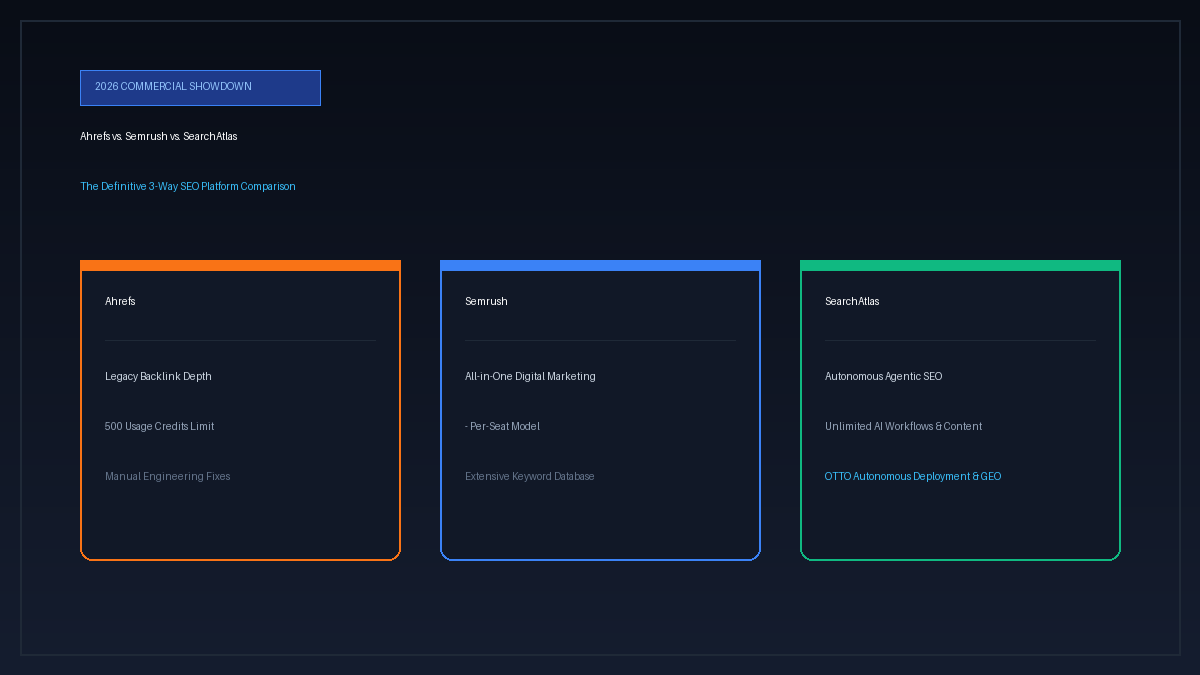 Ahrefs, Semrush, and SearchAtlas compared across architecture, consumption limits, and execution models.
At a Glance: Head-to-Head Comparison Matrix
Before analyzing each platform's granular feature set, the table below highlights how Ahrefs, Semrush, and SearchAtlas compare across core architectural criteria:
| Evaluation Dimension | Ahrefs | Semrush | SearchAtlas |
|---|---|---|---|
| Core Architecture | Passive Diagnostics & Analytics | Broad Digital Marketing Suite | Autonomous Agentic SEO & Execution |
| Primary Differentiator | Historical Backlink Archive | PPC & Social Media Tools | OTTO Autonomous CMS Deployment |
| Generative Visibility (GEO) | Limited / Not Integrated | Limited Beta | Native Multi-Engine (ChatGPT, Perplexity, Gemini, Copilot) |
| Content Optimization | Content Explorer (Research only) | ContentShake AI (Add-on fee) | Content Genius (Unlimited AI Production) |
| Technical Site Auditing | Static CSV/PDF Issue Reports | Static Issue Reports | Autonomous Remediation & Schema Sync |
| Pricing & Billing Model | Strict Consumption Credits (500/mo) | Per-Seat License Model ($139–$499/mo) | Collaborative Team Plans (No Credit Penalties) |
| Keyword Research Scope | Clicks metric & Parent Topics | Volume, CPC, PPC crossover | Intent Clustering, Semantic Maps, GSC Sync |
| CMS Integration | Read-only WordPress plugin | Read-only integrations | Full Bi-Directional Sync (WP, Shopify, Webflow, Custom) |
| Best Suited For | Technical Link Builders & Researchers | General Marketing Departments | SEO Agencies & High-Velocity Growth Teams |
1. Core Architectural Philosophy: Diagnostics vs. Autonomous Execution
The fundamental distinction separating these three platforms is what happens after an issue or opportunity is identified.
In legacy SEO workflows, identifying a technical error, missing meta description, broken internal link, or keyword cannibalization issue is only the first step. Marketers export a spreadsheet, write a Jira ticket, submit it to developers or copywriters, and wait weeks for implementation. This friction kills SEO momentum.
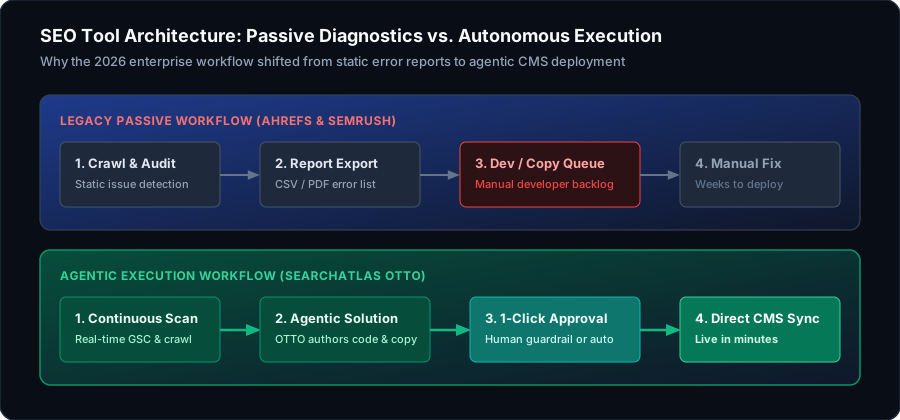 How SearchAtlas OTTO eliminates the developer backlog bottleneck by moving from passive audit reports to autonomous CMS execution.
Ahrefs: The Researcher’s Diagnostic Sandbox
Ahrefs was built from the ground up as a data analysis engine. Its crawler, AhrefsBot, is one of the most active web crawlers in existence, indexing billions of web pages and backlink connections.
- The Strength: Unmatched backlink analysis precision, clean UX, and historical link profile tracking.
- The Limitation: Ahrefs is completely passive. It cannot fix the problems it discovers. When Ahrefs reports 140 broken redirects or 45 missing canonical tags, those issues sit idle until human developers write and push the code.
For an exhaustive examination of Ahrefs' backlink index metrics, read our detailed Ahrefs Review.
Semrush: The Comprehensive Marketing Generalist
Semrush expanded beyond SEO into an expansive Swiss Army knife for digital marketing teams, incorporating tools for Google Ads, Facebook advertising, PR monitoring, and social media scheduling.
- The Strength: Breadth of features across paid advertising and organic channels.
- The Limitation: Breadth often comes at the expense of automated depth. Similar to Ahrefs, Semrush operates as an audit generator. Furthermore, features outside core SEO often require expensive monthly add-ons, increasing overhead without speeding up CMS implementation.
For a deeper dive into Semrush's suite structure, explore our Semrush Review.
SearchAtlas: Autonomous Agentic SEO via OTTO
SearchAtlas shifts search marketing from passive diagnosis to autonomous execution. While it includes enterprise-grade datasets for keywords, backlinks, and site health, its core engine is OTTO SEO—the industry's first autonomous AI SEO agent.
- Autonomous Remediation: OTTO connects directly to your content management system (WordPress, Shopify, Webflow, BigCommerce, or custom Next.js via API). When OTTO detects missing schema markup, sub-optimal heading structures, or internal link gaps, it writes the code and deploys the fix directly.
- Human Guardrails: Teams can operate OTTO in full autonomous autopilot or require one-click human approval before code goes live.
- Velocity Multiplier: Agencies and internal teams eliminate 80% of technical implementation backlogs, converting audit findings into live ranking signals in minutes rather than months.
Discover how autonomous execution accelerates workflows on the OTTO SEO Platform.
2. Generative Engine Optimization (GEO) & Multi-Engine LLM Visibility
By 2026, search behavior has fundamentally decentralized. High-intent B2B buyers and consumers increasingly bypass traditional 10-blue-link results to query large language models like ChatGPT, Claude, and Perplexity, while Google Gemini synthesizes answers directly inside AI Overviews.
Capturing commercial traffic requires tracking brand mentions and citations inside generative models—a discipline known as Generative Engine Optimization (GEO).
flowchart TD
    subgraph TraditionalRankTracking["Legacy Rank Tracking (Ahrefs / Semrush)"]
        G1[Google Desktop SERP] --> P1[Position 1-100 Blue Links]
        G2[Google Mobile SERP] --> P2[Position 1-100 Blue Links]
    end

    subgraph MultiEngineGEO["Modern GEO Tracking (SearchAtlas)"]
        LLM1[ChatGPT Search / OpenAI] --> C1[Citation Share & Prompt Visibility]
        LLM2[Perplexity AI Engine] --> C2[Source Attribution & Recommendation Rate]
        LLM3[Google Gemini & AI Overviews] --> C3[Layout-Aware Citation & Snippet Inclusion]
        LLM4[Microsoft Copilot / Bing] --> C4[Grounding Index Extraction]
    end
The Limitations of Ahrefs & Semrush in AI Search
Neither Ahrefs nor Semrush was architected for LLM citation graphs:
- Ahrefs tracks traditional SERP rank positions and SERP features (such as featured snippets and local packs), but provides zero native tracking for how large language models recommend your brand in generated answers.
- Semrush has introduced beta tools for tracking AI Overview presence on Google, but lacks cross-engine monitoring for ChatGPT, Claude, and Perplexity.
The SearchAtlas LLM Visibility Engine
SearchAtlas includes native, enterprise-grade LLM Visibility Tracking built specifically for the generative era:
- Multi-Engine Citation Auditing: Daily tracking of brand recommendation share across ChatGPT, Perplexity, Google Gemini, and Microsoft Copilot.
- Sentiment & Source Attribution: Reveals which authoritative third-party pages the AI models cite when recommending your competitors, allowing you to engineer targeted digital PR campaigns.
- Commercial Conversion Interception: Live GA4 data indicates that AI assistant referral traffic converts to SaaS free trials at a 1.6% direct conversion rate—higher than traditional social and display channels.
Learn how to monitor and protect your brand's AI search footprint with SearchAtlas LLM Visibility.
3. Keyword Research & Search Intent Precision
Keyword research remains the foundation of organic growth. However, evaluating keywords strictly by monthly search volume leads to wasted content budgets.
Ahrefs Keyword Explorer
Ahrefs Keyword Explorer is praised for its clean UI and unique secondary metrics:
- Clicks & Clicks-Per-Search (CPS): Shows whether a query actually results in website clicks or is swallowed by zero-click SERP features.
- Parent Topic: Identifies whether a sub-topic can be targeted on an existing page rather than creating a separate article.
- Drawback: Lacks automated intent clustering, requiring manual export and spreadsheet grouping to map large keyword sets.
Semrush Keyword Magic Tool
Semrush boasts one of the largest global keyword databases (over 25 billion keywords):
- Intent Labels: Automatically tags keywords as Informational, Navigational, Commercial, or Transactional.
- PPC Cross-Data: Pulls competitive Google Ads CPC estimates and ad copy history.
- Drawback: Keyword clustering features require additional fees or separate workspace tiers.
SearchAtlas Keyword Researcher & Semantic Topical Maps
SearchAtlas approaches keyword research through the lens of modern entity modeling and topical authority:
- Automated Semantic Clustering: Automatically organizes thousands of raw queries into cohesive pillar-cluster-spoke architectures using natural language processing.
- SERP Similarity Matching: Analyzes live Google top-10 overlap to determine mathematically whether two terms require separate URLs or belong on a single comprehensive page.
- GSC Opportunity Sync: Pulls your live Google Search Console data directly into the research view, instantly highlighting striking-distance queries (positions 11–40) where modest content enhancements yield immediate traffic gains.
Explore our integrated research engine with the SearchAtlas Keyword Research Tool.
4. Content Production & Optimization: Content Genius vs. ContentShake
Writing content that outranks entrenched competitors requires balancing algorithmic search intent matching with readability and information gain.
| Feature Comparison | Ahrefs | Semrush | SearchAtlas |
|---|---|---|---|
| AI Content Authoring | ❌ None (Research Only) | ContentShake AI (Paid Add-On) | Content Genius (Included) |
| Real-Time On-Page Scoring | ❌ None | SEO Writing Assistant | Content Score (Dynamic 0–100 Rubric) |
| Entity & NLP Recommendations | ❌ None | Basic keyword density | Full Knowledge Graph Entity Mapping |
| Generation Limits | N/A | Strict monthly word caps | Unlimited Articles & Words |
| Direct CMS Publishing | ❌ None | Export to Google Docs / WP | 1-Click Direct CMS Publish & Sync |
The Content Bottleneck in Ahrefs & Semrush
- Ahrefs does not offer an AI writing or on-page content optimization tool. Teams using Ahrefs must purchase a third-party subscription (such as Surfer SEO or Clearscope) to score content against live competitors.
- Semrush provides the SEO Writing Assistant and ContentShake AI. While useful, ContentShake enforces restrictive generation limits and additional subscription charges, making bulk content scaling cost-prohibitive for agencies.
SearchAtlas Content Genius
SearchAtlas integrates Content Genius, an enterprise-grade AI authoring and optimization suite:
- Algorithmic Information Gain: Identifies topics covered by top-ranking competitors and extracts missing entities, unique angles, and original research needs to satisfy Google's Helpful Content guidelines.
- Automated Layout Semantics: Structures articles with optimal heading ladders, comparison tables, FAQ schemas, and contextual internal links.
- Unlimited Production: Eliminates per-word anxiety, enabling teams to produce and refresh dozens of qualified articles each month without overage invoices.
5. Economic Modeling: Credit Burn vs. Seat Taxes vs. Unlimited Velocity
Pricing structures often dictate operational reality. When evaluating software costs, teams must calculate the Total Cost of Ownership (TCO), including usage limits and team member expansion.
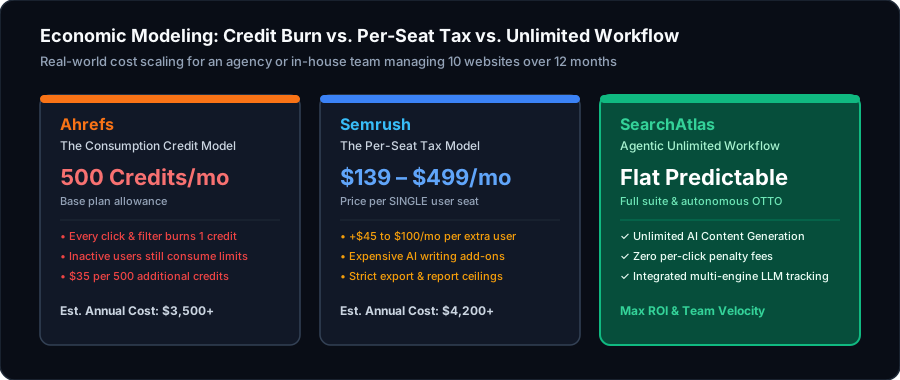 Comparing the annual cost scaling of Ahrefs consumption credits, Semrush seat taxes, and SearchAtlas predictable team workflows.
The Ahrefs Consumption Credit Penalty
In 2022, Ahrefs overhauled its pricing from flat allowances to a consumption credit system:
- Every base plan includes 500 credits per month.
- The Penalty: Every time a user opens a report, applies a filter, clicks to the next page of results, or checks backlink anchor text, 1 credit is consumed.
- Power users, agencies, and large teams frequently burn through their 500 credits within the first week of the month, triggering unexpected overage fees ($35 per 500 credits) or forced account upgrades.
The Semrush Per-Seat Tax
Semrush prices its platform on a single-seat basis:
- Pro Plan: $139.95/month (1 user)
- Guru Plan: $249.95/month (1 user)
- Business Plan: $499.95/month (1 user)
- The Penalty: Adding a team member or agency collaborator costs an extra $45 to $100 per user per month. A 5-person agency team on the Guru plan quickly scales to over $600/month before adding any AI writing or competitive intelligence add-ons.
The SearchAtlas Value Proposition
SearchAtlas provides transparent, predictable pricing designed for team collaboration:
- No Consumption Credit Throttling: Run site audits, analyze backlink profiles, and filter keyword lists without counting individual clicks.
- Generous User Seats: Collaborative accounts allow teams and clients to work together in a unified workspace without compounding seat taxes.
- All-Inclusive Tooling: Keyword research, backlink monitoring, technical auditing, OTTO autonomous execution, Content Genius AI writing, and LLM visibility are integrated into a single predictable subscription.
6. Honest Concession Blocks: Where Competitors Win
To make an informed software investment, teams must understand where each platform holds an undeniable advantage.
Where Ahrefs Wins
- Historical Backlink Archive: Ahrefs has collected and preserved backlink history longer than almost any other commercial tool. For forensic backlink audits, disavow analysis, and tracking link acquisition velocity over a 10-year horizon, Ahrefs remains the gold standard.
- Clean, Uncluttered Interface: By focusing primarily on core SEO rather than branching into social media or display advertising, Ahrefs maintains a lightning-fast, minimalist interface favored by technical analysts.
Where Semrush Wins
- Paid Advertising Intelligence: Semrush's PPC toolkit is vastly superior to both Ahrefs and SearchAtlas. It tracks competitor Google Ads copy, historical ad spend, Display banners, and Google Shopping ad positioning.
- All-in-One Marketing Generalists: For organizations that want a single login to manage organic search, schedule Twitter/LinkedIn posts, track brand PR mentions, and monitor Facebook ads, Semrush provides the broadest feature umbrella.
Where SearchAtlas Wins
- Autonomous Execution (OTTO): The only platform that actively deploys technical fixes, internal link bridges, and schema markup directly to your CMS, saving dozens of developer hours each month.
- Generative Engine Optimization (GEO): Native, production-grade tracking of brand citations and recommendations across ChatGPT, Perplexity, Claude, and Gemini.
- Agency Scalability & Content Velocity: Unlimited AI content generation and predictable team economics allow agencies and fast-scaling brands to publish high-performing content without per-word or per-click penalties.
7. The Final Verdict: Which Platform Should You Choose?
flowchart TD
    Start[What is your primary SEO objective?] --> Q1{Do you need PPC & Social Media tools?}
    Q1 -- Yes --> Semrush[Choose Semrush<br/>Best for multi-channel marketing generalists]
    Q1 -- No --> Q2{Do you focus solely on forensic backlink research?}
    Q2 -- Yes --> Ahrefs[Choose Ahrefs<br/>Best for specialized technical link auditors]
    Q2 -- No --> SearchAtlas[Choose SearchAtlas<br/>Best for autonomous execution, GEO tracking & high content velocity]
Choose Ahrefs If:
- You are an independent link builder or technical consultant who prioritizes historical backlink indexing above all else.
- You work solo and your daily research volume does not trigger the 500-credit consumption limit.
- You already have an internal engineering team ready to manually implement technical SEO tickets.
Choose Semrush If:
- You manage paid search (Google Ads / Shopping) alongside organic SEO and want ad copy intelligence in one workspace.
- Your marketing department values social media scheduling, PR monitoring, and display advertising analysis.
- You have the budget to support individual seat licenses for each team member.
Choose SearchAtlas If:
- You want an autonomous AI SEO agent (OTTO) that deploys technical fixes and internal links directly to your CMS without engineering delays.
- You need to track and optimize your brand's citation footprint inside ChatGPT, Perplexity, Google Gemini, and Microsoft Copilot.
- You are an agency or in-house team that requires unlimited AI content production, collaborative pricing, and high-velocity organic growth.
Ready to see how autonomous execution accelerates your rankings? Start your SearchAtlas free trial today and audit your website with OTTO.