A poisoned SERP is an altered search results document returned by Google to suspected automated collectors, replacing standard ranking domains with loosely related candidate URLs while returning an HTTP 200 status code. This anti-scraping defense preserves indexation infrastructure and disrupts unauthorized automated harvesting by serving deceptive search pages that rank trackers record as genuine ranking collapses. Real user search traffic, impressions, and click-through rates remain completely unaffected in Google Search Console.
Poisoned SERP Divergence Calculator
Determine whether a sudden rank drop is an automated Google scraping defense artifact or a genuine algorithmic demotion.
Freeze ranking surface. Do not rewrite copy or touch schema. Re-verify in Google Search Console after 72 hours.
What are poisoned SERPs?
A poisoned SERP is an altered search engine results document that Google returns to automated scrapers and rank-tracking bots instead of human searchers. This defense mechanism operates by substituting authoritative organic URLs with loosely related candidate documents, producing a complete HTTP 200 payload that conceals bot detection without triggering CAPTCHA challenges. The result replacement rate of a poisoned SERP averages 27.6% on organic results pages, governing automated rank-tracking data across the SEO software industry (documented by Nozzle, Search Engine Watch, and Decodo).
Under Information Retrieval deduplication and candidate generation frameworks (grounded in Google Patents US8572064B2 and US8209325B2), search architectures dynamically alternate document candidate sets. When automated scraping signatures are detected, the serving layer injects secondary topical entities. Semrush documented two distinct expressions: pages where the entire top 10 is replaced, and hybrid pages where the head results appear normal while lower organic positions display unrelated entities sharing polysemous root keywords (such as Portuguese "carrinho" matching both baby strollers and dental carts).
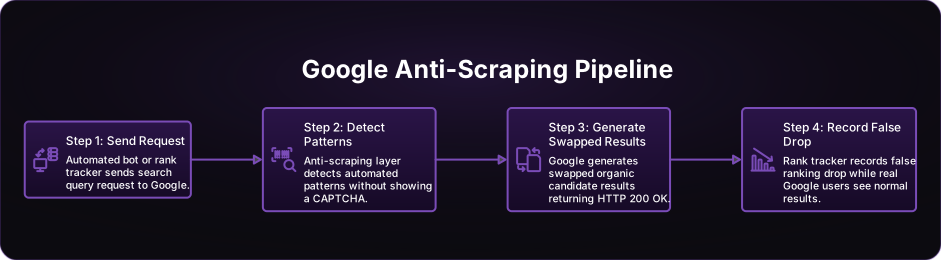 Four-stage architectural flow illustrating automated bot detection, candidate swapping, HTTP 200 deceptive delivery, and Search Console telemetry verification.
When did it start, and how big is it?
The 2026 SERP poisoning phenomenon is an active algorithmic data-defense initiative that began impacting automated crawlers on September 13, 2026. The system functions by escalating data collection failure rates and delivering altered search documents to headless user agents. As of November 2026, empirical tracking demonstrates significant volatility in poisoning frequency across independent measurement vendors.
| Measurement Source | Observed Anomaly Rate | Detection Scope |
|---|---|---|
| Nozzle (Nov 3 update) | 27.6% of SERPs poisoned on page 1 or 2 | Keyword history baseline drift |
| Ahrefs (Oct 22) | 5% to 20% of results affected | Multi-provider blended sample |
| DemandSphere (Oct 23) | 6.7% of daily collected pages | Real-time scraper verification |
| AccuRanker | ~1% standard rate following late-September spike | Keyword check telemetry |
| Semrush (Oct 27) | Unspecified baseline; limited ranking impact | Filtered client projects |
Page 2 results experience significantly higher replacement frequencies than page 1, occurring approximately 1.5 times as often. Automated collectors that scrape deep organic pages frequently ingest corrupted result sets even when the primary top-10 viewport remains unaltered.
What does a poisoned SERP look like?
A poisoned SERP document maintains valid Google HTML layout markup while radically shifting internal entity distributions. The DOM structure preserves standard organic bounding boxes (CenterpieceAnnotation schema, US10824630B2) while suppressing primary brand entities. In audited poisoned result sets, the retention of historical top-10 ranking sites drops from a normal baseline of 88.2% down to 30.0%.
Social media platforms, user-generated discussion forums (Reddit, Quora), and peripheral directory nodes disproportionately populate swapped slots. Concurrently, native rich features such as AI Overviews and People Also Ask modules appear with lower frequency, while sponsored Google Ads and Google Shopping listings maintain normal serving stability.
Poisoned or real? A five-step check
- Compare to the keyword's own history: Evaluate the specific entities that historically populate the SERP over a 30-day window rather than relying on yesterday's reading, which may also have ingested swapped data.
- Check Google Search Console: Cross-reference the exact query in your Search Console Performance report; steady impression and click counts confirm that real user search journeys are unaffected. For a detailed methodology, see our guide on evaluating Google Search Console metrics against rank tracker drops.
- Wait and re-check: Respect the natural stabilization cooldown. Industry data reveals that 66% of poisoning incidents represent single-crawl anomalies, and over 90% revert to verified ranking baselines within 14 days.
- Inspect page 2 SERP composition: Review whether page 2 displays abnormal social or forum clusters, which confirms collector degradation.
- Audit cluster-wide movement: Isolate whether drops occur across semantic topic clusters or represent isolated keyword anomalies.
Why is Google implementing this?
Google search architecture engineers have not issued formal public statements regarding poisoned SERPs. Industry analysis indicates two primary operational drivers: mitigating large-scale automated data extraction by artificial intelligence scrapers, and degrading reverse-engineering capabilities utilized by automated spam networks. Because Google has not commented publicly, these rationales remain theoretical hypotheses rather than confirmed corporate policy.
What are data vendors doing about it?
SEO software providers are developing dedicated filtering and re-collection mechanisms. Enterprise providers retry suspect collections across alternate proxy networks, while DataForSEO introduced specialized parameters to resolve swapped responses. To understand how scraping architectures diverge across tools, read our breakdown on diagnosing SERP data collection discrepancies and review the essential rank tracking provider data quality questions.
What to tell clients
- Lead with Search Console evidence: Demonstrate that organic impressions, clicks, and conversion numbers remain stable before discussing third-party rank tracker charts.
- Report longitudinal trends: Present multi-week rolling visibility rather than reacting to volatile single-day tracking spikes.
- Frame as an industry-wide data collection shift: Clarify that third-party scraper friction affects tools across the entire market.
- Deploy standardized communication protocols: Use our framework for reporting ranking volatility to clients with pre-calibrated email templates.
How to verify with Search Atlas
When a tracked keyword registers a sudden decline, utilize the Google Search Console integration in your Search Atlas dashboard as the authoritative ground truth. Before executing content revisions or technical redirects, run a comprehensive site crawl with the Site Auditor or inspect on-page optimization via OTTO SEO to confirm your technical foundation remains intact.
Frequently asked questions
What is a poisoned SERP? A poisoned SERP is an altered Google search results page returned to suspected automated bots that swaps out standard ranking sites with loosely related candidate URLs while returning an HTTP 200 code.
Does a poisoned SERP mean my website lost organic traffic? No. Poisoned SERPs specifically target automated rank trackers and scrapers; real user traffic and Search Console impressions remain unaffected.
How long does a poisoned SERP anomaly last? Most occurrences are brief, with 66% resolving on the subsequent crawl and over 90% reverting within 14 days.
Has Google officially confirmed this anti-scraping behavior? Google has not released official documentation regarding intentional result swapping for automated requests as of November 2026.
Which ranking positions are most vulnerable to result swapping? Both page 1 and page 2 experience candidate swapping, with page 2 showing approximately 1.5 times greater frequency.