Reporting ranking volatility to SEO clients requires verifying the movement against Google Search Console impressions, classifying the drop as an automated scraper anomaly or a genuine algorithmic shift, and dispatching a standardized communication with a firm follow-up date. When automated Google anti-scraping defenses trigger poisoned SERPs, third-party rank tracking dashboards display dramatic artificial drops while real human search traffic and conversion pipelines remain completely unaffected.
Principles of client volatility reporting
Client volatility communication is a structured agency management protocol that calibrates stakeholder expectations during search ranking fluctuations. This protocol operates by isolating third-party scraper artifacts from genuine algorithmic demotions using first-party Search Console data, producing verified progress reports that prevent reactive on-page refactoring. The follow-up cadence of an effective volatility notification is 5 to 7 business days, governing client retention and agency authority during broad search updates.
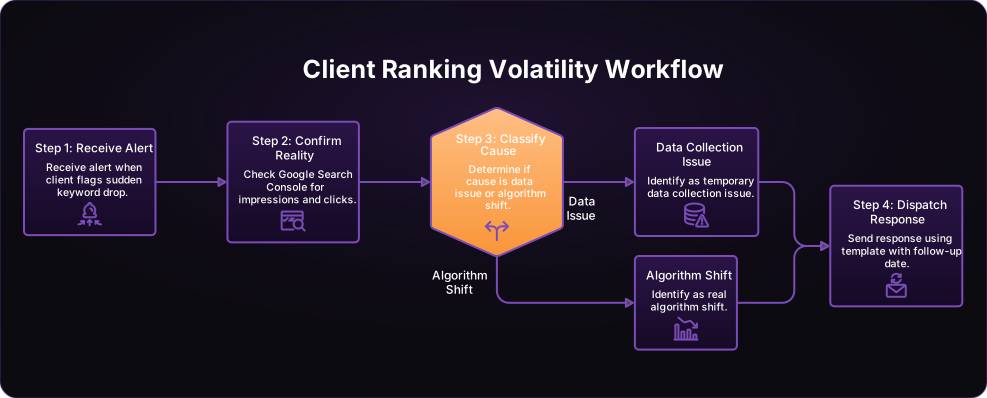 Four-stage agency protocol for managing client volatility notifications from triage to resolution.
- Confirm before explaining: Inspect Google Search Console performance metrics for the exact query and date range before drafting any client message. See our walkthrough on reconciling rank tracker drops with Search Console data.
- Report rolling trends over single-day spikes: Industry data from Nozzle and AccuRanker proves that over 66% of scraper anomalies resolve within 24 hours, and over 90% revert within 14 days. Reporting single-day snapshots introduces unnecessary panic.
- Frame data collection limits objectively: Clarify that search engine anti-scraping countermeasures impact tools sitewide across the search marketing ecosystem (including Semrush, Ahrefs, and independent data providers).
- Commit to an explicit re-check date: Providing a concrete calendar follow-up converts client anxiety into a structured analytical process.
Template 1: the drop is an automated data collection artifact
Use this template when Google Search Console impressions and clicks remain stable despite a rank tracker alert:
Subject: Re: Ranking update for [Keyword / Topic]
Hi [Client Name],
Thanks for flagging this. I inspected our first-party Google Search Console data for [Query] across [Date Range], and verified that impressions, clicks, and organic site traffic remain completely steady.
Across the search industry since September 2026, search engine anti-scraping updates have caused automated rank tracking tools to occasionally receive swapped search pages (known as poisoned SERPs). These automated defense mechanisms return altered results to software scrapers while human searchers continue seeing normal organic rankings.
Because your actual traffic and search visibility are unharmed, we are holding off on any on-page changes. I will run a secondary verification on [Date in 5 business days] and update you with our longitudinal tracking.
Best regards,
[Your Name]
Template 2: the drop reflects a genuine search visibility shift
Use this template only when Google Search Console confirms a corresponding decline in impressions and user clicks:
Subject: Re: Ranking update for [Keyword / Topic]
Hi [Client Name],
Thanks for reaching out. I cross-referenced our rank tracker alerts with Google Search Console data for [Query], and confirmed an impression adjustment beginning on [Date].
Because this movement is reflected in live user data, our technical team is treating it as an active search engine re-ranking. We are conducting a 7-point audit evaluating competitor content updates, internal link equity, and search intent alignment.
We will deliver our diagnostic findings along with our remediation action plan by [Date within 48 hours].
Best regards,
[Your Name]
Adding standard volatility disclosures to monthly reporting
To preempt client panic, include a standing technical disclosure in your standard monthly SEO deliverables:
"Search engine rank tracker readings reflect automated scraper snapshots and can experience temporary data collection anomalies during search engine anti-bot updates. Sudden single-day position shifts are systematically reconciled against first-party Google Search Console telemetry before strategic adjustments are deployed."
For broader reporting workflows, explore our complete guide on how to create client SEO reports and learn how automated collectors gather data in our breakdown of SERP data collection architectures.