When a third-party rank tracker registers a sudden keyword drop while Google Search Console impressions and clicks remain stable, the discrepancy represents a data collection divergence caused by poisoned SERPs rather than a genuine organic demotion. Third-party rank trackers record synthetic snapshots captured by automated datacenter proxies, whereas Google Search Console records verified human user impressions and NavBoost engagement signals (US Patent 8,595,225 B1). Google Search Console is the authoritative ground truth for real search performance.
Poisoned SERP Divergence Calculator
Determine whether a sudden rank drop is an automated Google scraping defense artifact or a genuine algorithmic demotion.
Freeze ranking surface. Do not rewrite copy or touch schema. Re-verify in Google Search Console after 72 hours.
Why the two tools can disagree
A rank-tracking data discrepancy is a measurement divergence that occurs when automated scraper results conflict with first-party search engine telemetry. This conflict operates by contrasting third-party synthetic HTTP requests against authentic human user sessions logged by Google Search Console, producing discordant ranking metrics for identical dates. The telemetry latency of Google Search Console averages 24 to 48 hours, governing how practitioners reconcile real-time tracker alerts against confirmed impression trends (per findings from Nozzle and Decodo).
When Google's anti-scraping filters detect automated crawler footprints, the serving infrastructure returns candidate-swapped results (US Patent 8,209,325 B2). The rank tracker faithfully parses this deceptive HTTP 200 payload, logging an artificial collapse. Meanwhile, human searchers continue receiving standard personalized results, leaving Search Console performance metrics unaffected.
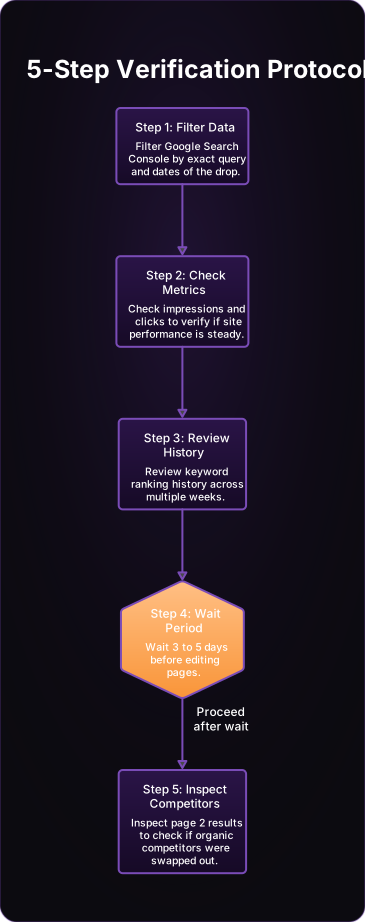 Five-step decision protocol for arbitrating between rank tracker drops and Google Search Console performance data.
A five-step verification protocol
- Filter exact query and date parameters in Search Console: Align the exact search query and inspect the specific 48-hour window where the rank tracker recorded the drop.
- Prioritize impression and click metrics over average position: If impression volume and click counts remain consistent with historical baselines, real users are finding your page, confirming that the site suffered no algorithmic devaluation.
- Audit longitudinal keyword history: Review multi-week SERP composition rather than comparing single-day points. Third-party scrapers frequently ingest anomalous data across consecutive daily runs.
- Enforce the 14-day hold rule before editing copy: Industry research confirms that 66% of poisoned SERP occurrences resolve on the next crawl cycle, and over 90% revert within two weeks. Editing on-page content prematurely disrupts validated semantic entities currently rewarded by search engines.
- Inspect page 2 organic distributions: Check whether page 2 results exhibit abnormal clusters of social media profiles and forums, indicating scraper degradation.
Telemetric markers of a genuine algorithmic drop
- Simultaneous impression and click collapse: Google Search Console displays a steep decline in impressions and clicks matching the rank tracker alert.
- Persistent multi-day depression: The drop sustains across multiple collection cycles and across distinct monitoring tools.
- Cluster-wide topical movement: Sibling URLs across the same topical cluster exhibit concurrent position shifts, signaling Core Update re-ranking or entity cannibalization.
Telemetric markers of a poisoned SERP artifact
- Divergent performance curves: The rank tracker plots an abrupt drop while Search Console impressions remain perfectly stable.
- Unfamiliar competitor landscape: The tracker records unfamiliar domains, foreign-language sites, or irrelevant forums in the top 10.
- Rapid recovery without intervention: The keyword restores to its historical position within several days without code or copy modifications.
Operational next steps
When telemetry indicates a temporary data anomaly, maintain strict ranking surface freeze. Note the anomaly in internal sprint logs and prepare client-facing updates using our framework for reporting ranking volatility to clients. To evaluate whether your rank tracking provider has implemented automated anomaly detection, review our guide on why rank trackers disagree on SERP data collection and the essential data quality questions for rank tracking providers. For technical domain hygiene, run a regular audit using the Search Atlas Site Auditor.