Evaluating rank tracker data quality requires auditing how a provider detects abnormal Google results, executes automated re-collection across fresh proxies, flags unverified data points, cleans affected historical charts, and reconciles against first-party Google Search Console telemetry. With search engines actively serving candidate-swapped poisoned SERPs to automated collectors, a software vendor's data-scrubbing architecture is now as critical as its reporting features.
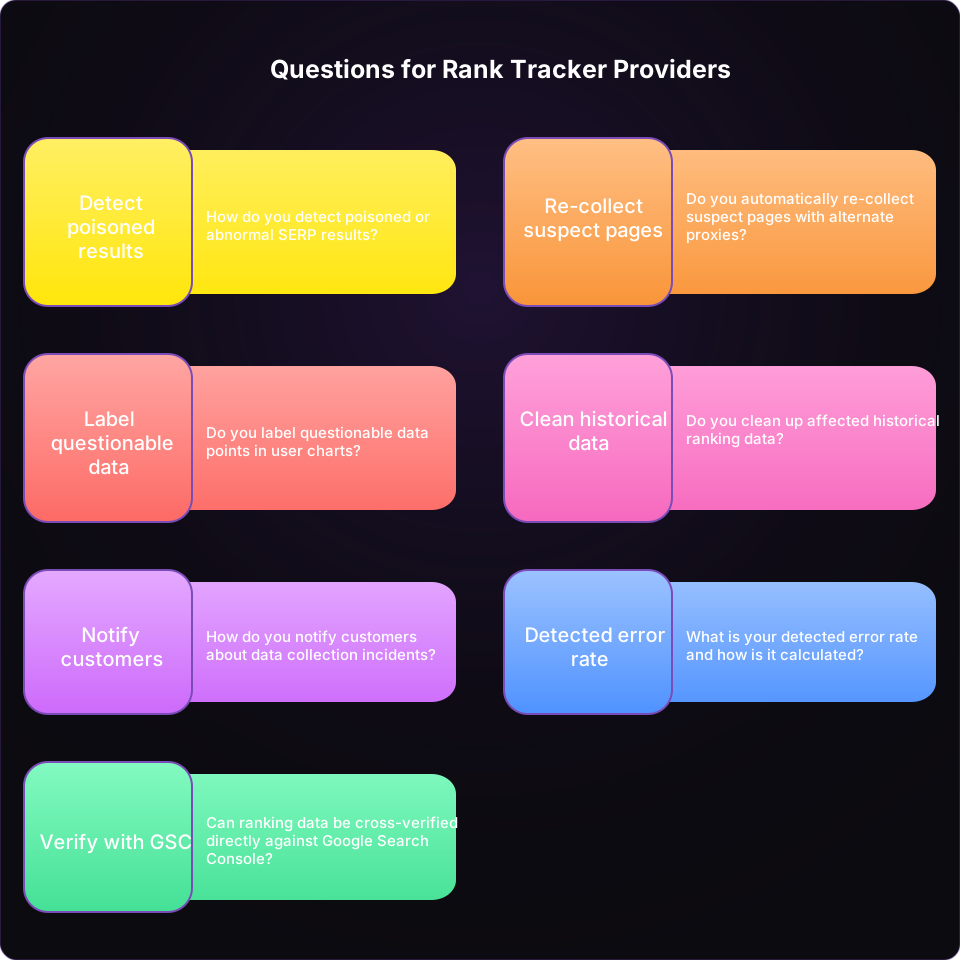 Seven core evaluation pillars for auditing rank tracker data quality and anti-scraping resilience.
1. How do you detect poisoned or abnormal results?
SERP anomaly detection is an algorithmic validation system that monitors incoming search results for statistical deviation against established keyword baselines. This system operates by comparing newly collected domain entity sets against 30-day historical ranking distributions, producing automated alert flags when result retention collapses below 50%. The detection sensitivity of modern rank tracker verification systems governs whether software users receive authentic ranking intelligence or false demotion alarms during search engine anti-bot updates.
DemandSphere scores incoming pages against historical domain sets, while Nozzle defines an anomaly as any result set retaining fewer than half of a keyword's historical ranking URLs. When auditing a provider, ask whether anomaly detection is automated or reliant on user-reported bug tickets.
2. Do you automatically re-collect suspect pages across alternate proxies?
When anti-scraping heuristics flag a datacenter proxy, Google returns altered candidate sets. Enterprise providers immediately trigger automated retries across residential or mobile proxy pools. Semrush and DemandSphere retry collections up to three times across alternate networks before storing results, ensuring that temporary bot-blocking challenges do not corrupt user reports.
3. Do you visually label questionable data points in user charts?
Silent data corruption creates severe operational disruption for SEO teams. High-integrity data providers visually badge unverified or flagged data points directly on historical trend charts. Transparent labeling alerts practitioners to data collection friction before they draft premature client communications.
4. Do you clean up affected historical ranking data retroactively?
If a data collection outage injects corrupted readings across several thousand keywords, storing those data points permanently distorts historical trendlines and average position calculations. Enterprise providers like Ahrefs purge confirmed poisoning artifacts from longitudinal history once verified data is re-collected.
5. How do you notify customers about data collection incidents?
Ask your software provider where and when data collection disruptions are communicated. Reliable platforms maintain dedicated status dashboards and issue in-app notifications detailing search engine scraping friction, rather than leaving customers to discover anomalies independently.
6. What is your detected error rate and how is it measured?
Vendor anomaly figures vary significantly across the industry: Ahrefs reported between 5% and 20% of results affected depending on the underlying data partner, whereas DemandSphere measured a 6.7% daily disruption rate. Inquire whether your provider tracks its scraping error rate continuously, and request documentation on how anomalies are separated from genuine search algorithm volatility.
7. Can ranking data be cross-verified directly against Google Search Console?
Third-party rank tracking should never exist in an unverified silo. Leading platforms provide native integration with Google Search Console, enabling instant cross-correlation between third-party position alerts and verified human user impression metrics. Review our step-by-step framework on how to evaluate rank tracker drops against Search Console.
How to score your current software provider
Score your rank tracking provider across these 7 criteria:
- 6 to 7 Affirmative Answers: Enterprise-Grade Resilience. Suitable for high-stakes client reporting and programmatic monitoring.
- 4 to 5 Affirmative Answers: Moderate Resilience. Requires manual Search Console cross-validation during search engine volatility.
- Fewer than 4 Affirmative Answers: High Risk. Prone to false alarms, wasted technical hours, and client friction.
For a comprehensive evaluation of the software landscape, explore our in-depth rank tracking tools comparison, review top SERP monitoring tools, and understand why rank trackers disagree on SERP data collection.