Rank trackers report conflicting ranking positions for identical keywords because each monitoring provider employs distinct data collection architectures, proxy IP geographies, JavaScript rendering engines, and candidate result filtering algorithms. Since Google deployed automated anti-scraping defenses leading to poisoned SERPs in September 2026, variance between independent tracking vendors has widened dramatically, making third-party rank snapshots less consistent across tools.
How rank trackers get their data
A SERP data collection pipeline is an automated scraping architecture that retrieves, parses, and structures search engine results pages for tracked keyword entities. This pipeline operates by dispatching programmatic HTTP requests through rotating proxy networks, extracting DOM node coordinates and text strings to record organic ranking positions. The parsing accuracy of automated scraping pipelines is sensitive to search engine anti-bot countermeasures, governing whether downstream rank reports display authentic search results or corrupted proxy artifacts (documented by DataForSEO and Decodo).
Under modern layout-aware search architectures (Google Patent US10824630B2), search results are rendered dynamically in 2D bounding boxes. Automated collectors must either execute complex headless Chromium browser sessions or reconstruct layout geometries from raw HTML responses, creating inherent measurement divergence.
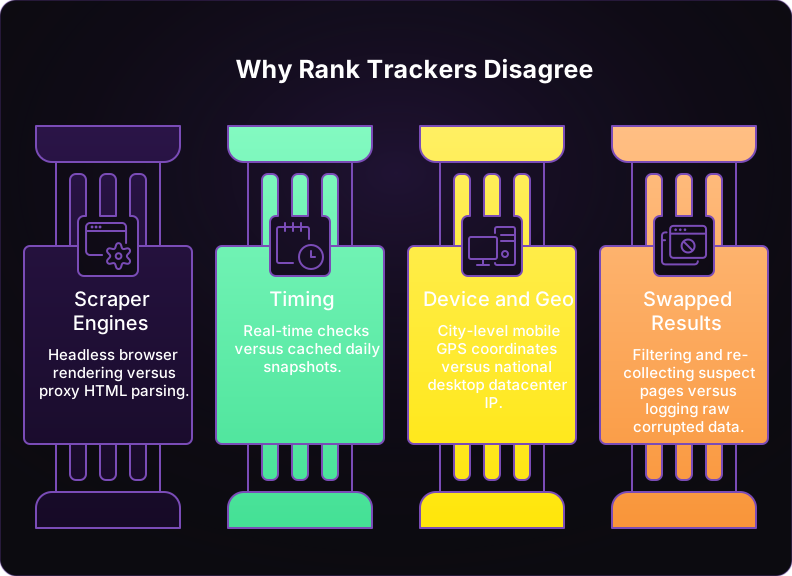 Four primary architectural dimensions causing automated rank tracking tools to report conflicting ranking numbers.
How search engine data collection changed in 2025–2026
Google has introduced successive technical hurdles that systematically increased the cost, latency, and fragility of automated SERP data collection:
| Timeline | Technical Search Engine Change | Impact on Scraper Architecture |
|---|---|---|
| January 2025 | JavaScript execution mandated for SERP rendering | Simple HTML cURL parsers broke; headless browser rendering became mandatory |
| September 2025 | Deprecation of num=100 URL query parameter | Retrieving 100 results escalated from 1 request to 10 sequential requests, multiplying proxy expenses |
| July 2026 | Deployment of google.com/goto redirect links | Organic URLs masked behind redirects, requiring secondary HTTP resolution |
| September 2026 | Active injection of poisoned SERPs | Deceptive HTTP 200 payloads with swapped organic candidates delivered to automated bots |
As DataForSEO observed, earlier changes made automated data collection more computationally expensive, but poisoned SERPs made unverified raw scraping fundamentally unreliable.
Core factors driving position variance across tools
- JavaScript rendering versus raw HTTP parsing: Providers using full headless browser execution capture JavaScript-rendered search elements (including interactive local packs and dynamic carousels), whereas lightweight HTTP scrapers miss deferred client components.
- Geographic and device coordinates: A rank check dispatched from a national datacenter IP address records a nationalized search result, whereas mobile rank checks simulate hyper-local GPS coordinates, producing distinct ranking orders.
- Anomaly detection and retry logic: When Google returns candidate-swapped pages, sophisticated providers identify baseline divergence and re-collect the page using fresh proxy pools. Less resilient tools ingest corrupted data directly into user dashboards.
- Crawl timing and caching windows: Search engine results fluctuate continuously throughout the day. A provider crawling at 04:00 UTC captures an entirely different result state than a provider polling at 16:00 UTC.
Best practices for reconciling divergent ranking data
- Maintain a single provider as your longitudinal baseline: Avoid switching tools mid-quarter; evaluate progress against consistent scraper methodology.
- Anchor analysis in Google Search Console: Use Search Console as the definitive ground truth for human impressions and clicks. See our guide on reconciling rank tracker drops with Search Console data.
- Audit provider verification capabilities: When evaluating enterprise SEO software, review our checklist of 7 critical data quality questions for rank tracking providers and compare leading platforms in our rank tracking tools evaluation.