AI citation eligibility optimization is the structured process of aligning content, entities, authority signals, and technical foundations so AI systems select, cite, and reference a brand inside AI-generated answers. Citation eligibility in AI search means that a passage meets the structural clarity, semantic completeness, and cross-source verification thresholds required for inclusion.
AI citation optimization differs from traditional SEO because ranking position does not guarantee inclusion in answers, and citation eligibility depends on entity authority, extractability, and consensus validation rather than on keyword placement alone. AI citation optimization operates as the next layer of modern search visibility, where inclusion inside AI-generated responses replaces blue-link prominence.
AI citation eligibility matters in 2026 because generative systems determine brand exposure through zero-click answer layers instead of traffic-driven rankings. Zero-click behavior exceeds 50%, and AI Overviews generate clicks in only 1% of sessions compared to 15% for traditional search. AI systems choose sources through risk reduction, entity density, structural clarity, freshness alignment, and cross-platform corroboration. AI citation optimization increases high-value traffic, strengthens compounding authority, and positions brands inside synthesized decision journeys where AI-referred visitors convert up to 23x higher than traditional organic visitors.
AI systems choose sources to cite based on authority signals, semantic structure, entity disambiguation, original research, and third-party consensus. The key components of AI Citation Eligibility Optimization are Answer-First Content, Structured Data and Schema Markup, Entity Disambiguation, Original Research and Data, and Third-Party Consensus. The core strategies include optimizing the Content Extraction Layer, strengthening the Technical and Entity Layer, reinforcing the Authority and Consensus Layer, and formatting content for deterministic AI parsing. Structured answer capsules, consistent entity identifiers, schema implementation, and distributed brand mentions collectively increase citation frequency and reduce attribution risk across AI assistants.
To get a brand cited by AI assistants requires structured content creation, listicle inclusion, trusted-platform presence, and continuous AI citation tracking to measure volatility and displacement. AI citation tracking monitors Citation Share, Survival Rate, Competitor Substitution Rate, and AI Share of Voice rather than rankings alone. Tools that support AI citation tracking (Search Atlas LLM Visibility tool) connect citation measurement with optimization workflows to increase inclusion stability. AI citations change rapidly, with average half-lives near 4-5 weeks and 62% decay within 90 days, which requires freshness updates every 3-6 months and reinforced third-party validation.
Common challenges in AI citation optimization include citation unpredictability, source misattribution, entity fragmentation, and platform fragmentation, which confirm that sustained citation eligibility depends on entity-based SEO, distributed authority signals, and structured extractability rather than backlinks or rankings alone.
What Is AI Citation Eligibility Optimization?
AI citation eligibility optimization is a digital content strategy that increases the probability of a brand being selected, cited, and referenced inside AI-generated answers by aligning content with the selection criteria used by generative AI systems. AI citation eligibility optimization focuses on authority, accuracy, accessibility, and verifiability so that AI systems treat content as a reliable grounding source rather than as a ranked webpage. AI citation eligibility optimization emerged between 2023 and 2025 as generative platforms displaced traditional link-based search, which required brands to optimize for citation inclusion instead of position-based visibility.
What does cited answers mean in AI tools? Cited answers in AI tools refer to generated responses that reference specific sources as attribution links within AI-generated summaries. AI systems extract structured content, synthesize explanations, and attach citation links to domains they classify as authoritative. AI citation optimization ensures that content qualifies for inclusion inside these cited answer blocks rather than remaining outside the AI response layer.
What does citation eligibility mean in AI search? Citation eligibility in AI search means that content meets the technical, semantic, and authority thresholds required for AI engines to select it as a reference source. AI systems evaluate structured headings, factual precision, entity clarity, third-party mentions, and original data before deciding which sources to cite. Citation eligibility differs from ranking because AI systems often cite pages that do not rank in the top 10 search results.
How does AI citation eligibility differ from traditional SEO? AI citation eligibility optimization differs from traditional SEO because it prioritizes inclusion inside AI-generated answers instead of ranking positions in search engine results. Traditional SEO optimizes for rankings, backlinks, and click-through rates, while AI citation optimization targets citation frequency, topical authority, and semantic reliability. Only 12% of AI-cited links rank in Google’s top 10, which confirms that backlinks influence AI-generated citations differently than traditional ranking factors.
How do AI engines decide which sources to cite? AI engines decide which sources to cite by evaluating topical authority, structured formatting, entity consistency, and cross-source validation before generating answers. AI systems prioritize domains with repeated brand mentions, original research, and clear factual statements because these signals increase attribution confidence. Brands in the top quartile for web mentions earn more than 10x AI citations compared to low-mention domains, which demonstrates how AI citation tracking aligns with entity recognition patterns.
What are the key components of AI citation eligibility optimization? The key components of AI citation eligibility optimization are answer-first content, structured data, entity disambiguation, original research, and third-party consensus. Answer-first content provides extractable definitions. Structured data clarifies relationships. Entity disambiguation prevents brand confusion. Original research increases citation probability by 4.1x. Third-party consensus reinforces authority signals across domains.
How does AI citation optimization improve conversions? AI citation optimization improves conversions by positioning brands inside trusted AI answers before users visit a website. AI-referred traffic converts at 14.2% compared to 2.8% from traditional Google organic traffic, which represents a 5x premium. Claude-referred traffic converts at 16.8%, and AI visitors spend 68% more time on-site, which confirms stronger pre-qualified trust.
Why does AI citation tracking matter? AI citation tracking matters because citation frequency, attribution context, and competitive displacement determine AI visibility rather than ranking metrics. 78% of marketing teams report zero AI visibility tracking, which creates strategic blind spots in AI search performance. AI citation tracking identifies which domains receive AI-generated citations, how AI engines decide which sources to cite, and where competitors dominate cited answers.
What defines AI citation optimization in modern search strategy? AI citation optimization defines a shift from ranking competition to citation competition within generative AI systems. AI citation optimization transforms brands from invisible domains into indispensable reference sources inside AI-generated responses. As AI platforms generated 1.13 billion referral visits in June 2025 with 357% year-over-year growth, AI citation eligibility optimization became a foundational requirement for digital authority in AI-mediated search environments.
What Does “Citation Eligibility” Mean in AI Search?
Citation eligibility in AI search means that a specific content passage satisfies the structural, semantic, and trust conditions required for AI systems to extract and reference it inside generated answers. Citation eligibility focuses on passage-level extractability instead of page-level authority. Generative AI systems shifted search behavior from link navigation to answer consumption between 2022 and 2024, which required new inclusion standards.
What distinguishes citation eligibility from basic search visibility? Citation eligibility differs from search visibility because it evaluates whether a passage is confidently reused inside an AI-generated response. AI systems examine clarity, entity definition, and factual grounding before selecting a source. Content that presents direct answers, defined terms, and verifiable claims increases citation probability because AI systems prioritize confidence during answer construction.
How does citation eligibility differ from traditional ranking criteria? Citation eligibility differs from traditional ranking criteria because it measures extraction confidence rather than keyword position. Traditional SEO ranks full pages, while citation eligibility determines whether individual passages qualify for inclusion inside synthesized responses. Only 38% of Google AI Overview citations originate from the top 10 organic results, which confirms that citation selection operates independently from ranking position.
What structural attributes increase citation eligibility? Structured formatting increases citation eligibility because AI systems parse segmented information more accurately than dense paragraphs. Lists, defined entities, question-and-answer blocks, and separated sections improve extraction precision. Adding statistics increases citation rates by 22%, and quotations increase citation rates by 37%, which demonstrates that factual density strengthens selection likelihood.
What semantic characteristics increase citation eligibility? Semantic completeness increases citation eligibility because AI systems prefer passages that resolve intent without external context. Content scoring 8.5 out of 10 or higher for semantic completeness becomes 4.2 times more likely to receive citations. Optimal passage length is 134-167 words, and 62% of featured content is 100-300 words, reflecting AI’s preference for concise explanation blocks.
What technical factors determine citation eligibility? Technical accessibility determines citation eligibility because AI crawlers require direct and reliable access to content. Content must remain crawlable, indexable, and free from blocking directives. JSON-LD structured data increases AI selection by 73%, and content updated within 30 days achieves 76-82% citation rates, which confirms that freshness and schema signals influence inclusion probability.
Why does citation eligibility function as a risk-control mechanism for AI systems? Citation eligibility functions as a risk-control mechanism because AI systems select sources that reduce factual and reputational uncertainty. AI systems evaluate authority, safety, and cross-source agreement before assigning attribution. This evaluation protects AI platform credibility and increases citation consistency for structured, verifiable content.
Why does citation eligibility matter for an AI visibility strategy? Citation eligibility matters for AI visibility strategy because AI-driven discovery replaces browse-and-click behavior with synthesized answers that define brand exposure. McKinsey estimates traffic losses between 20-50% as AI replaces traditional browsing patterns, and Gartner projects a 25% shift toward AI-driven discovery. Inclusion in AI-generated answers becomes a primary visibility signal rather than a secondary ranking outcome.
How AI Citation Eligibility Differs From Traditional SEO?
AI citation eligibility differs from traditional SEO because AI citation eligibility determines whether a passage qualifies for inclusion inside AI-generated answers, while traditional SEO determines whether a page ranks in search engine results. AI citation eligibility focuses on extractability, factual confidence, and entity consistency. Traditional SEO focuses on ranking signals, keyword alignment, and click acquisition.
What are the primary goals of AI Citation Eligibility and Traditional SEO? The primary goal of AI citation eligibility is citation inclusion inside zero-click AI answers, while the primary goal of traditional SEO is ranking position and traffic acquisition. AI systems summarize answers directly in the interface, which shifts visibility from clicks to citations. Traditional SEO measures success through higher rankings and organic sessions.
How does content optimization differ between AI Citation Eligibility and Traditional SEO? Content optimization for AI citation eligibility prioritizes passage-level clarity, structured answers, and semantic completeness, while traditional SEO prioritizes keyword placement and page-level relevance. AI systems extract short, self-contained sections that resolve intent without external context. Traditional SEO optimizes titles, headings, internal links, and keyword mapping to influence ranking algorithms.
How do targeting strategies differ between AI citation eligibility and traditional SEO? AI citation eligibility targets entities and conversational prompts, while traditional SEO targets discrete keywords and search phrases. AI prompts average longer query structures and reflect natural-language intent. Traditional search queries often contain shorter keyword clusters optimized for ranking competition.
What authority signals differ between AI Citation Eligibility and Traditional SEO? AI citation eligibility evaluates corroboration, brand mentions, and factual agreement across sources, while traditional SEO evaluates backlink quantity and link authority. AI systems treat authority as cross-source validation. Brand recognition shows a 0.334 correlation with LLM citations, which indicates that mention frequency influences citation probability beyond hyperlinks.
How do technical requirements differ between AI Citation Eligibility and Traditional SEO? AI citation eligibility requires structured data, crawler accessibility for AI bots, and visible content without JavaScript dependence, while traditional SEO requires crawlability, indexing, and performance optimization. Major AI crawlers do not render JavaScript consistently, which means key information must appear in clean HTML. Traditional SEO emphasizes robots.txt configuration, HTTPS, and Core Web Vitals compliance.
How do measurement metrics differ between AI Citation Eligibility and Traditional SEO? AI Citation Eligibility measures AI citations, brand mentions, entity presence, share of voice, and sentiment, while Traditional SEO measures rankings, organic traffic, CTR, and conversions. AI visibility tracking monitors citation frequency across generative platforms. Traditional SEO reporting tracks keyword movement and page-level performance.
How do AI citation eligibility and traditional SEO impact visibility differently? AI citation eligibility impacts visibility through answer inclusion inside AI Overviews and chat interfaces, while traditional SEO impacts visibility through ranking placement in link lists. Only 12% of AI-cited links rank in Google’s top 10, and 31% of AI-cited pages rank outside the top 100, which confirms structural decoupling between ranking and citation selection.
Why does this distinction redefine modern SEO strategy? This distinction redefines modern SEO strategy because visibility now depends on both ranking eligibility and citation eligibility across AI systems. Ranking alone does not guarantee citation inclusion. Citation inclusion establishes presence inside synthesized answers, which increasingly replace traditional browse-and-click discovery.
Why AI Citation Eligibility Matters in 2026?
AI citation eligibility matters in 2026 because generative AI systems increasingly determine brand visibility through answer inclusion rather than ranking position. AI platforms replace link lists with synthesized responses, which shifts exposure from page clicks to citation presence. Traffic patterns, authority signals, and discovery behavior now depend on whether AI systems select and reference a brand inside generated answers.
There are 3 main reasons why AI citation eligibility matters in 2026. These are listed below.
1. Zero-Click Search
Zero-Click Search is a search behavior pattern where users receive complete answers directly inside AI interfaces without visiting external websites. Between 58-65% of Google searches ended without a click in 2024, and projections exceed 65% by 2026. On mobile devices, zero-click behavior reaches 77%, which confirms that answer consumption replaces link navigation.
Why does zero-click behavior increase the importance of citation eligibility? Zero-click behavior increases the importance of citation eligibility because visibility shifts from page visits to answer inclusion. AI Overviews reduce organic CTR by 61% and paid CTR by 68% for pages beneath the answer layer. Only 1% of users click links inside AI Overviews, and 83% of AI-triggered searches end without a click.
Why does ranking no longer guarantee AI visibility? Ranking no longer guarantees AI visibility because fewer than 10% of AI-cited sources rank in Google’s top 10 for the same query. Only 7.2% of domains appear in both Google AI Overviews and LLM-generated results. Citation eligibility determines the presence inside AI summaries instead of ranking position.
Why do AI citations function as the new first-page visibility layer? AI citations function as the new first-page visibility layer because AI-generated answers replace traditional result lists at scale. Brands cited in AI Overviews earn 35% more organic clicks and 91% more paid clicks compared to non-cited brands. Repeated citation increases brand familiarity and reinforces authority signals across 2-3 months.
2. High-Value Traffic
High-Value Traffic refers to AI-referred visitors who demonstrate stronger intent, higher engagement, and superior conversion rates compared to traditional organic visitors. AI-referred traffic converted at 1.3% in 2025, which represents a 55% increase from 0.8% in 2024 Q4. AI-driven orders increased significantly across commerce platforms, which confirms a direct revenue impact.
Why do AI-cited brands receive measurable click advantages? AI-cited brands receive measurable click advantages because citation presence increases downstream branded search and direct engagement. Brands cited in AI Overviews experience 35% more organic clicks and 91% more paid clicks compared to non-cited brands. Citation becomes a visibility multiplier rather than a passive attribution signal.
Why do AI Overviews align with high-intent queries? AI Overviews align with high-intent queries because they appear in 74% of problem-solving searches and 69% of factual searches. Commercial queries increased from 8-18%, and transactional queries increased from 2% to 14% between January and October 2025. AI citation eligibility connects brands directly to users with defined intent.
Why do AI-referred visitors show stronger engagement metrics? AI-referred visitors show stronger engagement metrics because bounce rates decrease and session duration increases compared to traditional organic sessions. AI visitors convert 23x higher in some tracked environments and spend 68% more time on site. The average AI visitor delivers 4.4x higher conversion value compared to standard organic traffic.
3. Compounding Authority
Compounding Authority refers to the cumulative reinforcement effect created by repeated AI citations across multiple queries and platforms. Early citation inclusion establishes authority patterns before competitive saturation. Industry projections indicate citation dominance stabilizes around early adopters by mid-2026.
Why are AI citations more stable than traditional rankings? AI citations are more stable than traditional rankings because they embed a domain into the AI model’s authority layer for a topic. Ranking positions fluctuate regularly, while citation inclusion reinforces entity trust over time. Repeated citations increase future citation probability through reinforcement cycles.
Why does entity authority compound over time? Entity authority compounds over time because structured author profiles, third-party mentions, and validated signals create permanent trust markers. Each press mention, author entity, and verified attribution strengthens cross-source agreement. Entity-focused authority functions as a structural asset rather than a temporary ranking position.
Why does commercial query expansion strengthen compounding authority? Commercial query expansion strengthens compounding authority because AI platforms increasingly prioritize transactional and buying-intent queries. Informational query share declined from 91-57%, while commercial and transactional categories increased steadily. Citation eligibility positions brands inside revenue-generating AI responses.
How Do AI Systems Choose Sources to Cite?
AI systems choose sources to cite by prioritizing risk reduction, entity density, structural clarity, and cross-source corroboration rather than traditional ranking position. AI citation selection relies on Retrieval-Augmented Generation pipelines that retrieve dozens of candidate documents and select only a small subset for attribution. AI engines decide which sources to cite based on confidence thresholds, semantic alignment, and authority consistency across retrieved passages.
How does AI citation selection differ from traditional SEO ranking? AI citation selection differs from traditional SEO ranking because AI evaluates brand recognition, entity density, and structural completeness instead of backlink volume and keyword rank. Brand search volume shows a 0.334 correlation with AI citation frequency across more than 7,000 analyzed citations. Almost 90% of ChatGPT citations originate from pages outside the first or second search result page, which confirms that citation inclusion operates independently from ranking strength.
What signals influence how AI engines decide which sources to cite? Entity density, structural clarity, topical authority, freshness alignment, schema presence, and cross-platform consistency influence how AI engines decide which sources to cite. Entity density represents the concentration of named and verifiable entities per passage and functions as the most consistent citation predictor. Adding quantified statistics increases citation rates between 40-115%, which demonstrates that factual specificity strengthens selection probability.
Why does structural clarity affect AI citation frequency? Structural clarity affects AI citation frequency because AI systems extract single-threaded, logically segmented passages more reliably than dense or ambiguous text. Optimal article length ranges between 1,200 and 2,500 words, and content organized into clearly defined sections reduces semantic ambiguity. Clear narrative progression and defined headings increase extraction precision during synthesis.
What content characteristics increase citation probability? Explanatory, educational, and evergreen content increases citation probability because AI systems prioritize clarity, neutrality, and long-term validity. AI favors content that explains what something is, why it matters, and how it works in a structured form. Principle-based frameworks and conceptual explanations maintain citation stability over time because they remain relevant beyond short-term news cycles.
How do platform-specific citation patterns vary across AI systems? Platform-specific citation patterns vary because each AI model applies different weighting to authority, recency, and source diversity. ChatGPT typically cites 2-5 high-authority sources and heavily weights entity density. Perplexity cites 5-15 inline sources and prioritizes factual density and freshness more aggressively. Google AI Overviews and Gemini integrate ranking signals with generative filtering, which results in hybrid citation selection.
Why do AI-provided citations differ from actual model training data?n AI-provided citations differ from foundational training data because citation attribution reflects real-time retrieval rather than static model training memory. AI systems retrieve candidate passages during answer generation and attach citations based on retrieval confidence. Citations represent accessible web sources aligned with the generated response, not direct exposure to internal training datasets.
Why does citation inclusion now redefine digital visibility? Citation inclusion redefines digital visibility because AI-generated answers replace ranked lists with synthesized summaries that determine brand exposure. Only a small fraction of AI-cited pages rank in top organic positions, and citation frequency depends on semantic precision rather than backlink dominance. AI citation optimization becomes a primary strategic layer in modern search environments.
What Signals Influence AI Citation Selection?
AI citation selection is influenced by authority signals, content quality signals, structural extractability signals, entity consistency signals, and technical accessibility signals that reduce risk during answer generation. ChatGPT cites only 15% of retrieved pages and discards 85% after evaluation, which confirms that retrieval does not equal selection. AI citation optimization focuses on increasing selection probability rather than ranking position.
What authority signals influence AI citation selection? Authority signals influence AI citation selection through brand recognition, cross-platform mentions, entity consistency, and external validation. Brand search volume shows a 0.334 correlation with AI mentions. Brands mentioned positively across at least 4 independent platforms become 2.8 times more likely to appear in AI-generated answers. Domains with profiles on Trustpilot, G2, Capterra, and Yelp show 3 times higher selection probability, which demonstrates that AI defines authority through verification and consistency rather than backlink count.
What content quality signals influence AI citation selection? Content quality signals influence AI citation selection through clarity, verifiability, neutrality, recency, and depth. AI systems prioritize answer-first, fact-rich content that presents traceable claims and specific statistics. Adding quantified claims increases visibility by 40-115%, and freshness functions as a credibility filter for fast-changing topics. Original research and documented expertise strengthen citation likelihood because AI systems evaluate cross-source alignment before assigning attribution.
What structural signals influence AI citation selection? Structural extractability signals influence AI citation selection because AI systems prefer segmented, scannable, and self-contained passages. Advanced schema implementation shows an 89% correlation with AI Overview selection. Content that combines text, optimized images, and structured data achieves 156% higher selection rates compared to text-only content. FAQPage schema, HowTo schema, and Article schema improve extractability because they reduce computational interpretation cost.
What entity signals influence AI citation selection? Entity clarity signals influence AI citation selection through canonical descriptions, structured schema connections, and consistent cross-platform identity. A single, identical brand definition across the homepage, About page, author bios, Organization schema, and Google Business Profile increases entity resolution accuracy. Knowledge Graph alignment reduces ambiguity and strengthens long-term citation persistence.
What technical signals influence AI citation selection? Technical accessibility signals influence AI citation selection because AI crawlers require visible, crawlable, and indexable content. HTTPS, crawlable architecture, structured data markup, and clear internal linking strengthen retrieval reliability. AI systems deprioritize blocked crawlers, missing schema, anonymous authorship, and inconsistent topic coverage, which confirms that technical clarity increases selection probability.
What behavioral and prompt signals influence AI citation selection? Behavioral and prompt signals influence AI citation selection because prompt phrasing changes citation frequency and placement. Prompts containing the word “trusted” increase citation likelihood by 5.77%, and the word “source” increases citation likelihood by 2.88%. Brands mentioned within the first 2 sentences of AI responses receive 5 times higher user consideration, which demonstrates that citation positioning influences engagement.
Why does AI authority differ from traditional ranking authority? AI authority differs from traditional ranking authority because AI evaluates verification and cross-source agreement instead of link popularity. Almost 90% of ChatGPT citations originate from pages outside the first or second search result page. The top 10% of most cited pages rank for fewer keywords and receive fewer backlinks than the bottom 90%, which confirms an inverse correlation between ranking strength and AI citation frequency.
What Are the Key Components of AI Citation Eligibility Optimization?
The key components of AI citation eligibility optimization are answer-first content, structured data and schema markup, entity disambiguation, original research and data, and third-party consensus. AI citation eligibility optimization aligns content structure, entity clarity, factual density, and external validation with the selection criteria used by generative AI systems. These components increase passage-level extractability and reduce attribution risk during AI answer generation.
There are 5 key components of AI Citation Eligibility Optimization. These are listed below.
1. Answer-First Content
Answer-first content is a key component in AI citation eligibility because AI systems extract and select passages that resolve intent within the first 1-2 sentences of a section. AI models retrieve content in chunks and discard low-density passages during synthesis. 44.2% of AI citations originate from the first 30% of a page, which confirms that front-loaded clarity increases selection probability.
Why does the answer-first structure increase the selection rate? Answer-first structure increases selection rate because AI systems prioritize concise, self-contained answer capsules over narrative introductions. Retrieval pipelines extract 200-word segments and evaluate information gain before generation. Content that opens with a direct definition or conclusion becomes easier to verify and quote without semantic distortion.
2. Structured Data and Schema Markup
Structured data and schema markup are key components in AI citation eligibility because they convert visible content into machine-readable entity and relationship signals. Schema reduces ambiguity, strengthens entity resolution, and increases extraction confidence. Pages with schema markup show a 36% higher likelihood of appearing in AI-generated summaries.
Why does schema increase AI selection confidence? Schema increases AI selection confidence because it explicitly labels entities, attributes, and content purpose. Advanced schema implementation shows an 89% correlation with AI Overview selection. JSON-LD markup allows AI systems to map entities into knowledge graphs, which reduces interpretation errors and improves citation stability.
3. Entity Disambiguation
Entity disambiguation is a key component in AI citation eligibility because AI systems avoid citing sources with ambiguous or inconsistent identity signals. Content with explicit entity linking and an entity-to-contextual-word ratio of 1:20 or less achieves 2.5x higher direct citation rates compared to implicitly defined content.
Why does entity clarity influence citation inclusion? Entity clarity influences citation inclusion because AI systems resolve meaning through unique identifiers rather than textual similarity alone. Schema.org types, Wikidata references, and consistent sameAs links create a stable entity graph. Clear entity definition reduces computational disambiguation effort and increases citation confidence.
4. Original Research and Data
Original research and data are key components in AI citation eligibility because AI systems prioritize primary, verifiable, and risk-minimized sources. Websites hosting original research generate 4.31x more citation occurrences per URL than directory-style pages. Statistics addition alone increases AI visibility by 41%.
Why does proprietary data improve citation probability? Proprietary data improves citation probability because it reduces reliance on secondary interpretation and increases factual confidence. Pages ranking for both main queries and fan-out queries become 161% more likely to receive AI citations. Topical authority shows a stronger correlation with citation frequency than domain authority.
5. Third-Party Consensus
Third-party consensus is a key component in AI citation eligibility because AI systems evaluate cross-source agreement before assigning attribution. Domains with consistent mentions across 30-40 credible platforms demonstrate significantly higher AI mention rates. Brand search volume correlates with citation frequency at 0.334, which confirms that distributed validation influences AI selection.
Why does cross-platform validation strengthen citation inclusion? Cross-platform validation strengthens citation inclusion because AI models prioritize independent corroboration over self-reported claims. Brands mentioned positively across at least 4 non-affiliated forums become 2.8x more likely to appear in ChatGPT responses. AI authority depends on verification networks rather than ranking position.
What Are the Core Strategies for AI Citation Eligibility Optimization?
The core strategies for AI citation eligibility optimization are optimizing the content extraction layer, strengthening the technical and entity layer, building the authority and consensus layer, and formatting for AI systems. AI citation eligibility optimization aligns structural clarity, entity identity, external validation, and machine-readable formatting with how AI systems retrieve and select sources during answer generation.
There are 4 core strategies for AI citation eligibility optimization. These are listed below.
1. Optimize Content Extraction Layer
Optimize the content extraction layer by structuring content into clear, self-contained, information-dense passages that AI systems retrieve, evaluate, and quote without ambiguity. AI systems retrieve content in chunks, not full pages, and select only passages that resolve intent quickly. ChatGPT cites only 15% of retrieved pages and discards 85% after evaluation, which confirms that extraction clarity determines selection probability.
What structural principles improve extraction accuracy? Structural principles improve extraction accuracy by reducing ambiguity and increasing information density within the first 1-2 paragraphs of each section. 44.2% of AI citations originate from the first 30% of a page’s text, which confirms that front-loaded clarity increases citation inclusion. Each major heading requires a 40-80-word answer capsule that resolves the question before expanding into an explanation.
What formatting decisions increase extraction precision? Formatting decisions increase extraction precision by segmenting ideas into discrete, scannable units that AI systems isolate cleanly. Use short paragraphs of 60-120 words, question-based H2 or H3 headings, numbered steps, and structured lists. Dense micro-answers outperform narrative introductions because retrieval systems prioritize high information gain over storytelling.
What content patterns reduce extraction success? Long introductions, vague marketing language, ambiguous pronouns, and answers buried in images reduce extraction success. AI retrieval pipelines avoid passages that require contextual inference or multi-paragraph interpretation. Content that places the core claim after paragraph 5 or hides it behind JavaScript-dependent elements becomes invisible to the synthesis stage.
What operational steps strengthen the content extraction layer? Strengthen the content extraction layer by defining extraction objectives, auditing passage readiness, and aligning metadata with semantic intent. Firstly, define the primary query intent each section resolves. Secondly, audit each section for semantic completeness and entity clarity. Thirdly, align headings, metadata, and structured signals so retrieval systems identify the passage as authoritative and directly quotable.
Why does extraction optimization directly influence AI citation eligibility? Extraction optimization directly influences AI citation eligibility because retrieval and synthesis stages operate independently from ranking systems. Content that fails chunk-level evaluation never reaches the generation phase, which prevents citation regardless of domain authority. Optimized extraction therefore transforms content from retrievable to citable within AI-generated answers.
2. Strengthen the Technical and Entity Layer
Strengthen the technical and entity layer by ensuring machine-readable entity identity, crawlable infrastructure, consistent structured data, and unified entity relationships across all digital surfaces. AI systems cite sources they clearly identify, verify, and resolve without ambiguity. Weak entity identity or fragmented technical signals reduce citation eligibility even if content quality is high.
What defines a strong Technical Layer for AI citation eligibility? A strong technical layer ensures that content is crawlable, indexable, structured, and consistently accessible in clean HTML without dependency barriers. AI crawlers prioritize visible text, HTTPS security, stable architecture, and structured markup. Blocked crawlers, JavaScript-dependent core content, inconsistent canonicals, and schema-content mismatch reduce citation confidence.
What defines a strong Entity Layer for AI citation eligibility? A strong entity layer establishes a single, canonical identity for the organization, authors, services, and products using structured identifiers and consistent descriptions. AI systems rely on entity clarity rather than keyword frequency. Content with explicit entity linking and a 1:20 entity-to-contextual-word ratio achieves 2.5x higher citation probability compared to implicit contextual cues.
How does structured data reinforce the entity layer? Structured data reinforces the Entity Layer by labeling entities, attributes, and relationships in JSON-LD format that AI systems map into knowledge graphs. Organization, Person, Article, Product, Service, and FAQPage schema improve entity resolution accuracy. Advanced schema implementation shows an 89% correlation with AI Overview selection, which confirms that explicit markup increases citation confidence.
Why does @id consistency matter in entity optimization? @id consistency matters because it connects pages into a unified internal entity graph that AI systems interpret as one stable identity. Reusing canonical URLs as persistent identifiers across homepage, author pages, service pages, and schema types prevents entity fragmentation. Fragmented entity signals create ambiguity and reduce AI citation stability.
How does external corroboration strengthen the entity layer? External corroboration strengthens the Entity Layer by validating identity signals across independent platforms and knowledge bases. Brands mentioned consistently across at least 4 non-affiliated platforms become 2.8 times more likely to appear in AI-generated answers. Cross-platform consistency reduces interpretive load for AI models and increases attribution probability.
What operational steps strengthen both layers simultaneously? Strengthen both layers simultaneously by aligning structured markup, visible evidence, author identity, and internal linking into a cohesive entity system. Firstly, implement the organization and person schema with consistent sameAs references. Secondly, ensure every article links to a verified author profile with a structured identity. Thirdly, audit crawlability, schema validity, and entity consistency quarterly to prevent signal drift.
Why does strengthening the Technical and Entity Layer increase AI citation eligibility? Strengthening the Technical and Entity Layer increases AI citation eligibility because AI authority depends on verification, consistency, and machine-readable identity rather than backlink volume.
3. Build Authority and Consensus Layer
Build the authority and consensus layer by creating cross-platform validation, increasing brand mention density, strengthening third-party corroboration, and reinforcing topical authority across independent sources. AI systems prioritize sources that demonstrate consistency, verification, and distributed recognition instead of isolated self-published claims. Authority and consensus signals reduce citation risk because AI models verify claims against external agreement before assigning attribution.
What defines authority in AI citation eligibility? Authority in AI citation eligibility refers to cross-source verification, brand recognition, expert attribution, and consistent entity identity across platforms. Brand search volume correlates with AI citation frequency at 0.334, and brands mentioned across at least 4 independent platforms become 2.8 times more likely to appear in AI-generated answers. Authority depends on corroboration rather than backlink quantity.
What defines Consensus in AI citation eligibility? Consensus in AI citation eligibility refers to repeated, consistent validation of facts, positioning, and identity across multiple trusted sources. AI systems compare claims across review platforms, industry publications, forums, and directories before citation. Domains with consistent identity across 30-40 credible platforms demonstrate measurably higher AI mention rates.
What practical elements build the authority and consensus layer? Authority and consensus are built through structured identity, third-party citations, expert validation, review consistency, and media presence. The table below defines core elements and their impact.
| Layer Component | Description | Impact on AI Citation |
|---|---|---|
| Brand Mentions | Repeated brand references across independent platforms | Increases citation probability through cross-source agreement |
| Review Platforms | Verified presence on platforms (Trustpilot, G2, Capterra, Yelp) | 3x higher likelihood of AI selection |
| Expert Attribution | Named authors with credentials and a structured Person schema | Strengthens E-E-A-T validation |
| Media Coverage | Mentions in recognized publications and industry outlets | Reinforces authority through external corroboration |
| Original Research | Proprietary statistics and documented methodology | Improves visibility by 40-115% |
Why does distributed validation outperform isolated signals? Distributed validation outperforms isolated signals because AI systems evaluate consensus networks instead of single-domain strength. A single citation produces minimal impact, while a consistent network across dozens of credible platforms creates a reinforcement effect. AI authority depends on verification across independent sources rather than self-reported claims.
How does brand identity remain consistent across platforms? Brand identity remains identical in name format, description scope, expertise positioning, and entity attributes across all digital surfaces. Inconsistent naming, outdated addresses, or conflicting service descriptions weaken consensus signals. AI systems deprioritize fragmented entities because ambiguity increases attribution risk.
What operational steps build a stable authority and consensus Layer? Build a stable authority and consensus layer by auditing external mentions, strengthening high-authority listings, and publishing repeatable expertise signals. Firstly, secure presence on high-trust platforms and industry directories. Secondly, maintain consistent brand descriptions and entity attributes across 30-40 verified platforms. Thirdly, reinforce topical authority through original data, expert commentary, and recurring publication cycles.
Why does authority and consensus directly affect AI citation eligibility? Authority and consensus directly affect AI citation eligibility because AI models assign citations to sources that minimize factual and reputational risk. Almost 90% of AI-cited pages rank outside top search positions, which confirms that citation selection depends more on verification networks than ranking strength. Strong consensus transforms content from retrievable to repeatedly citable across queries and platforms.
4. Format Content for AI
Format content for AI systems by structuring information into clear, question-aligned, semantically segmented sections that AI models retrieve, interpret, and quote with minimal transformation. AI systems prioritize structured, low-risk, high-clarity passages that reduce extraction ambiguity. Structured formatting increases citation confidence because it lowers interpretation complexity during Retrieval-Augmented Generation pipelines.
What structural patterns improve AI comprehension? Structural patterns improve AI comprehension by using short paragraphs, direct sentences, explicit headings, and scannable layouts. Paragraphs contain 1-3 sentences and stay under 120 words to preserve extraction clarity. Each heading defines exactly what the following section explains. AI systems map headings directly to user prompts, which increases citation eligibility.
Why do question-based headings increase AI citation probability? Question-based headings increase AI citation probability because they mirror natural-language prompts entered into AI interfaces. Headings structured as “What is,” “How to,” or “Why does” align directly with fan-out query expansion. AI systems match these headings to retrieval tasks during synthesis, which improves selection accuracy.
How do lists, tables, and deterministic formatting improve extractability? Lists, tables, and deterministic formatting improve extractability because AI systems parse structured blocks more accurately than narrative paragraphs. Models reach up to 96% parsing accuracy when extracting information from tables. Numbered steps, bullet lists, and side-by-side comparison tables reduce computational interpretation cost and increase quotation likelihood.
What content formats do AI systems prefer? AI systems prefer content formats that deliver direct comparisons, best-of lists, step-by-step guides, FAQs, structured research summaries, and clearly labeled sections. Direct comparisons use binary framing that simplifies summarization. Step-by-step guides with numbered H3 sections align with the HowTo schema and retrieval logic. FAQ sections with 40-60-word answers increase passage-level citation probability.
Why does an informational writing style increase AI trust? Informational writing style increases AI trust because it emphasizes clarity, neutrality, and verifiable claims over persuasion. AI systems deprioritize promotional language and vague claims. Each sentence must deliver one measurable idea that remains independently quotable without contextual inference.
How does semantic optimization support formatting for AI? Semantic optimization supports formatting for AI by aligning headings, structured data, internal linking, and keyword placement with entity clarity. Primary keywords appear naturally in the title tag and H1. Structured data types (FAQPage, HowTo, Article, Organization, Person) strengthen machine-readable interpretation and reinforce passage-level eligibility.
Why does regular content refresh strengthen AI formatting performance? Regular content refresh strengthens AI formatting performance because recency functions as a credibility signal during AI retrieval. Updating statistics every 3-6 months, labeling content with clear update markers, and revising outdated comparisons maintain citation eligibility. AI systems prioritize up-to-date structured information for high-confidence reuse.
Why does formatting determine AI citation inclusion? Formatting determines AI citation inclusion because AI systems select the cleanest, most quotable chunk rather than the longest or most ranked page. Structured, direct, and semantically segmented content reduces ambiguity and increases extraction precision. Formatting transforms content from retrievable to consistently citable within AI-generated answers.
How to Create Content That AI Systems Prefer to Cite?
Create content that AI systems prefer to cite by structuring direct answers, using deterministic formats (lists and tables), and maintaining clarity and consistency across all sections. AI systems retrieve passages, evaluate information density, and select the safest, most verifiable chunks for citation. Citation preference depends on extractability, entity clarity, and semantic completeness rather than ranking position.
There are 3 main methods to create content that AI systems prefer to cite. These are listed below.
1. Structure Clear and Direct Answers
Structure clear and direct answers by placing the complete resolution of the question within the first 1-2 sentences under each heading. AI systems retrieve chunks, not entire pages, and evaluate passages based on clarity, density, and standalone meaning. 44.2% of AI citations originate from the first 30% of page content, which confirms that front-loaded summaries increase citation inclusion.
Why does answer-first positioning increase citation eligibility? Answer-first positioning increases citation eligibility because AI systems prioritize passages that resolve intent before elaboration. Retrieval pipelines evaluate information gain during synthesis and discard low-density narrative introductions. Pages with paragraph-length summaries at the top show 35% higher inclusion in AI-generated snippets, which confirms that directness strengthens extraction confidence.
How are paragraphs structured for AI systems? Paragraphs contain one idea, remain under 120 words, and avoid context-dependent pronouns. Each section functions independently without relying on earlier paragraphs. Ambiguous phrasing reduces citation probability because AI systems cannot safely quote unclear references.
2. Use Lists, Tables, and Definitions
Use lists, tables, and definitions to reduce ambiguity, increase scannability, and improve machine parsing accuracy. Structured formatting reduces computational extraction cost and increases citation stability. Models reach up to 96% accuracy when parsing tables compared to unstructured narrative text.
Why do numbered lists increase extraction precision? Numbered lists increase extraction precision because they define ordered logic that AI systems quote step-by-step without reinterpretation. Step sequences, comparison rankings, and procedural breakdowns align with retrieval logic and HowTo schema patterns.
Why do tables improve citation confidence? Tables improve citation confidence because they organize data into labeled fields that AI systems interpret deterministically. Comparison tables, pricing matrices, and feature breakdowns provide clear attribute-value relationships. Structured tables reduce ambiguity during answer synthesis.
Why are explicit definitions important? Explicit definitions increase citation eligibility because AI systems prioritize clearly scoped explanations that follow the structure “Entity is definition plus attributes plus impact.” Definition-first formatting reduces inference load and strengthens semantic clarity across extraction layers.
3. Improve Content Clarity and Consistency
Improve content clarity and consistency by maintaining uniform terminology, stable entity definitions, structured formatting, and periodic updates across all pages. AI systems evaluate cross-source agreement before assigning citations, which means inconsistency weakens selection probability.
Why does terminology consistency affect AI citation frequency? Terminology consistency affects AI citation frequency because inconsistent naming fragments entity identity across platforms. AI models require identical brand descriptions, service labels, and entity attributes to resolve meaning without ambiguity. Fragmented identity reduces attribution confidence.
Why does regular content refresh improve citation stability? Regular content refresh improves citation stability because recency functions as a credibility signal during AI retrieval. Updating statistics every 3-6 months and correcting outdated comparisons increases inclusion likelihood for fast-changing topics.
Why does a structured review workflow strengthen clarity? Structured review workflow strengthens clarity because multiple editing stages eliminate vague claims, redundant phrasing, and ambiguous sections. Peer review, metadata validation, and quarterly schema audits preserve alignment between visible content and machine-readable signals.
How to Increase Citation Opportunities Through Brand Mentions?
Increase citation opportunities through brand mentions by securing inclusion in curated listicles and roundups and by building a consistent presence across trusted third-party platforms. AI systems evaluate cross-source validation before assigning citations. Brands that appear repeatedly across independent sources gain higher citation probability because AI models prioritize consensus and verification.
There are 2 main methods to increase citation opportunities through brand mentions. These are listed below.
1. Get Listed in Listicles and Roundups
Get listed in listicles and roundups by targeting the actual author, providing a clear positioning angle, and demonstrating differentiated value with verifiable specifics. Most listicles are written by freelance contributors or beat journalists, not generic editorial inboxes. Direct outreach to the named author increases inclusion probability because it places the pitch in front of the decision-maker.
Why does positioning matter for listicle inclusion? Positioning matters because listicle editors prioritize originality, specificity, and reader value over generic promotion. Pitches must answer “why this product” and “why now” with quantified benefits, clear use cases, and a defined target segment. Listicles favor structured entries that follow consistent patterns (Tool name → Core feature → Ideal user profile).
Why do affiliate programs influence inclusion probability? Affiliate programs influence inclusion probability because many listicles prioritize monetizable products. If competing tools offer affiliate incentives and a product does not, editors deprioritize it. Competitive inclusion depends on aligning commercial structure with editorial incentives.
2. Build Presence Across Trusted Platforms
Build presence across trusted platforms by maintaining consistent brand identity, securing profiles on high-authority directories, and reinforcing third-party validation signals. AI systems treat distributed brand mentions as corroboration. Brands appearing consistently across 30-40 credible platforms show significantly higher AI citation rates.
Which platform categories increase citation probability? Platform categories that increase citation probability include review sites, industry directories, professional networks, media publications, and community forums. Domains with verified profiles on platforms (Trustpilot, G2, Capterra, Yelp, LinkedIn, and Crunchbase) and recognized industry associations demonstrate stronger authority signals. AI systems evaluate these platforms as independent validation layers.
Why does cross-platform consistency matter? Cross-platform consistency matters because inconsistent naming, descriptions, or service scope weakens entity resolution and reduces citation confidence. Brand name format, service categories, contact information, and expertise statements must remain identical across platforms. AI systems deprioritize fragmented identity signals because ambiguity increases attribution risk.
How to Track AI Citations and Visibility?
Track AI citations and visibility by measuring citation frequency, AI Share of Voice, sentiment context, brand visibility score, and AI-driven conversion performance across generative platforms. Traditional SEO metrics, rankings, and pageviews no longer reflect visibility in AI-generated answers. AI systems synthesize responses and cite selected sources without requiring clicks, which shifts measurement from traffic to inclusion and attribution.
What is Generative Engine Optimization in relation to tracking? Generative Engine Optimization is the process of optimizing and measuring content visibility inside AI-generated answers instead of search rankings. Princeton research indicates that GEO techniques improve AI visibility by up to 40%, which confirms that structured optimization directly impacts citation frequency. GEO tracking focuses on answer inclusion, citation presence, and placement weight rather than SERP position.
Why are traditional search metrics insufficient for AI visibility? Traditional search metrics are insufficient because AI-generated answers reduce click-through rates and increase zero-click consumption. Informational CTR dropped from 1.41% to 0.64% when AI summaries appear. Zero-click searches represent nearly 60% of searches in the US and EU, and Gartner predicts a 25% decline in traditional search volume by 2026. Visibility must therefore be measured at the answer layer rather than at the click layer.
What are the key performance indicators for tracking AI citations? The key performance indicators for tracking AI citations are Citation Frequency, AI Share of Voice, Brand Visibility Score, Sentiment Context, and LLM Conversion Rate.
There are 5 primary AI citation KPIs. These are listed below.
- Citation Frequency.
- AI Share of Voice (AI SOV).
- Brand Visibility Score (BVS).
- Sentiment Context.
- LLM Conversion Rate.
How does citation frequency measure AI visibility? Citation frequency measures how often a brand appears in AI-generated responses for defined query clusters. A benchmark target exceeds 30% appearance rate across core category prompts. Higher frequency indicates stronger entity authority and structured extractability.
How does AI Share of Voice measure competitive visibility? AI Share of Voice measures the percentage of total AI citations attributed to a brand compared to competitors. AI SOV exceeds traditional market share by 10-20% to demonstrate AI-layer dominance. Competitive comparison reveals displacement risk and citation gaps.
How does Brand Visibility Score quantify AI inclusion? Brand Visibility Score combines citation frequency, citation placement, link presence, and sentiment weighting into a composite performance index. Quarter-over-quarter improvement of at least 10% indicates strengthening generative presence.
How does Sentiment Context influence AI visibility assessment? Sentiment Context evaluates whether AI systems describe a brand positively, neutrally, or negatively within answers. A target of 70% or higher positive framing confirms that AI narratives align with brand positioning.
How does LLM Conversion Rate validate commercial impact? LLM Conversion Rate measures the conversion performance of AI-referred visitors compared to traditional organic visitors. AI-referred sessions convert at 14.2% compared to 2.8% for Google organic traffic, which confirms higher pre-qualified intent.
How do brands operationally track AI citations? Brands track AI citations through structured monitoring workflows combining analytics segmentation, manual prompt audits, and specialized AI visibility tools. GA4 segment AI-referral traffic into a custom channel. Google Search Console monitors AI-feature impressions, although it does not reveal citation-level attribution without clicks.
How does manual citation tracking work? Manual citation tracking involves running standardized prompts across AI platforms and documenting cited sources, placement order, and sentiment framing. Query fan-out behavior requires testing multiple prompt variations to capture full citation coverage.
What challenges complicate AI citation tracking? AI citation tracking faces challenges due to query fan-out, dynamic answer generation, third-party citation routing, and platform-level variability. AI engines conduct multiple subqueries before synthesis, which obscures exact citation triggers. AI systems frequently cite intermediary sources rather than the original brand domain, which complicates direct traffic attribution.
Why does AI citation tracking require a new measurement mindset? AI citation tracking requires a new measurement mindset because visibility now depends on inclusion inside AI-generated answers rather than ranking position. Brands cited consistently gain compounding exposure, while non-cited brands lose presence across a majority of informational buyer journeys. Tracking must therefore focus on citation inclusion, authority reinforcement, and answer-layer dominance rather than traffic alone.
What Tools Support AI Citation Tracking?
The tools that support AI citation tracking are specialized AI visibility platforms that measure citation frequency, AI Share of Voice, sentiment framing, and prompt-level inclusion across generative engines. Traditional analytics tools do not detect citation inclusion without clicks. AI citation tracking tools monitor whether a brand appears inside AI-generated answers and how often it displaces competitors.
There are 6 main tools that support AI citation tracking. These are listed below.
- Search Atlas LLM Visibility Tool. Search Atlas LLM Visibility Tool is the best option because it connects citation monitoring, competitive benchmarking, and actionable optimization inside one integrated platform. The LLM Visibility tool identifies which prompts trigger inclusion and which competitors replace a brand, then maps those gaps to content and entity signals. Search Atlas increases AI citation frequency by translating citation data into optimization tasks tied to entity clarity, extraction structure, and authority gaps. The platform functions as one of the seo tools that increase AI citation frequency because it links visibility measurement directly to structured remediation workflows. Integrated reporting allows teams to monitor citation volatility and adjust content layers accordingly.
- Profound. Profound supports AI citation tracking by providing enterprise-scale monitoring across more than 10 AI platforms with governance-level reporting. Profound measures citation inclusion, AI-driven traffic attribution, and page-level visibility. Enterprise dashboards allow brands to monitor citation coverage across large prompt clusters and content inventories.
- Peec AI. Peec AI supports AI citation tracking by offering prompt-level dashboards and competitive comparison reports for marketing teams. Peec AI distinguishes between “Used” and “Cited” content and segments brand positioning into structured visibility categories. Prompt-level tracking allows identification of inclusion patterns by query intent.
- Akii. Akii supports AI citation tracking by providing visibility scoring frameworks and structured optimization workflows for SaaS and agency teams. Akii quantifies citation performance using a visibility score model. Competitive benchmarking and guided recommendations connect performance data to remediation steps.
- OtterlyAI. OtterlyAI supports AI citation tracking by offering budget-friendly monitoring of brand mentions and citations across generative engines. OtterlyAI analyzes responses for citation inclusion and provides simplified reporting suitable for growth-stage teams. Coverage includes ChatGPT, Perplexity, and Google AI Overviews.
- PromptMonitor. Promptonitor supports AI citation tracking by delivering affordable multi-model prompt monitoring with daily refresh cycles. PromptMonitor tracks citation inclusion across ChatGPT and Google AI Overview environments. Prompt-level tracking allows brands to measure appearance frequency across predefined query clusters.
How to Measure and Adapt to AI Citation Changes?
Measure and adapt to AI citation changes by tracking citation frequency, survival rate, AI Share of Voice, sentiment context, competitor substitution rate, and AI-driven conversion performance across generative platforms. AI citation shifts directly impact traffic, visibility, and monetization because AI Overviews generate clicks in only 1% of search sessions compared to 15% for traditional search. AI chatbots generate 95-96% less referral traffic than traditional search, which confirms that citation inclusion must be measured independently from click-based metrics.
What core metrics measure AI citation drift? Core metrics that measure AI citation drift are Survival Rate, Reappearance Rate, Citation Share, Domain Rotation Rate, and Competitor Substitution Rate.
There are 5 primary drift metrics. These are listed below.
- Survival Rate.
- Reappearance Rate.
- Citation Share.
- Domain Rotation Rate.
- Competitor Substitution Rate.
How does Survival Rate quantify stability? Survival Rate measures the number of consecutive runs a brand remains visible, divided by total test runs. For example, 4 appearances across 10 runs equal a 40% survival rate. Only about 30% of brands maintain back-to-back visibility across AI results, which confirms high volatility for mid-tier domains.
How does the Reappearance Rate measure recovery? Reappearance Rate measures how often a brand resurfaces after disappearing from AI citations. A brand that drops out 5 times and resurfaces 3 times shows a 60% reappearance rate. Monitoring reappearance identifies whether the loss is a temporary fluctuation or a structural displacement.
How does Citation Share indicate competitive positioning? Citation Share measures how many runs include the brand, divided by total monitored runs. A 7/10 inclusion equals 70% citation share. The top 1% of domains account for 64% of all citations, which confirms strong concentration effects.
How does the Competitor Substitution Rate reveal displacement? Competitor Substitution Rate measures how often a brand is replaced by a competing domain across repeated tests. High substitution rates signal authority erosion. Among domains that changed week-over-week, 87% experienced declines while only 13% gained citations, which confirms tightening selection thresholds.
Why must traffic metrics be interpreted differently in AI environments? Traffic metrics must be interpreted differently because AI-generated answers reduce direct clicks while increasing authority-layer exposure. Zero-click searches represent nearly 60% of queries in the US and EU. Publishers report traffic reductions of up to 40% when AI summaries appear above their content, which confirms that visibility shifts from visits to inclusion.
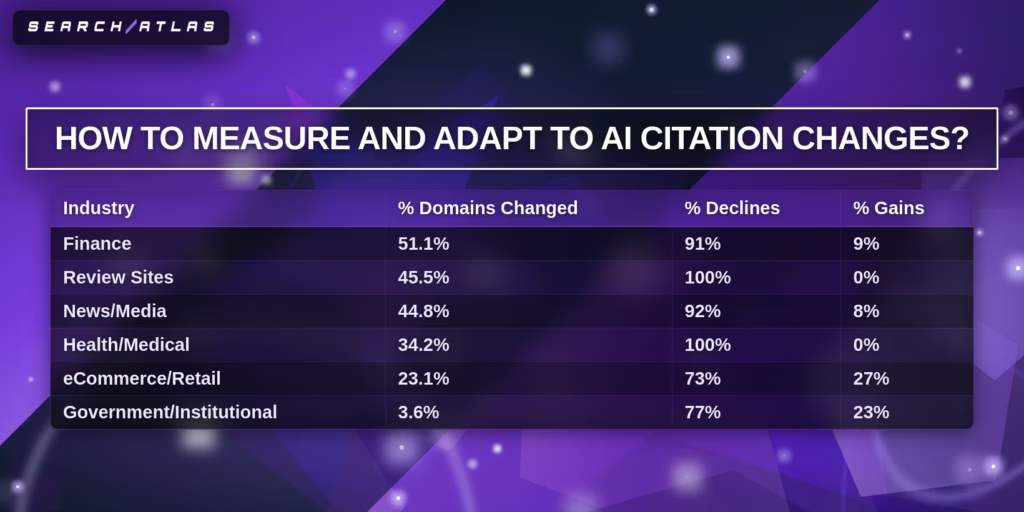
How does monitoring frequency adjust to volatility? Monitoring frequency must match competitive density and industry volatility. Finance and Review industries show over 45% weekly domain movement, while Government shows 3.6% change. High-competition sectors require weekly monitoring. Stable sectors require a monthly assessment.
How does content strategy adapt to citation changes? Adapt content strategy by strengthening topical depth, refreshing high-impact pages every 3-6 months, and reinforcing structured authority signals. AI assistants prefer content that is 25.7% newer than traditional search results. 70% of cited commercial pages were updated within 6 months, which confirms freshness as a selection filter.
How do teams operationalize AI citation monitoring? Operationalize AI citation monitoring by defining 15-25 high-value conversational queries, testing them across ChatGPT, Google AI Overviews, Gemini, and Perplexity, and averaging results across multiple runs. AI engines use probabilistic generation, so repeated sampling reduces variance distortion. Weekly testing captures short-term volatility. Monthly aggregation identifies durable authority shifts.
Why does adaptation require authority-layer reinforcement rather than ranking adjustment? Adaptation requires authority-layer reinforcement because AI citation stability depends on entity consistency, consensus signals, and cross-platform validation rather than ranking strength. 96.8% of cited domains show zero week-over-week change, which indicates strong inertia once authority is established. Declines tend to be binary disappearance events rather than gradual share erosion, which confirms that prevention depends on strengthening authority networks rather than chasing incremental ranking improvements.
Measuring and adapting to AI citation changes requires a shift from traffic-centric analysis to citation-centric authority tracking. Visibility now depends on inclusion durability, cross-source consensus, and structured extractability across AI answer layers.
What Are Common Challenges in AI Citation Optimization?
Common challenges in AI citation optimization include accuracy volatility, citation unpredictability, source misattribution, technical crawl barriers, entity ambiguity, declining traffic attribution, and platform fragmentation. Generative AI systems frequently produce inaccurate or partially correct responses, with more than 60% of tested queries receiving incorrect answers. Chatbots rarely signal uncertainty and often present incorrect information confidently, which complicates citation reliability and brand control.
Why does AI accuracy volatility create citation instability? AI accuracy volatility creates citation instability because generative systems prioritize answering over declining, even when information is incomplete or incorrect. Perplexity produced incorrect answers in 37% of tested cases, and Grok 3 demonstrated a 94% error rate in certain evaluations. Premium models exhibited higher error rates due to confidently incorrect answers rather than refusals, which increases risk for cited brands.
How does source misattribution weaken citation control? Source misattribution weakens citation control because AI systems fabricate links, cite syndicated copies, or link to incorrect URLs instead of sources. Grok 3 produced 154 broken citations out of 200 prompts. DeepSeek misattributed 115 of 200 excerpts, and chatbots frequently link to aggregator versions instead of original publishers, which dilutes brand authority.
Why does citation unpredictability complicate optimization? Citation unpredictability complicates optimization because AI engines rotate sources, adjust selection thresholds, and exhibit probabilistic output variation. Only about 30% of brands maintain back-to-back visibility for a given query. 96.8% of domains show zero week-over-week change, yet the minority that shifts experience mostly binary disappearance events rather than gradual share erosion.
How does zero-click behavior disrupt measurement models? Zero-click behavior disrupts measurement models because AI Overviews generate clicks in only 1% of sessions compared to 15% for traditional search. AI chatbots generate 95-96% less referral traffic than traditional search, and publishers report traffic reductions of up to 40% when AI summaries appear above their content. Citation inclusion produces authority visibility without corresponding traffic value.
Why do technical crawl barriers reduce citation eligibility? Technical crawl barriers reduce citation eligibility because AI systems cannot cite content they cannot crawl or interpret structurally. Blocked AI crawlers, slow page speed above 1.85s LCP, missing schema markup, broken internal linking, and absent semantic HTML reduce extraction confidence. The FAQ schema alone shows a limited direct impact without structured answer-first content.
How does entity ambiguity limit AI citation inclusion? Entity ambiguity limits AI citation inclusion because AI systems deprioritize brands with inconsistent naming, weak author attribution, or fragmented identity signals. Content with explicit entity linking and structured identity markers achieves 2.5x higher citation probability compared to implicitly defined content. Missing author schema or generic editorial attribution reduces trust weighting.
Why does platform fragmentation increase optimization complexity? Platform fragmentation increases optimization complexity because each AI system weights authority signals differently. Google AI Overview relies more heavily on traditional ranking alignment, while ChatGPT and Perplexity emphasize broader mention patterns across listicles, forums, and community platforms. 71% of studied sources appear on only one AI platform, and only 7% achieve universal presence across major engines.
How do content structure failures reduce AI citation probability? Content structure failures reduce AI citation probability because dense text blocks, vague language, and the absence of answer-first formatting increase extraction ambiguity. Content sections above 150 words experience diminishing citation performance compared to sections within optimal 40-80 word answer capsules. AI systems ignore generic content without definitive claims or verifiable data.
Why does monetization misalignment create strategic tension? Monetization misalignment creates strategic tension because AI platforms capture answer-layer visibility while reducing publisher traffic-based revenue. Publishers face a 95-96% traffic reduction from AI referrals despite citation presence. Authority attribution does not translate directly into monetizable visits, which forces adaptation toward subscription or licensing-based models.
How AI Citation Optimization Fits Into Modern SEO Strategy?
AI Citation Optimization fits into modern SEO strategy as an extension layer that shifts visibility from ranking positions to inclusion inside AI-generated answers while preserving traditional SEO foundations. AI Citation Optimization does not replace SEO; AI Citation Optimization builds on crawlability, authority, and content depth to increase citation eligibility across AI platforms. Modern SEO operates across 2 layers: ranking visibility and answer-layer citation inclusion.
How does AI Citation Optimization extend traditional SEO rather than replace it? AI Citation Optimization extends traditional SEO by transforming ranking strength into citation eligibility through structured extractability and authority validation. Google AI Overviews still prioritize pages ranking in the top 10 for informational queries, which confirms that traditional SEO remains foundational. ChatGPT, Perplexity, and Bing Copilot evaluate broader brand mentions, listicles, and third-party validation, which adds a second selection filter beyond rankings.
How do AI citation mechanisms differ across platforms within SEO strategy? AI citation mechanisms differ across platforms because Google AI Overview emphasizes top-ranking pages, while conversational AI models prioritize distributed brand mentions and consensus signals. Informational intent relies on structured SEO depth. Commercial intent relies on repeated brand presence across review platforms, comparison pages, and roundups. Modern SEO strategy must therefore align both ranking optimization and mention distribution to cover both selection models.
What core selection criteria connect SEO and AI citation optimization? Core selection criteria that connect SEO and AI citation optimization include authority, accuracy, accessibility, domain expertise, recency, and off-site validation. Authority derives from backlink strength and brand recognition. Accessibility requires crawlable architecture, schema markup, and structured HTML. Recency favors pages updated within 3-6 months. Off-site signals reinforce trust through unlinked mentions and third-party reviews.
How does the 4-step framework integrate into SEO operations? The 4-step framework integrates into SEO operations by combining ranking optimization, structured content creation, listicle distribution, and scaling outreach pipelines. Firstly, understand how each AI platform selects sources. Secondly, create citation-ready content with an answer-first structure. Thirdly, secure placements across listicles and review platforms. Fourthly, scale publication and distribution consistently to reinforce authority signals.
How does content intent alignment connect SEO and AI visibility? Content intent alignment connects SEO and AI visibility by separating informational and commercial optimization paths. Informational intent requires strong traditional SEO, structured definitions, and schema clarity. Commercial intent requires bottom-funnel guides, comparison pages, and repeated brand mentions across authoritative directories. AI-driven visitors convert at up to 23x higher rates, which confirms the strategic value of bottom-funnel alignment.
How do technical foundations remain central to AI citation optimization? Technical foundations remain central because AI systems require crawlable access, structured schema, and fast performance to evaluate citation eligibility. Implementing JSON-LD schema, allowing GPTBot and Bingbot access, maintaining page speed below 200ms TTFB, and ensuring semantic HTML structure increases citation confidence. Technical SEO becomes a prerequisite layer for AI citation inclusion.
Why does authority building function as a digital credit score in AI search? Authority building functions as a digital credit score because AI engines evaluate cross-source corroboration, expertise signals, and content history before assigning citations. Consistent publication cadence, expert authorship, original research, and verified third-party mentions strengthen this authority layer. Three or four high-quality authoritative pieces outperform eight shallow pages in citation probability.
How is AI visibility measured within modern SEO strategy? AI visibility is measured through AI Share of Voice, total citations, mention frequency, sentiment framing, and AI-driven conversions rather than rankings alone. Manual weekly prompt testing across ChatGPT, Google AI Overviews, and Perplexity tracks inclusion stability. Referral traffic from AI converts significantly higher than traditional search, which validates authority-layer performance.
Why does AI Citation Optimization operate as a complementary layer within SEO? AI Citation Optimization operates as a complementary layer because traditional SEO drives discovery while AI citation determines narrative control inside answer-based search environments. Rankings influence eligibility for Google AI Overview inclusion. Mention networks influence conversational AI selection. Modern SEO strategy integrates ranking optimization, authority distribution, and citation-layer monitoring into a unified visibility system.
How AI Citation Eligibility Relates to Entity-Based SEO?
AI citation eligibility relates to entity-based SEO because AI systems select and cite sources based on entity clarity, entity consistency, and verified entity relationships rather than keyword density. Entity-Based SEO defines a brand as a distinct, recognizable entity connected to attributes, authors, products, and trusted references across knowledge systems. Early adopters of entity-first strategies capture 3.4 times more AI-generated traffic than brands relying only on traditional SEO signals.
How do AI systems evaluate entities instead of keywords? AI systems evaluate entities instead of keywords by analyzing patterns, relationships, corroboration signals, and machine-readable identifiers. AI models rely on Named Entity Recognition and knowledge graph matching to determine whether a brand is a credible source. Content recognized as structured entities is 50% more likely to appear in AI-generated answers and knowledge-driven results.
What is entity authority, and why does it affect citation eligibility? Entity authority is the degree to which AI systems consistently recognize a business, its authors, products, and topical expertise across platforms and references. AI Citation Eligibility increases when entity authority is strong because AI systems cite sources with a stable identity and cross-source corroboration. Brands with fragmented signals experience 2.8 times lower citation rates compared to brands with consistent entity identity.
How does structured data reinforce Entity-Based SEO for AI citations? Structured data reinforces Entity-Based SEO by explicitly defining organization, author, product, and topic relationships in machine-readable form. Schema-equipped pages are 3 times more likely to be referenced by AI platforms. Organization, Person, Product, Service, FAQPage, and Article schema reduce ambiguity and increase citation confidence across ChatGPT, Perplexity, and Google AI Overviews.
Why do Knowledge Graph relationships influence AI citation inclusion? Knowledge Graph relationships influence AI citation inclusion because AI systems map brands to established entities within structured databases. Google’s Knowledge Graph contains over 54 billion entities and 1.6 trillion facts, which means entity recognition determines retrieval confidence. Entities with Wikipedia or Wikidata connections demonstrate stronger citation stability.
How do E-E-A-T signals connect Entity-Based SEO with citation eligibility? E-E-A-T signals connect Entity-Based SEO with citation eligibility because AI systems evaluate expertise, experience, authoritativeness, and trust before assigning citations. Third-party mentions, expert authorship, consistent updates, and verified external references strengthen entity trust. AI systems cite entities that demonstrate clear authorship, domain-level expertise, and cross-platform corroboration.
How does building an entity stack increase citation stability? Building an entity stack increases citation stability by aligning core attributes, schema identifiers, Wikidata entries, NAP consistency, and topical clusters into one coherent entity graph. Consistent brand attributes across platforms strengthen recognition speed and reduce interpretive ambiguity. At least 60% of entity-building effort must focus on off-site validation signals to reinforce cross-source consensus.
Why does AI Citation Eligibility depend on entity-first optimization? AI Citation Eligibility depends on entity-first optimization because AI search selects trusted entities, not isolated pages. Traditional SEO ranks documents, while Entity-Based SEO establishes identity within knowledge networks. AI citation inclusion requires clear entity definition, structured relationships, and distributed authority signals rather than keyword repetition.
Do Backlinks Influence AI Citations?
Yes, backlinks influence AI-generated citations, but backlink quality and contextual authority matter more than backlink quantity. Backlinks function as trust signals that reinforce domain authority and entity credibility. A Pearson correlation of 0.65 exists between Authority Score and AI mentions, which confirms that backlinks influence AI-generated citations when sourced from authoritative domains.
Why do high-authority backlinks increase AI citation probability? High-authority backlinks increase AI citation probability because AI systems evaluate cross-domain validation as a credibility signal. Domains with higher Domain Ratings show a greater likelihood of appearing in AI-generated answers. No domain with a Domain Rating of 40 or lower appeared in the top 25% of total AI citations, which demonstrates that baseline authority thresholds affect inclusion.
Why are backlinks alone insufficient for AI citation eligibility? Backlinks alone are insufficient because AI systems weigh semantic relevance and entity authority more heavily than link volume. Organic keyword coverage correlates more strongly with AI visibility at 0.41 than backlinks at 0.37. Google AI Overviews show only a 0.25 correlation with Domain Rating, which confirms that link-based authority does not fully determine citation selection.
Why does a high Domain Rating not guarantee AI citations? High Domain Rating does not guarantee AI citations because AI systems prioritize entity clarity, structured extractability, and consensus signals over raw link metrics. 18.5% of domains with a Domain Rating above 80 fall into the lowest 25% of total AI citations. Citation inclusion depends on topical depth, structured content, and cross-platform corroboration in addition to backlinks.
Are Brand Mentions Important for AI Citations?
Yes, brand mentions are important for AI citations because brand mentions correlate significantly more strongly with AI visibility than backlinks. Brand mentions show a 0.664 correlation with AI visibility, while backlinks show a 0.218 correlation, which confirms that AI systems prioritize recurring brand references across platforms over hyperlink volume.
Why do brand mentions influence AI-generated answers more than backlinks? Brand mentions influence AI-generated answers more than backlinks because AI models evaluate recurring entity references across the web rather than relying solely on link graphs. 85% of brands mentioned in ChatGPT answers do not include direct citation links, which demonstrates that entity recognition precedes formal citation. AI systems detect brand salience through contextual repetition, not just hyperlink structure.
How do brand mentions impact commercial performance? Brand mentions impact commercial performance because AI-referred visitors convert at up to 23x the rate of traditional organic search visitors. One documented case reported a 17K traffic increase within 3 months through a structured PR-driven brand mention strategy. AI systems surface brands that appear repeatedly in trusted discussions, which strengthens pre-qualified intent.
Why do citations still matter despite mention dominance? Citations still matter because citations validate source credibility and reinforce fact-based authority. Citations allow AI systems to trace original research, technical claims, and data provenance. Citations function as verification signals rather than primary ranking signals, confirming what AI already recognizes about a brand.
What is the Mention-Source Divide? The Mention-Source Divide is the phenomenon where AI platforms use a brand’s content as a source but recommend a different brand in the answer narrative. 80% of brands experience this divide, which indicates that mention authority and citation authority operate as separate visibility layers. Strong brand mention signals increase recommendation likelihood, while isolated citation presence without mention frequency limits competitive positioning.
How Often Do AI Citations Change?
AI citations change frequently, with most citations decaying within 4-5 weeks and 62% disappearing within 90 days. AI citation half-life averages approximately 47 days across platforms, and only 18% of sources maintain consistent citations across 6 months. 70-90% of cited domains change completely over 6 months for identical queries.
What is the overall decay rate of AI citations? The overall decay rate of AI citations follows a short half-life pattern, with 40-60% of cited domains changing month-to-month for the same query. Only 30% of brands remain visible from one AI answer to the next, which confirms that AI citation visibility is probabilistic rather than stable.
How does citation volatility differ across AI platforms? Citation volatility differs by platform, with ChatGPT rotating sources fastest and Perplexity showing longer persistence. ChatGPT shows a 3.4-week half-life for non-network domains, while Perplexity shows a 5.8-week half-life. Google AI Overviews average a 4.7-week half-life with 45.5% citation change during updates.
Why does content freshness influence citation stability? Content freshness directly influences citation stability because AI systems prioritize recently updated material. AI-cited content is 25.7% fresher on average than traditional search citations. 65% of AI bots hit target content published within the last year, and only 6% target content older than 6 years.
What factors cause citation replacement? Citation replacement occurs primarily due to content aging and the emergence of better-aligned alternatives. Better-aligned content offers clearer structure, stronger reinforcement across sources, or more recent updates. AI engines continuously re-weight freshness, reinforcement, and cross-source agreement signals.
How does third-party validation affect citation durability? Third-party validation increases citation durability because citations supported by earned media persist longer than owned-domain citations. 82% of AI citations originate from earned media sources, and brands are 6.5 times more likely to be cited through third-party domains than their own websites.
How does domain reinforcement influence long-term stability? Domain reinforcement increases long-term stability when content appears across multiple independent sources within the same topic ecosystem. Early citation authority compounds over time, creating a 70x volatility gap between frequently cited domains and rarely cited domains.