Key differences, SEO impact, and optimization strategies between AI citations and mentions define how citation artificial intelligence and brand mentions in AI function as distinct authority and visibility signals inside generative search systems. AI citations are structured source attributions where an AI system explicitly links or references a webpage as evidence. AI brand mentions are contextual inclusions of a brand name inside AI-generated answers without requiring a link. AI citation vs brand mentions reflects the difference between evidentiary validation and entity recognition, which now determines SEO impact in AI-mediated discovery environments.
Brand mentions in AI matter because AI systems prioritize entity frequency, contextual co-occurrence, and semantic reinforcement when generating answers. AI citations matter because citation artificial intelligence validates factual claims and signals trusted source status. Brand mentions correlate more strongly with AI visibility due to entity-based modeling, while citations strengthen authority, referral potential, and trust confirmation. Traditional backlinks remain foundational for discovery, yet AI citation vs brand mentions shifts ranking logic from link graphs toward entity consistency and conversational prominence.
AI citations function as evidence-based validation signals, while AI brand mentions function as narrative-level recognition signals that shape shortlist positioning. Citations provide machine-readable attribution and drive referral interaction. Mentions increase zero-click visibility and reinforce entity authority through repetition. Measurement differs accordingly (citation frequency, citation depth, and citation share quantify authority inclusion), while AI Share of Voice, sentiment distribution, and mention frequency quantify conversational dominance. AI citation vs brand mentions separates validation authority from visibility authority inside generative answers.
How brands optimize, track, and measure AI citations and mentions strategically? Brands optimize AI citations and brand mentions by engineering citation-worthy content, reinforcing entity corroboration across third-party platforms, and maintaining structured schema and consistent entity data. Tracking requires prompt-based audits, citation frequency monitoring, AI Share of Voice analysis, and sentiment scoring to detect the mention-citation gap. Measurement focuses on citation frequency benchmarks, conversion lift from AI traffic, and volatility monitoring across platforms. Common challenges include citation inaccuracy, hallucinated references, traffic misattribution, and inconsistency across AI engines.
What Are AI Citations?
AI citations are linked references that artificial intelligence systems generate to identify the specific external sources used to construct an answer. AI citations appear as clickable links, numbered references, or source boxes attached to AI-generated text. AI citations connect each factual statement to a traceable webpage, document, or database.
How do AI citations function inside AI systems? AI citations function as query-level attribution mechanisms tied to real-time retrieval. AI citations are generated dynamically per prompt rather than existing as static backlinks. AI citations reflect the model’s retrieval step at the moment of answering and form part of the citation artificial intelligence framework that governs answer traceability.
How do citation patterns of various AI’s differ? Citation čpatterns of various AI’s differ based on retrieval design and interface rules. Google AI Overviews consistently display visible source links because the system integrates with traditional search infrastructure. ChatGPT and Perplexity display citation bubbles or numbered references when browsing mode activates. These AI platforms’ citation patterns determine how often domains receive direct attribution and influence AI visibility impact.
What types of AI citations exist? There are 3 main types of AI citations. The 3 main types of AI citations are listed below.
- Informational citations. Informational citations reference educational resources (blog posts, documentation hubs, guides) that validate factual explanations.
- Product citations. Product citations link to commercial or comparison pages (product pages, review hubs, listicles) during transactional prompts.
- Multimedia citations. Multimedia citations reference visual or video assets (tutorial videos, image sources) during demonstration-style answers.
What determines whether AI citations appear in a response? AI citations appear when the model activates a retrieval step instead of relying solely on training memory. AI citations grounded in browsing mode connect to indexed live URLs. Inactive retrieval increases hallucination risk, where non-existent references appear. This dependency shapes AI platforms’ citation patterns and affects answer reliability.
How do AI citations affect AI visibility impact? AI citations shift visibility from ranking position to source selection inside generated answers. Only a limited set of sources appears per response, which creates selection-based competition. AI citation co-mentions in forums and brand mentions in generative AI influence which domains AI systems treat as authoritative. This selection logic directly affects AI visibility impact across informational and comparison queries.
Why do AI citations matter in the evolving search ecosystem? AI citations define how brands gain traceable inclusion inside AI-generated answers instead of relying solely on traditional rankings. AI citations connect answer generation to source authority and establish which entities AI systems repeatedly reference. This structural shift explains why citation artificial intelligence mechanisms now determine exposure in AI-driven discovery environments.
Why AI Citations Matter for SEO and AI Visibility?
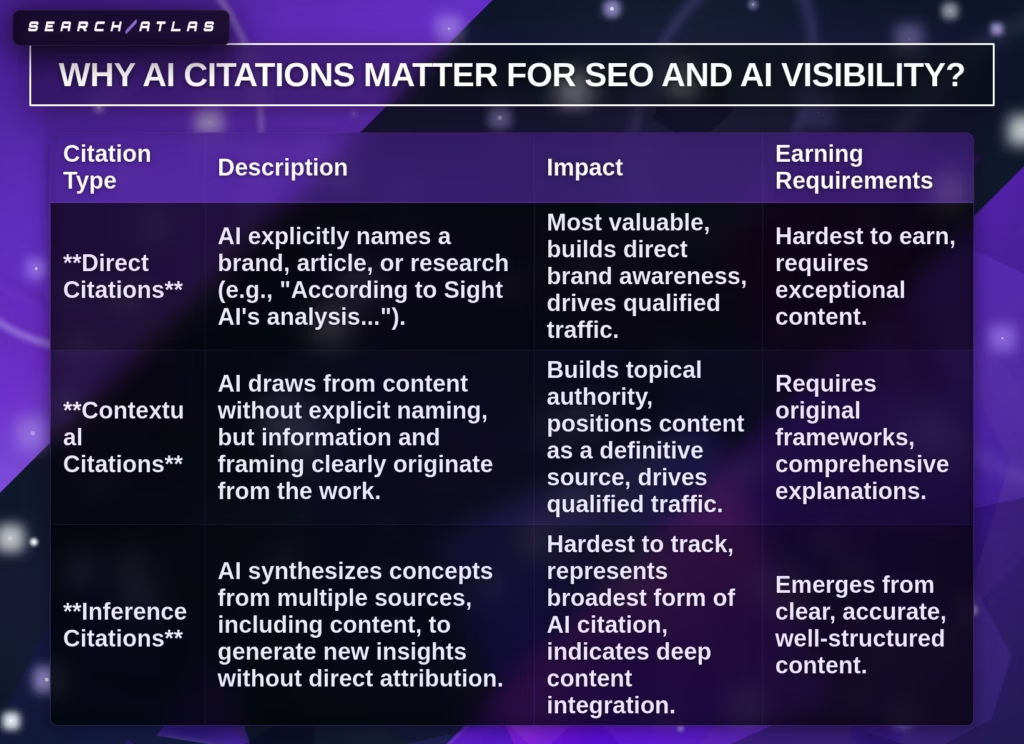
AI citations matter for SEO and AI visibility because they determine whether a brand becomes a trusted source inside AI-generated answers instead of remaining a ranked link in traditional search results. AI citations operate as a parallel evaluation layer that measures accuracy, attribution clarity, structure, and alignment with user intent rather than backlinks or page speed.
What is the fundamental shift introduced by AI citation systems? The fundamental shift introduced by AI citation systems is the move from popularity-based ranking to trust-based selection. Traditional SEO evaluates content through signals (backlinks and keyword optimization). AI citation systems evaluate reliability, factual grounding, and structural clarity before selecting a page as evidence in a generated answer.
How does AI citation worthiness differ from traditional SEO performance? AI citation worthiness differs from traditional SEO performance because it prioritizes verifiability and knowledge structure over ranking position. A well-structured article from a newer domain outperforms an older authority page in AI citations if it provides clearer attribution and stronger factual grounding. Content must satisfy both ranking algorithms and citation artificial intelligence systems simultaneously.
How do AI citations influence brand trust, and AI visibility impact? AI citations increase brand trust because they signal that an AI system selected a page as evidence for its reasoning. Citations appear in source lists or reference panels and function as validation signals. Research shows brand mentions correlate 3x more strongly with AI visibility than backlinks, and brands that earn both citations and mentions resurface more frequently across consecutive AI answers.
Why are AI rankings statistically unreliable compared to citation visibility? AI rankings are statistically unreliable because answer outputs change across repeated prompts, while citation presence measures inclusion frequency. Tests across ChatGPT, Claude, and Google AI show less than 1% probability of identical brand ordering across runs. Visibility percentage across 60–100 prompt repetitions represents the only stable metric for AI citation performance.
How does the Retrieval-Augmented Generation (RAG) architecture affect citation selection? Retrieval-Augmented Generation (RAG) architecture affects citation selection by retrieving content chunks instead of entire domains. AI systems convert 200–500 token sections into vector embeddings and compare them to expanded query variations. Only a small portion of retrieved pages appear in final citations, which makes structural clarity and extractability critical for AI visibility.
Why does freshness influence AI citation frequency? Freshness influences AI citation frequency because AI systems prioritize recently updated and maintained content during retrieval. Over 70% of AI-cited pages were updated within the past 12 months, and newly published structured content generates citations within days. Pages left unchanged for more than 3 months show a 3x higher risk of citation loss.
What is the AI citation discrepancy with traditional SEO rankings? The AI citation discrepancy with traditional SEO rankings shows that a high Google position does not guarantee AI inclusion. Only 12% of AI-cited URLs match Google’s top 10 results for the same query. ChatGPT overlaps with Google’s top 10 results at only 6.82%, which confirms that ranking authority and citation authority operate as separate systems.
How does Generative Engine Optimization (GEO) relate to AI citations? Generative Engine Optimization (GEO) relates to AI citations by structuring content specifically for extraction, grounding, and reuse inside AI answers. SEO ensures crawlability and indexing. GEO ensures citation eligibility through clear definitions, labeled sections, structured HTML, and entity consistency. AI citations represent the measurable outcome of SEO, GEO, and entity authority working together.
What Are the Differences Between AI Citations and Traditional Backlinks?
AI citations are answer-level references generated inside AI responses, while traditional backlinks are hyperlinks embedded in web pages that transfer ranking authority. AI citations influence inclusion in generative answers. Traditional backlinks influence search engine rankings through link-based algorithms.
How do AI citations and traditional backlinks differ in mechanism? Traditional backlinks function as external hyperlinks that signal popularity and authority to search engines, while AI citations function as retrieval-based attributions selected per prompt. Backlinks operate through PageRank-style evaluation. AI citations operate through retrieval-augmented generation systems that select specific pages as grounding evidence.
How do AI citations and traditional backlinks differ in location and appearance? Traditional backlinks appear inside web content as clickable links, while AI citations appear inside AI-generated answers as source cards, footnotes, or reference lists. Backlinks live within publisher-controlled pages. AI citations live within AI interfaces and do not reside inside standard HTML content.
How do AI citations and traditional backlinks differ in visibility impact? Traditional backlinks increase ranking position and organic traffic, while AI citations increase answer-level visibility and contextual authority. Backlinks drive referral sessions and ranking improvements. AI citations place a brand directly inside the generated response, which creates exposure even without a click.
How do AI citations and traditional backlinks differ in traffic generation? Traditional backlinks generate direct referral traffic from linking domains, while AI citations generate contextual exposure with limited but high-intent traffic. Backlinks move users between websites. AI citations embed brand presence inside AI answers, where traffic volume remains smaller but often conversion-focused.
How do AI citations and traditional backlinks differ in evaluation criteria? Traditional backlinks rely on link volume and domain authority, while AI citations rely on factual accuracy, structure, and extractability. AI-driven systems evaluate verifiability, neutrality, recency, and structured formatting rather than link count alone. Ranking signals and citation signals operate as separate evaluation systems.
How do AI citations and traditional backlinks differ in the predictability of visibility? Backlink volume correlates with ranking potential, while backlink volume shows weak or negative correlation with AI citation frequency. Research shows only 12% of AI-cited URLs match Google’s top 10 results for the same query. Citation artificial intelligence systems select based on retrieval match and knowledge structure, not position alone.
How do AI citations and traditional backlinks differ in manipulation difficulty? Backlinks can be acquired through outreach and link-building campaigns, while AI citations require structural and semantic eligibility. AI citations cannot be purchased directly. AI citations emerge from extractable content, entity consistency, structured HTML, and corroborated authority signals.
How do AI citations and traditional backlinks differ in local SEO impact? Traditional backlinks retain importance for competitive local rankings, while AI citations increasingly influence local AI answers and map-level visibility. AI systems evaluate consistency, entity alignment, and recency for “near me” prompts. Citation visibility inside AI responses affects local discovery in generative search environments.
How do AI citations and traditional backlinks differ in long-term strategic value? Traditional backlinks remain foundational for ranking performance, while AI citations define inclusion inside generative answers and zero-click discovery. Backlinks build search equity. AI citations build answer authority. An effective digital strategy requires alignment with both ranking algorithms and citation artificial intelligence systems.
What Are AI Brand Mentions?
AI brand mentions are instances where generative AI systems explicitly or implicitly name a brand, product, or service inside an AI-generated answer, recommendation, or summary without requiring a hyperlink. AI brand mentions appear directly in the body of responses and function as brand recognition signals rather than link-based references.
How do brand mentions in generative AI differ from traditional brand mentions? Brand mentions in generative AI originate from AI-generated outputs, while traditional brand mentions originate from human-authored web content. Traditional mentions rely on keyword detection across articles, forums, or social platforms. AI brand mentions reflect how large language models select and present brands during answer synthesis in zero-click environments.
What types of AI brand mentions exist? There are 3 main types of AI brand mentions. These are listed below.
- Explicit mentions. Explicit mentions directly name the brand inside the AI response (for example, “Use Microsoft Copilot for productivity”).
- Implicit mentions. Implicit mentions describe a product or service in terms that clearly identify a known brand without naming it.
- Negative mentions. Negative mentions amplify critical or outdated commentary inside AI summaries, which affects perception and trust.
Why are brand mentions in generative AI a discoverability signal? Brand mentions in generative AI act as shortlist placement signals inside AI answers. Generative systems typically present 3–5 brand options per response. Over 60% of Google searches end without clicks, which means appearance inside the AI-generated summary determines exposure instead of ranking position.
How do AI brand mentions influence trust and buying decisions? AI brand mentions influence trust because users treat AI-generated summaries as filtered recommendations. Users often rely on the summarized shortlist without reviewing sources. A named brand inside the response gains authority at the decision stage.
How volatile are AI brand mentions across platforms? AI brand mentions show high volatility across platforms and repeated prompts. Research shows only about 30% of brands remain visible from one AI answer to the next. Citation and mention patterns vary up to 615x across platforms, which means presence on one AI system does not guarantee presence on another.
What determines whether a brand earns mentions in generative AI? Brand mentions in generative AI depend on entity consistency, corroboration, and structured visibility across trusted sources. AI systems build candidate lists from training data and live retrieval, then filter those lists using credibility, sentiment, and relevance scoring. Brands repeatedly associated with a defined solution category enter the shortlist more frequently.
Why are AI brand mentions strategically important? AI brand mentions determine whether a brand appears inside AI answers during research, comparison, and purchase discovery. Ranking position alone no longer defines exposure. Brand visibility now depends on whether generative AI systems reference the brand directly inside synthesized responses.
Why AI Brand Mentions Matter for SEO and AI Visibility?
AI brand mentions matter for SEO and AI visibility because branded web mentions show the strongest correlation with AI search inclusion and entity authority. An Ahrefs study of 75,000 brands found a 0.664 correlation between branded web mentions and AI visibility, which exceeds traditional ranking signals.
How do AI brand mentions influence click-through behavior in AI Overviews? AI brand mentions influence click-through behavior because brands listed in AI Overviews receive measurable CTR advantages. AI Overviews reduce the first organic result CTR by 34.5%, yet brands included in AI Overviews gain 35% higher organic CTR and 91% higher paid CTR. Visibility inside the AI summary shifts attention from ranking position to shortlist inclusion.
How do AI brand mentions affect conversion quality? AI brand mentions affect conversion quality because AI search visitors convert at significantly higher rates than traditional organic visitors. AI search visitors convert at 23 times the rate of traditional organic traffic. Appearance inside AI answers places the brand at a decision-ready moment, not just a discovery stage.
How do AI systems evaluate brand mentions as trust signals? AI systems evaluate brand mentions as entity-level trust signals rather than link-based popularity metrics. Large language models operate on entity relationships and prediction models instead of PageRank alone. Consistent mentions across authoritative domains, structured data alignment, and Knowledge Graph completeness increase entity authority inside AI systems.
How do brand mentions contribute to AI search relevancy? Brand mentions contribute to AI search relevancy because AI systems interpret sentiment, context, and co-occurrence patterns to build entity profiles. Natural Language Processing detects positive versus negative tone. Repeated mentions alongside defined topics strengthen topic-to-brand associations and reinforce E-E-A-T signals.
How do content updates influence AI brand mention frequency? Content updates influence AI brand mention frequency because freshness acts as a citation filter inside AI retrieval systems. Pages updated within the last 3 months are 3 times more likely to receive citations from large language models. Structured information contributes 90%, and brand sentiment 85% to AI search relevancy scoring.
How does AI search adoption increase the strategic value of brand mentions? AI search adoption increases the strategic value of brand mentions because AI-driven sessions and zero-click behavior continue to expand. AI-referred sessions increased 527% between January and May 2025. AI Overviews now appear in approximately 48% of all search queries, and around 60% of searches end without a click. Brand inclusion inside AI answers replaces page-one ranking as the primary visibility gateway.
What metrics measure the impact of AI brand mentions on visibility? AI brand mention impact is measured through branded search volume trends, Share of Voice in AI responses, entity authority scoring, and AI mention tracking across platforms (ChatGPT, Perplexity, Gemini, AI Overviews). Sentiment analysis evaluates whether AI systems describe the brand positively or negatively. These metrics define competitive position inside generative search ecosystems.
Why Are Brand Mentions Becoming the Primary AI Visibility Signal?
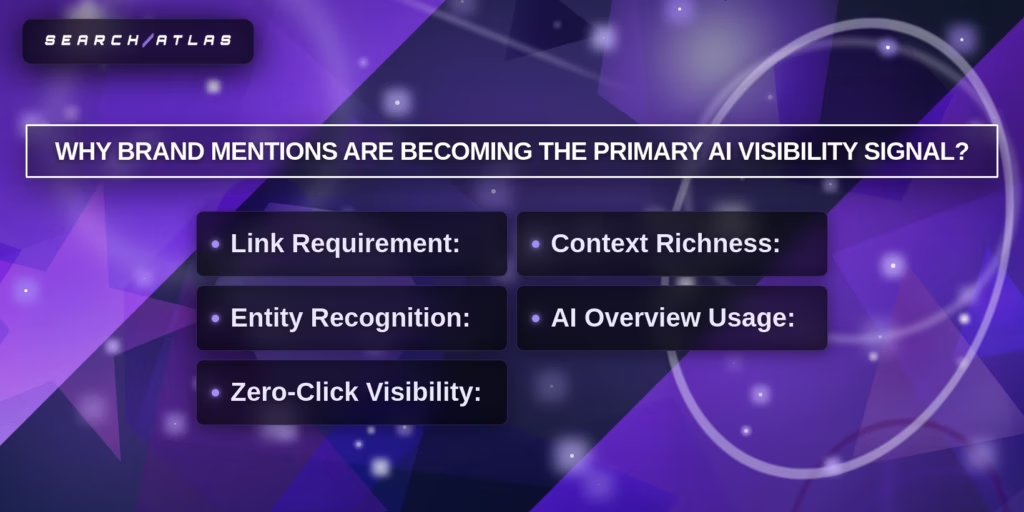
Brand mentions are becoming the primary AI visibility signal because AI search systems prioritize entity recognition, context frequency, and semantic association over backlink volume. AI engines read language patterns across the web and surface brands that appear consistently in meaningful discussions rather than brands with the highest link counts.
How is consumer behavior accelerating the importance of brand mentions? Consumer behavior accelerates the importance of brand mentions because users increasingly rely on AI-generated summaries instead of visiting websites. 44% of consumers treat AI summaries as a primary source of insight, and 58.5% of Google searches end without a click. Visibility now depends on appearing inside the AI summary rather than ranking on the results page.
How does AI search adoption shift visibility away from traditional rankings? AI search adoption shifts visibility away from traditional rankings because AI engines construct answers and shortlists directly inside the interface. AI Overviews appear on approximately 48% of tracked queries, and Gartner predicts a 25% decline in traditional search volume by 2026. Discovery now occurs inside synthesized responses rather than link lists.
Why do brand mentions correlate more strongly with AI visibility than backlinks? Brand mentions correlate more strongly with AI visibility because AI models interpret brands as entities connected to topics through repeated language patterns. Studies show branded web mentions correlate at 0.664 with AI visibility, while backlinks correlate at 0.218. AI systems evaluate semantic relationships rather than hyperlink counts.
How do unlinked mentions strengthen AI entity recognition? Unlinked mentions strengthen AI entity recognition because AI systems interpret repeated contextual references without requiring hyperlinks. AI models process co-occurrence, sentiment, and topic alignment to reinforce entity authority. Each consistent mention strengthens the brand’s footprint inside knowledge graphs and retrieval datasets.
How do context and sentiment affect mention effectiveness? Context and sentiment affect mention effectiveness because AI systems evaluate tone, relevance, and authority signals within surrounding text. Positive and authoritative mentions increase retrieval confidence. Negative or ambiguous mentions weaken entity trust and reduce inclusion probability.
Why do YouTube and cross-platform mentions amplify AI visibility? YouTube and cross-platform mentions amplify AI visibility because major AI models train on and retrieve from large multimedia and transcript datasets. YouTube mentions show the strongest correlation with AI visibility at approximately 0.737, exceeding backlinks and traditional authority metrics.
Why do citations alone no longer define AI visibility? Citations alone no longer define AI visibility because citations validate existing recognition rather than create it. Mentions establish entity presence through repetition and context. Citations confirm factual grounding after AI systems already recognize the brand as relevant.
How does early adoption of brand mention strategies create a compounding advantage? Early adoption of brand mention strategies creates a compounding advantage because AI citation stability favors frequently surfaced entities. Frequently mentioned brands show significantly lower volatility across AI responses, which reinforces future inclusion. This feedback loop increases Share of Voice inside generative answers over time.
How Do AI Citations and Mentions Affect Credibility and Trust?
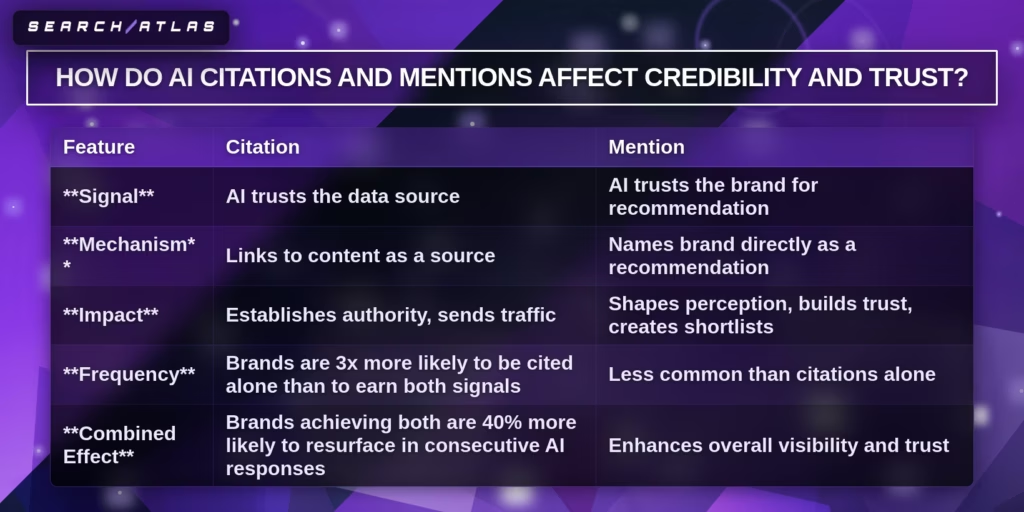
AI citations and mentions affect credibility and trust by positioning a brand as pre-validated inside AI-generated answers rather than as a self-promoted source. Citations establish authority through attribution. Mentions establish trust through recommendations and shortlist inclusion.
How do AI citations build baseline credibility? AI citations build baseline credibility by signaling that an AI system selected a specific page as evidence for its response. A citation communicates that the AI trusts the data source enough to reference it publicly. This attribution lowers skepticism and accelerates the transition from awareness to evaluation.
How do AI mentions build recommendation-level trust? AI mentions building recommendation-level trust by directly naming a brand as the solution in the answer body. A mention signals that the AI trusts the brand, not only the data. Mentions shape perception, create shortlists, and influence decision framing without requiring a click.
How does repeated AI visibility compound trust over time? Repeated AI visibility compounds trust because consistency across multiple prompts reinforces entity authority. Brands that appear across related queries gain cumulative credibility. Brands that earn both citations and mentions are 40% more likely to resurface in consecutive AI responses.
How do AI systems evaluate brands for trust internally? AI systems evaluate brands for trust through an evidence check and a recommendation check. The evidence check verifies factual accuracy and usefulness before granting citation status. The recommendation check evaluates cross-platform consistency, sentiment, and corroboration before granting mention status.
How do brand mentions compare to backlinks in building AI trust? Brand mentions correlate more strongly with AI trust than backlinks because AI systems interpret language patterns rather than link equity. Brand mentions correlate 3x more strongly with AI visibility than backlinks. AI systems perform background validation across independent sources before surfacing a brand.
How do user behaviors influence the trust impact of AI citations? User behavior moderates trust because most users rarely verify cited links. Approximately 42.1% of participants who saw citations checked at least one source, yet only around 9.8% minimally interacted with citation links. High trust correlates with reduced source checking, which increases the reputational impact of inclusion.
What risks affect credibility when AI citations are inaccurate? AI citations reduce credibility because hallucinated or misattributed references undermine factual trust. Large language models generate realistic but non-existent sources. Users must manually verify cited material to avoid misinformation and reputational harm.
How does AI disclosure influence perceived trust? AI disclosure reduces perceived trust because disclosure lowers perceived legitimacy in human-authored communication. Across multiple experiments, actors disclosing AI usage were trusted less than those who did not disclose. The legitimacy discount effect persists across industries and task types.
What is the overall trust baseline in AI-generated search results? The overall trust baseline in AI-generated search results remains moderate rather than absolute. Only 6% of surveyed users report high trust, while approximately half report moderate trust. AI citations and mentions act as amplifiers of perceived authority within an environment where baseline trust remains conditional.
How Do AI Search Engines Determine Brand Visibility?
AI search engines determine brand visibility through entity clarity, contextual frequency, structured information, trust signals, and corroborated authority across multiple sources. AI systems evaluate brands as entities within a knowledge graph rather than as isolated URLs, and selection depends on how consistently and credibly the brand appears in context.
How does clear entity framing influence AI brand visibility? Clear entity framing influences AI brand visibility by making brand purpose, category, and audience explicit and repeatable. AI systems prioritize pages that state “X is a that does Y” in direct, factual language. Specific, structured explanations outperform vague marketing language because clarity increases retrieval precision.
How do strong entity signals and authority affect AI prioritization? Strong entity signals and authority affect AI prioritization through consistent mentions, corroboration, and recognition across trusted domains. Brand web mentions show a 0.664 correlation with AI Overview visibility. Hyperlinked mentions, branded search volume, editorial coverage, and Knowledge Graph presence reinforce entity authority.
How do interactive tools and practical usefulness increase AI visibility? Interactive tools and practical usefulness increase AI visibility because AI systems surface pages where users engage meaningfully. Free utilities tied to narrow use cases attract contextual mentions and resurfacing. Engagement signals combined with specificity increase inclusion probability.
How does AI-specific optimization improve brand inclusion? AI-specific optimization improves brand inclusion by treating AI visibility as a separate measurement layer from traditional SEO. Brands must map trusted learning sources (Reddit, documentation hubs, comparison pages) and monitor Share of Voice inside AI answers. Inclusion frequency across prompts defines visibility.
Why is data consistency foundational for AI brand visibility? Data consistency is foundational for AI brand visibility because AI systems cross-verify brand identity across multiple data sources. Inconsistent addresses, categories, or descriptions reduce confidence and suppress recommendations. High-performing brands maintain near-complete profile accuracy across Google Business Profile and review platforms.
How do online reputation signals influence AI engine recommendations? Online reputation signals influence AI engine recommendations through ratings, sentiment, and response behavior. Recommended businesses on ChatGPT average 4.3-star ratings. Brands maintaining 4.5-star averages and rapid review responses demonstrate measurable trust indicators.
How do entity relationships and schema markup guide AI systems? Entity relationships and schema markup guide AI systems by defining brand identity, services, locations, and topical connections in machine-readable formats. Structured data clarifies who the brand is, what it offers, and where it operates. AI engines interpret these structured signals within a connected entity ecosystem.
How does AI content optimization differ from traditional SEO optimization? AI content optimization differs from traditional SEO optimization because it prioritizes answer trust over ranking position. AI systems extract concise, structured explanations framed around conversational queries. Authority now depends on consistent entity repetition, scannable summaries, and validated claims rather than link volume alone.
How is AI visibility measured differently from traditional rankings? AI visibility is measured by inclusion frequency and positioning inside AI-generated answers rather than by ranking position. AI engines do not display ordered result lists. Visibility depends on whether the brand appears at all and how prominently it appears across prompts.
How does AI search growth change the long-term outlook for brand visibility? AI search growth changes the long-term outlook for brand visibility by shifting discovery from clicks to curated AI decisions. AI search visitors are 4.4 times more valuable than organic visitors. Generative systems present a selected answer rather than multiple options, which makes entity authority and consistent mention presence decisive factors.
How Do AI Systems Interpret Citations vs Mentions?
AI systems interpret citations as evidence-level validation signals and interpret mentions as entity-level recognition signals. Citations confirm that a specific page supports a factual claim. Mentions confirm that a brand belongs inside a solution set or category discussion.
How do AI systems process citations internally? AI systems process citations through retrieval and grounding mechanisms that attach a response to a verifiable source. During Retrieval-Augmented Generation, models retrieve candidate passages, convert them into embeddings, and select specific chunks as evidence. A citation signals that the AI trusts the data contained in that passage.
How do AI systems process mentions internally? AI systems process mentions through entity recognition, co-occurrence patterns, and contextual frequency analysis. Large language models treat brands as entities connected to topics through repeated language patterns. Consistent appearance across authoritative contexts strengthens entity confidence scores.
What does a citation signal to an AI system? A citation signals that the AI system verified information against a specific retrievable source. Citations pass the evidence check. The AI confirms factual grounding before attaching a source reference, which increases answer reliability.
What does a mention signal to an AI system? A mention signals that the AI system recognizes the brand as a relevant solution within a topic cluster. Mentions pass the recommendation check. The AI includes the brand because recurring contextual patterns indicate category relevance and trustworthiness.
How do citation patterns of various AI’s differ from mention patterns? Citation patterns of various AI’s reflect retrieval diversity, while mention patterns reflect entity training bias and contextual reinforcement. Some platforms favor editorial sources, others prioritize forums or multimedia transcripts. Mention frequency depends more on repeated semantic associations than on link structure.
Why do mentions often influence visibility more than citations? Mentions often influence visibility more than citations because AI systems understand brands through language relationships rather than hyperlinks. Research shows brand mentions correlate more strongly with AI visibility than backlinks. Mentions create entity persistence, while citations validate isolated claims.
How do AI systems combine citations and mentions during answer generation? AI systems combine citations and mentions by first identifying relevant entities and then attaching evidence where required. Entity selection occurs during prediction. Citation attachment occurs during grounding. A brand that satisfies both layers appears repeatedly across prompts and platforms.
What happens when a brand earns citations but not mentions? A brand that earns citations but not mentions passes the evidence check but fails the recommendation check. The AI references the content as a data source but does not improve the brand into the shortlist. This distinction explains why citation presence does not guarantee AI visibility dominance.
What happens when a brand earns mentions without citations? A brand that earns mentions without citations achieves entity recognition but lacks direct source validation. The AI recognizes the brand as relevant yet does not attach a grounding link. Repeated contextual reinforcement increases long-term inclusion probability across generative responses.
What Are the Key Differences Between AI Citations and Mentions?
The key differences between AI citations and mentions appear across definition, purpose and impact, visibility mechanics, and measurement methodology. AI citations function as evidence-level attributions inside AI answers. AI mentions function as entity-level recognition signals that influence shortlist placement and recommendation strength.
There are 4 primary difference categories between AI citations and mentions. These are listed below.
- Definition.
- Purpose and Impact.
- Visibility.
- Measurement.
Definition
AI citations are structured source attributions that link specific claims to a verifiable publisher, while AI brand mentions are textual references to a brand without requiring a structured source link. AI citations connect an answer to a retrievable page. An AI brand mentions a signal that the AI recognizes the brand as relevant within a topic.
What defines an AI brand mention in technical terms? An AI brand mention is any explicit or implicit textual reference to a brand, product, or entity inside AI-generated or web-based content without a mandatory hyperlink structure. Brand mentions function as recognition signals processed through entity detection and co-occurrence modeling. Brand mentions indicate that the AI system identifies the brand as contextually relevant within a subject area.
How do explicit and implicit brand mentions differ in structure? Explicit brand mentions name the brand directly in text, while implicit brand mentions describe the brand in identifiable terms without direct naming or linking. Explicit mentions provide clear entity labeling. Implicit mentions rely on contextual association and semantic recognition by large language models.
What defines an AI citation in technical terms? An AI citation is a formal, structured reference where the AI system maps a specific claim to a named source with identifiable metadata. AI citations typically include the source title, publisher or author name, canonical URL, and retrieval timestamp. AI citations create a machine-readable attribution layer that strengthens evidentiary weight.
How do AI citations and brand mentions differ in link dependency and structure? AI citations require structured attribution and source mapping, while AI brand mentions do not require a link or formal reference. Citations operate as evidence markers attached to factual statements. Mentions operate as contextual signals embedded within narrative text.
How do AI citations and brand mentions differ in purpose? AI citations establish factual authority, while AI brand mentions establish entity recognition and mindshare. AI systems interpret citations through an evidence check that validates data accuracy. AI systems interpret mentions through a recommendation check that evaluates whether the brand fits the solution set.
How do AI citations and brand mentions differ in credibility weight? AI citations carry higher evidentiary weight because they explicitly connect claims to verifiable publishers, while AI brand mentions provide indirect credibility through repetition and contextual presence. Citations confirm that the content contributed directly to answer construction. Mentions confirm that the AI system associates the brand with the topic.
How do AI citations and brand mentions differ in outcome? AI citations create source-level visibility and attribution, while AI brand mentions create conversational inclusion and shortlist positioning. Citations position a page as a trusted reference. Mentions position a brand as a recognized participant in the category discussion.
Purpose and Impact
AI citations exist to validate information as evidence, while AI mentions exist to position a brand as a recognized solution within a topic. AI citations attach a specific claim to a verifiable source. AI mentions embed a brand directly into the AI-generated narrative without requiring source attribution.
What is the primary purpose of an AI citation? The primary purpose of an AI citation is to provide formal, machine-readable attribution for a factual claim. AI systems use citations during retrieval to map statements to publishers, URLs, authors, and timestamps. Citations function as evidentiary proof that the information meets reliability thresholds.
What is the primary purpose of an AI mention? The primary purpose of an AI mention is to establish brand awareness and category relevance inside an answer. AI systems insert mentions when a brand aligns semantically with the user’s query. Mentions signal that the brand belongs in the solution set, even without a clickable reference.
How do AI citations impact organic traffic? AI citations directly influence organic traffic because they provide a clickable path from the AI interface to the source page. Citation clicks often originate from high-intent users seeking deeper validation. Citations function as measurable traffic drivers inside AI-mediated discovery.
How do AI mentions impact brand authority? AI mentions influence brand authority by shaping perception inside zero-click environments. Users frequently rely on AI summaries without clicking sources. Mentions position the brand as a trusted market participant and reinforce topical authority across repeated prompts.
How do AI systems interpret citations versus mentions during answer generation? AI systems interpret citations through a retrieval validation process and interpret mentions through entity association modeling. Citations emerge when Retrieval-Augmented Generation identifies a matching source. Mentions emerge from learned co-occurrence patterns, frequency signals, and contextual reinforcement.
How do AI citations and mentions differ in value proposition? AI citations provide evidentiary authority and measurable referral value, while AI mentions provide reputational visibility and shortlist influence. Citations confirm that the page contributed directly to the answer. Mentions confirm that the brand occupies a recognized position within the category discussion.
How do AI citations and mentions differ in long-term impact?AI citations create compounding authority through repeated evidence-based inclusion, while AI mentions create compounding familiarity through repeated narrative presence. Citations strengthen trust through proof.
Visibility
AI citations create source-level visibility through linked attribution, while AI mentions create narrative-level visibility through direct brand inclusion inside AI-generated answers. Citations appear as references or source links. Mentions appear inside the body of the response and shape what the user reads first.
How frequently do AI citations and mentions appear in AI responses? AI brand mentions appear significantly more often than AI citations in generative search outputs. Brand mentions occur 3.2 times more frequently than citations. Mentions average 2.4 per prompt, while citations average 0.74 per prompt, which confirms a structural preference for unlinked brand inclusion.
How does zero-click behavior affect citation versus mention visibility? Zero-click behavior amplifies mention visibility while reducing the practical exposure of citations. AI Overviews and generative summaries frequently present brand names without requiring outbound clicks. Mentions therefore dominate zero-click environments, while citations depend on link interaction for measurable exposure.
How does link dependency affect AI visibility differences? Link dependency separates citation visibility from mention visibility because mentions require no hyperlink structure. AI systems recognize brands through entity modeling and contextual repetition without crawling a URL. Citations require structured links or source mapping, which limits their appearance to grounded evidence contexts.
How do context richness and entity recognition influence visibility? Context richness increases mention visibility because mentions appear inside explanatory narratives, while citations often appear as minimal reference elements. Mentions reinforce entity recognition through repeated semantic association. Citations reinforce verification but provide limited narrative prominence.
How does the query type change citation and mention visibility? Query type strongly influences mention frequency, especially in commercial and transactional searches. Commercial queries generate 4–8 times more brand mentions than informational queries. Transactional queries exceed informational ones by up to 10 times in visibility impact, which places mentions at the center of buyer-stage AI exposure.
When do AI citations maintain a stronger visibility influence? AI citations maintain a stronger visibility influence in fact-heavy, technical, or research-driven prompts where source validation is required. Citations verify data claims, support technical explanations, and confirm established entities. In these contexts, citation visibility reinforces credibility even if mention frequency remains lower.
How is AI visibility defined in relation to mentions? AI visibility measures how often and how prominently a brand appears across AI responses, while mentions quantify the count of direct brand inclusions. A single mention produces measurable visibility exposure. Citation frequency reflects source-level inclusion, while mention frequency reflects narrative prominence inside generative outputs.
Measurement
AI citations are measured through source-level attribution frequency and grounding signals, while AI mentions are measured through entity-level inclusion frequency and contextual presence inside AI-generated answers. Citation measurement focuses on retrievable links and structured references. Mention measurement focuses on brand name appearance and narrative prominence.
How are AI citations measured in practice? AI citations are measured by tracking how often an AI system references a specific URL or publisher as a source. Core metrics include citation frequency, share of citations, citation depth, prompt coverage, and source competition. Citation tracking requires running repeated prompts across AI platforms and recording which pages receive structured attribution.
How are AI mentions measured in practice? AI mentions are measured by counting direct brand inclusions inside AI-generated responses across defined prompt sets. Measurement focuses on mention frequency, Share of Voice inside answers, contextual framing, and sentiment tone. Mentions lack structured links, which requires manual or specialized AI monitoring instead of traditional link tracking.
Why do traditional SEO tools struggle to measure AI citations and mentions? Traditional SEO tools struggle to measure AI citations and mentions because they are designed for SERP position tracking rather than answer synthesis analysis. Standard rank trackers capture keyword positions and clicks. AI visibility requires prompt-based testing, citation extraction, and sentiment mapping, which fall outside traditional reporting systems.
What is AI Share of Voice (SOV) in measurement terms? AI Share of Voice (SOV) quantifies the proportion of AI-generated answers in which a brand appears relative to competitors. AI SOV combines citation frequency, mention frequency, and sentiment quality. AI SOV reflects presence inside zero-click answers rather than organic ranking position.
How does citation measurement differ from mention measurement in stability? Citation measurement focuses on grounded, repeatable references, while mention measurement reflects contextual and potentially volatile inclusion. Citations tie directly to retrievable URLs and structured metadata. Mentions depend on entity associations and prompt variations, which increase fluctuation across runs.
How does measurement impact long-term AI visibility strategy? Measurement impacts long-term AI visibility strategy because citation absence signals authority gaps, while mention absence signals entity recognition gaps. Citation metrics indicate whether AI systems treat content as evidence. Mention metrics indicate whether AI systems treat the brand as a recognized solution within the category.
Comparison Table
The comparison table between AI citation and mentions contrasts evidence validation versus entity recognition across definition, purpose, visibility mechanics, and measurement impact. AI citations function as structured source attributions inside AI answers. AI mentions function as narrative-level brand inclusions that influence AI visibility without requiring a link.
The core comparative differences are presented below.
| Category | AI Citations | AI Mentions |
|---|---|---|
| Definition | Structured source references attached to specific claims. | Direct brand name inclusions inside AI-generated responses. |
| Mechanism | Triggered through retrieval and grounding processes. | Triggered through entity recognition and co-occurrence modeling. |
| Link Dependency | Require explicit source mapping or link attribution. | Require no hyperlink or structured reference. |
| Purpose | Validate factual accuracy and provide evidentiary support. | Establish brand recognition and shortlist positioning. |
| Visibility Type | Source-level visibility through reference panels or footnotes. | Narrative-level visibility inside the main AI answer body. |
| Traffic Impact | Enable direct referral interaction through clickable attribution. | Influence perception without requiring a click. |
| Stability | More stable when grounded in structured, fresh, and retrievable content. | More volatile due to prompt variation and contextual shifts. |
| Correlation with AI Visibility | Moderate to strong when tied to reference SEO authority signals. | Stronger correlation with AI visibility through repeated AI mentions. |
| Measurement | Measured through citation frequency, citation depth, and prompt coverage. | Measured through Share of Voice, entity frequency, and sentiment analysis. |
| Strategic Value | Confirm authority and reinforce trust validation. | Drive awareness, memorability, and competitive shortlist inclusion. |
How does this comparison clarify the AI visibility strategy? This comparison clarifies the AI visibility strategy by separating validation authority from narrative prominence. AI citations strengthen reference SEO authority and prove factual grounding. AI mentions strengthen entity authority and increase inclusion probability across generative responses. An effective strategy requires structured content for citation eligibility and consistent brand reinforcement for AI mentions.
How to Optimize for AI Citations and Brand Mentions?
Optimize for AI citations and brand mentions by combining evidence-based content structure with consistent entity reinforcement across trusted digital environments. AI citations require retrievable, structured, and verifiable content. AI mentions require repeated contextual brand presence and entity clarity.
There are 6 core methods to optimize for AI citations and brand mentions. These are listed below.
- Create “Citation-Worthy” Content
- Build Presence on Trusted Third-Party Platforms
- Establish Consistent NAP and Entity Data
- Use PR and Guest Posting
- Monitor Sentiment and Visibility
- Strengthen Topical Authority
Create Citation-Worthy Content
Create citation-worthy content by engineering structured, data-dense, entity-clear pages that AI systems can parse, ground, and reuse as evidence. Citation-worthiness functions as the primary performance signal inside AI ecosystems because content that models do not parse and cite remains invisible.
How do generative AI systems select content for citation? Generative AI systems select content for citation through Retrieval-Augmented Generation processes that prioritize structure, semantic clarity, and consensus consistency. Models retrieve candidate passages, compare embeddings, and favor token-efficient sections that present clear definitions and tightly scoped answers. Shorter, denser pages often receive higher grounding coverage than long, unfocused documents.
What structural elements increase citation-worthiness? Structural elements increase citation-worthiness when content is modular, semantically tagged, and explicitly defined. Use clear H2 and H3 headings. Place direct answers within the first 40–80 words of each section. Write quotable, standalone sentences. Provide explicit definitions using “X is…” constructions. Maintain one core idea per section to increase model parsing fidelity.
What is Model Parsing Fidelity, and why does it matter? Model Parsing Fidelity measures how accurately and completely an AI model interprets structured content. High parsing fidelity increases recall probability inside AI outputs. FAQ blocks, structured schemas, and labeled content objects outperform unstructured text walls because models extract modular segments more reliably.
How does original data increase citation probability? Original data increases citation probability because AI systems must reference the unique source when no alternative dataset exists. Proprietary surveys, benchmark metrics, case study results, and first-party research create a grounding dependency. Exclusive statistics compel citation because models require a traceable origin.
What content length and freshness optimize AI citation? Content freshness and structural density optimize AI citation more than sheer volume. Pages updated within the last 60–90 days show higher inclusion rates. DateModified timestamps, revised examples, and refreshed statistics increase eligibility. AI systems weigh recency signals during retrieval selection.
How does authorship influence citation-worthiness? Expert authorship with verifiable credentials increases citation-worthiness through authority validation. Clear author pages, institutional backing, and accurate attribution enhance credibility signals. Content with identifiable expertise receives significantly higher citation frequency than generic material.
How resource hubs are architected for AI citation? Architect resource hubs using a three-level hierarchy that maximizes navigability and entity clarity. Firstly, build a Level 1 hub page with a comprehensive overview and high information density. Secondly, create Level 2 category clusters covering 3–5 subtopic groups. Thirdly, publish Level 3 deep-dive pages with focused specificity. Structured hubs achieve substantially higher AI citation rates than isolated blog posts.
Which technical implementations increase citation likelihood? Schema markup, entity-first content structure, and systematic internal linking significantly increase AI citation likelihood. Implement Article, FAQPage, HowTo, ItemList, and BreadcrumbList schema in JSON-LD format. Optimize semantic HTML. Maintain logical internal linking from hub to category to resource pages. Structured architecture increases retrieval confidence and grounding eligibility.
What ongoing maintenance practices sustain citation-worthiness? Quarterly review, structural refinement, and strategic expansion sustain citation-worthiness over time. Update outdated statistics. Add emerging subtopics. Remove obsolete examples. Monitor AI citation frequency to identify high-performing pages and expand adjacent clusters. Continuous reinforcement preserves inclusion across evolving AI retrieval patterns.
Build Presence on Trusted Third-Party Platforms
Build presence on trusted third-party platforms by earning consistent, contextual brand mentions across authoritative environments that AI systems frequently retrieve from. AI models rely on external corroboration to validate entity authority, and third-party platforms provide independent signals of expertise and recognition.
Why do trusted third-party platforms influence AI citations and brand mentions? Trusted third-party platforms influence AI citations and brand mentions because AI systems prioritize brands that appear consistently across reputable domains. Buyers require trust before purchase, and over 80% of decision-makers report increased confidence in brands demonstrating strong thought leadership. Independent mentions reinforce entity credibility inside AI knowledge graphs.
Which third-party platforms strengthen AI visibility most effectively? Third-party platforms that strengthen AI visibility include editorial publications, professional networks, review platforms, forums, and multimedia platforms. Examples (LinkedIn, YouTube, Reddit, industry blogs, Google Business Profile, review sites) frequently appear inside AI retrieval datasets. AI systems scrape these sources for contextual reinforcement and sentiment validation.
How are social platforms used for AI visibility? Use social platforms by focusing on 2–3 environments aligned with audience behavior and publishing structured, expertise-driven content. Maintain a 75/25 split between external thought leadership and company-created insights. Publish high-clarity posts with consistent entity naming to strengthen brand recognition in generative search contexts.
How does Google Business Profile strengthen AI visibility? Google Business Profile strengthens AI visibility by reinforcing structured local entity data and review credibility signals. Complete every profile field, maintain updated service descriptions, and actively manage reviews. Brands with reliable and accurate local profiles are 2.3 times more likely to appear in local AI-driven recommendations.
How are online reviews managed to support AI citations and mentions? Manage online reviews by proactively requesting feedback and responding consistently to positive and negative commentary. Respond to 60–80% of reviews to maximize engagement impact. Star ratings and response behavior act as AI trust indicators, influencing recommendation likelihood.
How does digital PR increase citation probability? Digital PR increases citation probability by generating authoritative third-party coverage that AI systems interpret as corroborated expertise. Secure placements in local news, trade journals, and niche editorial outlets. Track brand mentions systematically and amplify coverage through owned channels.
How does video content enhance AI entity recognition? Video content enhances AI entity recognition because major AI models process transcript data and multimedia metadata during training and retrieval. Optimize titles, descriptions, and tags with consistent brand descriptors. Publish explanatory videos tied to defined use cases to increase cross-platform visibility.
How do brands avoid strategic mistakes on third-party platforms? Avoid strategic mistakes by maintaining consistency, preserving SEO fundamentals, and diversifying platform presence. Neglecting reputation management or relying on a single channel reduces entity reinforcement signals. Sustainable AI visibility requires ongoing, structured participation across multiple trusted environments.
Establish Consistent NAP and Entity Data
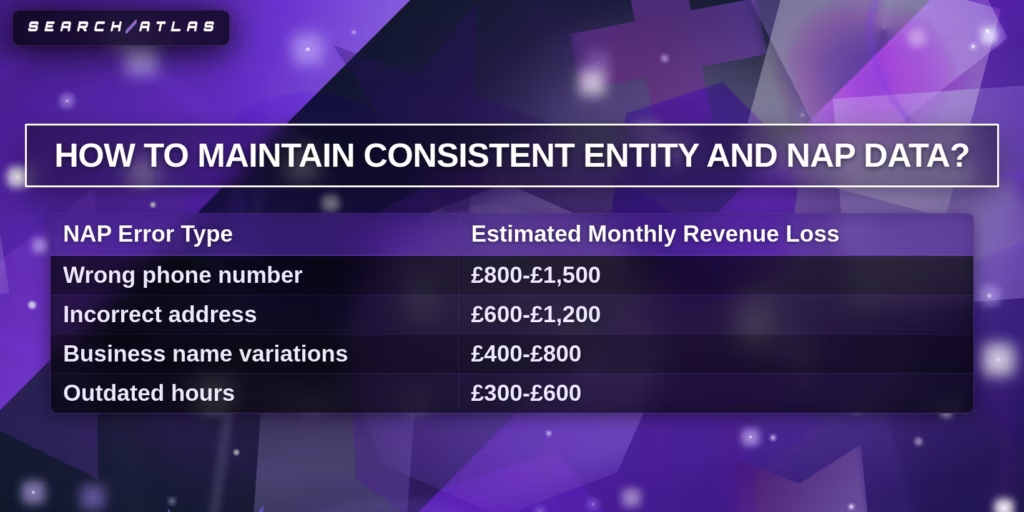
Establish consistent entity and NAP data by enforcing one canonical version of every brand identifier across all digital platforms and structured data sources. NAP consistency (Name, Address, Phone) functions as the foundation of entity recognition in both local SEO and Generative Engine Optimization. Inconsistent entity data reduces AI citation confidence and causes inaccurate brand descriptions across platforms.
Why does NAP consistency directly influence AI visibility and local rankings? NAP consistency directly influences AI visibility and local rankings because search engines and AI systems validate business legitimacy through cross-source matching. Businesses with a perfect NAP match are 2.7 times more likely to appear in the local pack. Inconsistent listings reduce local visibility by up to 73%, which suppresses both map placement and AI recommendation probability.
What are the most damaging NAP inconsistencies? The most damaging NAP inconsistencies involve brand name variation, description inconsistency, and URL format mismatch. Brand name format drift (ampersand versus “and,” Inc. versus no Inc., hyphen changes) fragments entity recognition. Description inconsistency weakens semantic reinforcement. URL variation causes AI systems to treat one business as multiple entities.
How do businesses standardize brand names and description formats? Standardize brand name and description formats by defining one exact canonical version and enforcing it universally. Firstly, document the official legal and trading name. Secondly, create a single-sentence brand definition that describes the category, core service, audience, and location. Thirdly, replicate that identical wording across website pages, directories, profiles, and schema markup.
How are address and phone number formatting standardized? Standardize address and phone number formatting by selecting one exact formatting structure and applying it without deviation. Use one consistent format for abbreviations (Street versus St.), suite identifiers, country codes, and spacing. Remove outdated numbers immediately. Audit all listings to eliminate duplicate or conflicting variations.
What is the recommended audit process for entity consistency? Run a full entity consistency audit quarterly and after every business change. Create a spreadsheet with one row per entity attribute and one column per platform. Compare every listing against the canonical source-of-truth record. The initial audit requires approximately 4 hours. Subsequent audits require about 45 minutes.
Which platforms must be prioritized during NAP audits? Prioritize the website, Wikidata, Google Business Profile, LinkedIn company page, Crunchbase, Wikipedia, and high-authority directories during NAP audits. The website acts as the canonical source. Wikidata feeds Knowledge Graph systems. Google Business Profile directly influences map and AI local recommendations.
How does structured data reinforce entity consistency? Structured data reinforces entity consistency by providing a machine-readable LocalBusiness schema inside the website HTML. Add Organization and LocalBusiness schema with exact NAP values. Align schema properties with canonical data. Structured markup reduces ambiguity and strengthens AI entity validation.
How do multi-location businesses maintain consistency? Maintain multi-location consistency by assigning each location a dedicated Google Business Profile and unique landing page with identical NAP formatting rules. Link each profile to its corresponding page. Avoid keyword stuffing inside business names. Maintain consistent store identifiers and standardized naming conventions across all properties.
What is the financial impact of NAP inconsistency? NAP inconsistency directly reduces revenue by eroding trust and blocking discoverability. 68% of consumers lose trust when they see inconsistent information. Wrong phone numbers and incorrect addresses produce measurable monthly revenue loss, which compounds over time.
Use PR and Guest Posting
Use digital PR and guest posting by securing contextual brand mentions and authoritative backlinks on trusted third-party publications that AI systems frequently retrieve and index. Digital PR expands entity recognition across editorial environments. Guest posting places structured, expertise-driven content on external domains to reinforce brand authority.
What is the strategic purpose of digital PR in AI visibility? The strategic purpose of digital PR is to generate independent, editorially validated brand mentions that strengthen entity authority signals. AI systems prioritize brands repeatedly referenced in reputable media, trade publications, and industry blogs. Earned coverage reinforces trust signals that influence both AI mentions and citation probability.
What is the strategic purpose of guest posting in citation growth? The strategic purpose of guest posting is to publish structured, expertise-aligned content on authoritative websites that produce contextual backlinks and brand reinforcement. Guest articles position the brand as a subject-matter contributor. High-quality editorial backlinks increase domain authority and expand citation eligibility.
How do digital PR and guest posting improve SEO and AI citation probability? Digital PR and guest posting improve SEO and AI citation probability by earning high-quality backlinks and contextual mentions from trusted domains. Search engines value authoritative links. AI systems interpret editorial mentions as corroboration signals. One high-authority backlink influences ranking strength more effectively than multiple low-quality links.
How are outreach and pitching structured? Structure outreach by presenting value-driven topic proposals tailored to the host audience. Provide examples of prior authoritative work. Align pitch angles with the publication’s editorial focus. Demonstrate expertise through data-backed insights rather than promotional framing.
How are links included within guest content? Include links naturally within context-relevant sections that reinforce reader value and topical alignment. Avoid repetitive exact-match anchor text. Maintain semantic clarity in anchor phrasing. Do not purchase backlinks because paid link schemes violate search guidelines and reduce long-term authority stability.
How does relationship building amplify long-term impact? Relationship building amplifies long-term impact by creating repeat placement opportunities and editorial trust. Engage with editors and publishers consistently. Provide value beyond single placements. Ongoing collaboration produces sustained brand mentions and citation reinforcement.
How is the performance of digital PR and guest posting measured? Measure performance by tracking referral traffic, branded search growth, citation frequency, and AI Share of Voice inside generative answers. Monitor brand references through social listening tools and backlink analysis. Evaluate improvements in ranking stability and AI mention frequency over quarterly cycles.
Why is relevance critical in digital PR and guest posting? Relevance is critical because AI systems and search engines prioritize contextual alignment between referring domains and brand expertise. Irrelevant placements weaken semantic reinforcement. Niche-relevant publications produce stronger entity association and long-term citation eligibility.
Monitor Sentiment and Visibility
Monitor sentiment and visibility by systematically analyzing how AI systems describe, rank, and position a brand across generated responses. Sentiment monitoring measures tone and framing. Visibility monitoring measures frequency, placement, and comparative presence across prompts.
What is AI brand sentiment tracking? AI brand sentiment tracking analyzes the tone, accuracy, and contextual framing of brand mentions inside AI-generated answers. AI brand sentiment tracking evaluates whether a brand appears as endorsed, neutral, cautious, negative, or hallucinated. Sentiment tracking differs from mention count because it measures qualitative positioning rather than appearance volume.
Why is AI brand sentiment tracking critical for AI visibility? AI brand sentiment tracking is critical because recommendation tone directly influences purchase decisions and perceived authority. 73% of B2B buyers report trusting AI recommendations over advertisements. Brands with higher endorsement rates improve competitive standing in AI summaries.
How is sentiment classified for measurement accuracy? Classify sentiment using a five-category framework to standardize evaluation. The five categories are endorsement, neutral mention, cautious mention, negative mention, and hallucination. Endorsement signals a positive recommendation. Neutral indicates factual inclusion. Cautious signals hedging language. Negative signals discourage. Hallucination signals incorrect factual framing.
How is Net Sentiment Score (NSS) calculated? Calculate Net Sentiment Score (NSS) using a weighted formula that balances positive and negative positioning. Use the formula (Endorsement + Neutral − Negative − Hallucination) ÷ Total Mentions × 100. NSS ranges from −100 to +100. Scores above +60 indicate strong positioning. Scores between −19 and +19 indicate unstable positioning.
How do organizations monitor AI visibility across platforms? Monitor AI visibility by running standardized prompt sets across major AI platforms and documenting inclusion frequency and position. Test prompts across (ChatGPT, Google Gemini, Perplexity, Claude). Record mention count, citation presence, ranking order, and sentiment tone. Visibility equals inclusion consistency rather than ranking position.
What tools support AI visibility and sentiment monitoring? Use automated AI visibility monitoring tools to track citation frequency, brand mentions, and sentiment shifts over time. Configure tools with brand terms, competitor names, and priority prompts. Set alert thresholds for sentiment drops greater than 10–20% week over week. Integrate dashboards with CRM and BI systems for operational reporting.
How does AI sentiment tracking differ from traditional social listening? AI sentiment tracking measures how AI models position a brand, while traditional social listening measures human conversation across social channels. AI tracking analyzes synthesized answers. Social listening analyzes raw user-generated content. Both require separate remediation workflows and reporting ownership.
How are ongoing monitoring workflows structured? Structure ongoing monitoring workflows through weekly reviews, monthly trend analysis, and quarterly parameter updates. Weekly sessions evaluate NSS movement and competitor displacement. Monthly reviews assess Share of Voice changes. Quarterly updates revise prompts based on product evolution and emerging query types.
How does real-time monitoring improve brand protection? Real-time monitoring improves brand protection by detecting misinformation, sentiment drops, and hallucinations before reputational damage compounds. Proactive tracking allows immediate content correction, schema updates, and third-party outreach. Continuous monitoring preserves AI recommendation stability and long-term entity authority.
Strengthen Topical Authority
Strengthen topical authority by building comprehensive, structured coverage around one clearly defined subject cluster and reinforcing it with consistent internal linking, entity clarity, and authoritative validation. Topical authority signals to search engines and AI systems that a site demonstrates deep expertise within a focused domain.
Why does topical authority influence rankings and AI inclusion? Topical authority influences rankings and AI inclusion because search systems prioritize expert sources that cover closely related queries with depth and consistency. Google confirmed using topical authority to identify experts for relevant queries. Higher rankings increase click-through rates, with the #1 result averaging 27.6% CTR.
How does niche clarity strengthen topical authority? Niche clarity strengthens topical authority by concentrating content within a narrowly defined domain rather than dispersing coverage across unrelated topics. Select one broad theme capable of supporting 100+ articles. Avoid overly broad verticals. Focused specialization reduces competition and increases semantic depth.
How does the pillar-cluster model reinforce topical authority? The pillar-cluster model reinforces topical authority by organizing content around a central pillar page supported by interlinked cluster articles. Firstly, publish a comprehensive pillar page that defines the main topic. Secondly, create 8–10 focused cluster pages addressing subtopics. Thirdly, link cluster pages back to the pillar and interconnect related clusters. This structure signals comprehensive coverage and semantic cohesion.
How does consistent high-quality content increase topical authority? Consistent high-quality content increases topical authority by demonstrating reliability, depth, and expertise across related queries. Publish in-depth articles averaging 1,500 words or more. Address information gaps identified through competitor analysis. Update content regularly to maintain freshness and semantic accuracy.
How does internal linking establish semantic relationships? Internal linking establishes semantic relationships by connecting pillar and cluster pages into a cohesive knowledge network. Link every cluster page to its pillar. Link pillar pages to clusters. Use contextual anchor text reflecting the main topic. This architecture improves crawlability and distributes authority signals.
How do backlinks and external validation reinforce topical authority? Backlinks and external validation reinforce topical authority by signaling third-party recognition of expertise. Acquire niche-relevant backlinks from authoritative domains. Earn placements through guest contributions and research citations. External references validate expertise beyond on-site signals.
How do E-E-A-T signals support topical authority? E-E-A-T signals support topical authority by strengthening perceived experience, expertise, authoritativeness, and trustworthiness. Add author bios with credentials. Create comprehensive About pages. Implement the Person schema for named contributors. Demonstrate firsthand knowledge and documented research.
How is the site structure optimized for topical authority? Optimize site structure by creating a clear hierarchy that reflects topical clusters and entity relationships. Place primary topic pages within top-level navigation. Avoid excessive category fragmentation. Maintain crawlable, logical URLs that mirror the content hierarchy.
How can competitive analysis accelerate topical authority growth? Competitive analysis accelerates topical authority growth by identifying information gaps within competing domains and publishing superior, more comprehensive coverage. Analyze competitors’ sitemap structures. Identify missing subtopics. Expand cluster depth beyond competitor scope to capture a semantic advantage.
Which metrics confirm strengthening topical authority? Metrics confirming topical authority growth include rising impressions, increasing keyword rankings, organic backlink acquisition, faster indexing of new pages, and favorable inclusion in AI Overviews. Monitor impressions in Google Search Console. Track cluster-level ranking improvements. Measure AI mentions frequency across prompts.
How to Track and Grow AI Citations and Mentions?
Track and grow AI citations and mentions by combining prompt-based visibility audits, structured citation measurement, Share of Voice analysis, and systematic content engineering. AI citations measure grounded authority. AI mentions measuring conversational inclusion. Growth requires closing the gap between recognition and citation trust.
How can I track citations to my site in AI results? Track citations to my site in AI results by running standardized prompt sets across major AI platforms and documenting citation presence, position, and link attribution. Build a library of 20–50 core prompts representing buyer queries. Record citation frequency, URL inclusion, and competitor comparison. Calculate Citation Frequency as (Prompts with citation ÷ Total prompts) × 100. The full measurement record for each run is laid out in the guide to tracking LLM mentions and citations.
How are AI mentions tracked alongside citations? Track AI mentions by counting direct brand inclusions across the same prompt set and calculating AI Share of Voice. AI Share of Voice equals (Brand mentions ÷ Total brand mentions across all brands) × 100. Mentions reveal entity presence. Citations reveal evidentiary trust.
What is the “mention-citation gap,” and how does it guide optimization? The “mention-citation gap” occurs when AI systems reference a brand but do not cite its content as a source. This gap signals recognition without content trust. Close this gap by publishing structured, answer-first pages designed for grounding and retrieval.
What metrics define AI visibility performance? AI visibility performance is defined by Citation Frequency, AI Share of Voice, Sentiment Distribution, Citation Stability, and LLM Conversion Rate. Citation Stability measures week-over-week volatility. LLM Conversion Rate measures revenue impact. Brands achieving 30%+ appearance in the core category prompt establish baseline inclusion.
How does AI citation tracking scale for enterprise coverage? Scale AI citation tracking based on prompt volume and reporting stability. Use 20–50 prompts for directional insight. Use 50–150 prompts for reliable category coverage. Use 300+ prompts for multi-product and multi-geo operations. Higher volume reduces volatility distortion.
How can organizations engineer content growth from citation gaps? Engineer growth by identifying competitor-cited domains and classifying them into outrankable sources, partner targets, and authority anchors. Publish improved content for outrankable gaps. Pursue collaboration for partner targets. Reference authority anchors to reinforce credibility.
How citable pages are engineered for higher inclusion? Engineer citable pages using structured H2 and H3 headings, answer blocks of 40–60 words, comparison tables near the top, and explicit definitions. Add Article, FAQ, HowTo, and Product schema in JSON-LD. Maintain consistent entity naming. AI systems favor extractable formatting 28–40% more frequently.
Why does content freshness increase AI citation growth? Content freshness increases AI citation growth because AI assistants prioritize newer sources during retrieval. AI citations average 25.7% newer than traditional search results. Update high-value pages quarterly and refresh statistics, examples, and structured definitions.
How can AI citation performance connect to revenue measurement? Connect AI citation performance to revenue by calculating the Value of an AI Citation and measuring conversion lift. LLM visitors convert 4.4x to 5x higher than traditional organic visitors. Compute AI visitor value using (Revenue ÷ Organic Visitors) × 4.4. Track revenue growth relative to monthly GEO investment to calculate ROI.
How is AI citation growth reported internally? Report AI citation growth using weekly citation metrics, monthly competitive Share of Voice analysis, and quarterly strategic audits. Include Citation Volume, AI Share of Voice, Sentiment Score, Traffic Impact, and Competitive Gap Analysis in executive dashboards. Translate metrics into business impact narratives rather than ranking reports.
How to Measure the Impact of AI Citations and Mentions?
Measure the impact of AI citations and mentions by combining citation frequency, AI Share of Voice, sentiment scoring, conversion analysis, and competitive benchmarking across structured prompt sets. AI citations quantify grounded authority. AI mentions quantify entity visibility and narrative prominence inside generative answers.
Why are traditional SEO metrics insufficient for measuring AI impact? Traditional SEO metrics are insufficient because AI systems provide definitive answers without requiring clicks, which hides influence from pageview-based analytics. Google Analytics and Search Console do not report which AI engine cited or mentioned a brand. AI referrals often appear as “direct” or unclassified traffic, which masks attribution accuracy.
How is Citation Frequency measured and benchmarked? Citation Frequency is measured as the percentage of prompts in which a domain is explicitly cited as a source. Use the formula (Prompts with citation ÷ Total prompts) × 100. LLMs typically cite only 2–7 domains per answer. A 30%+ citation presence across core category prompts indicates competitive inclusion.
How is AI Share of Voice (AI SOV) calculated? AI Share of Voice (AI SOV) measures the proportion of total brand mentions or citations a brand holds within a defined prompt universe. Use the formula (Brand mentions ÷ Total brand mentions across prompts) × 100. AI SOV exceeding traditional market share by 10–20% signals category leadership inside generative results.
How is Brand Visibility Score (BVS) evaluated? Brand Visibility Score (BVS) combines citation presence, mention prominence, link inclusion, and sentiment weight into a composite metric. Assign weighted values to placement (headline, body, footnote) and tone (positive, neutral, negative). A consistent 10%+ quarter-over-quarter improvement reflects growth momentum.
How is Sentiment Analysis integrated into AI impact measurement? Sentiment Analysis measures whether AI platforms describe a brand positively, neutrally, or negatively across prompts. A benchmark target of 70%+ positive sentiment indicates strong recommendation positioning. Negative framing reduces conversion probability and must be addressed through content correction.
How is the LLM Conversion Rate measured? LLM Conversion Rate compares the conversion performance of AI-referred visitors against traditional organic visitors. LLM visitors convert 4.4x to 5x higher than traditional organic traffic in many sectors. Target a conversion rate at least 2–3 times higher than baseline organic traffic.
What is the Mention-Citation Gap, and why does it matter? The Mention-Citation Gap measures the difference between frequent brand mentions and limited source citations. High mentions with low citations indicate recognition without content trust. Closing this gap requires engineering citable, structured pages.
How can organizations connect AI citations to revenue impact? Connect AI citations to revenue by calculating AI visitor value and modeling ROI against GEO investment. Use the formula (Revenue from organic ÷ Organic visitors) × 4.4 to estimate AI visitor value. Compute ROI as (Revenue from AI channel ÷ GEO investment) × 100.
How is AI citation performance reported internally? Report AI citation performance through a GEO dashboard that includes Citation Metrics, AI Share of Voice, Sentiment Trends, Conversion Performance, and Competitive Analysis. Track daily AI referral traffic, weekly citation metrics, monthly competitive benchmarks, and quarterly strategic audits. Translate metrics into business impact narratives rather than ranking fluctuations.
What Tools Help Monitor Brand Mentions and AI Citations?
The tools that help monitor brand mentions and AI citations include AI-native visibility platforms, SEO analytics suites with AI tracking extensions, and specialized citation analysis systems designed for generative search environments. These tools track AI mentions, citation frequency, Share of Voice, sentiment framing, and competitive displacement across AI platforms.
There are 6 leading citation analysis tools for AI search. These are listed below.
- LLM Visibility Tool by Search Atlas. LLM Visibility Tool by Search Atlas is the most purpose-built platform for monitoring AI mentions and AI citations across major generative engines. LLM Visibility Tool by Search Atlas tracks inclusion across (ChatGPT, Gemini, Perplexity, Google AI Overviews) and measures citation frequency, Share of Voice, sentiment shifts, and competitor displacement. The platform converts prompt-level AI responses into structured dashboards, which allows consistent tracking of brand visibility over time. The best tool for AI visibility monitoring and AI citation tracking is the LLM Visibility tool by Search Atlas.
- Ahrefs Brand Radar. Ahrefs Brand Radar tracks AI citations and brand mentions through structured SERP feature analysis and citation frequency reporting. Ahrefs Brand Radar identifies which domains receive AI Overview citations and compares visibility trends across competitors. The system integrates citation monitoring into broader domain authority and backlink evaluation workflows.
- Semrush AI Toolkit. Semrush AI Toolkit monitors AI mentions, sentiment distribution, and competitive Share of Voice across generative platforms. Semrush AI Toolkit integrates AI search tracking with keyword research and competitive intelligence systems. The toolkit allows structured monitoring of mention frequency and citation appearance across prompts.
- Conductor AI Visibility Tracking. Conductor AI Visibility Tracking provides enterprise-grade monitoring of brand mentions and citations using API-based AI response analysis. Conductor AI Visibility Tracking evaluates citation placement, frequency shifts, and competitor inclusion patterns. The platform connects AI visibility performance with traditional SEO reporting environments.
- Profound AI. Profound AI tracks citation stability, hallucination risk, and brand sentiment across generative AI systems. Profound AI analyzes conversation-level outputs and detects volatility in brand inclusion. The platform supports compliance monitoring and structured tracking of AI-generated responses.
- Otterly.ai. Otterly.ai monitors brand mentions and AI citations through automated prompt libraries and visualization dashboards. Otterly.ai tracks citation links, mention frequency, and Share of Voice shifts across generative platforms. The system visualizes competitive overlap and visibility growth patterns.
Why do AI-native tools outperform traditional analytics for citation tracking? AI-native tools outperform traditional analytics because traditional SEO systems measure rankings and clicks, not answer-level inclusion. AI citations and AI mentions occur inside synthesized responses rather than search result positions. Leading citation analysis tools for AI search capture prompt-level visibility, citation depth, sentiment tone, and volatility patterns that define modern AI visibility measurement.
What Are the Common Challenges in Managing AI Citations and Mentions?
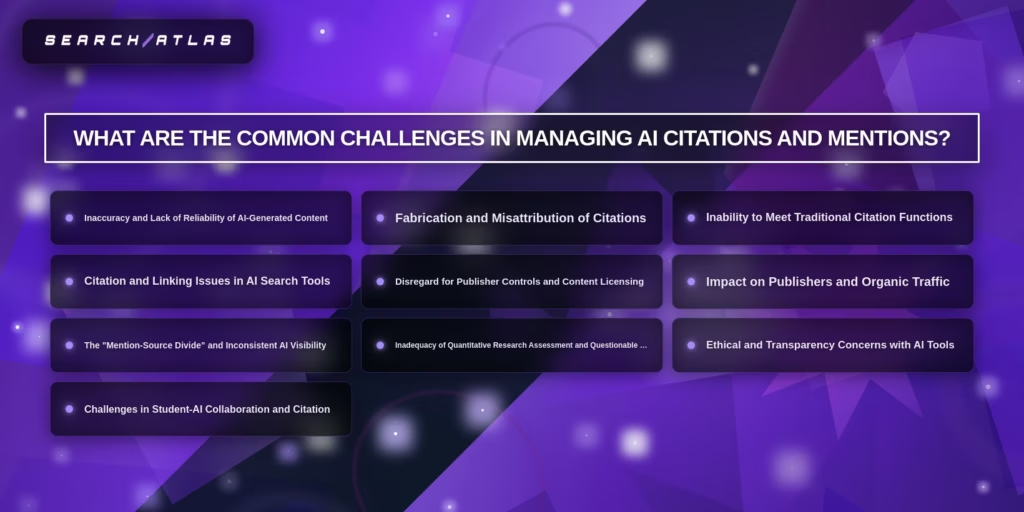
The common challenges in managing AI citations and mentions include citation inaccuracy, hallucinated sources, visibility volatility, traffic misattribution, licensing conflicts, and the mention-source divide that separates recognition from authority. These challenges complicate measurement, governance, and trust management inside generative search ecosystems.
How does inaccuracy and lack of reliability affect AI citations? Inaccuracy affects AI citations because large language models generate confident but sometimes unsupported statements tied to incorrect or outdated sources. Studies show high rates of citation mismatch and fabricated references in AI outputs. Inaccurate attribution damages credibility and increases verification burden.
What is fabrication and misattribution in AI citations? Fabrication and misattribution occur when AI systems generate plausible but non-existent references or assign claims to the wrong source. Some engines fabricate links or misattribute authorship under retrieval uncertainty. Misattribution weakens trust signals and exposes brands to reputational risk.
Why do AI citations fail to meet traditional citation functions? AI citations fail to meet traditional citation functions because they often summarize, paraphrase, or blend multiple sources without transparent contribution weighting. Multi-source synthesis prevents clear ownership mapping. AI answers cite one URL while relying on content patterns from several domains.
What citation and linking issues exist in AI search tools? Citation and linking issues exist because AI interfaces change source display formats and sometimes hide or reorder links across runs. AI Overview citations shift approximately 46% of the time. Volatility reduces measurement stability and weakens longitudinal tracking accuracy.
How do AI systems disregard publisher controls and licensing preferences? AI systems disregard publisher controls when they aggregate and summarize licensed content without transparent attribution logic. Some platforms extract information beyond original context boundaries. Licensing disputes and fair use ambiguity increase governance complexity.
How do AI citations impact publishers and organic traffic? AI citations impact publishers by reducing click-through rates and shifting traffic from owned domains to aggregated summaries. Informational query CTR declines from 1.41% to 0.64% when AI answers appear. Zero-click behavior now accounts for nearly 60% of searches, which reduces direct publisher traffic.
What is the “Mention-Source Divide” challenge? The “Mention-Source Divide” occurs when AI systems mention a brand but fail to cite its content as a source. This divide signals entity recognition without content authority. Brands receive awareness but lose referral and trust reinforcement benefits.
Why is quantitative research assessment unreliable in AI citations? Quantitative research assessment becomes unreliable because AI systems paraphrase academic content without precise citation mapping. Citation drift and paraphrased aggregation obscure source contribution. Researchers report high rates of incorrect or unsupported references.
What ethical and transparency concerns arise in AI citation management? Ethical and transparency concerns arise when AI systems present synthesized information without clear disclosure of model influence or source reliability. Disclosure paradox research shows trust declines when AI usage becomes explicit. Ambiguity in attribution erodes perceived legitimacy.
What challenges affect student-AI collaboration and citation practices? Student-AI collaboration challenges emerge because AI tools generate realistic but fabricated academic citations that mislead users. Improper source validation increases academic integrity risks. Institutions struggle to define consistent citation standards for AI-assisted writing.
How to Align Citations and Mentions With Entity-Based SEO?
Align citations and mentions with entity-based SEO by building consistent entity corroboration across authoritative third-party sources and structured data systems that feed the Knowledge Graph. Entity-based SEO requires independent validation signals that confirm identity, expertise, and topical relevance across the web.
How does entity corroboration strengthen citation and mention alignment? Entity corroboration strengthens citation and mention alignment by creating a self-confirming network of consistent brand references across trusted domains. Secure unlinked brand mentions, directory listings, industry database entries, and editorial coverage that repeat identical entity attributes. AI systems evaluate cross-source consistency through Natural Language Processing to increase authority confidence.
How is Knowledge Graph integration engineered? Engineer Knowledge Graph integration by linking the Entity Home to authoritative external profiles and reinforcing reciprocal confirmation. Maintain consistent entity naming across (Wikidata, Crunchbase, LinkedIn, Google Business Profile). Use the sameAs schema to connect official profiles. Knowledge Panel triggers require multi-source verification and structured entity mapping.
How does local entity SEO align citations and mentions? Local entity SEO aligns citations and mentions by maintaining perfect NAP consistency and geographic entity linkage across directories and review platforms. NAP (Name, Address, Phone) must match across (Yelp, Apple Maps, Bing Places, industry directories). Inconsistent NAP reduces algorithmic confidence and weakens local AI recommendations.
How does digital PR reinforce entity authority? Digital PR reinforces entity authority by generating contextual co-citations with recognized industry leaders and trusted publications. NLP algorithms process entity co-occurrence to strengthen Knowledge Graph positioning. Even unlinked editorial mentions contribute to entity salience when repeated consistently.
How does structured data support entity alignment? Structured data supports entity alignment by explicitly defining relationships between brand, products, services, and categories using JSON-LD schema. Implement Organization, Person, Product, Event, and FAQPage schema. Ensure properties accurately reflect canonical entity attributes. Machine-readable clarity increases citation probability.
How does internal linking strengthen entity-based SEO? Internal linking strengthens entity-based SEO by connecting related entity pages with descriptive, entity-rich anchor text. Link every authoritative page back to the primary entity page. Build hub-and-spoke architectures that reinforce semantic clustering. Contextual links improve entity salience across the site.
How does content strategy align with entity-based SEO? Align content strategy with entity-based SEO by expanding comprehensive coverage around primary entities and related sub-entities. Create detailed content explaining background, relationships, and use cases. Optimize for semantic search by including synonyms, related terms, and question-based headings. Cover gaps competitors leave uncovered.
How is entity SEO performance measured? Measure entity SEO performance through Knowledge Panel presence, citation frequency in LLM outputs, share of AI voice, and entity salience scoring tools. Monitor Google NLP API outputs for entity recognition. Track LLM mentions and citations across (ChatGPT, Gemini, Perplexity). Measure referral traffic from AI citations and compare to baseline organic performance.
Why does entity-first optimization future-proof AI visibility? Entity-first optimization future-proofs AI visibility because AI systems interpret brands as interconnected knowledge nodes rather than isolated URLs. Strong entity consistency ensures inclusion inside AI-generated answers even as ranking signals shift. Visibility now depends on being recalled as a trusted entity within large knowledge systems rather than occupying a single search position.
Do Citations Still Matter in 2026?
Yes, citations still matter in 2026 because they function as a core trust and entity validation signal within both AI-driven search and traditional local ranking systems. Citation density and citation quality increasingly influence entity confirmation as AI search adoption reduces traditional click-based discovery.
How have citations evolved in importance by 2026? Citations have evolved from supporting SEO signals to dominant off-page entity validation signals. Traditional search engine volume is projected to decline by 25% by 2026 as AI chatbots capture market share. Citation presence reinforces entity legitimacy and stabilizes Knowledge Graph interpretation across AI platforms.
How do citations function as trust and consistency signals? Citations function as trust and consistency signals by confirming business identity across independent third-party sources. Moz research identifies citation signals among top local ranking factors. Consistent mentions in directories, local news, and forums strengthen legitimacy and reduce ambiguity in entity understanding.
Do citations outweigh all other ranking factors in 2026? No, citations do not outweigh all other ranking factors because reviews, proximity, and profile activity influence local ranking more heavily. Google Business Profile performance depends significantly on review volume and freshness. Profile engagement signals and geographic relevance carry substantial weight alongside citation consistency.
How does Google treat citation manipulation in 2026? Google treats citation manipulation with the same enforcement standards applied to link spam under Helpful Content algorithms. Artificial quantity without authenticity reduces trust. Authentic, contextually relevant mentions provide stronger ranking reinforcement than volume-based directory saturation.
What is the strategic conclusion about citations in 2026? Citations still matter in 2026 because they validate entity identity, reinforce AI visibility, and stabilize local ranking signals, but they operate within a broader ecosystem of reviews, engagement, and structured data authority. Citation strength must align with authentic brand presence rather than volume-driven tactics.
Backlinks vs Mentions vs Citations: What Matters More for AI Visibility?
Brand mentions matter most for direct AI visibility, citations matter for evidentiary trust and validation, and backlinks remain foundational for traditional search authority that indirectly influences AI inclusion. Each signal plays a different structural role inside generative systems.
How do backlinks influence AI visibility? Backlinks influence AI visibility indirectly by strengthening domain authority and retrieval credibility. Backlinks function as clickable hyperlinks that define web infrastructure and authority context. Correlation with AI visibility remains moderate for some LLMs (0.39–0.42) and weaker for Google AI Overviews (0.25). Backlinks support discovery but do not guarantee AI inclusion.
How do brand mentions influence AI visibility? Brand mentions influence AI visibility directly because AI systems process language patterns, co-occurrence, and entity recognition rather than link graphs alone. Branded web mentions correlate at 0.664 with AI visibility. Brands in the top quartile for mentions earn over 10x more AI citations than the next quartile. Mentions dominate zero-click environments.
How do citations influence AI visibility? Citations influence AI visibility by validating factual claims and reinforcing source credibility inside generated answers. Citations act as formal references that map claims to publishers. 76% of AI Overview citations originate from top-10 ranked pages, yet ranking #1 provides only a 25% citation probability. Citations reinforce trust but do not drive visibility alone.
Which signal has the strongest direct correlation with AI visibility? Brand mentions have the strongest direct correlation with AI visibility because AI models treat brands as entities reinforced through contextual repetition. Backlinks correlate at 0.218 in broader AI visibility studies, while brand mentions significantly outperform link-only strategies. AI prioritizes semantic authority over hyperlink volume.
When do backlinks matter more than mentions or citations? Backlinks matter more when the objective is traditional ranking stability and broad web discovery. Google still drives 345x more traffic than AI engines. Retrieval-based AI systems (Perplexity and Gemini) reference link graphs to validate source credibility.
When do mentions matter more than backlinks or citations? Mentions matter more when the objective is zero-click visibility and shortlist positioning inside AI answers. AI Overviews frequently surface brands without links. Commercial prompts generate 4–8x more mentions than informational prompts, which amplifies purchase-stage influence.
When do citations matter more than backlinks or mentions? Citations matter more when prompts require factual verification, technical validation, or comparison-based reasoning. Fact-heavy queries increase citation weight. Citations provide explicit mapping between claims and publishers, which increases perceived trustworthiness.
What is the strategic conclusion for AI visibility? The strategic conclusion is to prioritize brand mentions for AI visibility, support them with structured citations for trust validation, and maintain backlinks for foundational authority. Entity-first optimization generates visibility. Evidence-based content engineering sustains trust.
Do Different AI Platforms Cite Different Sources?
Yes, different AI platforms cite different sources because each platform uses a distinct blend of model-native synthesis and retrieval-augmented generation (RAG), which directly affects citation behavior. Platform architecture determines whether answers rely primarily on trained patterns or live web retrieval.
Why does architecture influence citation behavior? Architecture influences citation behavior because model-native systems generate answers from internal training data, while RAG systems retrieve and ground responses in external documents. Model-first systems prioritize speed and fluency. RAG-based systems prioritize traceability and explicit source attribution. This structural difference explains why citation density varies across engines.
How does ChatGPT handle citations compared to other platforms? ChatGPT operates primarily as a model-first system, with citations appearing when retrieval or browsing modes activate. Default responses often synthesize information without explicit links. When retrieval activates, ChatGPT displays structured citations and source panels, but citation behavior remains query-dependent.
How does Perplexity differ in citation strategy? Perplexity is designed around live web retrieval and consistently displays inline citations for most responses. Perplexity indexes large volumes of web content and prioritizes citation transparency. Inline numbered references appear directly within generated answers, which increases traceability and source visibility.
How do Google Gemini and AI Overviews handle source citations? Google Gemini and AI Overviews integrate directly with Google Search and the Knowledge Graph, which produces citation behavior closely tied to search indexing systems. AI Overviews frequently surface links from top-ranking domains but also include sources beyond the top 10 results. Citation presence depends on query type and freshness signals.
Do citation overlaps remain consistent across platforms? No, citation overlap remains inconsistent because each platform applies different weighting to authority, recency, and entity signals. Studies show that only a small percentage of domains overlap between major AI engines. Source preferences vary by engine and by query intent, which creates platform-specific citation ecosystems.
What is the strategic implication of citation variation across platforms? The strategic implication is that AI visibility requires multi-platform optimization rather than reliance on one citation pattern. Brands must reinforce entity authority, freshness, and structured clarity across diverse sources. Cross-platform consistency increases the probability of citation inclusion regardless of architectural differences.
How is AI search changing the role of links and mentions?
AI search is changing the role of links and mentions by shifting visibility from link-based ranking to entity-based recognition and answer-level inclusion. Traditional search ranked pages based on link authority. AI search generates direct answers that prioritize entity consistency, contextual mentions, and structured citations.
How does AI search change user behavior around links? AI search changes user behavior by reducing reliance on clickable link lists and increasing satisfaction with summarized answers. AI overviews often satisfy informational intent without external clicks. Organic click-through rates decline when AI-generated summaries appear, which reduces traffic to traditional blue-link results.
What is the evolving role of backlinks in AI search? Backlinks remain foundational for web discovery and authority context, but backlinks no longer guarantee visibility inside AI-generated answers. SEO professionals still consider link signals influential, yet AI engines evaluate additional entity and contextual signals beyond link graphs. Link influence shifts from ranking dominance to credibility reinforcement.
What is the evolving role of brand mentions in AI search? Brand mentions gain prominence because AI systems interpret language patterns and entity frequency as trust signals. Mentions reinforce brand recognition even without hyperlinks. AI models surface brands frequently referenced by trusted publications, forums, and databases, which increases zero-click visibility.
How do citations function differently in AI search compared to traditional SEO? Citations function as explicit grounding references that validate specific claims inside AI-generated responses. Citations provide clickable source cards or inline references. Citations now act as traffic gateways within AI interfaces rather than as pure ranking signals.
How does AI search impact organic traffic patterns? AI search impacts organic traffic by decreasing informational clicks and concentrating higher-intent traffic through citation pathways. Zero-click searches increase as users consume summarized answers. Traffic that originates from AI citations converts at higher rates because users arrive closer to decision points.
How are link-building economics changing in the AI era? Link-building economics are changing because rising acquisition costs and scalability challenges reduce return on purely link-focused strategies. Professionals report increasing link costs and difficulty scaling high-quality placements. AI visibility now requires brand mentions and structured content alongside backlinks.
What content optimization strategies respond to this shift? Content optimization strategies respond by prioritizing structured, entity-rich, answer-first content designed for AI extraction. Effective AI search content includes concise definitions, comparison tables, strong author credentials, and clear hierarchical headings. AI systems favor extractable content blocks over keyword-stuffed pages.
What is the strategic conclusion about links and mentions in AI search? The strategic conclusion is that backlinks provide credibility context, citations validate claims, and mentions drive primary AI visibility through entity reinforcement. AI search rewards brands that combine authoritative links, consistent mentions, and structured content aligned with conversational prompts.