AI search visibility reporting for agencies is the recurring client report that shows where AI answer engines such as ChatGPT, Gemini, Perplexity and Claude mention, cite and describe a client's brand. The report measures five attributes: mention rate, citation rate, share of voice, sentiment and position. Agencies sample those attributes from a fixed prompt set and deliver the report on a monthly schedule.
Key takeaways
- The report measures five attributes: mention rate, citation rate, share of voice, sentiment and position.
- A locked prompt set and fixed AI platforms keep month-to-month trends comparable.
- Each AI platform appears separately, with the number of prompts and runs behind every percentage.
- The report describes observed visibility and never claims that a citation produced revenue.
- A change log pairs every metric with an agency action, so the client sees the work behind the numbers.
Why do clients ask agencies for AI search visibility reports?
Clients ask agencies for AI search visibility reports because AI answers now appear where buyers research, and rankings or traffic reports do not show whether the brand appears in them. An AI answer satisfies a buyer without a click, so a traffic report misses that exposure. Agencies without an AI search visibility report lose the evidence for scoping, pricing and proving work in the AI channel, and review calls fall back on screenshots.
How AI visibility reports differ from SEO reports
An AI visibility report differs from an SEO report in what it measures, how it samples and how stable the data is. The two reports share one client relationship, and the SEO client report remains the base for rankings, traffic and technical health.
| Dimension | SEO report | AI visibility report |
|---|---|---|
| What it measures | Rankings, clicks, traffic | Mentions, citations, sentiment, share of voice |
| Unit of measurement | Keyword | Prompt |
| Data source | Search analytics and rank tracking | Sampled answers from a prompt set |
| Stability | Positions change gradually | Answers vary between runs |
| Main risk | Misreading traffic dips | Overclaiming from a single answer |
Which five metrics does an AI search visibility report for agencies include?
An AI search visibility report for agencies includes five metrics: mention rate, citation rate, share of voice, sentiment and position. Each metric has one plain definition that agencies reuse in every client report, and each metric is reported per AI platform.
Mention rate
Mention rate is the percentage of prompts in the prompt set where an AI answer names the brand, with or without a link. Mention rate shows existence: whether ChatGPT, Gemini or Google AI Mode ever names the client for the topics that matter to the business.
Citation rate
Citation rate is the percentage of prompts where an AI answer links to a client page as a source. A brand earns mentions without citations when the answer names the brand but links elsewhere. The difference between the two is covered in AI citations vs mentions.
Share of voice
Share of voice is the percentage of relevant AI answers that name the brand compared with named competitors. The report tracks three to five competitors across the same prompts. Share of voice shows market position, which mention rate alone does not.
Sentiment
Sentiment is how an AI answer describes the brand, rated positive, neutral or negative. The report also checks accuracy, because an answer names a retired service or a wrong price. Sentiment and accuracy together protect the client's reputation inside AI answers.
Position
Position is where the brand appears inside an AI answer, such as first, later or not at all. A brand named first in a short answer carries more weight than a brand named last in a long list. The report records position per AI platform.
Which five client questions should an AI search visibility report answer?
The five client questions an AI search visibility report needs to answer are: whether the brand shows up in AI answers, whether it earns citations, how it compares with competitors, what the answers say about it, and what the agency is doing about it. A report that answers all five rarely needs a follow-up call. Each question maps to one metric and one report element.
| Client question | What the report shows |
|---|---|
| Are we showing up in AI answers? | Mention rate across the agreed prompt set |
| Are we being cited as a source? | Citation count and the pages that earn them |
| How do we compare with competitors? | Share of voice against named rivals |
| What do the answers say about us? | Sentiment and accuracy of the description |
| What are you doing about it? | Change log with actions and owners |
The question that carries the most weight for the agency
The fifth client question, "What are you doing about it?", carries the most weight for the agency. Clients renew on evidence that someone acts on the data. The change log answers that question, so the change log matters as much as the metrics.
How do agencies build the prompt set and sampling plan for an AI search visibility report?
Agencies build the prompt set and sampling plan for an AI search visibility report by fixing the questions, the AI platforms, the run count and the schedule before the first report. The agency freezes all four for the quarter, so each month's numbers compare with the last.
Prompt set and prompt groups
A prompt set is the fixed list of questions the agency asks AI platforms for a client every reporting period. Agencies write prompts from real customer questions and group them by funnel stage and topic, so the report shows where the brand is strong and where the brand is absent. The prompt set changes only at the quarterly review, because a mid-quarter change breaks the trend line. The method for writing the list is in the LLM visibility tracking plan.
AI platforms and the per-platform scorecard
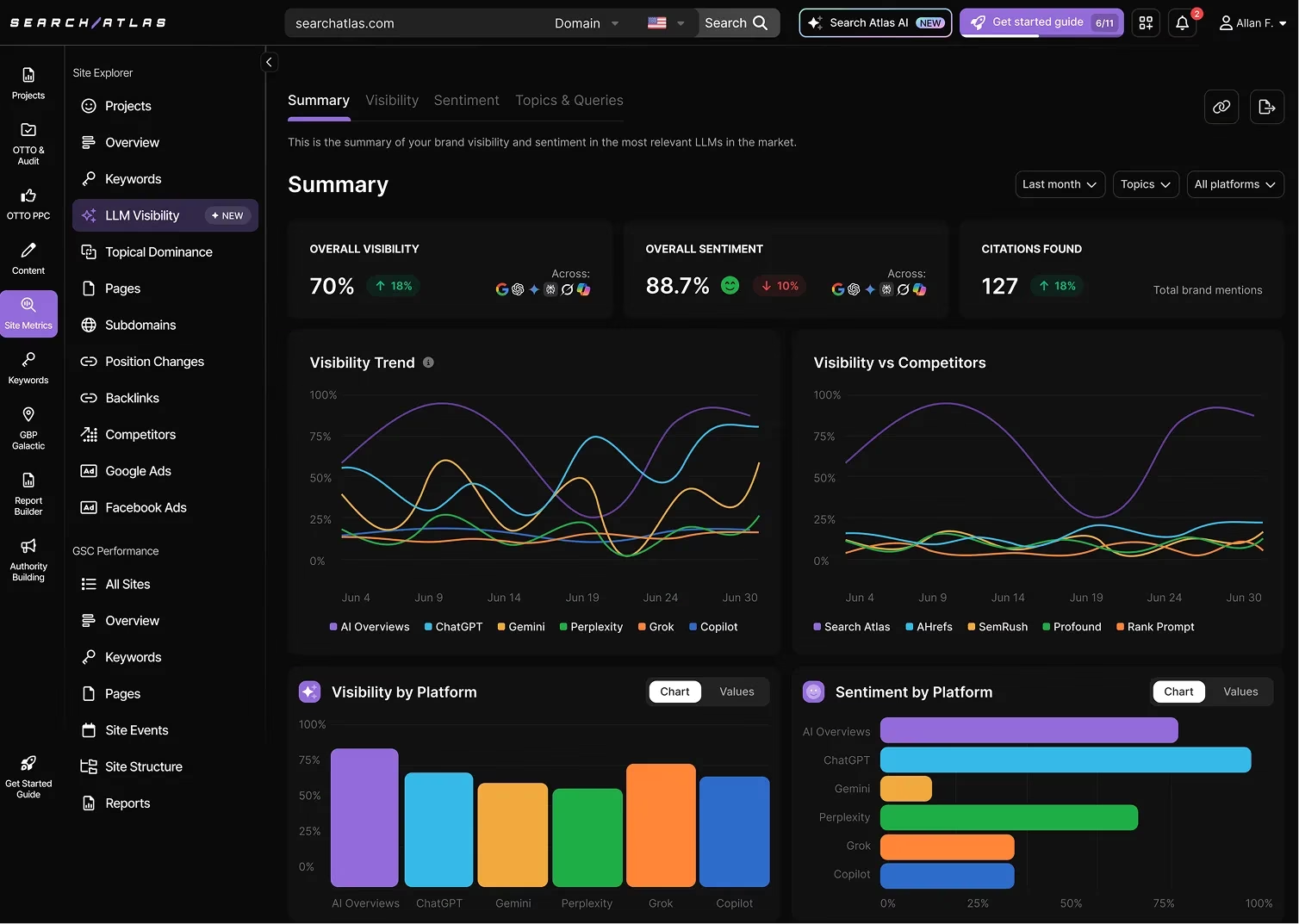
A client report covers the AI platforms the client's buyers use, and the report shows each platform separately. Search Atlas LLM Visibility tracks ChatGPT, Gemini and Google AI Mode on all paid plans, and adds Perplexity and Copilot on Pro plans and above. A per-platform scorecard shows which platforms gain and which slip, while a blended average hides both.
The example below uses a fictional dental practice, and every figure is illustrative.
Denominator and run count
The denominator is the number of prompts and runs behind a percentage, and the report states it every time. "24% of 50 prompts" tells a client more than "24%", and the denominator stops a report from showing only the best answers. A client report needs enough prompts to cover the client's main topics and enough repeat runs to separate trend from noise. The free Search Atlas AI Visibility Checker uses 10 prompts across two platforms, which is a useful floor for a first conversation.
Volatility and the reporting record
The report shows volatility by repeating each prompt and reporting the range of results. One run is a single sample, and two or more runs show whether a change is a trend or noise. The agency keeps a record of every run so the range stays auditable.
Reporting record
Save the exact prompt, platform, date, location, answer, cited sources, brand mention, sentiment and position for every run. Keep a regenerated answer as a new row instead of overwriting the earlier result.
What sections does a client-ready AI search visibility report contain?
A client-ready AI search visibility report contains six sections in a fixed order: executive summary, visibility scorecard, competitor view, prompt highlights, change log and next actions. The fixed order puts the same answer in the same place every month, and moves from headline to evidence to plan. The report runs one to two pages of narrative plus an appendix for prompt-level data.
| Section | What it shows | Question it answers |
|---|---|---|
| Executive summary | Three sentences on direction and priority | Is this going well? |
| Visibility scorecard | Mentions, citations, share of voice, sentiment | Where do we stand? |
| Competitor view | Share of voice against named rivals | How do we compare? |
| Prompt highlights | Wins, losses and gaps by topic | What exactly changed? |
| Change log | Dated actions with evidence | What did you do? |
| Next actions | Priorities, owners and dates | What happens next? |
Sample executive summary and competitor view
The sample below is for a fictional client, Northfield Dental, and every figure is illustrative. Northfield Dental appeared in more AI answers this month, and the gain came mostly from pricing and emergency-care prompts. The brand moved from a baseline mention rate of 18% to 24%, and two service pages now appear as cited sources.
In the competitor view, one competitor still leads Northfield Dental on implant prompts, and next month's plan targets that gap. Share of voice against three rivals rose slightly, and sentiment stayed stable. The agency refreshes the implant page and re-measures the same prompts, so the client sees whether the change moved the numbers.
Change log format and ownership
A change log is a dated record of what the agency changed and what evidence prompted the change. The change log lets a client link movement in the report to specific work, and the agency claims no credit that the evidence does not prove. A specialist writes the entries, and the account manager reviews them before delivery.
| Date | What changed | Evidence | Action | Owner |
|---|---|---|---|---|
| 03 Mar | Competitor page began appearing for implant prompts | Prompt-level results, two platforms | Refresh implant service page | Content lead |
| 12 Mar | Service page published with FAQ block | Page live, indexed | Re-measure in next cycle | Account manager |
| 20 Mar | One platform described a retired service | Answer screenshots | Correct source pages, log for review | SEO specialist |
The dates and entries in the change log above are templates for illustration only.
How do agencies explain AI visibility changes and uncertainty to clients?
Agencies explain AI visibility changes and uncertainty to clients by separating what was observed from what is suspected, and by stating plainly that AI answers vary. Clients accept uncertainty when the agency explains it once, early and consistently.
Why AI answers vary between runs and platforms
AI answers vary between runs and platforms because answer engines generate text rather than return a fixed list, and each platform uses its own model and sources. The same prompt asked twice names different brands, so the report treats a single answer as one sample. Search Atlas research on LLM and Google SERP overlap found that URL-level overlap stays low across models. A platform or model update also shifts results overnight, independent of the agency's work, so the report logs known updates beside the metrics.
Report language: what to say and what to avoid
Agency report language describes observed visibility and states the evidence behind it, and avoids claims about cause or the future. Phrases such as "Mention rate rose across the prompt set" hold up in renewal talks, while "Our work caused the increase" promises what the evidence cannot prove. A visibility drop gets the same treatment: the agency states the observed change, the evidence and the action under way, then names likely drivers as hypotheses.
Limitations to state in every AI visibility report
Every AI search visibility report states four limitations: sampling, model updates, platform differences and personalization. A short note at the bottom of the report keeps the numbers honest.
- Sampling: the report shows a sample of possible questions, so the report cannot list every possible answer.
- Model updates: a platform update shifts results overnight, independent of the agency's work.
- Platform differences: each AI platform draws on its own sources, so results are reported per platform.
- Personalization: answers differ by user, location and conversation history.
Attribution boundary between AI visibility and revenue
The attribution boundary is the rule that an agency never claims an AI citation or mention produced revenue. The report presents visibility evidence in one section and business outcomes such as leads, calls and sales in another. When the two move together, the agency reports the pattern as an observation, not as proof.
Never claim that an AI citation or mention produced revenue.
Report visibility evidence in one section and business outcomes such as leads, calls and sales in another.
AI referral sessions and conversions belong in the business-outcomes section, sourced from the client's own analytics. The guide to LLM traffic explains how to track them.
How often should agencies deliver an AI search visibility report to clients?
Agencies deliver an AI search visibility report to clients monthly, with a weekly internal check and a quarterly review around it. The three layers keep clients informed without turning every wobble into a meeting. The weekly check stays internal, and the monthly report goes to the client.
Monthly workflow for an AI visibility client report
The monthly workflow for an AI visibility client report has six steps, and one account runs them in about a working week spread across the month. The same sequence works for ten clients as for one, which is what makes the workflow scalable. The dashboard walkthrough shows where each metric lives in Search Atlas LLM Visibility.
- Collect (specialist, days 1 to 3): run or export the agreed prompt set and save the results.
- Review (specialist, day 4): check mention rate, citations, share of voice and sentiment against the baseline and last month.
- Annotate changes (specialist, day 5): add dated entries to the change log, with evidence for each.
- Write the narrative (account manager, days 6 to 8): draft the summary with the approved language and the limitations note.
- Agree actions (account manager and client lead, days 9 to 12): choose priorities, owners and dates.
- Deliver (account manager, by day 15): send the report and book the review call.
How do agencies build an AI search visibility client report in Search Atlas?
Agencies build an AI search visibility client report in Search Atlas with three products: LLM Visibility for the AI data, Report Builder for scheduled delivery, and White-Label SEO Software for agency branding. The sections below list the capabilities a reporting platform needs, map them to Search Atlas, and walk through the four build steps.
Capabilities a client reporting platform needs
A platform that reports AI visibility to clients needs six capabilities: multi-platform tracking, a fixed prompt set, prompt-level evidence, competitor comparison, scheduled delivery and white-label branding. The six capabilities form a checklist for any agency setup. To compare AI visibility platforms before choosing one, read how to choose and evaluate tools that track AI citations.
Search Atlas products behind the client report
LLM Visibility, Report Builder and White-Label SEO Software cover the six capabilities in Search Atlas. The table maps each capability to its product.
| Capability | Where it lives in Search Atlas |
|---|---|
| Multi-platform tracking | LLM Visibility: ChatGPT, Gemini and Google AI Mode on all paid plans, Perplexity and Copilot on Pro and above |
| Prompt-level evidence | LLM Visibility topics and queries view, and prompt-level results in the free AI Visibility Checker |
| Competitor comparison | LLM Visibility competitor benchmarking and share of voice |
| Scheduled delivery | Report Builder: scheduled reports with daily refresh, exported as dashboards, PDFs or CSVs |
| White-label branding | Report Builder branding, and White-Label SEO Software under the agency's logo, domain and colors |
Report Builder adds the scheduled SEO layer: GA4, Google Search Console, rankings, Google Business Profile, backlinks and content metrics in one client report.
Where the AI data comes from: Report Builder does not hold LLM Visibility data. The account manager adds the AI visibility section from LLM Visibility.
Step 1: Add the client brand and competitor set in LLM Visibility
The first build step adds the client's brand name, domain and competitor set to LLM Visibility. The competitor set stays fixed for the quarter, so share of voice remains comparable from month to month.
Step 2: Review the LLM Visibility dashboards
The second build step reviews the Summary, Visibility, Sentiment and Topics and Queries views in LLM Visibility. Those four views hold the evidence for the visibility scorecard, the prompt highlights and the sentiment check.
Step 3: Build the scheduled client report in Report Builder
The third build step creates the scheduled client report in Report Builder. The account manager chooses the modules, applies the agency's branding and sets the delivery date, then adds the AI visibility findings as their own section.
Step 4: Deliver the report under the agency's brand
The fourth build step delivers the report from the branded environment, under the agency's own name. White-Label SEO Software keeps the logo, domain and colors consistent across every client touchpoint.
Starting with the free AI Visibility Checker
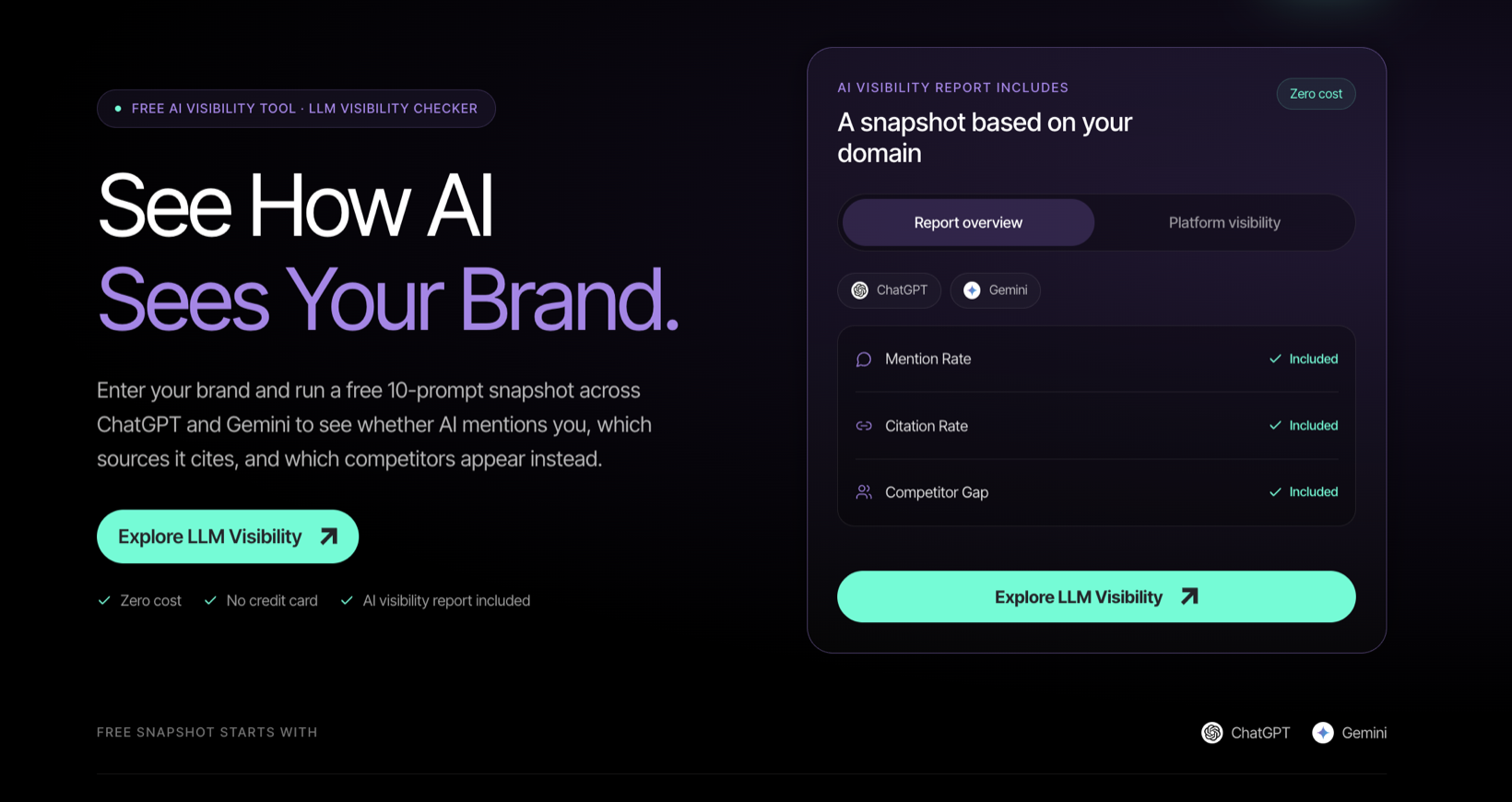
An agency starts AI visibility reporting with the free AI Visibility Checker, then moves to continuous tracking once the client agrees to a prompt set. The checker gives a one-time look at two AI platforms across 10 prompts, with mention rate, citation breakdown, prompt-level results and competitor comparison. The snapshot opens the baseline conversation with the client.
Which mistakes weaken an AI search visibility report for agencies?
Five mistakes weaken an AI search visibility report for agencies: cherry-picking answers, blending platforms, changing the prompt set, promising revenue and reporting without actions. Each mistake weakens client trust.
- Cherry-picking answers: showing the best single answer instead of the rate across the prompt set.
- Blending platforms: averaging all platforms into one number that hides gains and losses.
- Changing the prompt set mid-quarter: breaking the trend line the client relies on.
- Promising revenue: linking a citation to sales the agency cannot prove.
- Reporting without actions: sending metrics with no change log or next steps.
What do agencies ask most about AI search visibility reports?
These five questions cover the most common agency concerns about AI search visibility reports.
How long should a client AI visibility report be?
A client AI visibility report fits on one to two pages of narrative plus a short appendix for prompt-level data. Clients read the summary and the next actions, so the detail sits behind them.
Who should own AI visibility reporting inside an agency?
The account manager owns the narrative, and a specialist owns the data pull and the change log. The split keeps the client message consistent while the person closest to the prompts checks the evidence.
Should AI visibility results sit in the same report as SEO results?
Yes, as their own section. Placing AI visibility next to rankings and traffic shows clients one story, while a separate section keeps its different sampling and uncertainty apart from search analytics.
What should an agency say when a client's AI visibility drops?
State the observed change, the evidence for it, and what the agency is doing about it. Name the likely drivers as hypotheses, such as a model update or a competitor page, and commit to re-measuring in the next cycle.
When does a client get its first AI visibility baseline?
A client gets its baseline in the first reporting cycle, before any optimization work begins. A free snapshot starts the conversation, and a full prompt-set run becomes the baseline every later report compares against.