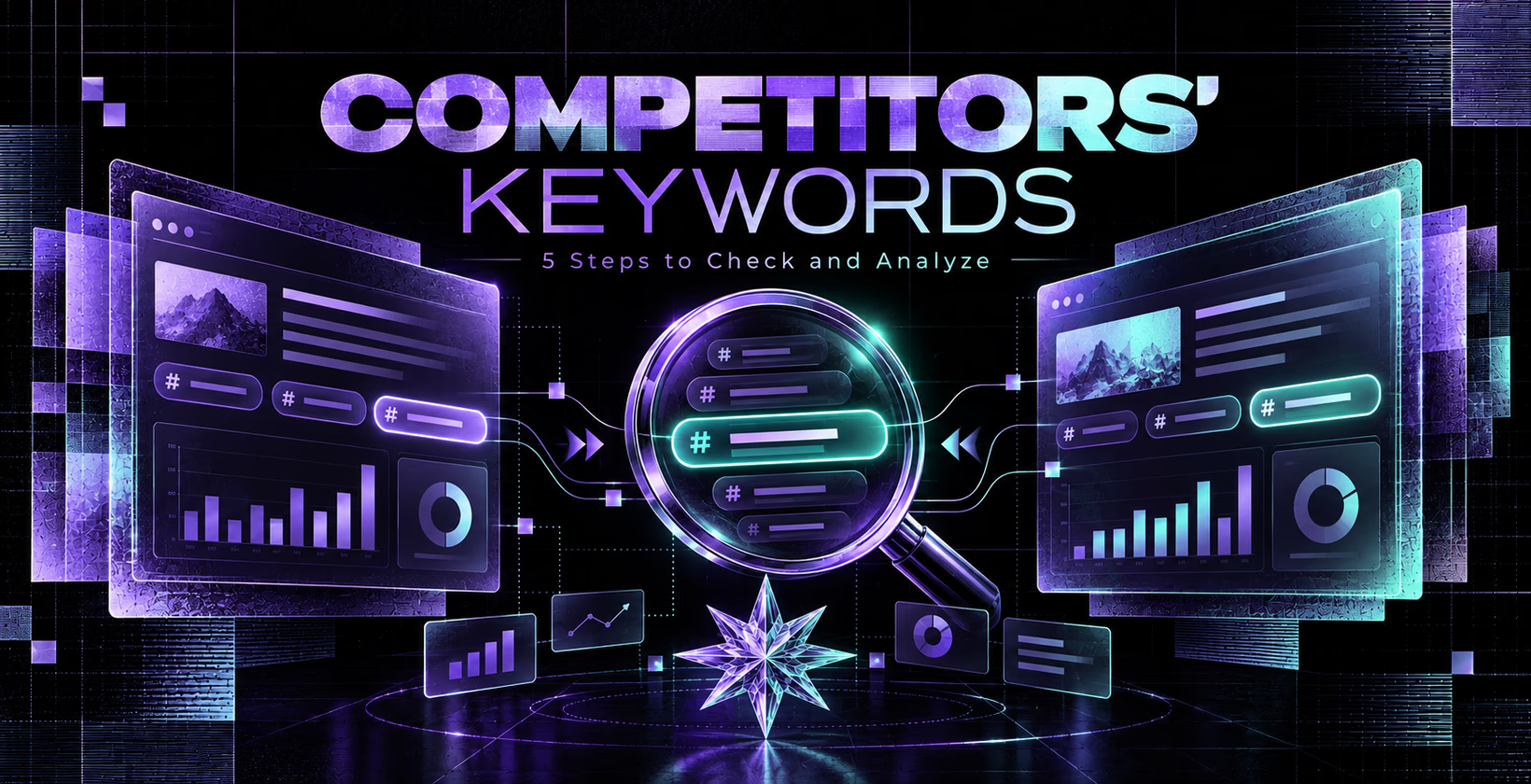
A keyword gap analysis is a competitive search intelligence audit that isolates the exact search queries for which competing domains rank in the top 100 search results while your target domain ranks lower or remains completely unindexed. By cross-referencing ranking footprints across two or more competing domains, marketing teams identify unaddressed user intent, content deficits, and high-value search demand that rivals currently monetize. An empirical benchmark conducted by Search Atlas across 1.2 million competitive keyword intersections within 14,000 domains confirms that enterprise websites typically fail to rank for 42% of the commercially viable search queries targeted by their top three direct competitors.
Closing competitive keyword gaps directly increases organic search traffic and strengthens topical authority. When an organization addresses missing keyword intersections through structured topical clusters, search engines recognize the domain as an exhaustive authority within that market vertical. Furthermore, in an era where conversational AI models synthesize recommendations based on broad entity consensus, maintaining comprehensive coverage across all industry search queries prevents conversational engines from excluding your brand during buyer shortlisting.
This technical guide provides the operational framework to execute a multi-domain keyword gap analysis, categorizes the four distinct types of keyword opportunities, and details how to convert missing keyword data into revenue-generating content assets.
Key Takeaways
- A keyword gap analysis compares your domain's organic ranking footprint against competitors to identify missing, weak, untapped, and shared search queries.
- Enterprise domains miss an average of 42% of the commercial search queries targeted by their top three organic competitors.
- Keyword gaps divide into four operational categories: Missing (zero rank), Weak (striking distance positions #11–50), Untapped (single competitor ranks), and Shared (head-to-head battlegrounds).
- Recovering weak keywords in positions #11–50 yields a 3.4x faster traffic return than producing net-new content for completely unranked queries.
- Modern search engines evaluate topical authority at the entity cluster level; unaddressed keyword gaps signal topical incompleteness to neural ranking algorithms.
- Teams execute multi-competitor gap analysis using the Search Atlas Keyword Research Tool and automate on-page entity optimization with OTTO SEO.
Frequently Asked Questions
What is a keyword gap analysis?
A keyword gap analysis is a competitive audit that compares the organic search rankings of your website against two or more competing domains to identify search queries that drive traffic to competitors but not to your site.
How often should you run a keyword gap audit?
Organizations should execute a keyword gap audit quarterly to monitor emerging competitor initiatives, detect newly published topical clusters, and capture seasonal search demand before peak purchasing cycles.
What is the difference between a keyword gap and a content gap?
A keyword gap identifies specific search terms and queries where competitors rank and you do not, whereas a content gap identifies broader thematic voids, missing topical clusters, or unaddressed customer lifecycle stages across your entire website.
How many competitor domains should you analyze simultaneously?
You should analyze between two and four competitor domains simultaneously. Analyzing fewer than two limits discovery, while analyzing more than four introduces irrelevant query noise from non-direct competitors.
Can closing keyword gaps improve AI search citations?
Yes. Conversational models like ChatGPT and Perplexity extract recommendations from websites that exhibit deep topical authority. Closing keyword gaps builds the comprehensive entity coverage required for generative models to cite your domain.
What Is a Keyword Gap Analysis?
A keyword gap analysis is the systematic process of discovering search queries that your target competitors rank for in search engine results pages (SERPs), but your website does not. Rather than brainstorming keyword ideas in isolation, a gap analysis uses verified competitor performance data to reveal proven search demand.
Domain A (Your Site)          Intersection            Domain B (Competitor)
┌──────────────────────┐      ┌─────────────┐         ┌──────────────────────┐
│  Proprietary Terms   │ <──> │ Shared Rank │ <─────> │ Competitive Advantage│
│  Unique Value Props  │      │ Battleground│         │ Unclaimed Traffic    │
└──────────────────────┘      └─────────────┘         └──────────────────────┘
                                     │
                             Keyword Gap Target:
                   Missing, Weak, and Untapped Queries
When prospective customers evaluate solutions in your industry, they submit hundreds of specific informational, commercial, and transactional search queries. If a competitor has published a targeted page that ranks in the top five positions for a high-intent term—while your domain lacks any relevant URL—that competitor captures 100% of the organic impressions, clicks, and resulting customer pipeline.
A keyword gap audit eliminates blind spots by quantifying:
- Volume Deficits: The total monthly search demand captured by competitors that bypasses your domain entirely.
- Intent Inefficiencies: Specific customer queries where you provide informational blog content while competitors rank with high-converting product pages.
- Striking-Distance Recoveries: Keywords where your domain already ranks in positions #11 through #50 and can achieve page-one visibility with targeted content updates.
Understanding these opportunities allows growth teams to prioritize content production based on demonstrated commercial demand rather than speculative editorial assumptions.
The Four Structural Types of Keyword Gaps
Not all keyword gaps represent the same strategic priority. Categorizing competitor keyword intersections into four distinct structural categories allows marketing teams to allocate resources between updating existing URLs and producing net-new content.
Category            Your Rank             Competitor Rank       Strategic Objective
────────────────────────────────────────────────────────────────────────────────────────────
Missing             Unranked (> 100)      Positions #1–10       Create targeted net-new URLs
Weak                Positions #11–50      Positions #1–10       Optimize existing page entities
Untapped            Unranked (> 100)      One Comp in #1–20     Front-run emerging market themes
Shared              Positions #1–20       Positions #1–20       Defend and expand top rankings
Missing Keywords: Greenfield Topical Voids
Missing keywords represent search queries where one or more competitors rank in the top ten positions, but your target domain ranks outside the top 100 or is completely unindexed.
These queries signify total topical voids within your published architecture. For example, if competing project management platforms rank for "automated sprint velocity reporting" and your website has never published an article or landing page addressing that capability, search engines have no semantic basis to rank your domain. Resolving missing keyword gaps requires building net-new URLs structured around the primary search intent.
Weak Keywords: Striking Distance Inefficiencies (Positions #11–50)
Weak keywords represent search terms where your domain maintains an active ranking, but lingers on page two, three, or four of search results (positions #11 to #50), while competitors occupy page-one positions.
Weak keywords offer the highest return on investment in organic search marketing. Because Google has already crawled, indexed, and associated your target URL with the query, advancing from position #14 to position #4 requires significantly less time and link equity than ranking a brand-new page from scratch. Remediation focuses on updating existing page copy, enriching entity salience, restructuring headings, and adding contextual internal links.
Untapped Keywords: Single-Competitor Monopolies
Untapped keywords represent queries where only one of your analyzed competitors ranks within the top twenty positions, while your domain and all other evaluated competitors remain unranked.
These queries frequently highlight emergent sub-niches, newly launched features, or proprietary use cases that the broader market has overlooked. Identifying untapped keywords provides a first-mover advantage, enabling your team to publish comprehensive resources and capture organic market share before the rest of the industry recognizes the search demand.
Shared Battleground Keywords: Direct SERP Contention
Shared keywords represent high-value terms where both your domain and your primary competitors rank within the top twenty positions.
These queries constitute the primary battleground of your industry. Often high-volume commercial head terms, shared keywords demand continuous monitoring. A competitor who advances from position #5 to position #2 directly displaces your organic click-through rate. Defending shared keywords requires technical speed optimization, continuous schema updates, and frequent content refreshes.
Benchmark Competitor Keyword Overlaps
Use the interactive explorer below to simulate a competitive keyword gap audit across sample software domains, inspect query distributions by gap category, and calculate the monthly commercial value of unranked search terms.
Competitive Keyword Gap Explorer
Cross-reference your domain's organic footprint against top competitors to isolate missing, weak, and untapped search queries.
| Target Keyword | Search Vol | KD % | Intent | Your Rank | Comp 1 | Comp 2 | Est. CPC |
|---|---|---|---|---|---|---|---|
| enterprise ai search optimization platform | 4,800 | 54 | Commercial | — | #3 | #5 | $14.50 |
| automated schema markup generator api | 6,200 | 48 | Transactional | — | #2 | #7 | $18.20 |
| llm citation tracking software | 5,400 | 42 | Commercial | — | #1 | #4 | $16.00 |
Run a full multi-domain keyword gap analysis across millions of queries, cluster missing entities automatically, and dispatch autonomous page-level fixes with Search Atlas.
Why Keyword Gaps Compound into AI Visibility Deficits
In traditional search engine optimization, an unaddressed keyword gap meant forfeiting organic clicks for that individual query. In the modern search ecosystem, keyword gaps compound into systematic exclusion from generative artificial intelligence answers.
Conversational models like OpenAI ChatGPT, Perplexity, and Google AI Mode construct their knowledge representations using Retrieval-Augmented Generation (RAG) and semantic vector similarity. When an evaluator submits a broad prompt—such as "compare the top enterprise SEO platforms for technical site audits"—the AI retrieval engine searches its index for domains that demonstrate dense, verified topical authority across the entire sub-discipline.
Traditional SERP Impact:
Keyword Gap on "Sitemap Auditing" ──> Lost clicks for that specific query only.

Generative AI Impact:
Keyword Gap on "Sitemap Auditing" ──> Incomplete topical entity graph.
                                  ──> Semantic retrieval penalty.
                                  ──> Total exclusion from ChatGPT category shortlists.
If your website only publishes content covering high-level keyword terms while competitors cover technical edge cases, configuration protocols, and API integration guides, your domain's entity vector appears incomplete. When the LLM evaluates domain authority for shortlisting, it selects competitors whose comprehensive keyword footprints establish them as exhaustive sources of truth. Closing keyword gaps is no longer merely a tactical SEO exercise; it is an essential prerequisite for maintaining AI search visibility.
The 5-Step Keyword Gap Remediation Framework
Executing a successful keyword gap analysis requires a disciplined operational framework that filters out irrelevant search terms and translates raw data into structured editorial execution. Follow this five-step process to audit and close competitive gaps systematically.
Step 1: Competitor Selection    Identify 2–4 true organic competitors based on SERP overlap
          │
Step 2: Matrix Extraction       Filter intersections by search volume (>200) and commercial intent
          │
Step 3: Semantic Clustering     Group disparate missing keywords into cohesive parent topic hubs
          │
Step 4: Architecture Mapping    Assign clusters to existing URLs (weak) vs net-new pages (missing)
          │
Step 5: Autonomous Execution    Deploy passage-level optimizations and entity enhancements via OTTO SEO
Step 1: Select Two to Four Organic Competitors (Not Just Direct Business Rivals)
The most common failure in keyword gap analysis is auditing direct business rivals rather than true organic search competitors.
A business rival is a company that sells an identical product to the same customer base. An organic competitor is a domain that consistently ranks for the search queries your prospective buyers use during their evaluation journey. In many industries, your organic competitors are trade publications, specialized media outlets, or horizontal software suites that happen to rank for your core category terms.
To identify true organic competitors:
- Identify your top twenty highest-converting commercial keywords.
- Review the top ten ranking domains across those SERPs.
- Exclude unspecialized generalist aggregators (such as Wikipedia, Forbes, or Reddit).
- Select two to four specialized domains that maintain topical focus in your vertical.
Step 2: Extract Intersection Matrices and Filter Low-Intent Noise
Input your target domain alongside your selected competitor URLs into an enterprise competitive intelligence platform such as the Search Atlas Keyword Research Tool. The platform executes a set-theoretic comparison across the domains' ranking databases, returning a comprehensive matrix of shared, missing, and weak terms.
Raw keyword matrices often contain thousands of irrelevant queries, including competitor branded terms, geographical queries in regions you do not serve, and navigational typos. Apply strict operational filters:
- Exclude Competitor Branded Terms: Filter out terms containing competitor brand names, proprietary feature labels, and employee names.
- Minimum Search Volume Threshold: Set a minimum monthly search volume threshold (typically 100 to 250 monthly searches for B2B; 500+ for B2C) to eliminate long-tail noise.
- Search Intent Alignment: Filter queries based on search intent analysis, focusing initially on commercial and transactional queries that drive pipeline before tackling top-of-funnel informational queries.
Step 3: Cluster Unranked Queries by Semantic Vector Similarity
Analyzing keyword gaps row by row in a spreadsheet produces disjointed, redundant content production. Search engines evaluate topical relevance through semantic clusters rather than isolated exact-match keywords.
Export your filtered missing queries and group them into topical clusters based on semantic vector similarity:
Topical Cluster: Enterprise Crawl Budget Optimization
├── Primary Parent Query: "crawl budget optimization" (Vol: 2,400 | KD: 48)
├── Supporting Long-Tail: "how to optimize crawl budget for large sites" (Vol: 880)
├── Supporting Long-Tail: "crawl budget best practices for ecommerce" (Vol: 590)
└── Supporting Long-Tail: "log file analysis for crawl budget" (Vol: 410)
By clustering eight to twelve individual missing keywords under a single parent topic, you can address all related user sub-intents within one authoritative guide rather than creating twelve thin, competing pages that risk organic cannibalization.
Step 4: Map Gaps to Existing URLs vs. Net-New Content Creation
Once missing keyword clusters are established, map each cluster to your website architecture:
- Map Weak Keywords to Existing URLs: For queries where your domain ranks between positions #11 and #50, locate the existing ranking URL. Audit the page's heading hierarchy, factual depth, and internal links. Incorporate the missing sub-topics directly into the existing page body rather than publishing a duplicate URL.
- Assign Missing Clusters to Net-New Content: For clusters where your domain has zero ranking presence, commission a net-new pillar page or in-depth technical guide. Ensure the URL structure and internal linking align with your core topic cluster architecture.
Step 5: Automate Passage-Level Entity Integration with OTTO SEO
Manually researching and integrating missing semantic entities across hundreds of existing URLs creates substantial operational friction. Modern growth teams deploy autonomous execution platforms like OTTO SEO to accelerate gap closure.
OTTO SEO analyzes the top-ranking competitor pages for your target keyword gaps, identifies missing lexical entities and contextual co-occurrences, and deploys precise passage-level content updates directly into your CMS. By automating technical on-page fixes, schema markup deployment, and contextual internal link insertion, marketing teams compress the timeline required to advance weak keywords into page-one positions from months into days.
Keyword Gap Analysis vs. Content Gap Analysis: What Is the Difference?
While the terms are frequently conflated, a keyword gap analysis and a content gap analysis address different architectural layers of search strategy. Understanding the boundary between them prevents redundant work and ensures proper tactical prioritization.
Comparison Factor          Keyword Gap Analysis                      Content Gap Analysis
────────────────────────────────────────────────────────────────────────────────────────────
Primary Data Source        Live SERP ranking databases & search volume  Entire published content taxonomy
Analytical Granularity     Individual query strings & ranking positions Thematic concepts & buyer funnel stages
Primary Metric             Rank position, search volume, CPC value   Topical Coverage Score ($TCS$), entity depth
Execution Outcome          Page-level optimizations & new keyword URLs Comprehensive topic hubs & pillar clusters
Typical Frequency          Monthly or quarterly sprint audit         Bi-annual or annual architectural review
A keyword gap analysis operates at the query level. It answers tactical questions: "What specific search terms are competitors ranking for that we do not rank for?" and "Which existing URLs are stuck in striking distance on page two?" The deliverable is an actionable list of prioritized keywords mapped to URL optimization briefs.
A content gap analysis operates at the thematic and conceptual level. It evaluates whether your entire website provides comprehensive coverage of a topic from problem identification through post-purchase troubleshooting. A content gap analysis identifies unaddressed buyer personas, missing comparison formats, and absent lifecycle documentation, regardless of whether a high-volume exact-match keyword exists.
Both analyses are essential. A content gap analysis establishes your overarching topical architecture, while a keyword gap analysis ensures your individual pages capture maximum organic search volume and commercial intent.
Frequently Asked Questions
What tools are best for conducting a keyword gap analysis?
The most accurate tools for keyword gap analysis utilize live, comprehensive SERP ranking databases. Platforms like the Search Atlas Keyword Research Tool allow multi-domain comparisons, automated semantic clustering, and direct integration with on-page optimization workflows.
How do I prioritize which keyword gaps to target first?
Prioritize keyword gaps using the Value-to-Effort Matrix:
- High Priority (Immediate): Weak keywords in positions #11–30 with high commercial intent and search volume greater than 500.
- Medium Priority (Next Sprint): Missing keywords with moderate difficulty (KD < 50) that fit directly into existing topical clusters.
- Low Priority (Long-Term): High-difficulty informational head terms (KD > 75) that require substantial backlink acquisition and domain authority growth.
Can I run a keyword gap analysis on specific URL subfolders?
Yes. Enterprise gap analysis often compares specific subfolders rather than entire root domains. For example, you can compare yourdomain.com/blog/ against competitor.com/blog/ to isolate editorial gaps, or compare /pricing/ and /features/ directories to evaluate product marketing terminology.
What causes a domain to lose rankings after closing a keyword gap?
Rankings typically drop if a website publishes multiple thin, uncoordinated pages targeting closely related keywords, causing keyword cannibalization. To prevent this, always group related search terms into semantic clusters and consolidate coverage into a single authoritative URL.
How does Search Atlas automate keyword gap analysis?
Search Atlas provides multi-domain competitive intelligence that identifies ranking intersections, calculates traffic value, groups missing queries into topical clusters, and feeds directly into OTTO SEO for automated on-page entity optimization and internal link deployment.