Knowledge injection in AI is the process of integrating external information into large language models (LLMs) to improve accuracy, adaptability, and contextual understanding. This definition explains how modern AI systems extend beyond static training data by incorporating dynamic, domain-specific knowledge during training or inference. Knowledge injection replaces isolated model knowledge with connected, continuously updated knowledge layers that improve how AI systems retrieve, interpret, and apply information.
Knowledge injection matters because AI systems operate in environments where information changes rapidly and accuracy determines reliability. LLMs rely on pretraining data that becomes outdated, which creates gaps in factual knowledge and domain expertise. Knowledge injection solves this limitation by introducing structured, real-time, and contextual knowledge sources that align outputs with current information. Systems that integrate external knowledge outperform static models in accuracy, reasoning, and contextual relevance across tasks.
Knowledge injection creates measurable performance advantages across AI systems by improving generalization, robustness, and factual accuracy. Methods (Retrieval-Augmented Generation, Few-Shot In-Context Learning, continual training, and synthetic data augmentation) define how knowledge enters the model. Retrieval-Augmented Generation consistently achieves higher accuracy in knowledge-intensive benchmarks, while Few-Shot In-Context Learning delivers 80% to 90% of performance gains with only 3 to 5 examples. These methods increase reliability by aligning model responses with verified and contextually relevant data sources.
Knowledge injection relies on a structured architecture that connects data sources, retrieval systems, and generation models into a unified pipeline. Architectures combine vector databases, knowledge graphs, embedding models, and orchestration layers to control how knowledge flows into the model. Retrieval systems select relevant context, while generation systems integrate that context into coherent outputs. This architecture reduces hallucinations by grounding responses in external data and ensures that knowledge remains consistent across tasks and domains.
Knowledge injection aligns AI systems with real-world use cases by enabling continuous updates, scalable knowledge integration, and domain specialization. Systems that implement dynamic retrieval and structured knowledge layers maintain accuracy even as data evolves. Platforms (Search Atlas) reinforce this model by structuring content, entities, and semantic signals for consistent retrieval across AI systems. Knowledge injection defines the next stage of AI development, where performance depends on how effectively systems integrate, validate, and apply external knowledge in real time.
What is Knowledge Injection?
Knowledge injection is a process in AI that incorporates external knowledge into AI models to improve performance and accuracy. Knowledge injection updates LLMs with new information while preserving existing knowledge, which prevents catastrophic forgetting and maintains instruction-following behavior.
Knowledge injection addresses a core limitation in pretrained models. Pretrained models contain static knowledge, which limits accuracy in dynamic environments. Knowledge injection resolves this limitation because it inserts updated facts and domain-specific data without full retraining.
Knowledge injection operates across what AI systems? Knowledge injection operates across LLMs, retrieval systems, and hybrid AI architectures. These systems generate responses by combining pretrained knowledge with injected external information.
Knowledge injection depends on external knowledge systems. Knowledge injection relies on knowledge graphs, vector databases, and embedding models, which define how information enters AI architectures and influences outputs. Knowledge injection enables domain-specific reasoning, accurate responses, and context-aware generation across applications that require updated information.
What does knowledge injection optimize in AI systems? Knowledge injection optimizes how models retrieve, integrate, and apply new information during response generation. Knowledge injection focuses on accuracy, contextual relevance, and factual grounding so outputs remain reliable.
Knowledge injection belongs to model updating methods. Model updating methods include fine-tuning, continual learning, and targeted knowledge integration. Knowledge injection differs from full retraining because knowledge injection applies efficient updates to specific knowledge areas instead of modifying entire model weights.
Knowledge injection competes with fine-tuning approaches. Fine-tuning integrates knowledge into model weights through retraining, which increases computational cost and risks knowledge loss. Knowledge injection provides faster updates with lower resource requirements, which makes knowledge injection effective for rapidly changing knowledge environments.
Knowledge injection defines modern AI adaptability. Knowledge injection ensures models remain accurate, current, and context-aware across evolving knowledge landscapes.
Why Does Knowledge Injection Matter?
Knowledge injection matters because it improves accuracy, closes knowledge gaps, and enables real-world AI applications across dynamic environments. Knowledge injection transforms static models into adaptive systems, which ensures outputs reflect current information and domain-specific expertise.
Why does knowledge injection address LLM limitations? Knowledge injection inserts relevant external data during generation, which ensures models respond with updated and context-specific information. Knowledge injection aligns model outputs with user intent, which resolves gaps between general training data and specific user needs.
Knowledge injection bridges critical knowledge gaps in modern AI systems. Knowledge gaps fall into 2 categories (fresh knowledge and niche knowledge). Fresh knowledge refers to recent updates, which include policy changes, new datasets, and evolving standards. Niche knowledge refers to specialized information, which includes industry-specific rules, internal processes, and uncommon terminology.
Why is bridging critical knowledge gaps significant? Knowledge injection fills missing information that does not exist in pretrained datasets, which ensures accurate responses in dynamic and specialized contexts. Knowledge injection improves relevance because models access precise data instead of relying on incomplete general knowledge.
Knowledge injection strengthens task-oriented dialogue systems and agentic AI solutions. Task-oriented systems require precise data for execution, which increases dependence on accurate knowledge integration. Agentic AI systems rely on continuous data updates, which ensure decisions reflect real-world conditions.
What makes knowledge injection crucial for task-oriented systems and agentic AI? Knowledge injection ensures systems execute tasks with correct information, which improves efficiency, reduces errors, and increases decision reliability. Knowledge injection enables automation in complex workflows, which improves operational performance in enterprise environments.
Knowledge injection enables cross-industry applications through targeted knowledge integration. Cross-industry applications require domain-specific data, which varies across sectors and use cases. Medical systems require updated clinical guidelines, financial systems require regulatory updates, and legal systems require current legislation.
How does knowledge injection enable cross-industry applications? Knowledge injection injects specialized data into models, which ensures outputs reflect industry-specific rules and standards. Knowledge injection adapts general-purpose models to vertical domains, which increases accuracy across diverse applications.
Knowledge injection relies on effective integration methods for dynamic knowledge updates. There are 2 main methods of knowledge injection. The 2 main methods are Retrieval-Augmented Generation (RAG) and Few-Shot In-Context Learning. RAG retrieves external data during generation, which ensures responses remain current and verifiable. Few-Shot In-Context Learning injects knowledge through structured prompt examples, which enables fast adaptation without retraining.
What effective methods define knowledge injection? RAG provides fresh, filterable context, which improves accuracy in changing environments. Few-Shot In-Context Learning adapts models using 3 to 5 examples, which delivers rapid knowledge integration with minimal resources.
Knowledge injection defines the foundation of modern AI performance. Knowledge injection ensures models remain accurate, adaptable, and aligned with real-world information across evolving domains.
How Is Knowledge Injection Performed in AI Systems?
Knowledge injection is performed in AI systems through structured methods that integrate external knowledge into model outputs and internal representations. Knowledge injection defines how AI systems access domain-specific data, which improves accuracy, relevance, and real-world applicability across dynamic environments.
Knowledge injection affects AI performance because models trained on generic data lack the institutional and domain-specific knowledge required for production systems. This limitation reduces output quality, weakens decision accuracy, and prevents AI systems from delivering tailored results in enterprise environments.
Knowledge injection relies on core technical mechanisms. Knowledge injection uses vector embeddings for semantic representation, chunking strategies for efficient data segmentation, and hybrid search systems that combine lexical and semantic retrieval. These mechanisms improve retrieval precision and context relevance, which ensures models access accurate information during generation.
The 3 main methods of knowledge injection are listed below.
1. Retrieval-Based Generation (RAG)
Retrieval-Based Generation connects models to external knowledge sources, which expands access to real-time and domain-specific information. RAG retrieves relevant data from vector databases and injects that data into prompts during generation, which improves factual accuracy and reduces hallucination rates by up to 80%. RAG operates through embedding models, vector databases, and retrieval pipelines, which enable semantic search across millions of documents. This method processes queries by converting them into embeddings, matching them against stored vectors, retrieving top relevant chunks, and re-ranking those chunks for precision before generating responses. This pipeline ensures responses remain grounded in current and verifiable data, which increases reliability in production systems.
2. Fine-Tuning-Based Injection
Fine-Tuning-Based Injection modifies internal model weights, which embeds new knowledge directly into the model architecture. Fine-tuning uses structured datasets, often in question-answer formats, which improve domain-specific reasoning and factual recall. This process adjusts parameters through training cycles, which internalizes new information permanently inside the model. Fine-Tuning-Based Injection requires high computational resources, which increases infrastructure cost and training time. This method introduces risks (catastrophic forgetting), where new data overwrites existing knowledge, and scalability limitations when large volumes of new facts require repeated retraining.
3. Prompt-Based Injection
Prompt-Based Injection integrates knowledge directly into model inputs, which influences behavior during response generation without modifying internal weights. Prompt-based methods rely on structured prompts, contextual examples, or external content, which guide outputs in real time. This approach enables fast adaptation to new knowledge without retraining, which increases flexibility in dynamic environments. Prompt-Based Injection introduces security risks because malicious instructions embedded in external content override intended behavior. This vulnerability creates instruction confusion, where models interpret external data and system instructions as a single command set, which leads to unintended actions or data exposure.
Knowledge injection defines how modern AI systems operate at scale. Knowledge injection ensures models remain accurate, context-aware, and aligned with real-world data across evolving knowledge environments.
What is the Architecture of Knowledge Injection Systems?
The architecture of knowledge injection systems is a layered system that moves external knowledge from source collections into AI-generated output. Knowledge injection systems organize knowledge through a Data Layer, Transformation Layer, Retrieval Layer, and Generation Layer. These layers define how information is collected, processed, selected, and integrated into model responses.
Knowledge injection architecture matters because AI systems need structured knowledge pipelines to produce accurate and domain-specific outputs. Models trained on public data often lack institutional context, private terminology, domain rules, and updated information. This gap limits AI performance in enterprise environments, where answers require exact knowledge from internal systems, policies, and specifications.
The 4 main layers of knowledge injection systems are listed below.
1. Data Layer: Source Collection and Knowledge Storage
The Data Layer is the foundation of knowledge injection systems because the Data Layer defines what knowledge exists, how knowledge is structured, and how knowledge remains accessible across AI workflows. The Data Layer collects, classifies, stores, and organizes all external knowledge before any processing or retrieval occurs. Knowledge injection systems depend on the Data Layer because inaccurate, incomplete, or unstructured data directly reduces output quality in downstream layers.
The Data Layer manages both structured and unstructured knowledge sources, which include enterprise databases, internal documentation, APIs, knowledge graphs, metadata catalogs, and domain-specific repositories. Structured data includes relational tables, metric definitions, and schema-based records. Unstructured data includes documents, PDFs, logs, emails, and long-form text. The Data Layer unifies these sources into a single knowledge environment, which ensures consistent access and interpretation across systems.
The Data Layer organizes knowledge through hierarchical structures, which replace flat storage systems with entity-based trees. A hierarchical system defines a root index that maps entities across multiple tiers, which creates clear navigation paths across large knowledge bases. For example, a system with 15 entities and over 615,000 tokens across 164 files requires hierarchical partitioning to avoid retrieval ambiguity. Each entity becomes a self-contained branch, which contains requirements, modules, interfaces, and outputs.
The Data Layer enforces formal schemas, which standardize how knowledge is defined, validated, and linked. Formal schemas assign structure to every artifact through JSON definitions, typed fields, lifecycle states, and required attributes. This schema enforcement ensures that all knowledge follows consistent formatting rules, which reduces ambiguity during retrieval and generation. Each artifact contains identifiers, entity classification, and structured metadata, which ensures traceability across the system.
The DataLayer uses typed cross-referencing, which connects artifacts across entities and layers. Cross-referencing links requirements to modules, modules to interfaces, and interfaces to outputs. For instance, a requirement node links to multiple backend modules and UI screens through structured references. This linking creates a dependency graph, which allows the system to trace relationships and assemble complete context slices during retrieval.
The Data Layer defines lifecycle states, which track how knowledge evolves. Artifacts move through stages (issue creation, backlog grouping, change requests, and implementation). This lifecycle tracking ensures that knowledge remains current and reflects system changes. For example, an issue artifact is promoted into a change request, which then links to implementation tasks. This lifecycle flow ensures that knowledge reflects active system state instead of static snapshots.
The Data Layer relies on semantic layers, which convert raw data into machine-readable context. Semantic layers define business glossaries, taxonomies, ontologies, and entity relationships. These layers assign meaning to data fields, which allows AI systems to interpret data correctly. For example, a semantic layer maps “client ID” and “customer ID” into a unified concept, which prevents inconsistent interpretation across systems.
The Data Layer integrates knowledge graphs, which store entities and relationships in structured graph formats, the same structures entity schema modeling defines on the publisher side. Knowledge graphs encode relationships between concepts, which allows systems to perform reasoning and contextual retrieval. For example, a knowledge graph connects a product entity to its features, dependencies, and usage rules. This graph structure enables systems to retrieve related knowledge through relationship traversal.
The Data Layer manages scale through indexing and partitioning strategies. Large knowledge bases require efficient indexing mechanisms, which allow fast lookup across millions of records. Partitioning divides knowledge into logical segments, which reduces retrieval latency and improves system performance. This approach ensures that knowledge injection systems remain scalable as data volume grows.
The Data Layer introduces failure points when structure or governance breaks. Manual cross-referencing creates missing links between artifacts, which results in incomplete context during retrieval. Lack of schema validation leads to inconsistent data formats, which disrupts downstream processing. Stale data sources reduce accuracy because outdated information enters the system. These failures highlight the importance of strict governance and validation in the Data Layer.
The Data Layer defines the quality boundary for knowledge injection systems. Accurate, structured, and well-governed data ensures that downstream layers operate with reliable inputs. Poor data quality propagates errors across transformation, retrieval, and generation, which reduces overall system performance. The Data Layer, therefore, determines the upper limit of accuracy in AI outputs.
2. Transformation Layer: Processing and Embedding
The Transformation Layer converts raw knowledge into machine-readable formats, which enables AI systems to interpret, compare, and use information effectively. The Transformation Layer processes collected data from the Data Layer and prepares that data for retrieval and generation. This layer defines how knowledge becomes usable inside model workflows.
The Transformation Layer processes text through multiple operations, which include cleaning, normalization, segmentation, and structuring. Cleaning removes noise (duplicated content, formatting artifacts, and irrelevant sections). Normalization standardizes formats, which ensures consistent representation across sources. Segmentation divides large documents into smaller chunks, which improves retrieval accuracy and reduces processing cost.
The Transformation Layer performs entity extraction, which identifies key concepts inside text. Entity extraction detects names, objects, relationships, and attributes, which allows systems to map knowledge into structured representations. For example, a sentence describing a product feature links that feature to the correct product entity inside a knowledge graph. This mapping ensures that knowledge remains context-aware and connected.
The Transformation Layer applies embedding models, which convert text into vector representations. Embeddings encode semantic meaning into numerical form, which allows systems to compare content based on meaning instead of keywords. For instance, 2 sentences with similar meaning produce similar embeddings, even when the wording differs. This capability enables semantic search and improves retrieval relevance.
The Transformation Layer builds semantic relationships through ontologies and taxonomies. Ontologies define rules and relationships between concepts, which guide how knowledge connects across domains. Taxonomies organize concepts into hierarchical categories, which improve navigation and classification. These structures allow systems to understand domain context, which enhances reasoning and retrieval accuracy.
The Transformation Layer supports knowledge graph enrichment, which expands relationships between entities. Enrichment adds new connections, attributes, and contextual metadata, which increases knowledge depth. For example, a product entity gains links to related services, dependencies, and usage scenarios. This enrichment improves retrieval quality because systems access a broader context during queries.
The Transformation Layer includes feature transformation techniques, which generate new representations from existing data. These techniques apply mathematical transformations, scaling, encoding, and aggregation, which improve model understanding. For example, transforming raw numerical data into normalized ranges ensures consistent interpretation across inputs.
The Transformation Layer supports advanced architectures, which integrate knowledge into model structures. Techniques (Kformer inject knowledge) into transformer layers, which allows models to access both internal and external knowledge simultaneously. Other methods use transformation networks, which map symbolic knowledge into neural network weights, which enables direct integration of domain knowledge.
The Transformation Layer influences generalization and robustness. Proper transformation reduces noise and improves alignment between data and knowledge, which increases model accuracy. Poor transformation introduces irrelevant features or misaligned embeddings, which reduces retrieval performance and increases error rates.
The Transformation Layer introduces failure points when processing pipelines break. Incorrect chunking reduces retrieval precision because relevant context splits across segments. Weak embeddings reduce semantic accuracy, which leads to irrelevant retrieval results. Missing entity mapping breaks relationships, which reduces context depth. These issues highlight the importance of precise transformation processes.
The Transformation Layer acts as the bridge between raw data and intelligent retrieval. This layer ensures that knowledge remains structured, meaningful, and accessible, which enables downstream layers to operate effectively.
3. Retrieval Layer: Query Matching and Context Selection
The Retrieval Layer determines which knowledge enters the model context, which directly impacts response accuracy and relevance. The Retrieval Layer matches user queries with stored knowledge, selects the most relevant information, and prepares that information for generation. This layer defines the effectiveness of knowledge injection because incorrect retrieval produces incorrect outputs.
The Retrieval Layer uses semantic search, which compares embeddings between queries and stored data. Semantic search identifies meaning rather than exact keywords, which improves recall and relevance. For example, a query about “pricing rules” retrieves documents about “billing policies” because embeddings capture semantic similarity.
The Retrieval Layer combines lexical and semantic retrieval, which improves performance across different query types. Lexical retrieval matches exact terms through techniques (BM25), while semantic retrieval matches meaning. Hybrid retrieval merges both methods, which ensures coverage across precise and conceptual queries.
The Retrieval Layer applies ranking and reranking, which orders retrieved results by relevance. Initial retrieval identifies candidate documents, while reranking models refine the order based on deeper analysis. This process improves precision because only the most relevant context enters the generation stage.
The Retrieval Layer uses filtering mechanisms, which remove irrelevant or low-quality results. Filters apply rules based on metadata, source reliability, access permissions, and semantic thresholds. This filtering ensures that only valid and relevant knowledge enters the model context.
The Retrieval Layer integrates vector databases, which store embeddings and enable fast similarity search. Vector databases index millions or billions of embeddings, which allows real-time retrieval. These systems use approximate nearest neighbor algorithms, which deliver results within milliseconds.
The Retrieval Layer supports query transformation, which improves retrieval effectiveness. Query rewriting expands or modifies queries, which increases the likelihood of matching relevant documents. For example, a query expands into multiple variations, which improves recall across diverse datasets.
The Retrieval Layer supports multi-step retrieval, which handles complex queries. Multi-step retrieval decomposes queries into sub-queries, retrieves information for each step, and combines results. This process improves reasoning because the system accesses multiple knowledge sources sequentially.
The Retrieval Layer introduces failure points when retrieval quality drops. Irrelevant retrieval produces incorrect outputs, stale data reduces accuracy, and missing context leads to incomplete answers. These issues require continuous optimization of retrieval pipelines and data freshness.
The Retrieval Layer defines the input quality for generation. Strong retrieval ensures accurate and relevant context, while weak retrieval introduces errors that propagate into outputs.
4. Generation Layer: Context Integration and Response Creation
The Generation Layer produces final outputs using retrieved and transformed knowledge, which defines the visible behavior of AI systems. The Generation Layer integrates context into prompts, conditions model outputs on injected knowledge, and generates responses aligned with domain-specific information.
The Generation Layer combines user queries with retrieved context, which forms the input prompt for the model. This prompt contains structured knowledge slices, which include specifications, data points, and contextual information. The model processes this prompt and generates outputs based on both the query and injected knowledge.
The Generation Layer uses transformer-based models, which generate text through sequential token prediction. These models process context and produce outputs that align with input data. Injected knowledge influences generation by providing factual grounding, which reduces hallucination and improves accuracy.
The Generation Layer supports deterministic prompt assembly, which ensures consistent context injection. Deterministic systems construct prompts from predefined components, which removes randomness in context selection. This approach improves reliability because each task receives a controlled knowledge slice.
The GenerationLayer integrates adapter modules, which guide model outputs toward domain-specific knowledge. These modules adjust model behavior without modifying core weights, which enables flexible knowledge integration. This approach balances performance and efficiency across different tasks.
The Generation Layer supports evaluation metrics, which measure output quality. Metrics include accuracy, relevance, coherence, and factual correctness. Continuous evaluation ensures that generated outputs meet system requirements and reflect injected knowledge correctly.
The Generation Layer introduces challenges (context limits, cost, and diversity). Large prompts increase computational cost, while limited context windows restrict input size. Balancing detail and efficiency remains critical for system performance.
The Generation Layer defines the outcome of knowledge injection systems. Accurate context integration produces reliable outputs, while poor integration leads to incorrect or generic responses. This layer determines how effectively knowledge injection translates into real-world AI performance.
Knowledge Injection vs. Fine-Tuning vs. RAG: What Is the Difference?
The difference between knowledge injection, fine-tuning, and RAG lies in how each method integrates knowledge, updates models, and controls output behavior. Knowledge injection integrates external knowledge dynamically, fine-tuning modifies model weights, and RAG retrieves external data at query time. This distinction defines cost, data freshness, explainability, and scalability across AI systems.
Knowledge injection, fine-tuning, and RAG address core LLM limitations through different mechanisms. These limitations include outdated training data, shallow domain coverage, and factual inconsistency. Knowledge injection focuses on efficient updates, fine-tuning focuses on permanent adaptation, and RAG focuses on real-time retrieval. This contrast explains why each method fits different enterprise scenarios.
The core differences between knowledge injection, fine-tuning, and RAG are below.
| Aspect | Knowledge Injection | Fine-Tuning | RAG |
|---|---|---|---|
| Purpose | Integrates external knowledge dynamically without retraining. | Embeds knowledge directly into model weights. | Retrieves external knowledge during generation. |
| Primary goal | Maintain adaptability and accuracy across changing data. | Specialize model behavior and output format. | Provide real-time, verifiable responses. |
| Knowledge update method | Updates through external pipelines and data sources. | Updates through retraining cycles. | Updates through document indexing and retrieval. |
| Data freshness | High freshness because updates do not require retraining. | Low freshness because knowledge becomes static after training. | High freshness because retrieval uses current data. |
| Model modification | Does not modify internal weights. | Modifies internal weights. | Keeps weights unchanged. |
| Cost structure | Moderate infrastructure cost. | High upfront cost ($50K–$500K per training). | Lower cost focused on the retrieval infrastructure. |
| Latency | Moderate due to processing steps. | Low latency with no retrieval overhead. | Moderate due to the retrieval step. |
| Explainability | Moderate, depending on implementation. | Low because knowledge is internal. | High due to source traceability. |
| Scalability | High scalability with modular updates. | Low scalability with frequent retraining. | High scalability across large datasets. |
| Risk level | Moderate due to data quality dependency. | High due to catastrophic forgetting risk. | Moderate due to retrieval errors. |
| Outcome | Adaptive, context-aware outputs. | Consistent, specialized outputs. | Grounded, up-to-date outputs. |
What does knowledge injection do in AI systems? Knowledge injection integrates external knowledge into model workflows without modifying internal weights. This integration enables models to access domain-specific information, which improves accuracy and adaptability across changing environments. This adaptability ensures systems remain current without expensive retraining cycles.
What does fine-tuning do in AI systems? Fine-tuning modifies model weights using new datasets, which embeds knowledge directly into the model. This modification improves domain-specific performance and output consistency, which is critical for style control and structured outputs. This embedding creates permanent knowledge but reduces flexibility and increases cost.
What does RAG do in AI systems? RAG retrieves external data at query time and injects that data into prompts. This retrieval ensures outputs remain grounded in current information, which improves factual accuracy and transparency. This grounding enables traceability because responses connect directly to source documents.
Why does RAG outperform fine-tuning for knowledge-intensive tasks? RAG outperforms fine-tuning because RAG accesses real-time data instead of relying on static training knowledge. This access ensures responses reflect current information, which improves accuracy in dynamic domains. This advantage explains why RAG performs better on current events and knowledge-heavy benchmarks.
Why does fine-tuning remain important despite the high cost? Fine-tuning remains important because fine-tuning controls model behavior, tone, and output structure. This control ensures consistent formatting and domain-specific reasoning, which is critical for applications requiring strict output standards. This consistency justifies cost in scenarios where behavior matters more than data freshness.
When does knowledge injection provide the best balance? Knowledge injection provides the best balance when systems require adaptability, efficiency, and structured knowledge integration. This balance allows models to update knowledge quickly while maintaining performance, which reduces operational cost and complexity. This approach fits environments with frequent updates and domain-specific requirements.
How does knowledge injection relate to other methods?
Knowledge injection relates to other methods because knowledge injection works alongside fine-tuning, RAG, continuing pre-training, and prompt-based approaches to improve LLM performance. Knowledge injection defines the broader framework, while fine-tuning modifies model weights, RAG retrieves external data, and prompt-based methods guide behavior without retraining.
Knowledge injection connects these methods through shared goals. These goals include improving factual accuracy, updating outdated knowledge, and adapting models to domain-specific tasks. Knowledge injection focuses on efficient integration, while other methods focus on either internal modification or external retrieval. This relationship explains how different techniques complement or replace each other depending on system requirements.
Knowledge injection overlaps with continuing pre-training through incremental learning. Continuing pre-training extends the original training process using new data, which injects additional knowledge into the model. This approach improves knowledge coverage but introduces risks (catastrophic forgetting and high computational cost). These limitations reduce practicality for frequent updates compared to lighter injection methods.
Knowledge injection aligns with fine-tuning through targeted model adaptation. Fine-tuning adjusts model weights using task-specific data, which embeds knowledge permanently inside the model. This alignment improves domain-specific performance and output consistency, but reduces flexibility because updates require retraining. This trade-off positions fine-tuning as a deeper but less agile form of knowledge injection.
Knowledge injection integrates closely with RAG through external knowledge retrieval. RAG retrieves relevant data at query time and injects that data into prompts, which ensures outputs remain grounded in current information. This integration improves factual accuracy and explainability, because responses link directly to source documents. RAG, therefore, represents the most dynamic and auditable form of knowledge injection.
Knowledge injection connects with synthetic data augmentation through data expansion. Synthetic data methods generate diverse variations of training data, which expose models to multiple representations of the same knowledge. This exposure improves knowledge retention and generalization, which strengthens performance across different tasks. This relationship positions augmentation as a supporting mechanism for knowledge injection.
Knowledge injection interacts with catastrophic forgetting through a balance between new and existing knowledge. Catastrophic forgetting occurs when new training overwrites previous knowledge, which reduces model reliability. Knowledge injection methods aim to minimize this effect by avoiding full retraining or by controlling how knowledge enters the system. This balance defines the effectiveness of different approaches.
Knowledge injection relates to Few-Shot In-Context Learning through prompt-based adaptation. Few-Shot In-Context Learning injects knowledge through 3 to 5 structured examples, which guide model behavior without modifying weights. This method enables rapid experimentation and low-cost updates, which makes it suitable for fast-changing or niche knowledge scenarios.
Knowledge injection frameworks extend into hybrid AI systems. Hybrid systems combine data-driven learning with structured knowledge representations, which integrate statistical models with symbolic reasoning. This integration improves consistency and interpretability, which strengthens performance in complex domains.
Knowledge injection relates to knowledge graph systems through structured reasoning. Knowledge graphs enforce relationships between entities, which improves retrieval consistency and contextual understanding. This structure enhances RAG systems by guiding retrieval paths and ensuring accurate knowledge connections.
Knowledge injection interacts with data quality and alignment challenges. Models often treat injected knowledge as noise when alignment is weak, which reduces performance gains. Increasing the volume of injected data does not guarantee improvement, which highlights the importance of clean, structured, and relevant knowledge sources.
Knowledge injection defines the connection between multiple AI improvement methods. Knowledge injection provides the framework for integrating knowledge efficiently, while fine-tuning, RAG, and prompt-based methods represent specific implementations of that framework.
Can Knowledge Injection Methods Be Combined?
Yes, knowledge injection methods are combined to improve model performance, adaptability, and knowledge coverage across AI systems. Combined methods integrate prompt-based learning, retrieval systems, and training-based approaches, which create hybrid workflows that balance accuracy, latency, and flexibility in knowledge-intensive applications.
Combining methods improves knowledge injection because each method solves a different limitation. Retrieval-based methods improve data freshness, fine-tuning improves behavioral consistency, and prompt-based methods improve speed and flexibility. This combination allows systems to access updated knowledge, maintain structured outputs, and adapt quickly to new requirements.
Few-shot In-Context Learning combined with Retrieval-Augmented Generation creates a dynamic knowledge injection pipeline. This combination retrieves 3 to 5 relevant examples from a vector database and injects those examples into prompts during generation. This approach improves contextual accuracy because the model receives both real data and structured examples at query time. This method avoids retraining loops, which reduces cost and improves update speed.
Prompt distillation represents another hybrid strategy that combines prompt-based injection with model adaptation. Prompt distillation uses a teacher model with injected knowledge to guide a student model adapted with LoRA. This process transfers knowledge from prompts into model weights, which enables low-latency inference while preserving knowledge integration. This approach achieves performance comparable to retrieval-based systems while embedding knowledge permanently inside the model.
Combining RAG with fine-tuning produces mixed results across different systems. Some implementations show improved accuracy when both methods operate together, while other implementations show lower performance compared to using RAG alone. This inconsistency occurs because fine-tuning modifies internal representations, which conflict with external retrieval signals during generation. This instability highlights the complexity of combining parametric and non-parametric knowledge injection methods.
Knowledge injection combinations depend on data alignment and quality. Injecting aligned knowledge improves relevance, but injecting unaligned knowledge sometimes produces similar results. Studies show that performance differences between aligned and random knowledge injection remain small, often below 0.3 F1. This behavior indicates that models do not always distinguish structured knowledge from noise during injection.
Increasing the volume of injected knowledge does not guarantee better performance. As more knowledge enters the system, the difference between structured and random injection decreases. For example, performance gaps shrink significantly as the number of injected triples grows, which reduces the impact of alignment. This pattern shows that knowledge quality matters more than knowledge quantity in combined systems.
Conceptual knowledge injection improves hybrid performance by using cleaner and more abstract representations. Conceptual knowledge organizes information into structured forms (entity type and concept relationships), which improves model understanding. This structured approach increases accuracy compared to raw text injection, with observed improvements of around 4% in controlled experiments. This improvement demonstrates that abstraction strengthens combined knowledge injection systems.
Hybrid knowledge injection methods require careful system design. Combining retrieval, prompts, and training increases system complexity, which introduces challenges in orchestration, cost control, and performance consistency. Systems need to balance retrieval quality, prompt structure, and model adaptation to avoid conflicts between methods.
Combining knowledge injection methods improves flexibility and scalability across AI applications. Hybrid systems enable real-time updates, structured outputs, and domain-specific adaptation within a single workflow. This flexibility allows AI systems to operate across dynamic environments while maintaining accuracy and performance.
What Are the Key Benefits of Knowledge Injection?
The key benefits of knowledge injection are improved accuracy, real-time updates, domain specialization, reduced hallucinations, and scalable knowledge integration. These benefits affect how AI systems learn new information, retrieve current facts, apply domain expertise, and generate grounded outputs.
Knowledge injection improves AI performance because it gives models access to external, structured, and domain-specific knowledge beyond static training data. This access reduces factual errors, improves knowledge conformity, and allows AI systems to stay useful in fast-changing environments.
The 5 key benefits of knowledge injection are listed below.
- Improves accuracy with external knowledge. Knowledge injection improves accuracy by giving models targeted information that fills gaps in pretrained knowledge. This external knowledge improves generalization, especially when training data is limited. Knowledge injection strengthens robustness because models rely on relevant facts instead of broad pattern matching. Accuracy gains depend on knowledge quality, data format, and alignment between injected knowledge and the target task.
- Enables real-time updates. Knowledge injection enables real-time updates by connecting AI systems to current data sources, knowledge bases, and retrieval pipelines. This connection prevents models from relying on outdated training data. Real-time updates improve decision quality because models access fresh policies, market data, product information, and internal documentation. This benefit matters in healthcare, finance, legal, and enterprise systems where stale information creates risk.
- Creates domain specialization. Knowledge injection creates domain specialization by adding field-specific knowledge to general-purpose models. This specialization improves performance in areas with complex terminology, strict rules, and expert workflows. Domain-specific knowledge helps models understand medical guidelines, financial regulations, legal amendments, technical documentation, and organizational processes. This benefit increases trust because outputs reflect the language and logic of the domain.
- Reduces hallucinations through grounded context. Knowledge injection reduces hallucinations by grounding model outputs in verified information. RAG, knowledge graphs, custom knowledge bases, and semantic caches give models factual context before generation. This grounding reduces invented answers, incorrect references, and unsupported claims — the same objective fact-grounding optimization targets from the publisher's side of the pipeline. Knowledge graphs strengthen this benefit because they connect entities, relationships, and evidence paths in auditable structures.
- Scales knowledge integration across large systems. Knowledge injection scales knowledge integration by organizing large knowledge bases into retrievable, structured, and reusable formats. Vector databases, semantic layers, adapters, and hierarchical summaries allow systems to manage large volumes of information without constant retraining. Scalable integration reduces training cost, improves update speed, and keeps enterprise knowledge accessible across many AI workflows.
These benefits occur because knowledge injection separates knowledge access from static model memory. AI systems become more accurate, current, specialized, and reliable when external knowledge enters the workflow through structured injection methods.
4 Steps to Implement Knowledge Injection
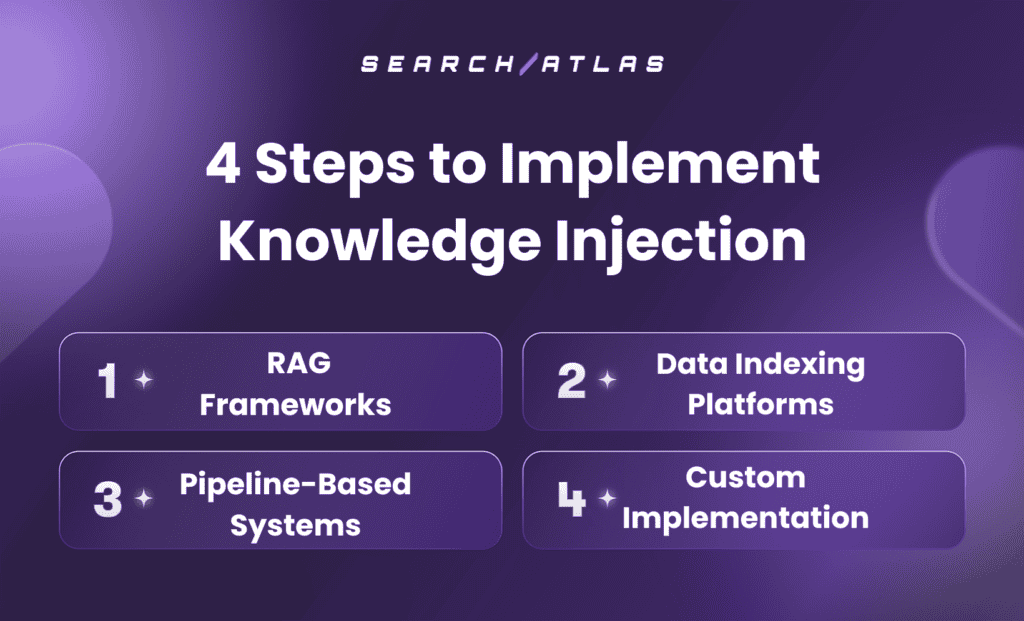
Knowledge injection is implemented by connecting external knowledge sources to large language models through retrieval, indexing, pipelines, and custom systems. This process gives AI systems access to current, domain-specific, and verified information instead of relying only on pretrained model memory.
The 4 steps to implement knowledge injection are listed below.
- RAG Frameworks: Retrieval Integration Systems.
- Data Indexing Platforms: Vector-Based Knowledge Systems.
- Pipeline-Based Systems: Modular Knowledge Workflows.
- Custom Implementation: End-to-End Knowledge Systems.
1. RAG Frameworks: Retrieval Integration Systems
RAG Frameworks are retrieval integration systems that inject external knowledge into large language models during response generation. RAG connects a model to documents, databases, knowledge bases, websites, and enterprise content, then retrieves relevant context before the model answers. This framework keeps the model weights unchanged while giving the model access to current and domain-specific information.
RAG matters because LLMs have fixed training data and limited access to recent information. A model trained before a policy update, product launch, or regulatory change cannot answer accurately without external context. RAG solves this limitation by retrieving fresh information at inference time. This retrieval allows the model to answer based on updated knowledge instead of outdated memory.
RAG impacts accuracy, trust, and hallucination reduction. The model receives relevant context before generation, which reduces unsupported claims and improves factual grounding. RAG systems cite retrieved documents, which increases explainability and auditability. This impact matters for healthcare, finance, legal, customer support, and enterprise search systems, where answers need source traceability.
RAG implementation starts with a knowledge base. The knowledge base contains the external information the model needs to access. This information includes PDFs, help center articles, product documentation, internal policies, databases, technical guides, call transcripts, and web pages. The knowledge base needs clean, complete, and current content because retrieval quality depends on source quality.
RAG implementation requires document ingestion. Document ingestion loads raw content into the system and prepares it for processing. The ingestion stage extracts text, removes boilerplate, detects language, handles formatting, and preserves metadata. Metadata includes document title, source URL, author, publication date, access permission, product category, and content type. This metadata improves filtering and source control during retrieval.
RAG implementation requires chunking. Chunking divides large documents into smaller passages to enable efficient retrieval of search results. Good chunking keeps each passage semantically complete. A chunk that is too large includes irrelevant information and weakens retrieval precision. A chunk that is too small loses context and weakens answer quality. Many RAG systems use chunks between 256 and 512 tokens, with overlap between related sections.
RAG implementation requires embeddings. Embeddings convert text chunks into numerical vectors that represent meaning. The embedding model creates vectors for both stored chunks and user queries. The system compares these vectors to identify semantically similar content. This semantic search finds relevant passages even when the user uses different wording than the document.
RAG implementation requires a vector database. The vector database stores embeddings and metadata for fast similarity search. Tools (Milvus, Pinecone, Qdrant, Weaviate, and FAISS store) these vectors and retrieve matching chunks within milliseconds. The vector database acts as the external memory layer for the RAG system.
RAG implementation requires retrieval logic. The retriever converts the user query into an embedding, searches the vector database, and returns top matching chunks. Advanced retrievers combine semantic search with lexical search to improve precision. Semantic search matches meaning, while lexical search matches exact terms. Hybrid retrieval combines both methods and reduces missed results.
RAG implementation requires reranking. Reranking takes the initial retrieved chunks and reorders them based on deeper relevance scoring. A reranker or cross-encoder compares the query with each chunk directly. This step improves precision because the most useful context appears first. Reranking matters when the first retrieval stage returns many partially relevant documents.
RAG implementation requires prompt augmentation. Prompt augmentation combines the user query with the retrieved context and sends the combined prompt to the model. This prompt often includes instructions, source passages, metadata, and answer rules. The model then generates an answer grounded in the retrieved information.
RAG implementation requires evaluation. Evaluation measures retrieval quality and answer quality. Retrieval metrics include Recall at K, Precision at K, Mean Reciprocal Rank, and hit rate. Answer metrics include factual accuracy, citation accuracy, completeness, refusal quality, and hallucination rate. Continuous evaluation shows whether the system retrieves the right content and answers correctly.
RAG systems fail when retrieval returns irrelevant context. Irrelevant retrieval causes the model to generate misleading answers from weak evidence. Poor embeddings, weak metadata, outdated content, and vague user queries create this failure. Reranking, filtering, query rewriting, and better chunking reduce this risk.
RAG systems fail when the knowledge base becomes stale. An outdated index injects old information into new answers. Scheduled reindexing, incremental indexing, and event-driven updates reduce staleness. Fast-changing domains need daily, hourly, or event-based updates.
A practical insight for RAG implementation is to start with one high-value knowledge domain and test retrieval before scaling. Strong RAG performance comes from clean documents, meaningful chunks, accurate metadata, and measured retrieval quality. The model matters, but the retrieval pipeline often determines answer quality.
2. Data Indexing Platforms: Vector-Based Knowledge Systems
Data Indexing Platforms are vector-based knowledge systems that convert raw content into searchable, structured, and retrievable knowledge. These platforms create the foundation for knowledge injection by turning documents, files, records, and media into indexed representations. The index allows AI systems to find relevant knowledge quickly and inject that knowledge into model workflows.
Data indexing matters because AI systems cannot use scattered enterprise information without structure. Organizations store knowledge across PDFs, spreadsheets, emails, CRM records, support tickets, wikis, slides, technical drawings, and legacy files. These sources often contain valuable information, but they remain difficult for models to search directly. Indexing platforms solve this problem by converting diverse formats into standardized, searchable content.
Data indexing impacts speed, accuracy, and scalability. A strong index changes search from slow document browsing to millisecond retrieval. This speed allows AI applications to answer questions quickly and consistently. Indexing improves accuracy because the model receives only relevant chunks instead of entire documents. Indexing improves scalability because the system handles millions of documents without loading full archives into the model context.
Data indexing implementation starts with the source connection. The platform connects to data sources (Google Drive, SharePoint, Confluence, Notion, Salesforce, Zendesk, databases, S3 buckets, local folders, and web crawlers). The connector needs to preserve permissions and metadata. Permission handling matters because AI systems do not retrieve content that a user lacks permission to access.
Data indexing implementation requires format conversion. Indexing platforms convert file formats into text or structured representations. These formats include Word documents, PDFs, emails, Excel files, PowerPoint files, scanned documents, HTML pages, JSON files, CSV files, and image-based documents processed with OCR. Standardized conversion ensures that downstream systems process content consistently.
Data indexing implementation requires cleaning and normalization. Cleaning removes duplicate text, navigation content, headers, footers, broken formatting, irrelevant boilerplate, and extraction artifacts. Normalization standardizes dates, units, casing, encoding, and document structure. This stage matters because noisy content creates noisy embeddings and weak retrieval results.
Data indexing implementation requires intelligent chunking. Chunking platforms divide documents into meaningful units based on headings, paragraphs, tables, sections, and semantic boundaries. A 200-page technical document does not work well as one retrieval object. The system needs smaller chunks that preserve meaning. Parent-child chunking improves this process by retrieving small chunks while passing larger parent sections into the model for context.
Data indexing implementation requires embedding generation. The platform sends each chunk to an embedding model and stores the resulting vector. The embedding model choice affects retrieval accuracy. A general embedding model works for broad documents, while a domain-specific embedding model performs better for medical, legal, scientific, or technical content. The embedding dimension, cost, speed, and language coverage influence platform design.
Data indexing implementation requires vector storage. The platform stores embeddings, chunk text, metadata, and source links inside a vector database or search index. The storage system needs fast similarity search, filtering, access control, and update handling. Vector search returns semantically similar chunks, while metadata filters narrow results by source, date, team, product, region, or permission.
Data indexing implementation requires incremental updates. Full reindexing becomes expensive when data changes frequently. Incremental indexing detects changed files, deleted files, new documents, and updated records. The system then updates only affected chunks and embeddings. Event-driven indexing uses file changes, database streams, or message queues to keep the index current.
Data indexing implementation requires observability. Observability tracks ingestion status, parsing errors, chunk counts, embedding latency, failed files, duplicate content, stale indexes, and retrieval patterns. Data lineage shows which source produced each chunk and which chunk influenced each answer. This traceability matters for debugging, compliance, and quality control.
Data indexing platforms address data silos. Data silos isolate knowledge across departments, systems, and formats. Indexing platforms unify these sources into a common retrieval layer. This unified index lets AI systems answer questions across multiple sources without forcing employees to know where information lives.
Data indexing platforms address unstructured data problems. Unstructured content represents a large share of enterprise knowledge. Emails, support threads, meeting notes, PDFs, and documents contain valuable context, but traditional databases cannot query them easily. Indexing platforms use NLP, OCR, embeddings, and metadata extraction to make this content searchable.
Data indexing platforms improve security. The system sends only relevant chunks to the model, not full document archives. This targeted retrieval reduces exposure. Strong indexing platforms preserve source permissions, apply role-based access controls, and log which chunks entered each response. These controls reduce data leakage risk and improve audit readiness.
Data indexing platforms fail when chunking, embeddings, or permissions break. Poor chunking loses context. Weak embeddings retrieve irrelevant material. Missing access controls expose sensitive data. Stale indexing returns outdated answers. Strong indexing requires continuous monitoring, refresh workflows, and quality checks.
A practical insight for data indexing is to treat the index as a product, not a one-time setup. The index needs maintenance, quality checks, permission audits, and refresh rules. Knowledge injection performs well when the index reflects clean, current, and well-governed knowledge.
3. Pipeline-Based Systems: Modular Knowledge Workflows
Pipeline-Based Systems are modular knowledge workflows that move data through repeatable stages from ingestion to retrieval and generation. These systems break knowledge injection into reusable components. Each component handles one task (loading files, parsing text, extracting entities, generating embeddings, enriching metadata, indexing chunks, retrieving context, or producing answers).
Pipeline-based systems matter because knowledge injection involves many dependent steps. A single RAG application needs ingestion, cleaning, chunking, embedding, storage, retrieval, reranking, prompt construction, generation, and evaluation. Manual handling creates inconsistency and slows updates. Modular pipelines automate these steps and make knowledge injection repeatable across teams, sources, and use cases.
Pipeline-based systems impact reliability, maintainability, and scale. A modular pipeline allows teams to change one component without rebuilding the entire system. A parser change without replacing the vector database. An embedding model change without rewriting the ingestion layer. A reranker improves retrieval without altering source connectors. This modularity reduces development time and makes quality improvements easier.
Pipeline-based implementation starts with raw data sources. These sources include local files, cloud folders, enterprise systems, web pages, data warehouses, APIs, audio files, video transcripts, and collaboration platforms. The pipeline needs source-specific connectors that collect data safely and preserve metadata.
Pipeline-based implementation requires extraction. Extraction retrieves text, tables, images, metadata, and structural information from raw sources. A PDF parser extracts paragraphs and tables. An OCR tool extracts text from scanned documents. A web parser extracts headings and body content. A transcript tool converts audio or video into text. Extraction quality matters because downstream components depend on clean inputs.
Pipeline-based implementation requires parsing. Parsing identifies document structure and content boundaries. The parser detects headings, lists, sections, footnotes, captions, table cells, and references. Structure-aware parsing improves chunking because the system understands how content sections relate to each other. This step prevents arbitrary splits that damage meaning.
Pipeline-based implementation requires enrichment. Enrichment adds semantic value to content. This stage extracts entities, classifies topics, summarizes sections, tags products, identifies sensitive data, detects language, applies redaction, or maps content to taxonomies. Enrichment makes retrieval smarter because the system searches by meaning, entity, metadata, and intent.
Pipeline-based implementation requires chunking and embedding. The pipeline divides enriched content into chunks and sends those chunks to an embedding model. Chunking strategies vary by content type. General chunks work for simple documents. Parent-child chunks work for long, structured documents. Question-answer chunks work for support and FAQ content. Code-aware chunks work for repositories and technical documentation.
Pipeline-based implementation requires loading and indexing. The system writes vectors, text, metadata, and source references into a knowledge base. This knowledge base includes vector stores, search engines, graph databases, relational databases, or hybrid systems. The index needs to handle updates, deletes, duplicate detection, and access controls.
Pipeline-based implementation requires orchestration. Orchestration tools schedule, run, monitor, and retry pipeline tasks. Apache Airflow, Prefect, Dagster, Kubeflow, and managed workflow tools coordinate these steps. Orchestration matters because knowledge injection pipelines often contain many dependencies. One failed parser or broken connector prevents fresh knowledge from reaching the model.
Pipeline-based implementation requires retrieval and answer workflows. A query pipeline converts the user query into a vector, retrieves relevant chunks, filters results, reranks candidates, constructs the prompt, and sends context to the model. This query-time pipeline needs low latency because users expect fast responses. Batch pipelines run slower, but query pipelines need speed and reliability.
Pipeline-based implementation requires evaluation and feedback loops. Evaluation checks whether retrieval returns useful chunks and whether generated answers remain accurate. Feedback loops collect failed searches, unanswered questions, user ratings, hallucination reports, and missing-document signals. These signals guide new indexing, better chunking, and updated data sources.
Pipeline-based systems use modular AI components. A component parse, summarize, classify, embed, rerank, redact, translate, or validate. This component design makes the system reusable. The same entity extraction component enriches support tickets, product documents, and policy files. The same reranker improves multiple retrieval applications.
Pipeline-based systems use governance controls. Governance defines which sources enter the pipeline, which data needs redaction, which users access which chunks, and which outputs require human approval. This control matters for regulated industries and internal enterprise systems.
Pipeline-based systems fail when pipelines drift or break silently. Data drift changes content patterns and reduces retrieval accuracy. Corrupted files break parsers. Outdated embeddings reduce semantic search quality. Missing metadata weakens filtering. Strong pipelines use validation, alerts, lineage, tests, and scheduled reprocessing.
A practical insight for pipeline-based systems is to separate offline processing from online retrieval. Offline pipelines handle ingestion, parsing, enrichment, chunking, embedding, and indexing. Online pipelines handle query embedding, retrieval, reranking, prompt construction, and generation. This separation keeps systems efficient, testable, and easier to scale.
4. Custom Implementation: End-to-End Knowledge Systems
Custom Implementation creates end-to-end knowledge systems that match a specific organization, domain, workflow, and risk profile. These systems combine retrieval, indexing, pipelines, governance, user interfaces, evaluation, and human oversight into one knowledge injection architecture. Custom implementation goes beyond plug-and-play RAG because it adapts every layer to business needs.
Custom implementation matters because standard knowledge systems often fail in complex organizations. Generic tools rarely understand internal terminology, permission structures, workflow dependencies, regulatory requirements, and domain-specific priorities. Custom systems solve this problem by designing knowledge injection around the actual environment where the AI operates.
Custom implementation impacts accuracy, adoption, and operational control. A custom system retrieves the right knowledge, follows business rules, respects permissions, and presents answers in formats users trust. This impact increases adoption because teams see responses that reflect their language, process, and standards. Custom systems become more reliable because the organization controls how knowledge enters and influences outputs.
Custom implementation starts with a knowledge audit. The audit identifies existing knowledge assets, source systems, high-value workflows, content owners, data quality issues, permission models, and business goals. This step defines what knowledge needs to be injected and which problems the system needs to solve. The audit prevents teams from building a retrieval system around incomplete or low-value data.
Custom implementation requires knowledge mapping. Knowledge mapping defines entities, relationships, taxonomies, and workflows. A custom map connects products to features, policies to teams, clients to requirements, and documents to decision processes. This map becomes the semantic foundation of the system. It tells the AI how the organization thinks, not just what documents exist.
Custom implementation requires an architecture design. Architectural design defines the Data Layer, Transformation Layer, Retrieval Layer, and Generation Layer. The Data Layer stores and governs sources. The Transformation Layer processes and embeds knowledge. The Retrieval Layer selects context. The Generation Layer produces grounded answers. A custom architecture aligns these layers with business constraints.
Custom implementation requires technology selection. Teams choose vector databases, search engines, embedding models, LLM providers, orchestration tools, connectors, metadata stores, and evaluation platforms. The best stack depends on latency needs, cost limits, security requirements, data volume, and domain complexity. A legal research system differs from a customer support system because the accuracy and citation requirements differ.
Custom implementation requires governance. Governance controls how knowledge enters the system, who approves content, which data needs masking, which sources are trusted, and which actions require human review. Governance ensures the model does not use outdated, unauthorized, or unverified information. Strong governance matters for compliance, customer trust, and internal accountability.
Custom implementation requires human oversight. Human experts validate sources, review answer quality, define business rules, and approve sensitive knowledge changes. Domain experts make the system smarter because they understand edge cases, terminology, and decision logic. Human review prevents important knowledge from being deprioritized or misinterpreted by automated systems.
Custom implementation requires user experience design. A knowledge injection system succeeds only if people use it. The interface needs clear answers, visible sources, feedback options, search controls, and confidence signals. Users need to understand where the answer came from and how to verify it. Strong UX increases trust and adoption.
Custom implementation requires evaluation. Evaluation measures retrieval accuracy, answer correctness, hallucination rate, citation quality, latency, user satisfaction, and compliance performance. Custom systems need benchmark questions that reflect real user workflows. Generic tests miss domain-specific failures. A finance system needs finance questions. A healthcare system needs clinical questions. A product support system needs real support questions.
Custom implementation requires continuous improvement. The system needs to learn from failed queries, missing answers, stale documents, user feedback, and new knowledge sources. Continuous improvement updates indexes, refines chunking, improves prompts, expands taxonomies, and strengthens evaluation sets. This process keeps the knowledge injection system aligned with changing business needs.
Custom implementation differs from standard systems through adaptability. A custom system adapts to user behavior, business priorities, and domain rules. It prioritizes certain sources, enforces specialized answer formats, applies industry-specific compliance rules, and routes different queries to different retrieval methods. This adaptability makes the system more useful than a generic knowledge search tool.
Custom implementation creates strategic value. A well-built system turns proprietary knowledge into an AI-accessible asset. The organization keeps its expertise structured, searchable, reusable, and governed. This creates a defensible advantage because competitors cannot easily replicate internal knowledge, workflows, and expert validation.
Custom implementation fails when teams skip governance or evaluation. A system with many connectors but poor source quality produces unreliable answers. A system with strong retrieval but weak permissions creates a security risk. A system with polished UX but no evaluation hides errors. End-to-end implementation requires every layer to work together.
A practical insight for custom implementation is to build around one business-critical workflow first. Start with a narrow use case, define trusted sources, build the pipeline, test retrieval, measure answers, and add governance before expanding. Custom knowledge injection succeeds when it grows from a validated workflow into a broader system.
How Can You Optimize Knowledge Injection Performance?
Knowledge injection performance improves by controlling knowledge quality, retrieval precision, content structure, and update frequency across AI systems. LLMs underperform on specialized knowledge because they rely on static training data, broad internet patterns, and limited domain context. Optimized knowledge injection gives models cleaner facts, stronger context, and better retrieval paths, which improves accuracy and reduces hallucinations.
Knowledge injection performance depends on balance. Too little knowledge creates weak specialization, while too much knowledge creates noise, forgetting, or memory collapse. Memory collapse happens when excessive knowledge injection reduces retention beyond a critical threshold. This failure shows why knowledge injection needs structured data selection, varied presentation, and measured injection frequency.
Search Atlas optimizes knowledge injection performance by making brand and website information easier for search engines and large language models to ingest, interpret, and reuse. OTTO SEO improves technical structure, internal links, schema, and indexability, which strengthens machine-readable context across the site. Content Genius improves semantic coverage, entity clarity, and topical depth, which gives AI systems cleaner information to retrieve and cite.
RAG improves knowledge injection performance by retrieving relevant external knowledge during inference. RAG connects models to current documents, vector databases, and trusted sources instead of relying only on model memory. This retrieval method improves factual accuracy because the model receives fresh context before generating an answer. RAG performs best with strong chunking, metadata filters, reranking, and updated knowledge bases.
Fine-tuning improves knowledge injection performance when the goal involves tone, format, or stable domain behavior. Fine-tuning adjusts model weights, which makes outputs more consistent for structured tasks. This method works poorly for fast-changing facts because every update requires retraining. Fine-tuning creates risk when too many facts enter the model at once, which increases catastrophic forgetting.
Prompt distillation improves knowledge injection performance by transferring prompt-based knowledge into a smaller adapted model. This method uses a teacher model to guide a student model, often through LoRA. Prompt distillation reduces latency because the model internalizes useful knowledge instead of retrieving every fact at runtime. This approach works best when the injected knowledge remains stable.
Knowledge injection performance improves when knowledge appears in varied formats. Repetitive templates weaken retention because models memorize token patterns instead of learning meaning. Paraphrases, question-answer pairs, examples, and natural explanations improve generalization. Five-shot prompting gives consistent gains because the model receives clear examples before handling the final query.
Search Atlas strengthens this process by improving how brand knowledge appears across pages. Content Genius identifies missing entities, weak topical coverage, and unclear semantic relationships. OTTO SEO fixes technical blockers that prevent crawlers and AI retrieval systems from accessing structured information. Together, these tools make website knowledge cleaner, more consistent, and easier for AI systems to select.
Knowledge injection performance requires measurement. Performance-by-Data AUC, retrieval hit rate, factual accuracy, hallucination rate, citation accuracy, and answer usefulness reveal whether injection improves the system. Strong measurement prevents teams from adding knowledge blindly. The best optimization strategy tests smaller knowledge sets, measures retention, and expands only when performance improves.
Knowledge injection performance ultimately improves through clean sources, controlled injection volume, strong retrieval infrastructure, and continuous validation. Search Atlas adds value by turning website content into structured, semantically rich, and technically accessible knowledge. This makes the brand easier for LLMs, AI search systems, and traditional search engines to understand and reference.
How to Deploy Knowledge Injection Systems in Production?
Knowledge injection systems are deployed in production through phased rollout, infrastructure integration, AI workflow automation, user adoption, and continuous evaluation. This deployment process matters because production systems need reliable knowledge capture, secure retrieval, current information, and measurable adoption across real organizational workflows.
Knowledge injection systems are deployed by starting with a knowledge inventory and assessment. This phase identifies critical knowledge holders, important workflows, high-risk knowledge gaps, and source systems that contain operational knowledge. A knowledge map then defines what information needs to be captured, where it lives, and which teams depend on it.
Knowledge injection systems are deployed by testing one high-value use case first. A pilot captures one critical skill, one expert workflow, or one domain-specific knowledge area through SOPs, documents, video walkthroughs, and structured examples. This pilot reduces risk because teams test retrieval quality, workflow fit, and user adoption before scaling.
Knowledge injection systems are deployed by selecting the right technology stack. The stack includes a Knowledge Base Management System, vector database, content management system, collaboration tools, AI search, APIs, and retrieval pipelines. These systems centralize procedures, manuals, best practices, safety protocols, and internal documentation for controlled access.
Knowledge injection systems are deployed by integrating with existing tools and workflows. Integrations connect ERP, PLM, MES, CRM, sensors, ticketing tools, document repositories, and collaboration platforms. This connection matters because production systems need the current operational context rather than isolated documentation. Workflows are published through APIs, MCP servers, or custom connectors.
Knowledge injection systems are deployed by using AI to capture, organize, and retrieve knowledge. AI detects FAQs, summarizes expert input, generates SOPs, classifies documents, extracts entities, and routes questions to trusted sources. RAG remains the practical production choice for frequent updates because it retrieves current information without retraining the model.
Knowledge injection systems are deployed by designing for adoption and culture. Employees need training, incentives, and simple contribution workflows to use the system consistently. Adoption improves when frontline workers contribute knowledge directly and receive answers inside the tools they already use. Recognition, feedback loops, and leadership commitment keep knowledge sharing active.
Knowledge injection systems deploy across global and remote operations through multilingual access, offline availability, and location-aware retrieval. These features ensure critical knowledge remains usable across production lines, field teams, and low-connectivity environments. Multilingual content and offline sync require governance so translated and cached content remains accurate.
Knowledge injection systems deploy with monitoring and iteration. Teams track time-to-competency, incident resolution time, search success, usage quality, answer accuracy, and content freshness. These metrics reveal whether the system improves work or creates new friction. Continuous updates retire stale content, refresh indexes, and refine workflows.
Knowledge injection systems create a strong ROI when they prevent institutional knowledge loss. Losing one experienced technician costs $80,000 to $200,000 in lost productivity, emergency repairs, and onboarding expenses. A KM program often costs $30,000 to $80,000 to launch, with $5,000–$10,000 in annual maintenance. Preventing knowledge loss yields ROI above 400% annually.
Knowledge injection systems fail when teams try to capture everything at once. Production deployment works better when teams prioritize high-value knowledge, involve experts early, and measure usage continuously. The practical deployment insight is simple: start with one urgent workflow, prove value, then expand the system with governance, integrations, and feedback loops.
What monitoring systems track knowledge injection performance?
Monitoring systems track knowledge injection performance by measuring accuracy, retention, retrieval quality, and AI-generated output consistency across tasks. These systems matter because knowledge injection changes model behavior, which requires continuous validation to prevent hallucinations, drift, and catastrophic forgetting in production environments.
Monitoring systems track knowledge injection performance by evaluating generated answers with LLM-based grading and rule-based matching. LLM-as-a-judge grading uses a secondary model to review answers, justify reasoning, and assign binary correctness labels. This evaluation method captures semantic correctness beyond exact wording, which improves evaluation coverage for complex answers.
Monitoring systems track knowledge injection performance by comparing generated responses against ground-truth answers using substring matching. Substring match grading detects whether expected answers appear inside generated outputs after normalization. This method produces stricter scores because it requires lexical overlap, which explains why substring accuracy often appears lower than LLM-based grading.
Monitoring systems track knowledge injection performance by measuring the gap between semantic grading and lexical grading. This gap reveals how models express correct knowledge in varied language forms. Instruction-tuned models and RAG pipelines often produce verbose answers, which increases the difference between semantic correctness and exact-match scoring.
Monitoring systems track knowledge injection performance by using benchmark datasets to evaluate generalization and retention. The MMLU benchmark measures factual knowledge across domains (biology, chemistry, astronomy, and anatomy). The Current Event task evaluates how well injected knowledge reflects recent information that did not exist during pretraining.
Monitoring systems track knowledge injection performance by analyzing catastrophic forgetting through proxy metrics. MMLU-Pro evaluates whether new knowledge injection degrades existing reasoning and general knowledge. Performance drops on these benchmarks indicate that injected knowledge overwrote existing capabilities instead of extending them.
Monitoring systems track knowledge injection performance through core metrics. Knowledge score measures the percentage of correct answers across evaluation sets. Relative accuracy gain measures improvement compared to the base model. Retrieval accuracy, citation accuracy, hallucination rate, and response consistency provide additional visibility into system behavior.
Monitoring systems track knowledge injection performance by analyzing retrieval pipelines in RAG systems. Retrieval hit rate measures how often relevant documents appear in the top results. Context precision evaluates whether retrieved chunks contain useful information. Reranking quality determines whether the system selects the best possible context before generation.
Monitoring systems track knowledge injection performance by analyzing trends across experiments. RAG consistently shows higher accuracy in knowledge-intensive tasks because it retrieves fresh information during inference. Five-shot prompting produces consistent improvements across models because examples clarify expected behavior. Paraphrase-based data augmentation improves fine-tuning performance because varied phrasing strengthens knowledge retention.
Monitoring systems track knowledge injection performance using observability platforms. Systems (LangKit) evaluate factual accuracy, detect hallucinations, track citations, and identify contradictions across generated outputs. WhyLabs monitors data drift, performance changes, and model degradation over time through production metrics and alerts.
Monitoring systems track knowledge injection performance through experiment tracking and model comparison platforms. Weights & Biases records training runs, evaluation results, and metric comparisons across model versions. Monitaur evaluates robustness through adversarial testing, sanity checks, and controlled stress scenarios.
Monitoring systems track knowledge injection performance at the application level through AI visibility tools. Search Atlas LLM Visibility measures how brands appear across generative engines, which connects knowledge injection performance to real-world outcomes. This system identifies which sources influence AI-generated answers and reveals gaps in content coverage, entity clarity, and citation presence.
Monitoring systems track knowledge injection performance by combining evaluation metrics, benchmark testing, retrieval analysis, and production monitoring. This layered approach ensures that injected knowledge improves accuracy without degrading existing capabilities. The practical insight is to measure both correctness and behavior over time, because stable knowledge injection depends on continuous monitoring, not one-time evaluation.
What is the Future of Knowledge Injection in AI Systems?
The future of knowledge injection in AI systems is defined by intelligent, real-time, and connected knowledge layers that integrate directly into model behavior and decision workflows. This shift matters because AI performance depends on accurate, up-to-date, and context-aware knowledge rather than static training data. Knowledge injection evolves from isolated techniques into a continuous system that governs how AI retrieves, updates, and applies information across environments.
How do AI systems reshape the role of knowledge injection? AI systems reshape knowledge injection by requiring dynamic retrieval, structured context, and continuous validation before generating answers. Static knowledge fails because AI operates in environments where information changes rapidly. This requirement increases the importance of RAG, vector databases, and knowledge graphs because they ensure fresh and verifiable outputs. Organizations improve outcomes by building systems that inject knowledge at inference time instead of relying only on model training.
What future requirements will define knowledge injection in AI systems? Future knowledge injection requires real-time updates, scalable retrieval systems, and consistent knowledge representation across pipelines. These requirements matter because AI systems depend on freshness, accuracy, and consistency to maintain reliability. Systems integrate hybrid approaches that combine RAG, fine-tuning, and synthetic data augmentation to balance performance and stability. This evolution transforms knowledge injection into a continuous optimization layer rather than a one-time model update process.
What is the current state of knowledge injection in AI systems? The current state shows strong performance from RAG systems, mixed results from fine-tuning, and rapid growth in hybrid approaches. Many implementations remain sensitive to retrieval quality, chunking strategies, and data consistency. Knowledge injection improves performance but introduces risks (hallucinations, catastrophic forgetting, and instability) across tasks. Systems that rely only on parametric updates often struggle to maintain accuracy over time.
How will knowledge injection evolve in the next phase of AI systems? Knowledge injection evolves toward autonomous, self-improving systems that generate, validate, and refine their own knowledge inputs. Future systems rely on synthetic data generation, paraphrasing pipelines, and feedback loops to continuously expand knowledge coverage. Knowledge graphs and semantic layers provide structured relationships that improve reasoning and retrieval. This evolution enables AI systems to move from static responses to adaptive, context-aware decision-making.
What risks will shape the future of knowledge injection? Key risks include catastrophic forgetting, retrieval errors, inconsistent knowledge representation, and over-injection that leads to memory collapse. These risks matter because excessive or poorly structured knowledge reduces model reliability and accuracy. Systems mitigate risk through evaluation frameworks, monitoring pipelines, and controlled injection strategies that balance learning and retention. Continuous validation ensures that new knowledge strengthens performance without degrading existing capabilities.
The future of knowledge injection in AI systems favors architectures that combine real-time retrieval, structured knowledge layers, and continuous evaluation. AI systems reward implementations that maintain accuracy, adapt to new information, and preserve existing knowledge. Platforms (Search Atlas) reinforce this direction by tracking how knowledge appears in AI-generated outputs and optimizing content for consistent retrieval and citation across generative search environments.