Multi-location local SEO coordinates search visibility, map rankings, and citation accuracy across 50 or more physical storefronts from a centralized data architecture. Brands that manage dozens or hundreds of units face duplicate map pins, conflicting directory records, and dispersed authority across regional markets.
A structured citation distribution model resolves these inconsistencies. By pairing centralized location management with local landing pages and spatial rank tracking, multi-unit brands protect their local 3-pack visibility in every target market.
Key Takeaways
- Centralize citation data into a single source of truth to distribute identical Name, Address, and Phone records across Google, Apple, Bing, and data aggregators.
- Suppress duplicate listings proactively, because algorithmic filters demote storefronts that exhibit split citation signals or conflicting map coordinates.
- Structure local landing pages under a nested state-city-store URL taxonomy to funnel domain equity directly to individual branch locations.
- Implement disambiguated JSON-LD
LocalBusinessschema with persistent@idURIs and explicitparentOrganizationrelationships. - Monitor localized visibility using geo-grid rank tracking, tracking proximity falloff from multiple coordinate points rather than a single zip code centroid.
TL;DR
What is multi-location local SEO?
Multi-location local SEO is the practice of standardizing business data, landing pages, and external citations for brands operating multiple storefronts to secure top positions in Google local pack and map results.
Why do citations break past 50 locations?
Citations fragment because secondary directories source data from disparate public registries, scraped directories, and legacy telephone records. When brands expand, unchecked third-party directories generate conflicting phone numbers, outdated suite addresses, and duplicate listings that dilute local search confidence.
What is the most effective URL structure for multi-location brands?
The most reliable structure is a nested subdirectory hierarchy: /locations/[state]/[city]/[store-id]/. This framework allows search engine crawlers to discover all storefront URLs through static HTML index pages without JavaScript bottlenecks.
Citation Health & Local Pack Vulnerability Scorecard
Evaluate citation consistency, directory distribution gaps, and annual revenue leakage across multi-unit storefront networks.
Occasional re-verification or address review flags
Synchronize Google Business Profiles, directories, and geo-grid tracking with automated duplicate suppression.
Core Citation Architecture for Multi-Unit Brands
Multi-location citation architecture is a centralized data model that distributes structured business records across search engines, map applications, and commercial directories. The system synchronizes Name, Address, Phone, and coordinates through API pipelines and publisher network feeds. This data flow eliminates fragmented location records and stabilizes localized rank positions across regional store footprints.
Managing 50 or more locations manually creates severe data drift. When a store changes hours, updates a suite number, or implements a tracking number, third-party scrapers spread outdated variations across the web. A modern citation architecture locks core fields at the source, preventing external databases from overwriting verified business attributes.
[ Central Brand Master Record ]
               |
  +------------+------------+
  |                         |
[ Tier 1 Direct APIs ]    [ Data Aggregators ]
  - Google Business Profile - Data Axle
  - Apple Business Connect  - Neustar Localeze
  - Bing Places             - Foursquare
  - Yelp Fusion
               |
  +------------+------------+
  |
[ Secondary Publisher Ecosystem ]
  - Industry Portals (Healthgrades, Avvo, Edmunds)
  - Navigation Engines (TomTom, HERE, Garmin)
  - Regional & Local Chamber Directories
Primary Publisher Networks and Aggregator Pipelines
Primary publisher networks are core distribution channels that syndicate verified business attributes directly to Tier 1 map ecosystems and major commercial databases. The pipeline delivers master records to Google Business Profile, Apple Business Connect, Bing Places, and data aggregators including Data Axle and Localeze. This distribution establishes authoritative entity consensus across independent navigation platforms.
Data aggregators function as the foundational wholesale suppliers of business data. Secondary directories, mobile applications, and in-car navigation systems query these databases periodically to refresh their local index. When an aggregator holds inaccurate NAP records, those errors propagate to hundreds of downstream directories.
| Distribution Tier | Primary Networks | Update Frequency | Algorithmic Impact |
|---|---|---|---|
| Tier 1 Direct | Google Business Profile, Apple Business Connect, Bing Places | Real-time API sync | Direct 3-pack ranking signal |
| Tier 1 Social / Review | Yelp, Facebook Places, TripAdvisor | Weekly direct push | High review consensus weight |
| Data Aggregators | Data Axle, Neustar Localeze, Foursquare | Monthly batch feeds | Long-term web ecosystem consistency |
| Tier 2 Directories | YellowPages, Superpages, Citysearch, Manta | Bi-weekly API sync | NAP corroboration baseline |
Directory Distribution and NAP Consistency Protocols
Directory distribution protocol is an automated governance framework that enforces uniform location data across secondary directories and industry platforms. The protocol queries directory endpoints, compares active attributes against the master record, and pushes programmatic updates to resolve discrepancies. This synchronization prevents algorithmic confidence loss across geographic proximity filters.
Search engine ranking algorithms compare data points across hundreds of websites to verify a physical entity's authenticity. If a storefront lists a call tracking number on a local chamber site and a landline on Yelp, search engines lower their confidence score for that location. High-performing multi-unit brands deploy centralized systems like Search Atlas Local SEO to maintain exact character-for-character consistency across all public touchpoints.
Duplicate Listing Detection and Suppression Workflows
Duplicate listing suppression is a remediation procedure that identifies and merges redundant map markers for identical physical storefronts. The workflow scans coordinate clusters, flags matching phone numbers or addresses, and submits removal tickets through publisher interfaces. This consolidation redirects accumulated review authority and link equity into the canonical listing.
Duplicates emerge from user check-ins, automated directory imports, and past address relocations. When two listings exist for one store, customer reviews split between both profiles, and search algorithms divide ranking signals. The team must identify duplicates by querying search engines with street addresses and raw phone strings, then mark redundant listings as permanently closed or submit official merge requests through Google Business Profile support.
Duplicate Suppression Workflow:
1. Scan 500-meter radius around verified latitude/longitude coordinates.
2. Flag records sharing street number, phone digits, or matching brand stems.
3. Determine primary canonical profile based on verification age and review volume.
4. Execute API redirect or submit merge request through publisher dashboard.
5. Verify downstream suppression across secondary citation directories.
Local Landing Page URL Structure and Taxonomy
Local landing page taxonomy is a hierarchical URL architecture that organizes regional store entities within a unified web directory. The structure nests location pages beneath state and city parent hubs to funnel domain authority through regional navigation paths. This organization yields clean crawl paths for search engine spiders while preserving localized relevance signals.
Flat URL structures such as /location-dallas-uptown/ dilute internal linking models and make regional reporting difficult. A nested taxonomy allows search crawlers to understand geographic relationships between stores, municipal markets, and statewide territories.
Canonical Multi-Location Directory Taxonomy:
https://example.com/locations/                      (National Directory Hub)
https://example.com/locations/tx/                   (State Level Hub)
https://example.com/locations/tx/dallas/            (City Level Hub)
https://example.com/locations/tx/dallas/uptown/     (Individual Storefront Page)
Store Locator Navigation and Crawl Efficiency
Store locator navigation is an HTML link structure that allows web crawlers to access every location URL without reliance on JavaScript execution. The framework generates static state-level index pages that distribute internal link equity directly to individual store profiles. This architecture secures complete search indexation for large networks exceeding 50 storefronts.
Many enterprise brands implement interactive map widgets that load location records via client-side AJAX calls. Search bots that fail to trigger user clicks or complex script routines will miss these deeper pages entirely. Providing a static HTML footer sitemap linking to state hubs guarantees that every single location receives consistent internal PageRank flow.
JSON-LD LocalBusiness Schema Standards
Multi-location JSON-LD schema is structured semantic markup that defines individual physical branches as distinct sub-organizations within a parent brand entity. The schema injects @type, @id, parentOrganization, geo coordinates, and opening hours directly into the page header. This machine-readable format enables search engines to associate regional web pages with verified Google Business Profile records.
Every location page must contain disambiguated schema that references its exact coordinates and primary corporate entity. The schema should use specific types such as AutoRepair, MedicalClinic, or Restaurant rather than generic LocalBusiness tags.
{
  "@context": "https://schema.org",
  "@graph": [
    {
      "@type": "MedicalClinic",
      "@id": "https://example.com/locations/tx/dallas/uptown/#location",
      "name": "Apex Health Dallas Uptown",
      "url": "https://example.com/locations/tx/dallas/uptown/",
      "telephone": "+1-214-555-0199",
      "priceRange": "$$",
      "address": {
        "@type": "PostalAddress",
        "streetAddress": "2800 McKinney Ave Suite 150",
        "addressLocality": "Dallas",
        "addressRegion": "TX",
        "postalCode": "75204",
        "addressCountry": "US"
      },
      "geo": {
        "@type": "GeoCoordinates",
        "latitude": 32.7981,
        "longitude": -96.8015
      },
      "openingHoursSpecification": [
        {
          "@type": "OpeningHoursSpecification",
          "dayOfWeek": ["Monday", "Tuesday", "Wednesday", "Thursday", "Friday"],
          "opens": "08:00",
          "closes": "18:00"
        }
      ],
      "parentOrganization": {
        "@type": "Organization",
        "@id": "https://example.com/#organization",
        "name": "Apex Health Systems",
        "url": "https://example.com"
      }
    }
  ]
}
Google Business Profile Bulk Verification and Management
Google Business Profile bulk verification is an enterprise authorization procedure that validates ten or more identical brand locations under a single administrative account. The procedure requires a corporate domain, a shared business category, and a structured spreadsheet upload to Google Location Manager. This authorization bypasses postcard delays and protects multiple storefronts against third-party hijacking.
Managing individual postcards for 50 locations takes months and causes operational bottlenecks. Bulk verification grants instant verification status to all existing and future storefronts published under the verified organization account.
Category Governance and Secondary Attribute Selection
Category governance is a standardized classification rule that aligns primary and secondary business categories across all brand storefronts. The rule mandates identical primary categories for equivalent units while assigning secondary attributes based on location-specific amenities. This alignment prevents category dilution and establishes baseline relevance across target service queries.
Primary categories represent the strongest relevance weight in Google local search algorithm. If 30 stores use "Optometrist" and 20 use "Eye Care Center", the brand divides its authority across keyword classes. Establish a corporate policy where every unit shares the identical primary category, adding secondary tags like "Contact Lens Supplier" or "Sunglasses Store" only when the facility offers those specific products on-site.
| Governance Element | Corporate Policy Requirement | Operational Purpose |
|---|---|---|
| Primary Category | Identical across all standard units | Maximizes category relevance consistency |
| Secondary Categories | Limited to verified on-site services (max 4-5) | Captures long-tail search intent without dilution |
| Location Name | Brand name only, zero keyword stuffing | Prevents algorithmic suspensions and profile penalties |
| Tracking Numbers | Primary = local landline; Secondary = tracking line | Preserves NAP consistency while capturing attribution |
Local Rank Measurement Across 50+ Storefronts
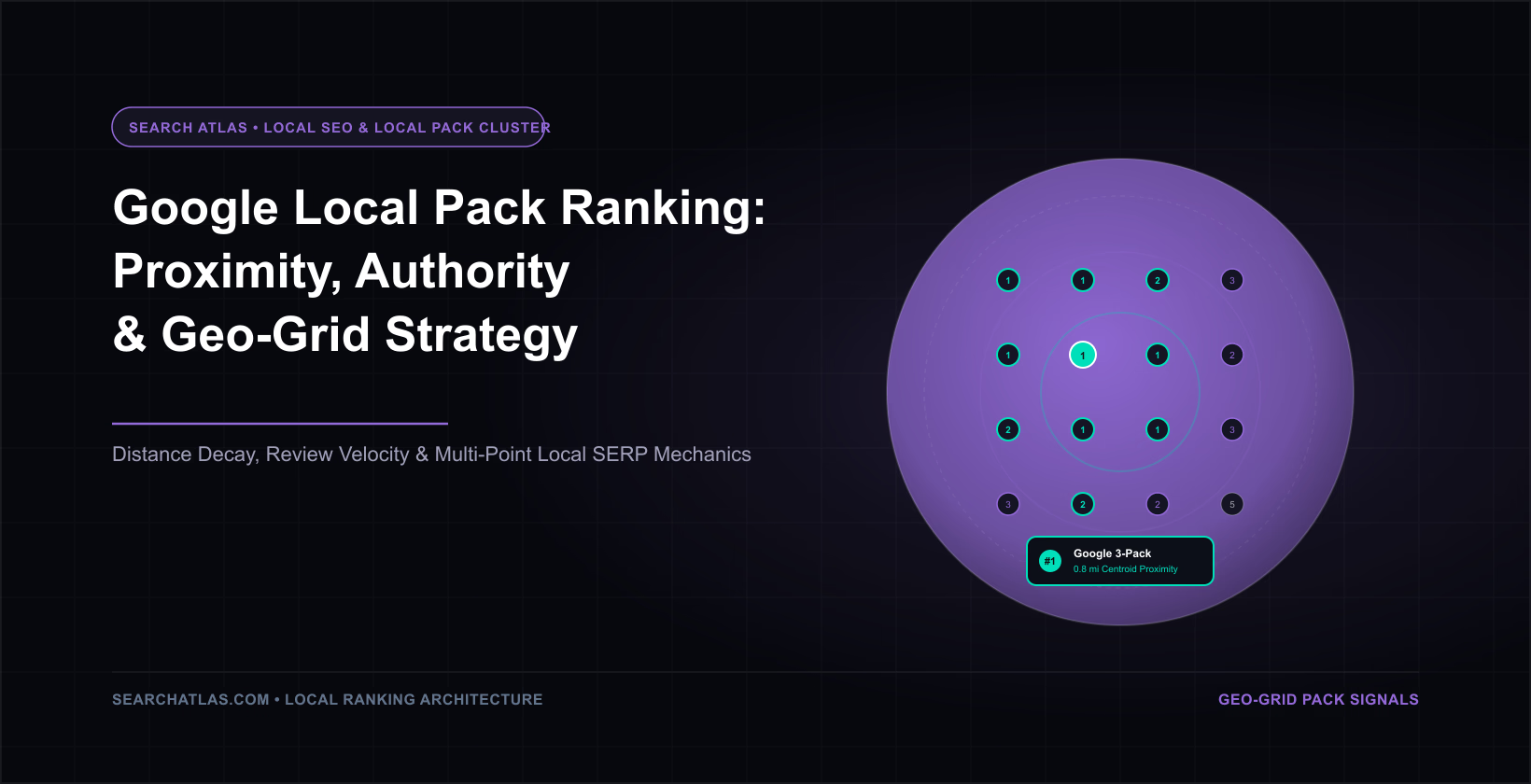
Geo-grid rank measurement is a spatial tracking method that records local pack visibility at coordinate-level increments across target service radii. The system queries search engine APIs from discrete latitude and longitude points to map ranking proximity falloff. This spatial telemetry reveals competitive boundaries and regional rank suppression across multi-city portfolios.
Traditional single-point rank checkers report rankings from a single geographic centroid, masking localized performance drop-offs. A store may rank #1 at its front door but fall to #8 just two miles away due to competitor proximity or citation inconsistencies.
Spatial Geo-Grid Scan (5x5 Matrix Example):
[ #12 ]   [ #9  ]   [ #6  ]   [ #8  ]   [ #14 ]
[ #8  ]   [ #3  ]   [ #2  ]   [ #4  ]   [ #10 ]
[ #5  ]   [ #2  ]   [ #1* ]   [ #2  ]   [ #7  ]  <-- Store Location (#1*)
[ #9  ]   [ #4  ]   [ #3  ]   [ #5  ]   [ #11 ]
[ #15 ]   [ #10 ]   [ #7  ]   [ #9  ]   [ #16 ]
Proximity Falloff and Grid Density Selection
Proximity falloff is an algorithmic decay rate that reduces a storefront ranking as the search user moves away from the physical address. The decay pattern reflects competitor density, centroid distance, and organic website authority within the local market. This metric dictates the required scan radius and node density for accurate local ranking audits.
In dense urban cores, a 5-mile radius scan produces skewed data because user search intent shifts within blocks. Urban stores require tight 1-mile to 3-mile grids with 500-meter spacing between tracking pins. Suburban and rural locations require wider 10-mile to 15-mile radiuses with larger spacing to capture true trade areas. Platforms evaluated in the Local Viking alternative analysis demonstrate how dynamic grid adjustments prevent false visibility reporting.
Platform Requirements for Multi-Location SEO
Multi-location local SEO software is a specialized enterprise platform that unifies listing distribution, review monitoring, and spatial rank tracking into a single dashboard. The software synchronizes data via direct API connections while monitoring coordinate-level grid performance across every managed unit. This platform reduces operational overhead and coordinates corporate strategy across regional marketing teams.
When selecting technology for 50 or more units, marketing leaders must choose between point solutions and all-in-one architectures. Our in-depth breakdown of SEO software for multi-location brands examines fee structures, listing lock capabilities, and API scalability across leading market platforms.
Search Atlas provides enterprise multi-location brands with end-to-end tooling that links Google Business Profile management, local citation distribution, and multi-point geo-grid tracking directly to comprehensive organic keyword data. This unified workflow prevents citation leakage and builds sustainable local pack leadership across regional and national footprints.