Multi-location SEO software is a platform that manages local search visibility across multiple business locations from one account, covering Google Business Profile (GBP) listings, local citations, reviews, location pages, geo-grid rank tracking, and reporting by location. The right platform keeps corporate standards intact while location managers handle day-to-day updates.
The guide is written for franchise systems, retail chains, healthcare groups, and multi-site service brands that have a corporate team plus location managers. The guide covers what the platform must do and how to test each requirement in a vendor demo. The tactics of running a local program live in the multi-location SEO strategy guide.
Disclosure: Search Atlas publishes this guide and is one of the platforms compared. Prices come from each vendor's official pricing page as checked in October 2026, with billing terms. G2 and Capterra ratings come from search listings of those sites and Trustpilot ratings from Trustpilot's pages, all as listed in October 2026.
What is SEO software for multi-location brands?
A multi-location SEO platform gives a brand one control point for the local search presence of every store, clinic, branch, or franchise unit. The platform holds the official location data, pushes that data to GBP and directories, collects reviews, tracks rankings by place, and reports results by location, region, or brand.
What are the types of multi-location SEO platforms?
Multi-location platforms fall into six types, and each type centers on a different job. Knowing a vendor's type explains the gaps that a demo exposes. The local citation services comparison covers the listing-focused vendors in more depth.
| Type | What it centers on | Example from this guide |
|---|---|---|
| All-in-one SEO platform with local modules | Local features inside a broader SEO, content, and AI visibility account | Search Atlas |
| Listing management platform | Location data distribution to publishers and directories | Yext, Uberall |
| Local marketing platform | Listings, social publishing, and reputation under one vendor | SOCi |
| Reputation platform | Review requests, replies, and customer feedback | Birdeye |
| Local SEO suite | Rank tracking, citations, audits, and review monitoring | BrightLocal |
| Local SEO module | Map rank tracking and listings inside a broader SEO account | Semrush Local |
How does a multi-location SEO platform differ from single-location local SEO tools?
Single-location local SEO tools manage one GBP and one set of rankings, while a multi-location platform adds shared data, role-based access, approval workflows, and rollup reporting. A single-location product has no concept of a franchisee who edits only one profile, or a regional manager who needs a view of twelve locations. The local SEO tools roundup ranks single products for smaller footprints.
Per-location pricing also changes the economics. Costs scale with the number of locations, so pricing structure becomes a selection criterion on its own.
What requirements should a multi-location SEO platform meet?
A multi-location SEO platform must meet seven requirements: location data, Google Business Profile management, local citations, reviews, location pages, rank and AI visibility tracking, and reporting with permissions. Each requirement below states what the platform must do, why it matters at scale, and how to test it live in a demo. Every test should run on the brand's own location data, because a prepared sample hides the gaps.
How should a platform govern location data?
The platform must hold one authoritative record of location data for every location and publish changes from that record. Location data is the set of facts about a place: name, address, phone number, hours, categories, and attributes.
Every other function, from GBP updates to citations, reads from this record, so a record that is editable in several places produces conflicts.
Demo tests:
- Ask the vendor to bulk edit holiday hours for 50 locations from a spreadsheet and show the result.
- Ask for the approval step: can a franchisee propose a change that corporate must approve?
- Request the audit trail for one location, showing who changed what and when.
- Ask how a change at the record level reaches each connected channel, and how failures are reported.
How should a platform manage Google Business Profiles at scale?
The platform must connect to Google Business Profile, import existing profiles in bulk, and apply edits across profiles under approval rules. A GBP is the listing that appears in Google Maps and local search for each physical location.
Google's Business Profile guidelines set the rules the platform has to respect. A business gets one profile per physical location. Chains keep one business name per country, unless the real-world name consistently varies or the location is a distinct sub-brand or department. Franchisees can use the underlying brand name when they are authorized, fully dedicated sellers. Google asks chains to keep names and categories consistent so customers can quickly identify the business. Google also offers bulk verification for businesses with 10 or more profiles, and service-area businesses are excluded.
A central record keeps names and categories consistent across profiles, and bulk verification saves effort only for qualifying chains. Search Atlas builds GBP Galactic around this requirement.
Demo tests:
- Connect a live Google account and import profiles in bulk.
- Edit categories and hours for a group of locations and check the change on Google.
- Ask how the platform treats a service-area business versus a storefront location.
- Ask whether posts and review replies publish automatically or wait for approval, and whether that setting differs by location.
- Ask for a profile health view that flags suspensions, missing fields, and unwanted edits.
How should a platform handle local citations?
The platform must distribute location data to the data aggregators and directories that feed local search, and keep those listings matching the official record. Local citations are mentions of a business name, address, and phone number on directories and other sites. Data aggregators are the companies that supply that data to multiple directories at once.
Coverage models differ. One group of vendors publishes to a wide directory network, and another group focuses on a short list of major platforms, so the directory count is a question for every vendor.
Demo tests:
- Ask for the exact list of aggregators and directories included, and which connect through a direct integration.
- Ask how duplicate listings are detected, and whether the platform suppresses them or only flags them.
- Change an address in the platform and ask how long the change takes to appear on each publisher, and how the status is shown.
- Ask what happens to listings after cancellation, using the master question list in the cost section.
How should a platform manage reviews across locations?
The platform must centralize reviews from every location into one inbox, with reply workflows, approvals, and escalation paths. The inbox lets corporate see volume and sentiment while location managers answer their own customers.
Google's policy for Maps content prohibits incentives for reviews and prohibits discouraging negative reviews. Software that sends review requests only to customers likely to leave positive reviews conflicts with Google's policy against selectively soliciting positive reviews.
A review workflow shapes the brand's reputation at every location, so one badly configured automation repeats across the whole network.
Demo tests:
- Ask whether replies can be set to draft, approve, or auto-publish by star rating.
- Ask how a one-star review escalates to a regional or corporate contact.
- Ask to see reply templates and how location managers personalize them.
- Confirm review requests are not limited to customers likely to rate highly.
How should location pages avoid doorway pages?
A platform that builds or manages location pages must let each page carry distinct, useful content for its location. Location pages are the website pages dedicated to one location, with address, hours, services, and local details.
Google's spam policies define doorway abuse as pages created to rank for specific, similar search queries that lead users to less useful intermediate pages. Scaled content abuse means pages generated at scale for the primary purpose of manipulating search rankings. Near-identical pages that differ only by city name resemble the spam policy's "substantially similar pages" example. Google does not require one page per location.
Google's documentation also describes LocalBusiness structured data for each location, with name and address required and url recommended.
Pages that violate the spam policies can draw a manual action, and a platform that automates page creation at scale multiplies the exposure.
Demo tests:
- Open a sample location page and find the content that differs from the neighboring location.
- Ask which fields in the template accept location-specific text, photos, staff, and services.
- Check the structured data output for name, address, and url on each location.
- Ask whether pages can be excluded from indexing until their content is ready.
How should a platform track geo-grid rankings and AI answers?
The platform must measure visibility at the place where customers search, using geo-grid rank tracking and by-location keyword sets. Geo-grid rank tracking checks a listing's position from a grid of coordinates around a location, and the result shows where the listing ranks well and where competitors outrank it.
A single rank number per city misses this pattern, because map pack results change across a city. Grid size, scan frequency, and keywords per location are questions for every vendor.
Local conversions depend on map pack visibility near the customer. Six of the seven vendors in this guide add AI visibility tracking, which records whether a brand appears in answers from AI assistants for local queries. Search Atlas offers a free AI Visibility Checker, a free 10-prompt snapshot on ChatGPT and Gemini, for a quick baseline.
Demo tests:
- Ask to run a geo-grid scan for one keyword at one real location and review the grid result.
- Ask whether keyword sets can differ by location and by region.
- Ask for the grid size and scan schedule options, and how scan usage is counted against the plan.
- Ask whether AI visibility tracking covers local queries and which assistants it checks.
What reporting and permissions do franchises need?
The platform must report results by location, region, and brand, and control who can see and change what. Role-based access means each user gets permissions matched to a job, such as corporate administrator, regional manager, franchisee, or agency partner.
Reporting needs two views: a rollup for executives and a drill-down for each location manager. Scheduled reports, exports, and API access determine whether the data reaches a business intelligence dashboard. The enterprise brand page from Search Atlas shows how one vendor describes tailored quotas and API access for large portfolios.
Franchise governance depends on permissions, and a franchisee who can edit another unit's profile is a brand risk.
Demo tests:
- Create a franchisee user and confirm that only one location is visible and editable.
- Ask for a report rolled up by region, then drilled down to one location.
- Ask whether reports can be scheduled, white-labeled for agency partners, and exported.
- Ask what API access exists, and whether the quoted plan includes it.
What are the best SEO platforms for multi-location brands?
Seven platforms are worth shortlisting for multi-location brands: Search Atlas, SOCi, Yext, Birdeye, Uberall, BrightLocal, and Semrush Local. Each platform covers the seven requirements to a different degree. The table below summarizes type, fit, and entry pricing as published in October 2026. The cards that follow frame each vendor's features around governance: roles and permissions, approvals, audit trail, bulk edit, per-location pricing, and rollups.
| Platform | Type | Best for | Entry pricing and billing term |
|---|---|---|---|
| Search Atlas | All-in-one SEO platform with local modules | Local visibility, SEO execution, and AI visibility in one account | $99 per month, billed monthly (Starter, 3 GBP projects); enterprise by custom quote |
| SOCi | Local marketing platform | Agent-driven local search, social, and reputation | Not published, custom quote by location and agent |
| Yext | Listing management platform | Enterprise location data control | Not published, custom quote |
| Birdeye | Reputation platform | Review-led growth across locations | Not published, quote by location band |
| Uberall | Listing management platform | Governed listings, reviews, and local social | Not published, three named plans plus add-ons |
| BrightLocal | Local SEO suite | Transparent per-location pricing | From $41 per month for one location on Track, billed monthly; $31 per month billed annually |
| Semrush Local | Local SEO module | Small and mid-size location counts | $30 per location per month (Local Base) |
1. Search Atlas (Best for Unified Local and AI Visibility)
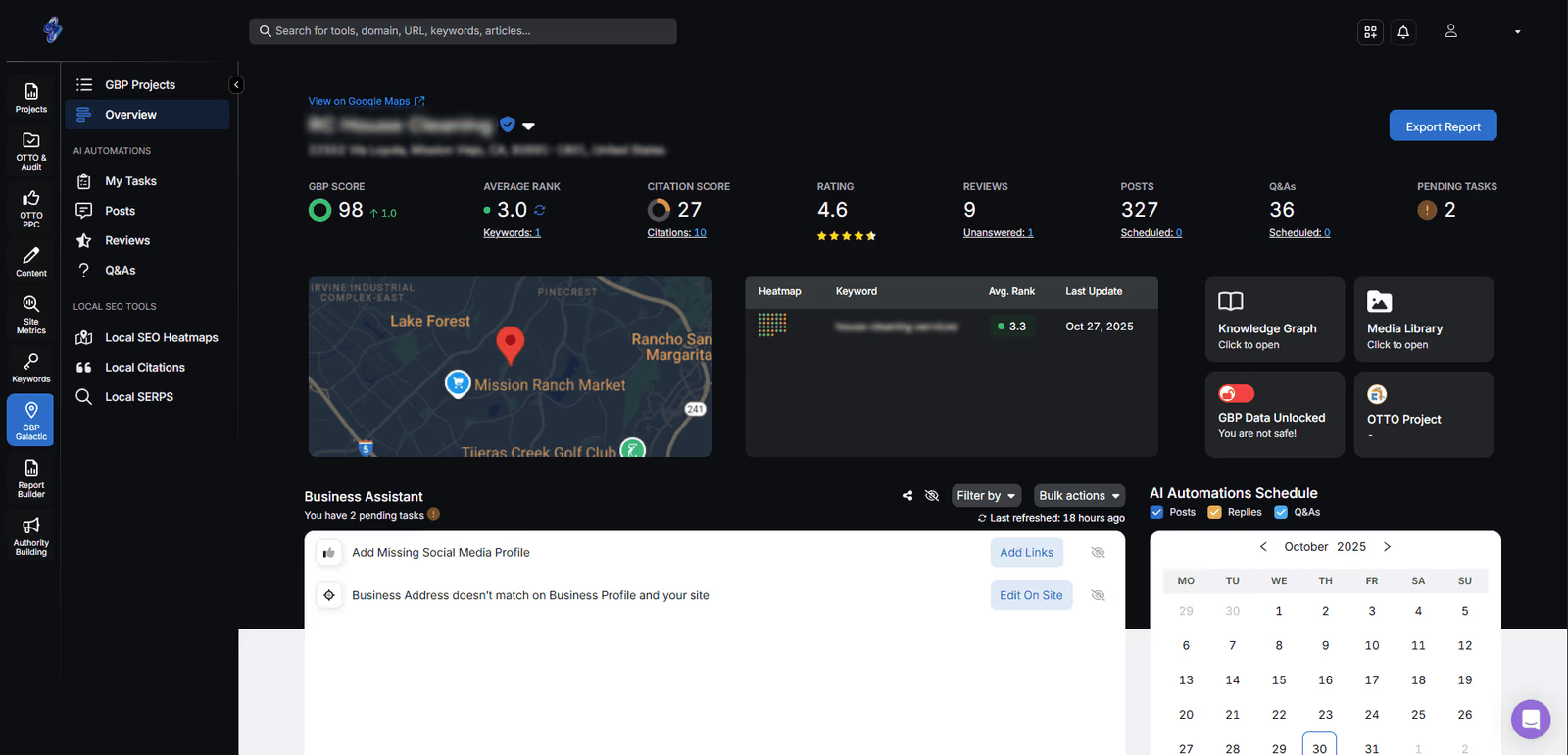
Search Atlas is an all-in-one SEO platform with local modules: GBP Galactic, Local Heatmaps, Local Citation Builder, and Report Builder. GBP Galactic manages Google Business Profiles by syncing hours, categories, and attributes, replying to reviews, and publishing posts across every connected location. Local Heatmaps simulates Google Maps searches to show where each location ranks, Competitor Heatmaps compare grids against local rivals, and a Local SERPs Viewer shows results from any city or ZIP code.
Local Citation Builder submits business data to five aggregators on one payment that keeps listings live for 12 months, and Report Builder produces white-labeled reports. The local toolset also covers geo-targeted landing pages, local keyword research by ZIP code, and schema markup, and it runs in the same account as Atlas Agent, OTTO SEO, and AI visibility tracking. Plans cap GBP projects at 3, 10, 25, and 100, and brands above that scale move to an enterprise plan.
Search Atlas Features
- GBP Galactic applies updates when they are enabled or approved, and a location's profile stays editable by hand.
- Review replies are configurable per location, with AI-written replies that can be edited before they publish.
- Atlas Agent includes approval checkpoints for high-impact changes, and OTTO SEO has approval mode and rollback.
- Local Citation Builder submits to Data Axle, Foursquare, Neustar Localeze, Yellow Pages Network, and GPS Network, and one payment covers 12 months. See the Local Citation Builder page.
- Report Builder rolls up GBP, Google Search Console, GA4, rank tracking, and heatmap data across multiple portfolios for regions or brands.
Search Atlas Pricing
Search Atlas publishes four plans, all billed monthly, and GBP project caps rise with each plan:
- Starter: $99 per month with 3 GBP projects.
- Growth: $199 per month with 10 GBP projects.
- Pro: $399 per month with 25 GBP projects and white-label dashboards and reporting.
- Agency: from $999 per month with 100 GBP projects and client portals.
- Enterprise: custom quote for brands with more than 100 profiles. The enterprise brand page describes 25 to 1,000+ websites or profiles with tailored quotas, role-based permissions, and API access.
What are the limitations of Search Atlas for multi-location brands?
Cons
- Search Atlas covers a wide range of SEO skills, so new users need time to learn the platform, and free onboarding is available.
- AI features draw from a monthly Universal Credits budget, so large location sets need usage monitoring.
Search Atlas Reviews
- G2: 4.6/5 (about 160 reviews)
- Capterra: 4.8/5 (82 reviews)
- Trustpilot: 3.9/5 (359 reviews)
2. SOCi (Best for Agentic Local Marketing)
SOCi is a local marketing platform that covers listings, social publishing, reputation, and local pages through three agents named Genius Local Search, Genius Social, and Genius Reputation. The platform is positioned for brands with hundreds or thousands of locations. Genius Local Search handles listings management and dynamic pages, and Genius Reputation handles review solicitation and surveys. Publishing rules can run automatically, by approval, or both, and SOCi charges no per-user fees. Pricing is set by location count and agent, so evaluation starts with a sales conversation.
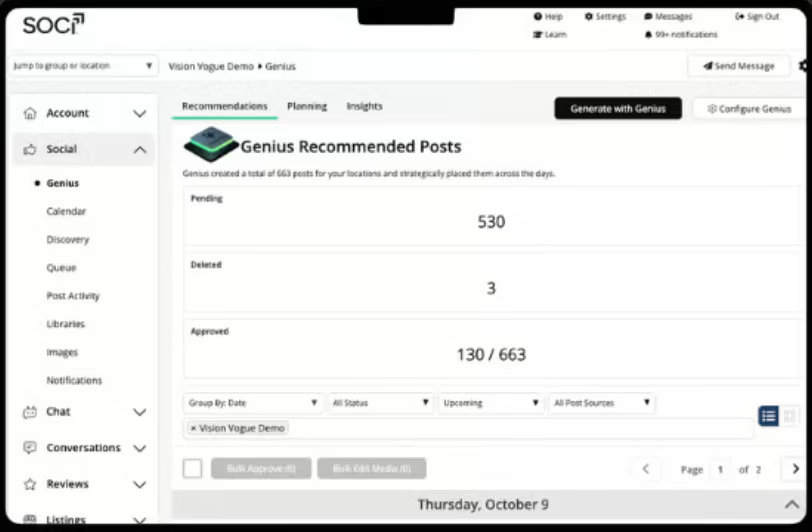
SOCi Features
- Publishing rules set to automatic, approval, or both.
- No per-user fees, so corporate staff, agencies, and local managers share one account.
- Visibility tracking benchmarked location by location, with an AI Visibility Snapshot.
- Genius Local Search Agent handles listings management and dynamic pages.
- Genius Reputation Agent handles review solicitation and surveys.
SOCi Pricing
SOCi does not publish prices. Pricing is set by location count and by agent, and a custom quote is required. SOCi lists no free trial on its pricing page.
What are the limitations of SOCi for multi-location brands?
Cons
- No published price and no free trial, so evaluation starts with a sales process.
- Roles, regional reporting, and geo-grid tracking are not documented on the public pages, so each needs a demo test.
SOCi Reviews
- G2: 4.5/5 (3,500+ reviews, per SOCi's pricing page)
- Capterra: 4.5/5 (251 reviews)
- Trustpilot: No Trustpilot profile found.
3. Yext (Best for Enterprise Listings Data Control)
Yext is a listing management platform that manages location data through a Knowledge Graph and distributes it to listings, reviews, social, and location pages. Yext describes itself as an enterprise agentic marketing platform. The Knowledge Graph acts as the single record for bulk location edits, and role-based approvals and audit trails govern who can change data. Listings Verifier detects errors, duplicates, and publisher overwrites after distribution. Yext does not publish pricing, and purchase runs through a demo and a sales contact.
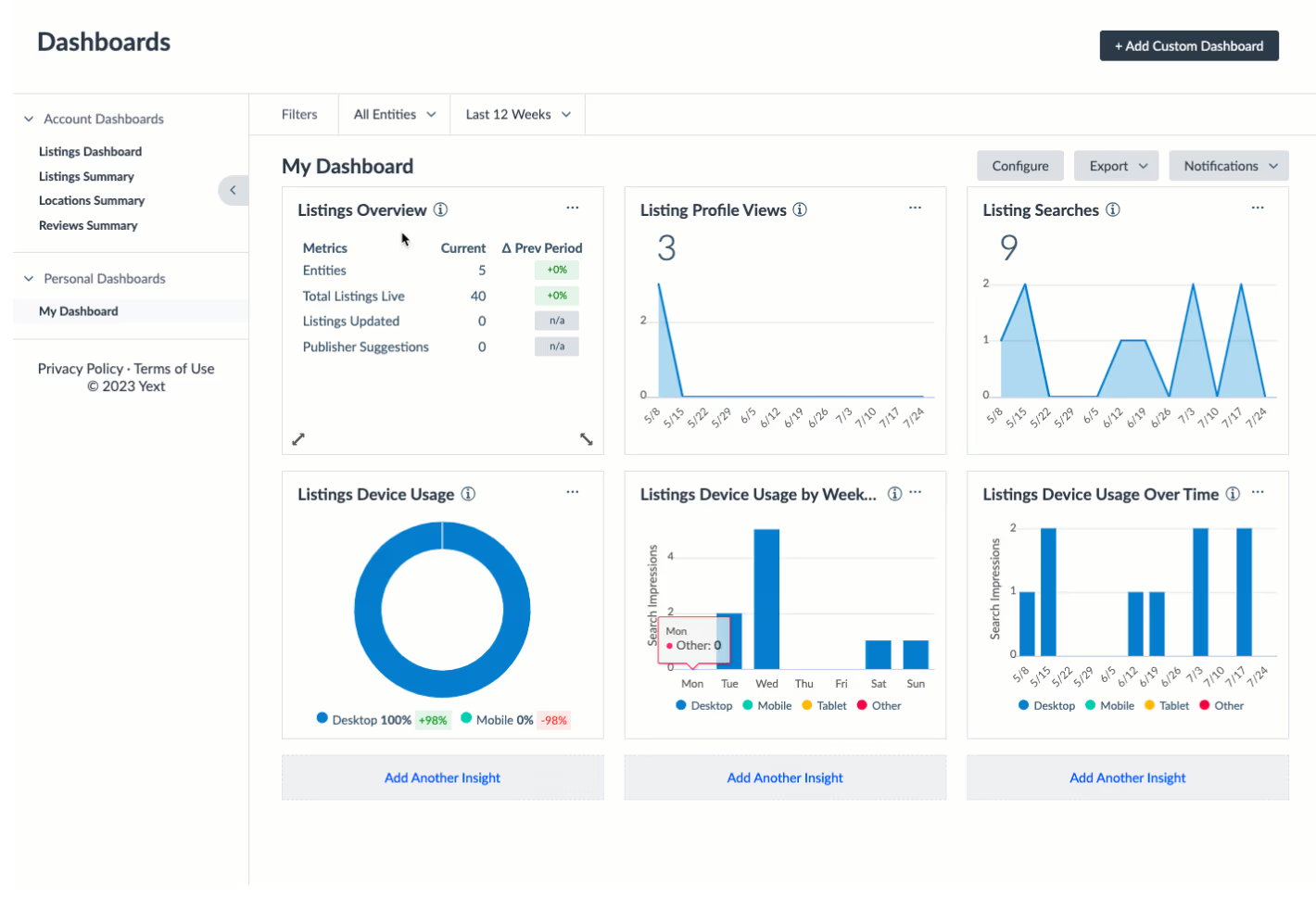
Yext Features
- Role-based approvals and audit trails govern who can change data.
- Knowledge Graph acts as the single record for bulk location edits.
- Listings Verifier detects errors, duplicates, and publisher overwrites.
- Social publishing defines who can view, draft, approve, or publish by role and region.
- Reviews carry approval workflows alongside auto-responses.
Yext Pricing
Yext does not publish pricing. Purchase runs through a demo and a sales contact.
What are the limitations of Yext for multi-location brands?
Cons
- No public pricing, so budgets cannot be estimated without a quote.
- Trustpilot reviewers cite billing and listing-correction disputes, which makes the contract terms a priority to confirm in writing.
Yext Reviews
- G2: 4.4/5 (946 reviews)
- Capterra: 4.2/5 (114 reviews)
- Trustpilot: 2.0/5 (348 reviews)
4. Birdeye (Best for Review-Led Reputation Management)
Birdeye is a reputation platform that covers reviews, listings, social, and AI search across multiple locations. Birdeye describes its product as AI coworkers for multi-location brands. Listing changes require approval by default, and review responses can post automatically or wait for approval. Every location is scanned for listing errors independently, and an AI Search Optimization Agent and an AI visibility check cover answer engines. Pricing is quoted by location band, from 1 to 3 locations up to 1,000+.
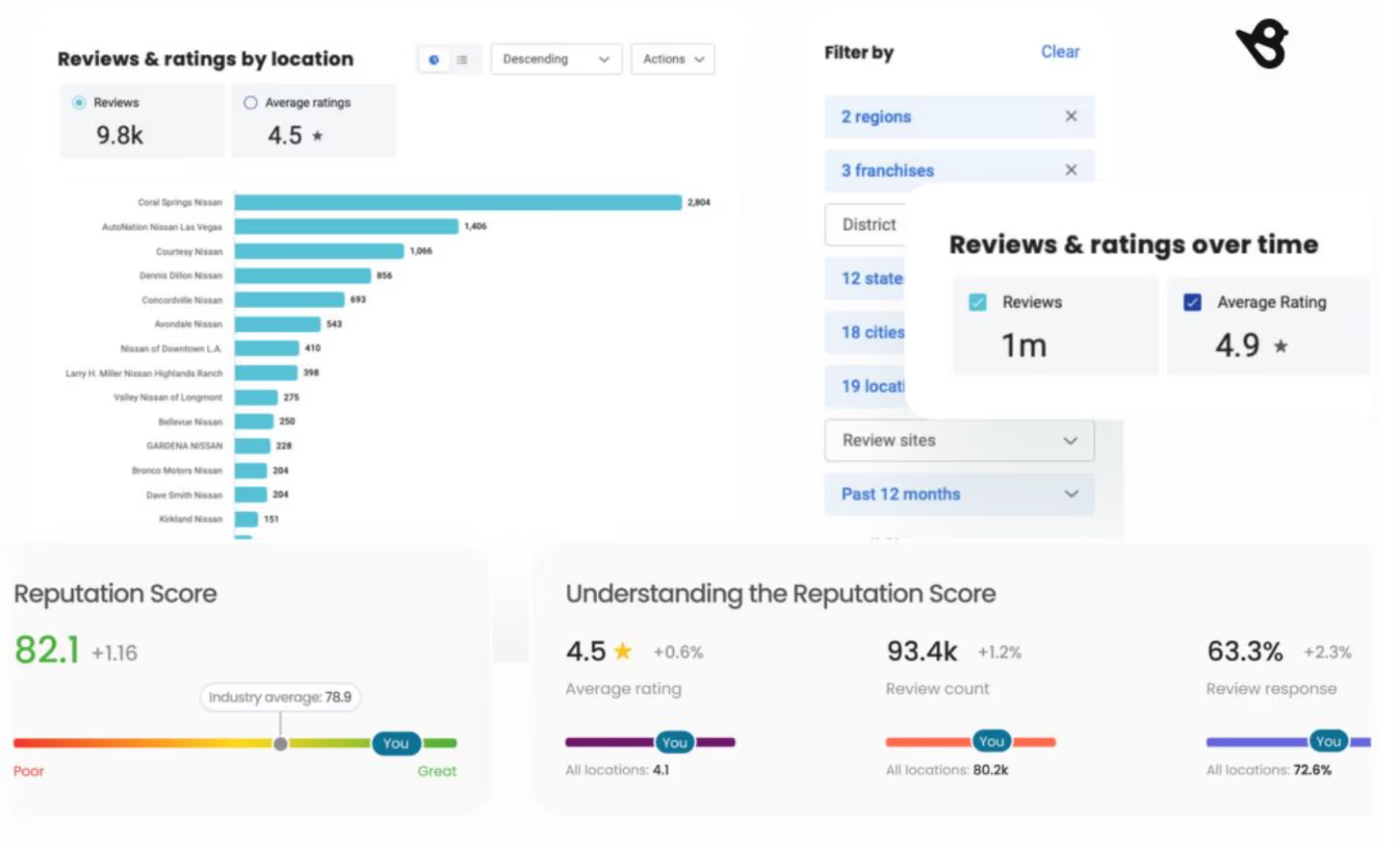
Birdeye Features
- Approval required by default for listing changes, so nothing goes live without sign-off.
- Review responses post automatically or hold for approval.
- Every location is scanned for listing errors independently.
- Pricing by location band, from 1 to 3 locations up to 1,000+.
- AI Search Optimization Agent and an AI visibility check.
Birdeye Pricing
Birdeye does not publish prices. The quote form asks for the number of locations, using bands from 1 to 3 locations up to 1,000+.
What are the limitations of Birdeye for multi-location brands?
Cons
- No published price, and Trustpilot reviewers raise cancellation and renewal terms.
- Roles and regional reporting are not documented on the public pages.
- Listings coverage is a deliberate short list of five platforms, so brands that need a wide directory network need to confirm fit.
Birdeye Reviews
- G2: 4.7/5 (3,889 ratings)
- Capterra: 4.7/5 (700+ reviews)
- Trustpilot: 3.2/5 (679 reviews). Trustpilot notes that Birdeye has not recently invited customers to review.
5. Uberall (Best for Governed Listings Rollouts)
Uberall is a listing management platform that also covers reviews, local social, store locators, and analytics. The vendor sells three named plans: Show Up, Stand Out, and Connect. The base Essentials package includes unlimited users, bulk upload by spreadsheet or API with real-time sync, and Local Performance Score and Local SEO Report rollups. Approval workflows, granular permissions, SSO, and white label sit in the paid Collaborate Plus add-on, so governance needs become a pricing question. GEO Studio adds AI share of voice.
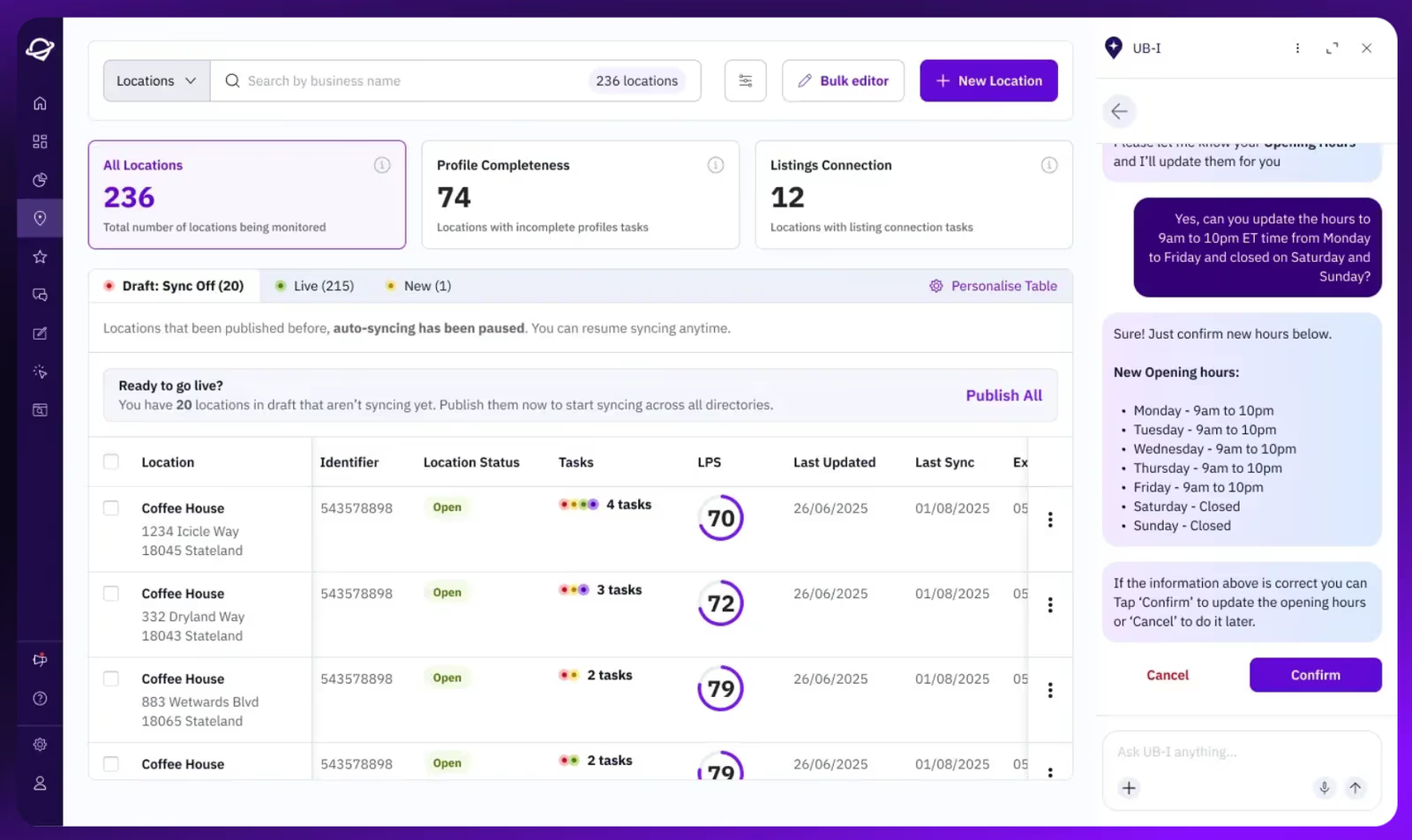
Uberall Features
- Collaborate Plus add-on: approval workflows, granular permissions, SSO, and white label.
- Bulk upload by spreadsheet or API with real-time sync.
- Unlimited users in the base Essentials package.
- Local Performance Score and Local SEO Report as base rollups.
- GEO Studio add-on for AI share of voice.
Uberall Pricing
Uberall does not publish dollar prices. Plans are named, and add-ons are priced separately on request.
What are the limitations of Uberall for multi-location brands?
Cons
- Approval workflows, granular permissions, SSO, and white label sit in the paid Collaborate Plus add-on, and the base plans exclude them.
- Uberall's pages give different directory counts, so confirm the exact network in writing.
Uberall Reviews
- G2: 4.4/5 (237 reviews)
- Capterra: 4.6/5 (37 reviews)
- Trustpilot: 2.3/5 (6 reviews, too small a sample to read as a trend)
6. BrightLocal (Best for Transparent Per-Location Pricing)
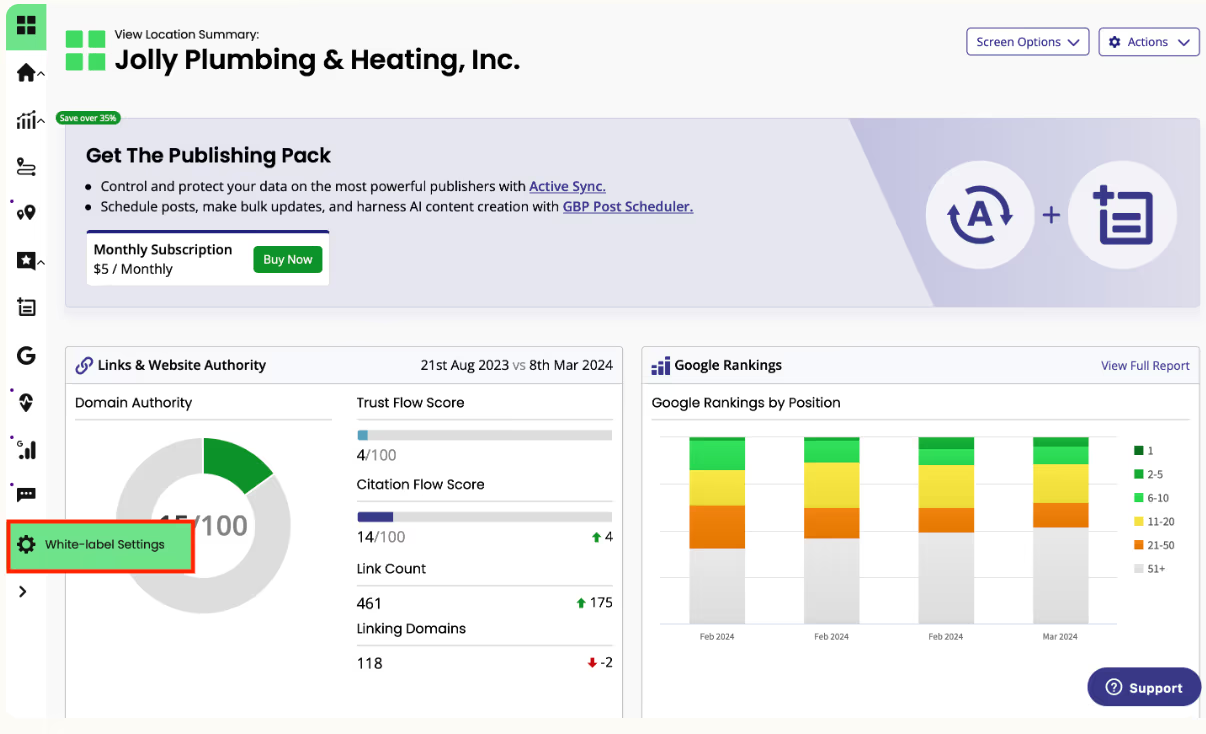
BrightLocal is a local SEO suite that covers rank tracking, citation tracking, listings sync, GBP posting, and review management. The suite sells three tiers named Track, Manage, and Grow, priced by location count in bands from 1 location up to 100. Active Sync protects location data on key sites, GBP Post Scheduler works for one or multiple locations, and Grow adds review monitoring and review requests. White-labelling and API access appear in the plan comparison. A 14-day free trial requires no card, which makes a low-risk test before a pilot.
BrightLocal Features
- Per-location price bands from 1 location up to 100.
- Active Sync keeps location data protected on key sites.
- GBP Post Scheduler works for one or multiple locations.
- White-labelling and API access appear in the plan comparison.
- Review monitoring and review requests on Grow.
BrightLocal Pricing
BrightLocal prices by location count, in US dollars per month. Billed monthly, one location costs $41 on Track, $54 on Manage, and $65 on Grow. Billed annually, the monthly equivalents are $31, $40, and $49. A group of 91 to 100 locations costs $524, $769, or $989 per month billed monthly. More than 100 locations is priced on request. A 14-day free trial requires no card.
What are the limitations of BrightLocal for multi-location brands?
Cons
- Per-location pricing climbs with location count and caps at 100 locations before a custom price.
- The pricing page documents no location pages, social publishing, or enterprise approvals.
BrightLocal Reviews
- G2: 4.6/5 (228 reviews)
- Capterra: 4.8/5 (281 reviews)
- Trustpilot: 4.0/5 (771 reviews)
7. Semrush Local (Best for Small Location Counts)
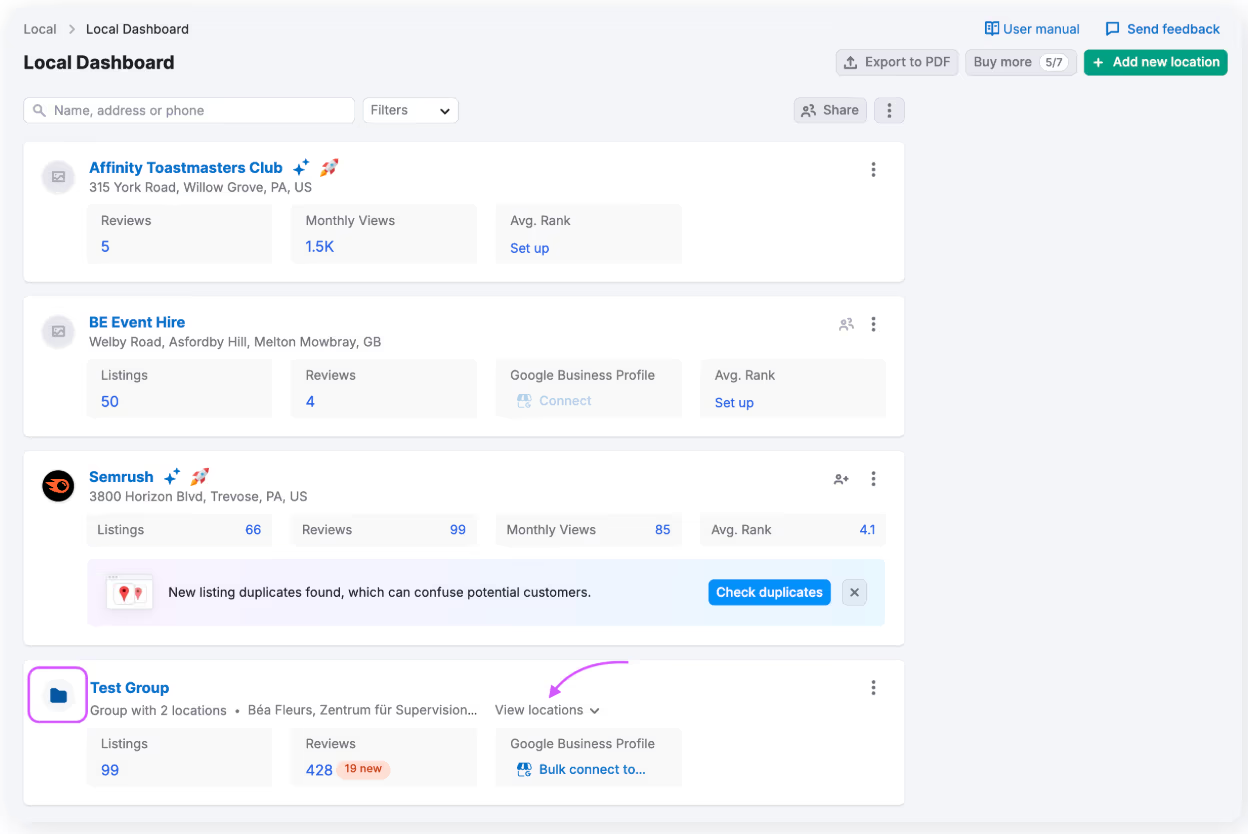
Semrush Local is a local SEO module inside Semrush that covers GBP management, map rank tracking, listing management, and review management. The module is sold per location in two plans: Local Base and Local Pro, at $30 and $60 per location per month. Map Rank Tracker carries a credit allowance per plan, and Local Pro adds Listing Management across 70+ directories and Review Management. A Local Business custom offer starts at 20+ locations, which positions the module toward small and mid-size location counts.
Semrush Local Features
- Flat per-location pricing at two levels.
- Map Rank Tracker with a credit allowance per plan.
- Listing Management across 70+ directories on Local Pro.
- Review Management on Local Pro.
- Local Business custom offer for 20+ locations.
Semrush Local Pricing
Local Base costs $30 per location per month and Local Pro costs $60 per location per month. Semrush's help article does not state the billing term for these plans, so the term needs confirmation at purchase. Local Business is a custom offer for 20+ locations.
What are the limitations of Semrush Local for multi-location brands?
Cons
- Semrush's pricing article does not detail role and approval controls.
- Social posting and regional reporting are not documented for Local.
- The custom quote begins at 20 locations, which positions the module toward small and mid-size location counts.
Semrush Local Reviews
- G2: No Local-specific ratings found.
- Capterra: No Local-specific ratings found.
- Trustpilot: No Local-specific ratings found.
How should a brand score and test a multi-location SEO platform?
Step by step
How should a brand pilot a multi-location SEO platform in seven steps?
Step through the sequence here. Each step is explained in the list below.
- Pick a pilot group
- Assign pilot users
- Load the same location data
- Run the same tasks
- Check the audit trail
- Test the rollups
- Score and decide
A scorecard and a pilot on the same locations give a brand comparable evidence for every vendor. The scorecard turns the seven requirements into numbers, and the pilot supplies the evidence for each score. General vendor due diligence, such as security review and references, is covered in the SEO vendor evaluation checklist, so the scorecard below stays on multi-location specifics.
| Criterion | Suggested weight | What a top score looks like |
|---|---|---|
| Location data governance | 20 | One record, bulk edits, approvals, and an audit trail per location |
| Google Business Profile management | 20 | Bulk import and edits, approval rules for posts and replies, and profile health monitoring |
| Listings and citations | 15 | Named aggregators and directories, duplicate handling, and written answers on listing handling |
| Review workflows | 15 | Central inbox, approval by star rating, escalation, and no filtering of review requests |
| Local rank and AI visibility tracking | 10 | Geo-grid scans by location, by-location keyword sets, and AI visibility for local queries |
| Reporting and permissions | 15 | Rollups by region and brand, franchisee-level access, scheduled exports, and API access |
| Pricing clarity | 5 | Published units, location bands, and stated onboarding terms |
The pilot plan runs every vendor through the same steps:
- Pick a pilot group. Choose a small group of real locations that includes a storefront, a service-area business, and a franchisee-owned unit.
- Assign pilot users. Create corporate, franchisee, and agency users and confirm each sees only the locations assigned.
- Load the same location data. Give every vendor the same spreadsheet and note how each platform imports, validates, and reports errors.
- Run the same tasks. Bulk edit hours, post an update, reply to a review, and run a rank scan on each platform.
- Check the audit trail. Open the change history for the pilot locations and confirm that each edit shows who made it and when.
- Test the rollups. Build the same regional rollup and location drill-down in each platform and compare the output.
- Score and decide. Fill the scorecard with evidence from steps 1 to 6.
How much does SEO software for multi-location brands cost?
Multi-location platforms are priced by location, by platform fee plus location count, by credits, or by custom quote. The pricing unit determines the total, because cost changes with every location added.
Published figures in October 2026 include BrightLocal's per-location tiers, Semrush Local at $30 or $60 per location per month, and Search Atlas plans from $99 to $399 per month plus Agency from $999 per month, all billed monthly. Yext, SOCi, Birdeye, and Uberall do not publish prices, so each requires a quote. Search Atlas lists current plans on its pricing page.
Per-location bands change the math at scale. BrightLocal's Grow tier costs $65 per month for one location and $989 per month for 91 to 100 locations, which is $10.87 down to $9.89 per location. Semrush Local's flat $30 per location means 50 locations on Local Base cost $1,500 per month. Model the total at the current location count and at the count planned for the next two years.
Master list of questions for every vendor:
- What is the minimum contract length and the minimum number of locations?
- Which location bands change the per-location price?
- Are onboarding, data migration, and setup fees charged?
- Which features, such as approvals, SSO, white label, and API access, are add-ons?
- How are credits, scans, or usage counted, and what happens at the limit?
- What happens to listings, reviews, and data after cancellation?
How should a brand roll out a multi-location SEO platform across locations?
Step by step
How should a brand roll out a multi-location SEO platform in six phases?
Step through the phases here. Each phase is explained in the list below.
- Clean location data
- Set roles and approvals
- Run the pilot
- Build templates
- Set the reporting cadence
- Expand in groups
A rollout moves in phases that follow the requirements, starting with data and governance and ending with expansion. The phases keep early mistakes small, because every automation repeats across locations once it is live.
- Clean location data. Correct names, addresses, phone numbers, hours, and categories in the official record before any import.
- Set roles and approvals. Define corporate, regional, and franchisee permissions, and decide which changes need approval.
- Run the pilot. Reuse the pilot group and steps from the scorecard section and review the audit trail.
- Build templates. Prepare templates for review replies, posts, and location pages, each with fields for location-specific content.
- Set the reporting cadence. Schedule rollups for corporate and drill-downs for location managers.
- Expand in groups. Add locations in batches and repeat the audit trail check on each batch.
Autonomous platforms add a governance layer on top of these phases, and the guide to delegating local SEO to autonomous platforms covers how brands decide what to hand over.
SEO software for multi-location brands FAQ
What is the difference between a multi-location SEO platform and a local SEO tool?
A multi-location SEO platform manages local search for many locations through shared data, role-based permissions, approval workflows, and rollup reporting, while a single-location local SEO tool serves one owner, one Google Business Profile, and one set of rankings. Platforms such as Yext, SOCi, and Uberall add governance for franchise systems.
What is the difference between listing management and local SEO software?
Listing management software distributes and syncs location data to publishers and directories, while local SEO software tracks rankings, runs audits, and monitors reviews. Yext and Uberall are listing management platforms, and BrightLocal and Semrush Local are local SEO products. The types table in this guide lists the type of each vendor.
Do franchises need separate Google Business Profiles for each location?
Yes, each physical location gets its own Google Business Profile under Google's guidelines. Authorized, fully dedicated franchisees can use the underlying brand name, and chains keep names and categories consistent across locations.
Does a multi-location SEO platform create location pages?
Some platforms do. Yext, SOCi, Birdeye, and Uberall offer location pages or store locators, and other platforms in this guide focus on tracking and syncing data. Any platform that builds pages needs location-specific content on each page to avoid doorway pages.
Can franchisees get limited access to a multi-location SEO platform?
Yes, on platforms with role-based permissions, where a franchisee user sees and edits only the assigned location. Confirm in a demo that the restriction works, and ask whether permissions and approvals sit in the base plan or in an add-on, as with Uberall's Collaborate Plus.
How is a multi-location SEO platform priced?
Multi-location SEO platforms are priced per location per month, as a platform fee plus a per-location charge, by credits, or by custom quote. BrightLocal starts at $41 per month for one location, Semrush Local at $30 per location, and Search Atlas at $99 per month. Larger location counts move from published tiers to quotes.
Which multi-location SEO platforms publish their pricing?
BrightLocal, Semrush Local, and Search Atlas publish prices. BrightLocal prices by location count, Semrush Local by location per month, and Search Atlas by plan with monthly billing. Yext, SOCi, Birdeye, and Uberall use custom quotes.
Does Search Atlas manage Google Business Profiles for multiple locations?
Yes, Search Atlas manages Google Business Profiles across locations through GBP Galactic, covering listing updates, review replies, posts, and profile health monitoring. Plan caps run from 3 to 100 GBP projects, and brands above 100 profiles use the enterprise plan.