An SEO vendor evaluation checklist is a structured set of criteria used to compare SEO platforms across data accuracy, integration requirements, pricing models, support quality, and lock-in risk before committing to a contract. The SEO vendor checklist converts buying decisions into scored, defensible comparisons that SEO professionals present to managers and clients. Generic SaaS procurement templates fail for SEO software purchases because they ignore the criteria that determine real platform fitness. They are keyword database freshness, proprietary metric methodology transparency, agency white-label requirements, and the true cost of switching platforms mid-campaign.
The checklist solves the problem of selecting SEO platforms based on feature lists and demo quality rather than on data accuracy, workflow fit, and total cost at scale. Generic SaaS procurement templates evaluate legal, financial, and security criteria that do not apply to SEO software purchases. Two platforms listing the same features differ materially in keyword database freshness, backlink index coverage, and proprietary metric methodology. The evaluation checklist translates those invisible differences into measurable criteria before the contract is signed.
SEO agencies and in-house marketing teams use the checklist when selecting a new platform, renewing a current subscription, or responding to a budget review that requires justifying existing tool spend. Agency buyers weigh client management features, white-label reporting, and multi-project organization higher than in-house teams, which weigh analytics integration and content workflow depth. The checklist accommodates both buyer profiles through weighted scoring that reflects each team’s operational priorities rather than a universal feature ranking.
What Is an SEO Vendor Evaluation Checklist?
An SEO vendor evaluation checklist is a requirements matrix that scores competing platforms against the specific operational, technical, and commercial needs of an SEO team or agency. The checklist covers eight categories. They are data accuracy, proprietary metrics, feature alignment, integration compatibility, pricing, support quality, data portability, and agency management. Each category produces a weighted score that removes subjective preference from the buying decision. The checklist converts platform capabilities into measurable criteria against which every competing vendor is rated on the same scale.
What separates an SEO vendor evaluation from a general tool review? An SEO vendor evaluation differs from a general tool review because it scores vendors against a predefined requirements matrix rather than describing features. A tool review lists what a platform does. A vendor evaluation scores what a platform does against what the buyer needs. The evaluation produces a ranked comparison tied directly to the buyer’s workflow, budget, and growth timeline. Platform X earning a high score in one evaluation does not indicate that Platform X is the right choice for a buyer with different requirements.
What is the primary output of an SEO vendor evaluation checklist? The primary output of an SEO vendor evaluation checklist is a weighted score matrix that ranks shortlisted platforms against criteria relevant to the buyer’s workflow. Each criterion receives a weight based on its importance to the buying team. Vendors receive scores on each criterion. Weighted totals produce a ranked list that the team defends to managers and uses to negotiate contract terms. The matrix makes the selection decision transparent and repeatable for future evaluation cycles.
Why Does SEO Software Require a Specialized Evaluation Framework?
SEO software requires a specialized evaluation framework because the data it produces drives decisions with direct revenue impact, and data quality differences between platforms are invisible in feature lists. Two platforms listing “keyword rank tracking” as a feature differ in crawl frequency, SERP sampling methodology, index size, and geographic granularity. A buyer who evaluates only feature presence selects the wrong platform and discovers discrepancies after committing to a contract. A specialized framework evaluates data accuracy mechanisms, not just feature labels.
Why do proprietary metrics create evaluation complexity specific to SEO tools? Proprietary metrics create evaluation complexity because platforms use different methodologies to measure organic visibility, domain strength, and content quality, and those methodologies produce incompatible scores across vendors. Domain Power in Search Atlas measures organic visibility and competitive strength on a 0-to-100 scale using a logarithmic model that integrates organic traffic, keyword performance, and ranking distribution across the top 100 SERPs. Domain Authority from Moz uses a different model and a different index. A metric from one platform cannot be directly compared to the equivalent metric from another platform. An evaluation framework identifies which metrics a buyer relies on and checks whether each vendor’s methodology is transparent and consistent.
Why does an SEO-specific framework address switching cost in a way that general SaaS evaluation does not? An SEO-specific framework addresses switching cost because SEO data accumulates over time and becomes operationally embedded in ways that standard SaaS evaluation criteria do not capture. Historical ranking data, backlink reports, and keyword tracking baselines built in one platform do not transfer cleanly to a competitor. Switching mid-campaign breaks trend lines, resets historical comparisons, and forces manual data migration. A specialized evaluation framework quantifies these costs before the buying decision, so the buyer weighs long-term lock-in risk alongside immediate capability comparisons.
How SEO Vendor Evaluation Differs From General SaaS Procurement?
SEO vendor evaluation differs from general SaaS procurement in that it prioritizes data methodology, index accuracy, and SEO-specific workflow continuity over the legal, financial, and organizational criteria that dominate enterprise SaaS procurement. General SaaS procurement verifies vendor financial health, legal compliance, security certifications, and enterprise contract terms. An SEO vendor evaluation verifies keyword database freshness, backlink index coverage, crawl configuration limits, and agency white-label availability. The evaluation criteria share a checklist format but address entirely different risk categories.
What dimensions separate SEO-specific evaluation from general procurement criteria?
| Dimension | General SaaS Procurement | SEO Vendor Evaluation |
| Primary risk | Legal, financial, security | Data accuracy, index coverage |
| Key data question | Is the vendor financially solvent? | Does the keyword data refresh daily or weekly? |
| Metric comparison | Standard uptime and SLA metrics | Proprietary metrics (Domain Power, visibility score) |
| Lock-in risk | Data portability clauses | Historical ranking and backlink data loss |
| Agency concerns | Multi-seat licensing | White-label reporting, multi-client dashboards |
| Pricing complexity | Per-seat models | Per-project, keyword-quota, and overage structures |
| Evaluation output | Vendor risk score | Weighted workflow fit score |
Why does the buyer audience shape the evaluation framework? The buyer audience shapes the framework because an agency evaluating an SEO platform scores agency management features at higher weights than an in-house team. An agency weighs white-label reporting, multi-client dashboards, and user permissions above integration depth. An in-house team weighs integrations with existing analytics stacks (Google Analytics 4, Google Search Console) and content workflow features above agency management features. The evaluation criteria remain consistent across buyer types, but the weights assigned to each criterion reflect the operational priorities of the specific buyer.
What Criteria Belong on an SEO Vendor Evaluation Checklist?
Eight criteria belong on an SEO vendor evaluation checklist. They are listed below.
- Data Accuracy and Freshness
- Proprietary Metric Methodology Transparency
- Workflow and Feature Alignment
- Integration and Technical Compatibility
- Pricing Structure and Total Cost of Ownership
- Support Quality and Onboarding Experience
- Data Portability and Platform Lock-In Risk
- Agency and Multi-Client Management Features
Each criterion addresses a distinct risk category. Data accuracy criteria catch platforms with stale or incomplete indexes. Proprietary metric criteria catch platforms that use opaque scoring models. Agency criteria catch platforms that cannot handle multi-client workflows at the volume an agency operates. The eight criteria together cover the full risk surface of an SEO platform selection decision.
What weight does each criterion receive in a standard evaluation matrix? Each criterion receives a weight based on its proportion of the buyer’s weekly workflow and its operational consequence when the vendor underdelivers. Data accuracy receives the highest weight because all downstream decisions depend on it. Pricing and total cost of ownership receive the second-highest weight for buyers with defined budget constraints. Agency management features receive high weight for agencies and low weight for in-house teams. An evaluation matrix that assigns equal weight to all eight criteria produces less accurate vendor rankings than a matrix tuned to the buyer’s specific operational priorities.
1. Data Accuracy and Freshness
Data accuracy and freshness are the first criterion because all downstream SEO decisions depend on the reliability of the underlying data. Content creation, link building, and technical prioritization are all grounded in platform-reported data. A platform with stale keyword data produces ranking reports that lag real SERP conditions by days or weeks. A platform with an incomplete backlink index reports link profiles that undercount referring domains, which distorts competitive analysis. Data accuracy failures surface after the platform is in use, not during the sales demo, so the evaluation forces accuracy evidence before the buying decision.
2. Proprietary Metric Methodology Transparency
Proprietary metric methodology transparency is the degree to which a platform discloses how it calculates its own branded authority, quality, and performance scores. Each major SEO platform uses proprietary metrics to measure authority and organic visibility. Domain Power in Search Atlas measures organic visibility and competitive strength on a 0-to-100 scale by aggregating organic traffic, keyword performance, and ranking distribution data. Domain Authority from Moz and Domain Rating from Ahrefs each use different inputs and different index sizes. A buyer who switches platforms mid-campaign loses metric continuity, which breaks trend comparisons in client reports.
3. Workflow and Feature Alignment
Workflow and feature alignment measures whether the platform’s features map to the specific SEO tasks the buyer’s team executes daily, not just to a general SEO capability list. Two teams running different workflows evaluate the same platform differently. The technical SEO team weighs crawl configuration depth, indexability reporting, and schema validation. The content-led team weighs keyword research depth, content scoring, and editorial workflow integration. An evaluation checklist scores feature alignment against the buyer’s actual workflow, not against an abstract ideal of what SEO software does.
4. Integration and Technical Compatibility
What does integration and technical compatibility measure in an SEO vendor evaluation? Integration and technical compatibility measure whether the platform connects natively to the data sources and tools already in the buyer’s stack, and whether those connections persist as the stack evolves. An SEO platform that does not integrate with Google Search Console requires manual data imports, which introduces lag and errors into performance reporting. A platform that does not connect to Google Analytics 4 cannot attribute organic traffic to specific content assets without intermediate exports. Integration coverage determines how much manual work the platform eliminates versus creates.
5. Pricing Structure and Total Cost of Ownership
The pricing structure criterion covers the model by which the vendor charges for the platform, including seat-based fees, project-based quotas, keyword tracking limits, and overage charges. Per-seat pricing scales linearly with team size. Per-project pricing scales with the number of client domains under management. Usage-based pricing scales with keyword query volume, crawl depth, and API call frequency. An evaluation checklist identifies which pricing variables the buyer’s growth trajectory drives most aggressively and selects the pricing model that produces the lowest cost at the expected scale.
6. Support Quality and Onboarding Experience
Support quality measures the vendor’s ability to resolve technical and operational problems at a speed and depth that matches the buyer’s workflow criticality. An SEO platform used to execute client deliverables on deadlines cannot tolerate 48-hour response windows on critical bugs or data discrepancies. Support quality indicators include response time commitments, support channel availability (chat, email, phone), escalation paths for technical issues, and the presence of dedicated account management at higher tiers. An evaluation checklist scores support quality by testing the vendor’s support response during the trial period.
7. Data Portability and Platform Lock-In Risk
Data portability measures whether the platform allows the buyer to export all accumulated data in standard formats that import cleanly into competing platforms or internal data systems. SEO data accumulates over time as ranking histories, crawl logs, backlink profiles, and keyword research libraries. A platform that restricts exports to summary-level reports or proprietary file formats prevents the buyer from transferring months of operational data if the vendor relationship ends. An evaluation checklist tests export completeness, export format compatibility, and the contractual terms that govern data ownership.
8. Agency and Multi-Client Management Features
Agency management features cover the platform’s ability to manage multiple client projects, user permissions, white-label reporting, and branded client deliverables inside a single account. An agency managing 20 client domains needs project isolation between accounts, customizable reporting templates, and the ability to present data under the agency’s own brand. A platform designed for in-house teams typically lacks multi-client workspace features, forcing agencies to maintain separate accounts per client. An evaluation checklist scores agency management features on workspace organization, reporting customization, white-label availability, and user permission granularity.
How to Evaluate SEO Data Coverage and Freshness?
A buyer evaluates SEO data coverage by verifying the keyword database size, backlink index breadth, and crawl frequency against the specific query volume and domain set that the team tracks. Database size matters because niche and long-tail queries at low search volumes disappear from smaller indexes. Backlink index breadth matters because a platform that misses large portions of the referring domain population produces incomplete competitive analysis. Crawl frequency matters because daily rank tracking produces different operational decisions than weekly rank tracking when campaigns are in active optimization phases.
What is the minimum keyword database size a platform needs for professional SEO workflows? The minimum keyword database size depends on the buyer’s primary language-market combinations and the estimated query volume of the buyer’s core topic space. A platform used for English-language US SEO needs a substantially larger English-language keyword index than a platform used for regional multilingual campaigns. An evaluation checklist specifies the buyer’s primary language-market combinations and tests coverage using representative queries from the buyer’s topic space during the trial period. Stated database size plus trial verification together confirm whether the database covers the operational requirements.
How does backlink index freshness affect SEO workflow quality? Backlink index freshness affects SEO workflow quality because newly acquired backlinks appear in reports days to weeks after indexing, and link loss alerts lag the actual loss by the same margin. A team running weekly link-building campaigns needs a backlink index that reflects acquisitions within 72 hours. A team running monthly audits tolerates weekly refresh cycles. An evaluation checklist compares each vendor’s stated refresh frequency against the buyer’s operational requirement. Freshness requirements scale with the buyer’s campaign velocity.
How does a buyer test rank tracking accuracy during a vendor trial? A buyer tests rank tracking accuracy during a vendor trial by running parallel tracking of 50 reference keywords across the trial platform and Google Search Console simultaneously. GSC provides position data directly from Google’s index. A rank tracker that consistently reports positions two to five places different from GSC positions uses a different sampling methodology or a different geographic resolution. Systematic discrepancies indicate calibration differences. Random discrepancies indicate sampling noise. An evaluation checklist records the direction and magnitude of discrepancies and flags systematic bias as a disqualifying accuracy problem.
What does crawl coverage breadth mean in practical SEO platform evaluation terms? Crawl coverage breadth measures the proportion of the buyer’s target URL set that the platform fully indexes and makes available for rank tracking and backlink research. A platform with deep crawl coverage for top-level commercial queries but shallow coverage for informational long-tail queries leaves content gaps in the team’s performance reporting. Crawl coverage testing requires the buyer to submit 100 representative URLs across query types and verify that the platform tracks positions for all 100 without gaps. An evaluation checklist treats incomplete crawl coverage as a data accuracy failure, not a feature limitation.
How to Compare Proprietary SEO Metrics Across Platforms?
A buyer compares proprietary SEO metrics by running a standardized reference domain set through each platform and measuring score consistency, ranking correlation, and the vendor’s public documentation of its scoring methodology. The reference set covers 30 domains spanning three authority tiers based on established independent signals (referring domain count, organic traffic volume). Each platform scores the 30 domains. Score distributions that correctly rank high-authority domains above low-authority domains on independent signals confirm the metric’s validity. Distributions that invert the order indicate calibration errors in the proprietary model.
Why does methodology documentation matter more than the score itself? Methodology documentation matters more than the score because a score without a documented methodology cannot be verified, cannot be used to identify platform errors, and cannot be explained to clients during reporting. A client who questions a Domain Power score of 42 for their domain deserves an explanation of what inputs produce that score. Domain Power in Search Atlas aggregates live keyword data, backlink trust, and topical relevance into a single correlated score that is continuously recalculated. A platform that describes its methodology only as “algorithmic” cannot provide that level of explanation. An evaluation checklist scores documentation depth specifically.
How do proprietary metric incompatibilities create problems during platform transitions? Proprietary metric incompatibilities create problems during platform transitions because historical trend lines built on one metric become invalid when the platform changes. A buyer who has tracked Domain Power in Search Atlas for 12 months and switches to a platform using a different authority metric loses 12 months of authority trend history. The new platform’s score for the same domain at the same point in time differs from the Search Atlas score. The trend line breaks. Clients who received monthly reports referencing the previous metric receive different numbers in the first report from the new platform. An evaluation checklist that includes metric continuity risk scores platforms lower when a transition would break existing client reporting.
What four questions expose proprietary metric weaknesses during vendor demos? Four questions expose proprietary metric weaknesses during vendor demos, and they are listed below.
- Ask how often the metric updates. Metric update frequency determines whether score changes reflect real authority changes or index lag.
- Ask what data sources feed the calculation. Data source transparency reveals whether the metric measures the same signals across domains of different sizes and languages.
- Ask what happens to the score during index gaps. Index gap behavior reveals whether a temporary crawl failure artificially deflates scores.
- Ask where the methodology is documented publicly. Public documentation confirms whether the buyer explains the metric to clients and leadership without relying on vendor-provided talking points.
How to Evaluate Feature Set Alignment With SEO Workflows?
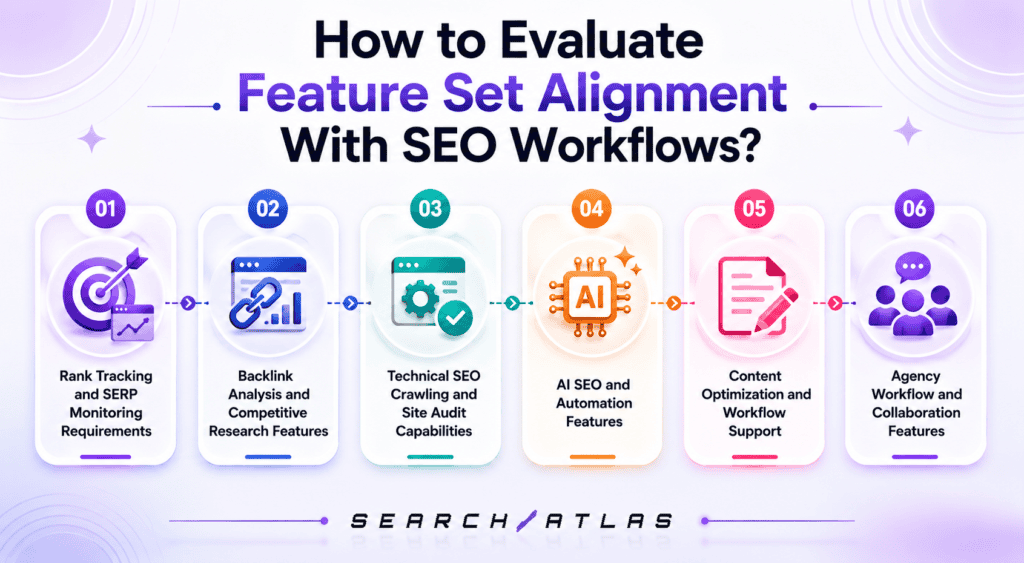
A buyer evaluates feature set alignment by mapping the platform’s core modules to the buyer’s primary SEO workflow categories and scoring each module against the depth, accuracy, and usability requirements of that workflow. There are six primary SEO workflow categories that the feature alignment evaluation covers. They are listed below.
- Rank Tracking and SERP Monitoring Requirements
- Backlink Analysis and Competitive Research Features
- Technical SEO Crawling and Site Audit Capabilities
- AI SEO and Automation Features
- Content Optimization and Workflow Support
- Agency Workflow and Collaboration Features
Each category receives a weight based on its proportion of the team’s weekly workflow. Weighted scores across all six categories produce the feature alignment score for each vendor.
1. Rank Tracking and SERP Monitoring Requirements
Rank tracking capabilities that belong on the checklist include update frequency, geographic granularity, device segmentation, SERP feature monitoring, and competitor tracking capacity. Update frequency determines how quickly the platform reports ranking changes after they occur. Geographic granularity determines whether the tracker reports positions at the city, state, or country level, which matters for businesses competing in local markets. Device segmentation separates desktop and mobile rankings, which differ materially for mobile-first content strategies. SERP feature monitoring tracks featured snippets, map pack appearances, and People Also Ask captures.
How does update frequency in rank tracking affect SEO decision-making? Update frequency in rank tracking affects decision-making because daily updates enable immediate response to ranking drops, while weekly updates introduce a 7-day lag between a ranking change and the team’s awareness of it. An SEO team managing a client site that drops 20 positions overnight needs same-day visibility to diagnose the cause and initiate a response. Search Atlas Keyword Rank Tracker provides daily, weekly, or monthly position updates, with direct integration with Google Search Console, feeding verified query performance data. An evaluation checklist specifies the buyer’s minimum required update frequency and verifies vendor compliance during trial.
What SERP feature monitoring capabilities does the evaluation checklist require? SERP feature monitoring capabilities the checklist requires include tracking for featured snippets, map pack positions, People Also Ask appearances, video carousels, and image packs for monitored keywords. SERP features represent ranking opportunities separate from the standard organic position. A keyword ranking at position five in organic results but capturing a featured snippet produces more impressions than a keyword ranking at position two without a SERP feature. Platforms that track only organic positions one through ten underreport the full visibility picture. An evaluation checklist verifies that the platform reports SERP feature captures at the keyword level, not only at the domain level.
2. Backlink Analysis and Competitive Research Features
Backlink analysis features that belong on the checklist include index size, referring domain tracking, link quality scoring, anchor text distribution analysis, and link gap analysis against competing domains. Index size determines how many of the buyer’s actual backlinks the platform detects. Referring domain tracking shows how many unique root domains link to a target URL. Link quality scoring identifies toxic or low-value links that dilute the profile. Anchor text distribution reveals over-optimization risk. Link gap analysis identifies backlinks pointing to competitors but not to the buyer’s domain, producing a prospecting list for outreach campaigns.
How does backlink index breadth affect competitive research quality? Backlink index breadth affects competitive research quality because a smaller index misses referring domains that appear in larger competing indexes, producing an incomplete picture of competitor authority. Backlink Research in Search Atlas tracks linking domains, linking pages, new and lost domains, top pages, anchor texts, and spam links across the index. An evaluation checklist compares each vendor’s stated index size and verifies coverage on reference domains by comparing the referring domain count against an independent data point. Index size alone does not determine accuracy; index freshness and crawl depth contribute to the same output.
3. Technical SEO Crawling and Site Audit Capabilities
Technical SEO crawling capabilities that belong on the checklist include crawl speed, crawl depth configuration, URL coverage limit, issue classification detail, and the actionability of the fix recommendations. Crawl speed determines how quickly the platform completes a full-site audit on domains of the buyer’s scale. Crawl depth configuration allows the buyer to set how many levels below the root URL the crawler traverses. URL coverage determines the maximum number of pages auditable per site. Issue classification detail separates critical blocking errors from warnings and informational notices. Actionability of fix recommendations determines whether the platform tells the team what to fix and how to fix it.
How does Search Atlas Site Auditor address the technical SEO crawling requirements on the checklist? Search Atlas Site Auditor addresses crawling requirements with a default crawl speed of 20 pages per second, configurable crawl depth, a URL range from 100 to 1,000,000 pages, and a 0-to-1000 health score scale. The Site Auditor crawls the domain and calculates a health score for each URL and for the domain overall. Each detected issue links to a prescriptive resolution step that includes an error definition, an impact assessment, and a correction procedure. Exports support XLS, Google Docs, and CSV formats. Integration with Google Search Console and Google Analytics 4 connects crawl findings to live performance data.
What site audit capabilities confirm a platform’s fitness for enterprise-scale technical SEO? Site audit capabilities that confirm enterprise fitness include crawl scheduling at custom frequencies, user-agent configuration, structured data validation, and the ability to compare crawl results across audit cycles. Crawl scheduling allows the platform to re-audit the domain automatically at set intervals, typically 7 days for active optimization campaigns on Search Atlas Site Auditor. User-agent configuration allows the team to simulate how Googlebot crawls the site versus how desktop or mobile users access it. Structured data validation checks schema markup for syntax errors and property completeness. Crawl comparison across cycles surfaces new issues introduced since the last audit.
4. AI SEO and Automation Features
AI SEO and automation features that belong on the checklist include automated on-page optimization, technical fix deployment, content suggestions triggered by performance data, and the transparency of AI-generated recommendations. (See what AI automation is and how it works for the underlying distinction between rule-based and AI-driven automation that this criterion is scoring for.) Automation depth determines how much of the SEO workflow the platform executes without manual intervention. Recommendation transparency determines whether the platform explains the reasoning behind each automated change. Rollback capability determines whether the team reverses an automated change that produces negative results. An evaluation checklist scores automation features on depth, transparency, and reversibility.
How does OTTO SEO in Search Atlas demonstrate the automation capabilities that the checklist evaluates? OTTO SEO demonstrates automation capabilities by deploying live page modifications through a JavaScript pixel installed on the site, without requiring developer intervention or CMS access. OTTO SEO audits the domain after pixel installation, identifies optimization gaps across on-page, technical, local, and off-page categories, and applies fixes in real time. Changes include title tags, meta descriptions, headings, canonical tags, Open Graph tags, internal links, and schema markup. Each change is reviewable before deployment, selectively implementable, and reversible through rollback capability with detailed change logs. The integration with Google Search Console feeds live ranking signal data to prioritize which changes produce the highest impact.
What automation transparency requirements does the evaluation checklist enforce? Automation transparency requirements the checklist enforces include change logging, pre-deployment review, selective implementation, and rollback access for all automated modifications. A platform that applies changes silently without logging creates an audit trail gap. Silent changes that produce ranking drops cannot be isolated or reversed without the change log. Pre-deployment review gives the team oversight of what the platform proposes to change. Selective implementation allows the team to approve high-confidence recommendations and defer uncertain ones. Rollback access allows the team to undo any change that produces unexpected results.
What efficiency claims for SEO automation does the evaluation checklist require vendors to substantiate? Efficiency claims for SEO automation require vendors to provide documented evidence of time savings at a comparable workflow scale, not only testimonial-based assertions. Search Atlas cites a 90 percent reduction in manual SEO labor through OTTO SEO automation based on the platform’s deployment across client sites. An evaluation checklist treats automation-driven labor savings as a cost offset in the total cost of ownership calculation when the vendor provides verifiable evidence of the labor reduction claim. Unverified efficiency claims receive no weight in the cost comparison.
5. Content Optimization and Workflow Support
Content optimization features that belong on the checklist include semantic keyword analysis, entity coverage scoring, heading structure validation, content length benchmarking, and integration with the team’s publishing workflow. Semantic keyword analysis surfaces related terms and entity connections that improve topical completeness. Entity coverage scoring measures how completely the content addresses the topic’s key concepts relative to top-ranking competitors. Heading structure validation checks whether the document hierarchy (H1, H2, H3) follows a logical progression. Content length benchmarking compares the draft’s word count against top-ranking pages for the target query.
How does Content Genius in Search Atlas address content optimization workflow requirements? Content Genius addresses content optimization requirements through NLP-based entity recognition, real-time semantic scoring, and live content score panels that measure keyword density, heading coverage, and contextual completeness. Content Genius integrates with Keyword Research, Scholar, and Topical Map Generator within the Search Atlas platform, applying the same entity-coverage scoring logic used by AI agents for content gap analysis to identify which briefs are worth writing in the first place. Three operational modes cover manual drafting (Write Yourself), collaborative AI-assisted writing (Write With AI), and automated bulk production (Write With AI in Bulk). AI Folders store brand rules, tone presets, and language consistency settings across content projects. An evaluation checklist that scores content optimization features across semantic depth, workflow integration, and scalability.
What is the Scholar content grading system, and how does it appear in feature alignment evaluation? Scholar is the 12-dimensional content grading system in Search Atlas that scores content quality across semantic, structural, and engagement dimensions used to evaluate SEO readiness before publishing. Scholar grades content across 12 measurement dimensions that collectively assess topical completeness, entity coverage, and structural quality. Each dimension produces a score, and the combined Scholar grade gives the content team a single quality indicator to optimize toward. An evaluation checklist that includes content quality scoring as a feature criterion checks whether each vendor’s content grading system publishes its scoring dimensions, provides actionable improvement suggestions, and integrates with the content creation workflow.
6. Agency Workflow and Collaboration Features
Agency workflow features that belong on the checklist include multi-client workspace organization, project-level access control, white-label report generation, and shareable dashboard links for client review. Multi-client workspace organization separates each client’s data into isolated projects that prevent cross-contamination of reports and keyword tracking. Project-level access control prevents team members from viewing or modifying client accounts outside their scope. White-label report generation allows agencies to deliver reports under their own brand, not the platform’s brand. Shareable dashboard links allow clients to view live performance data without requiring a paid seat in the platform.
How does a buyer verify agency workflow capabilities during platform evaluation? A buyer verifies agency workflow capabilities by setting up a mock agency environment during the trial period with three to five simulated client projects and testing the full cycle. Each step surfaces workflow gaps not visible in sales demos. Project creation speed and template availability determine onboarding efficiency for new clients. Data isolation verification confirms that keyword data from one project does not appear in another project’s reports. Report generation tests whether the white-label output quality matches the agency’s presentation standards.
How to Assess Integration and Technical Fit?
A buyer assesses integration and technical fit by auditing which data connections between the SEO platform and the existing tool stack exist natively, which require third-party middleware, and which are absent entirely.
Each category produces a binary (integrated or not) or scored assessment. Platforms with native integrations across all six categories score higher than platforms that require manual exports or third-party connectors to cover integration gaps.
The six integration categories the technical fit assessment covers are listed below.
1. Integration With Google Search Console
Google Search Console integration matters because GSC provides query-level performance data directly from Google’s index, and platforms that integrate with GSC natively produce reports grounded in Google’s own attribution rather than third-party estimates. Click, impression, CTR, and average position data from GSC reflect actual user behavior and search engine reporting. An SEO platform that does not integrate with GSC requires the team to cross-reference platform reports against GSC data manually. The manual cross-reference introduces errors and doubles the time required to identify performance changes.
How does Search Atlas integrate with Google Search Console? Search Atlas integrates with Google Search Console through the GSC Performance feature, which imports query, page, country, and device data at the keyword level. The Keyword Rank Tracker in Search Atlas feeds verified query data from GSC alongside the platform’s own SERP index for cross-validated position reporting. OTTO SEO uses GSC data to prioritize which on-page and technical changes produce the highest impact on actual ranking performance. An evaluation checklist that scores GSC integration depth confirms whether the vendor’s connection imports all four data dimensions (query, page, country, device) or only a subset.
What GSC integration depth does the evaluation checklist require? The evaluation checklist requires GSC integration that imports query-level data, page-level performance attribution, device segmentation, and country-level breakdowns at a minimum refresh cycle of 24 hours. Query-level data allows the platform to align rank tracking with actual CTR performance. Page-level attribution connects ranking changes to specific content assets. Device segmentation enables mobile-first analysis. Country-level breakdowns cover international SEO campaigns. Platforms that integrate GSC at the domain-aggregate level only (total clicks and impressions without query-level detail) do not meet the checklist’s integration depth requirement.
2. Integration With Google Analytics 4
Google Analytics 4 integration matters because it connects organic traffic attribution to on-site behavior data, including session duration and conversion events, which the SEO platform alone cannot report. An SEO platform that reports ranking positions but not what those positions produce in qualified traffic and conversions provides an incomplete performance picture. GA4 integration allows the team to connect ranking changes to traffic changes to conversion changes inside a single reporting environment. An evaluation checklist marks GA4 integration as a required capability and scores platforms on whether the integration reports at the keyword level, the page level, or only the channel level.
What GA4 integration depth does the evaluation checklist require? The evaluation checklist requires GA4 integration that attributes organic traffic at the landing page level, connects session-level behavior metrics to ranking data, and refreshes at a cadence matching the platform’s rank tracking update frequency. Landing page attribution connects specific ranking positions to specific traffic volumes. Session behavior metrics (engagement rate, average session duration) identify landing pages where rankings drive traffic, but the page fails to convert that traffic into engagement or action. Cadence matching between rank tracking updates and GA4 refreshes ensures that the platform reports on the same time window for both data types.
3. CMS and Third-Party Platform Integrations
An SEO vendor evaluation checklist verifies whether the platform connects natively to the buyer’s CMS for content publishing, schema markup deployment, and on-page optimization application. A platform that generates optimized meta descriptions, headings, and schema markup, but cannot push those changes directly to the CMS (WordPress, Webflow, Shopify) requires the team to copy changes manually. Manual copy-paste introduces errors and adds labor to every content update. OTTO SEO deploys changes through a JavaScript pixel that works across any CMS without native integration requirements. An evaluation checklist scores CMS integration by the degree to which changes made in the platform apply to the live site without manual intervention.
What third-party integrations does the evaluation checklist prioritize beyond CMS? Third-party integrations the checklist prioritizes include outreach tools for link building workflows, project management tools for task assignment, and business intelligence tools for custom reporting. Outreach tool integration (Pitchbox, Respona, BuzzStream) determines whether backlink prospects export directly into the outreach platform with pre-populated authority data. Project management integration (Asana, Trello, ClickUp) determines whether SEO audit findings generate tasks automatically. Business intelligence integration (Looker Studio, Tableau) determines whether the platform’s data feeds into custom executive dashboards. An evaluation checklist scores the breadth and reliability of each integration type.
4. API Access and Rate Limits
API access matters because it determines whether the platform’s data integrates into custom workflows, proprietary dashboards, and automated reporting pipelines that the team builds outside the platform’s native interface. A platform without API access restricts the buyer to using only the platform’s built-in reports. Teams that build custom dashboards for clients, automate data extraction for reporting, or connect SEO data to proprietary scoring models require API access as a non-negotiable capability. An evaluation checklist marks API access availability and rate limit generosity as separate scored criteria.
What API rate limit criteria does the evaluation checklist specify? API rate limit criteria the checklist specifies include the number of requests per day, the granularity of data accessible via API (query-level versus aggregate), and whether API access is included in all pricing tiers or restricted to enterprise plans. A team running automated daily reporting across 50 client domains needs a higher daily request limit than a team pulling weekly summary data for a single domain. Rate limits that force the team to queue requests or stagger report generation introduce latency into automated workflows. An evaluation checklist records each vendor’s rate limit structure and maps it against the buyer’s expected API call volume at scale.
5. Data Export Options and Automation Compatibility
An SEO vendor evaluation checklist requires export options that cover all major data types in formats that import into standard data tools. The major data types are keyword rankings, backlink profiles, crawl reports, and content performance data. The required formats are CSV, XLS, and JSON. Proprietary export formats that require the vendor’s own import tool to read create lock-in because the data becomes unreadable outside the platform ecosystem. Standard format exports allow the buyer to import data into any analytics environment, share data with clients in universal formats, and migrate historical data to a successor platform.
How does export automation differ from manual export in platform evaluation? Export automation differs from manual export in that scheduled exports push data to a destination (email, Google Drive, Slack) without requiring the team to log into the platform and initiate the download. Manual exports require time, introduce scheduling risk when someone forgets to run the export, and scale poorly across large client portfolios. Scheduled automated exports run at set intervals and feed downstream reporting tools without human intervention. An evaluation checklist scores automation compatibility by testing whether the platform delivers scheduled exports, API-driven data pushes, and webhook triggers for data freshness events.
6. Crawl Configuration and Site Tracking Limits
Crawl configuration options the checklist requires include adjustable crawl speed, custom crawl depth, user-agent selection, crawl frequency scheduling, and URL exclusion rules. Adjustable crawl speed prevents the crawler from overloading the target site’s server during large-scale audits. Custom crawl depth controls how many levels below the root URL the audit traverses. User-agent selection simulates how Googlebot, a desktop browser, or a mobile browser accesses the site. Crawl frequency scheduling determines how often the platform automatically re-audits the domain. URL exclusion rules prevent the crawler from wasting quota on non-indexable pages (admin panels, login pages).
What site tracking limits does the evaluation checklist verify? Site tracking limits the checklist to include the maximum number of tracked domains per plan, the maximum number of keywords per domain, and the maximum number of pages per site audit. A buyer managing 25 client domains at 200 tracked keywords per client needs a plan that covers 5,000 total tracked keywords without triggering overage charges. Search Atlas Starter at $99/month includes 2,000 tracked keywords across 5 GSC projects. Search Atlas Growth at $199/month includes 3,500 tracked keywords across 15 projects. Search Atlas Pro at $399/month includes 6,000 tracked keywords across unlimited GSC projects. An evaluation checklist maps the buyer’s current and 12-month-projected tracking volume against each vendor’s plan limits to identify which tier the buyer requires at the target scale.
How to Evaluate SEO Platform Pricing and Total Cost of Ownership?
A buyer evaluates SEO platform pricing by mapping the team’s current and projected usage against each vendor’s pricing model, quota limits, and overage structure to calculate the actual annual spend at the target scale. List price comparisons between vendors are misleading because the variables that drive real cost differ by vendor: one platform charges per seat, another charges per tracked domain, and a third charges by keyword volume. A buyer who compares only the base plan prices selects the platform cheapest at current usage and discovers that the platform becomes the most expensive option at the target scale. The total cost of ownership calculation prevents this error. The evaluation steps are listed below.
- Per-Seat vs Per-Project vs Usage-Based Pricing Models
- Hidden Costs in SEO Platform Pricing
- API Usage Fees and Overage Costs
- Multi-Client and Agency Pricing Considerations
- Total Cost of Ownership Over Long-Term Campaigns
1. Per-Seat vs Per-Project vs Usage-Based Pricing Models
There are three primary SEO platform pricing models. They are per-seat pricing, per-project pricing, and usage-based pricing. Per-seat pricing charges a fixed fee per user with platform access. Per-project pricing charges based on the number of domains or client accounts under management. Usage-based pricing charges based on consumed resources (keyword queries, crawl pages, API calls). The three models are listed below.
- Per-seat pricing produces predictable costs for teams with stable headcounts. Per-seat pricing scales disproportionately for agencies that need many clients on the platform without adding proportional team members.
- Per-project pricing suits agencies with large client portfolios where the number of managed domains drives cost more than headcount. Per-project pricing becomes expensive for single-client teams managing deeply tracked domains.
- Usage-based pricing rewards low-volume users but penalizes high-volume campaigns with unpredictable overage charges. Usage-based pricing requires careful monthly usage monitoring to prevent bill spikes during campaign-intensive periods.
How does an agency buyer calculate which pricing model produces the lowest cost at scale? An agency buyer calculates the lowest-cost pricing model by projecting the three key usage variables (team size, active domains, keyword tracking volume) at 12-month and 24-month horizons and applying each vendor’s pricing formula to those projections. A team of three people managing 30 client domains at 100 tracked keywords per client consumes 3,000 total tracked keywords. Search Atlas Pro at $399/month includes 6,000 tracked keywords across unlimited projects for up to 5 users, covering this usage volume with capacity headroom. Projection-based comparison reveals the crossover point where each pricing model becomes the more expensive option.
2. Hidden Costs in SEO Platform Pricing
There are four categories of hidden costs in SEO platform pricing. They are onboarding fees, data migration costs, API overage charges, and costs for features listed as add-ons to the base plan. Onboarding fees appear as one-time setup charges buried in the contract rather than in the advertised price. Data migration costs appear when switching platforms and discovering that the previous vendor charges for data export in certain formats or volumes. API overage charges trigger when automated workflows consume more API calls per month than the plan includes. Add-on features advertised during the demo as included capabilities appear as separate line items on the invoice.
How does a buyer uncover hidden costs during the evaluation process? A buyer uncovers hidden costs by requesting a fully itemized quote that covers setup, onboarding, standard feature access, API access, data exports, and support tier. The itemized quote forces the vendor to list charges tthat he sales conversation treats as optional or assumed. Comparing itemized quotes across vendors reveals cost structures that headline price comparisons obscure. A buyer reviewing a trial agreement before signing confirms whether the trial terms differ from the production contract terms on data access, export frequency, and overage policy. Discrepancies between trial terms and production terms signal contract terms worth negotiating before signing.
3. API Usage Fees and Overage Costs
The evaluation checklist examines whether API access is included in the base plan or costs extra, the daily request limit per plan tier, and the per-request overage rate above the included limit. API costs vary substantially across SEO platforms. Platforms that charge enterprise-only API access rates block mid-market buyers from building custom data pipelines. Platforms that include API access at all paid plan tiers with generous daily limits accommodate automated workflows for agencies and in-house teams at mid-market scale. An evaluation checklist records the API cost structure for each vendor and calculates the monthly API cost at the buyer’s expected call volume.
How do overage charges affect long-term SEO platform costs? Overage charges affect long-term costs because campaign-intensive months consume resources at multiples of the average monthly baseline. New site launches, algorithm recovery campaigns, and competitive research sprints each generate temporary spikes in keyword tracking volume and crawl requests. A team tracking 3,000 keywords in steady state adds 1,000 keywords for a major campaign launch. The additional 1,000 keywords trigger overage charges when the plan limit is 3,000. An evaluation checklist calculates the overage cost for the three highest-intensity campaign scenarios the team runs and adds those costs to the annual cost projection.
4. Multi-Client and Agency Pricing Considerations
Agency-specific pricing factors the checklist covers include the number of client projects included in the base plan, the cost per additional client project, white-label feature availability by plan tier, and whether reporting seats for clients cost the same as production seats for team members. An agency that needs 20 client dashboards but only three internal team members does not benefit from a per-seat pricing model that charges the same rate for a read-only client reporting seat as for a full-access team member seat. Search Atlas Pro at $399/month includes 4 OTTO SEO projects, 25 GBP projects, unlimited GSC projects, and full white-label dashboard capability for up to 5 seats. An evaluation checklist scores agency pricing favorably when the plan structure separates production seats from client-facing reporting access.
How does white-label availability by plan tier affect agency total cost of ownership? White-label availability by plan tier affects the total cost of ownership because agencies that need branded reporting for all clients are forced into the highest plan tier when white-label features are restricted to enterprise pricing. A platform that restricts white-label reporting to enterprise plans effectively charges agencies a premium for a feature that clients expect as standard. Search Atlas includes white-label dashboard capability in the Pro plan at $399/month. An evaluation checklist notes the plan tier at which white-label features become available for each vendor and includes the step-up cost to that tier in the total cost of ownership calculation.
5. Total Cost of Ownership Over Long-Term Campaigns
A buyer calculates the total cost of ownership by summing the base subscription cost, API overage costs, onboarding fees, migration costs, and efficiency savings across a 24-month projection. The calculation starts with the base subscription cost at the target scale. API overage costs are projected from the three highest-intensity monthly campaign scenarios. Onboarding fees and data migration costs from the previous platform are added as one-time charges in month one. Efficiency savings from automation features reduce the effective cost by estimating the team labor hours that the platform eliminates. An evaluation checklist treats automation-driven labor savings as a cost offset when the vendor provides verifiable evidence of the labor reduction claim.
Why does the switching cost calculation matter more at the two-year horizon than at initial contract signing? Switching cost matters more at the two-year horizon because the operational cost of changing platforms grows proportionally with the volume of historical data accumulated in the current platform. A team that has tracked 5,000 keywords, run 200 site audits, and built campaign history in one platform for 24 months loses all of that operational context when switching. The loss extends beyond data export. The loss includes institutional knowledge embedded in the platform’s campaign structure, benchmark comparisons built against historical data, and client reporting templates tuned to the platform’s output format. An evaluation checklist that includes a switching cost estimate at the 24-month mark surfaces the full cost of the initial vendor selection decision.
How to Evaluate SEO Vendor Support and Onboarding?
A buyer evaluates vendor support by testing response speed and resolution quality during the trial period, reviewing support channel availability across plan tiers, and reading the service-level terms for critical-issue resolution timelines. Support quality correlates directly with the operational risk of adopting the platform.
A SEO platform that resolves billing questions in minutes but takes three business days to address data discrepancies creates an operational gap for teams running client deliverables on weekly reporting cycles. An evaluation checklist scores support across five dimensions. They are onboarding workflows, training resources, support channel availability, response time commitments, and technical account management access.
The evaluation steps are listed below.
- Onboarding Workflows and Implementation Timelines
- Training Resources and Documentation Quality
- Support Channel Availability
- Response Time and SLA Expectations
- Technical Account Management and Strategic Support
1. Onboarding Workflows and Implementation Timelines
The evaluation checklist requires the vendor to specify the implementation timeline from contract signature to full operational readiness, the onboarding steps the team completes without vendor assistance, and the steps that require vendor-provided support. The implementation timeline determines how quickly the team begins generating value from the platform after purchase. Steps requiring vendor assistance create schedule dependencies that delay operational readiness. An evaluation checklist maps the implementation timeline against the buyer’s operational calendar and flags vendors whose onboarding requirements conflict with active campaign commitments.
What onboarding resources does Search Atlas provide? Search Atlas provides step-by-step tutorials, contextual tooltips, onboarding videos, and customer support as standard onboarding resources across plan tiers. These onboarding resources offset the platform’s acknowledged learning curve for complex workflows. An evaluation checklist records the format and depth of onboarding resources for each vendor and notes whether live onboarding sessions are included in the plan price or require a separate purchase. Vendors that restrict live onboarding to enterprise contracts force mid-market buyers to complete complex implementations using self-service documentation only.
2. Training Resources and Documentation Quality
Training resource quality signals that the checklist assesses include the depth of written documentation, the recency of video tutorials relative to the current product version, the availability of searchable knowledge bases, and the presence of certification or training programs. Documentation depth determines whether a new team member becomes independently operational from self-service resources. Recency of video tutorials matters because platforms that update frequently produce a growing gap between tutorial content and the current UI. Searchable knowledge bases reduce the time a team member spends finding the answer to a specific operational question.
How does documentation quality affect team onboarding speed at scale? Documentation quality affects onboarding speed because teams that join an agency and receive access to well-structured documentation become productive faster than teams that rely on colleague knowledge transfer. An agency that hires two new SEO coordinators every quarter needs documentation quality that enables self-service learning. Poor documentation quality forces senior team members to train new hires manually, which removes senior team members’ time from client work. An evaluation checklist that scores documentation quality by testing whether a new user completes five standard tasks using only self-service resources produces a reliable proxy for real documentation effectiveness.
3. Support Channel Availability
The evaluation checklist specifies that the vendor provides, at a minimum, email and live chat support on business days, with documented response time commitments per channel and per issue severity. Email covers non-urgent questions and documentation requests. Live chat covers urgent operational questions during active work sessions. Phone or video support indicates a vendor prepared to handle complex technical issues that written communication resolves poorly. An evaluation checklist records which channels each vendor provides at each plan tier and notes whether channel access changes when the buyer upgrades from one tier to another.
How does support channel availability vary across SEO platform pricing tiers? Support channel availability typically expands as plan tier increases, with lower tiers receiving email and community support and higher tiers receiving live chat, phone, and dedicated account management. A buyer on a starter plan who encounters a data discrepancy affecting an active client report needs faster resolution than an email-only support channel provides. An evaluation checklist maps the support channels included in the plan tier the buyer intends to purchase and flags vendors that restrict real-time support to enterprise contracts. Real-time support availability at mid-market plan tiers is a scored differentiator that directly affects the risk-adjusted cost of adopting the platform.
4. Response Time and SLA Expectations
The evaluation checklist requires the vendor to commit to maximum first-response times by channel (chat, email, phone) and by issue severity (critical, high, standard), documented in the service agreement. Critical issue response time standards matter most for platforms used in production workflows where a data outage or reporting failure affects client-facing deliverables. A 4-hour critical issue response standard differs materially from a 24-hour standard for a team running weekly client reports. An evaluation checklist records the committed response times for each vendor and tests the actual response time during the trial period.
How does a buyer test support response time during the vendor trial? A buyer tests support response time during the vendor trial by submitting a series of support requests of varying severity at different times of day and recording the time between submission and the first substantive response. A substantive response addresses the issue raised, not only acknowledges receipt. Testing at different times of day confirms whether response time commitments hold across time zones and business hours boundaries. Testing with a technical issue (not a billing question) confirms support quality for the issues most likely to arise during production use. An evaluation checklist records actual response times and compares them against the vendor’s service level commitments.
5. Technical Account Management and Strategic Support
Technical account management features the checklist scores, which include the availability of a named account manager, the account manager’s technical SEO knowledge level, the cadence of proactive check-ins, and the quality of strategic recommendations the account manager provides. A named account manager provides a direct escalation path when standard support channels resolve issues too slowly. The technical SEO knowledge level determines whether the account manager adds strategic value or only coordinates ticket routing. Proactive check-in cadence indicates a vendor investment in the buyer’s success beyond the initial sale. An evaluation checklist scores technical account management availability by plan tier.
When does strategic account management become a cost-justified evaluation criterion? Strategic account management becomes cost-justified when the buyer’s platform spend exceeds $1,000 per month, and the team lacks internal SEO expertise to independently interpret platform recommendations. At lower spend levels, self-service documentation and chat support cover the majority of operational questions. At higher spend levels, the platform forms a critical dependency in client delivery workflows where a named expert who understands the buyer’s configuration accelerates issue resolution beyond what standard support channels achieve. An evaluation checklist weights strategic account management availability higher for buyers at Pro and Enterprise tiers.
How to Evaluate Data Portability and Platform Lock-In Risk?
A buyer evaluates data portability by testing the completeness and format compatibility of data exports during the trial period and by reviewing the contractual data ownership terms before signing. Lock-in risk combines the technical difficulty of extracting data from the platform and the contractual restrictions on using that data after the vendor relationship ends. A platform with comprehensive CSV and API exports, but a contract clause preventing the buyer from using exported data with competing tools creates lock-in through legal terms rather than technical barriers. An evaluation checklist covers both the technical export capability and the contractual data ownership position.
The evaluation steps are listed below.
- Export Formats and Historical Data Access
- Migrating Historical Rankings and Backlink Data
- Risks of Proprietary Reporting Structures
- Workflow Dependency and Switching Cost Calculation
1. Export Formats and Historical Data Access
The evaluation checklist specifies that all data types are exported in CSV, XLS, or JSON formats, with no minimum export size restrictions per export event. The major data types requiring export coverage are keyword rankings, backlink profiles, crawl reports, content performance data, and audit history. Export format diversity determines interoperability with data tools the buyer uses outside the platform. CSV and XLS formats import into Excel, Google Sheets, Looker Studio, and BI tools without transformation. JSON formats feed programmatic data pipelines. Platforms that restrict exports to PDF or HTML formats produce outputs that display information but do not allow data manipulation.
How does the evaluation checklist verify historical data access rights? The evaluation checklist verifies historical data access rights by requesting a sample export of 12-month historical ranking data during the trial period and confirming that the export includes timestamps, position values, SERP feature captures, and URL-level attribution for each keyword. Historical data access is the data type most likely to be restricted or degraded on plan downgrade or account cancellation. A buyer who cancels a subscription and discovers that historical ranking data is inaccessible outside the platform loses the operational history needed for trend analysis on the successor platform. Testing historical export completeness during trial prevents this loss.
2. Migrating Historical Rankings and Backlink Data
The main obstacles in migrating historical rankings are proprietary position calculation methodologies, inconsistent timestamp formats across platforms, and missing keyword grouping or tag structures that the original platform used to organize tracked keywords. Position calculation methodologies differ because platforms sample SERPs differently (time of day, geographic point, device) and report positions differently (average position, top position, exact instantaneous position). Timestamp inconsistencies prevent direct date-aligned comparisons between the old and new platforms’ data. Missing keyword groups require manual re-tagging of the entire tracked keyword set in the new platform.
How long does SEO platform migration typically take for an agency managing 20 client domains? SEO platform migration for an agency managing 20 client domains typically takes 2 to 6 weeks when historical data exports are complete and format-compatible, and 2 to 3 months when data exports are incomplete or require manual reformatting. The migration timeline covers exporting data from the current platform, validating export completeness, re-importing into the new platform, re-creating keyword tracking projects for all domains, and rebuilding report templates. An evaluation checklist that factors migration timeline into the vendor selection decision flags vendors whose export limitations extend the migration timeline as higher lock-in risk.
What data types present the highest migration complexity in SEO platform transitions? Backlink data presents the highest migration complexity because backlink indexes differ materially across platforms, and a new platform’s index for the same domain rarely matches the old platform’s index exactly. A domain tracking 4,500 referring domains in Search Atlas Backlink Research and switching to a competing platform discovers a different referring domain count because the competing platform’s index differs in size and crawl depth. The discrepancy is not a data error in either platform. The discrepancy is an index methodology difference. An evaluation checklist that documents each vendor’s backlink index methodology sets client expectations for post-migration metric differences before the migration occurs.
3. Risks of Proprietary Reporting Structures
Proprietary reporting structures create lock-in risk because report templates built inside the platform use the platform’s metric names, visualization formats, and data structures, which do not transfer to competing platforms. A report template using Domain Power scores, OTTO SEO health indicators, and Scholar content grades in Search Atlas does not translate to a competing platform using different metric names and different scoring systems. Rebuilding report templates for 20 clients on a new platform requires significant template recreation work. An evaluation checklist quantifies the reporting template migration effort as part of the switching cost calculation.
How does an agency minimize proprietary reporting structure lock-in during platform selection? An agency minimizes proprietary reporting lock-in by building client-facing reports in a platform-agnostic business intelligence tool (Looker Studio, Tableau) that pulls data from the SEO platform via API rather than using the SEO platform’s native report builder. Platform-agnostic reports use metric definitions and visualization structures that the agency controls. A move to a new SEO platform requires only updating the API data source in the BI tool, not rebuilding all report templates from scratch.
4. Workflow Dependency and Switching Cost Calculation
A buyer calculates workflow dependency by auditing which team workflows run natively inside the current platform and cannot be replicated outside it without significant rework. Workflow dependency audit steps are listed below.
- List every recurring SEO task the team completes and mark which tasks use the current platform’s features exclusively.
- For each platform-dependent task, estimate the hours per month the team spends inside the platform completing that task.
- For each task, identify whether a competing platform replicates the feature at equivalent quality, requires a workaround, or does not cover the task at all.
The audit produces a dependency map that quantifies how many team-hours per month rely on platform-specific features. High dependency scores indicate that switching platforms disrupts more workflow than switching cost estimates suggest.
How does a team calculate the full switching cost for an SEO platform change? A team calculates the full switching cost by summing direct migration costs (labor for data export, re-import, and template recreation), indirect migration costs (productivity loss during the learning curve on the new platform), and ongoing cost differentials between the current and new platform. Direct migration costs are calculable from the dependency audit and migration timeline estimate. Productivity loss is typically 20 to 40 percent of normal team output for the first 30 days on a new platform. Ongoing cost differentials compare the new platform’s annual cost against the current platform’s cost adjusted for growth.
How Vendor Lock-In Affects Long-Term SEO Operations?
Vendor lock-in affects long-term SEO operations by reducing the team’s ability to adopt better-performing tools, negotiate contract terms from a position of strength, and respond to platform price increases without incurring high switching costs. A team deeply embedded in a single platform’s reporting structures, metric definitions, and workflow automations loses negotiating use at contract renewal. The vendor raises prices because the team’s switching cost exceeds the price increase. The team absorbs the increase. Over a three-to-five-year horizon, lock-in produces compounding cost growth unrelated to the value the platform delivers.
What are the four operational indicators of SEO platform lock-in? There are four operational indicators of SEO platform lock-in, and they are listed below.
- Client reports built exclusively on platform-native metrics signal lock-in. Reports using only platform-native metrics cannot migrate without client-facing metric definitions changing.
- Workflow automations that run only inside the platform’s interface signal lock-in. Workflow automations built with platform-specific scripting tools require rebuilding on a new platform.
- Historical data older than 12 months is accessible only through the platform’s UI signals lock-in. Historical data inaccessible outside the platform UI creates a data hostage situation at contract renewal.
- Team members who have not used alternative SEO tools in the preceding year signal lock-in. Team members unfamiliar with alternative tools require extended retraining on migration.
What strategies during vendor selection reduce long-term lock-in risk? Three strategies during vendor selection reduce long-term lock-in risk. They are requiring API access at the contracted plan tier, building client reports in platform-agnostic BI tools, and conducting annual platform benchmarking against competing vendors. API access at the contracted plan tier ensures that all data is extractable programmatically at any time. Platform-agnostic BI reporting separates the client’s data presentation layer from the vendor’s native report builder. Annual benchmarking exercises maintain the team’s familiarity with alternative platforms and provide negotiating use at contract renewal.
How does lock-in risk affect the ROI calculation for SEO platform investments? Lock-in risk affects the ROI calculation because the true cost of a platform decision includes the future cost of staying on the platform, not only the cost of the initial contract. A platform priced competitively at $399/month at contract signing that raises prices 20 percent at renewal because of high switching costs produces a higher real cost over three years than the initial comparison suggested. An evaluation checklist that builds a three-year cost model, including conservative assumptions about price increases and platform change cycles, produces more accurate ROI projections than single-year cost comparisons.
What Agency-Specific Criteria Matter in SEO Vendor Evaluation?
Five agency-specific criteria matter in SEO vendor evaluation. They are listed below.
- White-Label Reporting and Branded Deliverables
- Multi-Client Project Management
- User Permissions and Team Collaboration Controls
- Client Dashboard and Reporting Features
- Scalability for Agency Growth
These criteria separate platforms built for agencies from platforms designed for in-house teams that agencies repurpose. An in-house team managing one domain weighs data accuracy and integration depth above all else. An agency managing 30 domains weighs project isolation, permission controls, and client-facing presentation quality above feature depth for any single domain.
1. White-Label Reporting and Branded Deliverables
White-label reporting covers the platform’s ability to generate client-facing deliverables (reports, dashboards, proposals, and audit documents) under the agency’s brand identity rather than the platform’s brand. An agency that sends a client a report displaying a competitor platform’s logo and color scheme presents a weaker brand identity and reveals the underlying tooling to the client. White-label reporting removes the platform’s branding from all client-facing outputs and replaces it with the agency’s logo, color palette, and domain.
What white-label customization depth does the evaluation checklist require? The evaluation checklist requires white-label customization that covers logo and favicon replacement, color scheme configuration, custom URL domain for client-facing portals, and the ability to rename platform modules in client-facing views. Logo and favicon replacement applies the agency’s visual identity to all report headers and browser tab indicators. Color scheme configuration aligns report design with the agency’s brand standards. Custom URL domains allow clients to access dashboards at a URL reflecting the agency’s domain rather than the platform’s domain. Module renaming allows agencies to present OTTO SEO functionality under a client-appropriate name without exposing the underlying platform.
How does white-label reporting depth affect client retention in agency operations? White-label reporting depth affects client retention because branded deliverables reinforce the agency’s value in the client’s perception, while unbranded deliverables transfer value perception to the platform vendor. A client who receives a well-designed monthly report under the agency’s brand associates the SEO results with the agency’s work. A client who receives a report with visible platform branding associates the results with the platform and questions what the agency’s fee covers. An evaluation checklist that scores white-label depth at the report level, the dashboard level, and the portal URL level captures this retention risk quantitatively.
2. Multi-Client Project Management
Multi-client project management features that an agency requires include isolated project workspaces for each client, bulk operations across multiple projects, centralized performance monitoring across all client domains, and project-level tagging and filtering. Isolated workspaces prevent keyword data, crawl reports, and backlink data from one client from appearing in another client’s reports. Bulk operations allow the agency to apply the same technical fix, tag update, or report template change across multiple client projects simultaneously.
How does portfolio-level monitoring improve agency operational efficiency? Portfolio-level monitoring improves operational efficiency because it surfaces underperforming client accounts before the account manager reviews each project individually. An agency managing 30 clients without portfolio monitoring reviews each account on a scheduled cycle. An account whose performance dropped sharply between scheduled review dates receives no attention until the next review. Portfolio-level monitoring flags ranking drops, crawl health score declines, and traffic anomalies across all 30 accounts simultaneously. The account manager addresses flagged accounts immediately rather than discovering problems during a scheduled review 14 days later.
3. User Permissions and Team Collaboration Controls
The evaluation checklist requires user permission granularity that allows the agency to assign different access levels (read-only, editor, manager, administrator) at both the account level and the individual project level. Account-level permissions control what a user sees and modifies across all projects. Project-level permissions restrict a user to specific client accounts, which prevents junior team members from accessing client data outside their assigned accounts. Administrator access includes billing, user management, and global settings.
How do team collaboration controls affect quality assurance in agency SEO workflows? Team collaboration controls affect quality assurance because they determine who reviews and approves changes before they reach the client. A platform without approval workflows allows any team member with editor access to publish a report or apply an on-page change without manager review. Approval workflows add a review step before reports are published or changes are deployed. Change logs record who made each modification and when. Comment and annotation features allow reviewers to flag specific report sections for revision before client delivery.
4. Client Dashboard and Reporting Features
Client dashboard features the checklist requires include real-time performance data visibility, customizable metric selection per dashboard, shareable live links that do not require client login credentials, and scheduled automated report delivery. Real-time performance data allows clients to check their own rankings and traffic metrics without contacting the account manager. Customizable metric selection limits what the client sees to the metrics relevant to their business objectives, removing technical noise that confuses non-SEO clients. Shareable live links give clients view access to their dashboard without requiring a paid platform seat.
What reporting features differentiate SEO platforms in agency evaluations? Three reporting features differentiate SEO platforms in agency evaluations. The depth of report customization, the interactivity of shared dashboards, and the ability to schedule and automate delivery at scale. Customization depth determines whether the agency presents the same generic report template to every client or builds client-specific reports that reflect each client’s goals and tracked KPIs. Dashboard interactivity determines whether clients view static data snapshots or live, filterable data interfaces.
5. Scalability for Agency Growth
The evaluation checklist measures scalability by projecting the platform’s cost and capability constraints at three growth milestones. They are the current client count, 2x client count at 12 months, and 3x client count at 24 months. Cost scalability identifies whether the platform’s pricing structure grows linearly with client count or exponentially. Capability scalability identifies whether the platform’s crawl limits, keyword quotas, and user seat structures accommodate the projected growth without requiring an enterprise contract negotiation at each milestone.
What platform features indicate that a vendor designed its product for agency-scale operations? Four platform features indicate agency-scale design, and they are listed below.
- A plan structure that separates client project limits from team member seat limits indicates agency-scale design. Separating project limits from seat limits allows agencies to add client domains without adding team headcount.
- Native white-label availability below the enterprise tier indicates agency-scale design. Native white-label availability at non-enterprise tiers makes the feature accessible to growing agencies before they reach enterprise pricing levels.
- API access at mid-market plan tiers indicates agency-scale design. API access at mid-market tiers allows agencies to build custom reporting infrastructure before outgrowing the platform’s native reports.
- Bulk operation tools for applying changes across multiple client projects simultaneously indicate agency-scale design. Bulk operation tools prevent the operational bottleneck that emerges when managing large client portfolios through individual project interfaces.
What Are the Biggest Mistakes Teams Make When Evaluating SEO Software?
There are seven biggest mistakes teams make when evaluating SEO software. They are listed below.
- Comparing feature lists instead of data accuracy
- Evaluating at the current scale instead of the 12-month projected scale
- Ignoring proprietary metric incompatibility with existing client reports
- Skipping the trial period data verification tests
- Underweighting switching costs in the cost comparison
- Selecting on demo quality rather than workflow fit
- Failing to review contract data portability terms before signing
Each mistake produces a specific type of regret after adoption. Feature list comparison produces regret when platforms with identical feature lists differ materially in data accuracy. Scale mismatch produces regret when the initially affordable platform becomes the most expensive option at growth.
What is the most common error teams make during the feature alignment stage? The most common error during feature alignment is evaluating platform features against an abstract ideal of complete SEO capability rather than against the team’s actual recurring workflow tasks. A team that evaluates 10 platform modules during the demo but uses only three modules regularly in production pays for the capability it does not use. A platform with fewer modules but deeper execution of the three modules the team actually uses produces better workflow outcomes than a platform with 10 modules executed at average depth.
What error in cost comparison leads teams to select underperforming vendors? The error of comparing only base plan prices leads teams to select platforms that appear cheapest at current usage but become most expensive at target scale. The base plan price comparison ignores keyword quota overages, API access tier requirements, white-label upgrade costs, and data export fees. A platform priced at $99/month at current usage that requires a $399/month upgrade at 12-month projected scale costs the same over the evaluation period as a platform priced at $199/month with no upgrade required. Projecting full-year costs at the target scale removes this error from the comparison.
What Contract Terms Matter Most in SEO Software Agreements?
The contract terms that matter most in SEO software agreements are data ownership clauses, data portability rights on cancellation, auto-renewal conditions, price increase notice periods, and API access terms. Data ownership clauses confirm that the buyer retains ownership of all data entered into or generated by the platform. Data portability rights on cancellation confirm that the buyer receives a full data export before account deactivation. Auto-renewal conditions specify the advance notice period required to cancel without triggering the next billing cycle.
What auto-renewal and cancellation terms does the evaluation checklist flag as unfavorable? Unfavorable auto-renewal and cancellation terms include renewal notice periods shorter than 30 days, automatic contract length extensions triggered by plan upgrades, and data deletion timelines shorter than 60 days after account cancellation. A renewal notice period shorter than 30 days does not give the buyer time to evaluate alternatives before the next billing cycle triggers. Automatic contract extension on upgrade locks the buyer into a longer commitment than the original agreement.
What data ownership language does the evaluation checklist require in the service agreement? The evaluation checklist requires explicit language confirming that the buyer owns all data imported into the platform and all data generated by the platform’s analysis of the buyer’s domains. Vendor service agreements sometimes claim a license to the buyer’s data for product improvement purposes. This license does not transfer ownership, but it raises questions about data use after the vendor relationship ends. An evaluation checklist flags broad data use licenses as negotiable terms and seeks specific carve-outs that confirm the buyer’s exclusive rights to their operational data on contract termination.
How to Run Reference Checks for SEO Platform Vendors?
A buyer runs reference checks by requesting three to five customer references from the vendor that match the buyer’s profile (similar team size, agency or in-house, similar client domain count) and conducting structured interviews with those references using a fixed question set. Reference check steps are listed below.
- Request references that match the buyer’s operational profile, not the vendor’s showcase clients.
- Prepare a fixed question set covering data accuracy experience, support response quality, onboarding timeline, platform limitations discovered after adoption, and renewal decision reasoning.
- Ask each reference whether they evaluated competing platforms before selecting this vendor and what the deciding factor was.
The reference check validates vendor claims that the sales process cannot independently verify, including actual support response times, onboarding quality, and the real-world discrepancy rate between demo performance and production performance.
What four questions expose the most critical platform weaknesses during reference checks? Four questions expose the most critical platform weaknesses during reference checks, and they are listed below.
- Ask what data accuracy problems appeared after adoption that did not appear during the demo. Data accuracy problems appearing post-demo indicate that trial-period verification tests missed issues visible only at production scale.
- Ask how long the onboarding took compared to the vendor’s stated timeline. Onboarding time discrepancy reveals whether the vendor’s stated timeline reflects guided enterprise onboarding or self-service starter onboarding.
- Ask what feature or limitation would cause the reference to switch platforms if an alternative existed. The hypothetical switch question surfaces honest assessments of platform weaknesses that the reference is reluctant to raise without a direct prompt.
- Ask whether the reference has attempted to export their full data history and what limitations they encountered. Export limitation experience reveals lock-in problems that the vendor does not disclose in the sales process.
How does reference check evidence compare to trial period evidence in evaluating vendor fit? Reference check evidence covers long-term operational realities that trial periods cannot simulate, including platform behavior at scale, vendor support quality under production pressure, and contract renewal dynamics. A 7-day trial period reveals UI quality, feature depth, and data accuracy for a known domain set. Reference interviews from customers who have used the platform for 12 to 24 months reveal accuracy drift over time, support quality when real problems arise, and whether the vendor’s roadmap commitments materialize into shipped features. An evaluation checklist that combines trial verification with structured reference checks produces the most complete vendor assessment.