Searchable: A Good Idea You Can Buy at searchable.com
Verdict: Live at searchable.com with paid Pro plans; still no execution layer.
searchable.ai redirects to a domain marketplace; the product moved to searchable.com (checked October 1, 2026).
Searchable's Focused Design
- Focused scope
- Nine-engine coverage on every plan
- Linear export
- Opportunity scoring
Searchable's Missing Layers
- No execution layer
- No keyword rank tracking
- No backlink or technical SEO features
- Prompt volume cap at entry tier
| Need | Fit | Why |
|---|---|---|
| AI citation tracking alone | Decent | Nine engines tracked per plan |
| Execution or research layers | Never | No fixes, ranks, or links |
| Buying today | Available | Live at searchable.com with paid Pro plans; searchable.ai redirects to a marketplace |
Searchable tracked how AI engines cited a site; the product moved to searchable.com and sells paid Pro plans there, while searchable.ai redirects to a marketplace.
What is Searchable?
Searchable is an AI-answer visibility monitoring tool designed for brands that need to track whether their content appears in AI-generated responses. The platform scans AI answers against a configured set of prompts, then records share of voice, citation frequency, brand mention detection, AI answer placement, and visibility trends across historical windows.
The platform also includes an AI Crawler Setup feature that confirms OAI-SearchBot and PerplexityBot can access a site, a baseline check before broader AI-visibility work.
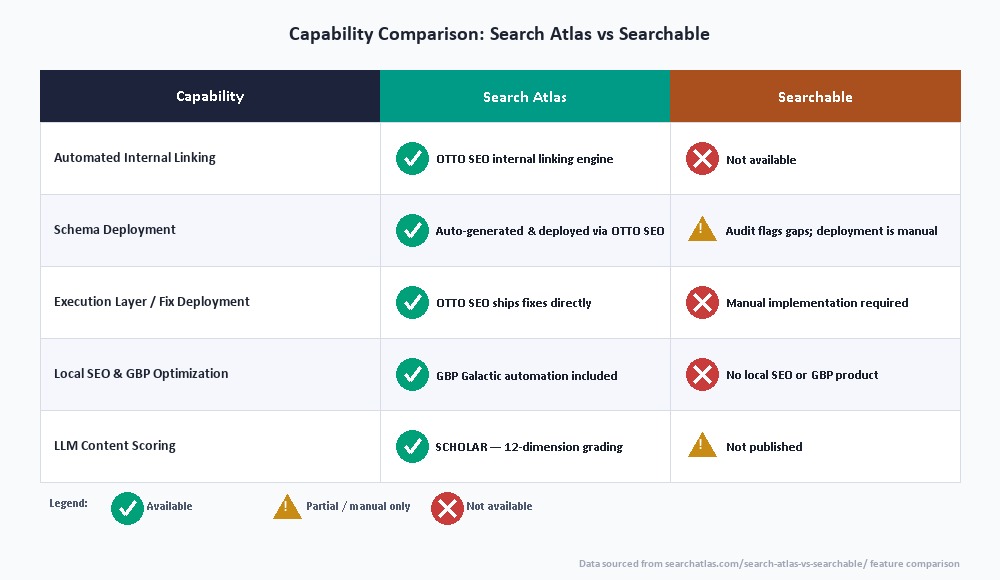
Searchable does not include keyword rank tracking, backlink research, or technical SEO auditing. The platform operates as a specialized AI-visibility analytics layer, not a full-service SEO suite. Several capabilities common to broader SEO platforms (including automated internal linking, schema deployment, entity-alignment scoring, and local SEO or GBP tooling) are not available.
What Does Searchable's Actions Feature Do?
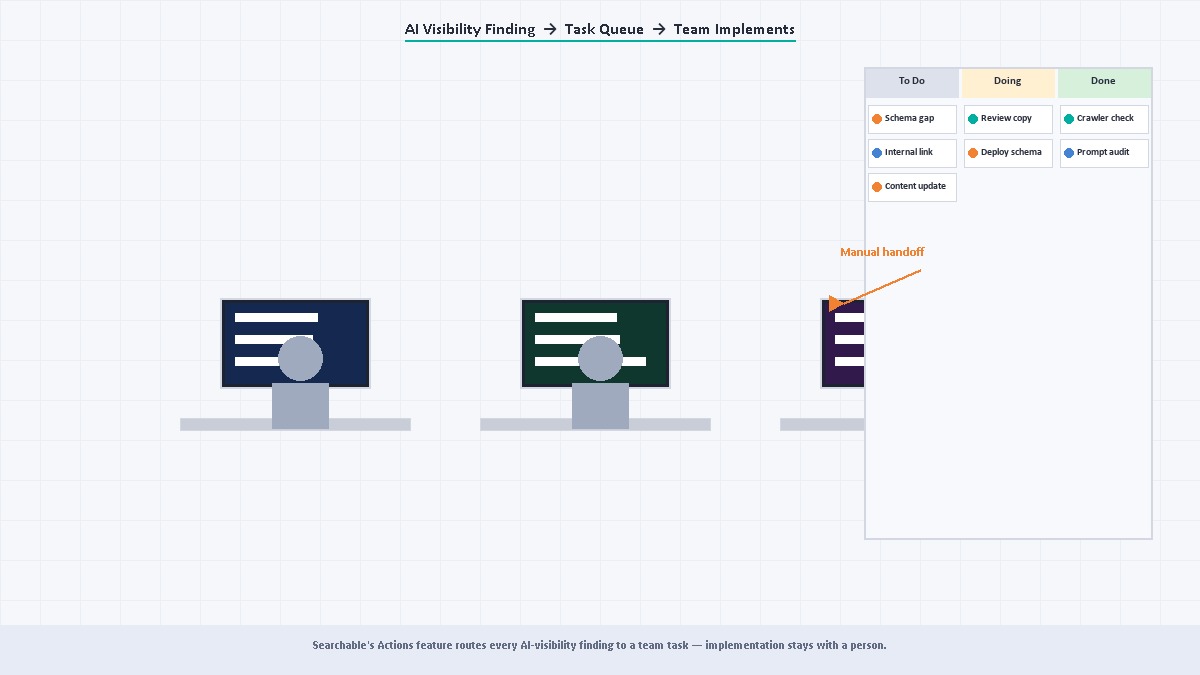
Searchable's Actions feature converts AI-visibility findings into a prioritized task list for a team to implement. Actions scores each finding as an Opportunity, ordered by impact and severity, and assigns it as a structured task. Teams can manage those tasks inside Searchable's dashboard or export them to Linear.
Actions does not publish changes to a website. Schema gaps flagged by the audit require manual deployment. Content updates drafted by the platform's content engine require a person to place them. Internal link improvements, if identified, route to the task queue rather than deploying automatically. The execution loop runs through a human handoff at every step.
Search Atlas OTTO SEO handles the equivalent category of work without that handoff: OTTO SEO ships rewrites, schema markup, and internal links directly to production through one pixel, with review and rollback built in. For a full feature-by-feature breakdown across both platforms, see the Search Atlas vs Searchable comparison.
What AI Engines Does Searchable Track?
Searchable tracks nine answer engines: ChatGPT, Google AI Overviews, Google AI Mode, Perplexity, Gemini, Copilot, Claude, Grok, and DeepSeek. Every published plan lists all nine, and teams select the engines to track during onboarding.
Search Atlas LLM Visibility tracks five platforms (ChatGPT, Gemini, Google AI Mode, Copilot, and Perplexity) on the Pro plan, at $319 per month billed annually.
What Are Searchable's Pricing Plans?
When checked on October 1, 2026, the product was live at searchable.com, which lists paid Pro and Business plans on its pricing page. The old searchable.ai domain redirects to a domain marketplace listing, and exact prices at searchable.com are JavaScript-rendered, so they could not be statically verified.
| What we verified | Detail |
|---|---|
| Vendor site | Live at searchable.com; searchable.ai redirects to a marketplace |
| Plans | Pro and Business plans listed; prices are JS-rendered and unverified |
This review describes the product as documented at searchable.com and flags that exact prices were not statically verifiable.
What Are the Pros of Searchable?
Pros and cons
Weigh Searchable’s strengths against its limits
Each point is explained in the pros and cons sections below.
Pros
- Focused scope
- Nine-engine coverage on every plan
- Linear export
- AI Crawler Setup
- Opportunity scoring
Cons
- No execution layer
- No keyword rank tracking
- No backlink or technical SEO features
- Prompt volume cap at entry tier
- No automated internal linking
- Schema deployment is manual
The pros of Searchable are listed below.
- Focused scope. Searchable's single-purpose design makes AI-answer monitoring fast to set up and easy to interpret for teams that need tracking data only.
- Nine-engine coverage on every plan. ChatGPT, Google AI Overviews, Google AI Mode, Perplexity, Gemini, Copilot, Claude, Grok, and DeepSeek are all listed from the entry Pro plan.
- Linear export. Teams already managing work in Linear can route Searchable's Opportunities directly into their existing workflow without a manual re-entry step.
- AI Crawler Setup. The platform verifies OAI-SearchBot and PerplexityBot access, a practical diagnostic before investing in broader AI-visibility improvements.
- Opportunity scoring. Actions ranks findings by impact and severity rather than presenting a flat list, giving teams a starting priority order.
What Are the Cons of Searchable?
The cons of Searchable are listed below.
- No execution layer. Every fix Searchable identifies (schema, content, internal links) requires a person to implement it. The platform stops at the task.
- No keyword rank tracking. Searchable does not monitor traditional search engine keyword positions.
- No backlink or technical SEO features. Site crawling, backlink research, and technical auditing are outside the platform's scope entirely.
- Prompt volume cap at entry tier. The entry Pro plan covers 100 tracked prompts, a narrow window for brands managing multiple topics, product lines, or markets.
- No automated internal linking. Searchable does not offer an automated internal linking engine: the capability is absent, not manual.
- Schema deployment is manual. Searchable's audit surfaces schema gaps as prioritized tasks; deploying the fix requires a person at every step. Search Atlas OTTO SEO auto-generates and deploys schema markup without a handoff.
What is the Best Alternative to Searchable?
Search Atlas is the best alternative to Searchable for teams that need AI visibility tracking connected to an execution layer. LLM Visibility covers five AI platforms on the Pro plan. OTTO SEO ships fixes (rewrites, schema, and internal links) directly to production without routing work through a task queue first.
Search Atlas Coworker runs the same category of actions from Slack, Teams, and ClickUp, and builds multi-step playbooks from a single prompt. Content Genius handles entity alignment and grades every draft across 12 SCHOLAR dimensions. QUEST, Site Explorer, and Site Auditor extend the platform into research, backlink analysis, and technical crawls up to 100 million pages per month, capabilities Searchable does not offer.
Migrate from Searchable to Search Atlas to close citation gaps directly instead of filing them as tasks.