Lindy: Cheap Agents Until Credits Run Out
Verdict: Great value agents until credit consumption outruns the sticker.
Lindy's per-user rates were read from lindy.ai, September 27, 2026.
Lindy's Automation Wins
- Ease of use
- Broad integration coverage
- Genuinely useful monitoring and reporting
- Fast setup for common automations
Lindy's Cost Traps
- Unpredictable cost at scale
- No native SEO or rank data
- Multi-step workflows are fragile
- Cancellation friction
| Job | How well Lindy handles it | Evidence in this review |
|---|---|---|
| Ops automations without developers | Well | No-code agents with broad integrations |
| Budget-certain heavy automation | Poorly | Credits scale costs unpredictably |
| SEO-specific data | Absent | No rank or keyword datasets |
Lindy builds no-code AI agents from $29.99 per user per month, priced on a credit allowance that rewards lean workflows.
What is Lindy.ai?
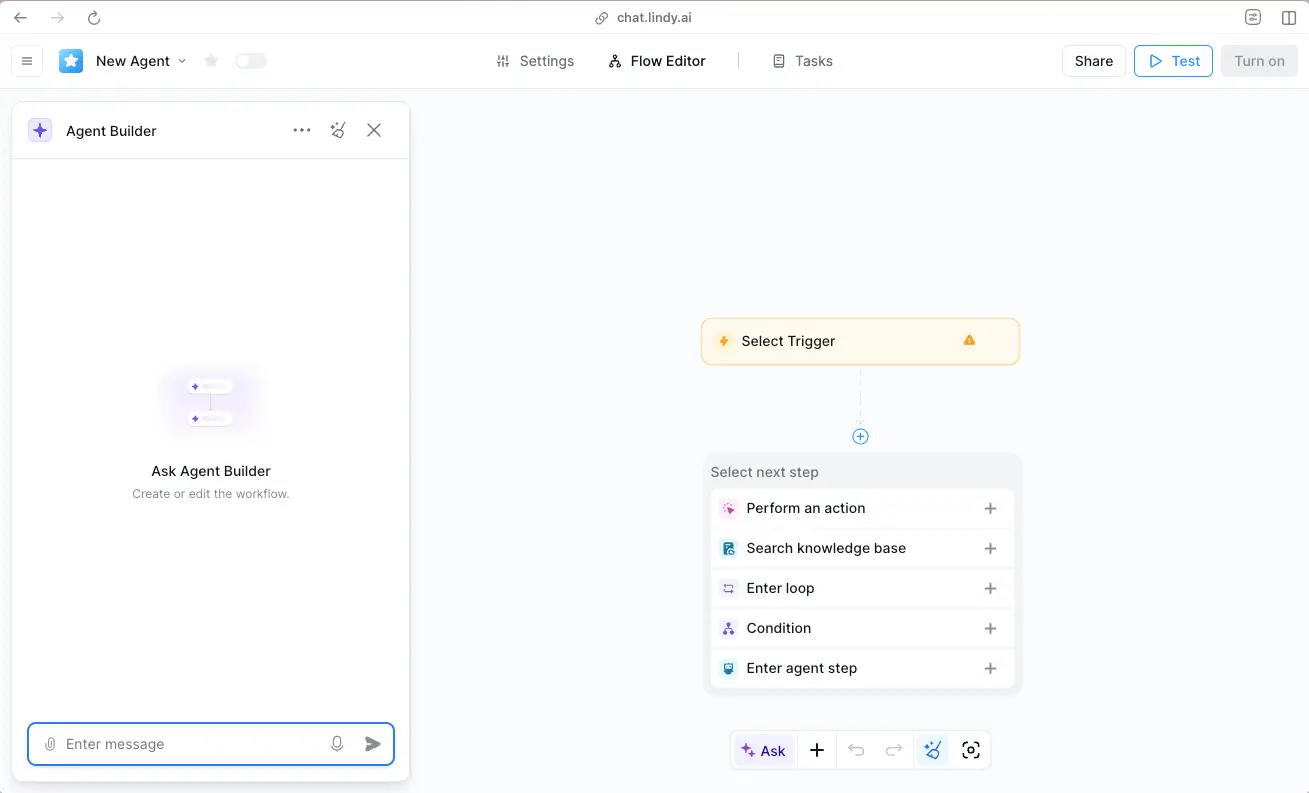 Via Lindy.ai
Lindy.ai is a no-code platform for building AI agents that run email, scheduling, meetings, and CRM tasks across connected apps. Its design is executive-assistant-first rather than discipline-specific. Lindy.ai's own homepage describes it as "a personal AI work assistant for inbox, meetings, calendar, scheduling, follow-ups, CRM updates, and ad hoc work across connected apps." SEO shows up as one workflow template among hundreds, not a core product line.
As a no-code agent builder, Lindy.ai sits in the broader category of general-purpose AI automation platforms, tools built for breadth across business operations rather than depth in any single discipline. Every Lindy.ai capability, from summarizing an inbox to updating a CRM record, is a workflow the user assembles from building blocks and connects to one of Lindy.ai's 200+ third-party integrations.
An agent builder is a platform for assembling custom AI workflows from triggers, actions, and third-party connections, rather than a product built around one discipline's own data. A general agent builder can be pointed at almost any task, including SEO, but it only performs as well as whatever the user wires into it.
What is the history of Lindy.ai?
Lindy.ai was founded by Flo Crivello, a former Uber product manager who previously built the remote-work startup Teamflow. Crivello started the company in late 2022, positioning it as an AI agent platform that could take over recurring knowledge-work tasks rather than just answer questions.
Lindy.ai raised a $50 million Series A led by Battery Ventures, with participation from Lightspeed Venture Partners and Coatue. Other backers include Andreessen Horowitz, Menlo Ventures, and Tiger Global.
Lindy.ai's most recent major release, often called Lindy.ai 3.0, added a natural-language agent-creation flow, sometimes described as "vibe coding." A user describes what they want automated in plain English, and Lindy.ai's builder generates the trigger, action, and integration steps behind it, rather than requiring the user to assemble each block by hand.
Who is Lindy.ai for?
Lindy.ai is built for individuals and small teams who want to automate recurring inbox, scheduling, and CRM work without writing code or hiring a developer. Its natural-language agent creation and template library make it approachable for non-technical users.
Lindy.ai is a weaker fit for teams that need a discipline-specific system of record, like SEO. That value comes from proprietary data, such as a keyword index, a SERP crawler, or a ranking history, not from connecting to apps the user already has. For that kind of work, Lindy.ai functions as a workflow layer on top of whatever data source gets wired in, not as the data source itself.
What are Lindy.ai's features?
Lindy.ai's platform centers on four components: the agent builder, natural-language agent creation, 200+ third-party integrations, and a library of pre-built workflow templates that includes the AI SEO Assistant. The features below cover how each one actually works.
1. Agent builder (workflow canvas)
The agent builder is Lindy.ai's core interface, a visual canvas where a user assembles triggers, actions, and connected-app steps into a working automation. A trigger might be a new email arriving or a calendar event starting. The actions that follow can draft a reply, update a CRM record, or post a message to Slack.
There's no pre-built orchestration layer for dependent, multi-step sequences. A workflow with several steps that each depend on the last one is only as reliable as the blocks the user chains together.
2. Natural-language agent creation
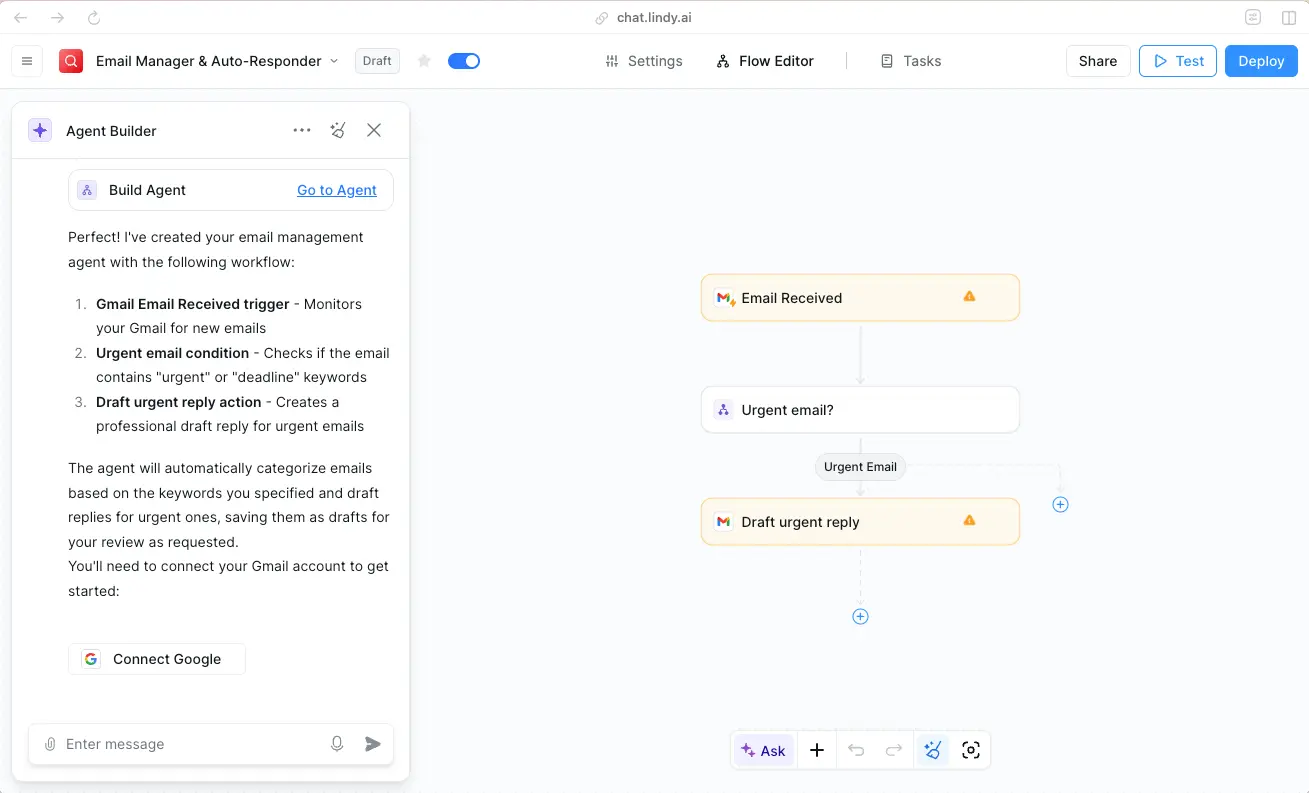
Instead of building an agent block by block, a user can describe the automation in plain English. Lindy.ai generates the trigger-action sequence from that description. Typing something like "read incoming sales emails and draft a reply" produces a runnable workflow with an email trigger and an AI-response action already wired in. The user can then edit or extend it on the same canvas.
 Via Lindy.ai
This lowers the setup barrier significantly for common jobs. It doesn't change what the underlying workflow can access: a generated agent still only reaches whatever apps and data sources are connected to the account. A prompt like "track my keyword rankings" produces a workflow shell, not a rank-tracking data source. Lindy.ai simply has none of its own to draw from.
3. 200+ third-party integrations
Lindy.ai connects to more than 200 apps, including HubSpot, Salesforce, Google Analytics, Google Search Console, Notion, Slack, and Zoom. These integrations supply whatever data or destination a workflow needs. They're what make the agent builder useful in practice: a monitoring workflow needs a connected Google Search Console account, a CRM update needs a connected HubSpot account, and so on. Every capability Lindy.ai has is downstream of one of these connections.
4. AI SEO Assistant template
The AI SEO Assistant is a pre-built, configurable workflow template, not a native SEO module built into the platform. It claims automated site audits, keyword clustering, rank tracking, and on-page optimization. That's the reason Lindy.ai surfaces in SEO-tool roundups and word-of-mouth recommendations. The vocabulary on the page, audits, clustering, rank tracking, reads like a purpose-built SEO product, even though the agent-builder architecture underneath it was built for a different job.
Where does Lindy.ai break for SEO work?
Lindy.ai breaks down on three specific SEO jobs, and all three trace back to the same root cause: an agent builder with no proprietary SEO data source underneath it.
1. No native rank tracking or SERP data
Lindy.ai has no SERP index or rank-tracking data of its own. Its own DataForSEO integration listing confirms it: "Streamline your Lindy.ai agents with reliable SEO data from DataForSEO. Whether you need real-time SERP results, keyword data, or backlink insights, you can plug our APIs directly into your automated workflows."
Setting that up means creating a separate DataForSEO account, generating API credentials, and wiring "pre-built DataForSEO Actions" inside a custom agent workflow just to get a ranked-keyword number.
A platform with no rank data of its own can't produce a real before-and-after rank-tracking result, because there's nothing native to measure against. That's the real reason the "Boost rankings 10x faster" and "Increase organic traffic 300%" claims on Lindy.ai's AI SEO Assistant page carry no citation, methodology, or case study.
2. Complex multi-step workflows fail
A real technical SEO fix runs through several dependent steps in order: audit the page, prioritize the fix by impact, apply the change, re-crawl to confirm it took, and watch for regression.
In Lindy.ai, each step is a separate block in the workflow builder. Each one consumes usage allowance, and each added step is a new place the workflow can break. There's no orchestration layer holding the sequence together the way a dedicated SEO agent would.
3. No content optimization or on-page intelligence
Lindy.ai's AI SEO Assistant page claims on-page optimization across titles, meta descriptions, H1 through H3 tags, FAQs, internal links, and entity coverage. None of it has a disclosed scoring system behind it. Without a grading layer benchmarked against live SERP data, the output is a list of suggested edits with no way to verify which ones would actually move a ranking before a human implements them.
What can Lindy.ai legitimately do for SEO?
Three SEO-adjacent jobs hold up well, and none of them require a native SEO data layer, which is exactly why they work better than the audit and rank-tracking claims do.
- Monitoring and alert workflows. Lindy.ai can watch a connected Google Analytics or Google Search Console account and post an alert to Slack when traffic or a tracked metric shifts. It's triggering on someone else's numbers rather than generating its own, so the alert is only as good as the underlying GA4 or GSC data feeding it.
- Content research and summarization. Lindy.ai can pull competitor pages or search results through a connected model and summarize them into a research brief, similar to how someone might use ChatGPT for SEO research prompts. The output stays a summary rather than a scored, SERP-benchmarked recommendation.
- Reporting tasks via connected apps. Lindy.ai can compile a weekly performance report by reading connected Google Analytics and Google Search Console data, drafting a summary, and dropping it into Slack or Notion on a schedule. It's the same reporting-automation pattern Lindy.ai applies to sales and recruiting workflows, just repointed at marketing data.
What is the price of Lindy.ai?
Lindy prices per user with a monthly credit allowance on every tier.
| Plan | Per user | Credits | Positioning |
|---|---|---|---|
| Plus | $29.99/mo | 3k | Everyday usage |
| Pro | $99.99/mo | 15k | Power users |
| Max | $199.99/mo | 35k | Heavy workloads |
Credits gate agent runs, so heavy automation can outpace the headline price quickly.
What are the pros of Lindy.ai?
Pros and cons
Weigh Lindy.ai’s strengths against its limits
Each point is explained in the pros and cons sections below.
Pros
- Ease of use
- Broad integration coverage
- Genuinely useful monitoring and reporting
- Fast setup for common automations
- No-code, so no developer required
Cons
- Unpredictable cost at scale
- No native SEO or rank data
- Cancellation friction
- No scoring behind on-page suggestions
- Multi-step workflows are fragile
- Wide rating disparity across review platforms
The pros of Lindy.ai are given below.
- Ease of use. Lindy.ai's most consistently repeated praise across reviews is how approachable it is for non-technical users, especially since the natural-language agent-creation flow removed the earlier requirement to hand-assemble every workflow block.
- Broad integration coverage. 200+ connected apps, which includes HubSpot, Salesforce, Google Analytics, Notion, Slack, and Zoom, cover most of the tools a small team already uses.
- Genuinely useful monitoring and reporting. Alert workflows and scheduled reports built on connected Google Analytics or Search Console data work as described and save real manual effort.
- Fast setup for common automations. Inbox triage, meeting notes, and CRM updates can go live in minutes through a template rather than a custom build.
- No-code, so no developer required. Every capability is assembled visually or described in plain English, which keeps automation in the hands of the person who wants it running.
What are the cons of Lindy.ai?
The cons of Lindy.ai are given below.
- Unpredictable cost at scale. The usage-allowance system is sold in relative multiples ("3x," "7x") rather than published credit counts, so cost at volume is hard to estimate in advance. This is the single most common complaint across user reviews.
- No native SEO or rank data. Lindy.ai has no proprietary keyword index, SERP crawler, or rank-tracking history, so any SEO workflow depends on a separate paid data connection like DataForSEO.
- Cancellation friction. Multiple user reports describe difficulty finding a cancel option inside billing settings, along with charges continuing after a cancellation attempt.
- No scoring behind on-page suggestions. The AI SEO Assistant's on-page recommendations aren't benchmarked against live SERP data, so there's no way to verify which suggested edit would actually move a ranking.
- Multi-step workflows are fragile. Each step in a dependent sequence is a separate block a person has to keep functional, since there's no orchestration layer holding the sequence together.
- Wide rating disparity across review platforms. A 4.9 out of 5 on G2 sits next to a sub-2 score on Trustpilot, and the negative reviews concentrate almost entirely on billing rather than the product's core functionality.
What do users say about Lindy.ai?
The split in Lindy.ai's reviews tracks almost exactly with what the reviewer was evaluating. On G2, reviewers praising the product focus on how quickly they got a working automation live and how little technical setup it required. One verified G2 reviewer summed it up: "Lindy is easy to use and astoundingly versatile."
On Trustpilot and in broader online discussion, the recurring complaints are about the bill. Usage allowances run out faster than expected, a single voice-call automation can burn a disproportionate share of a monthly allowance, and cancellation requests take longer or cost more than users expected. One Trustpilot reviewer described "$350 taken out of my account without my authorization." Very few complaints target the underlying automation quality itself.
Is Lindy.ai a scam?
No, Lindy.ai is a legitimate no-code agent-builder platform for inbox, calendar, and CRM automation, and its monitoring, research-summary, and reporting workflows genuinely work as described. The billing and cancellation friction in user reviews reflects real account-management problems, not evidence of fraud.
Separately, the AI SEO Assistant page is the part that doesn't hold up on its own claims. "Boost rankings 10x faster," "Increase organic traffic 300%," and "Save 20 hours weekly" appear with no citation, methodology, or case study behind any of them. The platform also has no native rank-tracking or SERP data source to have generated those numbers from in the first place.
What is the best Lindy.ai alternative for SEO?
The best alternative to Lindy.ai for SEO-driven workflows is Search Atlas. Where Lindy.ai is a general agent builder pointed at SEO tasks through manual configuration and a separate paid data connection, Search Atlas ships the SEO data layer, execution, and grading natively, run through Atlas Agent.
OTTO SEO deploys on-page and technical fixes live with rollback, and the Keyword Rank Tracker holds ranking history from Search Atlas's own SERP index rather than a bolted-on DataForSEO call.
Search Atlas Coworker reports back in Slack, Teams, or ClickUp before anyone has to ask. It's the same execution-first approach covered in how AI CMO platforms get ranked, running the work rather than just recommending it.
The scope goes past SEO, too. Search Atlas runs SEO, AEO, Google Ads, Meta Ads, content, and site health from the same dashboard, and repairs what breaks in any of those channels overnight. A team evaluating Lindy.ai for SEO is really deciding whether to keep assembling one workflow at a time, or hand the whole channel mix to a system built to run it.
Search Atlas starts at $99 per month, with published keyword, project, and seat quotas per tier, and a 7-day free trial.
Lindy.ai is a capable agent builder for the inbox-and-calendar work it was designed for. SEO needs its own data layer underneath it, whether that's a native SERP index or the kind of answer engine optimization signals now showing up in AI search results. A workflow bolted onto a general assistant can't replace that, no matter how it's configured.