An AI CMO for local SEO is an autonomous marketing system that runs Google Business Profile updates, citation accuracy, location page content, and local rank tracking across every store, branch, or franchise location without waiting for a person to approve each task. For a single-location business, most of that work fits on a weekly to-do list.
For a brand running fifty, two hundred, or two thousand locations, the same work multiplies by every address on the map and breaks any team that tries to keep up by hand. This piece is written for the marketing leader who owns that scale problem, covering what to decide, what to hand to the system, and what still needs a human signature.
What an AI CMO for local SEO actually does
An AI CMO for local SEO is the local-marketing layer of a broader autonomous marketing platform, not a separate product built only for franchises. It handles the same Google Business Profile, citation, content, and schema work that a local SEO specialist would handle manually. Still, it runs continuously across every location instead of waiting for a monthly audit or a quarterly agency report.
The distinction that matters to a CMO is execution versus reporting. A rank tracker reports that a location dropped out of Google's Local Pack. An AI CMO identifies the cause, checks the Google Business Profile, citations, reviews, and local SEO signals, then applies the appropriate fix before the next reporting cycle.
That difference compounds at scale. A single incorrect phone number at one data aggregator can propagate to hundreds of downstream directories across a franchise network within days. A marketing team checking listings by hand catches that kind of error weeks after it started costing calls. A system built to run continuously catches it inside the same refresh cycle it monitors rankings on, which is the practical reason franchise and multi-location brands are the buyers this model was built for.
None of this replaces judgment. It replaces the repetitive execution that consumes a local marketing team's week, the profile updates, the citation checks, the page-by-page schema audits, so that the humans on the team spend their time on positioning, franchisee relationships, and the decisions a system should not make alone.
Why local and multi-location SEO overwhelms a traditional marketing team
Multi-location SEO overwhelms a traditional team because every task a single-location business does once, a franchise brand does hundreds or thousands of times, on a schedule that never pauses. A regional restaurant chain with 300 locations does not have 300 separate SEO problems. It has one problem: keeping accurate, optimized, competitive local signals live everywhere, which scales linearly with headcount if a human has to touch every location.
Franchise marketing has an added wrinkle a single-location business never deals with: the split between brand-level control and local execution. Corporate marketing owns the national site and the brand voice. Individual franchisees or store managers, who often have no marketing background, own the day-to-day reality of their Google Business Profile, whether that means a real address, a new hours-of-operation schedule, or a review that needs a response.
What are the four systems a local AI CMO has to keep running?
A local AI CMO has to keep four interlocking systems running at once: Google Business Profile, NAP consistency and citations, location and service-area pages, and local business schema markup. Skip one and the others degrade, a broken citation drags down GBP trust signals, a thin location page drags down both.
1. Google Business Profile at scale
Google Business Profile signals carry the single largest share of local pack ranking weight, roughly 32% by most current studies, which makes GBP the highest-impact surface a local AI CMO runs. GBP Galactic is Search Atlas's system for this layer. It tracks profile completeness across every connected location through a task module that flags missing attributes, outdated service listings, and stale images location by location, and it generates AI-written, editable replies to reviews and Q&A entries so no profile sits unanswered while a corporate team is asleep.
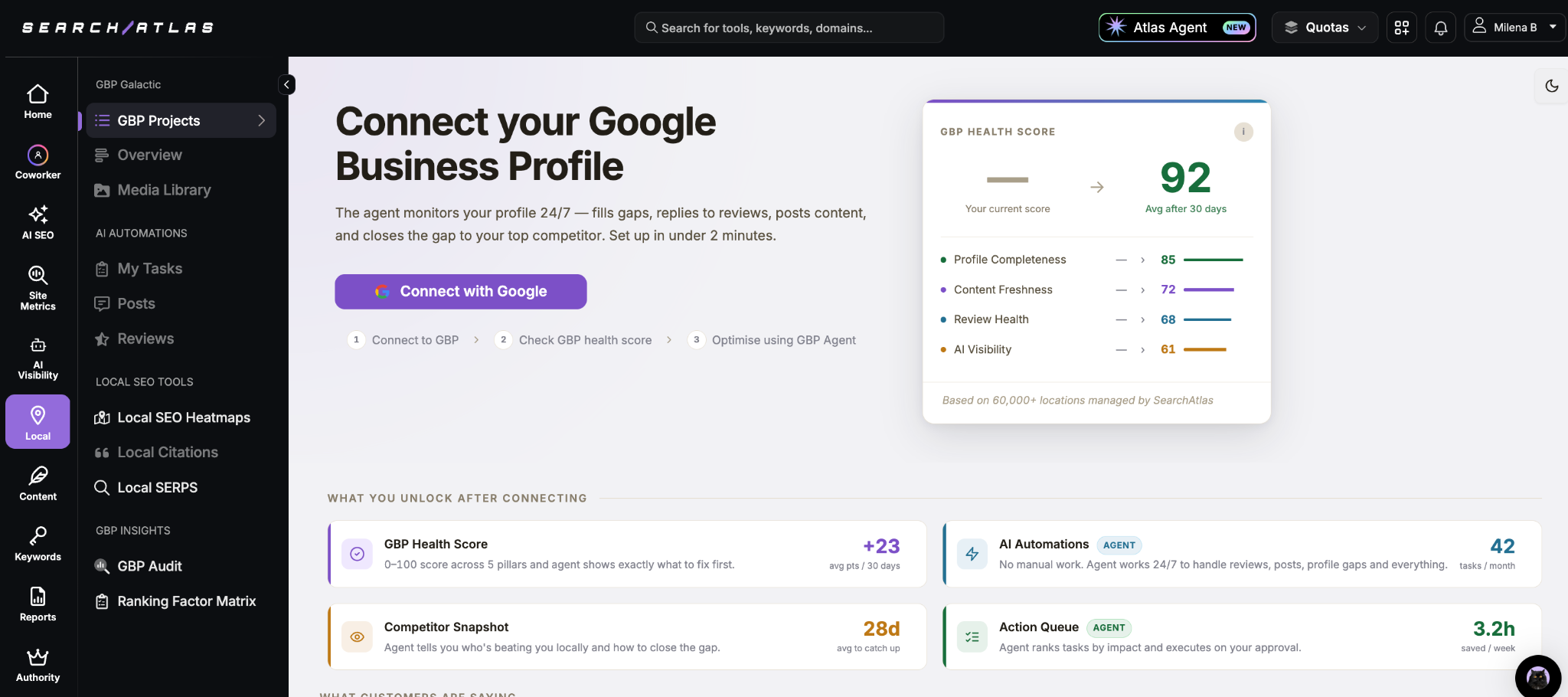
A complete GBP profile is not a cosmetic detail. Businesses with a fully filled-out profile are 70% more likely to attract a location visit and 50% more likely to be considered for a purchase than businesses with an incomplete one. Multiply that gap by three hundred locations and the revenue difference between "someone checks profiles quarterly" and "profiles stay complete continuously" becomes the whole argument for automating this layer.
2. NAP consistency and citation management
NAP consistency means a business's name, address, and phone number match exactly across every directory and citation source that lists it, and inconsistency is one of the few local ranking problems that gets worse the bigger a brand gets, since every new location is another record that can drift.
Local Citation Builder distributes verified business data across five major data aggregator networks: Data Axle, Foursquare, Neustar Localeze, Yellow Pages Network, and GPS Network, and enforces that the record at each one matches the primary source rather than waiting for a location manager to notice a stale listing.
This is where a lot of franchise brands still rely on point tools that only sync data one direction or require a recurring subscription per location just to keep it accurate. A citation platform that treats accuracy as a one-time submission instead of an enforced standard leaves a brand exposed every time an aggregator resyncs from an outdated source.
3. Location and service-area pages
A location page is a dedicated page on the brand's website built to rank that specific address for its local market, and a service-area page does the same job for a business that serves a radius rather than a storefront. Franchise SEO generally runs on a hub-and-spoke model: one national site builds brand authority, and every location or service-area page acts as a local spoke competing for its own map pack and organic results.
A deeper walkthrough of building these pages at scale lives in multi-location SEO strategies, and the page-level content patterns that convert are covered in service pages that boost local SEO traffic.
The CMO-level decision here is deciding the template, the required fields, and the review process that keep three hundred location pages from reading like three hundred copies of the same paragraph with a city name swapped in, which is exactly the pattern search engines are built to discount.
4. Local business schema markup
Local business schema markup is structured data, written in a format called JSON-LD, that tells search engines and AI systems the exact name, address, hours, and service area of a business in a machine-readable way, rather than leaving that information for a crawler to infer from page text.
Search Atlas's Schema Markup Generator supports a LocalBusiness template alongside Organization, Product, Review, and FAQ types, with automatic version updates aligned to current Google documentation and injection through the OTTO so a schema fix goes live without a developer ticket.
At single-location scale, schema markup is a one-time setup task. At franchise scale, it is hundreds of near-identical templates that all need the same fields kept current when a location changes its hours or adds a new service, which is exactly the kind of repetitive, rules-based work an autonomous system should own instead of a person doing search-and-replace across a spreadsheet.
Why local rankings alone no longer capture visibility
A local business can rank at the top of Google's map pack and still be invisible to a customer who asks ChatGPT or Perplexity for a recommendation instead. That gap is now measurable. AI visibility runs on a different and considerably harder standard than traditional local search.
Three factors decide which businesses clear that bar:
- Data accuracy. Business information was only about 68% accurate when surfaced by ChatGPT and Perplexity, compared with close to 100% for Gemini, which pulls directly from Google Maps data. The businesses whose GBP, citation, and website data agree everywhere are the ones AI systems can cite with confidence, and the ones with fragmented data get skipped rather than guessed at.
- Review quality. Locations that AI systems actually recommended averaged 4.3 stars, and brands below roughly 4.0 stars with thin review-response rates were effectively invisible to these systems regardless of how they ranked organically.
- Cross-platform consistency. A location's data has to agree across Google Maps, the brand website, and the review platforms an AI model draws from, not just the one directory a marketing team happens to check most often.
For a CMO, AI-answer visibility runs on the same clean-data foundation, GBP, citations, schema, and reviews, that traditional local rankings already depend on. Getting the foundation right earns visibility in both places at once, and neglecting it costs a brand ground in both places at once.
What an AI CMO decides and what gets delegated to the system
An AI CMO governing a multi-location or franchise SEO program has to draw one dividing line, once, before turning a system loose across every location: what stays automated execution and what requires human judgment.
Four decisions belong to the AI CMO and cannot be handed to an autonomous system:
- The brand voice and escalation rules that govern every automated review reply, GBP post, and Q&A answer, so a system knows what tone to use and what topics require a human before anything publishes.
- The location page template and required fields, so three hundred pages read as genuinely local rather than as a mail-merge with a city name changed.
- The primary source of truth for NAP data, meaning which system holds the canonical name, address, and phone number that every citation and profile update gets checked against.
- The KPI the local program is actually optimizing for, whether that is map pack visibility, AI-answer citation rate, foot traffic, or franchisee-reported lead volume, since a system without a defined target will default to optimizing the easiest metric to move.
Everything downstream of those four decisions, the actual GBP updates, the citation submissions, the schema field maintenance, the routine review replies, is exactly the repetitive, rules-based execution an autonomous system should own.
For the execution-level detail on how that agentic workflow actually runs, including how an agent decides when a ranking drop or a citation error crosses its action threshold, agentic local marketing covers the practitioner playbook this piece does not repeat.
How to evaluate an AI CMO platform for a franchise or multi-location brand
A CMO evaluating platforms for this job should work through a short, concrete checklist rather than a feature comparison sheet, since most local SEO platforms will claim the same capabilities in a sales deck.
- Confirm the platform updates listings directly through the Google Business Profile API, not through a static report a location manager has to act on manually. A platform that only surfaces recommendations still leaves the execution gap the whole model is meant to close.
- Check how many verified data aggregator networks the citation system actually submits to, and whether corrections happen on a defined cycle or only when someone notices an error. Search Atlas's Local Citation Builder submits to five verified networks and revalidates data within the same aggregator on every update.
- Ask whether heatmap or rank-tracking data ties back to the same dashboard as GBP and citations, or lives in a separate tool that requires manual cross-referencing. Local SEO Heatmaps track map pack position by keyword and geographic pin, refreshed daily, weekly, or monthly, inside the same system that manages the profile and citation layers it reports on.
- Verify the platform supports LocalBusiness schema specifically, not just generic Organization markup, and confirm updates deploy without a developer dependency.
- Ask what happens when the platform is wrong. Every automated system eventually flags something incorrectly. The relevant question is whether the escalation path routes to a human quickly or silently applies a bad fix across every location at once.
A brand comparing this model against a listings-only platform or a citations-and-tracking specialist will find both stop at data synchronization or static reporting. Neither writes review replies, builds service-area pages, or updates schema without a separate tool bolted on, which is the gap an integrated AI CMO closes by running all four systems from one source of truth.
What changes in the first 90 days
The first ninety days of running an AI CMO for local SEO are mostly about setting the four governance decisions above. Weeks one and two go to auditing current NAP accuracy across every location and correcting the aggregator-level records that are already wrong, since starting an automated system on top of bad source data just automates the errors faster.
Weeks three through six typically go to building or repairing the location and service-area page template, deploying LocalBusiness schema across every location, and setting the review-response and escalation rules the system will operate under going forward. By week eight or so, most brands see GBP task completion rates across the network climb toward full completeness, since that queue empties fast once a system is working through it continuously instead of whenever a regional manager has spare time.
The rankings and AI-visibility gains follow the data cleanup, not the other way around. A franchise brand that spends its first quarter getting NAP, GBP, schema, and reviews consistent across every location is the brand that shows up cleanly in both the map pack and the next AI-generated answer, because by that point there is nothing inconsistent left for either system to skip over.