Agentic local marketing is the location-based execution channel inside agentic marketing, closely tied to agentic digital PR for citation and authority signals. It uses autonomous AI agents to execute Google Business Profile optimization, citation management, and heatmap-based rank tracking as an interconnected system, not as separate manual tasks. Unlike AI-assisted tools that respond to user prompts, agentic systems monitor ranking signals continuously, decide what actions to take based on defined conditions, and apply changes without step-by-step human direction.
This article explains how each component works, how they connect, and how to configure an agentic local workflow using OTTO SEO and GBP Galactic.
What does “Agentic” mean for local marketing?
An agentic system is software that independently plans, decides, and executes multi-step tasks toward a goal without requiring a human to direct each step. In local marketing, that means an agent monitors GBP profile signals, citation accuracy, and heatmap ranking data, then acts on gaps or drops without waiting to be prompted.
How do agentic systems differ from AI-assisted local SEO tools?
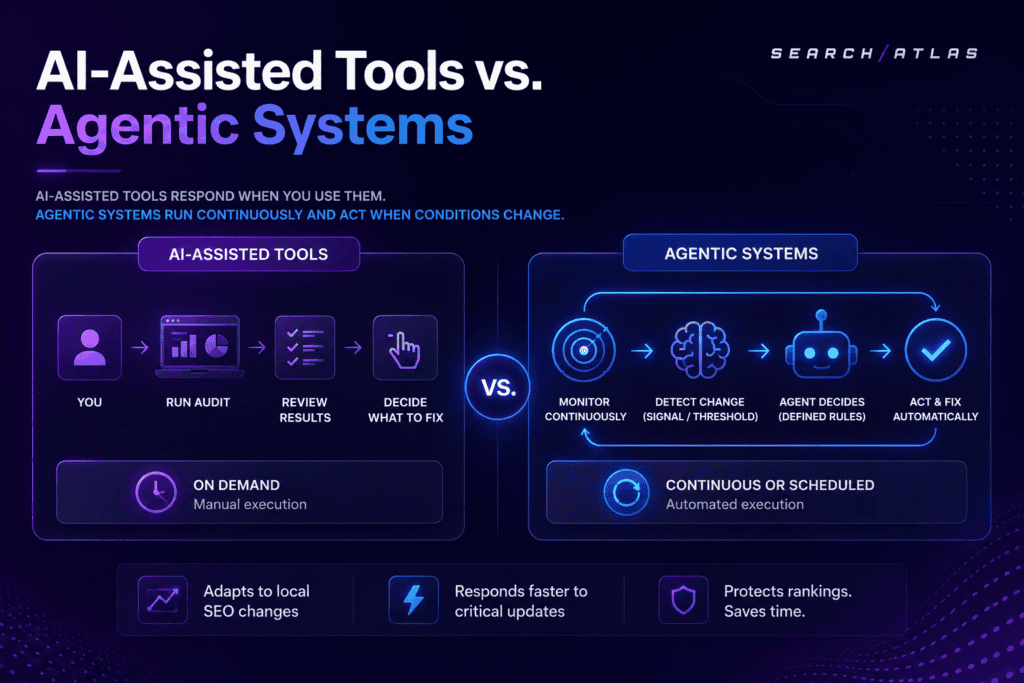
AI-assisted tools respond when you use them; agentic systems run continuously and act when conditions change. With an AI-assisted tool, you log in, run a citation audit, review the results, and decide what to fix. An agentic system runs that audit on a schedule, compares results against a defined baseline, and submits corrections automatically.
| Characteristic | AI-assisted tool | Agentic system |
| Triggered by | User action | Signal or threshold |
| Decision-making | Human reviews and acts | Agent acts within defined rules |
| Execution | Manual | Automated |
| Scope | Single task | Multi-step workflow |
| Frequency | On demand | Continuous or scheduled |
The distinction matters because local SEO signals change continuously. A citation error introduced by a data aggregator sync, a drop in Map Pack position across a specific geographic radius, or an unanswered Q&A item on a GBP profile all require faster response than a weekly manual audit provides.
What signals trigger an agent to act?
An agent acts when it detects a discrepancy between the current state and a defined target. For local marketing, triggering signals fall into three categories:
- Profile signals: Missing attributes, outdated service listings, unanswered Q&A items, or images below a defined quality or volume threshold.
- Citation signals: NAP data that does not match the primary source record across one or more aggregator networks or directories.
- Ranking signals: A heatmap pin showing a position drop below a defined Map Pack threshold for a target keyword and geographic point.
These signals come from continuous data pulls tied to the connected tools, not from a user opening a dashboard.
How do autonomous agents manage Google Business Profile?
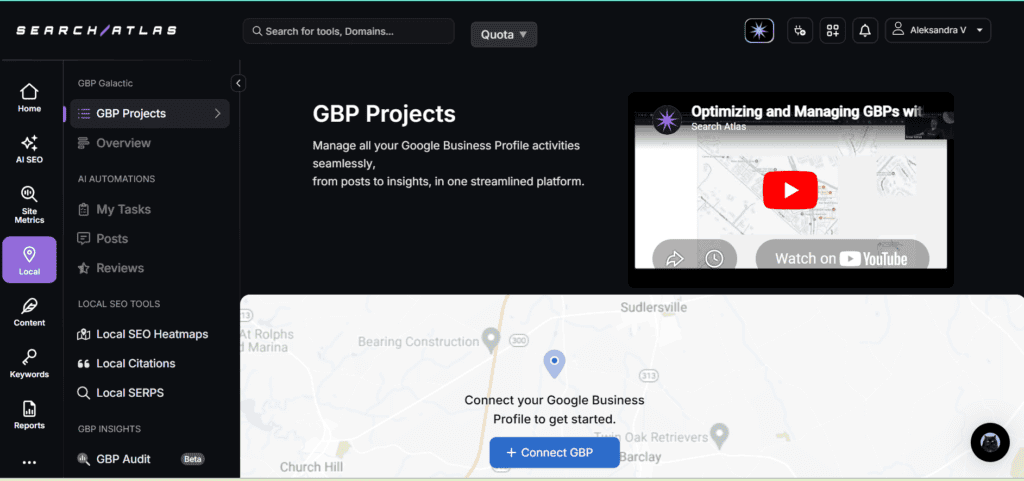
GBP Galactic is an AI local SEO automation system inside Search Atlas that manages, optimizes, and scales Google Business Profiles across multiple locations by synchronizing business data, updating listings, and automating reviews and Q&A in real time.
Monitoring profile completeness and filling gaps automatically
GBP Galactic tracks profile completeness through a “My Tasks” module that identifies specific missing attributes across all connected locations: images, service updates, business descriptions, category assignments, and service area definitions for non-storefront businesses. When a gap is detected, the module surfaces the specific location and field that needs attention.
For multi-location businesses, this runs across all profiles simultaneously. A missing attribute on one of 50 locations does not require checking each profile manually. The agent identifies which location, which field, and what is missing.
Automated post scheduling and Q&A management
GBP Galactic generates and schedules GBP posts and Q&A entries with AI-written drafts that can be edited before publishing. Posts created through GBP Galactic are distributed automatically to connected Facebook and Instagram accounts, so a single GBP content update reaches social channels without a separate workflow step.
Q&A generation is proactive: the agent creates relevant Q&A pairs based on business category, service listings, and existing GBP data before users ask questions. This populates the profile signal and pre-answers common queries visible directly in search results.
Review response generation and escalation thresholds
GBP Galactic generates AI-written replies to incoming reviews, editable before posting. The agent handles standard review responses, acknowledging positive feedback or addressing common complaints with configured logic, but escalation conditions must be defined at setup.
Escalation is the boundary between what agents handle autonomously and what requires human judgment. Reviews containing disputes, legal language, specific complaints that require operational verification, or sensitive content should route to a human reviewer before any response posts. These conditions are configured in advance. The agent does not determine escalation criteria on its own.
How do agents monitor and build citations?
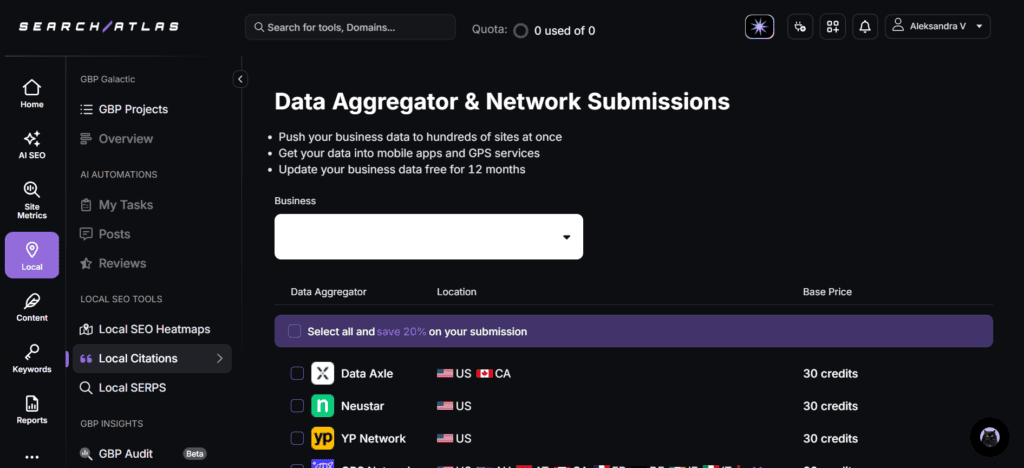
Local Citation Builder automates the distribution and accuracy enforcement of business data (Name, Address, Phone) across five verified data aggregator networks: Data Axle, Foursquare, Neustar Localeze, Yellow Pages Network, and GPS Network.
NAP consistency checks across directories
NAP consistency means the business name, address, and phone number match exactly across every directory listing. Aggregator networks propagate business data to hundreds of downstream directories, so a single incorrect record at the aggregator level creates inconsistencies across many listings simultaneously.
Local Citation Builder connects to the five major aggregators and verifies that the NAP data in each network matches the primary source record in Search Atlas. Local Citation Builder discrepancies trigger a correction workflow rather than waiting for the next manual audit cycle.
Gap detection and submission workflows
A citation gap is a missing business listing in a target aggregator network. Local Citation Builder closes gaps through a four-stage submission workflow:
- Initial Data Check: Verifies that the business data in Search Atlas is accurate and complete before any submission begins. Errors caught here prevent incorrect data from propagating to all five networks.
- Submission Phase: Transmits validated NAP data, business category metadata, and website URL to the selected aggregators. Submitting to all five costs 120 Hyperdrive credits (30 per aggregator).
- Quality Assurance Phase: A compliance review confirms that the submitted data meets each aggregator’s format and accuracy requirements.
- Reporting Phase: Generates a campaign report with live listing URLs for each submitted record.
Each submission includes 12 months of free updates. If business data changes within that window (a new phone number, address correction, or category update), the correction propagates to all five aggregators without additional credit cost. This removes the manual re-audit step that would otherwise follow any business data change.
What do local rank tracking heatmaps feed into the agent loop?
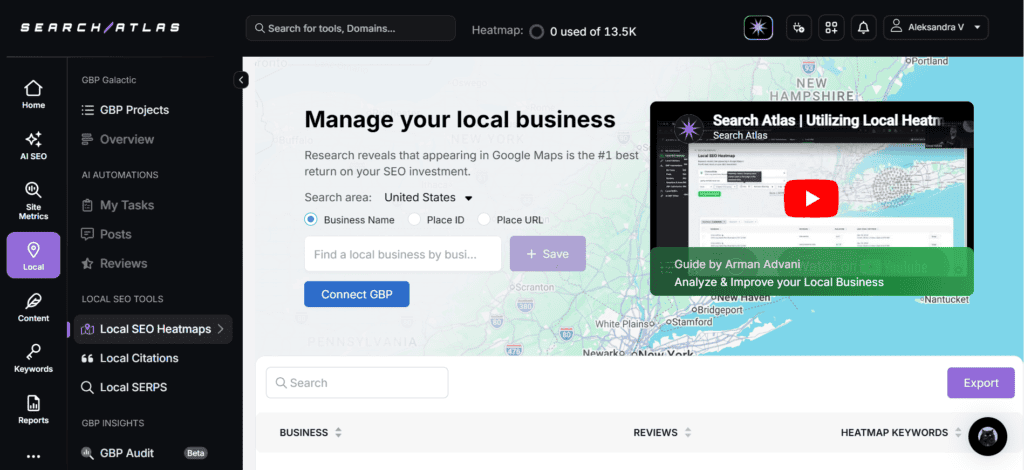 Optimize your local SEO with Search Atlas’s advanced tools and Google Maps data.
Local SEO Heatmaps visualize Map Pack ranking positions for a target keyword across a geographic grid, with each pin representing a physical search location and its current position in local results. This gives the agent spatially specific ranking data rather than an average position across an entire region.
How do heatmaps measure geographic ranking variance?
Geographic ranking variance is the difference in the Map Pack position a business holds, depending on where within its service area a search originates. A business that ranks in the top three from its address location may rank outside the top 10 from a point two miles away for the same keyword.
Heatmaps measure this by placing simulated search points across a configured grid (up to 175 pins per heatmap) and pulling live Map Pack data for each point. The resulting visualization shows where the business has strong local visibility and where it falls off, which is the geographic input the agent uses to prioritize optimization work.
Configuration options control what the data captures: refresh cadence (daily, weekly, or monthly), device segmentation (desktop or mobile), and coverage shape (circle or rectangle). Smart Suggest uses AI to recommend relevant local keywords from the GBP category and business data, reducing the work of identifying what to track in a new market.
How does heatmap data trigger agent actions?
Heatmap data feeds into GBP Galactic as a ranking signal that determines which optimization actions are most urgent. A pin showing a position drop in a specific area triggers the agent to check whether GBP content for that area (service area definitions, category attributes, relevant posts) is complete and accurate.
The connection between the heatmap signal and GBP action creates the feedback loop: a position drop in a defined radius prompts profile and content checks, which, when corrected, feed back into improved heatmap readings on the next refresh. This differs from reviewing heatmap data manually and then deciding separately what to investigate. The Local SEO agent connects the ranking signal to the relevant action category automatically.
How do GBP, Citations, and Heatmaps function as a feedback loop?
The three components operate as an interconnected system where each produces signals that the others act on. GBP profile completeness and citation accuracy are both inputs to local prominence, which is one of the three factors (alongside relevance and proximity) that determine Map Pack position. Heatmap data tracks the output of those inputs across the service area geography.
When heatmap positions drop in a specific area, the agent traces back to whether the issue is a profile completeness gap, a citation inconsistency, or a content coverage problem for the affected location. When corrections are applied, the next heatmap refresh captures whether the position moved. Any position drop detected in that refresh restarts the diagnostic cycle.
Without heatmap data, there is no geographic feedback on whether GBP and citation work is producing ranking movement in specific service areas. Without citation accuracy, GBP completeness alone is insufficient to build prominence signals. Without GBP content and profile completeness, citation volume does not compensate. The system requires all three components to function as intended.
How to set up an agentic local marketing workflow with OTTO SEO and GBP Galactic?
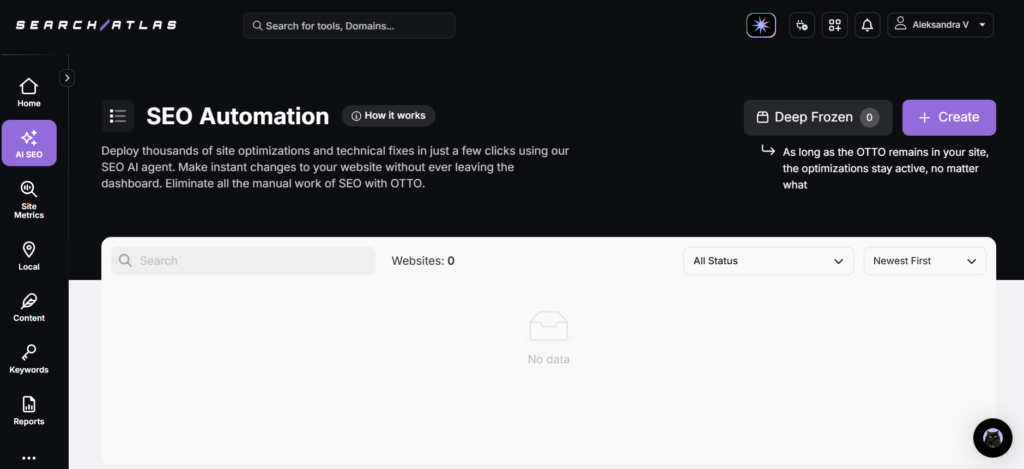
OTTO SEO is an AI autopilot SEO agent that deploys live page modifications via a single JavaScript pixel across any CMS, covering local SEO tasks (GBP posts, Q&A, reviews, citations) alongside on-page and technical SEO, all from one dashboard. It saves 90% of manual SEO labor by completing work that previously required SEO specialists, developers, and content writers in minutes.
- Install the OTTO pixel. Add the OTTO SEO JavaScript pixel to the target website. The pixel connects the site to OTTO’s automation layer without CMS-specific modifications or developer access.
- Connect Google Search Console. OTTO requires an active GSC connection to prioritize which optimizations to apply first. Local queries with low CTR or declining positions are surfaced as priority actions before broader site changes.
- Configure the Knowledge Graph. Enter business name, address, phone, categories, service areas, and target audience into OTTO’s Knowledge Graph. This is the source OTTO references when generating local content, schema updates, and GBP posts. Accuracy here determines accuracy across all automated outputs.
- Connect GBP Galactic to your locations. Link each Google Business Profile location inside GBP Galactic. The “My Tasks” module surfaces profile completeness gaps across all connected locations immediately after connection.
- Run Local Citation Builder for each location. Submit NAP data to all five aggregator networks using 120 Hyperdrive credits per location (30 per aggregator). The 12-month free update window activates on submission, so subsequent data changes propagate without additional credit cost within that period.
- Configure Local SEO Heatmaps. Access heatmaps through GBP Galactic under Local SEO Tools. For each target service area, use Smart Suggest to identify relevant keywords, then configure the grid shape, pin density, and refresh cadence. Daily refresh is appropriate for competitive local markets where rankings shift frequently. Weekly is sufficient for lower-competition service areas.
- Define review escalation rules. Specify which review categories route to human review before the agent posts a response. At minimum: reviews with high-severity negative sentiment, reviews mentioning specific complaint categories tied to operations or legal, and any review containing compliance language.
- Review the first OTTO deployment batch. Before enabling full autonomous deployment, use OTTO’s review-before-deployment mode to inspect the first round of proposed changes. Confirm the change categories are correct, then enable selective automation for the task types you are confident delegating.
What agentic local marketing cannot automate yet?
Agentic systems handle signal detection, data distribution, and repeatable response tasks reliably. They do not handle the judgment calls that require contextual business knowledge or real-time human verification.
Review disputes and escalations
An agent generates a response draft, but deciding whether to acknowledge a complaint, initiate a dispute, or escalate to an operations or legal team is a human call. Escalation rules defined at setup control what gets surfaced, but the decision on disputed content stays with a human reviewer.
Service area strategy changes
Expanding or contracting service areas in GBP determines which search queries a business is eligible to appear for. That decision involves business capacity and market strategy, not ranking signals alone.
Primary category selection
GBP primary and secondary category assignments directly affect which queries trigger a listing in local results. An agent can flag a missing category, but selecting the correct primary category requires knowledge of the business’s actual service scope and how Google interprets that category against local query patterns.
NAP conflict resolution when the source data is inconsistent
If business data contains conflicts within Search Atlas (multiple addresses across locations, outdated phone numbers, variant business names), the agent distributes whatever data is in the system. Data accuracy upstream is a human responsibility before any automated submission runs. An agent that submits incorrect NAP data to all five aggregator networks distributes that error at scale.
The operating limit of agentic local marketing is the accuracy of its inputs. Agents amplify what the data says. Correct, complete, consistently maintained source data is what agentic systems multiply into scale. Multi-location and ecommerce brands running this stack alongside paid and content execution are covered in AI CMO for Ecommerce Brands.
Related Reading
- What is Agentic Marketing? Definition, Components, and Execution Model
- Agentic Digital PR
- AI CMO for Ecommerce Brands
FAQ
Is agentic local marketing the same as local SEO automation?
These are related but distinct. Automation applies predefined rules to known tasks. Agentic systems determine what to prioritize and act on based on live signals, without a human defining each action. The difference is whether the system decides what to do, not just how to do it.
What is the difference between a GBP listing and a citation?
A GBP listing is your business profile on Google, managed through Google Business Profile. A citation is a mention of your business’s NAP data on an external directory or aggregator network. Citations reinforce the prominence signal Google uses in local ranking; the GBP listing is the presence signal those citations point to.
Does GBP Galactic post review responses automatically, or does a human always approve first?
GBP Galactic generates AI-written review responses that are editable before posting. Whether a response posts automatically or routes to human review depends on the escalation rules configured at setup. Reviews outside the defined escalation conditions can post automatically; reviews that meet an escalation condition queue for human approval.
What happens when Local Citation Builder detects a NAP discrepancy after the initial submission?
Corrections within the 12-month update window are resubmitted to the affected aggregator networks without additional Hyperdrive credit cost. The tool runs the same four-stage workflow (data check, submission, quality assurance, reporting) for the corrected data.
Can OTTO SEO handle local SEO and technical SEO from the same dashboard?
Yes. OTTO SEO covers local SEO (GBP posts, Q&A, reviews, citations), on-page SEO (titles, descriptions, headings, internal links), technical SEO (canonical tags, indexing, Open Graph), and off-page SEO (press releases, cloud stacks) from a single dashboard connected via the OTTO pixel.