Agentic digital PR is one execution channel inside agentic marketing, alongside agentic content marketing and agentic local marketing. It is the practice of using autonomous AI agents to execute the full digital PR pipeline: discovering link and coverage opportunities, qualifying journalist targets, generating and sending pitches, and tracking placement outcomes, all without human intervention at each step. It differs from using AI tools within a PR workflow, where a human still decides when and how each tool is applied. Because earned coverage now affects both traditional search rankings and the probability of appearing in AI-generated answers, how that coverage is acquired has become a practical SEO consideration, not just a PR one.
What the agent controls vs. what still requires human judgment
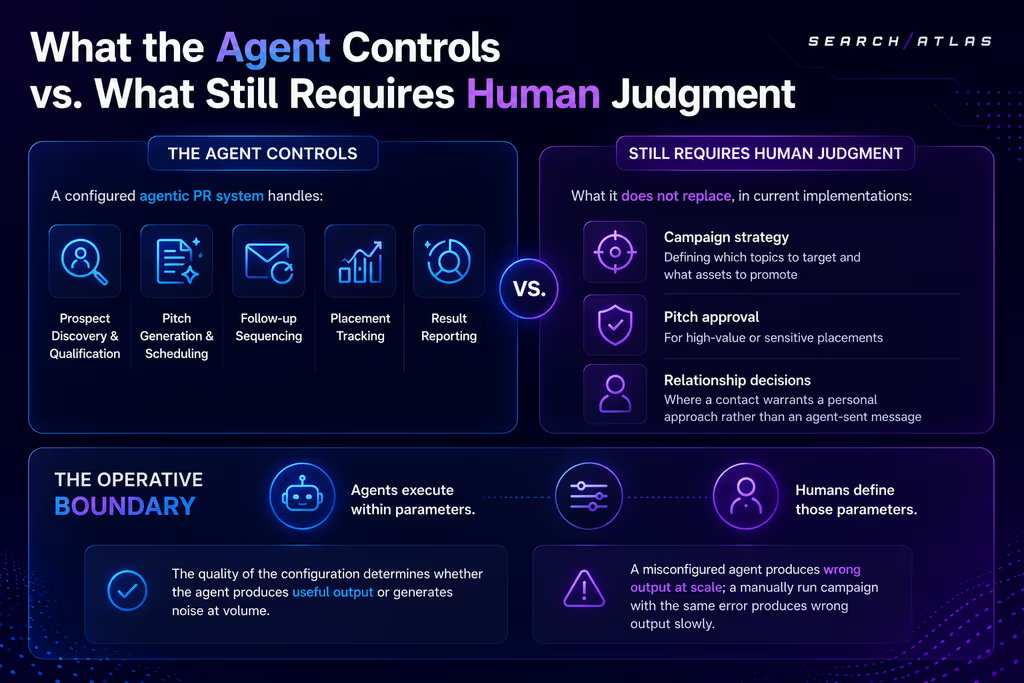
A configured agentic PR system handles: prospect discovery and qualification, pitch generation and scheduling, follow-up sequencing, placement tracking, and result reporting.
What it does not replace, in current implementations:
- Campaign strategy (defining which topics to target and what assets to promote)
- Pitch approval for high-value or sensitive placements
- Relationship decisions where a contact warrants a personal approach rather than an agent-sent message
The operative boundary: agents execute within parameters. Humans define those parameters. The quality of the configuration determines whether the agent produces useful output or generates noise at volume. A misconfigured agent produces wrong output at scale; a manually run campaign with the same error produces wrong output slowly.
AI-assisted PR vs. agentic PR: where the line is
The distinction is not about which tools are used. It is about who initiates each step.
| AI-Assisted PR | Agentic PR | |
| Who initiates each step | Human | Agent (after setup) |
| Decision scope | Individual task | Multi-step pipeline |
| Output type | Drafts, suggestions, lists | Executed outreach with tracking |
| Human involvement | Required per action | Required at setup and review |
| Primary failure mode | Human bottleneck | Misconfigured parameters |
AI features in platforms that handle prospecting, relationship tracking, or pitch drafting are AI-assisted: they accelerate discrete tasks on request. An agentic system connects those tasks and runs the sequence without a human triggering each one. Conflating the two leads to over-attributing capability to AI-assisted tools and under-configuring truly agentic ones.
How AI agents source link and coverage opportunities
AI agents find link and coverage opportunities by running structured discovery across search results, publication indexes, and journalist contact databases, then applying qualification rules to filter prospects before they reach the outreach queue.
Prospect discovery: SERP Analysis, journalist beat matching, and opportunity classification
Discovery runs three parallel processes.
1. Publication and content mapping. The agent scans search results for the target topic to identify which publications rank for related queries, what content formats are earning links in the space, and which editorial voices are actively covering the territory. This produces a current landscape of active publications and authors, not a static contact list pulled from a database.
2. Beat matching. The process of cross-referencing the pitch topic against a journalist's documented coverage history to estimate editorial fit. A pitch on AI and SEO carries a higher probability of engagement when sent to a journalist who has published on search marketing tools in the past 60–90 days, compared to one whose last relevant piece was eighteen months ago. Agents can execute this check across hundreds of contacts in the time a human would evaluate a dozen. The output is a filtered list weighted toward contacts with active, relevant beat coverage.
3. Opportunity classification. Sorting prospects by placement type. A technology news outlet expects a news-peg pitch tied to a specific development. A resource library expects a content addition request. A data journalism outlet wants an original dataset or study angle. Classifying by type before drafting begins means the pitch format can be matched to editorial preference rather than defaulting to one generic template.
Qualifying prospects: the signals agents use to rank opportunity quality
After discovery, the agent scores each prospect against thresholds set during campaign configuration. The signals typically weighted are:
- Domain Power, the authority score of the referring domain
- Topical relevance, how closely the publication's indexed content matches the campaign topic
- Editorial fit, whether the publication publishes the content format being pitched
- Contact accuracy, whether a current, valid journalist or editor is associated with the opportunity
Prospects that fall below the configured thresholds are filtered before any pitch is drafted. This is the phase that produces the largest time saving over manual outreach: high-volume discovery followed by precise filtering means the outreach queue contains only actionable targets.
Search Atlas Backlink Research provides the link intelligence layer for this step, including Domain Power scores, anchor text distribution, new and lost domain trends, and spam link detection, giving teams an accurate baseline for calibrating qualification thresholds before the agent runs.
How agents draft and send journalist pitches
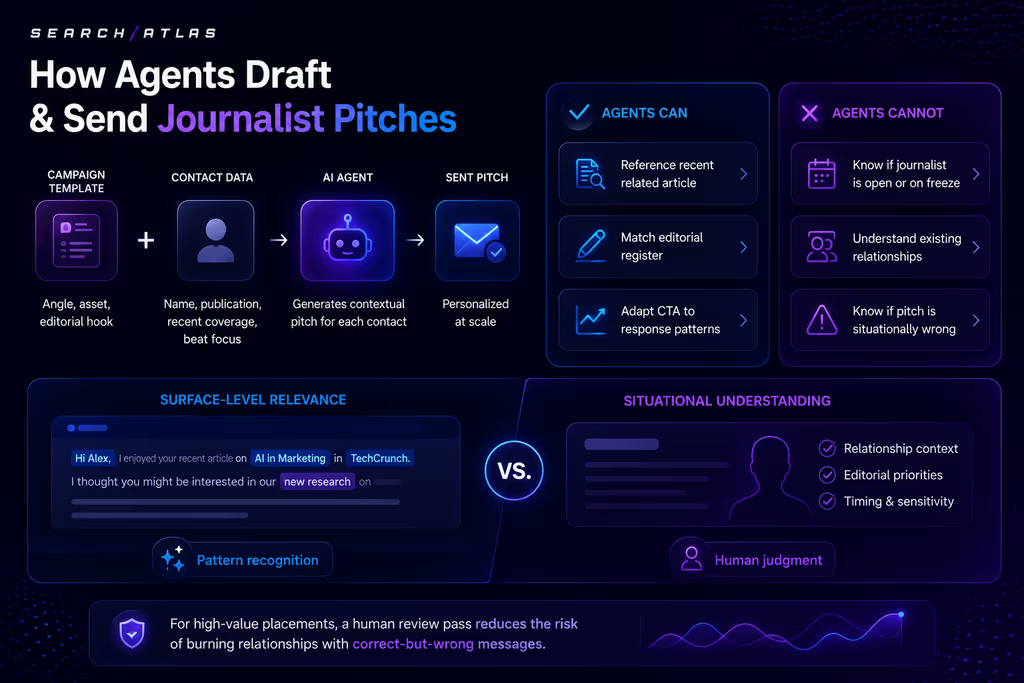
An agentic system generates journalist pitches by combining a campaign template (the angle, the asset, the editorial hook) with contact-level variables (the journalist's name, publication, recent coverage, and beat focus) to produce a message that references specific context without requiring manual composition per recipient.
Personalization at scale: what agents can and cannot do contextually
Agent-generated pitches are contextually variable, not genuinely personalized. The practical difference matters.
An agent can:
- Reference the journalist's most recently published article on a related topic
- Adjust the pitch's opening line to the publication's editorial register
- Vary the call-to-action based on the contact's documented response patterns
An agent cannot:
- Assess whether the journalist is currently accepting pitches or on an editorial freeze
- Adjust for an existing relationship between the brand and that contact
- Recognize when a technically matching pitch is situationally wrong
The result is pitches that pass surface-level relevance checks but are constructed from pattern recognition rather than situational understanding. For standard outreach volumes with qualified contacts, this produces workable engagement. For placements where the contact or publication matters more than the volume, a human review pass before sending reduces the risk of burning a high-value relationship with a correct-but-wrong message.
Search Atlas Press Release Distribution handles the structured end of the placement pipeline: for newsworthy announcements, it generates fully structured releases (headline, subhead, quotes, editorial formatting) and produces per-channel variations for distribution across 130+ outlets and 9+ channels. The agent handles structure and targeting; the editorial judgment on what constitutes a newsworthy angle stays with the team.
Sequence logic: follow-up timing, tone adjustment, and stop conditions
After the initial pitch sends, the agent manages follow-up sequences based on configured rules: send a follow-up after a defined number of days if no reply; shorten and sharpen the second follow-up; stop after a set number of unanswered attempts.
Stop conditions are not an optional configuration. An agent without a sequence ceiling will continue following up past the point where a journalist considers the sender credible, generating deliverability problems and damaging the contact relationship for future campaigns. Standard practice is two to three follow-ups across a ten to fourteen-day window, after which the sequence stops regardless of outcome.
The agent should also handle non-silence responses correctly: negative replies, opt-out requests, and editorial auto-replies all require different handling than no response. A well-configured sequence exists for the contact from the follow-up queue on any response, not only on a positive one.
Why coverage placement now affects AI search visibility
Earned coverage in authoritative publications now affects two distinct visibility channels:
- Traditional search rankings through the link equity placement deliver
- AI answer visibility through the increased probability that LLMs reference a brand or source when answering related questions
How authoritative coverage feeds LLM training data and AI answer pools
Language models are trained on web content weighted toward authoritative, editorially reviewed, and widely cited sources. A brand mentioned in a publication that is heavily indexed, cited across domains, and widely syndicated is more likely to appear in a model's training data and to be retrieved when the model generates answers about that topic or industry.
This creates a compounding visibility effect that does not appear in standard backlink reports. A placement builds link equity through the established mechanism of an editorial backlink from an authoritative domain. But if that outlet's content feeds into LLM training or surfaces in AI Overviews responses, the same placement also increases the frequency with which the brand appears in AI-generated answers over time.
Tracking AI citation presence alongside traditional link metrics gives teams a complete picture of what each placement is producing. OTTO SEO within Search Atlas includes LLM visibility tracking that monitors whether a brand appears in AI answer outputs across major models, allowing teams to see whether coverage campaigns are moving the AI citation needle, not just the backlink count.
Which publications carry weight in AI citation vs. which are invisible to AI crawlers
Not all earned coverage produces equivalent AI visibility impact. Publications that tend to carry more weight in LLM citation share common characteristics:
- Heavily and regularly crawled by major search engines
- Content is cited by other authoritative sources
- Cover topics that generate high query volumes in AI answer engines
- Broad syndication depth, their content is reproduced or referenced by multiple downstream outlets
A placement in a niche outlet with limited organic traffic and minimal syndication earns a backlink. It does not meaningfully affect AI answer presence.
When setting publication targets for an agentic campaign, syndication depth and topical coverage breadth should be weighted alongside Domain Power, particularly where GEO (Generative Engine Optimization) impact is a campaign goal. A smaller number of placements in high-syndication, high-authority outlets typically produces more AI visibility lift than a larger number of placements in lower-profile publications.
Running an agentic digital PR campaign: from setup to placement
An agentic digital PR campaign requires more precise upfront configuration than a manually managed one, because the agent executes at volume without judgment at each step. A configuration gap at setup produces proportional errors across the full campaign run.
Defining the brief and qualifying criteria before the agent runs
- Set the campaign angle. Define the topic, the asset being promoted (data study, expert perspective, announcement, or resource), and the editorial hook. The agent uses this to identify matching opportunities and draft pitches against a defined angle.
- Set publication thresholds. Define the minimum Domain Power floor for target publications, the required topical relevance, and any excluded publication types such as forums, content aggregators, or outlets outside the target geography.
- Define contact rules. Set journalist recency criteria: only target contacts who have published on a related topic within a specified window. Build exclusion lists for existing contacts, publications already covering the brand, and opt-outs from prior campaigns.
- Set sequence parameters. Define the number of follow-ups, the interval between them, and the stop conditions for both non-response and any type of response. Decide whether the agent sends autonomously or routes drafts for human approval on the first send.
Use Search Atlas Backlink Research before configuring thresholds: review the Domain Power range of publications currently earning links in the target space, what anchor text patterns appear, and where competitors are placing coverage. This produces calibrated thresholds rather than estimates.
Reviewing agent output: what to check and when to intervene
Before the agent begins outreach, review the qualified prospect list. Check for:
- Publications outside the intended topical scope (false positives from broad keyword matching)
- Contacts whose documented beat coverage is outdated or has shifted
- High-value targets where a manually written pitch would outperform agent-generated output
Once outreach begins, monitor open and reply rates against the first 48-72 hours of sends. A low open rate points to a subject line problem in the template. A high open rate with a low reply rate points to the pitch body. Both can be corrected in the sequence configuration without stopping the campaign.
Measuring results: coverage quality, link equity, and AI citation impact
Three output layers require measurement:
1. Link equity, track new linking domains, their Domain Power distribution, dofollow ratios, and anchor text patterns using Backlink Research. Growth pattern graphs show whether acquisition velocity is sustainable or concentrated in a short burst, which affects how the profile reads over time.
2. Coverage quality, beyond the backlink, evaluates where within the article the brand is mentioned (introductory, contextual, or cited as a source), the quality of the surrounding content, and the syndication reach of the publishing outlet. These factors affect how the placement registers to both readers and crawlers.
3. AI citation impact, AI citation impact: monitor whether brand mentions in AI Overviews, model-generated answers, or cited sources increase following the campaign. OTTO SEO's LLM visibility tracking provides this layer, allowing teams to attribute AI citation changes to specific campaigns rather than treating AI visibility as an unmeasured background variable.
WILDFIRE, the automated link exchange network within Search Atlas, operates as a complementary acquisition layer alongside earned PR. Using a 2:1 exchange ratio (two outbound links generate one inbound backlink), it matches referring domains based on topicality, Domain Power, and spam probability, filtering low-quality and irrelevant sources before any link is approved. For campaigns where earned placements alone do not hit authority targets, WILDFIRE adds a quality-validated, non-reciprocal link layer without manual prospecting.
Where agentic digital PR breaks down
Agentic digital PR scales the underlying strategy, whatever its quality. A well-configured campaign with a strong angle and precise qualification criteria produces higher-volume results than a manually run version of the same campaign. A poorly configured campaign with a weak angle or loose qualification produces higher-volume errors.
Specific failure modes
Volume without qualification. Removing the friction of manual outreach removes the natural filter that friction creates. Without strict qualification parameters, the agent contacts every technically matching prospect, including low-authority publications, off-beat journalists, and outdated contacts, at the same rate it contacts high-value targets.
Personalization that reads as automation. Experienced journalists recognize the pattern: a reference to their last article, a formatted pitch, a follow-up at exactly seven days. Agent-generated personalization signals are now common enough that pitches that reference recent coverage but make a generic ask do not land differently from undifferentiated ones. The angle and the ask still require human judgment.
Missing stop conditions. Agents that follow up more than three times without a response, or that continue the sequence after a negative reply, generate opt-outs and spam complaints. Those signals affect deliverability for the sending domain across all future campaigns, not just the current one.
Measuring only link equity. Campaigns that report exclusively on backlink count and Domain Power gains miss whether coverage is contributing to AI citation presence. A campaign that earns ten placements in high-syndication, high-authority publications may produce more AI visibility lift than one that earns forty placements in lower-profile outlets with limited syndication reach.
Treating the first configuration as correct. If qualifying thresholds are miscalibrated, the campaign executes at full volume before the error is visible in results. The review checkpoint before outreach begins is the last point at which a configuration error can be caught before it multiplies across the full prospect list.
Frequently Asked Questions
What is beat matching in journalist outreach?
Beat matching is the process of cross-referencing a pitch topic against a journalist's documented coverage history to estimate how likely they are to cover it. An agent checks recency and topical alignment, filtering out contacts whose published work no longer aligns with the campaign angle.
Can an AI agent send journalist pitches without human approval at every step?
Yes, once configured. The agent drafts pitches from a campaign template and contact-level variables, then sends them according to the sequence schedule without requiring human sign-off on each message. Most teams apply human review to the first send batch or to high-value contacts, then allow the agent to run subsequent sends and follow-ups autonomously.
Does digital PR coverage affect AI Overviews and LLM citations?
Coverage in heavily indexed, widely syndicated publications increases the probability that a brand appears in LLM training data and is cited in AI-generated answers. The effect is not guaranteed for any single placement, but placements in high-authority outlets with broad syndication depth have a measurable impact on AI answer presence over time.
How do agentic PR platforms avoid producing spam at scale?
By applying qualification thresholds before outreach begins and stop conditions within the sequence. Strict Domain Power floors, topical relevance filters, and journalist recency criteria eliminate low-fit contacts before any pitch is drafted. Sequence stop conditions prevent repeated follow-ups to non-responsive or opted-out contacts, which is the primary source of spam complaints in agentic outreach.
How many follow-ups should an agentic outreach sequence include?
Two to three follow-ups over a ten to fourteen-day window are standard. Beyond that, additional follow-ups produce diminishing returns and increase the risk of opt-outs or spam complaints that affect deliverability for the sending domain across future campaigns.
Related Reading