Search Atlas vs Markifact both put an AI agent to work on advertising accounts, but they were built to close different loops. Markifact is an MCP agent that plugs into Claude, ChatGPT, Gemini, or Cursor and executes bulk operations across Google Ads, Meta Ads, and other paid channels. Search Atlas runs paid media as one piece of a wider engine that also runs SEO, content, and AI search visibility, then ships and verifies the change itself.
This guide breaks down what each platform actually does, what it costs, and the eight places the two diverge once the shared "AI agent touching your ad account" pitch wears off.
What is Markifact?
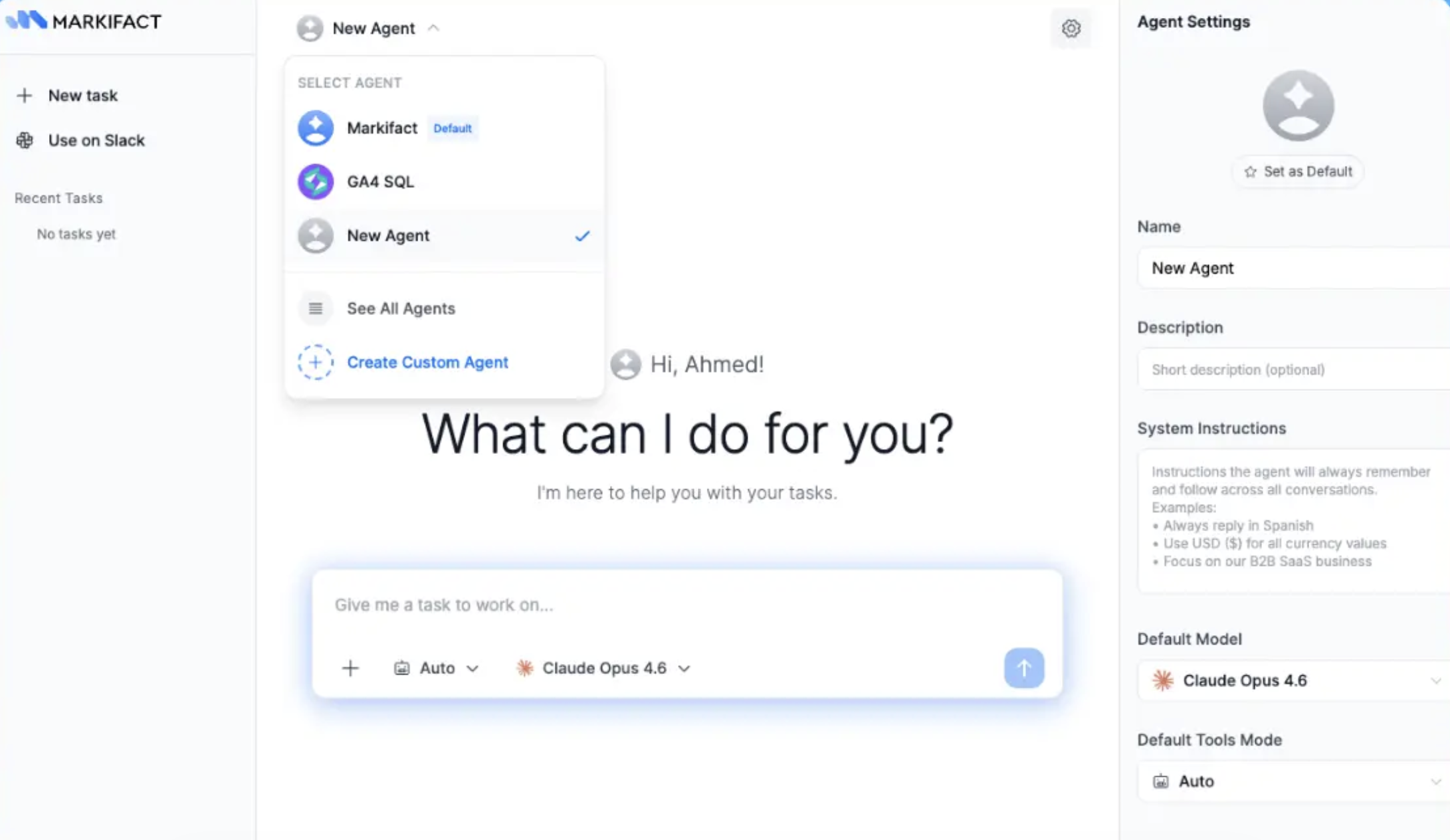
Markifact is an AI marketing automation platform that connects Claude, ChatGPT, Gemini, Cursor, and other MCP-compatible AI clients to a marketer's advertising and analytics accounts through a single OAuth connection. MCP, short for Model Context Protocol, is the standard that lets an AI chat client read and write to an outside system, in this case a Google Ads or Meta Ads account, instead of just answering questions about it.
Once connected, a person can type a request inside their AI client of choice and have Markifact carry out the underlying account change.
The platform is built specifically around paid-media execution. Rather than running SEO, content, or site health, Markifact focuses on giving an AI agent the write access it needs to operate ad accounts directly: creating campaigns, adjusting keyword bids, editing creative, and pulling performance data, all from inside a chat window instead of the native ad platform dashboard.
What are Markifact's features?
Markifact's core feature is an MCP server that exposes more than 500 operations across Google Ads, Meta Ads, TikTok Ads, LinkedIn Ads, Microsoft Ads, Reddit Ads, Pinterest Ads, Snapchat Ads, Amazon Ads, and DV360, plus connections to GA4, BigQuery, Google Search Console, and Google Merchant Center. A marketer can ask an AI client to launch a campaign, rotate ad creative, add negative keywords, or diagnose a performance drop, and Markifact executes the request against the connected account.
Every write operation requires explicit approval before it goes live, a pattern the company calls human-in-the-loop. Nothing changes in a live ad account until a person confirms the action, which is a deliberate safeguard against an AI client making an unsupervised change to real ad spend. Markifact also connects to organic and social channels (Facebook, Instagram, LinkedIn, Google Business Profile), e-commerce platforms like Shopify, and CRM and messaging tools including HubSpot, Klaviyo, and WhatsApp.
What Markifact does not do is run SEO, build content, or track how a brand shows up in AI answers. It has no proprietary keyword rank tracker, no content grading system, and no dedicated layer for AEO or GEO, the practice of getting cited inside ChatGPT, Gemini, Perplexity, and Google's AI Overviews. Its job is executing paid-media instructions at volume across whichever AI client a marketer already has open, not watching or improving organic search visibility.
What is Markifact's pricing?
Markifact runs on a credit-based pricing model priced lower than most dedicated marketing platforms, with the real monthly cost depending on how many workflow credits a team's usage burns through.
- Free plan: 100 credits per month, enough for light, occasional use.
- Starter plan: $29/month for 200 workflow credits, with automation runs on a 24-hour cycle and one user seat.
- Premium plan: $79/month for 1,500 workflow credits, hourly automation runs, priority support, and one user seat.
- Higher tiers exist beyond Premium for teams running heavier automated workflows.
Because credits are consumed per workflow run rather than per seat, a team's actual bill scales with how often its campaigns need attention, not with a fixed monthly rate. A quiet month with few underperforming ad sets to fix costs less than a month spent rebuilding multiple campaigns from scratch.
What is Search Atlas?
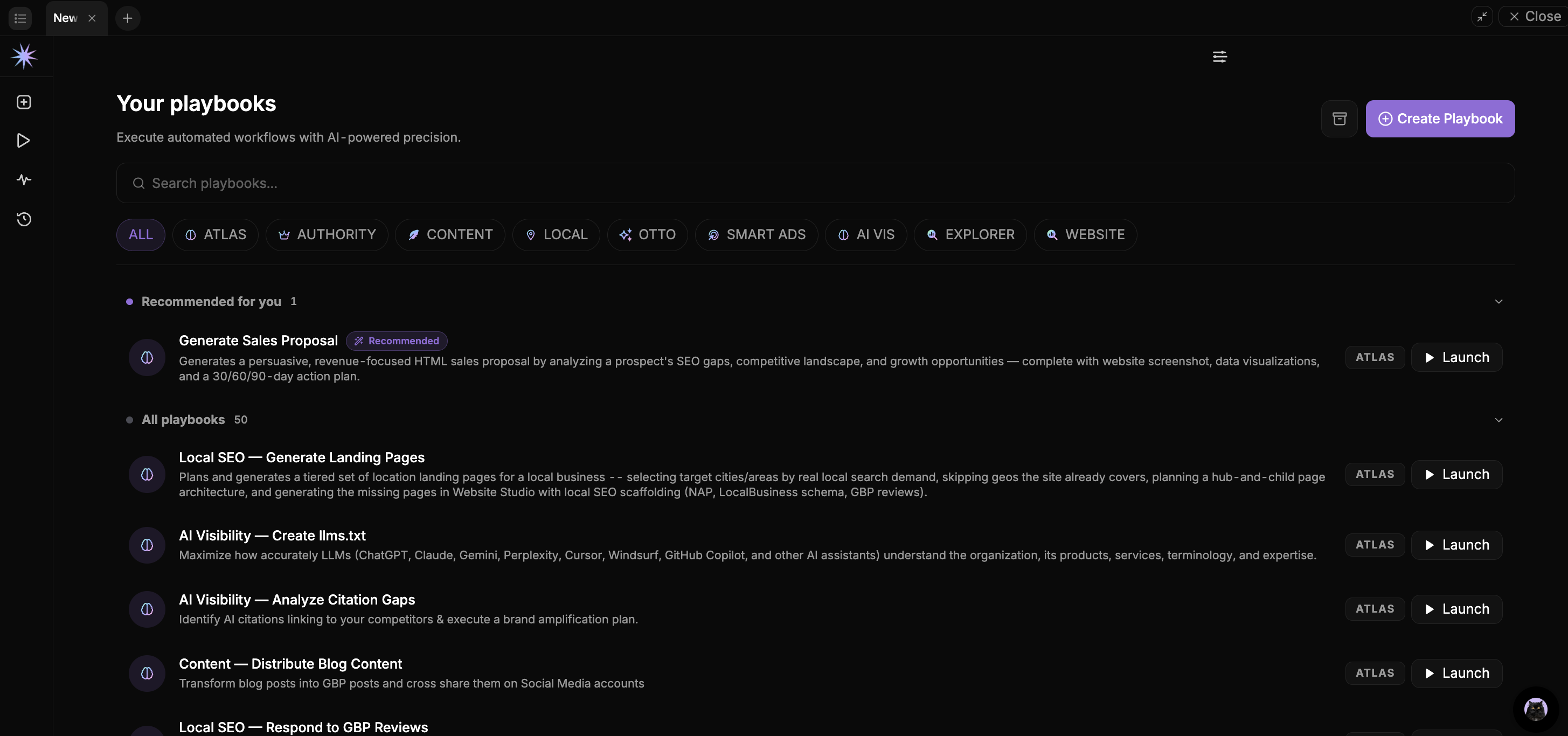
Search Atlas is an agentic AI marketing platform that runs SEO, AEO (answer engine optimization, the practice of getting cited inside AI chat answers), Google Ads, Meta Ads, content, and site health on its own. Instead of stopping once a task executes, Search Atlas tracks whether the change actually moved a ranking, a click-through rate, or a conversion, and repairs its own work when something drifts, a pattern it calls a self-healing loop.
The Search Atlas Coworker extends that same execution layer into Slack, Microsoft Teams, and ClickUp, so a team gets proactive updates and can issue requests from the workspace it already uses every day. Where Markifact waits inside an AI client for a person to type a request, the Coworker speaks first, surfacing a ranking drop, a leaking ad set, or a lost AI citation before anyone asks.
Where Markifact executes paid-media operations once a person approves them, Search Atlas connects paid spend to organic search and AI search visibility in one closed loop: signal in, recommendation out, change shipped, impact measured. That loop is what separates a system built to run one channel at volume from a system built to run every channel and check its own work.
What are Search Atlas's features?
Search Atlas is an agentic AI marketing platform that runs SEO, AEO, paid search, content, websites, and site health on its own. Instead of handing a team a recommendation to execute manually, it builds the work, fixes what breaks through self-healing loops, and reports progress through the Search Atlas Coworker, an AI CMO agent powered by Atlas Agent, the execution engine behind every capability in the platform.
One of the platform's core capabilities is OTTO SEO, an AI agent that deploys SEO improvements through a lightweight JavaScript pixel installed on any CMS. OTTO continuously audits websites, analyzes Google Search Console performance data, and automatically updates titles, meta descriptions, schema markup, internal links, and technical issues. A team can review every recommendation before it ships, enable full autopilot, or roll back a change using detailed deployment logs.
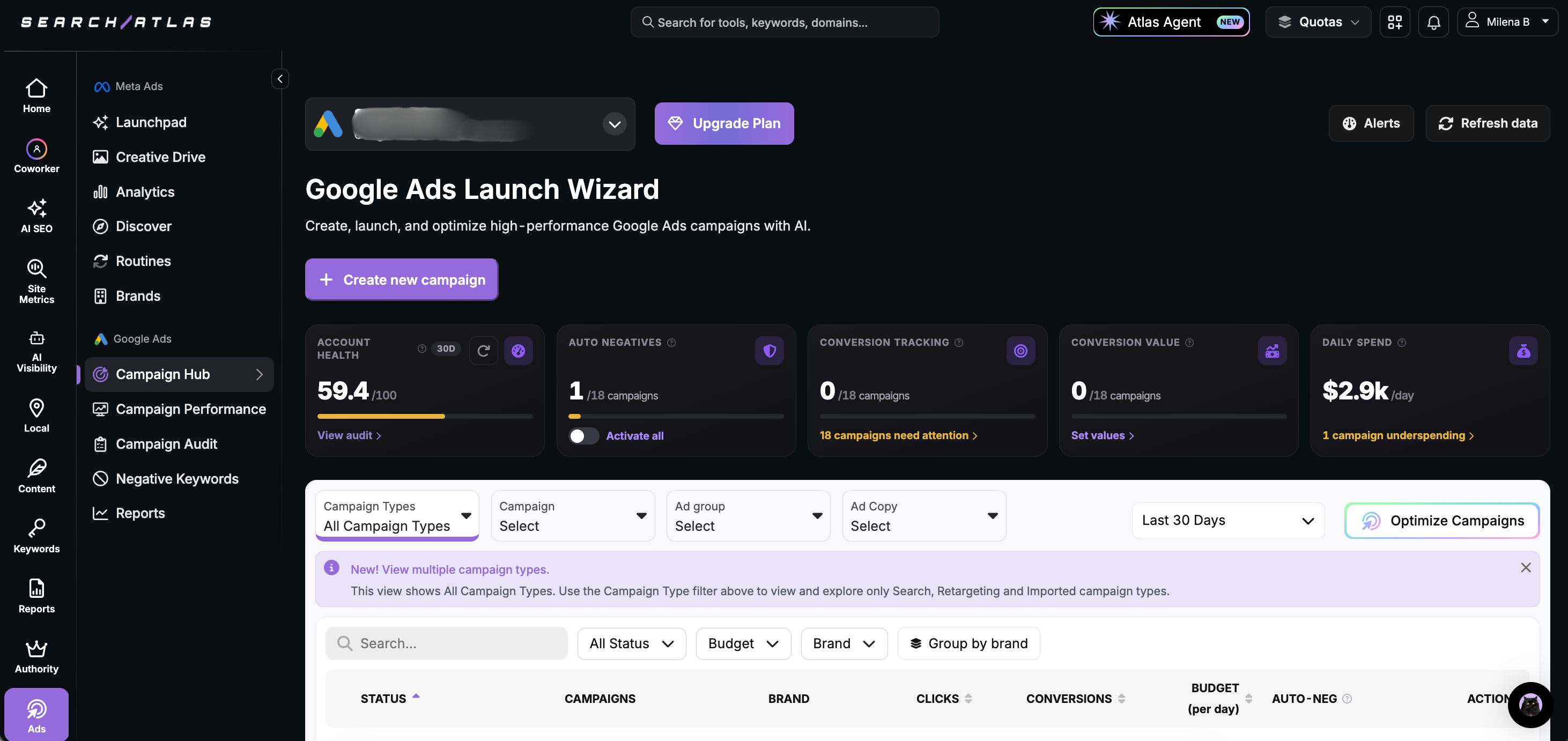
On the paid side, Smart Ads builds Google Ads campaigns, writes ad copy, and reallocates budget toward whatever is actually converting, using the same live rank and traffic data that feeds OTTO SEO. It runs a Fast mode for speed and an Advanced mode with step-by-step approvals, adds negative keywords automatically, and builds retargeting campaigns for visitors who didn't convert the first time.
For content, Content Genius creates and optimizes articles while SCHOLAR evaluates every draft across 12 quality dimensions, including factual accuracy, topical coverage, entity optimization, and information gain before publication. Local businesses can automate Google Business Profile management through GBP Galactic, which publishes posts, manages reviews, and maintains local citations.
Search Atlas also tracks AI visibility across ChatGPT, Gemini, Claude, and Perplexity through its LLM Visibility engine, surfacing brand mentions, sentiment shifts, and citation sources. That's the layer Markifact doesn't have, since its execution model stops at the ad account and never touches how a brand shows up when someone asks an AI chatbot a question instead of typing a search query.
What is Search Atlas's pricing?
Search Atlas offers three standard plans plus a custom Enterprise tier, with every plan including a 7-day free trial and no credit card required.
- Starter: $99/month with one OTTO SEO project, 10 Google Ads campaigns, unlimited one-click content publishing, three Google Business Profile projects, five Google Search Console site projects, 2,000 tracked keywords, and two user seats.
- Growth: $199/month (regularly $249) with two OTTO SEO projects, 10 GBP projects, 3,500 tracked keywords, and three seats.
- Pro: $399/month with four OTTO SEO projects, unlimited GSC projects, 6,000 tracked keywords, five seats, and full white-label dashboard capabilities for agencies.
- Enterprise: Custom pricing with unlimited scale, API access, and dedicated support.
Search Atlas also holds a strong review profile in the SEO software category, with a 4.8/5 rating on Capterra across 67 reviews and 4.7/5 on G2 across 99 reviews. Capterra recognized it as the #1 SEO platform of 2024.
Search Atlas vs. Markifact: a detailed look
The real difference between Search Atlas and Markifact comes down to how wide the loop runs, beyond how many ad operations it can fire off. Markifact executes a paid-media instruction once a person approves it and reports the result. Search Atlas connects that same kind of execution to organic search performance and AI search visibility, then checks whether the change moved a real number before calling it done. The eight sections below break that distinction down by category.
1. What each system was built to run
Markifact was built specifically for paid-media execution, giving an AI client write access to ad and analytics accounts, and Search Atlas was built to run SEO, AEO, content, paid media, and site health from one platform. A marketer using Markifact for Google Ads still needs a separate system for organic rankings, content production, and AI search visibility. Search Atlas runs all of it from the same dashboard and the same Coworker.
Winner: Search Atlas. Scope is the core difference here, more than raw execution speed.
2. Data feeding the decision, beyond the write access
Search Atlas prioritizes every paid and organic change against live Google Search Console data and its own SERP index through the Keyword Rank Tracker, and Markifact has no equivalent search-performance layer of its own. Smart Ads reallocates ad budget using the same rank and traffic signals that drive OTTO SEO's fixes. Markifact reads and writes ad-platform and analytics data directly, but nothing in its stack tracks whether a paid change also moved organic visibility.
Winner: Search Atlas.
3. Approval model and autonomy
Both platforms require human approval before a change ships by default, but Search Atlas also offers a fully autonomous mode a team can opt into. Markifact's human-in-the-loop model means every write, a new campaign, a budget shift, a paused ad set, waits for explicit confirmation inside the chat thread. Search Atlas supports that same review-first workflow through Advanced mode, plus a Fast mode and a full autopilot option once a team trusts the system enough to let it deploy on its own.
Winner: Search Atlas. Same safety net, with an additional autonomy option Markifact doesn't offer.
4. AI search visibility (AEO and GEO)
Answer engine optimization is the practice of getting a brand's content cited inside AI chat answers rather than just ranked on a traditional search results page, and generative engine optimization covers the broader practice of shaping content so AI systems surface it at all. Search Atlas tracks that visibility across ChatGPT, Gemini, Claude, and Perplexity through the same dashboard used for rank tracking.
Markifact has no dedicated feature for monitoring AI citations. Its stack covers paid media, analytics, and a handful of organic and CRM tools, but nothing purpose-built for watching whether a brand shows up when someone asks an AI chatbot a question instead of running a Google search.
Winner: Search Atlas.
5. Content and organic growth
Search Atlas produces and grades content through Content Genius and SCHOLAR's 12-dimension scoring system, and Markifact has no content creation or SEO layer at all. A team running only Markifact still needs a separate content platform or writer to produce the blog posts, landing pages, and site copy that organic search and AI answer engines both draw from.
Winner: Search Atlas.
6. Workspace presence and proactive reporting
Markifact operates inside whatever AI client a person already has open, Claude, ChatGPT, Gemini, or Cursor, waiting for a typed request before it acts. The Search Atlas Coworker lives inside Slack, Microsoft Teams, and ClickUp and speaks first, surfacing a ranking drop, a leaking ad set, or a lost AI citation before a person notices the problem.
That distinction matters for how much a team has to remember to ask for. Markifact is reactive by design, useful the moment someone opens their AI client with a specific task in mind. Search Atlas runs scheduled routines and recurring playbooks that report back without anyone triggering the check.
Winner: Search Atlas.
7. Channel breadth versus execution volume
Markifact's strength is genuine: more than 500 operations across ten-plus paid-media platforms plus GA4, BigQuery, Search Console, Shopify, and CRM tools, all reachable from one OAuth connection. For a team that only needs an AI agent to execute paid-media changes at high volume across many ad platforms, that breadth of write access is hard to match.
Search Atlas covers fewer paid platforms directly (Google Ads and Meta Ads through Smart Ads) but adds the organic, content, and AI-visibility layers Markifact was never built to include. A team weighing the two is really choosing between depth of ad-operation volume and breadth across every channel that drives visibility.
Winner: split, depending on whether the job is paid-execution volume or full-funnel visibility.
8. Pricing
Markifact starts cheaper on paper, $29/month for the Starter plan and $79/month for Premium, but both are metered by workflow credits that scale with how often campaigns need attention. A month spent rebuilding several campaigns from scratch burns through credits faster than a quiet month with light adjustments, so the effective cost moves with usage.
Search Atlas starts at $99/month with a fixed feature set (OTTO projects, tracked keywords, seats) rather than metered credits, which makes the monthly bill more predictable once a team knows its plan. The higher entry price buys SEO, content, and AI-visibility tracking alongside paid-media execution, not paid execution alone.
Winner: Markifact on entry price for pure paid-ops volume, Search Atlas on predictability and on what the price actually includes.
Choosing between Search Atlas and Markifact
Choose Markifact if the job is strictly paid-media execution at volume and the team already has SEO, content, and AI-visibility tracking covered elsewhere. Its MCP connection to Claude, ChatGPT, Gemini, and Cursor makes it a genuinely useful layer for a team that wants to manage hundreds of ad operations from inside the AI client it already uses, without leaving that chat window.
Choose Search Atlas if the goal is one system that connects paid spend to organic rankings and AI search visibility instead of managing them as separate problems. That's the same closed loop, signal in, recommendation out, change shipped, impact measured, that shows up across agentic paid media and the broader shift toward agentic marketing, where a system is expected to execute and verify a change instead of drafting a suggestion and waiting.
The trade-off is scope versus depth in one channel. Markifact doesn't try to run SEO or content, it gives an AI client deep write access to paid-media accounts and stops there. Search Atlas runs fewer paid platforms directly but closes the loop between paid, organic, and AI answer visibility, the parts of a marketing stack that increasingly need to move together as more search happens inside a chatbot instead of a search bar.
Frequently asked questions
Is Markifact better than Search Atlas for Google Ads?
No. Search Atlas is the stronger choice for Google Ads because Smart Ads is part of an end-to-end marketing platform that connects paid search with SEO, content, AI visibility, website performance, and attribution. While Markifact supports more advertising platforms, Search Atlas continuously optimizes Google Ads using signals from the rest of your marketing ecosystem, allowing campaigns to improve alongside organic growth instead of operating in isolation.
Does Markifact track AI visibility in ChatGPT or Gemini?
No, Markifact has no dedicated feature for monitoring whether a brand gets cited inside AI chat answers. Search Atlas tracks that visibility, often called AEO or answer engine optimization, across ChatGPT, Gemini, Claude, and Perplexity through its LLM Visibility engine.
Does Markifact handle SEO or content the way Search Atlas does?
No, Markifact focuses on paid-media and analytics accounts and has no keyword rank tracker, content creation tool, or content grading system. Search Atlas runs SEO through OTTO SEO and content through Content Genius and SCHOLAR, both fed by the same live performance data used for paid media.
Which one is cheaper?
Markifact's $29/month Starter and $79/month Premium plans are lower than Search Atlas's $99/month Starter plan, but Markifact's cost is metered by workflow credits, so a heavier month of campaign work moves a team into a more expensive tier. Search Atlas's pricing is set by feature and quota tiers instead, which makes the monthly bill more predictable once a team knows its usage level.
Does Search Atlas require approval before deploying changes?
Search Atlas supports both a review-before-deployment mode and a fully autonomous mode, and the choice belongs to the team running it. Nothing ships unseen unless a team has deliberately opted into full autopilot, and every deployment, whichever mode is active, is logged with a change history and a rollback option.
Is Markifact a good fit for an agency running SEO and paid media together?
Not on its own, since an agency running both channels for a client still needs a separate system for rank tracking, content, and AI visibility that Markifact doesn't provide. Search Atlas was built for that combined workload, running SEO, AEO, content, and paid media from the same platform and the same AI CMO reporting layer, which matters for agencies weighing execution depth against the cost of stitching multiple point systems together.