Agentic marketing for enterprise is the use of AI systems that autonomously plan, execute, and optimize marketing work across multiple channels while operating within predefined business rules and human approval workflows. Unlike traditional AI assistants that generate recommendations or complete individual tasks, agentic marketing systems coordinate work across SEO, paid media, content, analytics, and websites, continuously adapting to new data and changing conditions.
At enterprise scale, autonomous execution is only valuable when it is governed. An AI system that can publish content, change campaigns, or modify customer-facing websites must provide clear approval workflows, role-based permissions, complete audit logs, and compliance controls before it can be trusted in production.
This guide explains what enterprise governance actually requires for agentic marketing, including the procurement criteria, approval models, security controls, and audit capabilities organizations should evaluate before deploying AI to execute marketing work autonomously.
What agentic marketing for enterprise actually does
Agentic marketing for enterprise runs on three capabilities that separate it from ordinary marketing automation: multi-step task execution, cross-system coordination, and real-time adaptation, all working over a unified data stack instead of siloed exports. Multi-step task execution means the agent plans a sequence of actions toward a goal, not just triggers a single rule when a condition is met. Cross-system coordination means it acts across ad platforms, content systems, and analytics tools that used to require a person moving data between tabs by hand.
Real-time adaptation means the agent reads performance signals as they happen and adjusts, rather than waiting for a weekly report to prompt a manual change. A unified data stack is what makes the other three capabilities possible, because an agent coordinating across systems needs one consistent view of performance, not three dashboards that disagree with each other.
Where enterprises are actually deploying agentic marketing
Enterprises are deploying agentic marketing in workflows where AI can continuously execute, optimize, and improve marketing operations without requiring manual intervention for every decision. The highest adoption is in repeatable, data-driven functions that benefit from continuous optimization across channels.
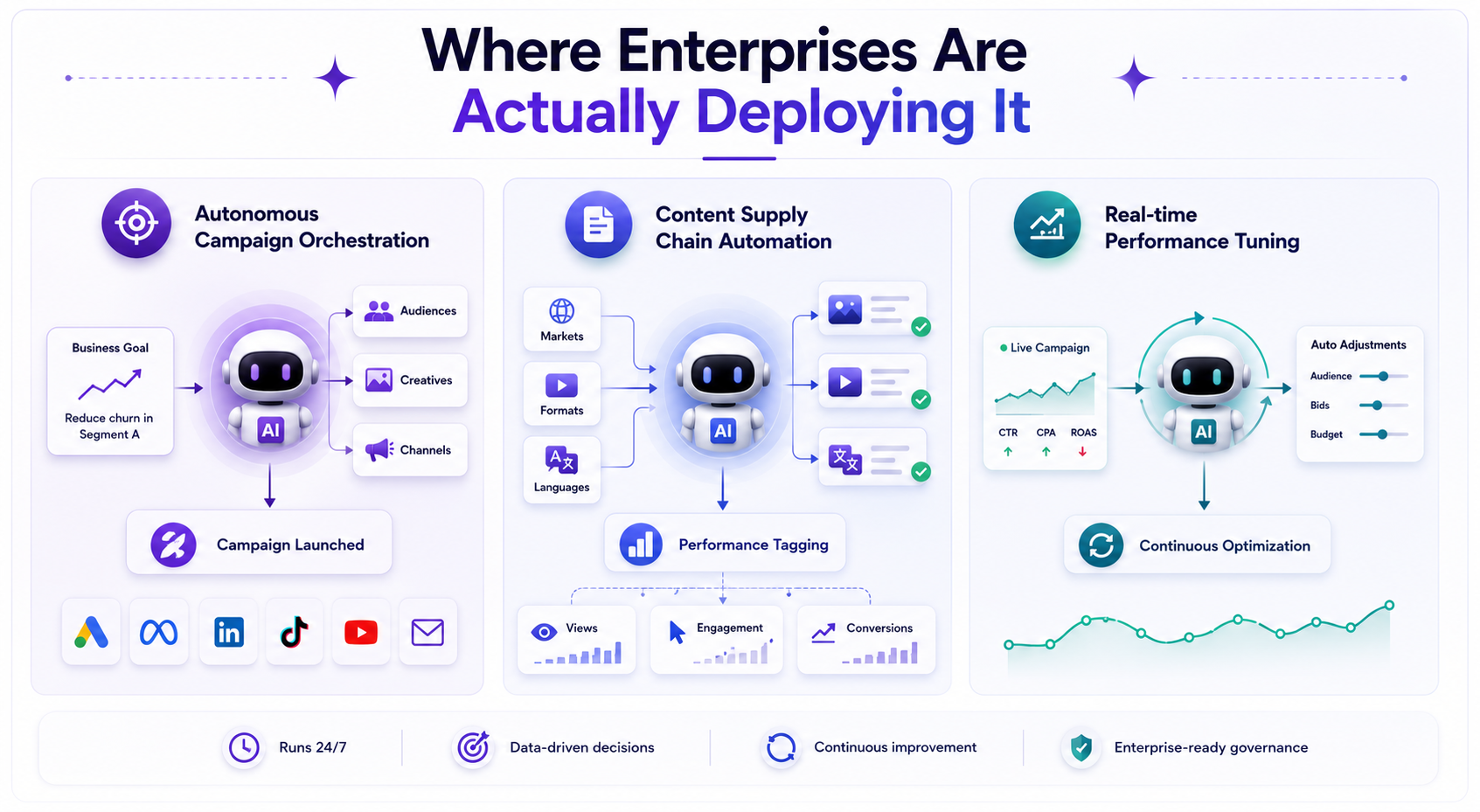
The most common enterprise use cases include:
- Autonomous campaign orchestration. An agent translates a high-level business goal, such as reducing churn in a specific customer segment, into the target audiences, asset variations, and channel deployments needed to act on it, then ships the campaign rather than handing a plan to a person to build.
- Content supply chain automation. An agent scales asset creation and localization across markets and formats, then tags each piece by performance so the next round of content generation learns from what actually worked.
- Real-time performance tuning. An agent monitors a live paid media campaign, adjusts audience parameters and bids as performance shifts, and runs the optimization loop continuously instead of waiting for a scheduled review.
This is the capability set that makes governance non-negotiable rather than optional. An agent that only drafts a slide deck for a person to review carries little risk if it gets something wrong. An agent that plans, executes, and adjusts a live campaign across channels on its own is making decisions with real budget and brand exposure attached, which is exactly the class of action an enterprise buyer has to govern before granting it.
What agentic marketing governance actually means
Agentic marketing governance is the set of rules, approval gates, and logging requirements that determine which actions an autonomous marketing agent can take on its own across SEO, paid media, content, and site changes, and which ones require a person to sign off first. It is not a features list. A vendor can hand a procurement team a slide with "governance" written on it and still have nothing underneath: no defined tiers of autonomy, no record of what shipped and why, no named owner if something goes wrong.
Governance only means something once it is testable, meaning a reviewer can ask "show me the last ten changes this agent made across our campaigns and site" and get a real answer with timestamps, not a demo.
This matters more for marketing than most departments realize, because marketing agents increasingly touch live systems, not just a draft. An agent that rewrites a meta description, shifts a paid media budget, or publishes a piece of content live is making a change a customer, a channel algorithm, and a compliance auditor will all see. That is a different risk profile than an agent drafting a slide deck nobody ships without review.
Enterprise governance for agentic marketing has to be built around the fact that some of these actions are irreversible in effect even when the underlying edit can be rolled back, because a page that ranked differently for three days already shaped what customers saw and clicked.
Who is accountable when an agent changes a live site
Accountability for an autonomous agent's changes to a live customer-facing site has to trace to a specific, named owner inside the vendor's product, not a general support queue, and most vendors don't have that answer ready. That single question is the one that decides whether an enterprise deal closes. IT wants to know if the change is logged and reversible. Legal wants to know if a person reviewed anything with regulatory exposure before it went out.
Procurement wants a named party, not a shrug, when something breaks. A vendor whose best answer is "the AI is trained to be careful" has not built a governance model, it has built a hope.
The honest answer has three parts. First, every autonomous action needs an owner inside the vendor's product, a specific role or account that the change traces back to. Second, the customer needs a way to see what happened before finding out the hard way, through their own monitoring rather than a support ticket.
Third, the vendor needs a clear statement of which action types run without a human checkpoint today, because that list should be short at first and only grow as trust is earned against a real track record.
What earned autonomy means in agentic marketing
Earned autonomy is a marketing agent's permission to act without human review, expanded only as it builds a track record on that specific type of action, never granted all at once and never by default.
A new deployment starts by watching, then proposing changes for a human to approve, then, once enough of those proposals have been approved without correction, moving to autonomous execution on that narrow category of change, with a rollback path kept live the entire time.
This is the mechanism behind Search Atlas Coworker's sense, detect, propose, approve, heal loop. The agent watches live marketing surfaces and the current brand strategy, flags where something has drifted, drafts the fix, and a human reviews and gates the change before it ships. Nothing goes live unseen in that loop, which is a deliberate design choice rather than a limitation waiting to be removed.
The same logic shows up in how OTTO SEO handles live site changes: an approval mode to review each change individually, selective implementation so a team can accept some fixes and reject others, and rollback control so nothing that ships is a one-way door.
The same tiering logic that governs a single agent's permissions also governs which decision categories get automated first across a whole marketing function, which is covered in more depth for paid media specifically, where the sorting runs from draft-only recommendations up to auto-deploy-with-rollback based on how expensive a wrong call is and how easily it can be undone.
The same four tiers apply to SEO changes, content publishing, and schema deployment, just with different actions sitting in each tier. A negative keyword exclusion and a schema markup fix might both land in auto-deploy-with-rollback, while a budget reallocation and a canonical tag change on a high-traffic page both sit in approve-to-publish, because both carry a cost that compounds if the call is wrong.
The five procurement criteria to score before signing
An enterprise procurement team evaluating an agentic marketing platform should score five specific criteria, not a generic feature checklist, because features don't tell you what happens when the agent is wrong. These criteria apply whether the platform runs SEO, content, or paid media, and they map closely to how procurement teams already evaluate any SEO or marketing platform before buying, with governance-specific weight added on top.
- Audit trail completeness. Can the vendor produce a structured log of every autonomous action, not a marketing dashboard summary, including what changed, when, and under whose account.
- Approval gating configurability. Can the customer set which action types require review and which don't, rather than accepting the vendor's default split.
- Rollback capability. Can any autonomous change be reversed without a support ticket, and how long does that reversal take in practice.
- Access and credential scoping. Does the agent operate on scoped, revocable credentials tied to specific systems, or does it require a single broad access grant to everything.
- Reporting cadence and ownership. Does a named person or role review the change log on a set schedule, or does the audit trail exist but nobody is assigned to read it.
A platform that scores well on four of these and fails audit trail completeness should still fail the evaluation, because the other four criteria are unverifiable without it. Rollback capability means nothing if there's no record of what needs to be rolled back. Access scoping means nothing if there's no log showing what the scoped access was actually used for.
This is the same logic behind a broader AI audit checklist, where the audit trail is the evidence layer everything else in a governance review depends on.
What a real audit trail has to capture
A usable audit trail is a continuous, structured record of what an agent did, when, on whose behalf, what it accessed, and what reasoning led to the action, built so any single decision can be reconstructed and verified later. A generic activity feed showing "12 changes shipped today" is not an audit trail. A real one lets a compliance reviewer trace one specific page change or campaign adjustment back through the exact rule or performance signal that triggered it.
At minimum, each logged action should include the agent's identity and version, the specific permission or credential in effect at the time, the tool or system it invoked, the before-and-after state of what changed, a timestamp, and the outcome of any approval gate the action passed through. Frameworks like the NIST AI Risk Management Framework treat this level of traceability as a baseline requirement for any AI system operating with meaningful autonomy, not an advanced feature reserved for regulated industries.
Enterprise marketing teams are increasingly held to the same standard, especially once a marketing agent's changes touch schema markup, ad copy, pricing pages, or any content with regulatory exposure.
What approval workflow gets agentic marketing past IT and legal
A workable approval workflow for agentic marketing starts with read-only access and expands in defined stages, never with full write permissions granted on day one. The sequence that actually gets past IT and legal review looks like this in practice.
- Connect the agent in read-only mode first. Let it observe rankings, campaign performance, content output, and site health without making a single live change, so the team can see what it flags before trusting what it fixes.
- Define the action tiers with names attached. Decide, in writing, which categories are auto-deploy-with-rollback, which need approval before publishing, and which stay recommend-only indefinitely, and assign a specific role to review each tier.
- Set an escalation path before the first autonomous action ships. Name who gets notified if a rollback is triggered, and how fast, before it's needed rather than after.
- Pilot on the lowest-risk action category for a fixed window. Thirty to sixty days is typical, long enough to build a real track record without leaving a wide surface exposed the whole time.
- Expand scope only after reviewing the pilot's audit trail. If the log shows a clean record with no rejected or rolled-back actions, move the next tier from approve-to-publish to auto-deploy. If it doesn't, tighten the gate rather than loosening it.
This is the same earned-autonomy pattern described earlier, just written as a procedure a governance committee can actually sign off on rather than a philosophy. Each stage produces evidence for the next one, which is what separates a real rollout from a vendor asking for trust up front.
Why not just use a general enterprise agent platform
A general enterprise agent platform can give a company governance infrastructure, but it can't give a marketing team domain depth, and both are required before an agent earns autonomy over marketing-specific actions. This distinction is the reason agentic marketing for enterprise buyers can't just be handed off to whichever agent orchestration platform IT has already approved for other departments.
A wave of general-purpose agent platforms built exactly this kind of governance rigor by 2026, strong on observability and control, with permissions and approval gates enforced architecturally before anything reaches production. That is a real and valuable capability for a company standing up agents across many departments at once.
None of that infrastructure is a weak product, it solves a real problem for the buyer it's built for. But a general governance layer has no opinion on what a healthy internal link looks like, what a well-structured schema deployment is, or whether a campaign adjustment was the right call against a competitor's move. It can confirm an agent executed within its permitted scope. It cannot confirm whether the action the agent took was good marketing.
A governance layer without domain depth approves actions it can't actually evaluate, and domain depth without enterprise-grade governance earns trust it can't prove. Search Atlas's position for this buyer is that both have to exist in the same platform, because the class of action in question, shipping changes to a live customer-facing site, requires both at once.
Where domain depth actually earns autonomy
Domain depth is what lets a marketing platform judge whether an autonomous action was actually good, which a general agent platform structurally cannot do. A schema markup deployment can be technically valid JSON-LD and still be the wrong schema type for the page, missing required properties, or duplicated in a way that confuses a search engine.
A general orchestration platform can confirm the agent executed the task it was assigned. It has no way to confirm the task itself was the right SEO move.
This is where OTTO SEO earns its autonomy incrementally, learning from a site's own Knowledge Graph inputs and Google Search Console data, prioritizing changes based on live ranking signals rather than a generic best-practices list, and logging every fix with a rollback path attached.
The audit trail isn't just a compliance artifact here, it's also how the platform's own prioritization improves over time, since a change log that shows which fix types correlate with ranking gains is what lets the next round of autonomous actions get more precise rather than more generic.
The same principle extends to how Search Atlas Coworker reports back inside a company's existing workspace instead of a separate dashboard nobody checks. A governance model only works if the people responsible for reviewing it actually see the log, and putting that review inside Slack, Microsoft Teams, or ClickUp, the tools a marketing and IT team already have open, removes the excuse of a report nobody read.
A compliance reviewer scanning a Monday thread for what shipped autonomously last week is a governance process that survives contact with a busy team's actual habits.
How long it actually takes to earn full autonomy
Earning full autonomy over a marketing action type typically takes one full pilot cycle, usually thirty to ninety days, followed by a review of the accumulated audit trail before the gate loosens. There's no universal number, because the real variable isn't a calendar date, it's how many instances of that action type have shipped and how many of those needed a correction.
A high-volume, low-risk action like a broken internal link fix can accumulate a meaningful track record in a few weeks. A low-volume, high-stakes action like a pricing page schema change might take a full quarter to generate enough approved instances to justify loosening the gate.
Why multi-location and franchise brands earn autonomy differently
This is also why a multi-location or franchise brand experiences earned autonomy differently from a single-site company. A brand running the same governance model across four hundred location pages can build a track record much faster in absolute terms, because the same action type, say, a Google Business Profile post template, runs hundreds of times in the first month instead of a handful. But that speed cuts both ways.
A flawed template applied autonomously across four hundred locations before anyone reviews it is a much larger blast radius than the same mistake made once. The procurement criteria don't change for a multi-location brand, but the pilot window and the review cadence usually need to be tighter, since more instances accumulate before a human ever looks at the pattern.
A governance committee evaluating a platform for a franchise or multi-location deployment should ask specifically how the audit trail aggregates across locations, whether a systemic error across dozens of sites gets flagged as one pattern or buried as dozens of individual log entries, and whether rollback can be applied in bulk or only one location at a time.
A platform that can only roll back one site at a time when the same flawed change shipped to four hundred of them has a governance gap that only shows up at exactly the scale an enterprise buyer operates at.