An AI CMO for PPC is an autonomous software system that manages, optimizes, and scales pay-per-click advertising campaigns inside platforms like Google Ads. It builds campaigns from a stated goal, adjusts bids, clears out negative keywords, rotates creative, and reallocates budget as performance data comes in, running that work continuously rather than waiting for a person to log in and act on a report.
Some of what it does ships the moment it decides, and some of it runs through a review checkpoint first, because not every PPC decision carries the same risk if it's wrong. What follows is a working model for where that checkpoint belongs, with concrete examples of how the model plays out.
What does an AI CMO decide inside a Google Ads account?
An AI CMO is a marketing platform that makes and executes decisions across channels without a person planning each task individually. Inside a Google Ads account, that means bid adjustments, keyword changes, budget shifts, and creative swaps can happen without someone opening the interface first. That's a meaningfully different claim than "AI-assisted PPC," which usually still means a human reading a recommendation and clicking a button.
The mechanics of how those changes actually get built inside a Google Ads account are their own subject. Campaign architecture, keyword clustering, ad copy generation, and bid logic are covered in detail in our guide to agentic paid media, which walks through the five-stage pipeline from campaign brief to live bidding. This piece sits one layer above that: which of those actions should ship the moment the AI decides them, and which ones benefit from a person looking first.
Getting that line wrong in one direction means a marketer spends their week re-approving negative keywords that never needed a second look. Getting it wrong in the other direction means a budget shift can drain a week's spend before anyone catches it.
What are the four decision tiers for PPC automation?
Every PPC decision an AI CMO can make falls into one of four tiers, ranked by how expensive a wrong call is and how easily it can be undone. The tiers aren't unique to paid media, the same logic applies to SEO changes or content publishing, but the specific decisions that land in each tier look different in a Google Ads account than they do on a website.
- Draft-only. The AI produces something, a keyword list, an ad variant, an audience definition, and nothing goes live until a person builds or publishes it manually. Nothing ships without a separate human action.
- Recommend-only. The AI surfaces a specific action with its reasoning attached, and a person clicks approve or reject. No default action happens if nobody responds.
- Approve-to-publish. The AI builds the complete change, a new ad group, a negative keyword batch, a retargeting audience, and queues it to go live on a set schedule unless someone intervenes. The default outcome is deployment, not inaction.
- Auto-deploy-with-rollback. The AI ships the change immediately and continuously, keeps a full change log, and gives a person a one-click way to reverse it. Review happens after the fact instead of before.
The table below maps the PPC decision categories this piece works through onto those four tiers.
| PPC decision | Typical automation tier | Why |
|---|---|---|
| Negative keyword additions | Auto-deploy-with-rollback | Cheap to reverse, clear signal from search term data |
| Ad copy and creative rotation | Auto-deploy-with-rollback | Tested in parallel, low downside per variant |
| Retargeting and audience adjustments | Approve-to-publish | Slower-to-surface risk, affects brand exposure |
| Bid strategy changes | Approve-to-publish | Can reset the platform's own learning period |
| Budget reallocation across campaigns | Recommend-only or approve-to-publish | High spend velocity, seasonality risk, attribution lag |
| Landing page routing | Recommend-only | Touches UX, legal, and brand outside the ad platform |
Why are negative keywords the safest PPC decision to automate?
Negative keyword additions are the easiest PPC decision to hand to auto-deploy-with-rollback, because a mistake here is cheap and instantly reversible. A search term report shows exactly which queries triggered an ad, and whether those queries produced clicks, conversions, or neither. If a term has generated fifty clicks and zero conversions over a meaningful window, excluding it is a low-ambiguity call.
Reversing a bad negative keyword is also trivial. Removing the exclusion restores the term to eligibility immediately, with no lingering damage to Quality Score, ad rank, or historical performance data. Compare that to a bid strategy change or a budget shift, both of which can alter how the platform's own bidding algorithm behaves for days afterward.
Negative keyword management is the one category where the cost of a wrong automated call and the cost of catching it late are both close to zero. That's exactly the profile that justifies letting an AI CMO run it without a checkpoint.
Why do retargeting and audience adjustments need more caution?
Retargeting and audience adjustments sit in the approve-to-publish tier rather than auto-deploy, because the downside of a bad audience change takes longer to surface and is harder to isolate. A negative keyword mistake shows up in the next day's search term report. An audience mistake can take a week or two of impression and frequency data before it's visible, and by then the damage has already compounded.
Audience overlap is the first risk. If a retargeting audience and a lookalike audience both include the same visitor, that person can see two competing ad sets simultaneously, splitting budget against itself without adding reach. Frequency capping is the second risk, because an AI CMO reallocating budget toward a high-converting retargeting segment can quietly push impression frequency per user from a healthy three or four times a week into double digits.
At that point, performance degrades from fatigue rather than poor targeting. Creative fatigue compounds both problems, since the same three ad variants shown nine times to the same person stop converting long before the underlying audience does.
None of these issues are visible in a single day's dashboard. They show up as a slow CTR decline that's easy to misread as audience saturation instead of a frequency or overlap problem. A short human review before an audience change ships, checking overlap against existing segments and confirming the frequency cap moved in the intended direction, catches the kind of mistake that a purely automated system won't notice until the metrics have already slipped.
Why does budget reallocation across campaigns need a human checkpoint?
Budget reallocation is the PPC decision an AI CMO should generate continuously but rarely execute without a human checkpoint, because being wrong here compounds instead of resetting. A bad audience call degrades gradually and gets caught in a weekly review. A bad budget shift can burn through several days of spend before the next report even runs.
Three specific risks make cross-campaign budget shifts different from the other categories on this list.
- Spend velocity. Moving 30 percent of a campaign's budget into another campaign changes how fast that money gets spent inside a single day, since a newly funded campaign with headroom can burn through its new budget in hours if it hits a favorable auction.
- Seasonality blindness. An AI system reallocating on the last two weeks of conversion data will read a seasonal dip as underperformance and shift budget away from a campaign right before that campaign's seasonal upswing arrives.
- Attribution lag. Conversions from last week's spend often get recorded this week, so a system reallocating on real-time numbers is sometimes reacting to noise from a prior decision rather than the decision it thinks it's evaluating.
Google's own documentation on Smart Bidding is worth citing directly here, because it confirms the mechanism rather than just the risk. A campaign typically enters a learning phase lasting five to seven days after a significant change, and a large budget shift counts as significant enough to reset it.
That means an AI CMO moving budget continuously on a tight feedback loop can keep a campaign permanently stuck relearning instead of ever reaching stable performance. Many PPC teams handle this by keeping any single reallocation to a modest slice of a campaign's daily budget, large enough to matter, small enough not to force the algorithm to start over.
None of this means an AI CMO shouldn't generate budget recommendations continuously. It should, because it's watching performance signals a human team checks weekly at best. The distinction is between generating the recommendation and pulling the trigger. A system that flags "Campaign A is converting at half the cost of Campaign B, shift 15 percent of B's spend" every morning is doing useful work even if a person has to confirm the shift before it executes.
Where do bid strategy, creative rotation, and landing page routing fit?
Three more decision categories round out a typical PPC account, and each lands in a different tier than the three above. Bid strategy changes, like switching a campaign from manual CPC to a target ROAS strategy, belong in approve-to-publish for the same reason budget shifts do. They can trigger the same learning-phase reset described above, so an automated mistake here costs more than a bad bid. It costs days of degraded performance while the algorithm relearns.
Ad copy and creative rotation are closer to negative keywords on the risk spectrum. Multiple ad variants typically run in parallel inside the same ad group already, so pausing an underperformer and promoting a stronger variant doesn't remove the account's ability to test, it just reallocates impressions toward what's already proven to work. That reversibility is what makes creative rotation a reasonable auto-deploy-with-rollback candidate in most accounts.
Landing page routing is the odd one out, because the risk isn't primarily a performance risk. Routing traffic to the wrong page can create a legal or brand problem, like sending a promotional ad to a page that no longer reflects current pricing or availability, faster than it creates a conversion-rate problem. That's a category where recommend-only makes more sense than either extreme, since the decision touches things outside what conversion data alone can tell an AI system.
What do classified AI CMO examples in PPC look like?
Concrete AI CMO examples make the tiering easier to apply than the abstract version above. Here are three typical scenarios, each classified using the same logic.
Scenario one: negative keywords
A software company runs ads against "project management software," and after 300 clicks, the search term report shows a meaningful share of that traffic came from queries containing "free." None of those clicks converted to a trial signup. An AI CMO running in auto-deploy-with-rollback mode adds the term as a negative keyword the same day, logs the change with the underlying data, and moves on. No approval step is needed because the signal is unambiguous and the change reverses in one click if it's ever wrong.
Scenario two: retargeting adjustments
Impression frequency per user on a retargeting campaign climbs from roughly three times a week to nine over two weeks, while click-through rate drifts down. An AI CMO in approve-to-publish mode drafts a lower frequency cap and a new lookalike audience to spread reach beyond the saturated segment, then queues both changes for review. A marketer checks the proposed cap and audience overlap against existing segments and approves within a day, rather than the AI shipping the change unreviewed.
Scenario three: budget reallocation
Over a rolling 30-day window, Campaign A is converting at half the cost per acquisition of Campaign B. An AI CMO recommends shifting 20 percent of Campaign B's budget into Campaign A, but flags that Campaign B's recent dip coincides with a known seasonal trough for that product category. A human reviews the seasonality note, confirms the shift still makes sense outside the seasonal window, and approves it manually rather than letting the reallocation execute on the recommendation alone.
The pattern across all three examples is the same. The tier gets chosen by how expensive a wrong call is and how fast that cost shows up, not by how confident the AI sounds.
How does Search Atlas Smart Ads operationalize the sign-off model?
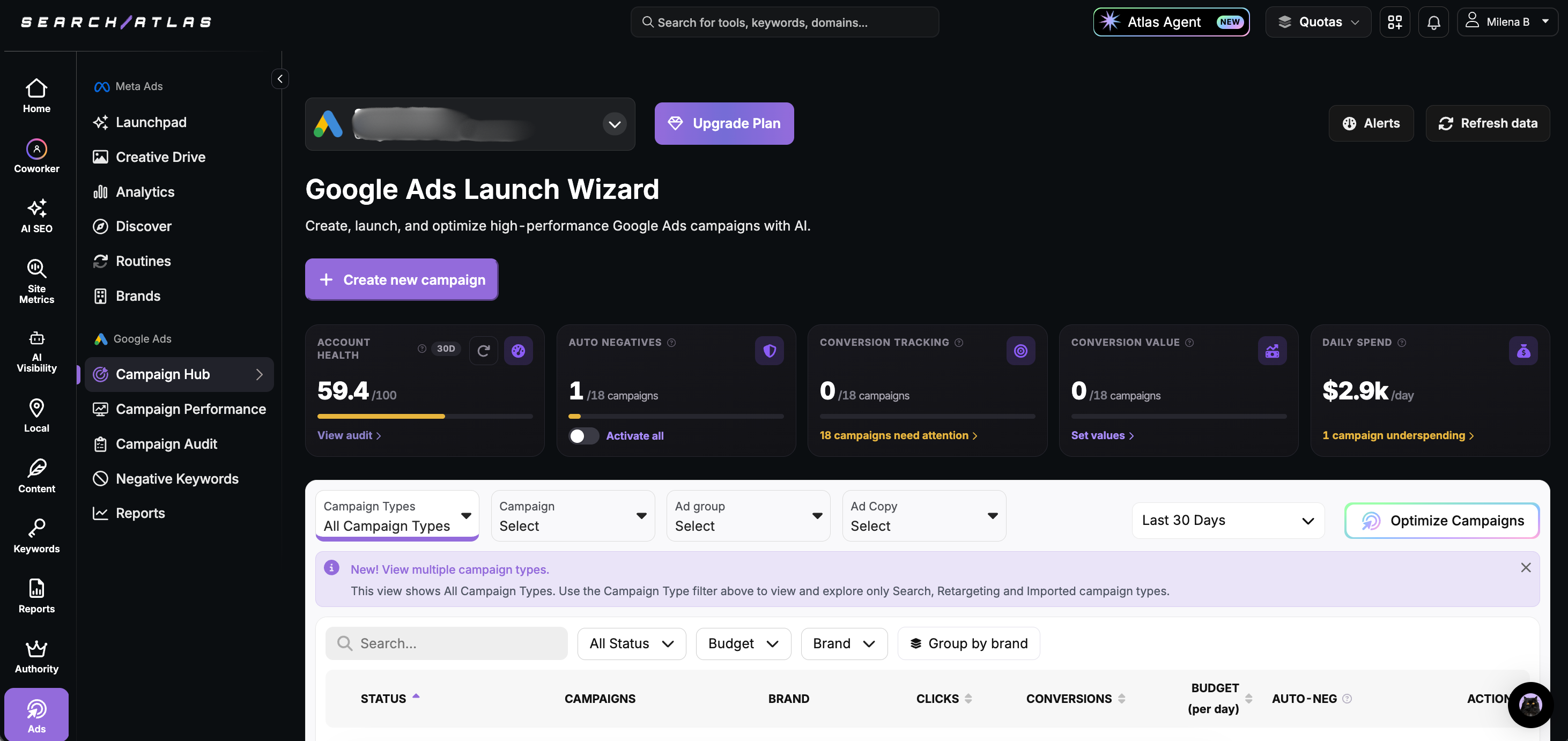
Smart Ads is the Search Atlas skill that runs Google Ads campaigns, applying tiered automation instead of treating every PPC decision as equally safe to automate. Powered by Atlas Agent, Smart Ads builds campaigns from a stated goal, audits performance continuously, reallocates budget toward what converts, and clears out negative keywords automatically as search term data comes in.
Smart Ads offers two operating modes that map directly onto the tiering above. Fast mode runs with minimal setup and lets the system optimize continuously after launch, appropriate for the lower-risk categories like negative keyword cleanup and creative rotation. Advanced mode introduces step-by-step approval checkpoints before changes ship, which is where budget reallocation and retargeting audience adjustments belong for most accounts.
Every change Smart Ads makes is visible inside a campaign health score and a change log. A team running Advanced mode reviews the same reasoning the AI used to generate the recommendation, rather than approving changes blind.
How do you build an approval framework for your own PPC account?
Setting up this kind of framework doesn't require new software, it requires deciding, in advance, which categories of change get which tier. The steps below cover how to do that.
- List every recurring PPC decision your team currently makes, from negative keyword cleanup to bid strategy changes to cross-campaign budget shifts.
- Assign each category to one of the four tiers using the risk-and-reversibility logic above, not by how comfortable the category feels emotionally.
- Start conservative on anything involving spend velocity. Budget reallocation and bid strategy changes belong in approve-to-publish even if the platform you're using supports full automation for that category.
- Track override rate by category, meaning how often a human rejects or modifies what the AI proposed. This is the single clearest signal of whether a category is ready to move toward more automation, and it's covered in more depth in our guide to measuring AI CMO performance, which lays out healthy override-rate benchmarks by change type.
- Revisit the tiers after 90 days of change-log data, moving a category toward auto-deploy only once its override rate has stayed low and stable, not after one good week.
For agencies running this framework across dozens of client accounts rather than one, the tiering above is what keeps automation consistent without a senior strategist re-approving the same category of change account by account. That kind of standardized governance is central to how agencies scale PPC management without proportional headcount growth, since the tiers travel with the account rather than living in one person's judgment.
The goal is a deliberate, documented line between what ships on its own and what waits for review, revisited as the data proves a category safe to move.