An AI assistant for marketing teams should do three distinct kinds of work: low-risk support (drafting, research, summarizing), workflow automation (bounded, repeatable multi-step tasks), and execution (shipping live changes to a site or campaign). Most AI marketing assistants only cover the first tier, even though they're marketed as full marketing assistants.
That gap matters because teams adopt a general-purpose assistant expecting it to close the gaps in their marketing. Most only describe those gaps instead. The sections below break down what each tier actually covers, how to tell which tier a given tool operates in, and when a general assistant stops being enough.
What is an AI assistant for marketing teams?
An AI assistant for marketing teams is a system that drafts content, automates a bounded workflow, or executes a live change to a site or campaign, depending on how much of the work it's built to handle without a person driving every step. The term gets used loosely across the industry, which is why two products both called "AI marketing assistants" can do completely different amounts of work.
Some assistants stop at generating text a person then reviews and publishes elsewhere. Others run a fixed process on a schedule, like pulling last week's rankings into a formatted report. A smaller group can read live performance data, decide what to prioritize, and make the change directly in a CMS or ad account. All three are legitimately "AI assistants." The difference is what happens after the assistant finishes its part, and who's left holding the next step.
Part of the confusion comes from how the category is marketed. "AI assistant" sells better than "text generator," so a product that only drafts copy still uses the same label as a system that can rewrite a live title tag on its own. Nothing about the wording tells a buyer which one they're getting, which is exactly why the tier questions later in this piece matter more than the name on the pricing page.
What are the three tiers of AI assistant work?
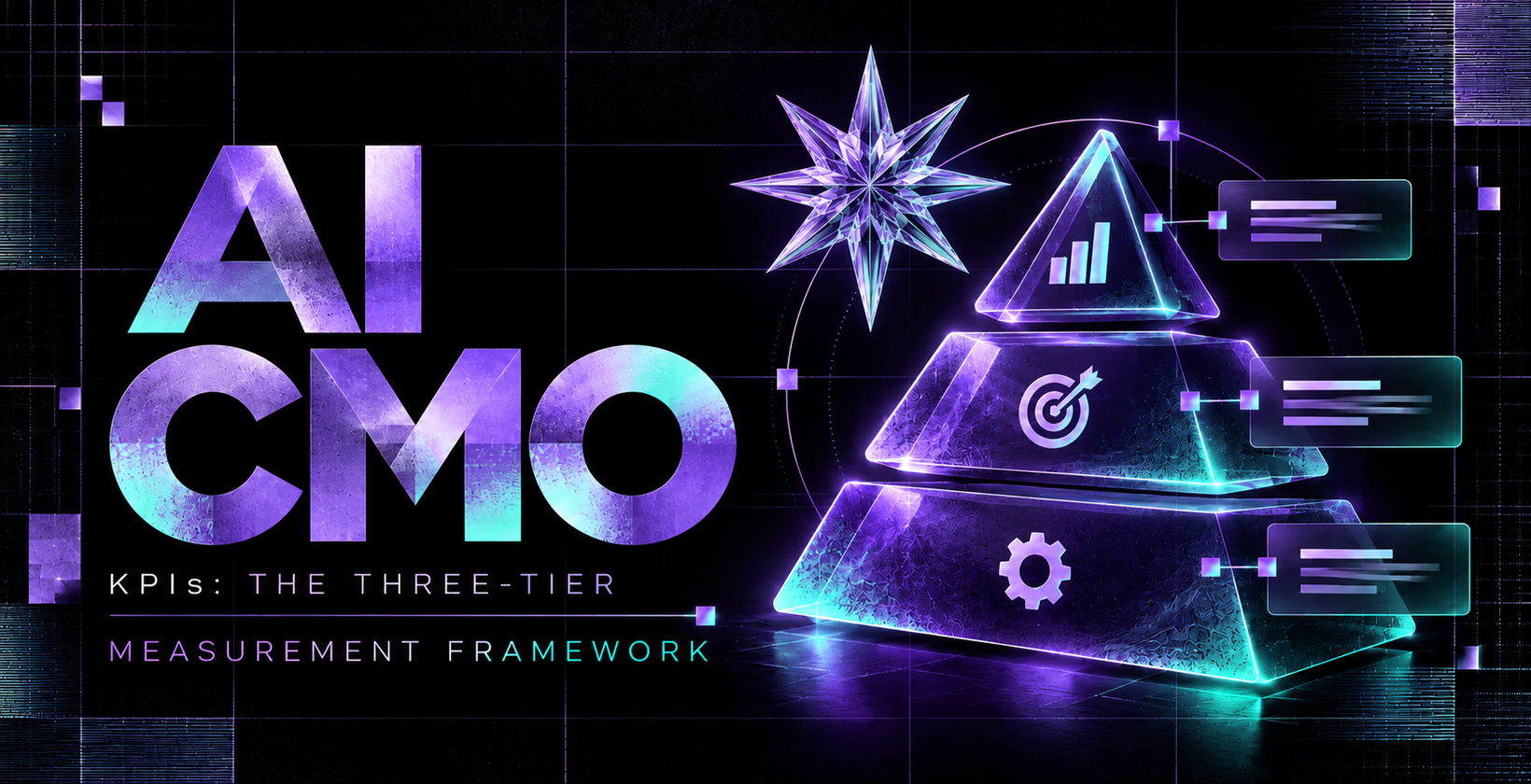
Every task a marketing team hands to an AI assistant falls into one of three tiers, ranked by what happens if the output is wrong: support, workflow automation, and execution.
| Tier | What it does | Risk if wrong | Examples |
|---|---|---|---|
| Support | Drafts, summarizes, researches, brainstorms | Low: a person reviews before anything ships | Drafting ad copy, summarizing a competitor's blog, brainstorming headlines |
| Workflow automation | Runs a bounded, repeatable multi-step task | Moderate: contained to one process | Scheduling a report, tagging leads, formatting a weekly summary |
| Execution | Publishes or changes something live | High: affects a real page, campaign, or customer | Publishing a page, rewriting a title tag, adjusting ad spend |
Think of the tiers as a framework for matching work to the right level of AI execution.
A single marketing team typically has tasks running in all three tiers at once, often without naming them that way. A content lead asking an assistant to draft five headline options is:
Tier 1. A recurring Monday report that pulls last week's traffic into a slide is Tier 2. A rule that automatically pauses an underperforming ad set is Tier 3. The tiers classify the task itself. A team can be advanced in one tier and have no coverage at all in another.
What is tier 1 support work?
Support work is anything the assistant produces that a person reviews before it goes anywhere. A draft blog outline, a summarized customer call, a list of subject line options. None of it touches a live system, so a mistake there costs a few minutes of editing rather than a broken page.
This is where general-purpose assistants like ChatGPT, Claude, or a Slack-based copilot are genuinely useful. They read fast, write fast, and don't need deep integrations with a team's actual marketing stack to be helpful here. A marketer asking an assistant to summarize five competitor landing pages or draft three variations of an email subject line is squarely in this tier, and so is a strategist asking for a first pass at a campaign brief.
What is tier 2 workflow automation?
Workflow automation is a fixed, repeatable process the assistant runs on a trigger or a schedule, with a bounded outcome. Think of it as automation with a language model attached: pull this week's traffic numbers into a formatted summary, tag inbound leads by source, flag pages that dropped in rankings.
This tier is defined by scope, not by how capable the underlying model is. A workflow automation follows the same steps every time it runs. It doesn't decide whether the task is worth doing or reprioritize based on new information. It executes the process it was configured to execute. That's still valuable, especially for recurring reporting and repetitive campaign housekeeping, but it stops short of judgment calls about what to do next.
What is tier 3 execution work?
Execution work is any change the assistant makes directly to a live system: a page goes live, a title tag updates, a campaign budget shifts, a technical SEO fix deploys. This is the tier where most tools marketed as "AI marketing assistants" quietly stop, because it's the one that requires deep write access to a team's actual stack and a real answer for what happens when the assistant is wrong.
Execution work also raises a question the first two tiers don't: who decided this was worth doing, and who's accountable if it wasn't. That's the point where a general assistant and a marketing execution system start to diverge.
A useful gut check is to ask what happens if the assistant gets a given task wrong. If the answer is a person spends a few extra minutes editing a draft, the task is tier 1 or tier 2. If the answer involves a live page serving the wrong content, a campaign spending budget on the wrong audience, or a customer seeing a broken change, the task is tier 3, and it needs the accountability structure that tier implies.
Why do most AI marketing assistants stop at tier one?
Most AI marketing assistants stop at tier one because they're built to answer prompts, not to run a marketing function. A general-purpose assistant has no persistent view of a site's technical health, no read access to a brand's ranking history, and no write access to the CMS or ad platform it would need to act on. Every task starts from zero context and ends when the conversation does.
That's a reasonable design for a tool meant to help with writing and research. It becomes a limitation the moment a team expects the same assistant to notice that a page dropped in rankings, decide whether that's worth fixing, and ship the fix. An AI marketing agent is built specifically to close that gap: it takes a goal, plans the steps, calls the tools needed to execute them, and adjusts based on the result, instead of waiting for a new prompt at every step.
Reaching tier 1 only requires reading and writing text well. It doesn't require write access to a customer's production systems, an approval workflow, or a way to measure whether a change actually worked. Tier 3 requires all three, which is a large part of why so few products get there.
Building for tier 3 also means owning the failure case. A drafting tool that produces a weak headline costs a person a few minutes of editing. A system with write access to a live CMS that ships a bad change costs traffic, rankings, or revenue, and someone has to be accountable for catching it before or after it goes out. That's a materially different product to build and support, and it's why the gap between tier 1 and tier 3 tools is wider than the marketing copy suggests.
When is a general AI assistant enough?
A general AI assistant is enough when marketing work stops at drafting, research, summarization, or other tasks that people still review before anything goes live. These are tier 1 tasks and, in some cases, structured tier 2 workflows that never modify a live system.
Common examples include:
- Drafting first versions of ad copy, emails, landing pages, or social posts
- Summarizing research, competitor analysis, or customer feedback
- Brainstorming campaign ideas, headlines, or messaging angles
- Formatting recurring reports from data someone has already collected
- Answering marketing questions or explaining industry concepts
For these tasks, the primary goal is producing information faster, not executing work. A general AI assistant helps teams create better first drafts, reduce manual writing, and speed up research, while people remain responsible for reviewing decisions and implementing changes.
The limitation appears when the bottleneck shifts from creating ideas to executing them. Once a team knows what should change, the remaining work is publishing pages, updating campaigns, adjusting budgets, fixing SEO issues, or making other production changes. Better prompts cannot complete those actions because the work still depends on someone carrying them out.
That gap doesn't reflect a broken tool. It reflects a boundary in what a prompt-and-response system is designed to do. Recognizing that boundary early saves a team from repeatedly asking a general assistant to finish work it was never built to complete.
When do teams need an orchestration layer instead?
Teams outgrow a general assistant when the work requires cross-channel prioritization, direct execution, and measurement tied back to what shipped. That shows up as needing to:
- Decide what to work on next across SEO, content, paid media, local, and AI search visibility, based on live performance data rather than a fixed schedule
- Ship the fix directly, whether that's a metadata rewrite, a published article, or a campaign budget change, instead of handing a recommendation to a person to implement
- Track whether a shipped change actually moved the metric it was meant to move, and feed that result into what happens next
A general assistant, even a very capable one, has no way to weigh a ranking drop on one page against a stalled ad campaign on another, because it has no shared view across those channels in the first place.
That's the job of an orchestration layer, not an assistant. Atlas Agent, the execution engine behind the Search Atlas Coworker, is built around exactly this loop: detect a signal, turn it into a recommendation, route it through an approval gate appropriate to its risk level, ship the change, then measure the impact before the cycle restarts.
How much autonomy a given change gets still depends on its risk level. A metadata tweak on a low-traffic page can move without anyone reviewing it first, while a pricing page rewrite or a large budget shift routes through a person before it ships. The goal is to reserve human review for the changes where getting it wrong actually costs something.
The Search Atlas Coworker surfaces that same execution layer inside Slack, Microsoft Teams, and ClickUp, so a team doesn't need a separate login to see what shipped and what's next. For a fuller picture of what that operating model looks like end to end, see what an AI CMO is and how it works.
How do you tell which tier a tool actually operates in?
The fastest way to tell which tier a tool operates in is to ask four direct questions before adopting it.
- Does it read from our actual data, or only from what we paste into a prompt? A tool limited to prompt input can't notice a ranking drop or a conversion dip on its own, someone has to bring it the data first.
- Can it write to our systems directly (CMS, ad platform, GBP), or does it only produce a recommendation for someone to copy in manually? Write access is the line between a tool that can ship a fix and one that can only describe it.
- Does it decide what to prioritize, or does it run the same fixed steps every time regardless of what changed? A tool that can't reprioritize will keep formatting a report for a page that no longer needs attention while a bigger problem goes unnoticed elsewhere.
- Does it measure whether what it did actually worked, or does the task end the moment the output is delivered? Without a measurement step, a shipped change and a failed one look identical on the tool's dashboard.
A tool that answers "no" to all four is a tier 1 support assistant. A tool that automates a fixed process but doesn't reprioritize or measure outcomes is tier 2. A tool that reads live data, writes directly to production systems, prioritizes based on results, and closes the loop with measurement is operating at tier 3, the orchestration layer most general assistants were never built to reach.
This check works whether the tool being evaluated is a general-purpose assistant repurposed for marketing, a point solution built for one channel, or a platform that claims to cover the whole funnel. Asking it directly, rather than reading how the product is described on its pricing page, is what actually reveals which tier a team is buying into.
Related reading
- What Is an AI CMO, and How Does It Work?
- What Is an AI Marketing Agent? Differences, Practice, and Deployment
- Atlas Agent as Your AI CMO: How It Actually Runs the Work
FAQ
Is an AI marketing assistant the same thing as an AI marketing agent?
No. An assistant typically responds to prompts and produces drafts or summaries for a person to use. An AI marketing agent plans a sequence of actions toward a goal and calls tools to execute them, with less per-step input required from a person.
Can one tool cover all three tiers?
Some platforms do, but most tools marketed as assistants are built specifically for tier 1 and don't have the data access or write permissions needed for tiers 2 and 3. A tool built for execution, like Atlas Agent, generally covers all three because drafting and bounded automation are prerequisites for shipping a change safely.
What's the risk of using a tier-1 assistant for tier-3 work?
The assistant will produce a plausible-sounding recommendation, but it has no way to verify the recommendation against live data or measure whether the change worked, because it doesn't have write access to the systems involved. That gap usually surfaces as recommendations a team implements manually, then loses track of whether they helped.
Do marketing teams need to choose one tier and stick with it?
No. Most teams use a general assistant for tier 1 work like drafting and research while relying on an execution system for tier 2 and tier 3 work that needs to reach a live site or campaign. The tiers describe the type of task, not a single tool a team has to commit to exclusively.
How do you know if a task belongs in tier 2 or tier 3?
A task belongs in tier 2 if it follows the same steps every time and never needs a judgment call about priority. It belongs in tier 3 the moment it changes something live or requires deciding what's worth doing next from current data rather than a fixed schedule.