Atlas Agent is the execution engine behind the Search Atlas Coworker, the AI CMO that runs your marketing while you sleep. Instead of waiting for prompts or producing another list of recommendations, it continuously builds, ships, and fixes marketing work across every channel while keeping your team informed inside Slack, Microsoft Teams, or ClickUp.
This is what makes the AI CMO possible. Atlas Agent powers the execution while the Search Atlas Coworker delivers the experience your team collaborates with every day.
This guide explains how that system detects opportunities, prioritizes work, builds and ships improvements, and keeps people informed without requiring them to coordinate every task manually.
What does "AI CMO" mean, and where does Atlas Agent fit?
An AI CMO is an AI system that continuously runs marketing work across SEO, paid media, content, AI search, and website optimization while keeping teams informed. In Search Atlas, that role belongs to the Search Atlas Coworker, which is powered by Atlas Agent, the execution engine that runs the work behind the scenes.
The distinction matters because the term AI CMO is often used for assistants that summarize reports or generate recommendations but leave every next step to a person. Those systems support marketers, but they don't execute marketing.
Atlas Agent turns a marketing objective into completed work by building content, optimizing paid campaigns, monitoring AI search visibility, and applying technical SEO improvements. Instead of handing those jobs back to the team, it executes them, then reports what changed and how performance responded.
The Search Atlas Coworker brings that execution into Slack, Microsoft Teams, and ClickUp. Rather than asking for updates, teams receive completed work, recommended priorities, and overnight progress where they already collaborate.
How Atlas Agent runs marketing work
Atlas Agent runs marketing work as a five-stage loop that repeats on its own. Every action it takes starts with something it noticed and ends with a measurement of whether that action worked, which then feeds the next cycle.
1. Detecting a signal
A signal is any indication that marketing performance has changed. That could be:
- Ranking drop
- New technical issue
- Competitor gaining visibility
- Your brand appearing less often in AI-generated answers
Atlas Agent continuously monitors data from Google Search Console, site crawls, and AI search platforms (ChatGPT, Claude, Gemini, and Perplexity), detecting those changes as they happen instead of waiting for someone to discover them in a report.
2. Turning a signal into a recommendation
A raw signal is a candidate for action, evaluated before it becomes one. Atlas Agent weighs the signal against business context, the brand's Knowledge Graph, its priorities, its competitors, and decides whether it's worth acting on and how.
A ranking drop on a page tied to a revenue-relevant query gets turned into a specific recommendation: rewrite this title tag, restructure this heading, add this internal link, refresh this section with updated information.
3. Routing the recommendation through an approval gate
This is where Atlas Agent departs from a plain automation script. It runs in two operating modes. Fast mode moves quickly with minimal setup for teams that want low-risk changes to go live without a review step. Advanced mode adds step-by-step approval checkpoints and tighter governance at each stage, so nothing high-impact ships unseen.
The system decides which changes are safe to execute on their own and which ones need a human to confirm first, based on the risk profile of the change. A metadata tweak sits in a different risk category than a page-structure rewrite or a paid budget shift.
4. Shipping the change
Once approved, or, for low-risk actions in Fast mode, on its own, the change goes live. This is the part most AI marketing products stop short of. A recommendation engine hands a list back to the team and calls it done.
Atlas Agent applies the fix directly by updating the metadata, publishing the content, deploying the technical correction, or adjusting the campaign inside the connected Search Atlas modules, without someone manually copying a suggestion into a CMS or a Google Ads account.
5. Measuring the impact and feeding it back into the loop
Every shipped change gets tracked against what happened after it went live, on top of whether it was applied. Search Console performance, ranking movement, and citation data get tied back to the specific change and the date it was deployed.
That measurement becomes the input for the next cycle: did the title tag rewrite move rankings within 45 days, did the content refresh change the page's topical coverage score, did the AI-visibility fix bring back citations for the queries that dropped. The loop restarts from measurement.
What Atlas Agent actually detects
Atlas Agent continuously monitors the parts of your marketing that have the greatest impact on growth. Instead of relying on scheduled audits, it watches live performance across SEO, content, authority, and AI search to identify opportunities as they appear.
-
Technical SEO and Website Health: Atlas Agent watches for issues that can limit search performance, including crawl errors, indexing problems, broken internal links, metadata opportunities, schema gaps, and other technical changes that affect how pages perform.
-
Content Opportunities: Content is monitored against search demand, existing site coverage, and competitor performance. Atlas Agent identifies pages that need refreshing, missing topic coverage, and opportunities to strengthen topical authority with new or updated content.
-
Authority Growth: Atlas Agent tracks your backlink profile alongside competitors to uncover opportunities for stronger authority. That includes identifying valuable link prospects, monitoring authority trends, and highlighting gaps that could improve search visibility.
-
AI Search Visibility: Atlas Agent also monitors how your brand appears across AI search platforms, including ChatGPT, Gemini, Claude, Perplexity, and AI Overviews. It tracks brand mentions, citations, Share of Voice, sentiment, and competitor visibility, helping identify where your presence is growing or where it has started to decline.
Because this monitoring runs continuously, Atlas Agent can identify new opportunities as conditions change instead of waiting for the next manual audit. The result is an agentic marketing system that keeps adapting as search engines, competitors, and AI platforms evolve.
What Atlas Agent executes
Atlas Agent executes marketing work across SEO, content, paid media, authority building, local SEO, and AI search. Instead of handing teams a checklist, it completes the work inside the Search Atlas platform and records every action along the way.
On the SEO side, title tags and meta descriptions get rewritten and deployed, heading structures and internal linking get restructured, canonical tags and indexing issues get corrected, and Google Business Profile posts, Q&A responses, and citations get managed for local visibility, all without a developer or manual CMS edit.
Content workflows run research to publish end-to-end: identifying the topical gap, building the brief, drafting the piece, scoring it against competitor benchmarks, and publishing it. Authority workflows run outreach and digital PR without manual coordination between a strategist and an outreach team. AI visibility workflows generate and ship the content built to close a citation gap once one is detected.
This is what an agentic marketing approach looks like in practice. Atlas Agent plans the work, executes it, and records every completed action, so teams always know what changed, when it happened, and how those changes affected performance while marketing continues moving forward.
How teams stay in control

Atlas Agent is built to run marketing work autonomously, but every team decides how that work reaches production. Some organizations prefer to review changes before they're deployed, while others allow routine work to run automatically.
That flexibility makes it easier to adopt autonomous marketing without changing existing workflows overnight. Teams can choose the level of oversight that matches their processes while Atlas Agent continues identifying opportunities and preparing the work.
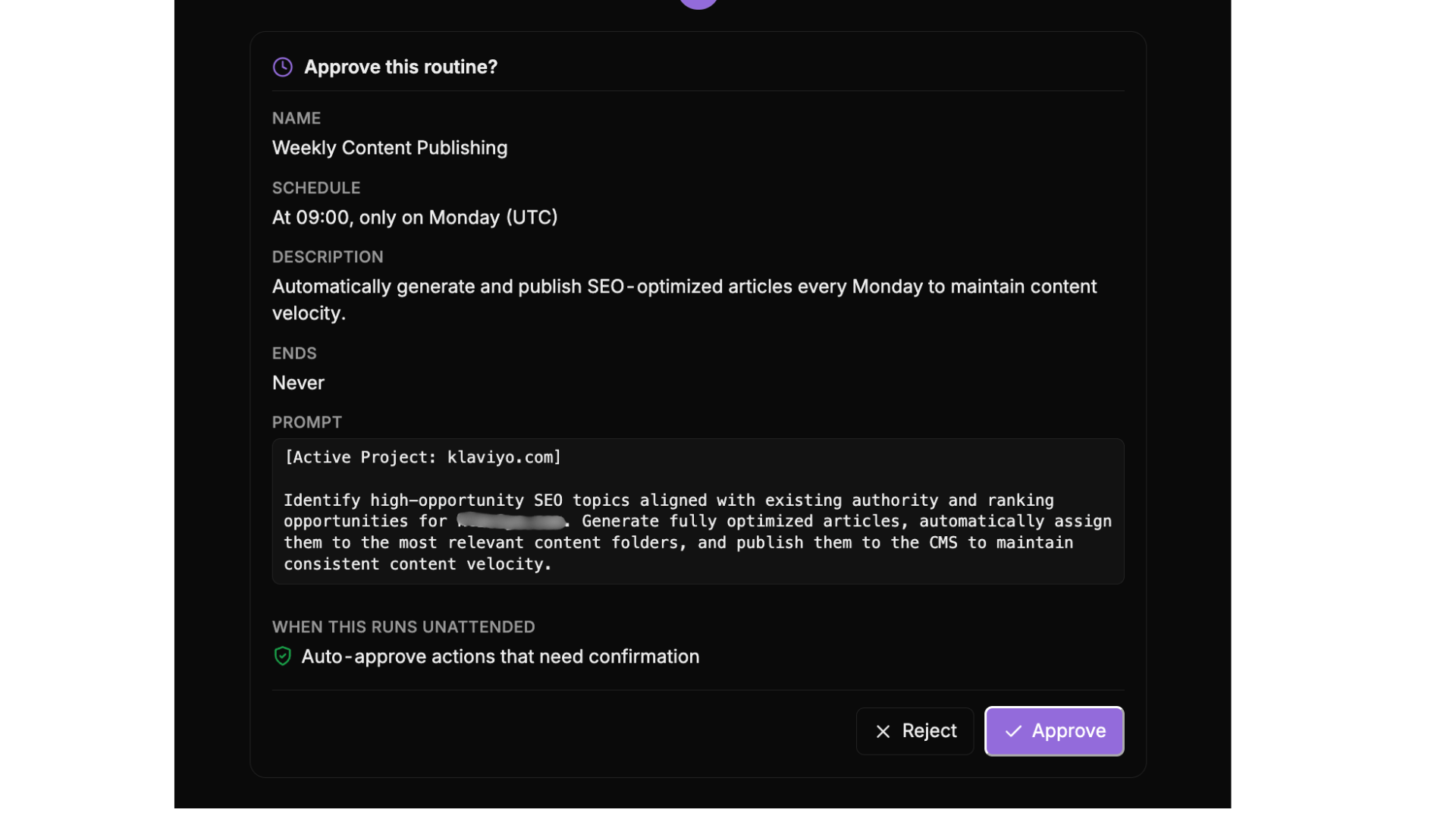
As teams become more familiar with Atlas Agent, many choose to automate a larger share of routine marketing work while continuing to review changes that require business or editorial judgment. The result is a workflow where people stay focused on strategy and priorities while Atlas Agent handles execution in the background.
Where Atlas Agent lives beyond the dashboard
Atlas Agent powers the Search Atlas Coworker, bringing marketing execution into Slack, Microsoft Teams, and ClickUp. Instead of opening the platform to check progress, teams can collaborate with their AI CMO from the workspace they already use every day.
The Search Atlas Coworker provides updates on completed work, surfaces new priorities, answers questions about marketing performance, and helps teams approve work when reviews are part of their workflow. Every interaction is connected to the same execution engine running inside Search Atlas, so work stays consistent regardless of where it starts.
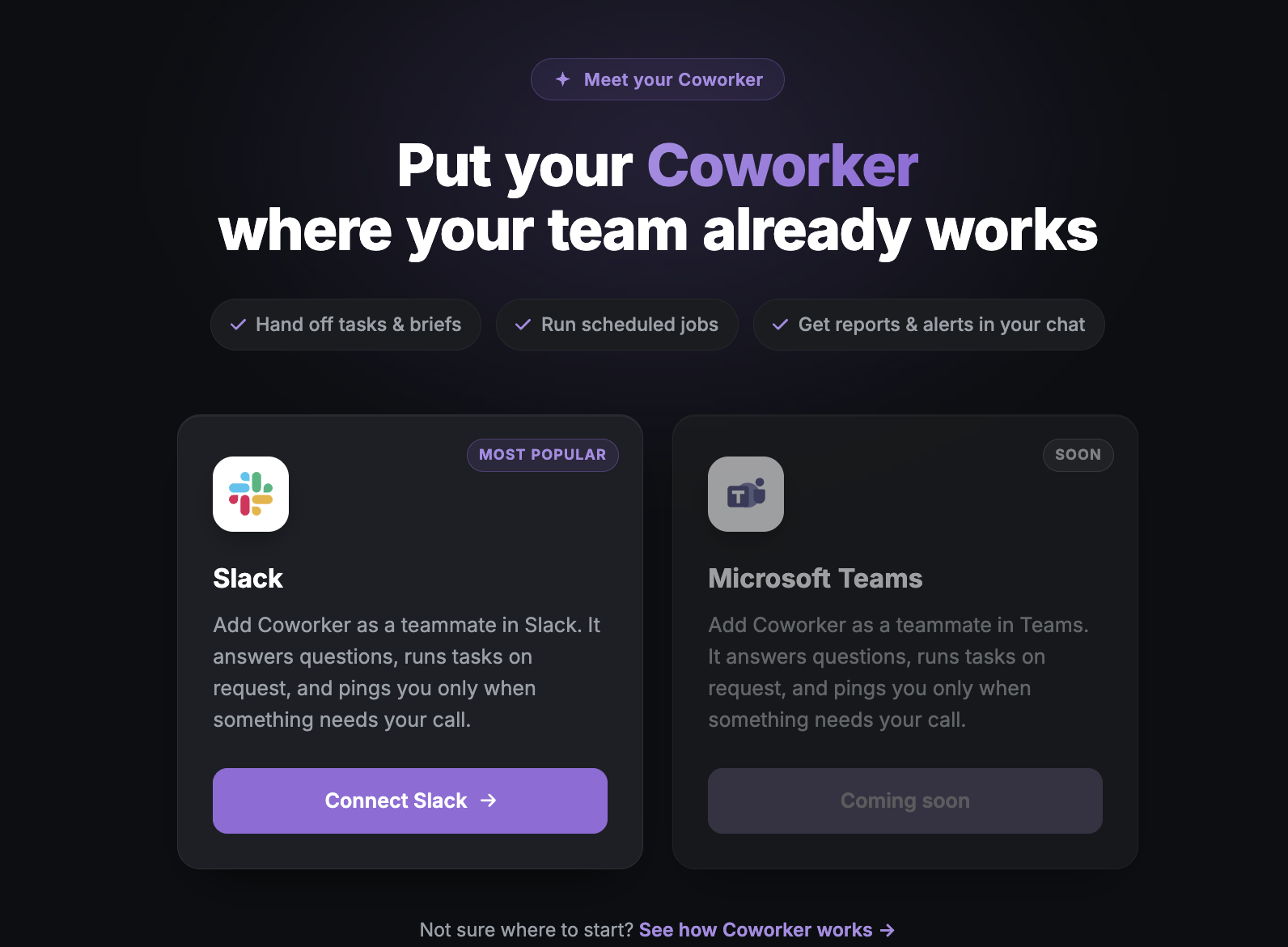
That approach eliminates the disconnect between collaboration and execution. Teams don't need one application to discuss marketing and another to carry it out. The Search Atlas Coworker keeps everyone informed while Atlas Agent continues building, shipping, and measuring work behind the scenes.
For lean marketing teams, that means fewer status meetings, fewer dashboard check-ins, and more time spent making strategic decisions. Marketing keeps moving throughout the day, and the Search Atlas Coworker reports back where the conversation is already happening.
How impact actually gets measured
Impact measurement in Atlas Agent ties every shipped change to a specific, dated action and compares performance before and after that action. This beats reporting a general trend and leaving the team to guess what caused it.
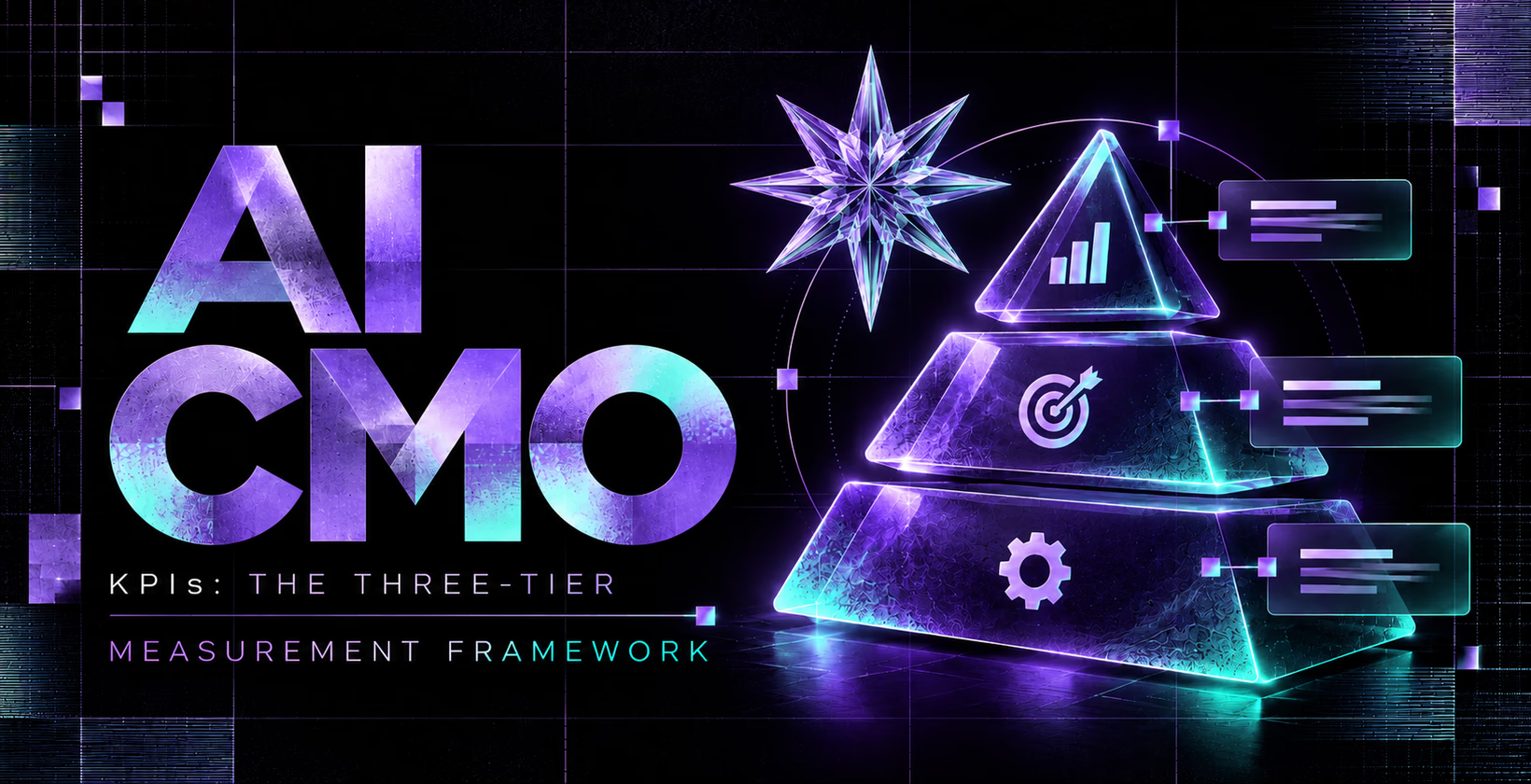
This is the piece of the loop that most automation products skip entirely. It's also what makes the KPI framework for AI CMO platforms possible to apply at all: decision quality, coverage rate, and override rate can't be measured without a change log that records what happened and when.
Concretely, that means Google Search Console performance data, queries, positions, and click-through rates, gets tracked at the page and asset level, tied to the exact change that shipped and the date it went live. A title tag rewrite on a specific page gets checked weeks later against that same page's own prior performance, keeping the signal specific instead of blurring it into a site-wide average.
The same applies to content, where a refreshed page's topical coverage and ranking movement get tracked against its pre-refresh baseline. It applies to AI visibility too, where citation and mention frequency for specific queries get tracked before and after a fix ships.
That granularity is what turns "the AI CMO is working" from a feeling into something a team can actually show a stakeholder. A change log with asset-level resolution and pre- and post-performance data is the difference between reporting a coincidence and reporting a result.
Getting a team started with Atlas Agent
Turning Atlas Agent on for a team follows a four-step setup sequence: connect a project, set the objective, review the execution plan, then let the loop run.
1. Select a project
Choose the website or project Atlas Agent will work on. Search Atlas uses the project's existing data, site structure, performance history, and business context to ground the work from the start.
2. Set a goal or choose a playbook
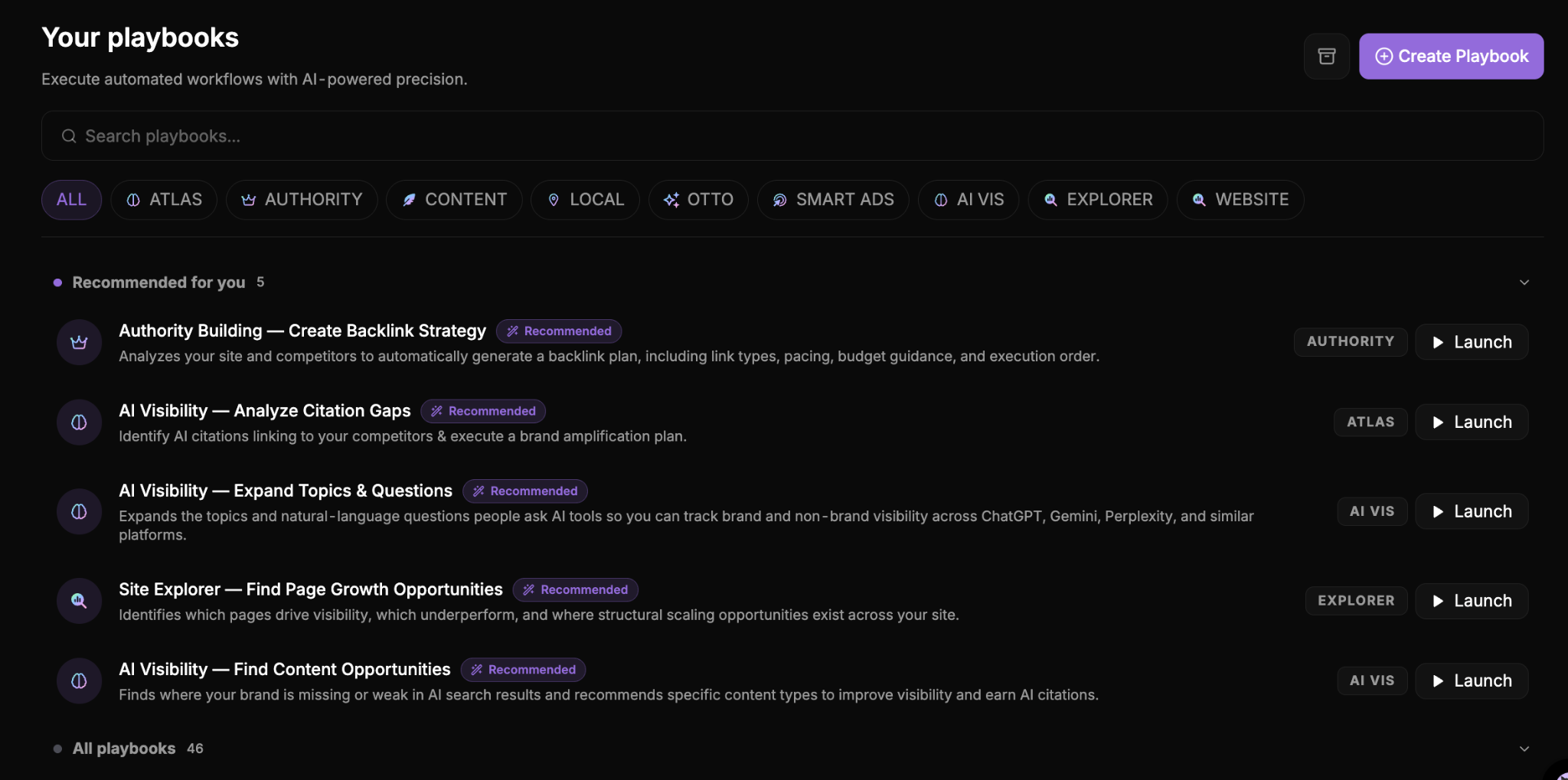
Describe the outcome you want in plain language, or start with a pre-built Playbook for a repeatable marketing workflow.
A goal might be improving rankings for a group of pages, finding content gaps, resolving site health issues, or strengthening visibility across AI search. Atlas Agent turns that objective into a sequence of specific actions.
3. Review the execution plan
Atlas Agent shows how it plans to approach the goal before the work runs. Teams can review the proposed steps and adjust the level of oversight based on their workflow.
Some teams prefer to approve work before it ships. Others allow routine execution to run autonomously and review the completed work afterward.
4. Let Atlas Agent run the work
Once the workflow begins, Atlas Agent carries out the planned actions, records what changed, and measures how performance responds.
From there, the cycle continues. Atlas Agent monitors the project, identifies the next priority, executes more work, and reports back through Search Atlas or the Search Atlas Coworker.
More detail on the full feature set, including Playbooks, the comparison against tools that stop at recommendations, and current pricing, is on the Atlas Agent product page.
Frequently asked questions
What does it mean for Atlas Agent to function as an AI CMO?
It means Atlas Agent runs the operational loop of marketing work, detecting signals, generating recommendations, shipping approved changes, and measuring what happened, across SEO, content, authority, paid media, and AI search visibility, without a human directing every individual task.
Does Atlas Agent replace a human marketing leader?
No. Atlas Agent executes marketing work. Brand positioning, business strategy, and stakeholder decisions still require a human. Atlas Agent takes the objectives a marketing leader sets and turns them into coordinated, executed action.
What is the difference between Atlas Agent and a tool that just gives SEO recommendations?
A recommendation tool stops at a list a person has to implement. Atlas Agent applies the fix directly, whether that's a metadata rewrite, a content publish, or a technical correction, and keeps a change log tied to performance data before and after the change.
Where does Atlas Agent run for a team that lives in Slack or ClickUp?
Through Search Atlas Coworker, the AI CMO a team actually works with in Slack, Microsoft Teams, and ClickUp, powered by the same Atlas Agent execution layer underneath. It's the same agent and the same data, surfaced in the workspace instead of a separate login the team has to keep in sync.
How is impact measured after a change ships?
Each shipped change is tied to a date and compared against that specific asset's own performance before and after, using Google Search Console data, ranking movement, and AI-citation tracking, rather than reported as a general trend. For the full measurement stack around that loop, see AI CMO KPIs: The Three-Tier Measurement Framework.