An AI CMO, short for AI Chief Marketing Officer, is an autonomous marketing system that plans, executes, and optimizes marketing activities across SEO, content, paid media, and AI search visibility. It's the orchestration layer built on top of agentic marketing technology and AI marketing agents — coordinating priorities across the whole stack rather than executing one bounded workflow.
Most marketing teams already know what needs to happen. They can identify content gaps, SEO opportunities, and campaign inefficiencies. The challenge is turning those insights into execution fast enough to impact results.
An AI CMO addresses that problem by translating business goals into coordinated actions and continuously optimizing performance through AI agents.
The sections below explain what an AI CMO is, how it works, how it compares to a human CMO, and which organizations benefit most from this model.
What is an AI CMO?
An AI CMO is an autonomous marketing system that plans, executes, and optimizes marketing activities across channels without requiring day-to-day management by a human Chief Marketing Officer to direct each task.
Instead of acting as a single AI tool, an AI CMO operates through a network of specialized AI agents that manage activities across SEO, content marketing, paid advertising, and AI search visibility. These agents work together inside a connected system that turns business goals into executed marketing actions.
The concept refers to both a new operating model and a growing software category. AI CMO platforms receive objectives, analyze available data, determine priorities, and deploy work across the marketing stack through one centralized environment.
This shift moves marketing from manually managed workflows to continuous execution, in which strategy, analysis, and implementation operate within the same system.
How does an AI CMO work?
An AI CMO works by turning business goals into executed marketing activities across SEO, content, paid media, and AI search visibility. Instead of generating recommendations for a team to implement, it plans, prioritizes, and deploys work.
The process starts with a business objective. The AI CMO analyzes the goal, identifies the highest-impact opportunities, and transforms strategy into coordinated actions across the marketing stack.
The workflow typically follows 5 stages:
1. Gather business context: The AI CMO collects information about the business, website, products, audience, competitors, and historical performance. This context creates the foundation for every decision and helps the system align execution with business goals.
2. Build a marketing strategy: A coordination layer analyzes available data and determines the highest-impact opportunities. Rather than producing a static marketing plan, the system creates an execution roadmap that continuously adapts as performance changes.
3. Assign work to specialized AI agents: The AI CMO assigns work to specialized agents across marketing functions. Each agent contributes to the same objective while operating from a shared intelligence layer that keeps strategy and execution aligned.
4. Execute across marketing channels: The system launches campaigns, publishes content, deploys SEO improvements, adjusts advertising budgets, and manages optimization tasks across connected platforms.
5. Measure, learn, and optimize: Every action generates performance data. The AI CMO continuously evaluates results, identifies new opportunities, and adjusts execution based on outcomes.
This creates a continuous optimization cycle where strategy, execution, and measurement operate inside the same system. Marketing strategies improve over time without relying on manual coordination between teams or disconnected tools.
What does an AI CMO do?
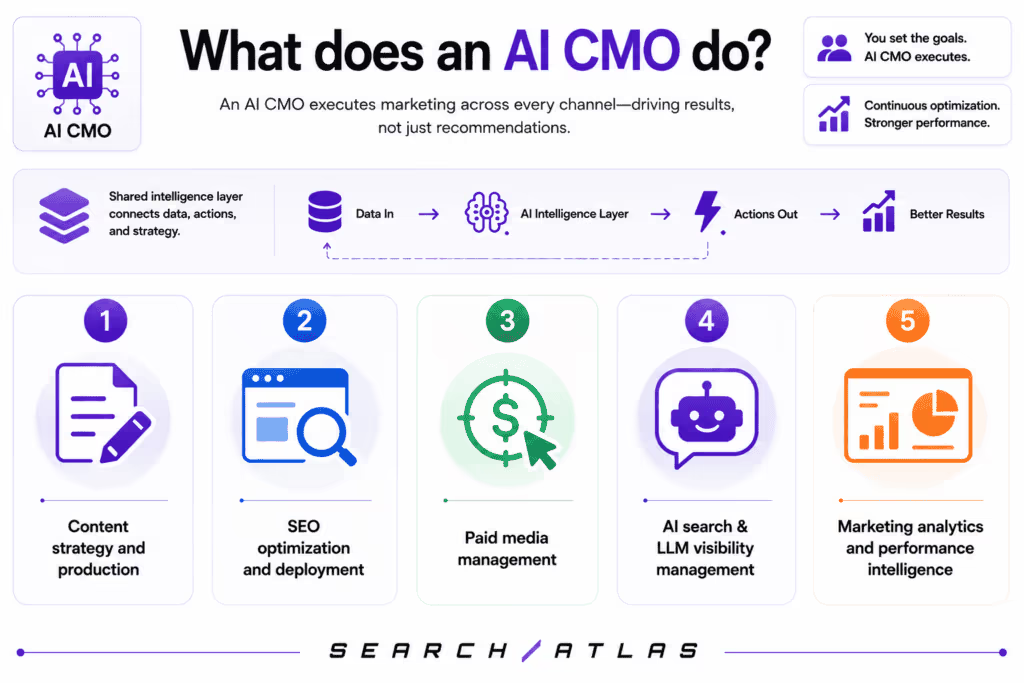
An AI CMO manages and executes the core functions of modern marketing through a coordinated network of AI agents. Instead of providing recommendations, it performs the work across content, SEO, paid advertising, AI search visibility, and reporting.
The system operates from a shared intelligence layer where every function contributes data and actions back into the broader marketing strategy. Marketing teams define objectives while the AI CMO handles execution, optimization, and ongoing performance improvements.
1. Content strategy and production
An AI CMO builds and manages the entire content lifecycle, from opportunity discovery to publication and optimization. Key responsibilities include:
- Identifying content gaps and topical opportunities.
- Building topical maps and content clusters.
- Generating content briefs and article outlines.
- Creating SEO-optimized content drafts.
- Evaluating content quality against competitor benchmarks.
- Refreshing existing content based on performance data.
Instead of targeting individual keywords in isolation, the system develops content strategies around complete topic ecosystems that strengthen topical authority and increase search visibility.
2. SEO optimization and deployment
An AI CMO identifies SEO opportunities and applies optimizations directly to websites. Unlike traditional SEO platforms that generate task lists, an AI CMO connects analysis and execution in one workflow.
Core SEO functions include:
- Auditing technical, on-page, and local SEO factors.
- Updating title tags and meta descriptions.
- Improving heading structures and internal links.
- Fixing canonicalization and indexing issues.
- Monitoring search performance signals.
- Prioritizing actions based on business objectives.
The system evaluates performance data alongside business objectives, audience alignment, and conversion outcomes. This ensures optimization efforts contribute to meaningful business growth.
3. Paid media management
An AI CMO manages paid media campaigns from creation through optimization. Typical responsibilities include:
- Building campaign structures and ad groups.
- Managing keyword targeting.
- Identifying and applying negative keywords.
- Adjusting budgets based on performance.
- Optimizing audience targeting.
- Running retargeting initiatives.
Because paid and organic data share the same intelligence layer, campaign decisions reflect a broader view of customer acquisition performance. This approach allows campaigns to adapt as market conditions change, keeping performance aligned with defined business targets without requiring constant manual intervention.
4. AI search and LLM visibility management
An AI CMO manages brand visibility across AI search platforms and large language models. It tracks how platforms like ChatGPT, Claude, Gemini, and Perplexity mention, cite, and recommend a brand compared to competitors.
Visibility monitoring includes:
- Brand mention frequency.
- Citation volume and source attribution.
- Share of voice across AI platforms.
- Competitor visibility comparisons.
- Sentiment analysis.
- Content opportunities for citation growth.
The system identifies citation gaps, analyzes the sources influencing AI-generated answers, and creates content to increase citation share. This turns Generative Engine Optimization (GEO) into a continuous execution process rather than a one-time optimization project.
5. Marketing analytics and performance intelligence
An AI CMO centralizes performance measurement across every marketing channel. Reporting capabilities include:
- SEO performance tracking.
- Paid media performance monitoring.
- Content impact analysis.
- AI visibility measurement.
- Conversion attribution.
- Action-to-outcome reporting.
Every optimization remains connected to business outcomes, creating a complete view of how execution influences traffic, visibility, leads, and revenue.
How is an AI CMO different from a human CMO?
The difference between an AI CMO and a human CMO is that an AI CMO executes marketing activities directly, while a human CMO focuses on strategy, leadership, and organizational decision-making.
A traditional Chief Marketing Officer defines marketing objectives, aligns teams, and oversees execution. An AI CMO takes those objectives and turns them into actions across SEO, content, paid media, and AI search visibility. It identifies opportunities, prioritizes initiatives, and deploys improvements continuously.
The distinction becomes clear in how work moves from strategy to execution. Human CMOs rely on teams, processes, and departments to implement initiatives. AI CMOs rely on coordinated AI agents, connected systems, and shared data to execute work automatically.
This difference has a significant impact on speed. Human teams often move through planning cycles, approvals, handoffs, and implementation queues before changes go live. An AI CMO can analyze new information, determine the next best action, and execute improvements as opportunities emerge.
The gap widens further at scale. Modern marketing requires organizations to manage content, SEO, advertising, local visibility, and AI search performance simultaneously. An AI CMO operates across these functions from a unified intelligence layer where every action contributes to the same objective. Traditional teams often manage these activities through separate workflows, tools, and reporting systems.
Consistency is another advantage. An AI CMO can evaluate thousands of pages, optimize hundreds of campaigns, and monitor visibility across multiple platforms while applying the same optimization standards across every asset. Human teams must prioritize where to focus their limited time and resources.
An AI CMO does not replace every aspect of a human marketing leader. Brand positioning, business strategy, executive communication, organizational leadership, and creative direction still require human judgment. The role of the AI CMO is to own marketing execution, allowing human leaders to focus on strategic decisions that guide growth.
Who needs an AI CMO?
Organizations that benefit most from an AI CMO need to execute marketing across multiple channels but lack the resources, bandwidth, or team size to do it efficiently.
An AI CMO is especially valuable for:
- Startups and early-stage companies that need SEO, content, paid advertising, and AI visibility without hiring specialists for every channel.
- Growth-stage businesses looking to scale marketing execution faster than team growth. An AI CMO allows small teams to operate with the execution capacity of a much larger department.
- Marketing agencies managing multiple client accounts across SEO, content, paid media, and AI search visibility. An AI CMO improves consistency and reduces the operational overhead required to scale services.
- Lean in-house marketing teams that are responsible for multiple channels and initiatives. An AI CMO automates execution while allowing teams to focus on strategy and priorities.
- Enterprise organizations that need to coordinate large-scale marketing activities across websites, campaigns, business units, and markets from a centralized system.
See how the model applies by context: AI CMO for Startups, AI CMO for Marketing Agencies, and AI CMO for Ecommerce Brands.
Success with an AI CMO still requires human oversight. Teams need to define clear objectives, review high-impact actions, and evaluate results against business goals. An AI CMO executes marketing activities at a scale and speed that would be difficult to achieve manually.
How Search Atlas functions as an AI CMO platform
Search Atlas functions as an AI CMO platform by combining strategy, execution, and optimization into a single system powered by AI agents. Rather than relying on separate tools for SEO, content, paid media, and AI visibility, Search Atlas connects these functions through a shared intelligence layer that executes marketing activities from one platform.
At the center of the platform is Atlas Agent, the AI agent responsible for translating business goals into marketing actions. Atlas Agent analyzes objectives, identifies opportunities, prioritizes initiatives, and coordinates execution across the platform.
Search Atlas delivers AI CMO capabilities through four core systems:
- OTTO SEO automates SEO execution by identifying opportunities and deploying on-page, technical, local, and authority-building improvements.
- Content Genius creates and optimizes content using AI-assisted workflows, topical analysis, entity optimization, and real-time content scoring.
- Smart Ads manages paid media campaigns through automated campaign creation, budget optimization, audience targeting, and retargeting.
- LLM Visibility tracks brand presence across AI search platforms, measuring citations, mentions, sentiment, and share of voice across ChatGPT, Claude, Gemini, and Perplexity.
Together, these systems create a unified marketing execution platform where data, strategy, and optimization operate from the same intelligence layer. The result is an AI CMO that can coordinate and execute marketing activities across multiple channels from a single objective.
Related Reading
- What is Agentic Marketing? Definition, Components, and Execution Model
- What Is an AI Marketing Agent?
- AI CMO KPIs: The Three-Tier Measurement Framework
- 10 Best AI CMO Platforms Ranked by Execution Depth
AI CMO FAQ
- What Is an AI CMO?
An AI CMO is an autonomous marketing system that plans, executes, and optimizes marketing activities across SEO, content, paid media, and AI search visibility. It combines AI agents, automation, and performance data to turn business goals into executed marketing actions without manual coordination across teams and tools.
- How Is an AI CMO Different From Marketing Automation?
An AI CMO makes decisions and executes marketing activities based on goals and performance data. Marketing automation follows workflows created in advance. While automation executes predefined instructions, an AI CMO identifies opportunities, prioritizes actions, and continuously adapts execution based on changing conditions.
- Will an AI CMO Replace a Human CMO?
An AI CMO replaces the operational execution layer of marketing, not the leadership layer. Human CMOs still define business strategy, brand positioning, audience development, and organizational priorities. The AI CMO executes within those parameters, allowing marketing leaders to focus on strategic decisions and business direction.
- What Types of Organizations Benefit Most From an AI CMO?
Organizations that need to execute across multiple marketing channels without increasing headcount benefit most from an AI CMO. Common examples include startups, growth stage companies, lean in-house marketing teams, agencies managing multiple client accounts, and enterprises operating at scale.
- What Controls Does an AI CMO Provide?
Most AI CMO platforms provide configurable autonomy levels, approval workflows, change tracking, and rollback capabilities. Teams can review high-impact actions before deployment, monitor every modification, and maintain full control over how autonomous execution operates within the organization.