An AI CMO for ecommerce brands keeps your entire catalog marketing moving. It fixes SEO issues, updates product and category pages, improves paid campaigns, and catches problems before they cost you sales.
The work keeps running while your team focuses on growth.
Every improvement compounds because your catalog, content, and campaigns keep improving, even when your team is offline. To achieve consistent revenue growth, marketing needs to continue executing across all channels.
This guide explores where an AI CMO changes revenue outcomes for ecommerce brands, where autonomous execution makes the biggest difference, and why continuous marketing activity delivers more growth than another report waiting for someone to act on it.
What is an AI CMO for an Ecommerce brand?
An AI CMO for an ecommerce brand is an autonomous marketing system that keeps SEO, content, paid media, and AI search visibility moving across an entire product catalog. Instead of waiting for teams to implement recommendations, it executes the work directly and keeps improving performance over time.
For ecommerce brands, an AI CMO removes much of the manual work required to keep thousands of products, categories, and campaigns updated. Product pages stay optimized, content keeps improving, campaigns adapt to changing conditions, and issues get repaired before they become expensive problems.
Unlike traditional marketing platforms that stop at reporting or recommendations, an AI CMO continuously executes and evaluates work across every channel. This allows ecommerce brands to grow without relying on endless audits, manual updates, or disconnected workflows that struggle to keep pace with large and constantly changing catalogs.
Why generic AI CMO tools miss ecommerce's real revenue levers?
Most AI CMO platforms fall into two categories, and neither is designed around the way ecommerce brands actually grow.
- Reporting Platforms: Some platforms focus on attribution, channel reporting, and budget recommendations. They connect data from multiple sources and suggest where marketing teams should invest next, but they rarely change anything on the website, in the catalog, or in paid campaigns.
- Single-Channel Automation: Other platforms automate one area of marketing, such as content creation, paid advertising, or social publishing. They improve one channel while leaving product pages, site health, and search visibility to separate systems.
Marketing stalls when product pages, category pages, shopping feeds, and ads live in separate platforms. Updates happen slowly, issues stay unresolved, and teams spend more time coordinating work than improving revenue.
An ecommerce catalog needs continuous execution across every channel. Product information changes, inventory shifts, campaigns need updates, and pages require ongoing optimization. Platforms that stop at reporting or operate in a single channel often miss the daily work that directly influences revenue.
Where an AI CMO actually moves revenue in an Ecommerce catalog
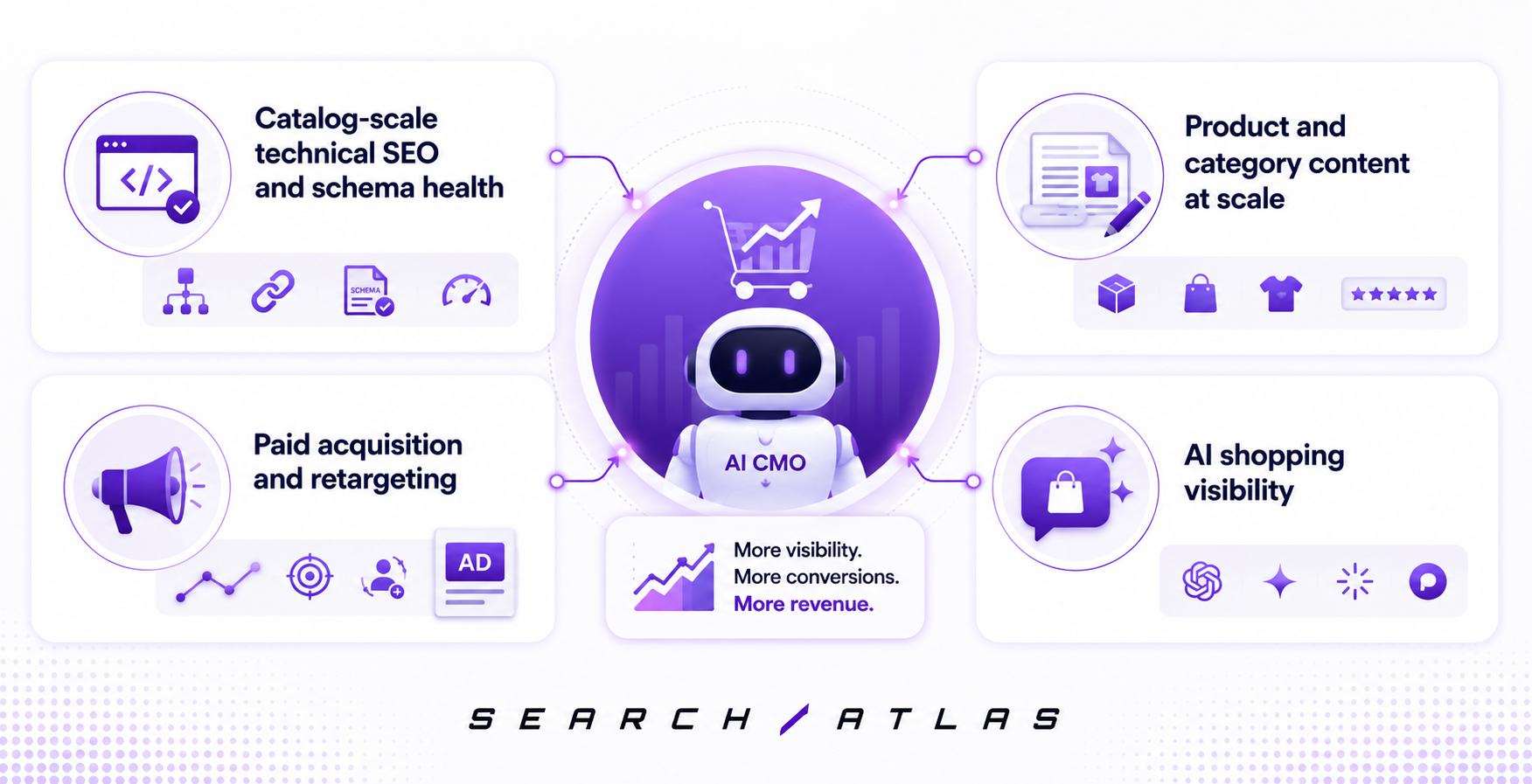
Most ecommerce revenue comes from technical SEO, product and category content, paid acquisition, and AI shopping visibility. These areas shape how products get discovered, how efficiently traffic converts, and how often customers return.
Small problems across these surfaces compound quickly in large catalogs, which is why continuous execution has such a direct impact on revenue.
Catalog-scale technical SEO and schema health
Technical issues multiply as a catalog grows.
Missing schema, broken internal links, duplicate URLs, and outdated metadata affect hundreds or thousands of pages before anyone notices. An AI CMO keeps the catalog healthy by continuously identifying and repairing these issues across the site.
Product information stays eligible for rich results and shopping experiences, important pages remain easy to crawl, and new issues get addressed before they spread across the catalog.
The result is a catalog that stays healthy over time, with less technical debt and fewer revenue opportunities slipping away.
Product and category content at scale
Content gaps grow just as quickly as technical ones. New products launch, categories expand, and descriptions become outdated or duplicated over time.
An AI CMO keeps content moving by continuously creating, updating, and improving product and category pages based on search demand and changes across the catalog. Instead of waiting for the next content project, the work keeps progressing in the background.
Every improved page creates another opportunity to capture demand, attract qualified traffic, and generate sales.
Paid acquisition and retargeting
Paid campaigns rarely stay effective for long. Product availability changes, customer demand shifts, and yesterday's winning keywords can become tomorrow's wasted spend.
An AI CMO keeps campaigns aligned with those changes by continuously refining targeting, adjusting budgets, and reconnecting with visitors who leave without purchasing. Campaigns keep improving instead of slowly drifting away from what customers want.
The result is more efficient spending and more opportunities to turn existing traffic into revenue.
AI shopping visibility
Product discovery increasingly starts with AI-generated answers. Shoppers ask conversational questions, compare products, and look for recommendations before they ever visit a website.
An AI CMO keeps monitoring how products and brands appear across AI search platforms and surfaces new opportunities as they emerge. Visibility in these answers becomes another source of demand, especially as more buying journeys begin with a conversation instead of a search query.
Brands that stay present in AI recommendations create another path to discovery and another opportunity for revenue growth.
How to set up an AI CMO that keeps ecommerce growth moving
An AI CMO works best when the initial setup gives it clear direction and a strong foundation to build on. The goal is to provide enough context for the system to keep improving the catalog long after the setup is complete.
Ecommerce growth depends on thousands of small decisions happening across product pages, category pages, campaigns, and shopping experiences. A missing schema tag, an outdated description, or a campaign promoting an out-of-stock product can affect revenue long before someone notices.
The six steps below create the conditions for continuous execution.
1. Map the catalog and define what growth looks like
An AI CMO needs context before it can start improving performance. Product categories, competitors, and keyword themes shape every decision that follows.
Start by documenting:
- The categories that drive the most revenue.
- The products that matter most to the business.
- The three to five competitors that customers actually compare against.
- The search themes and keyword clusters each category should own.
Clear inputs create better outputs. A well-mapped catalog gives the system enough context to prioritize work that contributes to real business growth.
2. Build a stable technical foundation
Technical issues quietly slow growth across large catalogs. Missing schema, crawl issues, broken links, and indexation problems often affect hundreds or thousands of pages before anyone notices.
Start by:
- Connecting data sources such as Google Search Console.
- Reviewing schema coverage across product and category pages.
- Identifying crawl and indexation issues.
- Running approval workflows during the first few weeks.
A stable foundation keeps small issues from turning into larger revenue problems. A missing schema can prevent products from appearing in rich results. Crawl issues can delay the discovery of new products and inventory changes. Broken internal links can leave valuable pages isolated and difficult to find.
Resolving these issues early gives the system an environment where improvements can compound over time. New content reaches its full potential faster, campaigns send traffic to stronger landing pages, and future optimizations build on a healthier catalog instead of fighting against unresolved technical debt.
3. Clean up the catalog before expanding it
Large ecommerce sites naturally accumulate duplicate and outdated pages over time. Categories overlap, old products remain indexed, and thin content begins competing with stronger pages.
Before publishing anything new, review the pages that need to be:
- Updated and expanded.
- Redirected to stronger pages.
- Removed entirely.
Publishing new content on top of unresolved duplication often spreads the problem instead of fixing it. A cleaner catalog creates more room for future growth and makes every new optimization more effective.
4. Start small and let the work compound
Scaling an entire catalog at once makes mistakes harder to catch and more expensive to correct. Begin with one category cluster:
- Create or improve content.
- Review the output for brand voice and product accuracy.
- Measure the results.
- Use those learnings before expanding further.
This approach establishes a quality standard before the work reaches hundreds or thousands of pages. Once the foundation is right, improvements can keep rolling through the catalog, creating momentum that continues long after the first pages are published.
5. Focus paid campaigns on the strongest opportunities
Not every category deserves the same level of investment. Some products generate significantly stronger purchase intent than others. Start with:
- The highest-intent categories.
- Campaigns that align with real customer demand.
- Retargeting for visitors who leave without purchasing.
This creates a feedback loop where campaigns continue learning which products drive revenue and where additional demand exists.
Over time, small improvements in targeting and budget allocation can have a meaningful impact on profitability.
6. Establish a baseline for AI shopping visibility
Product discovery increasingly starts with AI-generated answers. Shoppers compare products, ask for recommendations, and research alternatives before they ever visit a website.
Track:
- Which brands appear most often.
- Which products receive recommendations.
- Which sources AI platforms cite.
- Which competitors own the conversation today.
A clear benchmark reveals where visibility already exists and where opportunities remain.
As AI becomes a larger part of the buying journey, measuring visibility early makes it easier to understand whether future improvements are creating more discovery, more traffic, and ultimately more revenue.
Platform-specific shopping surfaces matter here too — see our Meta AI Shopping Tools review for how one major channel is already shaping product discovery and recommendations.
What happens after the AI CMO goes live?
Launching an AI CMO is only the beginning. Ecommerce catalogs never stay still. Products go out of stock, pages get updated, campaigns drift, and technical issues appear without warning.
An effective AI CMO keeps working long after the initial setup. Atlas Agent continuously monitors the catalog, identifies changes that no longer match the intended state, applies or proposes the appropriate fix, and keeps watching once the issue is resolved.
Search Atlas Coworker then surfaces those actions in Slack, Teams, or ClickUp, so teams know what changed and where new opportunities have emerged.
This continuous loop matters because small issues rarely stay small in ecommerce.
- A schema regression can reduce product visibility for days before anyone notices.
- A category page that accidentally becomes no-indexed can lose rankings and traffic.
- A paid campaign can continue spending on products that are no longer available.
- A product description update can introduce duplication across dozens of pages.
The value comes from timing. Fixing these issues the same day they appear creates a very different outcome than discovering them weeks later, after visibility, traffic, and revenue have already declined.
Instead of waiting for the next audit, the catalog stays under constant watch. Small problems get repaired before they become expensive ones, and the work that drives growth keeps moving in the background.
Wake up to an ecommerce catalog that kept growing overnight
Ecommerce growth slows when every page update, campaign adjustment, and technical fix waits for someone to find it, assign it, and finish it.
Search Atlas removes that delay.
Your catalog keeps moving while your team is offline. Product and category pages improve, SEO issues get fixed, paid campaigns adapt, AI search visibility grows, and new marketing assets keep shipping across every channel.
The work also repairs itself. Self-healing loops catch broken schema, declining pages, wasted ad spend, and other revenue leaks before they spread across the catalog.
That means less time coordinating agencies, employees, and fragmented platforms. Fewer growth opportunities sit untouched. More of the work that drives revenue gets completed without increasing marketing headcount.
You own the growth. Search Atlas runs the engine while you sleep. Try it now for FREE!
AI CMO for Ecommerce FAQ
What is an AI CMO for ecommerce?
An AI CMO for ecommerce is a platform that executes SEO, content, paid, and AI-visibility work directly against a product catalog, applying fixes and publishing changes rather than only recommending them.
How is an AI CMO different from ecommerce marketing automation?
Marketing automation triggers predefined actions based on rules a team sets up in advance, such as an abandoned-cart email sequence. An AI CMO analyzes the catalog and live performance data continuously and decides what to fix or produce next, then executes it. See AI CMO vs. Marketing Agency for how this compares to an outsourced execution model, and agentic paid media for how the ad-spend side of this executes.
Does an AI CMO replace an ecommerce marketing team?
No. It replaces the execution work of implementing fixes and drafting content at a catalog scale. Merchandising strategy, pricing, promotion calendars, and brand voice on flagship products stay with the team.
How fast does an AI CMO act on a large catalog?
Once the OTTO SEO pixel is installed, fixes deploy directly to live pages rather than queuing in a batch process, so schema, metadata, and content changes can go live the same day they are identified.
Does catalog size change how an AI CMO should be configured?
Yes. A larger catalog needs a Knowledge Graph built around category-level keyword clusters and named competitors, plus a tracked-keyword allowance (Growth or Pro plan) large enough to cover every category that matters.
Related Reading