Agentic paid media is the paid-channel execution layer of agentic marketing. It changes how Google Ads campaigns are built, launched, and optimized through continuous AI-driven execution. Instead of managing campaigns manually across fragmented tools and repetitive workflows, AI agents handle campaign structure, creative generation, bidding, optimization, and budget allocation in real time.
This approach simplifies paid media management by connecting strategy, execution, and optimization into a single continuous system. You define campaign goals, while AI agents analyze intent, build campaigns, optimize performance, and apply improvements directly inside Google Ads.
This guide explains how agentic paid media works, how AI agents manage campaigns from brief to bid, what infrastructure powers the system, and how continuous optimization changes Google Ads management at scale.
What is agentic paid media?
Agentic paid media is a Google Ads execution model where autonomous AI agents build, launch, optimize, and manage campaigns from a single business goal. Agentic paid media integrates campaign planning, ad generation, bidding, targeting, and optimization into one continuously operating system.
Rather than relying on predefined automation rules**, agentic paid media systems interpret goals, evaluate performance signals, and dynamically execute campaign actions.** They build campaign structures, cluster keywords by intent, generate ad variations, adjust bids, and redistribute budgets based on real conversion data.
This model removes the delays created by fragmented tools and disconnected workflows. Campaign architecture, audience targeting, creative testing, budget allocation, and bid management operate within a single connected environment, where changes are deployed directly to Google Ads.
The defining characteristic is autonomous execution. AI agents move beyond recommendations and apply campaign updates directly. Marketing teams maintain full control over autonomy levels, from manual approval workflows to continuous hands-free optimization.
How does an agentic Google Ads pipeline work?
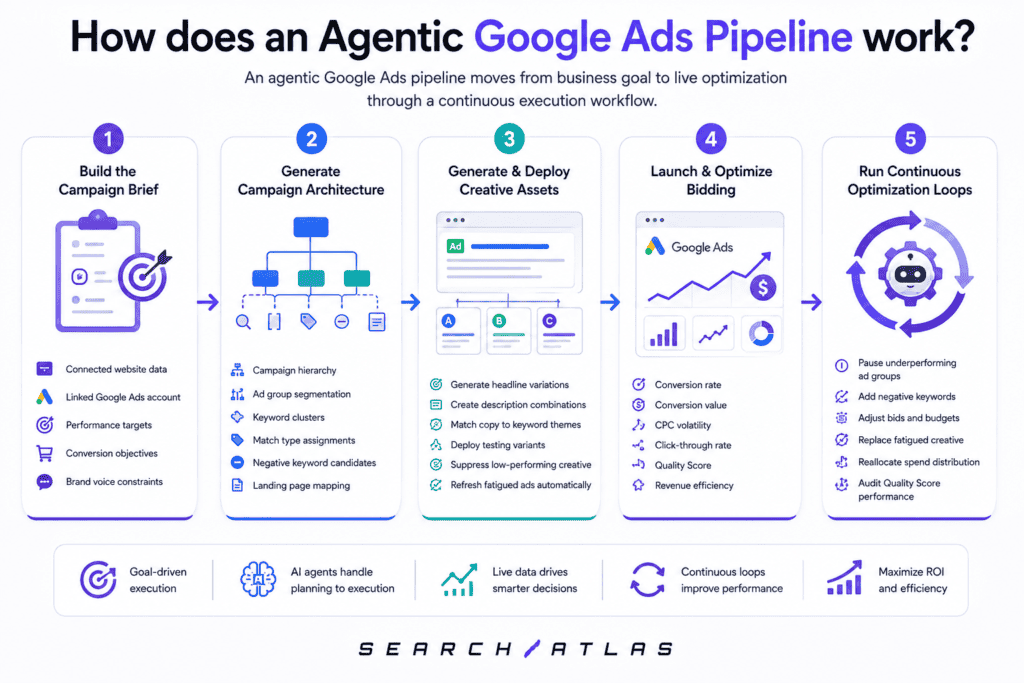
An agentic Google Ads pipeline moves from business goal to live optimization through a continuous execution workflow. AI agents handle campaign planning, structure creation, ad generation, bidding, deployment, and optimization without relying on manual coordination between stages.
The 5 main stages are listed below.
Stage 1: Build the campaign brief
The campaign brief stage defines campaign direction, performance targets, audience intent, and execution constraints before any ads launch. AI agents analyze connected business data to determine how campaigns should operate.
The brief stage focuses on business intent rather than isolated keywords. The system evaluates website structure, existing account performance, conversion history, and product segmentation before generating campaign logic.
The main inputs required during this stage are:
- Connected website data.
- Linked Google Ads account.
- Numeric performance targets.
- Conversion objectives.
- Brand voice constraints.
Performance targets guide campaign structure and budget logic. Specific goals, such as target ROAS or acquisition cost, create stronger execution signals than broad traffic objectives.
AI agents resolve intent conflicts during the brief stage by separating products, services, or audience categories into distinct campaign themes. Different buyer intents receive independent structures, bid strategies, and messaging frameworks.
Stage 2: Generate campaign architecture
The campaign architecture stage organizes campaigns into structured intent groups designed for stronger Quality Score alignment. AI agents create scalable account structures that connect search intent, ad copy, and landing pages precisely.
Keyword clustering happens before copy generation because relevance depends on intent alignment at the ad group level. Broad campaign groupings weaken targeting precision and reduce ad relevance across auctions.
The architecture stage generates the following outputs.
- Campaign hierarchy.
- Ad group segmentation.
- Keyword clusters.
- Match type assignments.
- Negative keyword candidates.
- Landing page mapping.
Most agentic systems structure campaigns using tightly themed keyword groups rather than broad category targeting. This improves query relevance, click-through rates, and conversion efficiency across campaigns.
The architecture layer creates the operational foundation for bidding, creative generation, and optimization workflows that follow later stages.
Stage 3: Generate and deploy creative assets
The creative stage generates ad copy variations matched to keyword intent, audience signals, and predicted conversion behavior. AI agents automatically create headlines, descriptions, extensions, and test variants across ad groups.
Creative generation happens inside predefined brand constraints established during the brief stage. These constraints maintain consistent terminology, tone, claims, and positioning across large campaign environments.
The creative execution workflow includes:
- Generate headline variations.
- Create description combinations.
- Match copy to keyword themes.
- Deploy testing variants.
- Suppress low-performing creative.
- Refresh fatigued ads automatically.
Agentic systems optimize creativity continuously after launch. Performance signals such as CTR decline, conversion drops, or engagement reduction trigger new variant generation automatically without requiring manual rewrite cycles.
This creates a continuous creative feedback loop where ads evolve based on live performance data rather than static testing schedules.
Stage 4: Launch and optimize bidding
The bidding stage initializes campaign spend allocation and continuously adjusts bids using live conversion and revenue data. AI agents optimize budget distribution dynamically as campaigns generate performance signals.
Traditional automation adjusts bids inside fixed campaign structures. Agentic systems optimize both bidding behavior and campaign allocation simultaneously. Underperforming segments lose spend while high-value opportunities receive additional budget automatically.
The bidding layer evaluates several performance signals continuously.
- Conversion rate.
- Conversion value.
- CPC volatility.
- Click-through rate.
- Quality Score.
- Revenue efficiency.
Conversion value data changes how optimization decisions happen. Revenue-generating campaigns receive higher bid priority even when lower-volume campaigns produce fewer total conversions.
This shifts optimization away from click volume and toward profitability, return efficiency, and long-term revenue generation.
Stage 5: Run continuous optimization loops
The optimization stage operates as a recurring execution loop where AI agents audit campaigns, apply corrections, and improve performance continuously. Optimization happens automatically inside predefined approval thresholds.
Agentic systems monitor campaign health in real time instead of relying on weekly or monthly review cycles. AI agents detect inefficiencies immediately and deploy updates directly into Google Ads environments.
The optimization loop performs the following actions continuously.
- Pause underperforming ad groups.
- Add negative keywords.
- Adjust bids and budgets.
- Replace fatigued creative.
- Reallocate spend distribution.
- Audit Quality Score performance.
Negative keyword management becomes fully automated inside this workflow. Search terms generating irrelevant traffic or low-intent clicks trigger exclusion logic automatically without requiring manual search term reviews.
Continuous optimization transforms Google Ads management from periodic maintenance into a live execution system that improves performance continuously as new data enters the environment.
How is agentic paid media different from traditional PPC tools?
Agentic paid media platforms execute campaign actions automatically, while traditional PPC tools depend on manual implementation after recommendations appear. Agentic systems connect analysis, decision-making, and execution into one continuous workflow instead of separating insights from action.
Traditional PPC tools improve visibility but still rely on human execution. Teams need to:
- Review reports manually.
- Adjust bids and budgets.
- Update targeting settings.
- Add negative keywords.
- Deploy optimizations manually.
Agentic paid media removes those execution gaps. AI agents apply updates directly inside Google Ads while optimizing campaigns continuously based on live performance data.
The main operational differences are below.
| Workflow Area | Traditional PPC Tools | Agentic Paid Media |
| Execution Model | Recommendation based | Autonomous execution |
| Optimization | Manual updates | Continuous optimization |
| Negative Keywords | Manual audits | Automated filtering |
| Budget Allocation | Human controlled | AI-driven allocation |
| Campaign Structure | Manually maintained | Dynamically optimized |
| Human Role | Execution focused | Strategy and governance |
Negative keyword management highlights the operational difference clearly. Traditional workflows require marketers to review search term reports and add exclusions manually.
Traditional PPC workflows rely on humans to:
- Review recommendations.
- Approve changes.
- Deploy updates manually.
Agentic systems automate that process continuously. AI agents detect low-intent queries, apply negative keywords automatically, and refine targeting as campaign data evolves. Agentic paid media shifts routine execution to AI agents while humans focus on goals, governance, and high-impact decisions.
What is the difference between agentic paid media and Google Smart Bidding?
Google Smart Bidding optimizes bid amounts inside an existing campaign structure, while agentic paid media manages the entire campaign lifecycle automatically. Agentic systems handle structure, creativity, targeting, budget allocation, and optimization inside one continuous execution workflow.
Smart Bidding improves bidding efficiency but still depends on humans to build and maintain campaigns. Marketing teams still manage ad groups, keyword clustering, negative keywords, copy testing, and budget distribution manually.
Agentic paid media expands optimization beyond bids. AI agents continuously:
- Build and restructure campaigns.
- Generate and replace ad copy.
- Cluster keywords by intent.
- Add negative keywords automatically.
- Reallocate budgets dynamically.
- Detect creative fatigue and performance drops.
This operational difference becomes critical in underperforming campaigns. Smart Bidding adjusts bid levels but does not fix structural issues causing weak performance.
An ad group with poor keyword alignment or weak ad relevance still struggles even with higher bids. Agentic systems identify those problems directly, reorganize campaign structure, rewrite creative assets, and optimize targeting before adjusting bids.
Agentic paid media adds the execution layers missing from Smart Bidding. Instead of optimizing a single variable, AI agents manage the full campaign system continuously while using Smart Bidding signals as one input inside a broader optimization loop.
What infrastructure does agentic paid media require?
Agentic paid media requires a connected setup that gives AI agents access to campaign data, website behavior, and conversion performance. These integrations allow the system to launch campaigns, optimize bids, adjust targeting, and improve results continuously without relying on manual execution.
Three core components make this possible.
1. Google Ads API connection
The Google Ads API gives the system direct access to your advertising account. AI agents use this connection to create campaigns, update bids, pause ad groups, add negative keywords, adjust budgets, and deploy optimizations automatically inside Google Ads.
This is what turns the platform into an execution system instead of a recommendation tool. Traditional PPC platforms generate suggestions that marketers still need to implement manually. Agentic systems apply those changes directly and continue optimizing performance in real time.
2. Website and intent analysis layer
Your website gives the system the business context required to structure campaigns correctly. AI agents analyze landing pages, products, services, and conversion paths to understand what you sell, who you target, and which searches drive revenue.
This allows the system to build campaigns around real search intent instead of broad keyword lists. Campaign structure, ad groups, targeting logic, and creative assets align directly with your products, services, and conversion goals.
3. Conversion tracking and value attribution
Conversion tracking powers the optimization loop behind agentic paid media. Google Tag Manager and conversion tracking integrations send lead, purchase, and revenue data back into the system continuously.
This data allows AI agents to optimize toward profitability instead of traffic volume alone. The system identifies which campaigns generate the highest conversion value, reallocates budgets automatically, and adjusts bids based on revenue performance in real time.
Without conversion value tracking, optimization stays limited to clicks and conversion counts. Revenue attribution gives the system the financial context required for value-based bidding and full-funnel campaign optimization.
How to build an agentic Google Ads workflow
Building an agentic Google Ads workflow requires a connected execution environment where AI agents can analyze data, launch campaigns, and optimize performance continuously. Agentic paid media works best when the workflow starts with clear goals, accurate tracking, and direct platform integrations.
The 4 main stages are listed below.
1. Configure conversion tracking and campaign goals
Conversion tracking creates the foundation of the workflow. AI agents rely on conversion signals to evaluate campaign performance, optimize bids, and prioritize budget allocation across campaigns and ad groups.
The setup process starts with three core requirements:
- Verified conversion tracking.
- Google Ads API access.
- A measurable campaign objective.
Goals need to remain specific and measurable to guide optimization decisions effectively. Objectives such as target ROAS, lead generation cost, or revenue growth create stronger execution signals than broad traffic goals.
Accurate conversion tracking allows the system to optimize toward profitability instead of clicks or impressions alone.
2. Generate campaign structure automatically
The campaign structure stage organizes campaigns into intent-driven ad groups designed for stronger targeting precision and Quality Score alignment. AI agents analyze keywords, audience intent, and landing page relevance before generating campaign architecture.
The system automatically:
- Cluster keywords by intent.
- Build themed ad groups.
- Apply negative keyword filters.
- Align landing pages with search intent.
- Define initial targeting settings.
This structure creates the operational foundation for creative generation, bidding, and optimization workflows that follow later stages.
3. Generate creative assets and bid configuration
The creative and bidding stage transforms campaign structure into live advertising assets. AI agents generate ad variations, configure bidding logic, and distribute budgets across campaigns automatically based on the defined business goal.
The workflow includes:
- Generating headline variations.
- Creating ad descriptions.
- Matching copy to keyword intent.
- Configuring bid strategies.
- Setting budget allocation rules.
Multiple creative variations launch simultaneously to create continuous testing environments from the beginning of the campaign lifecycle.
4. Launch continuous optimization Loops
After deployment, the workflow shifts into continuous optimization mode. AI agents monitor campaign performance in real time, identify inefficiencies, and apply updates automatically as new data enters the system.
The optimization loop is continuous:
- Adjusts bids and budgets.
- Adds negative keywords.
- Detects creative fatigue.
- Replaces underperforming ads.
- Reallocates spending dynamically.
- Audits campaign health.
Imported campaigns can enter the same optimization workflow without requiring a full rebuild. AI agents analyze existing structures, detect inefficiencies, and begin optimizing campaigns from their current performance state.
This continuous execution model transforms Google Ads management from periodic maintenance into an always-on optimization system that improves performance automatically over time.
How does Search Atlas Smart Ads implement agentic Google Ads Management?
Search Atlas Smart Ads implements agentic Google Ads management by combining AI campaign execution, continuous optimization, and automated PPC management inside one connected system. Powered by Atlas Agent, Smart Ads transforms business goals into live Google Ads actions without requiring manual execution between optimization cycles. The Smart Ads launch announcement covers the original product rollout and the ROI case for automating campaign creation and management.
Instead of relying on static automation rules or isolated recommendations, Smart Ads continuously audits campaigns, identifies inefficiencies, applies optimizations, and reallocates budget automatically based on real conversion performance.
AI campaign execution through Atlas Agent
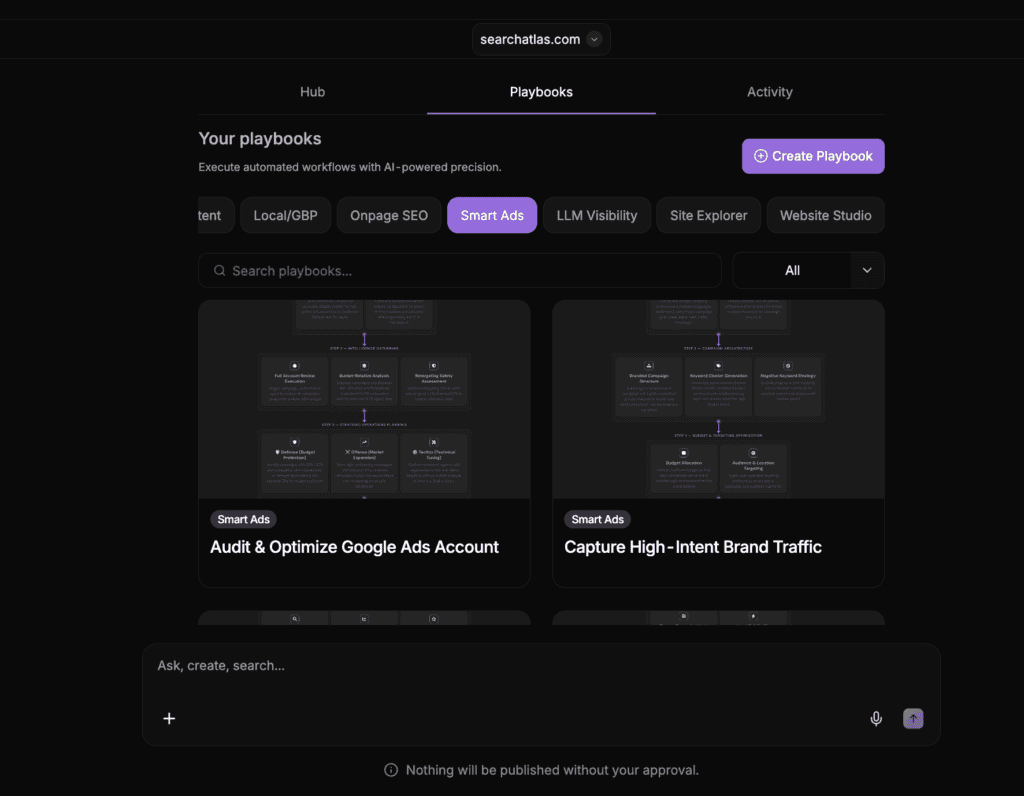
Atlas Agent functions as the reasoning and execution layer behind Smart Ads. Marketers define campaign goals in natural language, and Atlas Agent translates those goals into structured PPC workflows across campaign creation, optimization, and scaling.
The system continuously:
- Audit campaign health.
- Generate ad copy automatically.
- Cluster keywords by intent.
- Reallocate budget dynamically.
- Apply negative keywords.
- Detect creative fatigue.
- Optimize bids in real time.
This removes the delays created by manual PPC management workflows where teams wait for scheduled reviews before implementing changes.
Flexible execution modes for different teams
Smart Ads supports different execution modes depending on how much control advertisers want during campaign management.
Fast mode focuses on rapid campaign deployment with AI-managed optimization running continuously after launch. Advanced mode introduces approval checkpoints where teams review campaign structure, creative assets, budget allocation, and optimization actions before deployment.
This allows businesses, agencies, and in-house marketing teams to control autonomy levels while maintaining continuous optimization workflows.
Centralized campaign management across PPC workflows
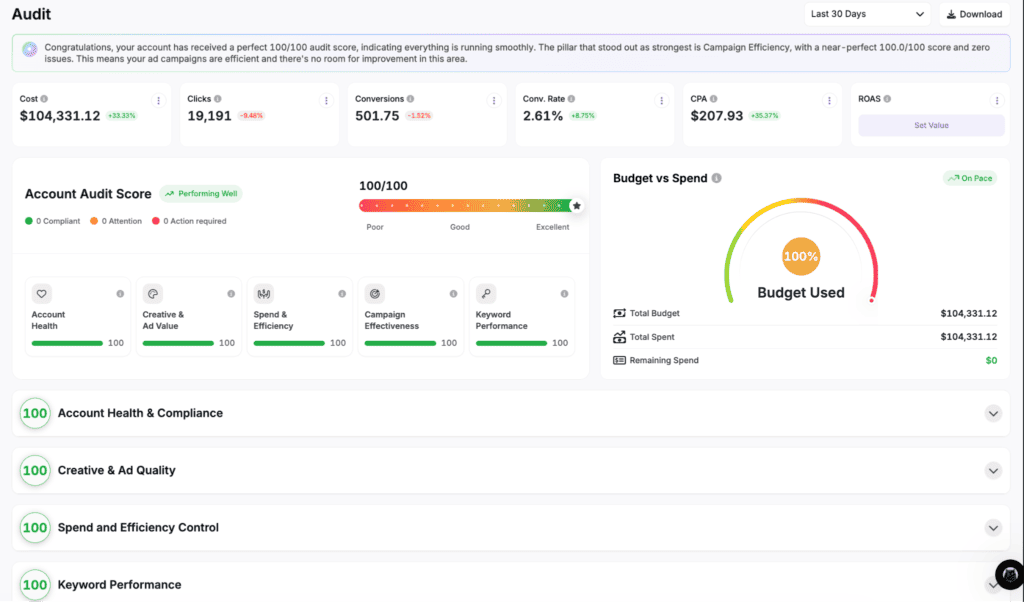
Smart Ads manages multiple campaign types inside one connected environment. Paid search campaigns, retargeting campaigns, display ads, remarketing workflows, and imported Google Ads accounts operate through a centralized Campaign Hub.
The platform provides:
- Campaign health scoring.
- Real-time performance tracking.
- Negative keyword automation.
- Budget pacing analysis.
- Executive reporting.
- Cross-campaign visibility.
Instead of switching between disconnected dashboards and campaign interfaces, teams manage campaign execution, optimization, and reporting inside one unified PPC workflow.
Continuous optimization instead of periodic management
Traditional PPC management depends on recurring manual reviews where marketers analyze performance reports, identify inefficiencies, and implement updates manually.
Smart Ads replaces that cycle with continuous optimization. Atlas Agent monitors campaigns in real time, detects performance changes immediately, and deploys approved optimizations automatically through direct Google Ads integration.
This execution model allows campaigns to improve continuously instead of waiting for the next optimization review window.
Start running agentic Google Ads campaigns
Agentic paid media changes Google Ads management from manual optimization to continuous AI-driven execution**. Campaign structure, bidding, creative generation, budget allocation, and optimization operate inside one connected workflow** that improves performance continuously over time.
Smart Ads brings this execution model directly into your Google Ads environment through Atlas Agent. Instead of spending hours reviewing reports, adjusting bids, managing keywords, and rewriting ads manually, your campaigns optimize automatically based on live conversion and revenue data.
You define the goal. AI agents handle execution, optimization, and scaling across the full campaign lifecycle while you maintain visibility and control over approvals, budgets, and strategy.
Start using Smart Ads to launchcampaigns faster, reduce wasted spend, automate optimization workflows, and scale Google Ads performance through fully agentic PPC execution.
Related Reading