An AI marketing agent is a software system that takes a marketing goal, plans the steps to reach it, calls connected tools to execute those steps, and adjusts based on the result. An AI marketing agent is distinct from a chatbot (which responds to a prompt), a workflow automation (which follows a fixed rule), and a generative AI tool (which produces output on request).
The ‘AI agent’ category is new enough that vendors apply the label inconsistently, so the sections below define the term, contrast it with adjacent technology, and describe what an agent actually does day to day.
What is an AI Marketing Agent?
An AI marketing agent is a software system that pursues a marketing goal by perceiving the state of its data and tools, planning an action sequence, executing through API calls, and updating its approach based on the outcome.
Three components define an AI marketing agent: a goal it accepts (rather than a single command), a planner that decides which steps to take, and tool access that lets it act on systems outside itself. Without all three, the system is closer to a chatbot, a workflow, or an analytics dashboard.
The Four-step Loop: Perceive, Plan, Act, Learn
The four-step loop is how an agent processes a task: it perceives the state of relevant data, plans an action sequence, acts by calling external tools, and learns from the result before the next iteration.
In the perceive step, the agent reads from connected sources (CRM, CDP, ad platforms, web analytics, the live site). In the plan step, an LLM-based reasoner selects the next action given the goal and the state. In the act step, the agent makes the call: send an email, update an audience, run a query, fix a meta tag, or post a campaign. In the learning step, it compares the result to the expected outcome and uses that signal to adjust its next plan.
Agent vs. Chatbot vs. Automation vs. Copilot
An agent decides what to do, a chatbot responds to a turn, an automation runs a fixed rule, and a copilot suggests work for a human to accept.
| Type | Decides what to do | Calls tools | Learns from outcomes | Acts without a per-step prompt |
| Chatbot | No | Limited | No | No |
| Automation | No (rule-based) | Yes | No | Yes (event-triggered) |
| Copilot | Suggests only | Sometimes | No | No |
| Agent | Yes | Yes | Yes | Yes |
Generative AI vs. Agentic AI vs. Predictive AI
Generative AI produces content when prompted, predictive AI forecasts an outcome from data, and agentic AI plans and executes a sequence of actions to reach a goal.
| Category | Primary function | Triggers external actions | Operates without per-step input |
| Generative AI | Creates text, image, code, and audio | No (output only) | No |
| Predictive AI | Estimates the likelihood or value | No (informs decisions) | No |
| Agentic AI | Plans and executes multi-step work | Yes (tool and API calls) | Yes (within a scoped goal) |
Agentic systems usually contain a generative model as the planner and may rely on predictive models for scoring (lead score, churn risk) before they act. The categories stack rather than compete.
What AI Marketing Agents Do in Practice
AI marketing agents handle marketing work that has clear inputs, observable outcomes, and a feedback signal the agent can use, which today covers four areas: segmentation, campaign execution, reporting, and outreach.
Audience Segmentation and Enrichment
An audience agent queries customer data, builds segments by behavior or attribute rules, and enriches profiles with third-party signals before passing the segment to a campaign system.
It replaces the manual loop of writing a SQL query, exporting to a CSV, enriching in a sheet, and uploading to an ad platform.
Campaign Execution and Optimization
A campaign agent launches campaigns, monitors performance against a defined metric, and reallocates spend or pauses underperforming variants without requiring approval at each change.
Guardrails set the bounds: which budgets it can shift, which channels it can touch, what threshold triggers a pause.
Reporting, Anomaly Detection, and Decision Support
A reporting agent ingests data from connected platforms, detects anomalies against historical baselines, and produces a written explanation of what changed and the most likely contributing causes.
The output is a short narrative tied to specific metrics, not a chart. The reader gets a hypothesis to act on rather than a dashboard to interpret.
Outreach, Lead Routing, and Follow-up
An outreach agent b a lead record, drafts a personalized first message based on the lead’s company and recent signals, routes the lead to the right rep, and schedules follow-ups based on response or silence.
Most production deployments require human review before hitting send. Fully autonomous outbound carries compliance and brand risk that few teams accept yet.
Examples of AI Marketing Agents in Production
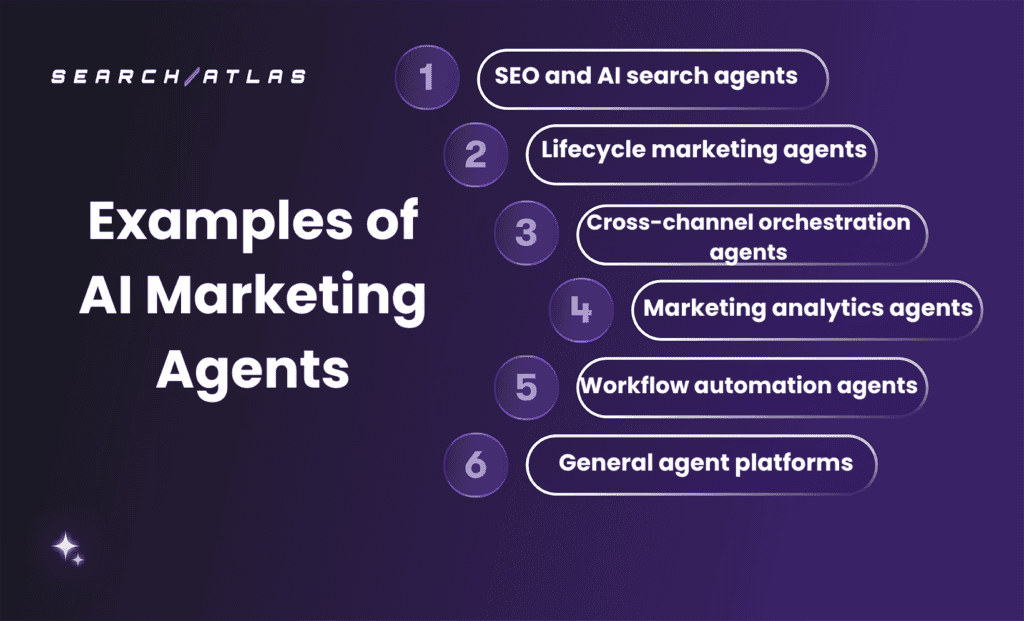
Illustration of AI marketing agents for SEO and digital marketing.
AI marketing agents are shipping today across six categories: SEO and AI search agents, lifecycle marketing agents, cross-channel orchestration agents, marketing analytics agents, workflow automation agents, and general agent platforms applied to marketing.
1. SEO and AI search agents execute SEO and AI-visibility tasks from a chat interface rather than returning recommendations for a human to implement. Atlas Agent (formerly Atlas Agent) is positioned in this category, running site audits, rewriting pages with entities pulled from SERP analysis, building topical maps, comparing backlink profiles against competitors, drafting PR outreach, auditing Google Business Profiles, and scheduling recurring reports, all from a single conversational interface tied to live site data via the OTTO pixel and integrations with Shopify and WordPress.
- Best fit: teams that want SEO, technical fixes, and LLM visibility work executed end-to-end rather than handed back as suggestions.
- Tradeoff: deepest value comes from pairing the agent with the underlying platform like Search Atlas; standalone use captures less of the connected workflow.
2. Lifecycle marketing agents handle email, SMS, and on-site flows for ecommerce and DTC brands. Klaviyo’s K:AI Marketing Agent is positioned in this category.
- Best fit: a brand with high message volume on a single primary channel.
- Tradeoff: tightly bound to the host platform’s data model.
3. Cross-channel orchestration agents sit on top of a CRM and coordinate marketing, sales, and service touchpoints. Salesforce Agentforce is positioned in this category.
- Best fit: enterprises already running on the same stack the agent is built into.
- Tradeoff: limited value if the team is not already on that platform.
4. Marketing analytics agents unify data from ad platforms, CRMs, and web analytics, then answer business questions in natural language and surface anomalies. Improvado’s AI Agent is positioned in this category.
- Best fit: teams with data scattered across many platforms and limited analyst capacity.
- Tradeoff: the agent’s answers are only as good as the underlying data integration.
5. Workflow automation agents sit on top of a connector library and chain steps across hundreds of apps. Zapier Agents is positioned in this category.
- Best fit: small teams that need cross-app orchestration without engineering.
- Tradeoff: limited reasoning depth for complex multi-step decisions.
6. General agent platforms are not marketing-specific but are configured for marketing work. IBM Watsonx Orchestrate is one example.
- Best fit: regulated organizations that need governance and a unified runtime across functions.
- Tradeoff: longer setup and more configuration work than a vertical agent.
The marketing agent category is moving quickly. Verify current capabilities in trial before committing, since any feature claim more than a quarter old should be re-checked against the current product.
How AI Marketing Agents Change AI Search Visibility
AI marketing agents change AI search visibility by reading and writing across the same answer surfaces brands optimize for, which means an agent doing research for a buyer can cite a competitor when your content is missing or harder to retrieve.
Two flows matter. On the producing side, SEO and content agents now write directly for LLM ranking signals: entity coverage, clear definitions, and structured topical depth. Atlas Agent is built for this workflow specifically: it rewrites pages with entities extracted from live SERP analysis, builds topical maps designed for both Google and LLM retrieval, and ships dedicated workflows for LLM Visibility and Generative Engine Optimization (GEO). Unlike content tools that return suggestions, it executes the rewrite, applies the schema, and reports the change.

On the consuming side, buyer-side agents (vendor research, evaluation summaries, shortlist generation) read from ChatGPT, Perplexity, Claude, and Google AI Overviews. The agent does not visit your homepage; it reads the snippet that an answer engine has indexed.
Visibility in AI answer engines is no longer just an awareness channel for human readers. It is the input layer for the agents now making first-pass vendor and product decisions, which means the optimization target is the snippet an LLM retrieves, not only the page a human lands on.
How to Tell if a Tool is Actually an Agent (Diagnostic Checklist)
A tool is an agent if it accepts a goal rather than a single command, decides which actions to take and in what order, calls external tools or APIs to act, observes the outcome, and operates without a user prompt at each step.
Five questions to ask a vendor:
- Can it work toward a goal described in a sentence, or does it require step-by-step setup?
- Does it choose its next action, or does it run a fixed flow?
- Which external systems can it write to, and through what mechanism (API, function calling, RPA, site pixel)?
- How does it know an action worked, and how does that change the next step?
- Can it run on its own between checkpoints, or does it pause for input each time?
If most answers are “no” or “with workarounds,” the product is closer to a workflow with an LLM wrapper than an agent. If the product returns suggestions for a human to implement, it is a recommendation engine, not an agent.
How to Deploy Your First AI Marketing Agent
Deploying your first AI marketing agent works best as a narrow pilot followed by expansion, not as a stack-wide rollout.
- Pick one bounded task. Choose work with clear inputs, a measurable outcome, and a low blast radius (weekly performance reporting, lead enrichment from form submissions, technical SEO audits with auto-fix, anomaly alerts on key metrics). A narrow scope makes the pilot evaluable.
- Audit the data that the agent will read. Confirm the connected sources are accurate, complete, and current. An agent acting on stale or partial data makes confident but wrong decisions.
- Define the success metric and a baseline. Pick one metric that the agent will move (time to report, lead enrichment rate, indexed pages with valid schema, anomaly lead time) and record the current performance. Without a baseline, you cannot tell whether the agent helped.
- Choose the autonomy level. Decide whether the agent recommends only, acts with human approval, or acts independently inside guardrails. Higher autonomy speeds work but raises the cost of a wrong decision.
- Set guardrails for outbound actions. Define what the agent can change without review (budget caps, message volume, segment size, audience exclusions, page-level edits). Guardrails contain failure modes before they reach customers or the live site.
- Run a pilot of two to four weeks against the baseline. Compare the agent’s output and outcomes to the prior process. A short pilot surfaces failure patterns before they compound.
- Review results and decide on expansion. Either expand the scope, increase autonomy, or roll back. Treat the pilot’s results as a gate, not a formality.
Risks and Limits with AI Marketing Agents
AI marketing agents fail in predictable patterns: ungrounded decisions, runaway action chains, compliance gaps in outbound messages, vendor lock-in to a proprietary runtime, and confidence in stale data.
- Ungrounded decisions. An LLM planner can fabricate justifications for an action when its inputs are thin. Mitigation: require the agent to cite the data row or source it acted on.
- Runaway action chains. A multi-step plan can drift off course over many iterations. Mitigation: cap action count per task and require a checkpoint at defined intervals.
- Compliance gaps. An agent who sends customer messages by editing live pages can violate consent rules, channel-specific regulations, or brand voice. Mitigation: route all outbound and on-site changes through the same review layer that governs human-made changes.
- Vendor lock-in. Proprietary agent runtimes make it hard to move logic to another platform later. Mitigation: prefer agents that expose their tools and prompts, not just their UI, and confirm whether changes (for example, on-page SEO fixes) persist if you move off the platform.
- Stale data. An agent confidently acts on what it reads. Mitigation: monitor data freshness for every connected source.
Will AI Marketing Agents Replace Marketers?
AI marketing agents will not replace marketers in the near term, but they will replace specific tasks: routine reporting, baseline campaign monitoring, repetitive enrichment, technical SEO fixes, and first-pass message drafting.
What stays with humans: strategy, brand judgment, exception handling, creative direction, and accountability for outcomes that a model cannot own. The marketer’s role shifts toward defining goals, setting guardrails, reviewing agent decisions, and intervening when the agent’s judgment is wrong.
The broader move from individual agents to a coordinated system of agents running SEO, content, ads, and social across one stack is what agentic marketing describes. When that coordination layer takes on responsibility for priorities across the whole marketing function rather than a single bounded task, it's usually the role described as an AI CMO.
Related Reading
- What is Agentic Marketing? Definition, Components, and Execution Model
- What Is an AI CMO?
- Agentic Marketing vs. Marketing Automation
FAQ
What data does an AI marketing agent need to be useful?
At minimum, the agent needs reliable read access to relevant data sources (CRM, ad platforms, analytics, CDP, the live site for SEO agents) and write permissions to the systems it will act on. Quality matters more than volume; an agent acting on inconsistent data will reach confidently wrong conclusions.
Can a small team deploy an AI marketing agent without engineers?
Yes, for narrow tasks on platforms with prebuilt connectors, such as workflow agents, lifecycle agents, and SEO agents that ship with CMS integrations like Shopify or WordPress. Custom agents that integrate a non-standard data source or run novel logic still require engineering support.
Are AI marketing agents safe for outbound customer communication?
Only with guardrails. Most teams in production keep a human approval step on customer-facing outbound and route agent-drafted messages through the same compliance checks as human-sent messages.
How is an AI marketing agent different from marketing automation?
A marketing automation runs a fixed rule when a trigger fires. An AI marketing agent decides which actions to take, calls tools, and adjusts based on outcomes, without a predefined flow. See agentic marketing vs. marketing automation for the full comparison.
What’s the minimum signal an agent needs to learn from outcomes?
A defined metric that the agent can read after each action (open rate, conversion, response, ranking change, anomaly resolved). Without an observable outcome, the agent cannot improve and operates as a one-shot generator.