Agentic marketing is emerging as a response to a growing execution gap in modern marketing, where execution becomes part of the system itself and runs in real time.
Teams today use analytics platforms, automation tools, and AI to understand performance. They can identify what needs to be optimized and where opportunities exist. But turning those insights into action still moves through tasks, approvals, and multiple tools.
Automation improved parts of this process, but it remains limited. Most systems follow predefined rules and require constant setup. They can trigger actions, but they cannot independently decide, adapt, and execute across channels.
Agentic marketing redefines how marketing gets executed.
Autonomous AI agents take defined goals and execute activities directly across SEO, content, paid media, and other channels. They act, adjust, and improve continuously, without waiting for step-by-step instruction.
The sections below break down what agentic marketing is, how it works, its components, and why it replaces traditional marketing execution models with AI.
What is Agentic Marketing?
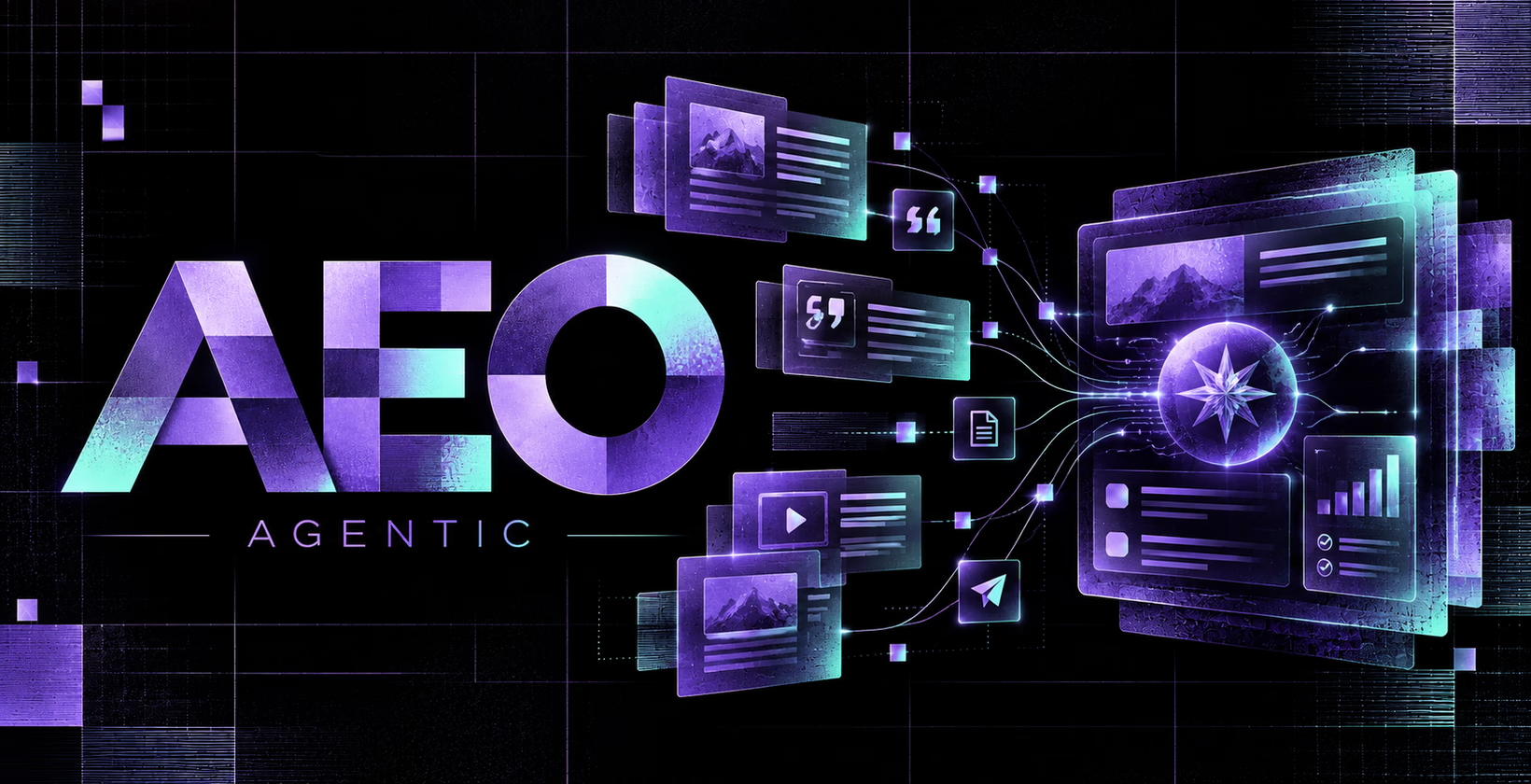
Agentic marketing is a new marketing operating model where autonomous AI agents execute marketing activities across channels in real time without continuous human supervision. Agentic marketing integrates strategy, execution, and optimization into a single, continuously running system.
Rather than following static workflows, agentic marketing systems unify strategy, execution, and performance. They identify opportunities, launch initiatives, and improve performance based on live data, learning as they operate.
This model replaces fragmented tools and manual coordination with a unified environment. Functions across SEO, on-page optimization, content creation, paid campaign management, and local presence updates run inside one system where actions deploy directly.
The defining characteristic of agentic marketing is autonomous execution. These systems operate within structured guardrails and approval layers, allowing full control over autonomy levels, from manual review to continuous deployment.
How Does Agentic Marketing Work?
Agentic marketing works through autonomous AI agents that execute marketing activities based on goals, data, and continuous feedback. The system takes a defined objective and turns it into real actions across channels without relying on manual workflows.
You start by defining a clear objective, focused on increasing traffic, improving conversions, or expanding visibility. Intelligent agents operate within defined guardrails, analyzing data from your website, campaigns, historical performance, and market signals. This analysis allows the system to identify opportunities and act in real time.
Execution happens through specialized agents trained for specific functions. Some optimize on-page elements, others create and update content, while others manage campaigns or improve local visibility. All activity operates within defined guardrails and approval layers, where you control the level of autonomy, from reviewing actions to allowing continuous execution with minimal oversight.
Continuous learning drives improvement through a constant execution loop. The system gathers context, makes decisions, executes actions, measures results, and adjusts based on real outcomes. Campaigns evolve as new data becomes available, allowing marketing to operate with speed, scale, and consistency that manual execution cannot achieve.
The 5 Core Components That Define Agentic Marketing
Agentic marketing combines intelligence, execution, and continuous learning into a single operational model. Instead of separating planning, data analysis, and execution across different tools, it integrates them into one unified framework that operates in real time.
Five core components define how agentic marketing operates. Each component has a distinct role, and together they enable continuous planning, execution, and optimization across marketing workflows.
1. Autonomous Agents
Autonomous AI agents form the foundation of the system. Autonomous AI agents are AI-powered systems designed to act on behalf of the marketer and focus on specific outcomes, such as increasing conversions or improving return on ad spend.
A prompt defines intent, while the agent interprets that intent, makes decisions, and executes the work across connected systems. These AI agents analyze situations, make decisions, and take action across areas like channel selection, targeting, content creation, and budget allocation, all within defined guardrails.
2. Unified Data and Context Layer
The unified data and context layer provides the information that the agentic marketing systems use to operate. They collect and connect data from your website, CRM, analytics tools, and campaigns into a single, real-time view.
It tracks user behavior, engagement patterns, and conversion events across all channels. This allows the system to understand what is happening at any moment and ensures that every decision made by the system is based on complete and current information.
3. Reasoning and Decision-Making Engine
The reasoning and decision-making engine determines what actions the system takes. This is where intelligence is applied. Using advanced AI models, the system interprets data, understands context, and determines the best course of action.
It breaks down high-level goals into executable steps and continuously evaluates different options. Decisions are made at high speed, often in milliseconds, allowing the system to respond instantly to changes in user behavior or campaign performance.
4. Multi-Channel Execution Layer
Agentic marketing is defined by its ability to act, not just analyze**. The multi-channel execution layer turns decisions into real actions without relying on manual intervention.**
It updates web pages, publishes and modifies content, adjusts campaigns, and manages assets across platforms in real time. This ensures that strategy moves into execution immediately, without delays from handoffs or disconnected tools.
5. Continuous Learning and Optimization Loop
The continuous learning and optimization loop improves the system over time. Every action generates data, and that data is fed back into the system to refine future decisions. The system improves through constant feedback.
Performance is monitored continuously, and strategies adjust automatically based on outcomes. This creates a closed loop where the system learns, adapts, and becomes more effective with each cycle.
Search Atlas walks through this exact five-component system live at the Agentic Marketing Summit, an event built for operators and agency founders covering AI-powered search, AEO, agentic workflows, MCP integrations, and entity SEO.
How Did Marketing Systems Evolve From Automation to Agentic Execution?
Marketing systems have evolved to keep up with increasing complexity, faster data cycles, and the need for real-time execution. This progression unfolds across three stages:
- Manual Marketing Systems: All work is performed by humans. Execution is slow, manual, and difficult to scale.
- Automated and AI-Assisted Systems: Systems follow predefined rules and provide insights. Humans still make decisions and execute actions. See what AI automation is and how it works for the underlying mechanics of this stage, and agentic marketing vs. marketing automation for a direct comparison against the next one.
- Agentic Marketing Systems: AI agents analyze data, make decisions, and execute actions continuously. Campaigns run and improve in real time without manual intervention.
This shift happened because traditional marketing workflows could not keep up with growing complexity and real-time demands. Each stage reflects how these limitations were addressed over time.
Traditional Marketing followed a linear process of planning, launching, and analyzing. Each step required time, coordination, and manual effort. As channels expanded and data became real-time, this model became too slow and fragmented to keep up.
Automation improved efficiency but introduced clear limitations. Rule-based systems operate only within predefined conditions. Even with AI-powered insights, most platforms just surface data, generate reports, and recommend actions, but they do not execute them. Humans still bridge the gap between insight and action, which creates delays and bottlenecks.
Agentic marketing defines the current stage of this evolution. These systems interpret data, make decisions, and execute actions continuously without waiting for manual input. They replace rigid workflows with continuous execution, connecting all parts of marketing and operating at a speed and scale that manual or rule-based systems cannot match.
The industry is already moving in this direction. According to International Data Corporation, by 2030, 45% of organizations will orchestrate AI agents across their operations. This signals a transition toward systems that do not just assist marketers but actively run execution.
Why AI Marketing Lacks an Execution Layer?
Most AI marketing platforms were built to inform decisions, not to execute real marketing work. They analyze data, identify patterns, and generate recommendations, but they stop short of taking action. This creates a gap between insight and execution.
In traditional AI-driven marketing, systems surface opportunities such as underperforming pages, keyword gaps, or budget inefficiencies. They suggest what should happen next, but execution still depends on human teams, who must:
- Interpret recommendations
- Prioritize tasks
- Coordinate across multiple tools
- Manually implement changes
This process introduces delays**, friction, and inconsistency.**
What defines this limitation is not intelligence, but capability. These systems provide visibility and guidance, but they do not act inside the environments where marketing work happens. As a result, valuable insights are delayed, partially implemented, or never executed.
This is why many organizations struggle despite having access to advanced AI tools. They lack execution capacity. As insight volume increases, the burden on teams increases, which slows response time and reduces overall impact.
Agentic performance marketing addresses this limitation by introducing execution as a core system layer. Instead of stopping at recommendations, it applies changes directly across websites, content, campaigns, and digital assets, connecting decision-making with real-world action.
This shift turns AI from a passive assistant into an active operator. Specialized agents handle complex, multi-step tasks such as optimizing pages, generating content, and managing listings. These actions are executed directly in live environments, often within minutes.
Execution remains controlled through guardrails and approval layers. Teams define the level of autonomy while maintaining alignment with business goals. Marketing operates faster, at greater scale, with consistent output.
What Problems Does Agentic Marketing Solve?
Agentic marketing solves the core limitations of traditional marketing systems by connecting decision-making and execution into a continuous process. Agentic marketing enables real-time action and scalability, drives consistent performance improvement, and unlocks new levels of speed and scale.
Below are the core challenges agentic marketing solves.
1. Eliminates Slow Execution and Enables Continuous Operation
Traditional marketing depends on manual workflows that delay execution. Campaign updates, optimizations, and deployments often take days or weeks. Agentic marketing actions are executed as soon as opportunities are identified, without waiting for approvals, handoffs, or task queues. This results in faster iteration cycles and always-on campaign performance.
2. Replaces Reactive Marketing with Real-Time Optimization
Most marketing teams operate reactively, relying on reports and delayed insights to make decisions after performance has already changed. Agentic systems operate in real time. They monitor performance, adjust campaigns instantly, and respond to changes as they happen. This leads to more efficient budget allocation and stronger overall results.
3. Solves Scalability Constraints Without Increasing Headcount
As marketing grows, complexity increases. Managing multiple channels, campaigns, and audiences requires more time and more people. Agentic performance marketing breaks this limitation with AI agents that handle execution across channels simultaneously, allowing teams to scale output without scaling resources. This enables organizations to manage significantly more campaigns, websites, and initiatives with the same team.
4. Eliminates Fragmented Tools and Disconnected Workflows
Marketing teams often rely on multiple platforms that do not communicate effectively, creating inefficiencies and gaps between strategy and execution. Agentic performance marketing unifies these functions into a single system. Strategy, data, execution, and optimization are all connected, removing the need for tool switching and manual coordination. This creates a more streamlined and consistent workflow across all channels.
5. Improves Performance Through Continuous Learning and Optimization
Static campaigns lose effectiveness over time because they are not designed to adapt continuously. Agentic marketing systems constantly learn from performance data. Every action is measured, analyzed, and improved, creating a continuous optimization cycle that leads to higher conversions, better engagement, and stronger return on investment.
6. Enables Personalization and Precision at Scale
Delivering personalized experiences across large audiences is nearly impossible to execute manually. Agentic performance marketing makes real-time personalization scalable. AI Agents analyze behavior and intent signals to adjust content, messaging, and offers across channels, increasing relevance and engagement.
7. Removes Execution Bottlenecks Between Strategy and Action
In traditional marketing workflows, strategy and execution are separated, creating delays and inconsistencies. Agentic performance marketing connects directly. High-level direction is translated into live execution. Tasks that previously required coordination across teams can now be deployed in minutes, ensuring faster and more consistent implementation.
What Are Marketing Agents in Agentic Marketing?
Marketing agents are the core operators behind agentic marketing systems. They are autonomous AI software systems designed to plan, create, and execute marketing activities on behalf of the marketer in real time.
Unlike traditional AI tools that generate outputs or provide recommendations, marketing agents take action. They apply changes, manage workflows, and improve performance across channels without requiring constant human intervention.
Types of Marketing Agents
Marketing agents operate across different functions within the marketing stack. Each agent focuses on a specific area while working within a shared system that connects data, decisions, and execution. The main types of marketing agents include:
- SEO Agents: Manage on-page optimization, technical improvements, and content updates to improve search visibility. Agentic SEO monitors rankings, identifies gaps, and applies changes directly to websites.
- PPC Agents: Handle paid advertising campaigns. They adjust budgets, refine targeting, test creatives, and optimize performance in real time based on campaign data.
- Content Agents: Generate, update, and optimize content based on search intent, audience behavior, and performance signals. Content evolves continuously instead of remaining static after publication. Agentic content marketing covers how these agents brief, write, optimize, and deploy at each stage, and modern implementations increasingly rely on AI agents for content gap analysis to decide what to create next.
- Analytics and Reporting Agents: Track performance across channels and turn data into actions. Instead of only presenting reports, they feed insights back into the system to drive ongoing improvements. Attributing that performance correctly across AI-driven channels increasingly depends on frameworks like an AI-source taxonomy for classifying traffic in GA4.
In more advanced systems, these specialized agents are unified into a single orchestration layer. Rather than operating independently, they work together as part of a coordinated execution model that connects strategy, data, and action. This orchestration role is often described as an AI CMO — the layer that coordinates agents across the entire marketing stack rather than executing a single channel.
The next step is consolidation. Instead of managing multiple specialized agents, systems evolve into unified agents that handle entire marketing workflows end to end. These systems execute across SEO, content, paid media, authority, and optimization within one continuous workflow.
An example of an end-to-end agentic marketing system is Atlas Agent by Search Atlas. Through a conversational interface, the system translates high-level direction into real execution across the full marketing stack. A single input can trigger actions such as launching campaigns, updating content, optimizing pages, and improving performance across channels.
Execution happens directly inside connected systems, without switching tools or coordinating across teams. Work moves from strategy to deployment in one continuous process under a single interface.
Agentic Marketing Defines the Evolution of Marketing Execution
For the past decade, marketing technology has been built around visibility. Dashboards, reports, and AI-generated insights promised better decisions, but left a critical gap unresolved. They told teams what to do without doing it. That model has reached its limit.
Agentic marketing replaces passive systems with active ones. It closes the gap between insight and action by embedding execution directly into the platform. Instead of relying on manual follow-through, specialized AI agents handle complex, multi-step tasks across SEO, content, paid media, and beyond.
This changes how work actually happens. Strategy turns into live changes in minutes, not days. Campaigns no longer pause between analysis and action. They run continuously, adapting and improving in real time.
With execution embedded into the system, scale no longer depends on team size. One platform can operate across hundreds of websites, campaigns, and channels at the same time. This is why agentic marketing is not just an upgrade but a shift in how marketing works. Action happens as fast as insight, and performance improves continuously by design.
The companies that adopt this model will operate in a fundamentally different way, where execution is continuous, scalable, and built into the system itself.
Related Reading
- What Is an AI CMO?
- What Is an AI Marketing Agent?
- Agentic Marketing vs. Marketing Automation
- 8 Agentic Marketing Use Cases
Agentic Marketing FAQ
What Is Agentic Marketing?
Agentic marketing is a model where autonomous AI agents plan, execute, and optimize marketing activities continuously. Instead of only generating insights or recommendations, these systems take action across channels in real time. Strategy moves directly into execution, allowing campaigns, content, and optimizations to run without manual coordination.
What Are the Key Benefits of Agentic Performance Marketing?
Agentic marketing improves speed, efficiency, and performance. Campaigns launch faster, optimizations happen continuously, and execution no longer depends on manual workflows. It enables real-time personalization, reduces operational overhead, and improves return on investment by acting on data instantly instead of waiting for analysis cycles.
How Is Agentic Marketing Different From Traditional Marketing?
Traditional marketing relies on manual workflows, delayed analysis, and disconnected tools. Agentic performance marketing operates as a continuous system. It connects data, decision-making, and execution, allowing actions to happen in real time. Instead of reacting to performance after the fact, it adapts as conditions change.
How Agentic Marketing Relates to Agentic AI?
Agentic AI is the underlying technology. It refers to systems that can reason, decide, and act independently. Agentic marketing applies this technology to marketing execution. It uses AI agents to manage campaigns, content, and optimization across channels, turning autonomous capabilities into measurable marketing outcomes.
Will Autonomous AI Agents Replace Humans?
Autonomous agents do not replace marketers. They handle execution, repetitive work, and continuous optimization. Marketers focus on strategy, goals, and oversight. This allows teams to scale output without increasing workload, while maintaining control through defined guardrails and approvals.