An AI-source taxonomy is a classification framework that organizes AI traffic sources based on shared behavioral and attribution characteristics. An AI-source taxonomy explains how analysts separate AI platforms with different referral patterns, citation mechanisms, and measurement limitations. An AI-source taxonomy reflects how AI traffic differs across platforms instead of treating every AI source as a single channel.
An AI-source taxonomy matters because AI platforms generate fundamentally different traffic and visibility signals. Analytics platforms often group ChatGPT, Perplexity, Gemini, and Google AI Overviews into one category, which hides important behavioral differences. ChatGPT desktop passes referrer information in most cases, while ChatGPT mobile frequently strips attribution data. Perplexity generates direct citation clicks, while Google AI Overviews generate large impression volumes with comparatively few visits. These differences create reporting distortion when every source appears inside the same channel.
An AI-source taxonomy improves reporting accuracy by separating sources according to measurable characteristics. Organizations gain clearer visibility into attribution coverage, referral reliability, and conversion behavior. Channel reports become easier to interpret because referral traffic, citation traffic, and impression-driven visibility remain distinct measurement categories. Distinct categories reduce attribution errors and produce more reliable performance analysis across AI platforms.
An AI-source taxonomy applies across GA4 implementations, data warehouses, and enterprise analytics environments where AI traffic continues growing. An AI-source taxonomy ensures that platforms with different behaviors remain classified correctly, which improves channel reporting, attribution analysis, and decision making. An AI-source taxonomy works through structured dimensions and tier assignments connected to custom channel groups, regex rules, and reporting frameworks.
What Is an AI-Source Taxonomy?
An AI-source taxonomy is a classification system that groups AI platforms into distinct categories based on their behavior as traffic sources, using measurable technical and behavioral dimensions rather than platform name or brand grouping alone.
The purpose of a taxonomy is analytical precision. A flat list of AI referrer domains tells an analyst which platforms sent sessions. A taxonomy tells the analyst what those sessions mean, how reliably they are counted, and how comparable they are to each other within the same report. Two sessions attributed to different AI platforms are not analytically equivalent when one arrived with a full referrer header, and the other arrived as direct traffic because referrer headers were stripped in transit.
What distinguishes a taxonomy from a simple list of AI platforms? A list categorized by identity. A taxonomy categorizes by behavior. A list places chat.openai.com and perplexity.ai in the same group because both are AI platforms. A taxonomy separates them when their referral fidelity, citation mechanisms, and crawl-to-refer ratios are different enough to affect attribution, conversion analysis, or channel reporting. The classification criteria produce different groupings for different platforms depending on how those platforms actually behave, not how they are marketed.
What does a tier structure add to a taxonomy? A tier structure assigns each classified group a priority level that reflects its analytical reliability and its strategic relevance. Tier 1 in an AI-source taxonomy groups platforms that send referrer headers consistently, link to content directly, and produce measurable, attributable traffic. Tier 2 groups platforms with partial attribution coverage. Tier 3 groups platforms that index content without reliably sending referred sessions. The tier structure makes explicit which sources produce reliable data and which require supplemental server-side measurement to assess accurately.
How does a taxonomy interact with existing GA4 channel structures? GA4 organizes sessions into channels based on source and medium rules. The default channel groupings do not include AI-specific tiers. A custom channel group built on a taxonomy creates AI-specific channels within GA4 that reflect the classification criteria rather than the default source groupings. This allows reports that compare Tier 1 AI referral sessions against Tier 2 AI referral sessions directly, using the same GA4 interface that reports on organic, paid, and direct channels.
What Are the Different Ways to Classify AI Traffic Sources?
AI traffic sources are classified by domain-based grouping by referrer URL, channel-type grouping by traffic delivery mechanism, behavior-based grouping by post-arrival session patterns, and compliance-based grouping by how reliably the platform passes attribution signals.
Domain-based grouping is the simplest classification method. Domain-based grouping assigns sources to groups based on the referring domain. The approach is straightforward to implement in GA4 custom channel groups using regex patterns. Its limitation is that domain-based grouping treats platforms as equivalent when their referral behavior differs significantly by device type, platform architecture, or user interaction pattern.
How does channel-type grouping differ from domain-based grouping? Channel-type grouping assigns sources based on how they deliver traffic rather than which domain they originate from. A channel-type classification separates chatbot referrals (sessions that begin with a user clicking a cited link in a conversational AI response) from AI overview impressions (queries where an AI-generated answer appears in a SERP but the user does not click through to a page). These two source types produce sessions with different intent signals, different engagement patterns, and different conversion rates. Grouping them by domain alone places a ChatGPT click-through and a Google AI Overview non-click in separate groups by accident rather than by analytical design.
What is behavior-based classification? Behavior-based classification assigns sources to groups based on what post-arrival session behavior looks like, rather than what the source domain is. Platforms that send users with high engagement rates, low bounce rates, and above-average session depth form one behavioral group. Platforms that send users with short session durations and minimal downstream event activity form another. Behavior-based classification is applied after collecting several months of data for each source and is used to validate the dimension-based tier assignments made at taxonomy design time.
What is compliance-based classification? Compliance-based classification groups sources by how reliably they pass attribution signals that analytics platforms read and record. A compliant AI source sends a referrer header on every click or appends UTM parameters that GA4 reads as source data. A non-compliant source strips referrer headers, routes through intermediate redirect domains, or sends traffic through mobile app webviews that suppress referrer information. Compliance-based classification is the operational foundation of the referral fidelity dimension in a five-dimension taxonomy.
What Is the Difference Between an AI Referrer and an AI Crawler?
The difference between an AI referrer and an AI crawler lies in their role within the AI traffic ecosystem. An AI referrer sends human visitors to a website through cited links, while an AI crawler accesses content for indexing, retrieval, or training purposes. This distinction defines how organizations separate traffic measurement from content discovery inside an AI-source taxonomy.
The core differences between an AI referrer and an AI crawler are below.
Aspect | AI Referrer | AI Crawler |
Purpose | Directs human visitors to a website through citations and links. | Accesses website content for indexing, retrieval, and AI knowledge systems. |
Primary goal | Generates referral traffic and user visits. | Collects content for future retrieval and citation. |
Visitor type | Human visitor. | Automated bot. |
Data source | Appears in analytics platforms through sessions and referral data. | Appears in server access logs through user agent records. |
Measurement method | Tracked through GA4 sessions, events, and attribution reports. | Tracked through server logs and crawl monitoring systems. |
Typical examples | ChatGPT referrals, Perplexity referrals, Gemini referrals. | GPTBot, PerplexityBot, ClaudeBot. |
Business value | Measures traffic, engagement, and conversions. | Measures content accessibility and AI discovery. |
Relationship | Represents the visitor acquisition phase. | Represents the content collection phase. |
What does an AI referrer do? An AI referrer sends human visitors from an AI platform to a website. The referrer creates measurable sessions inside analytics platforms. A user reads an AI response, clicks a cited source, and visits the destination website. This visit generates attribution, engagement metrics, and conversion data.
What does an AI crawler do? An AI crawler accesses website content without generating user sessions. The crawler collects information for indexing and retrieval purposes. GPTBot, PerplexityBot, ClaudeBot, and Google-Extended access pages through automated requests that appear only in server logs. These requests do not generate GA4 sessions or conversion events.
Why does the AI referrer and AI crawler distinction matter? An AI-source taxonomy requires separate classification because referral traffic and crawler activity represent different behaviors. Referral traffic measures human engagement. Crawler activity measures content discovery. Combining both categories inflates platform visibility metrics and creates inaccurate reporting. A taxonomy increasingly needs to account for a third category as well: sessions generated by agentic browsers, which execute tasks autonomously and produce behavioral signals that resemble neither a human referral session nor a crawler request.
How are AI crawlers identified? AI crawlers are identified through user agent strings recorded in server access logs. OpenAI uses GPTBot. Perplexity uses PerplexityBot. Anthropic uses ClaudeBot. Google uses Google-Extended. These crawler identifiers remain separate from referral domains used for traffic attribution and channel reporting.
How Does an AI-Source Taxonomy Affect Attribution and Channel Reporting?
An AI-source taxonomy affects attribution and channel reporting by determining which sessions are grouped for comparison, which sources receive credit for conversions, and which traffic patterns are visible or hidden in channel reports.
Without a taxonomy, AI referral sessions from ChatGPT, Perplexity, Google AI Overviews, and Claude are typically distributed across three default GA4 channels. Sessions from AI Overviews that click through arrive with a google.com referrer and land in Organic Search. Sessions where referrer headers were stripped land in Direct. Sessions where referrer headers were recorded land in Referral. This distribution prevents any direct measurement of aggregate AI-sourced traffic or any comparison between AI platform behaviors.
What attribution errors result from missing taxonomy structure? The most common attribution error is dark AI traffic assigned to the Direct channel. Sessions from mobile ChatGPT, which operates in an iOS or Android webview that suppresses referrer headers, arrive in GA4 without a referrer value and are classified as Direct. A site receiving 500 AI-sourced sessions per month from mobile ChatGPT sees those sessions counted in its Direct channel alongside branded navigation, bookmark clicks, and URL bar entries. The conversion behavior of AI-sourced direct traffic differs from the conversion behavior of navigational direct traffic, and conflating them produces a Direct channel with internally inconsistent behavioral data.
How does a taxonomy change conversion attribution? A taxonomy with a custom channel group separating Tier 1 AI referrals (with reliable referrer headers) from Tier 2 AI referrals (with partial attribution coverage) allows separate conversion rate analysis for each tier. A site that finds its Tier 1 AI referral sessions convert at 3.2 percent and its Tier 2 sessions convert at 1.1 percent has actionable data. The content and UX changes that serve high-intent AI-referred users differ from the changes that serve lower-engagement AI referral traffic, and separated reporting is what makes those differences visible.
What does a taxonomy add to standard GA4 channel reports? A GA4 custom channel group built on a taxonomy adds AI-specific channels that appear in the standard Traffic Acquisition report alongside Organic Search, Paid Search, and Direct. These channels replace the fragmented picture of AI traffic appearing across multiple default channels with a unified view that reflects the classification criteria in the taxonomy. The custom channels coexist with default GA4 channels and do not overwrite them.
Why Does Grouping AI Sources by Platform Name Produce an Incomplete Taxonomy?
Grouping AI sources by platform name produces an incomplete taxonomy because platform names do not reflect the behavioral, technical, or attribution differences between how those platforms route traffic, making platform-name-grouped data unreliable for any analytical question beyond raw session counts.
Platform names are brand identifiers, not behavioral descriptors. ChatGPT desktop and ChatGPT mobile carry the same platform name but produce different referral fidelity outcomes. ChatGPT desktop sends sessions with a chat.openai.com referrer in most configurations. ChatGPT mobile, running in an iOS WKWebView or Android Custom Tab, strips the referrer header in most configurations, sending the session to GA4 as Direct traffic.
A taxonomy built on platform name places both session types in the same group, producing a ChatGPT channel that mixes attributable sessions with sessions that are only recoverable through server-side logging or UTM parameter analysis.
What other platforms exhibit internal behavioral variation that platform-name grouping conceals? Google exhibits internal variation across its AI surfaces. A click from a Google AI Overview within a standard search result arrives at the site with a Google.com referrer, where it is indistinguishable in GA4 from an organic search click. A click from the Gemini app sends a gemini.google.com referrer. A query that produces an AI Overview but no click generates an impression in Google Search Console that never appears in GA4 at all.
Three distinct AI interactions from one platform produce three distinct data footprints, and a platform-name grouping that places all Google AI activity in one channel fails to distinguish the attributable from the unattributable and the click from the non-click.
How GA4’s Native “AI Assistant” Channel Flattens Behavioral Differences
GA4’s native “AI Assistant” channel, introduced in May 2026, groups all sessions from known AI referrer domains into a single channel, which resolves the problem of AI sessions scattered across default channels but flattens the behavioral and attribution differences between those sources into a single undifferentiated number.
The AI Assistant channel captures sessions from recognized AI platform referrer domains and assigns them a consistent channel label in GA4 standard reporting. This is an improvement over the prior state, which distributed AI referral sessions across Organic, Referral, and Direct based on whatever referrer value arrived with each session.
What does the AI Assistant channel not capture? The AI Assistant channel does not capture sessions that arrived without a referrer header. A ChatGPT mobile session that stripped its referrer in transit arrives in GA4 as Direct and is not reassigned to the AI Assistant channel retroactively. The channel captures what GA4 was already able to see. It does not recover attribution for traffic that was dark before the channel existed. Organizations that rely on the AI Assistant channel to measure total AI referral traffic receive a count that excludes dark AI traffic from mobile and webview sources.
How does the AI Assistant channel handle platform-level variation? The AI Assistant channel groups chat.openai.com, perplexity.ai, gemini.google.com, and claude.ai into the same channel definition. A session from Perplexity, which passes referrer headers reliably and sends users who read AI-cited content actively, appears in the same channel as a session from a lower-traffic AI platform with intermittent referrer behavior. The channel total is accurate as a count of sessions GA4 attributed to AI platforms, but it does not reflect the behavioral or attribution quality differences between the sources it combines.
What does applying the AI Assistant channel alongside a custom taxonomy look like in practice? The AI Assistant channel and a custom taxonomy-based channel group coexist in GA4. The AI Assistant channel serves as a quick reference total for attributed AI sessions. The custom taxonomy-based channel group segments those sessions into tiers with distinct behavioral and attribution characteristics. The AI Assistant channel answers “how many AI-attributed sessions did we receive,” and the taxonomy channel group answers “which AI sources are analytically reliable, which require supplemental measurement, and which are primarily crawling rather than sending visitors.”
What Gets Lost When ChatGPT and Perplexity Are Treated as Equivalent Sources
Treating ChatGPT and Perplexity as equivalent AI traffic sources in channel reporting produces incorrect conclusions about engagement quality, attribution completeness, and content performance, because the two platforms differ on referral fidelity, citation mechanism, user intent, and crawl-to-refer ratio in ways that produce structurally different session data.
Perplexity sends referrer headers consistently across desktop and mobile sessions in its most common configurations. Sessions from perplexity.ai arrive in GA4 with a readable referrer value. ChatGPT desktop sessions from chat.openai.com arrive with a referrer value in most configurations. ChatGPT mobile sessions in iOS and Android apps suppress the referrer in most configurations. Measuring both platforms by their GA4 session count treats the attributable and the unattributable as comparable numbers when they are not.
What engagement differences appear between ChatGPT and Perplexity sessions? Perplexity sources content citations more directly. A Perplexity user who clicks a citation link in a Perplexity response has already read a summary of the destination content and is clicking for additional depth or verification. That session intent produces measurable differences in engagement: longer session duration, lower bounce rate, and higher page depth compared to sessions from platforms where AI-generated answers are more self-contained and the cited link is secondary to the response. ChatGPT sessions tend to reflect lower initial intent toward the cited content and higher variance in behavior across users, because the citation mechanism is less prominent and user navigation is less structured around source verification.
What happens to content performance data when ChatGPT and Perplexity are grouped? Content performance analysis that groups ChatGPT and Perplexity into the same AI channel finds that top-performing landing pages for AI referral traffic reflect a mixture of the two intent patterns. A page that ranks well as a Perplexity citation and converts at a high rate for those sessions appears to underperform in the combined view because ChatGPT sessions to the same page convert at a lower rate. The combined conversion rate is a weighted average of two different session types and gives no signal about which changes to the page improve either one.
How to Build a Good AI-Source Taxonomy
A good AI-source taxonomy is built by defining classification dimensions before assigning platforms, scoring each platform against each dimension independently, grouping scored platforms into tiers based on their combined dimension profiles, and mapping each tier to GA4 custom channel group definitions with regex patterns.
The sequence matters. Defining dimensions first prevents the taxonomy from being organized around platform marketing categories rather than analytical criteria. A dimension is a measurable property of source behavior. Each dimension produces a binary or ranked score for each platform. The tier assignment follows from the combined score, not from prior assumptions about which platforms are “major” or “minor.”
Dimension 1: Referral Fidelity — Does the Source Pass Referrer Headers Consistently?
Referral fidelity is the degree to which an AI platform passes HTTP referrer headers on outbound clicks, measured as the proportion of sessions from that platform that arrive in GA4 with a recognizable referrer value rather than arriving as direct or unattributed traffic.
A platform with high referral fidelity passes referrer headers on the majority of outbound clicks across device types. Perplexity and Claude desktop demonstrate high referral fidelity in most configurations. A platform with low referral fidelity strips referrer headers on a significant proportion of outbound clicks, either because its mobile app uses a webview that suppresses referrers, because its architecture routes clicks through an intermediate redirect domain that applies a Referrer-Policy header, or because its link delivery mechanism delivers the URL in a way that prompts user copy-paste behavior rather than direct navigation.
How is referral fidelity measured for a specific platform? Referral fidelity is measured by comparing the session count from a platform in GA4 against the click count for that platform in server access logs or UTM-tagged referral data. A platform that GA4 records 400 sessions from, while server logs show 1,000 HTTP requests carrying that platform user agent or IP range in the same period, has a referral fidelity gap of 600 sessions. Those 600 sessions arrived but were not attributed. The proportion attributed to total arriving sessions is the referral fidelity score for that platform.
What referrer header mechanisms reduce fidelity for specific platforms? Three mechanisms reduce referral fidelity. The first is mobile webview suppression (iOS WKWebView and Android Custom Tabs), both of which suppress referrer headers in certain configurations, which means platforms that send significant mobile traffic through app-embedded browsers produce lower fidelity on mobile than on desktop. The second is intermediate redirect domains, where some platforms route outbound clicks through a redirect domain that applies a strict Referrer-Policy header, dropping the original referrer before the destination site receives the request. The third is the Referrer-Policy header application at the platform level, where platforms that apply “no-referrer” or “same-origin” Referrer-Policy headers to their outbound links produce no referrer value at the destination, regardless of the user device or browser.
What tier assignment follows from referral fidelity scoring? Platforms with referral fidelity above 80% of attributable sessions qualify for Tier 1. Platforms with referral fidelity between 40 and 80% qualify for Tier 2 and require supplemental server-side measurement to estimate total session volume. Platforms with referral fidelity below 40% qualify for Tier 3 and are treated as primarily unattributable through client-side analytics alone. Tier 3 platforms require server-side logging and custom channel group rules built on UTM parameter detection rather than referrer domain detection.
Dimension 2: Citation Mechanism — Does the Source Link to Content Directly?
The citation mechanism dimension classifies AI platforms by whether they link to content through user-clickable citations, present content inline without prominent linking, or generate impressions that are counted without producing navigable links, because these three citation types produce fundamentally different traffic outcomes regardless of platform referral fidelity.
A platform with a direct citation mechanism embeds clickable source links in its responses. Perplexity labels cited sources with numbered footnote-style links that appear inline and at the bottom of the response. Clicking a numbered citation opens the source URL directly. This mechanism produces high click-through intent because the user action is deliberately navigational.
How does inline content presentation differ as a citation mechanism? Inline content presentation describes platforms that use source material to generate a response but present the answer as the primary output, with cited links in a secondary position. ChatGPT cites sources in responses generated through web search, but the citation link is subordinate to the generated text. Many users read the response and do not click the citation. The click-through rate from ChatGPT citations is lower than from Perplexity citations in comparable queries because the citation is informational rather than navigational in the user interface.
What is the impression-only citation mechanism? The impression-only mechanism describes AI surfaces that answer queries without presenting navigable source links. Google AI Overviews generate a response visible in the SERP that appears in Google Search Console impression data. The impression registers before the user takes any action. Many users read the AI Overview and do not click on any source page. For queries where the AI Overview fully answers the question, the click-through rate approaches zero, and the impression produces no GA4 session data for any source site cited in the overview — a shift in how visibility works that is explored in depth in the future of AI answer engines.
How does the citation mechanism interact with referral fidelity in tier assignment? A platform with high referral fidelity and a direct citation mechanism produces Tier 1 behavior where sessions that arrive reliably, carry referrer headers, and reflect deliberate navigation from a cited source. A platform with high referral fidelity and an inline citation mechanism produces Tier 2 behavior where resessions that arrive reliably when clicked, but with a lower click-through rate, which makes the total attributable session volume lower than the platform user base implies. A platform with an impression-only citation mechanism belongs in Tier 3 for referral purposes, regardless of its referral fidelity score, because the impression-only mechanism does not reliably produce sessions that reach GA4.
Dimension 3: Traffic Intent — What Is the User Doing When They Click?
Traffic intent classifies the motivation of a user who clicks from an AI platform to a content source, distinguishing between verification intent (the user is confirming or deepening an answer already provided), discovery intent (the user is following a cited source for further learning), and navigational intent (the user is seeking a specific resource the AI platform referenced by name).
Intent classification matters for content strategy because each intent type corresponds to different landing page requirements and different conversion pathways. A user arriving with verification intent has already read an AI-generated summary of the destination content. The landing page experience that serves verification intent is different from the experience that serves discovery intent, and both differ from the experience that serves navigational intent.
What session signals indicate verification intent? Verification intent produces short, focused sessions. The user lands on the cited page, reads enough to confirm the AI summary was accurate, and either exits or navigates to a related section. Session depth is shallow, but time-on-page is non-trivial because the reading behavior is engaged. Bounce rate, by the traditional definition, is often high, but engagement rate, by GA4 standards, where ten seconds of engagement or interaction with a key event is moderate to high.
What session signals indicate discovery intent? Discovery intent produces longer sessions with higher page depth. The user encountered a topic in an AI response that they want to understand more fully, and the cited source is a starting point rather than a verification target. Session depth of three or more pages, time-on-site above the site average, and scroll depth above 70% on the landing page are behavioral signals of discovery intent. Platforms that embed source links as learning pathways rather than citations produce higher discovery intent sessions.
What session signals indicate navigational intent? Navigational intent produces sessions with high conversion rates and low browsing depth. The user is looking for a specific thing, the AI mentioned by name, a tool, a resource, or a product, and the AI provided the destination URL. The session begins with navigation directly to the relevant page, has minimal browsing, and either converts or exits. Navigational sessions from AI platforms closely resemble branded direct traffic in behavioral profile, which is why they need separate measurement from discovery and verification intent sessions rather than combined reporting with them.
Dimension 4: Crawl-to-Refer Ratio — Does the Source Index Without Sending Visitors?
The crawl-to-refer ratio measures the number of server-side HTTP requests from an AI platform crawler relative to the number of human sessions that platform sends as a referrer, and a high ratio indicates a platform that extensively indexes content without producing proportional referral traffic, which affects how crawler activity is weighted in content optimization decisions.
The crawl-to-refer ratio is calculated from two data sources. The crawler request count comes from server access logs filtered by the AI platform’s known crawler user agent strings. The referral session count comes from GA4 sessions attributed to the same platform referrer domain. Dividing crawler requests by referred sessions produces the ratio.
What crawl-to-refer ratios are documented for major AI platforms? Published estimates for OpenAI GPTBot indicate a crawl-to-refer ratio in the range of hundreds of thousands of crawl events per referred session for some measurement datasets. This ratio reflects that GPTBot indexes extensively to build training and knowledge retrieval datasets, while the resulting referral traffic from chat.openai.com represents a small fraction of the underlying crawl volume. Perplexity shows a lower crawl-to-refer ratio in some measurements, reflecting a tighter coupling between crawling and citation behavior. These figures are platform-specific and vary by site and measurement period. Treat reported industry ratios as directional rather than universal.
Why does a high crawl-to-refer ratio affect taxonomy tier assignment? A platform with a high crawl-to-refer ratio is active in its indexing behavior, but that indexing does not translate directly to referral traffic. Optimizing content for GPTBot crawl coverage does not produce proportional increases in GA4-attributable ChatGPT referral sessions. A taxonomy that places such platforms in a separate tier for referral analysis prevents conflating crawler-indexed content volume with actual user referral volume, which are different metrics with different optimization implications.
How is the crawl-to-refer ratio monitored over time? The ratio is monitored by maintaining a running calculation from server log data and GA4 session data for each AI platform. A platform whose ratio decreases over time is sending more referred sessions per crawler request, which indicates increasing citation-to-click conversion within the platform. A platform whose ratio increases over time is indexing more without sending proportional traffic, which indicates a change in citation behavior, a change in user behavior in response to AI answers, or a platform architecture change that reduces click-through rates.
Dimension 5: Attribution Coverage — What Percentage of Traffic Is Measurable?
Attribution coverage is the proportion of total sessions arriving from an AI platform that GA4 attributes to that platform rather than misassigning to Direct, Organic, or an unknown source, and it is the single most operationally significant dimension because it determines how much of the platform traffic is measurable with standard analytics tooling.
Attribution coverage is distinct from referral fidelity. Referral fidelity measures whether the platform passes referrer headers. Attribution coverage measures the combined result of referral fidelity, citation mechanism, GA4 channel grouping rules, and any UTM parameter appending by the platform. A platform with high referral fidelity but no GA4 custom channel grouping has sessions scattered across default channels rather than captured in a single AI channel, reducing effective attribution coverage even when the sessions are technically attributable.
What is the relationship between attribution coverage and dark AI traffic? Dark AI traffic is the portion of AI-sourced sessions that arrive without referrer headers and are assigned to the Direct channel. Dark AI traffic represents attribution coverage below 100%. An organization with 300 AI-sourced sessions per month, 210 of which arrive with referrer headers and 90 of which arrive without, has attribution coverage of 70% for that platform. The 30% dark traffic is recoverable partially through server-side log analysis and UTM parameter tracking, but is not attributable through GA4 alone.
How does UTM parameter appending improve attribution coverage? Platforms that append UTM parameters to outbound citation links improve attribution coverage by providing GA4 with explicit source data that overrides the referrer-based attribution. ChatGPT desktop began appending utm_source=chatgpt.com to some outbound links in June 2025. Sessions that arrive with this UTM parameter are attributed to chatgpt.com regardless of whether the referrer header survived transit. For mobile ChatGPT sessions where the referrer is stripped, UTM parameters provide attribution where referrer data fails, improving coverage for sessions from that device type.
What attribution coverage threshold determines taxonomy tier assignment? Platforms with attribution coverage above 80 percent qualify for Tier 1 in the attribution dimension. Coverage between 50% and 80% qualifies for Tier 2. Coverage below 50% qualifies for Tier 3, and traffic from these platforms is supplemented with server-side log estimates before any analysis that requires total session counts. The attribution coverage threshold interacts with the other four dimensions to produce a combined tier score. A platform with low referral fidelity but high UTM coverage scores higher on attribution coverage than on referral fidelity alone, which reflects the actual measurement situation accurately.
What Are The Best Practices for Applying an AI-Source Taxonomy in GA4?
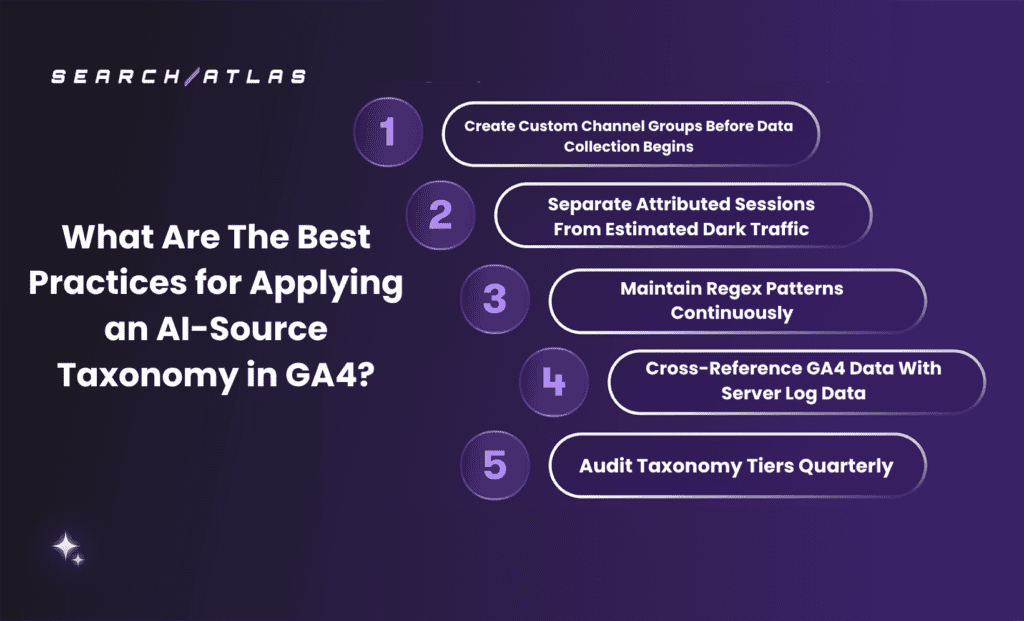
Applying an AI-source taxonomy in GA4 requires structured classification, ongoing maintenance, and consistent measurement practices. AI-source taxonomy implementation transforms AI traffic reporting from broad platform grouping into behavior-based attribution analysis. AI-source taxonomy application creates clearer visibility into referral traffic, attribution coverage, and platform performance.
The 5 main best practices for applying an AI-source taxonomy in GA4 are listed below.
1. Create Custom Channel Groups Before Data Collection Begins
Creating custom channel groups before data collection begins establishes the foundation of the taxonomy. Custom channel groups classify sessions only after the configuration exists. Historical sessions do not inherit new channel definitions retroactively. This timing matters because organizations lose tier-level visibility across earlier reporting periods when channel groups are created late. Early implementation creates complete reporting coverage from the first day of measurement.
2. Separate Attributed Sessions From Estimated Dark Traffic
Separating attributed sessions from estimated dark traffic preserves measurement accuracy. Attributed sessions originate from GA4 reporting and represent directly measured visits. Dark traffic estimates originate from server logs and attribution models that infer missing referral activity. This separation matters because measured data and estimated data answer different analytical questions. Clear separation prevents reports from presenting inferred figures as confirmed traffic.
3. Maintain Regex Patterns Continuously
Maintaining regex patterns continuously keeps channel classification accurate. AI platforms frequently introduce new domains, subdomains, and referral structures. Existing regex rules stop matching sessions when platform architectures change. This maintenance matters because unmatched sessions fall into default channels and distort attribution reporting. Monthly review of source reports identifies new referral patterns before classification gaps expand.
4. Cross-Reference GA4 Data With Server Log Data
Cross-referencing GA4 data with server log data validates taxonomy accuracy. GA4 captures attributed sessions while server logs capture crawler activity, referral requests, and attribution gaps. This comparison matters because attribution coverage changes as AI platforms modify referral behavior. Quarterly comparison reveals platforms that require reclassification or updated measurement rules. The comparison creates a more complete picture of AI traffic visibility.
5. Audit Taxonomy Tiers Quarterly
Auditing taxonomy tiers quarterly keeps classifications aligned with the current platform behavior. New AI platforms emerge regularly while existing platforms modify referral and attribution systems. Quarterly audits evaluate every platform across the taxonomy dimensions and confirm proper tier placement. This review matters because outdated classifications reduce reporting quality over time. Regular audits maintain consistent measurement standards across changing AI ecosystems.
What Tools Help Implement an AI-Source Taxonomy?
The tools that implement an AI-source taxonomy fall into analytics platforms with configurable channel groupings, server-side log analysis tools for dark traffic estimation, data warehouses for cross-source analysis, and SEO audit tools that track which content AI platforms are indexing.
The tools that help implement an AI-source taxonomy are listed below.
1. Search Atlas Site Audit. Search Atlas Site Audit identifies which pages on a site are accessible to AI crawlers, which file types AI platforms index, and which content formats appear most frequently as sources in AI-generated answers. This visibility informs the crawl-to-refer dimension analysis by showing which content accumulates high crawler activity without proportional referral traffic, and which content formats produce the highest citation-to-click conversion rates among AI platforms.
2. GA4. GA4 custom channel groups are the primary implementation surface for an AI-source taxonomy. A custom channel group in GA4 applies regex-based rules to session source and medium values, assigning matching sessions to named channels that appear in Traffic Acquisition and other GA4 reports. Each taxonomy tier maps to a named channel in the custom group. The channel group is created under Admin, then Reporting Identity, then Channel Groups.
3. Server-side log analysis tools. Server-side log analysis tools process access log files to count AI crawler requests and estimate dark traffic volume. Nginx and Apache access logs are parsed using command-line tools or log analysis platforms. Cloud-hosted log services from AWS CloudWatch Logs, Google Cloud Logging, and Cloudflare Workers Analytics provide structured access to server log data with filtering by user agent and time range.
4. BigQuery. BigQuery stores GA4 event-level data and server-side log data in a unified warehouse, enabling cross-source queries that compare GA4-attributed sessions against server-log-estimated total sessions for each AI platform. This cross-source capability is the operational foundation of the attribution coverage dimension calculation and makes tier-level analysis reproducible across reporting periods.
How to Map the Taxonomy to GA4 Custom Channel Groups and Regex
Mapping an AI-source taxonomy to GA4 custom channel groups requires writing regex patterns that match the referrer domain values and UTM source values for each tier, then ordering those conditions within the channel group rules so that more specific patterns take precedence over broader ones.
A Tier 1 custom channel in GA4 matches sessions where the session source matches a regex that includes all Tier 1 AI referrer domains. The regex for a Tier 1 channel uses the pipe operator to match any of the included domains. A two-platform Tier 1 pattern for Perplexity and Claude desktop takes the form perplexity.ai|claude.ai. The channel rule applies to sessions where source matches this regex and medium matches “referral” or is not set for direct-arriving sessions captured via UTM parameters.
How are UTM-attributed ChatGPT sessions captured in the regex? ChatGPT desktop sessions that arrive with utm_source=chatgpt.com are captured by a channel rule that matches session source equal to “chatgpt.com” regardless of the medium value. This rule requires separate handling from the referrer-based rules because UTM source data populates a different GA4 field than the referrer domain value. The channel group rule for UTM-attributed ChatGPT sessions uses the Source condition set to “exactly matches” chatgpt.com rather than the Source/Medium regex condition used for referrer-based sessions.
How is the rule ordering structured within the custom channel group? GA4 custom channel groups apply rules in the order they appear in the channel group definition. The first matching rule wins. Tier 1 rules appear first because they are the most specific and most analytically reliable. Tier 2 rules appear second. Tier 3 rules for crawler-associated referrer patterns appear third. A fallback rule that captures any remaining sessions from domains that match a broader AI platform regex appears last and is labeled “AI Source Unclassified” to preserve those sessions in the AI taxonomy without assigning them to a specific tier prematurely.
What regex pattern structure handles subdomains across AI platforms? Some AI platforms use multiple subdomains for different product surfaces. Google AI activity spans gemini.google.com, ai.google.com, and bard.google.com across different time periods. A regex that matches only gemini.google.com misses sessions from other Google AI surfaces. A broader pattern that uses (gemini|ai|bard).google.com captures all current Google AI subdomain variations. Subdomain patterns require quarterly review as platforms add new surfaces or retire old ones.
What Are Common Examples of Taxonomy Errors for AI Traffic Sources?
Taxonomy errors for AI traffic sources happen when platforms, sessions, crawlers, impressions, and attribution signals receive incorrect classification. These errors reduce reporting accuracy, distort platform comparisons, and create misleading performance conclusions. AI-source taxonomy management requires consistent classification because every error affects attribution, visibility measurement, and traffic analysis.
There are 4 main taxonomy errors for AI traffic sources.
- Creating platform equivalence errors. Platform equivalence errors classify different AI platforms into the same tier despite major behavioral differences. ChatGPT mobile and Perplexity generate different attribution patterns, referral fidelity scores, and measurement reliability. Assigning both platforms to the same tier creates inaccurate comparisons and weakens taxonomy accuracy. Platform classification needs to reflect actual platform behavior instead of broad AI platform labels.
- Combining crawler activity with referral traffic. Combining crawler activity with referral traffic mixes automated requests with human visits. AI crawlers generate server log entries, while AI referrers generate GA4 sessions and engagement metrics. Reports that combine GPTBot crawl requests with ChatGPT referral sessions inflate platform reach and distort traffic analysis. Crawler data and referral data require separate classification and reporting.
- Combining impressions with sessions. Combining impressions with sessions treats visibility metrics and traffic metrics as the same measurement. AI Overview impressions represent search results exposure, while GA4 sessions represent website visits. A website with 10,000 AI Overview impressions and 200 AI referral sessions receives 200 visits, not 10,200 visits. Impression data and session data require separate reporting categories to preserve analytical accuracy.
- Using static regex patterns. Static regex patterns become outdated as AI platforms change referral architectures, domains, subdomains, and UTM structures. Outdated regex rules fail to classify new referral sources correctly. Sessions that fail regex matching fall into default GA4 channels and create artificial traffic declines. Monthly regex reviews preserve taxonomy accuracy and maintain complete channel classification.
What Happens When AI Overviews Are Grouped with Chatbot Referrers?
Grouping Google AI Overviews with chatbot referrers in the same taxonomy tier produces a combined channel metric that mixes impression-based search behavior with direct citation-based referral behavior, which makes it impossible to determine whether changes in AI traffic volume reflect changes in search behavior, citation behavior, or click-through behavior.
Google AI Overviews generate Search Console impressions for queries where the AI-generated answer appears in the SERP. These impressions register before any user action and do not produce GA4 sessions unless the user clicks through to a source page. Chatbot referrers generate GA4 sessions only when a user actively clicks a cited link, which means every GA4 session from a chatbot referrer represents a user navigation decision.
A taxonomy that groups AI Overview-influenced sessions with Perplexity or ChatGPT referral sessions combines two fundamentally different engagement thresholds. The AI Overview session, when it occurs, represents a user who read an AI-generated answer and clicked through despite the answer being available in the SERP. The chatbot referral session represents a user who read a cited link in a conversational context and followed it. These are different user behaviors with different intent levels, and reporting them together produces an AI traffic number that is analytically incoherent.
What does the separated AI Overview analysis reveal that the combined analysis conceals? Separated analysis reveals the click-through rate for AI Overview-influenced queries, which is the proportion of queries where an AI Overview appeared that resulted in a click to a source page. This rate is significantly lower than the click-through rate for chatbot citations and varies by query type, SERP format, and content category. Separated analysis reveals which specific content topics drive AI Overview impressions versus chatbot citations, which are different optimization targets requiring different content interventions.
Does GA4’s native AI Assistant channel replace the need for a custom taxonomy?
GA4’s native AI Assistant channel does not replace the need for a custom taxonomy because it captures only sessions that arrive with a recognized AI platform referrer domain and assigns them all to a single undifferentiated channel, without separating platforms by referral fidelity, citation mechanism, intent, or attribution coverage.
The AI Assistant channel solves the scattering problem. AI referral sessions that previously appeared across Organic, Referral, and Direct default channels are consolidated into a named channel. This is an improvement for high-level reporting. For any analytical question that requires comparing platform behaviors, measuring attribution completeness, or optimizing content for specific AI citation mechanisms, the AI Assistant channel is insufficient because it does not distinguish between the sources it groups.
A custom taxonomy-based channel group provides the tier structure that the AI Assistant channel omits. Both exist in GA4 simultaneously. The AI Assistant channel appears in default reporting. The custom group appears in the reporting identity view, where custom channel groups are applied. Neither replaces the other, and the custom taxonomy group is the necessary addition for organizations that need platform-level behavioral analysis rather than aggregate AI session counts.
What is the difference between an AI referrer and an AI crawler in a taxonomy?
An AI referrer is a platform that sends human users to a website through cited links and produces GA4 session data, while an AI crawler is a bot that accesses a website for indexing purposes and produces server access log entries without creating GA4 sessions, and the two categories belong in separate taxonomy tiers with separate analytical roles.
AI referrers belong in the referral-tier structure of the taxonomy, classified by their referral fidelity, citation mechanism, intent, and attribution coverage. Their data source is GA4 supplemented by server-side log estimates for dark traffic. AI crawlers belong in a separate crawler tier that tracks indexing activity rather than referral activity. Their data source is server access logs filtered by user agent strings, not GA4.
A taxonomy that places AI crawlers and AI referrers in the same tier produces incorrect crawl-to-refer ratio calculations, because the denominator (referral sessions) and the numerator (crawl requests) are no longer from clearly separated data sources. The tier separation is the structural requirement that makes the crawl-to-refer dimension calculation coherent.
Should Google AI Overviews and ChatGPT be in the same taxonomy tier?
Google AI Overviews and ChatGPT belong in different taxonomy tiers because their citation mechanisms, attribution characteristics, and user intent signals are structurally different in ways that make their session data analytically incomparable when grouped.
ChatGPT operates as a chatbot referrer. Users click cited links in a conversational interface, and those clicks produce GA4 sessions when referrer headers are not stripped. Attribution is partial but measurable through a combination of referrer domain matching and UTM parameter detection.
Google AI Overviews operate as an impression-based surface. The AI-generated answer appears in the SERP, registers as a Search Console impression, and produces a GA4 session only on the subset of queries where the user clicks through to a source page rather than reading the answer in the SERP. The click-through rate is lower, the measurement source is different (Search Console impressions versus GA4 sessions), and the optimization implications are different. Grouping them forces a comparison between a referral-click behavior and an impression-to-click behavior that are not the same analytical phenomenon.
How often should an AI-source taxonomy be updated as new platforms emerge?
An AI-source taxonomy requires a quarterly review cycle to account for new AI platforms entering the referral landscape, existing platforms changing their referral architectures, and shifts in crawl-to-refer ratios that alter tier assignments established in prior reviews.
The AI referral landscape changes faster than annual review cycles accommodates. A platform that enters the market with high referral fidelity and a direct citation mechanism qualifies for Tier 1 at launch but produces no historical data for the first one to two quarters. A quarterly review adds new platforms to the taxonomy as their behavioral data accumulates and removes or reclassifies platforms that have changed their architecture in ways that alter their dimension scores.
Quarterly review is the minimum cadence for regex pattern maintenance. Platforms that add new subdomains, change referrer domain structures, or begin appending UTM parameters require regex updates within the quarter they change, not at the next annual review. A regex pattern that becomes stale mid-year creates a growing attribution gap in the custom channel group data for the remainder of the year.
The quarterly review cycle accommodates the emergence of entirely new AI surface types. A platform that launches an AI Overview equivalent, a new in-app browser behavior, or a new citation UI pattern requires a dimension re-scoring against all five taxonomy criteria before it is assigned to a tier. New surface types that do not fit existing dimension definitions require the taxonomy itself to be updated, which is a deeper revision than a tier reassignment and benefits from a structured review process rather than ad hoc modification.