The future of AI answer engines is a shift from single-step question answering to autonomous multi-step task execution. AI answer engines retrieve content from indexed sources and rank it by relevance to the query. They generate a synthesized response inside the interface rather than returning a list of links. This architecture bypasses the traditional click-through model. A user who receives a complete answer inside the platform has no reason to visit the source page. High-quality content now drives AI answers without driving traffic to the page that provided the answer.
The mechanism behind the AI answer engine responses is retrieval-augmented generation, or RAG. In a RAG system, the model fetches real documents at query time. It extracts relevant passages from those documents. It generates a natural-language answer grounded in those passages rather than in pre-trained parameters alone. Answer quality depends on which documents the retrieval step surfaces. It depends on how well those passages are structured for extraction. It depends on whether the content places the answer in the first sentence of each section. This is why two pages covering the same topic produce different citation rates. Extractability determines whether retrieved content becomes part of the generated answer.
The next phase of this landscape moves past answering questions. AI agents receive a goal rather than a query. They decompose that goal into sub-tasks and generate queries at each step. They retrieve content autonomously and complete the task without waiting for human input. The agent is the searcher. The queries it generates are narrower, more entity-centric, and more varied in phrasing than human-typed queries. Content that satisfies agent-generated sub-queries gets cited across multiple task steps. Content built only for broad search intent gets passed over when agents need precise, specific answers at each task stage.
What Is an AI Answer Engine?
An AI answer engine is a system that generates a synthesized response to a query by retrieving and ranking relevant content, rather than returning a list of links. The output is a direct answer, drawn from indexed or retrieved material, with or without citations. The core distinction from a search engine is in the output format. A search engine returns ranked links. An AI answer engine returns a generated response derived from those links.
How does an AI answer engine generate its response? An AI answer engine generates its response through a three-step process (retrieve relevant content, rank it by relevance to the query, and generate a natural-language answer). This architecture is called retrieval-augmented generation, or RAG. In RAG systems, the model does not rely solely on pre-trained knowledge. It fetches real documents at query time, extracts relevant passages, and uses them as the grounding for the generated text. This is why the same question returns different answers when different documents are retrieved.
What makes an AI answer engine different from a large language model? An AI answer engine differs from a standalone large language model because it retrieves external content at query time rather than answering from pre-trained parameters alone. A pure language model generates answers from patterns learned during training. An answer engine grounds its output in documents retrieved at the moment of the query. This retrieval step is what enables citations. It is what creates the competition between content creators, because the retrieved documents define the answer surface.
Why are AI answer engines competing with search engines rather than extending them? AI answer engines compete with search engines because they resolve the same informational queries without requiring the user to click a link. A user asks, “What is retrieval-augmented generation?” An AI answer engine returns a complete explanation. The user gets the answer without visiting a source page. The traditional traffic model, where ranking position drives clicks, breaks down for a large share of informational queries. The click happens in the answer engine’s interface, not on the publisher’s website.
What Is the Difference Between AI Answer Engines vs Traditional Search Engines?
The core architectural difference between an AI answer engine and a traditional search engine is in the output layer. A traditional search engine indexes content, ranks documents by relevance signals, and returns a ranked list. An AI answer engine retrieves content, processes it through a language model, and generates a synthesized response. The retrieval mechanism uses a similar index, but the output is a generated sentence or paragraph, not a document list.
What does this architectural difference mean for content discovery? The architectural difference means that content needs to satisfy two separate criteria to drive value in an AI answer engine context need to be retrieved, and it needs to be extracted into the generated response. In traditional search, ranking position determines traffic. In AI answer engines, retrieval determines whether the content enters the generation process at all. Extractability determines whether the content appears in the final answer. A page is retrieved but not cited if the language model finds more extractable passages elsewhere.
| Dimension | Traditional Search Engine | AI Answer Engine |
| Output format | Ranked list of links | Generated text response |
| User action required | Click through to the source | Read the in-interface answer |
| Citation mechanism | Ranking position | Passage extraction and attribution |
| Freshness | Crawl-based index | Real-time retrieval or pre-trained plus retrieval |
| Optimization target | Ranking position | Citation likelihood and extractability |
| Click-through expectation | High (positions 1 to 3) | Low (answer resolved in the interface) |
| Content structure signal | Title, URL, meta description | Definition clarity, entity density, answer-first formatting |
| Primary metric | Organic traffic | Citation frequency, mention rate, share of voice |
For the fuller comparison, including how each discipline measures success rather than just this structural breakdown, see How AEO Differs from Traditional SEO.
How does optimizing for an AI answer engine differ from optimizing for a search engine? Optimizing for an AI answer engine requires structuring content for passage extraction, not for ranking position. In traditional SEO, on-page signals (title tags, meta descriptions, and internal links) affect rank. In answer engine optimization, the signals that matter are structural. “Does the page open each section with a direct, citable answer?” “Are named entities present with enough context for the model to extract and attribute them?” “Does the page answer a discrete question in each section, or does it bury the answer in the middle of a paragraph?”
Why Does AI Answer Engines Change What “Visibility” Means?
AI visibility refers to whether a brand, domain, or piece of content appears in AI-generated answers, not whether it ranks in position 1 through 10. A page ranked at position 3 in Google’s organic results never appears in Google AI Overviews. A page ranked at position 15 is cited in every Perplexity response for a related query. The metric that captures this is citation frequency, “how often the content appears in AI answers for a defined set of queries”.
What does AI visibility measurement require that traditional rank tracking does not? AI visibility measurement requires tracking citations across multiple answer engine platforms simultaneously. Traditional rank tracking monitors position changes in a single search index. AI visibility tracking monitors whether a domain appears in generated answers across ChatGPT, Perplexity, Google AI Overviews, Gemini, and Copilot. The platforms use different retrieval architectures, so a domain is visible on one and absent on another for the same query set. Structuring that tracking correctly in GA4 requires its own classification system — see how to build an AI-source taxonomy.
How does zero-click search relate to AI answer engine visibility? Zero-click search describes queries that resolve entirely within the search interface without a user clicking to a source page. AI answer engines increase the share of zero-click interactions because they generate full answers in the interface. The implication for content strategy is not uniformly negative. A brand cited in 40% of AI answers for a competitive query set builds brand association and topical authority even without a corresponding traffic spike. The metric shifts from click volume to mention rate and citation frequency.
Why does being cited in AI answers still create value without a click? Citation in AI answers creates value through brand mention, topical association, and increased authority signals, even when the user does not click through. AI answer engines name a domain or brand as the source of information, and users associate that brand with expertise on the topic. Repeated citation across queries builds trust with an audience that converts later through direct search or branded query. The value model for AI visibility is closer to earned media than to organic traffic.
How Major AI Answer Engines Differ From Each Other?
The major AI answer engines differ in retrieval architecture, citation behavior, and index source. Google AI Overviews integrates with Google’s existing search index. Perplexity runs its own crawler and surfaces citations explicitly. ChatGPT retrieves content at query time during browsing mode using the Bing API. Microsoft Copilot integrates directly with Bing. Gemini retrieves through Google’s index across products. Claude uses pre-trained knowledge with optional web search enabled through tool use. These differences determine which content gets retrieved and which gets cited.
The main differences between AI engines are listed below.
- Google AI Overviews and Index-Integrated Retrieval
- Perplexity AI and Citation-First Retrieval
- ChatGPT Browsing and Query-Time Retrieval
- Microsoft Copilot and Bing-Integrated Retrieval
- Gemini and Cross-Product Retrieval Infrastructure
- Claude and Citation Behavior Differences
1. Google AI Overviews and Index-Integrated Retrieval
Google AI Overviews use Google’s existing search index as the retrieval source, pulling ranked content into a generation step that produces a synthesized answer displayed above organic results. The retrieval is not separate from Google’s crawl-and-index process. Pages that rank in Google’s index are the candidate pool for AI Overviews. Traditional SEO signals (crawlability, indexed status, and authority) directly affect whether a page enters the AI Overviews generation step.
How do AI Overviews select which pages to cite? Google AI Overviews selects pages to cite based on a combination of ranking signals and passage extractability. High-authority pages that appear in the top 10 results for a query are more likely to be candidates. Within that candidate pool, the generation system extracts passages that directly answer the query. Pages with answer-first paragraph structure, clear definitions, and named entities have higher extraction rates. Schema markup accelerates accurate parsing during the extraction step.
What does index-integrated retrieval mean for content strategy? Index-integrated retrieval means that ranking in Google’s organic index is a prerequisite for appearing in AI Overviews. A page that is not indexed cannot enter the AI Overviews candidate pool. A deindexed page disappears from both organic results and AI Overviews simultaneously. This creates a direct dependency. Google AI Overviews visibility is downstream of Google SEO health, not parallel to it.
How does AI Overviews citation behavior differ from featured snippets? AI Overviews citations differ from featured snippets in that a single AI Overviews response pulls passages from multiple sources, while a featured snippet attributes the answer to one page. Featured snippets occupy a single position and credit one URL. AI Overviews synthesize across 3 to 7 source pages in a single generated paragraph. A page contributes a passage to an AI Overviews answer without being the primary citation, and without receiving a featured snippet.
| Feature | Google AI Overviews | Google Featured Snippet |
| Sources per answer | 3 to 7 pages | 1 page |
| Attribution | Multiple citations | Single URL |
| Retrieval source | Google index | Google index |
| Prerequisite | Indexed and ranking | Indexed and ranking |
| Answer structure | Synthesized multi-source | Direct lift from one page |
| Triggers | Broad informational queries | Specific factual queries |
2. Perplexity AI and Citation-First Retrieval
Perplexity AI uses a citation-first retrieval model that crawls the web in real time, retrieves source documents for each query, and displays numbered citations alongside every claim in the generated response. Perplexity runs its own web crawler, distinct from Google’s or Bing’s index. Every response surfaces the source documents it retrieved. The user sees which sites contributed which parts of the answer.
Why does Perplexity’s citation model matter for content strategy? Perplexity’s citation model matters because it attributes sources explicitly, making citation frequency directly measurable and linked to brand visibility. A domain cited in 60% of Perplexity answers for a topic cluster drives consistent brand exposure even without traffic. Perplexity’s user base skews toward researchers, technical professionals, and early adopters. This makes Perplexity citations particularly valuable for B2B and technical content.
What content signals increase citation likelihood in Perplexity? Content signals that increase citation likelihood in Perplexity are listed below. First, direct answer formatting pages that open each section with a citable sentence get extracted more often than pages that bury the answer. Second, topical specificity Perplexity retrieves pages that match the query at the entity level, not just the keyword level. Third, freshness Perplexity’s real-time crawler weights recently updated content for time-sensitive queries. Fourth, clear source attribution within the content pages that cite their own sources signals credibility to the retrieval system.
How does Perplexity’s fresh crawl differ from index-based retrieval? Perplexity’s real-time crawl retrieves current versions of pages at query time, while index-based systems retrieve the cached version in the index. Updating a page with a more extractable answer structure affects Perplexity citations faster than it affects Google rankings. Perplexity does not wait for a crawl cycle in the way that Google’s index does. Content updates for AEO purposes have faster feedback loops on Perplexity than on Google.
3. ChatGPT Browsing and Query-Time Retrieval
ChatGPT retrieves content at query time during browsing mode by sending real-time web requests through Microsoft Bing’s search API. With browsing enabled, ChatGPT does not rely on pre-trained knowledge. It searches Bing for current information, retrieves the top results, extracts relevant passages, and incorporates them into the generated response. Without browsing mode, ChatGPT answers from pre-trained parameters only, which carry a training data cutoff.
How does ChatGPT decide which sources to cite in browsing mode? ChatGPT in browsing mode cites sources based on Bing ranking results and passage relevance to the query. The top-ranked pages in Bing for the query become the candidate pool. Within that pool, ChatGPT extracts passages that match the query intent and incorporates them into the response. Citation consistency varies. Not all responses display citations even when web retrieval is used. The citation behavior is less systematic than Perplexity’s explicit citation model.
What is the implication of Bing integration for content visibility in ChatGPT? Bing integration implies that Bing SEO signals determine whether content enters ChatGPT’s retrieval candidate pool during browsing. A page that ranks in Bing for a relevant query is more likely to be retrieved when ChatGPT browses for that topic. Content excluded from Bing’s index, or that ranks below the retrieval threshold, does not enter the generation process. This creates a parallel optimization need. Bing’s presence matters for ChatGPT visibility in a way that most SEO workflows have not prioritized.
Why does ChatGPT’s training data still matter alongside browsing mode? ChatGPT’s training data matters because browsing mode is not enabled for every query or every user. Many ChatGPT interactions use the base model without web retrieval. In those interactions, the model answers from its training corpus. Pages and brands that appeared frequently in high-authority training data are more likely to receive unprompted mentions in non-browsing mode. This is a separate visibility layer from citation in browsing mode.
4. Microsoft Copilot and Bing-Integrated Retrieval
Microsoft Copilot uses Bing’s search index as its primary retrieval source and integrates directly with Microsoft 365 products for enterprise query types. For web queries, Copilot retrieves ranked results from Bing and generates a synthesized response with citation links. For enterprise queries, Copilot retrieves from internal documents, emails, and calendar data when connected to Microsoft 365 via the Graph API. This dual retrieval mode separates Copilot from consumer-only answer engines.
How does Copilot’s enterprise integration affect its citation behavior? Copilot’s enterprise integration means that citation behavior for enterprise users depends on internal data sources, not just the public web index. A team member asks Copilot a question about a company process or document, and Copilot retrieves it from internal repositories. Public web content competes with internal content for the answer. For B2B content, this creates a distinct visibility challenge appearing in Copilot for enterprise users, requiring either internal content integration or a strong Bing presence for the queries that fall through to web retrieval.
What Bing SEO signals affect Copilot visibility? Bing SEO signals that affect Copilot visibility are listed below. IndexNow submission speeds up Bing crawl notification. Bing Webmaster Tools provides crawl data and indexing status. Domain authority in Bing’s ranking system, measured by backlink profile and domain history, determines baseline ranking eligibility. Structured data accelerates passage extraction. HTTPS, canonical signals, and clean redirect chains prevent indexing gaps that would exclude pages from the retrieval candidate pool.
5. Gemini and Cross-Product Retrieval Infrastructure
Gemini is Google’s AI model integrated across Google Search, Google Workspace, and Android, using Google’s search index and Knowledge Graph as the primary retrieval sources. In Google Search, Gemini powers AI Overviews. In Gmail, Gemini retrieves from the email history. In Docs and Drive, Gemini retrieves documents from connected workspace documents. Each product context activates a different retrieval source while using the same underlying model.
How does Gemini’s cross-product integration affect content visibility? Gemini’s cross-product integration means that visibility in Gemini is not a single optimization target but a category of visibility across multiple Google surfaces. A page optimized for Google AI Overviews benefits Gemini’s visibility in Search. A brand with strong Knowledge Graph coverage benefits Gemini responses in Assistant. The connecting thread is Google’s index and Knowledge Graph, which means that traditional Google SEO infrastructure remains the foundation for Gemini visibility.
What is the Knowledge Graph’s role in Gemini retrieval? Google’s Knowledge Graph provides structured entity data that Gemini uses to anchor factual claims and attribute named entities in generated responses. Gemini generates an answer that includes a person, organization, product, or place, it draws entity attributes from the Knowledge Graph. Pages that have strong entity associations in the Knowledge Graph, through structured data, authoritative mentions, and Wikipedia presence, are more likely to see their entity data referenced in Gemini answers.
6. Claude and Citation Behavior Differences
Claude is an AI assistant developed by Anthropic that answers primarily from pre-trained knowledge, with optional web search available through the tool when retrieval is explicitly enabled. In standard interactions, Claude does not retrieve live web content. It generates answers from training data. When web search is enabled as a tool, Claude retrieves search results and incorporates them. This makes Claude’s default behavior distinct from Perplexity, ChatGPT in browsing mode, and Google AI Overviews.
How does Claude’s training data affect brand visibility? Claude’s training data affects brand visibility in that brands and domains appearing frequently in high-authority training sources are more likely to receive unprompted mentions. Training data includes published web content through the training cutoff date. Brands with strong editorial coverage, authoritative backlink profiles, and frequent citation in widely read sources are more likely to appear in Claude’s training corpus. This creates a visibility layer based on editorial authority that predates any real-time retrieval.
What does Claude’s retrieval-optional model mean for content strategy? Claude’s retrieval-optional model means that the content strategy for Claude’s visibility requires two parallel approaches. First, building strong editorial authority and training data presence for queries handled by the base model. Second, ensuring pages are crawlable and well-structured for queries where Claude’s web search tool retrieves live content. Teams that optimize only for live retrieval miss the training corpus dimension of Claude visibility.
How will AI Answer Engines specialize over the Next Three to Five Years?
AI answer engines will specialize because general-purpose retrieval produces unreliable answers in domains where factual precision, citation traceability, and liability sensitivity are high. A general-purpose answer engine is optimized for breadth. A specialized answer engine for medical queries needs to retrieve from peer-reviewed sources, apply dosage and contraindication verification, and cite sources with enough specificity for a clinician to verify the claim. That requirement is architecturally different from answering a question about marketing strategy.
Vertical AI Answer Engines for Legal, Medical, and Finance Queries
Legal AI answer engines will specialize by restricting retrieval to verified legal databases, statute repositories, and case law indexes rather than the open web. General-purpose answer engines retrieve from any indexed page. Legal answer engines will retrieve from official government legal databases and jurisdictionally verified statute collections. The output will include citations that a legal professional verifies in a primary source, not blog summaries of legal concepts.
How will medical AI answer engines specialize their retrieval? Medical AI answer engines will specialize in retrieving from peer-reviewed databases, clinical guidelines, and drug interaction registries rather than general health content. PubMed, clinical trial registries, FDA drug databases, and evidence-based guideline repositories will form the retrieval corpus for medical answer engines. The generation step will require confidence thresholds. A medical answer engine will refuse to generate a dosage recommendation it cannot verify against a clinical guideline, rather than generating a plausible but unverified answer.
How will finance AI answer engines specialize their citation behavior? Finance AI answer engines will specialize by linking every quantitative claim to a verified filing, regulatory report, or real-time market data source. An answer about a company’s earnings cannot be sourced from a secondary summary. It requires a link to the SEC filing or earnings report. The citation model in finance becomes a compliance requirement, not just a quality signal. Primary sources, regulatory filings, and real-time data feeds will outrank secondary analysis in finance retrieval systems.
Why Regulated Industries Require Citation-Sensitive Retrieval?
Citation-sensitive retrieval is necessary for regulated industries because the cost of an incorrect answer includes legal liability, patient harm, or regulatory violation. A general-purpose answer engine tolerates a 5% hallucination rate on factual queries about history or marketing. A medical answer engine cannot tolerate any hallucination rate on drug interaction queries. The retrieval system needs to trace every generated claim to a verifiable source, and the citation needs to be specific enough for the claim to be independently verified.
How does the liability structure of regulated industries change retrieval requirements? The liability structure of regulated industries creates retrieval requirements that are technically incompatible with general-purpose answer engine architecture. General-purpose retrieval optimizes for coverage, retrieves a broad set of relevant documents, and extracts the most useful passages. Regulated industry retrieval needs to optimize for traceability, retrieve only from verified primary sources, attribute every claim to a specific document and section, and flag claims that cannot be traced. This requires a purpose-built index, not a filtered version of a general web index.
What content creates visibility in regulated vertical answer engines? Content that creates visibility in regulated vertical answer engines is listed below. Primary sources peer-reviewed papers, regulatory filings, statute text, and official guidelines. Verified author credentials content published under named professionals with verifiable credentials in the relevant domain. Structured citations within content pages that cite their claims with specific source references signal traceability to the retrieval system. Version-controlled content pages with clear publication dates and revision history enable the retrieval system to select the most current authoritative version.
Real-Time Retrieval vs Pre-Trained Knowledge Systems
Real-time retrieval fetches live content at query time, while a pre-trained knowledge system answers from parameters encoded during the training process. Real-time retrieval incorporates content published hours ago. A pre-trained system cannot answer questions about events after its training cutoff. The tradeoff is speed and reliability. Pre-trained systems respond faster and do not depend on web content availability, but they become stale over time. Retrieval systems are current but return errors if the retrieval step fails or if the retrieved content is low quality.
How does real-time retrieval affect which content gets cited? Real-time retrieval increases citation opportunity for recently published content because the retrieval step queries the live index, not a frozen training corpus. A page published after a model’s training cutoff cannot appear in a pure pre-trained response. In a real-time retrieval system, that same page gets retrieved and cited within hours of publication, assuming it is crawled and indexed. Content freshness becomes a ranking and citation signal in real-time retrieval systems.
| Dimension | Real-Time Retrieval | Pre-Trained Knowledge System |
| Content freshness | Current at query time | Fixed at training cutoff |
| Citation ability | Attributes of living sources | Attributes to training data |
| Latency | Higher (retrieval step adds time) | Lower (no retrieval step) |
| Error mode | Poor retrieval quality; hallucination from bad sources | Stale information; outdated facts |
| Content strategy implication | Fresh content and crawlability matter | Training corpus coverage matters |
| Platform examples | Perplexity, ChatGPT browsing, Google AI Overviews | Claude base model, pre-2024 ChatGPT |
Platform Consolidation vs Fragmentation in AI Search
Platform consolidation in AI search describes the scenario where a small number of AI answer engines capture the majority of query volume across most topic categories. Google, OpenAI, and Microsoft are the consolidation candidates. Their distribution advantages (Google Search, ChatGPT’s consumer base, and Microsoft’s enterprise integration) create scale effects. A consolidated market means fewer platforms demand independent optimization, and content strategies converge around a handful of retrieval architectures.
What does fragmentation in AI search look like? Platform fragmentation in AI search describes the scenario where vertical and specialized answer engines capture significant query share within specific domains. Legal queries route to legal AI engines. Medical queries route to clinical AI engines. Financial queries route to finance AI engines. The general-purpose platforms retain broad consumer query volume but lose share in high-stakes verticals to purpose-built systems. A fragmented market requires content strategies that account for platform-specific retrieval logic in each vertical.
| Dimension | Consolidation Scenario | Fragmentation Scenario |
| Number of platforms to optimize for | 3 to 5 | 10 to 20 |
| Retrieval architecture variation | Lower | Higher |
| Vertical specialization | Low | High |
| Citation logic consistency | Higher across platforms | Platform-specific per vertical |
| Content strategy complexity | Lower | Higher |
| Risk concentration | High (one algorithm change affects broad visibility) | Distributed across platforms |
Which scenario is more likely over the next three to five years? The most likely outcome is partial fragmentation. General-purpose platforms consolidate consumer query volume while vertical platforms capture regulated and high-stakes domain queries. Google, OpenAI, and Microsoft retain the broadest general-purpose query share. Legal, medical, and finance verticals develop purpose-built answer engines that general-purpose systems cannot replace for liability-sensitive queries. Most teams need to optimize for 3 to 5 general-purpose platforms and 1 to 3 vertical platforms relevant to their industry.
Which AI Platforms Are Gaining Query Share Fastest?
Perplexity AI and ChatGPT are the two AI answer engine platforms gaining query share fastest from 2025 to 2026. Perplexity grew from negligible query volume to serving over 100 million queries per month by late 2024. ChatGPT’s search functionality, launched with Bing integration in late 2023, expanded through 2024 and 2025 with growing browsing mode adoption. Google AI Overviews launched to over 1 billion users in the US and India in 2024 and remains the highest-volume AI answer layer by absolute queries.
How is Google AI Overviews query volume different from Perplexity and ChatGPT? Google AI Overviews reaches a higher absolute query volume because it is embedded directly in Google Search, which processes over 8.5 billion queries per day. Perplexity and ChatGPT operate as separate platforms that users need to navigate to intentionally. AI Overviews intercepts existing Google queries without requiring a platform shift. The growth metric for AI Overviews is coverage, the percentage of Google queries that trigger an AI Overview response, which expanded from roughly 20% in 2024 to broader coverage through 2025.
How does Microsoft Copilot compare in query share growth? Microsoft Copilot’s query share growth is concentrated in enterprise productivity contexts rather than consumer informational queries. Copilo,t integrated into Microsoft 365, Windows, and Bing, has hundreds of millions of potential users through enterprise contracts. Enterprise query volume is less publicly measurable than consumer query volume, but Copilot’s distribution advantage within corporate environments makes it a significant channel for B2B content visibility.
What does query share growth mean for content strategy prioritization? Query share growth data determines which platforms to prioritize in an AI visibility tracking and content optimization workflow. A platform that processes 5% of the query volume in a given topic category is a lower priority than one that processes 40%. The challenge is that the platform query share varies by topic category. Perplexity captures a higher share of research-oriented and technical queries than it does of broad consumer queries. ChatGPT captures a higher share of conversational and task-oriented queries. Platform selection for content optimization accounts for category-level distribution, not aggregate platform size alone.
From AI Answer Engines to AI Agents
The transition from AI answer engines to AI agents represents a shift from systems that respond to queries to systems that execute tasks autonomously. An AI answer engine waits for a user query, retrieves relevant content, and generates an answer. An AI agent receives a goal, generates its own queries, browses relevant sources, and completes a multi-step task without waiting for human input at each step. This transition changes what retrieval means because the agent, not the user, defines which queries get executed.
AI Answer Engines vs AI Agents
The core difference between an AI answer engine and an AI agent is that an answer engine responds to a query while an agent pursues a goal. An answer engine is reactive. It waits for a question and returns an answer. An AI agent is proactive. It receives an objective, decomposes it into sub-tasks, generates the queries it needs to complete each sub-task, and executes actions. The retrieval behavior is fundamentally different because the agent generates its own information needs rather than responding to user-defined questions.
| Dimension | AI Answer Engine | AI Agent |
| Trigger | User query | User goal or task |
| Query generation | User-defined | Agent-generated |
| Retrieval scope | Single query | Multi-step, multi-query |
| Output | Answer to a question | Completion of a task |
| Interaction model | Reactive | Proactive |
| Citation behavior | Attributes to sources for the answer | Retrieves and acts on sources across tasks |
| Content discovery model | Passive | Active (agent determines which queries to run) |
| Examples | Perplexity, Google AI Overviews, ChatGPT | OTTO SEO, AutoGPT, Operator AI |
How does an AI agent interact with web content differently from an AI answer engine? An AI agent interacts with web content by browsing multiple sources across a task sequence, not by retrieving sources for a single answer. For a task (compiling a competitive analysis of three SEO platforms, an AI agent runs separate queries for each platform, retrieves pricing pages, feature documentation, and review aggregators, and synthesizes the information into a structured output. Each retrieval step within the task is a separate citation opportunity. The agent visits the same page multiple times across a task if it provides information relevant to multiple sub-goals.
How AI Agents Handle Multi-Step Tasks?
A multi-step task is a goal that requires the agent to decompose the objective into sub-tasks, execute each sub-task in sequence, and consolidate the outputs into a final result. Writing a competitive analysis, booking travel, auditing a website, and building a content calendar are multi-step tasks. Each step requires different retrieval inputs. The agent maintains state across steps, using outputs from earlier steps as inputs to later ones.
How do AI agents decompose a multi-step task? AI agents decompose a multi-step task by identifying the information and actions required at each stage of the goal, then generating a plan that sequences those steps. For a research task, the decomposition produces steps (defining the scope, generating a query set, retrieving sources, extracting key claims, comparing findings, and synthesizing output). The agent executes each step autonomously. A human sets the initial goal and reviews the final output without intervening in the intermediate steps. A similar decomposition process powers AI agents for content gap analysis, which plan, query, and score opportunities across multiple data sources in one autonomous run.
How does state management across steps affect content retrieval? State management across steps means that the content retrieved in step 2 affects which content gets retrieved in step 4. If the agent retrieves information about Platform A in step 2 and finds a gap, it generates a follow-up query in step 4 specifically targeting that gap. Content that answers follow-up and clarifying queries, not just primary queries, has higher visibility in agentic retrieval workflows. A page that provides a complete, self-contained answer to a topic reduces the agent’s need for follow-up retrieval elsewhere.
What content structure reduces the agent’s need for follow-up queries? Content structure that reduces agent follow-up queries includes answer-first formatting, complete entity coverage within a single page, and explicit treatment of common sub-questions. An agent that retrieves a page answering the main question and three common follow-up questions in one visit is more likely to cite that page across multiple task steps. A page that answers one narrow question and requires the agent to visit 4 other pages for related context provides less value in an agentic workflow.
How Agentic Retrieval Changes Content Discovery?
Agentic retrieval is the process by which an AI agent determines its own information needs, generates queries to satisfy those needs, and retrieves content autonomously as part of task execution. The agent is the searcher, not the user. The queries sent to search indexes and retrieval systems are generated by a model, not typed by a human. The query structure, specificity, and sequence are determined by the agent’s task decomposition logic.
What does agent-generated query specificity mean for content structure? Agent-generated query specificity means that content covering specific entity attributes, precise feature comparisons, and technical mechanism explanations gets retrieved more often in agentic workflows. Broad overview pages that cover a topic without depth in any specific dimension are less likely to satisfy agent queries. Pages structured around discrete subtopics, each answering a specific question about a named entity or concept, match the narrower, more targeted queries that agents generate.
How does agentic retrieval change the concept of content discoverability? Agentic retrieval changes content discoverability because discovery is no longer a function of a human deciding to search for a topic. In traditional search, a human decides to look something up. In agentic workflows, the agent decides which information it needs based on the task. Content that answers questions the agent is likely to generate as part of task execution gets discovered, whether or not any human would have searched for those specific terms. Content strategy needs to anticipate agent task flows, not just human search intent.
What Visibility Means When AI Agents Generate the Query?
Visibility in agentic retrieval means that content is retrieved and incorporated into agent task outputs, not that a human searcher saw a ranking position. The traditional visibility metric, ranking position, requires a human to observe the SERP. The agent generates queries and processes results autonomously; ranking position is still relevant but secondary. What matters is whether the content was retrieved, whether relevant passages were extracted, and whether those passages informed the agent’s task output.
How does content quality affect agent task output incorporation? Content quality affects agent task output incorporation because agents that retrieve low-quality or unsupported content generate worse task outputs. Agents produce accurate, well-sourced outputs. Content that provides direct, verifiable, specific answers gets incorporated. Content that makes broad claims without supporting detail gets passed over in favor of content that answers the agent’s query precisely. Content quality is a direct input to agentic citation rates.
What is the new visibility metric for agentic retrieval contexts? The new visibility metric for agentic retrieval is the task output inclusion rate, how often content from a domain appears in the final output of agent task completions. Citation frequency in answer engines tracks how often a page is cited in a single-step response. Task output inclusion rate tracks how often a domain’s content shapes the information in a multi-step task completion. This metric requires monitoring AI agent behavior, not just AI answer engine responses.
How AI Agents Change Citation and Recommendation Behavior?
AI agents cite content as a function of task relevance at each step, not as a function of relevance to a single user query. An answer engine cites the source that best answers the query. An agent cites the same source at multiple task steps if it provides information relevant to multiple sub-goals. A source cited at 3 task steps within a single agent run contributes more to the final output than a source cited once. This creates a compounding citation advantage for comprehensive, multi-dimensional content.
How do recommendation behaviors change in agentic AI systems? Recommendation behaviors in agentic AI systems are driven by the agent’s task model rather than by user preference signals. In traditional recommendation systems, a user’s past behavior drives recommendations. In agentic AI, the agent’s task decomposition determines which content to retrieve and recommend as part of the task output. A brand recommended by an agent is recommended because its content matches the agent’s query at a specific task step, not because of historical user preferences.
What does this shift in recommendation logic mean for brand visibility? The shift in recommendation logic means that brand visibility in agentic AI depends on content alignment with agent task flows rather than historical user engagement metrics. A brand that produces precise, entity-rich, answer-first content for the queries that agents generate in a given topic category gets recommended consistently. A brand that produces high-engagement content optimized for human browsing behavior is underrepresented in agentic recommendations if the content does not satisfy agent-generated queries.
What Determines Whether Content Gets Cited in AI Answers?
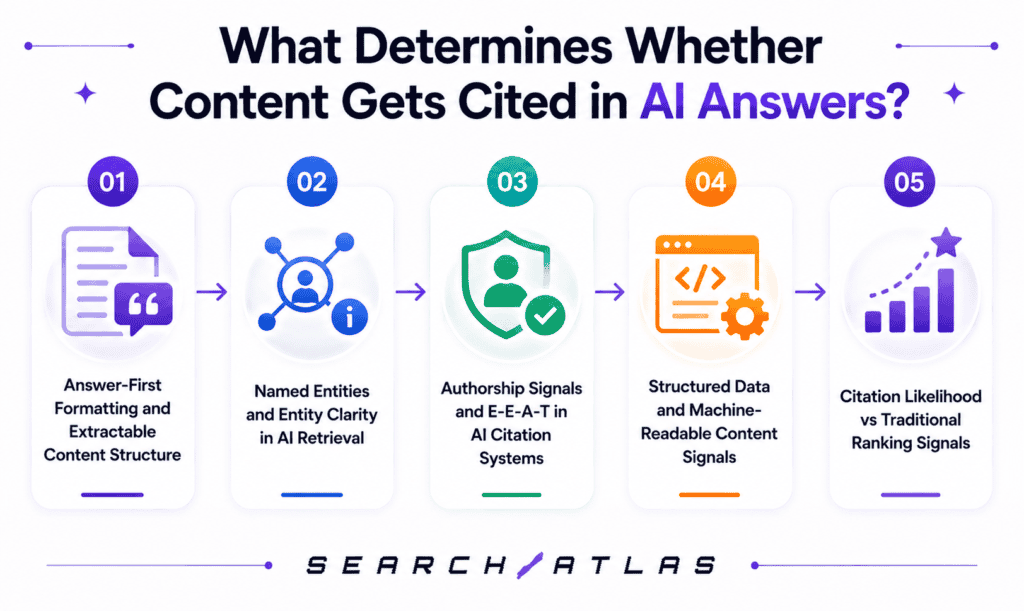
The primary factors that determine content citation in AI answers are listed below.
- Answer-First Formatting and Extractable Content Structure
- Named Entities and Entity Clarity in AI Retrieval
- Authorship Signals and E-E-A-T in AI Citation Systems
- Structured Data and Machine-Readable Content Signals
- Citation Likelihood vs Traditional Ranking Signals
1. Answer-First Formatting and Extractable Content Structure
Answer-first formatting is a content structure pattern where each section opens with a direct, complete answer to its governing question before providing a supporting explanation. The AI retrieval step extracts passages at the sentence and paragraph level. If the answer to the governing question is in the first 1 to 2 sentences of the section, the retrieval system extracts and attributes it with high precision. If the answer is buried in the third or fourth paragraph, passage extraction misses it or extracts a less precise version.
How does the extractable content structure affect citation rates? Extractable content structure affects citation rates because AI systems score passages by how completely they answer the query in isolation. A passage that answers the query as a standalone unit, without requiring surrounding context to make sense, receives a higher extraction score. Passages that begin with “As we mentioned above” or rely on context from earlier sections are harder to extract. Each section of a piece of content needs to be comprehensible if extracted alone.
What structural patterns improve passage extractability? Structural patterns that improve passage extractability are listed below. Opening sentences that define or directly answer the section topic. Paragraphs limited to one idea, with the core idea stated first. Named entity references are in every paragraph, so the extraction system attributes the passage without needing context from outside the paragraph. Numbered lists converted to prose paragraphs with a leading sentence stating the list count. Short sentences that express one idea per sentence, without subordinate clauses that bury the key claim.
How does paragraph length affect extraction precision? Shorter paragraphs with one idea per paragraph produce more precise extractions than long, multi-idea paragraphs. A retrieval system extracting from a 40-word paragraph that answers one question produces a precise, citable passage. A retrieval system extracting from a 200-word paragraph covering four related points extracts a longer passage that is less specific. Length per paragraph is a citation precision variable, not just a readability variable.
2. Named Entities and Entity Clarity in AI Retrieval
Entity clarity is the degree to which a piece of content unambiguously identifies and describes the named entities it discusses. A page that discusses “the platform” without naming it, or “the method” without defining it, has low entity clarity. A page that names Google AI Overviews as the specific platform and retrieval-augmented generation as the specific mechanism has high entity clarity. AI retrieval systems extract passages more reliably from high entity-clarity content because the named entities anchor the passage to the query’s entity references.
Why does entity disambiguation matter for AI citation? Entity disambiguation matters because AI retrieval systems need to determine whether the entity in a content passage matches the entity in the user’s query. “ChatGPT” and “OpenAI” are related but distinct entities. A page that uses them interchangeably has lower entity clarity. A page that distinguishes between ChatGPT as a product and OpenAI as the organization provides clearer disambiguation signals. AI systems extract passages from disambiguated pages more accurately for entity-specific queries.
How do named entity references in content affect retrieval system behavior? Named entity references in content create explicit associations between the content and the entities the AI retrieval system uses to match queries. A page discussing AI answer engines that mentions Google AI Overviews, Perplexity, ChatGPT, Microsoft Copilot, and Gemini by name is more likely to be retrieved for queries about any of those specific platforms. A page that discusses “AI search platforms” generically matches fewer entity-specific queries. Entity coverage functions as a topical relevance signal for AI retrieval systems, similar to how it functions for Google’s Knowledge Graph.
What is the relationship between entity coverage and topical completeness? Entity coverage and topical completeness are related but distinct dimensions of content quality for AI retrieval. Topical completeness describes whether all major subtopics within a subject are addressed. Entity coverage describes whether the specific named entities associated with those subtopics are present and clearly identified. A page is topically complete but entity-poor if it covers all subtopics without naming the specific platforms, people, concepts, or organizations that define those subtopics. AI retrieval systems require both.
3. Authorship Signals and E-E-A-T in AI Citation Systems
Authorship signals indicate to AI retrieval systems that the content was produced by a named, credentialed individual whose expertise in the topic is verifiable. A page with a named author, an author bio linking to a professional profile, and publication history in the domain provides stronger authorship signals than an anonymous page. AI systems use authorship signals as a proxy for content reliability, particularly for topics where expert judgment matters.
What is E-E-A-T, and how does it affect AI retrieval? E-E-A-T stands for Experience, Expertise, Authoritativeness, and Trustworthiness, Google’s framework for evaluating content quality. In traditional SEO, E-E-A-T is a quality rather than a direct ranking signal. In AI retrieval, similar signals function as content quality filters. Retrieval systems that use Google’s index inherit E-E-A-T-influenced rankings as a starting point. Content with strong authorship signals, expert credentials, and credible sources is more likely to pass the quality threshold required for retrieval.
How do authors establish signals that AI retrieval systems recognize? Authors establish signals that AI retrieval systems recognize through consistent publication under a real name, author bio pages that link to verifiable credentials, and citations in third-party authoritative sources. An author whose name appears in Search Atlas Blog articles, who has a bio page listing credentials, and whose work is cited by industry publications has a stronger author entity signal than an anonymous writer. The Person schema type marks up the author’s name, title, and organization for machine-readable parsing.
Why does named authorship increase citation rates beyond anonymous content? Named authorship increases citation rates because retrieval systems use author entity signals as a quality filter, not just as attribution metadata. A page attributed to a named expert in a relevant field passes a trust threshold that anonymous pages do not. In YMYL topics (Your Money Your Life), including finance, health, and legal content, authorship signals carry disproportionate weight in retrieval filtering. The citation advantage of named authorship is highest in high-stakes domains where the retrieval system prioritizes source credibility over coverage breadth.
4. Structured Data and Machine-Readable Content
Structured data types that most directly affect AI retrieval and citation are listed below.
- Article schema marks up the content type, author, publication date, and headline, giving retrieval systems machine-readable metadata for passage attribution.
- The FAQPage schema marks up discrete question-answer pairs as extractable units, directly aligning with the passage-level extraction model.
- Person schema links the author to verifiable credentials.
- The organization schema connects the publisher to a known entity. HowTo schema marks up procedural content as step-level extractable units.
How does the FAQ schema affect extraction in AI answer engines? The FAQ schema marks up question-and-answer pairs in a machine-readable format that AI answer engines extract at the pair level. When FAQPage markup is present, the retrieval system does not need to infer which text answers which question. The markup makes the association explicit. Perplexity and Google AI Overviews demonstrate higher extraction rates for FAQ-marked content compared to unmarked question-answer paragraphs with equivalent text quality.
What structured data errors reduce AI citation eligibility? Structured data errors that reduce AI citation eligibility are listed below. Schema validation errors prevent the markup from being parsed correctly. Markup that does not match the visible text creates a trust gap that the retrieval system penalizes. Missing required properties in the Article schema (author and datePublished) reduce the completeness of the machine-readable metadata. Duplicate schema declarations for the same entity create ambiguity. JSON-LD syntax errors cause the parser to skip the markup entirely.
How does structured data interact with content formatting to determine citation eligibility? Structured data and content formatting interact in that structured data accelerates machine parsing while content formatting determines extraction precision. A page with a correct Article schema and answer-first paragraph structure is easier to both parse and extract from than a page with a correct schema and poor paragraph structure. Structured data does not compensate for buried answers. Formatting does not compensate for an absent or broken schema. Both need to be present for maximum citation eligibility.
5. Citation Likelihood vs Traditional Ranking Signals
Citation likelihood measures how often content gets extracted and attributed in AI-generated answers, while traditional ranking signals measure the factors that determine a page’s position in a ranked list. Traditional ranking signals include backlink authority, on-page keyword relevance, Core Web Vitals, and engagement metrics. Citation likelihood signals include answer-first formatting, entity clarity, passage extractability, structured data completeness, and authorship signals. Some signals affect both, but the optimization targets are different.
| Signal Type | Traditional Ranking Impact | Citation Likelihood Impact |
| Backlink authority (Domain Power) | High direct impact | Indirect (authority filter for retrieval candidate pool) |
| Answer-first formatting | Low impact | High direct impact |
| Entity clarity and density | Moderate impact | High direct impact |
| Page speed and Core Web Vitals | Direct ranking factor | Indirect (crawl efficiency) |
| Schema markup | Moderate (rich results) | High (extraction anchor) |
| Author credentials | Low direct impact | High (trust filter) |
| Passage extractability | Not measured | Primary citation factor |
| Keyword density | Moderate impact | Low impact |
| Content freshness | Moderate impact | High in real-time retrieval systems |
How does optimizing for citation likelihood interact with traditional SEO? Optimizing for citation likelihood reinforces most traditional SEO practices while adding a new layer of formatting and structural requirements. Crawlability, indexing health, site authority, and content relevance remain necessary for both traditional ranking and AI citation eligibility. The additional layer is structural formatting that makes passage extraction precise, entity coverage that makes topic attribution accurate, and authorship signals that pass quality filters. The two optimization paths reinforce rather than compete with each other.
How to Audit Content for AI Answer Engine Eligibility?
An AI answer engine eligibility audit assesses whether existing content meets the structural, entity, and technical requirements for retrieval and citation in AI-generated answers. The audit identifies which pages already satisfy answer-first formatting, entity coverage, structured data, and crawlability requirements. It identifies which pages need rework and what type of rework produces the largest citation likelihood improvement. The output is a prioritized list of pages and the specific changes each page needs.
The steps are listed below.
- Assess Answer-First Formatting
- Audit Entity Coverage and Context
- Identify Pages With High Citation Potential
- Rework Existing Content for AI Extraction
- Audit Citation Readiness Across Multiple Platforms
1. Assess Answer-First Formatting
Answer-first formatting assessment checks whether each major section of a page opens with a direct, citable answer to its governing question. The assessment reads the first sentence of each section. If the first sentence defines the topic or answers the section’s implicit question, the section passes. If the first sentence provides context, background, or a transition without answering the question, the section fails. A passing section rate below 60% indicates significant formatting rework is needed.
What does a failed answer-first check look like? A failed answer-first check produces a section opening where the answer is delayed past the first sentence. An example of a failing opening. “Many people wonder about the differences between AI answer engines and traditional search engines. The topic has become increasingly important as AI tools have grown in adoption.” The question is not answered in either sentence. A passing version “AI answer engines generate synthesized text responses from retrieved content, while traditional search engines return ranked lists of links.” The answer is in the first sentence.
How do you prioritize which pages need answer-first rework? Prioritize pages for answer-first rework based on query volume, current retrieval rate, and citation gap. Pages covering high-volume queries where the site is not being cited in AI answers are the highest-priority candidates for formatting rework. Pages getting cited at high rates are lower priority. The gap between query relevance and citation rate identifies the pages where structural improvement produces the largest citation lift.
What is the fastest way to identify answer-first failures at scale? The fastest way to identify answer-first failures at scale is to extract the first sentence of every H2-level section across the target pages and evaluate each sentence against one criterion. Does it answer the section’s governing question? This produces a pass-fail list for every section on every page in the audit set. Sections that fail are flagged for reformatting. The evaluation does not require reading the full page. The first sentence alone determines the verdict.
2. Audit Entity Coverage and Context
Entity coverage audit checks whether the named entities required for topical completeness are present in the content with sufficient identifying context. The audit maps the expected entity set for the topic, then checks whether each entity appears, how many times it appears, and whether it appears with enough descriptive context for an AI system to extract and attribute it. An entity that appears once without a definition provides less retrieval value than an entity with a definition, a contextual sentence, and a relationship to the article’s primary topic.
How do you identify entity gaps in existing content? Entity gaps are identified by comparing the entity set in the existing content against the entity set present in content that is currently cited for the target queries. Review the citations in Perplexity, Google AI Overviews, and ChatGPT responses for the target queries. List the named entities present in the cited pages. Compare that list against the entities in the existing content. Entities present in cited competitor pages but absent from the target page are entity gaps. Adding those entities with appropriate context increases citation eligibility.
What is the minimum entity context requirement for retrieval? The minimum entity context requirement for retrieval is that every core entity in the topic needs to appear at least once with a definitional or functional sentence. Supporting entities need to appear with enough context to be parsed without requiring knowledge from outside the article. Entities that appear only in titles or headings without body-text elaboration provide weaker extraction signals than entities with inline definitions. An entity mentioned once with a clear definition in the first paragraph establishes a retrieval association. An entity mentioned only in a heading does not.
3. Identify Pages With High Citation Potential
Pages with high citation potential share four characteristics. They are topically aligned with high-volume AI queries, existing answer-first structure, strong entity coverage, and active indexing status. A page that already ranks in the top 10 for a relevant query, covers the topic with entity clarity, and uses structured paragraphs is close to citation-eligible. Minor formatting improvements or entity additions are all that is needed. These pages represent the lowest-effort path to improved AI citation rates.
How do you identify pages that are already close to citation-eligible? Pages close to citation eligibility are identified by checking existing AI answer citations for the target queries and comparing cited pages against uncited pages with similar topical coverage. If the cited page and the uncited page cover the same topic, but the cited page opens each section with a direct answer while the uncited page does not, the answer-first formatting gap is the barrier. Fixing that gap is the most targeted intervention available.
What is the difference between a high-potential page and a high-effort page? A high-potential page already has strong entity coverage and topic relevance,e but needs formatting fixes. A high-effort page needs entity additions, structural rewrites, and structured data corrections. High-potential pages produce faster citation lifts per hour of editorial work. High-effort pages require more investment but address content that is not eligible for citation at all in its current state. Audits need to separate these two categories before assigning editorial resources.
4. Rework Existing Content for AI Extraction
Reworking existing content for AI extraction involves three changes. They are reformatting section openings to answer-first structure, adding entity definitions and context where entities appear without them, and adding or correcting structured data markup. The reformatting step changes paragraph order and sentence structure. The entity addition step adds definitional sentences for named entities that appear without context. The structured data step adds Article, FAQ, or Person schema where missing, or fixes validation errors in existing markup.
What is the rework priority order for AI extraction improvements? Rework priority order for AI extraction improvements is listed below.
- Fix crawlability and indexing issues. A deindexed page cannot be cited regardless of content quality.
- Reformat section openings to answer-first structure. This is the highest-impact content change per page.
- Add entity definitions and context for core and supporting entities.
- Add or fix structured data markup.
- Add or strengthen authorship signals on the page and the author profile.
How does OTTO SEO fit into the rework workflow? OTTO SEO handles the technical implementation layer of AI extraction improvements once the audit identifies gaps. After the audit determines which pages need schema corrections, canonical fixes, or metadata updates, OTTO SEO deploys those changes through a single JavaScript pixel without requiring developer intervention per page. OTTO SEO modifies structure, metadata, schema, and internal links in real time, applying live fixes to the technical signals that determine retrieval candidate pool inclusion.
5. Audit Citation Readiness Across Multiple Platforms
Citation readiness audits across multiple platforms check whether the page’s content meets the retrieval requirements specific to each platform’s architecture. Google AI Overviews require Google index eligibility and structured data. Perplexity requires crawlability and real-time accessibility. ChatGPT in browsing mode requires the Bing index presence. Claude requires training data presence or web search accessibility. A cross-platform audit checks each requirement separately and identifies which platforms have gaps.
What tools are used to audit cross-platform citation readiness? Cross-platform citation readiness audits use a combination of platform-specific tools and AI visibility monitoring tools. Google Search Console confirms Google index status and crawl health. Bing Webmaster Tools confirms Bing index status. Manual citation checks on Perplexity and ChatGPT for target queries confirm live citation status. The Search Atlas LLM Visibility Tool monitors citation rates, share-of-voice metrics, and sentiment patterns across ChatGPT, Claude, Gemini, and Perplexity simultaneously.
How do you consolidate cross-platform audit findings into a single action list? Cross-platform audit findings consolidate into a single action list by mapping each finding to the specific page and change type it requires. A finding of “not indexed in Bing” maps to the page and the action “submit to IndexNow and check Bing Webmaster Tools for crawl errors.” A finding of “low citation rate on Perplexity despite Google indexing” maps to the page and the action “review freshness of content and restructure section openings.” The action list is ordered by estimated citation impact per page, not by platform.
How to Measure AI Answer Engine Visibility?
The primary metrics for measuring AI answer engine visibility are citation frequency, mention rate, share of voice, and sentiment score. Citation frequency measures how often content from a domain appears in AI answers for a defined query set. Mention rate measures how often the brand name appears in AI responses, including responses that cite other pages. Share of voice measures the brand’s citation volume as a percentage of total citations across competing domains for the same query set. Sentiment score measures the tone of the AI-generated context in which the brand appears.
How does citation frequency measurement work in practice? Citation frequency measurement runs a defined set of target queries across one or more AI platforms and records which domains are cited in each response. A query set of 50 representative queries for a topic cluster, run weekly, produces a citation frequency percentage. The share of queries where the target domain appears. This measurement is done manually for small query sets or at scale using an AI visibility monitoring platform. The percentage, not the raw count, is the comparable metric across platforms.
How does Search Atlas measure AI visibility across platforms? Search Atlas measures AI visibility across platforms through the LLM Visibility Tool, which analyzes any domain, brand, or topic across ChatGPT, Claude, Gemini, and Perplexity. The LLM Visibility Tool generates visibility percentages, sentiment evaluations, citation source analysis, and competitor benchmarks from a single interface. Data views include visibility trends over time, share-of-voice comparisons against competing domains, cross-platform ranking comparisons, sentiment patterns by topic and platform, and topic-level performance breakdowns.
What does a complete AI visibility tracking setup look like for a team monitoring multiple platforms? A complete AI visibility tracking setup for a team monitoring multiple platforms includes a defined query set, a measurement cadence, platform-specific tools for index and citation checks, and a centralized dashboard for cross-platform comparison. The query set covers the primary topic clusters that the brand targets. The measurement cadence runs weekly or biweekly.
How does sentiment tracking complement citation frequency measurement? Sentiment tracking complements citation frequency measurement because a brand cited in negative or incorrect AI contexts produces worse outcomes than a brand cited less frequently in accurate, positive contexts. Citation frequency measures presence. Sentiment tracking measures the quality of presence. A brand cited frequently as an example of a problematic practice has high citation frequency and negative sentiment. The Search Atlas LLM Visibility Tool tracks sentiment patterns by topic and platform, identifying whether high citation frequency correlates with positive, neutral, or negative framing.
How do you set a citation frequency baseline for new campaigns? A citation frequency baseline is set by running the target query set across all monitored platforms before any content optimization begins and recording the domain’s citation percentage for each platform. This baseline captures the current state before changes are made. Subsequent measurements compare against the baseline to isolate the citation lift attributable to the content changes. Without a baseline, it is not possible to determine whether citation rate improvements result from content changes or from natural platform fluctuation.
How AEO and SEO Will Converge Over the Next Five Years?
AEO and SEO will converge because the content infrastructure required for AI citation eligibility and the content infrastructure required for traditional search ranking share the same technical and structural foundation. Crawlability, indexing health, backlink authority, structured data, and content quality matter for both. The divergence between AEO and SEO is in formatting emphasis and measurement metrics, not in the underlying infrastructure. Teams that treat AEO as a separate workflow produce contradictory advice and redundant processes.
What specific SEO practices directly transfer to AEO? SEO practices that directly transfer to AEO are listed below.
- Technical crawl health. Pages need to be indexed and accessible to both Google’s crawler and AI system crawlers.
- Structured data deployment. Article, FAQ, and Person schema benefit both rich results in traditional search and passage extraction in AI retrieval.
- Topical authority. Content clusters that establish depth on a topic improve both ranking signals and AI retrieval relevance.
- Backlink authority and Domain Power increase retrieval candidate pool inclusion across platforms that use authority signals as quality filters.
How will the convergence change what keyword research means? Keyword research will expand to include query pattern analysis for AI answer engines, covering the questions that agents and answer systems generate, not only the terms humans type. Traditional keyword research models query frequency and competition for human-typed search terms. As agentic AI generates more queries autonomously, query pattern analysis needs to model the types of questions agents generate during task execution. This requires analyzing agent task flows and the information needs that arise at each step, not just aggregating human search volume data.
What does full convergence of SEO and AEO look like as a practice? Full convergence of SEO and AEO produces a content production workflow where every piece of content is simultaneously optimized for traditional ranking position and AI citation eligibility. The content is written answer-first, with strong entity coverage, structured data, and named authorship. It targets both human search queries and the entity-specific questions that AI systems generate. It is measured by both ranking position and citation frequency across the target platform set. The two optimization paths reinforce each other.
What Are the Best Practices for AI Answer Engine Visibility?
Best practices for AI answer engine visibility are listed below.
- Use Answer-First Content Structures
- Build Strong Entity and Authorship Signals
- Structure Pages for Retrieval and Citation Extraction
- Monitor Visibility Across Multiple AI Platforms
- Combine SEO and AEO Into a Unified Content Strategy
- Optimize for Citation Likelihood Instead of Click-Only Metrics
1. Use Answer-First Content Structures
Implementing an answer-first content structure requires rewriting each section opening so that the first sentence contains a complete, citable definition or direct answer. The process starts with identifying the governing question for each section. Then, the first sentence is revised to answer that question directly, without preamble. Subsequent sentences provide supporting explanation, mechanism detail, and context. The answer is not restated at the end of the section.
How do you write an answer-first opening sentence? An answer-first opening sentence names the subject, states what it is or does, and includes at least one specific detail. A vague opening, “There are several important differences to consider.” A specific answer-first opening. “AI answer engines generate synthesized text responses from retrieved content, bypassing the ranked link list that traditional search engines return.” The specific version names both entities, states the core distinction, and is extractable as a standalone answer.
Why does the first sentence placement matter more than total content length? The first sentence placement matters more than total content length because AI extraction systems score passages based on where in the paragraph the answer appears. A 2,000-word page where the answer to each section question is in the first sentence of each section provides higher extraction value than a 4,000-word page where the answers are scattered throughout paragraphs. Length provides coverage depth and entity density. Answer-first structure provides extractability. Both matter, but extractability directly affects citation rates.
What is the most common reformatting error when applying the answer-first structure? The most common reformatting error is moving the answer to the first sentence without removing the preamble that previously preceded it. The result is a sentence. “As context, it is important to understand that AI answer engines generate synthesized responses from retrieved content.” The answer is present, but the preamble phrase “As context, it is important to understand that” weakens it. The first sentence needs to be the answer itself, with no setup. Every word before the answer reduces the extraction score.
2. Build Strong Entity and Authorship Signals
Building named entity signals requires creating a consistent entity presence across owned and third-party content. The owned dimension covers structuring every authored page to include a named author with an author bio page, Person schema, and links to the author’s professional profiles. The third-party dimension covers publishing in external authoritative sources, earning editorial mentions in industry publications, and building a Knowledge Graph presence through Wikipedia entries or Wikidata listings for the organization and key personnel.
What authorship signals do AI retrieval systems prioritize? The authorship signals that AI retrieval systems prioritize are listed below.
- Named authorship. Every content piece is published under a real person’s name rather than anonymously or under a generic brand name.
- Author bio pages. Dedicated pages describing the author’s credentials, experience, and publication history.
- Third-party citation. The author’s name appears in other authoritative sources outside the owned domain.
- Schema markup. Person and Article schema linking the author entity to the content entity.
- Publication history. A consistent body of work in the relevant topic domain.
How does Domain Power relate to entity signal strength in AI retrieval? Domain Power, Search Atlas’s proprietary authority metric, correlates with entity signal strength in AI retrieval because high-authority domains are more likely to appear in the training data and retrieval candidate pools of AI answer engines. A domain with strong Domain Power has a larger backlink profile from credible sources, which increases its representation in the indexed content that AI systems retrieve. Domain Power functions as a quality filter for retrieval candidate pool inclusion in platforms that weight authority signals.
3. Structure Pages for Retrieval and Citation Extraction
Page structure elements that most directly improve retrieval and citation extraction are listed below. Heading hierarchy from H1 through H3, with each heading reflecting a specific sub-question. Section openings with answer-first sentences. Short, single-idea paragraphs where each paragraph begins with the governing question in plain text. Structured data matches the visible content without conflicts or validation errors. Explicit entity mentions in every paragraph, not just in headings.
How do you structure an individual paragraph for maximum citation extractability? Maximum citation extractability requires that each paragraph open with the governing question, answer it in the first 1 to 2 sentences with the answer bolded, and expand within the same paragraph. The question is in plain text, not a heading. The bold answer mirrors the question’s terminology rather than introducing synonyms. The expansion adds mechanism, context, and specific detail. The paragraph is complete and self-contained. It does not rely on context from adjacent paragraphs to make sense.
What heading structure produces the best retrieval outcomes? Heading structure that produces the best retrieval outcomes uses H2 headings for main topic sections, H3 headings for specific sub-questions, and no heading that is a question. Headings that are questions cause the retrieval system to parse the heading as query text, not as section metadata. Headings that describe the section topic, without question formatting, preserve the section structure for machine parsing. The question that the section answers belongs in the opening paragraph, not in the heading.
4. Monitor Visibility Across Multiple AI Platforms
A multi-platform AI visibility monitoring workflow defines a target query set, selects monitoring tools for each platform, sets a measurement cadence, and establishes baseline and benchmark metrics. The target query set covers 30 to 100 queries across the primary topic clusters that the brand targets. The monitoring tools cover both native platform checks and third-party aggregators. Measurement cadence is weekly or biweekly. Baseline metrics record initial citation frequency, mention rate, and share of voice at the start of the monitoring period.
How do you compare visibility across platforms with different citation models? Comparing visibility across platforms with different citation models requires normalizing the citation metric to a percentage of queries in the target set rather than comparing raw citation counts. Perplexity cites sources in almost every response. Google AI Overviews cite sources in a smaller percentage of responses. A direct count comparison makes Perplexity appear to have higher citation volume, even if the brand’s citation share on Google AI Overviews is stronger in percentage terms. Normalizing to the percentage of target queries cited enables cross-platform comparison.
How often should AI visibility monitoring run? AI visibility monitoring runs on a weekly or biweekly cadence for active optimization campaigns and monthly for maintenance monitoring. Weekly monitoring provides fast feedback on content changes, allowing teams to identify citation rate shifts within days of publishing reworked pages. Monthly monitoring is adequate for stable campaigns where content changes are infrequent. The Search Atlas LLM Visibility Tool supports continuous monitoring with automatic grouping of citation sources, topics, and sentiment drivers into dashboards.
5. Combine SEO and AEO Into a Unified Content Strategy
A unified SEO and AEO content strategy applies answer-first formatting, entity coverage, and structured data to every piece of content while maintaining the keyword targeting, internal linking, and authority-building practices of traditional SEO. The content production workflow does not split into an SEO track and an AEO track. Every content piece is answer-first by default, entity-rich by default, and structured data-marked by default. The additional measurement layer tracks both ranking position and citation frequency for every target query.
How does the content cluster strategy support both SEO and AEO? Content cluster strategy supports both SEO and AEO because deep topical coverage, the foundation of cluster strategy, produces the entity density and topical completeness that both ranking algorithms and AI retrieval systems reward. A cluster of 10 interlinked pages covering all major subtopics of an AI answer engine topic provides more retrieval surface area than a single broad page. Each page in the cluster answers a specific sub-question. Together, the cluster covers the entity set required for full topical attribution in AI retrieval.
What role does internal linking play in a unified SEO and AEO strategy? Internal linking in a unified SEO and AEO strategy distributes authority across the cluster while creating explicit entity associations between related pages. A hub page on AI answer engines that links to dedicated pages on Google AI Overviews, Perplexity, and ChatGPT passes authority to each subtopic page. AI retrieval systems that follow internal links during crawl associate the hub’s topical authority with the subtopic pages, increasing retrieval candidate eligibility for the entire cluster, not just the hub.
6. Optimize for Citation Likelihood Instead of Click-Only Metrics
Shifting content goals from click metrics to citation likelihood requires adding citation frequency and mention rate as primary performance metrics alongside organic traffic and click-through rate. Click-through rate measures whether a human clicked. Citation frequency measures whether an AI system cited the content. A page with high citation frequency and low click-through rate still builds brand authority and topical association. Treating clicks as the only measure of content value undervalues AI citation exposure.
What optimization changes improve citation likelihood without compromising click-through rate? Optimization changes that improve citation likelihood without compromising click-through rate are listed below. Answer-first paragraph structure increases citation extractability without reducing the quality or depth of content that drives clicks. Entity coverage improvements add topical completeness, which benefits both AI retrieval and traditional ranking. Structured data additions improve rich result eligibility, which increases click-through rates while also improving AI parsing. The changes are additive. They do not require removing content that drives clicks.
How does optimizing for citation in AI answers affect long-term brand equity? Optimizing for citation in AI answers builds long-term brand equity by establishing the domain as a consistently cited source in AI-generated answers for the target topic set. Users who encounter the brand cited in AI answers across multiple queries develop a topical association between the brand and the subject matter. This association drives branded search volume over time, creating a compounding visibility effect where AI citation drives brand awareness that drives direct traffic independent of any individual ranking position.
What Common Mistakes Prevent Content From Appearing in AI Answers?
The most common mistakes that prevent content from appearing in AI answers are listed below.
- Answer burial. The main answer to the section question is in the third or fourth paragraph, making passage extraction imprecise.
- Entity vagueness. The content discusses concepts without naming the specific entities, reducing entity-query matching.
- Missing or broken structured data. Schema markup is absent, invalid, or conflicts with visible text.
- Blocked or deindexed pages. The page cannot be retrieved because it is excluded from the target platform’s index.
- Generic phrasing. The content describes topics without mechanism-level specificity, producing passages that match the general query but fail the relevance threshold for extraction.
How does treating AI platforms as interchangeable harm citation rates? Treating AI platforms as interchangeable harms citation rates because each platform uses a different retrieval architecture, index source, and citation model. A strategy designed for Google AI Overviews (index-based, structured data weighted) does not transfer directly to Perplexity (fresh crawl, citation-first) or to ChatGPT in browsing mode (Bing-based, inconsistent citation display). Content optimized for one platform’s retrieval logic without accounting for the others produces uneven citation rates across the platform set.
Why does platform-specific tactic focus produce fragile content strategies? Platform-specific tactic focus produces fragile content strategies because platform retrieval logic and citation models change rapidly. A tactic calibrated to Google AI Overviews behavior in Q1 2025 is ineffective by Q4 2025 if Google updates the AI Overviews generation or citation model. Strategies built on architectural principles (answer-first structure, entity clarity, and structured data) remain effective across platform updates because they align with the fundamental extraction requirements of any RAG system, not with specific interface behaviors.
How does ignoring the agentic transition create long-term visibility risk? Ignoring the agentic transition creates long-term visibility risk because content optimized only for single-step answer engine queries does not satisfy the multi-step query flows that AI agents generate. As AI agents handle more task-oriented information needs, the queries they generate are more specific, more entity-centric, and more varied than the informational queries that current answer engines receive. Content that answers broad questions without depth in specific sub-dimensions gets passed over by agents in favor of more targeted content that satisfies step-level information needs.
Why does conflating zero-click with traffic loss misrepresent the content goal? Conflating zero-click with traffic loss misrepresents the content goal because citation in AI answers produces brand value even without a click-through. Zero-click interactions where an AI answer engine cites a domain create brand exposure, topical association, and authority signals for the cited domain. A brand that appears in 50 AI answer citations per day for competitive queries in its category accumulates brand recognition that eventually converts through direct or branded search. Measuring only traffic from AI citations undercounts the full value of AI visibility.
What Are the Limitations of AI Answer Engines?
The primary limitations of AI answer engines are hallucination risk, citation inconsistency, freshness lag in pre-trained systems, and coverage gaps in specialized domains. Hallucination refers to generated text that is plausible-sounding but factually incorrect, produced when the retrieval step fails or returns low-quality content. Citation inconsistency describes the variation in which sources are cited across identical queries on the same platform. Freshness lag affects systems that rely on pre-trained knowledge without real-time retrieval. Coverage gaps appear when queries target specialized domains where the retrieval index contains insufficient high-quality content.
How does hallucination risk affect content strategy? Hallucination risk affects content strategy because AI answers containing errors name a domain as the source of a false claim. A brand cited by an AI answer engine for an inaccurate claim faces reputational risk regardless of whether its published content contained that claim. This makes content precision more important; pages with specific, verifiable claims are less likely to be extracted out of context or combined with hallucinated material in a way that creates an inaccurate citation.
Will AI Answer Engines Replace Google?
No. AI answer engines will not replace Google within the next three to five years, but they will capture a growing share of informational queries that currently route to Google. Google processes over 8.5 billion queries per day. The majority of those queries are navigational, transactional, or local. AI answer engines are most effective for informational questions that require a synthesized explanation. For navigational queries, transactional queries, and local queries, the link-return model of traditional search remains more effective than a generated text response.
How will query type distribution determine Google’s long-term position? Query type distribution determines Google’s long-term position because AI answer engines erode the informational query category, which represents approximately 30% of Google’s total query volume. Navigational and transactional queries represent the remaining 70% and are less vulnerable to AI answer engine displacement. Google’s defensive position includes AI Overviews, which insert an AI answer layer into the existing Google interface, retaining user attention within the Google ecosystem rather than routing it to Perplexity or ChatGPT.
What is the realistic 5-year scenario for Google’s market position? The realistic 5-year scenario is a bifurcated market. Google retains dominance in navigational, transactional, and local query categories while AI-native platforms capture 20 to 35% of informational query volume. This is not a replacement scenario. It is a category redistribution. Content strategy for the bifurcated market requires optimizing for Google ranking in transactional and navigational categories while building AI citation eligibility for informational content. Both optimization tracks are necessary. Neither is sufficient alone.
How Does Real-Time Retrieval Affect AI Citations?
Real-time retrieval increases citation opportunity for recently updated content and creates a citation lag for older content cached in pre-trained systems. A page published today and crawled within hours appears in Perplexity citations for relevant queries the same day. A page not in a model’s training data and not retrieved in real-time cannot appear in non-browsing-mode responses. The citation landscape in real-time retrieval systems is more dynamic than in pre-trained systems because it reflects the current web index rather than a frozen training snapshot.
What does real-time retrieval mean for the content update strategy? Real-time retrieval creates a citation advantage for content updated frequently with current information, definitions reflecting the latest platform behavior, and entity coverage matching the most recent developments. A page on AI answer engines written in 2023 that has not been updated has lower citation rates in real-time retrieval systems than a page updated in 2026, reflecting current platform architectures, query share data, and agentic AI developments. Content refresh cadence is a direct input to citation frequency in real-time retrieval platforms.
How do you decide how frequently to update content for AI citation purposes? Update frequency for AI citation purposes is determined by how quickly the topic changes, not by an arbitrary editorial calendar. AI answer engine platform architectures, market share data, and retrieval behavior are changing monthly. Content covering these topics warrants quarterly updates at a minimum. Topics with stable underlying facts (foundational SEO concepts, warrant annual reviews). The trigger for an update is a change in the factual content that the AI retrieval system retrieves, not the passage of a fixed time interval.