To optimize content for Google AI Overviews, start with the one thing Google requires: a page that is indexed and eligible to show a snippet in Google Search. Then answer the query in the first sentence of each section, keep each section self-contained, and cite a named source next to each claim. Google says AI Overviews need no special optimization beyond its SEO best practices, so AIO starts from the same foundation as SEO.
AI Overview Optimization (AIO) is the practice of getting a page selected and cited as a supporting link inside Google's AI-generated search summaries. Google launched AI Overviews publicly on May 14, 2024.
This guide gives the eight steps first. It then explains how Google selects sources, how AIO differs from SEO and GEO, and how to measure AI Overview visibility. If you want the background on what AI Overviews are and how they affect clicks to your site, start with our guide to Google AI Overviews and their effect on organic clicks.
How Do You Optimize Content for Google AI Overviews?
You optimize content for Google AI Overviews in eight steps: make the page eligible, write answer-first sections that stand on their own, support them with sources, and track which pages Google cites. Google's AI features documentation states that "specific optimization isn't required for AI Overviews and AI Mode" and that "all existing SEO fundamentals continue to be worthwhile." Each step below either follows that documentation or makes a page easier to quote accurately.
1. Make Sure Google Can Index the Page and Show a Snippet
A page must be indexed and eligible to show a snippet in Google Search before it can appear as a supporting link in an AI Overview. Google lists no additional technical requirements for AI features. Before changing any copy, check these:
- robots.txt, and any CDN or hosting layer, allow the page to be crawled.
- Search Console reports the page as indexed.
- No
nosnippet,data-nosnippet,max-snippetornoindexrule limits the text you want cited.
Google names those four controls as the way site owners limit what Search shows from a page, and AI features are part of Search.
2. Answer the Query in the First Sentence of Each Section
Put the direct answer in the first sentence under each heading, and name the subject you are answering about. Context, examples and caveats come after it. A section that opens with background makes the reader, and any system quoting a single passage, wait for the answer.
Use the question people type as the heading when a section answers one question. For example, a section headed "What is query fan-out?" should open with "Query fan-out is a technique where Google issues several related searches across subtopics to build one AI response," then explain why it matters.
3. Write Each Section as a Self-Contained Passage
Each section should make sense without the rest of the page. Google says AI Overviews may use query fan-out, issuing related searches across subtopics and data sources to develop one response. A section that fully answers one subtopic gives each of those searches a clear match. A section that depends on the paragraph above it does not.
- Cover one question per section.
- Name the subject in the opening sentence instead of "it" or "this".
- Keep the supporting evidence inside the same section.
- Use a table for comparisons and a numbered list for sequences.
4. Keep Important Content in Text, Supported by Images and Video
Put anything you want cited in on-page text, then add images and video where they explain it better. Google's AI features guidance lists "making sure that important content is available in textual form" and supporting it "with high-quality images and videos, when applicable" among the SEO practices that still apply. A process shown only inside an image leaves no text on the page for that answer.
5. Publish Information You Own and Cite Sources Inline
Add information only your page has, and put the source next to every claim you borrow. Original data, first-hand testing and named methods give a page something other pages cannot repeat. Every Search Atlas figure in this guide links to the study that produced it.
For borrowed facts, cite the primary source in the same sentence or paragraph, with a date. A bibliography at the bottom separates each claim from its proof. Useful evidence includes:
- Your own data or test results, with the sample size and date.
- Named studies, patents or official documentation, linked where the claim appears.
- Quotes from named people, with their role.
6. Link Related Pages With Descriptive Anchor Text
Link each page to the related pages on your site, using anchor text that names the destination topic. Google lists "making your content easily findable through internal links on your website" among the practices that apply to AI features. In a topic cluster, link the how-to page to the definition, comparison and measurement pages, and link them back.
7. Keep Structured Data Accurate, but Do Not Rely on It for AI Citations
Keep structured data valid and matched to the visible text, and do not treat it as a way to earn AI citations. Google's AI features guidance sets no schema requirement for AI Overviews. Its one structured data practice is "making sure your structured data matches the visible text on the page."
Search Atlas tested the citation question in The Limits of Schema Markup for AI Search (December 2025). The study grouped domains into five schema-coverage bands from 0% to 100% and found highly similar LLM visibility across all of them on Perplexity, Gemini and OpenAI. Higher schema coverage did not reliably lead to higher LLM visibility. The study measured those AI assistants rather than Google AI Overviews, and Google's documentation makes no schema requirement for AI features either.
8. Track AI Overview Citations and Update the Pages That Slip
Track which queries show an AI Overview and which pages Google cites in it, then update the pages that lose citations. Google includes AI Overview and AI Mode appearances in the Search Console Performance report under the "Web" search type, together with the rest of the results page. Sampled query tracking fills the gap, and the next section covers the four metrics to watch.
Refresh pages on fast-moving topics first. In the Search Atlas URL Freshness in LLM-Generated Answers study, every platform tested with web search enabled showed strong recency bias, and most cited URLs had been published within a few hundred days of the response.
To see how AI assistants describe your brand today, run the free AI visibility checker for a one-time snapshot. Ongoing tracking is covered in the LLM visibility section below.
What is AI Overview Optimization (AIO)?
AI Overview Optimization (AIO) is the process of optimizing content to appear inside Google’s AI-generated answers at the top of search results. AIO focuses on increasing visibility, citations, and brand exposure inside AI Overviews, where Google summarizes information directly on the search results page.
AIO improves the chances of becoming one of the sources selected and cited inside these AI-generated summaries. Google looks for pages that provide clear answers, strong topical relevance, trustworthy information, structured formatting, and strong entity relationships. Content that feels easy for AI systems to interpret and summarize gains stronger visibility inside AI Overviews.
This shift changed how visibility works across Google Search. Users now receive complete answers directly inside the search results page, which reduces the need to click traditional organic listings. Pages optimized for AIO increase the likelihood of appearing inside Google’s AI search results, even in highly competitive search environments.
AIO became significantly more important throughout 2025 and 2026 as Google expanded AI-generated search experiences. Google integrated Gemini 3 into AI Overviews and AI Mode, expanded conversational follow-up questions, and introduced changes through the March 2026 Core Update that adjusted how sources are selected and cited inside AI-generated answers.
AIO focuses on making content easier for AI systems to interpret, trust, summarize, and cite. Strong AIO strategies combine structured content, semantic clarity, entity optimization, authoritative sourcing, and direct answers that match how Google generates AI-powered search summaries.
How Do Google AI Overviews Select Sources?
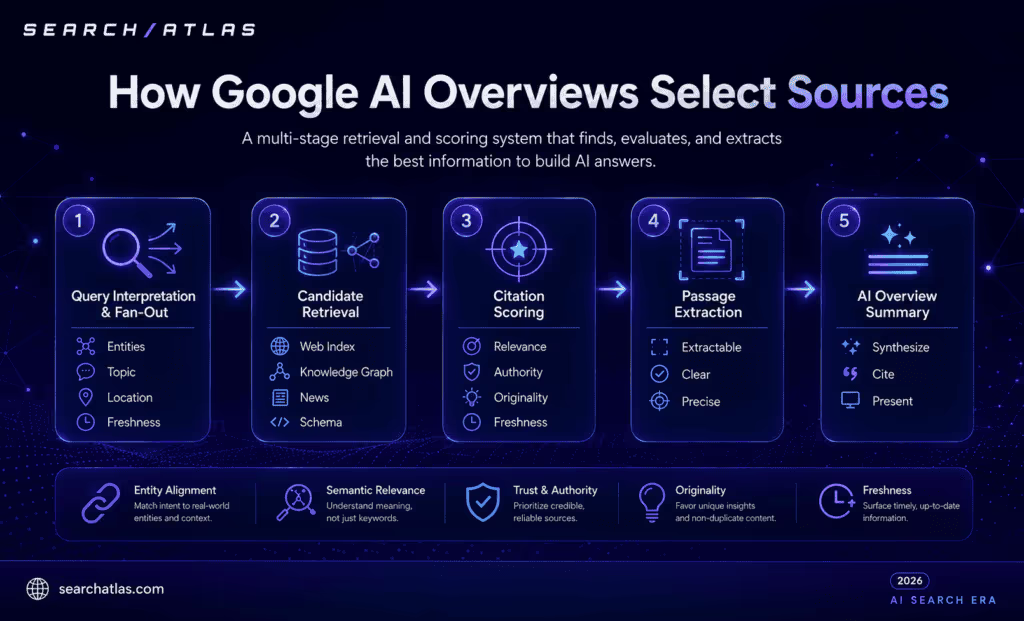
Google AI Overviews selects sources through a multi-stage retrieval and scoring system that analyzes search intent, retrieves candidate pages, evaluates relevance and trust signals, and then extracts passages that best answer the query. Instead of choosing pages only from traditional rankings, Google builds AI summaries from content that matches the query clearly, semantically, and contextually.
The process starts before the AI summary appears. Google first interprets the query, expands it into multiple related searches, retrieves potential sources from different systems, and then evaluates which pages contain the strongest information for the generated response.
1. Query Interpretation and Query Fan Out
Google AI Overviews begin by interpreting the search query. The system analyzes entities, intent, language, location, topical relationships, and freshness signals before retrieving any information. After understanding the query, Google expands it into multiple related searches through a process called query fan-out. Instead of searching only the exact keyword typed by the user, Google generates additional variations and sub-queries connected to the topic.
For example, a search for “best AI SEO tools” can trigger additional retrieval queries related to:
- AI SEO platforms.
- Automated SEO software.
- Agentic SEO tools.
- AI content optimization.
- SEO automation systems.
This retrieval model matches Google patent US20240289407A1, published in August 2024. The patent describes synthetic query expansion, where Google generates related search variations, retrieves documents for each variation, and then combines the results before generating the AI response.
Google AI Overviews retrieve information from multiple systems simultaneously:
- Google’s web index.
- Knowledge Graph.
- Structured data repositories.
- Product feeds.
- Real-time news systems.
These systems act as evidence pools during answer generation. Google collects potential sources from each system before evaluating which pages deserve citation inside the AI summary.
2. Candidate Source Retrieval
After query interpretation, Google retrieves a large pool of possible source pages. This stage works as a filtering process where Google narrows thousands of pages into a smaller candidate set for evaluation.
Google evaluates candidate pages across 3 main relevance areas:
- Query relevance.
- Location and language relevance.
- Document relevance to the generated response.
Query relevance measures how closely the page matches the interpreted intent and expanded sub-queries. Google’s patent references historical “selection rate” signals, which suggest previous retrieval performance and engagement patterns influence future visibility.
Location and language relevance determine whether the source fits the geographic and linguistic context of the search. Local publishers and region-specific content gain stronger visibility for geo-sensitive searches.
Document-level relevance evaluates how well the page supports the final AI-generated response itself, not only the original search query. This matters because AI Overviews build synthesized answers instead of displaying simple blue-link rankings.
Google increasingly favors original-source content during retrieval. The March 2026 Core Update shifted visibility away from aggregator pages that summarize third-party information. Original publishers, first-party research, manufacturer pages, government resources, and firsthand studies gained stronger retrieval visibility after the update.
3. Candidate Source Scoring and Citation Signals
After retrieval, Google evaluates candidate pages using multiple citation and scoring signals before selecting which sources appear inside the AI Overview.
- Passage relevance.
- Entity alignment.
- Content freshness.
- Source originality.
Passage relevance measures how directly a section answers the sub-query generated during retrieval. AI systems prefer content that answers questions clearly without excessive introductions or unrelated information.
Entity alignment strongly influences citation selection. Google matches entities between the query, sub-query expansions, and page content. Strong entity SEO improves retrieval eligibility because pages that repeatedly define and expand important entities across multiple sections create stronger semantic relationships during AI retrieval.
For example, a page about “OTTO SEO” that explains features, integrations, automation workflows, and use cases creates stronger entity coverage than a page mentioning the term only once.
Freshness matters heavily for rapidly changing topics such as AI systems, products, regulations, and news. Recently updated pages often gain stronger visibility for freshness-sensitive searches.
Structured data is not on that list. Google's AI features guidance sets no schema requirement for AI Overviews, and Search Atlas research on schema coverage found that more schema did not reliably lead to higher LLM visibility.
Traditional authority signals alone do not fully determine citation selection. Research from Search Atlas in the report Authority Metrics in the Age of LLMs: Visibility Correlation Analysis, which analyzed 21,767 domains and measured competition-tier effects across 368,972 domains, found weak negative correlations between traditional authority metrics and LLM visibility. This suggests AI systems weigh content quality, entity clarity, and informational value more heavily than backlink-based authority.
Original-source ownership became one of the strongest citation signals after the March 2026 Core Update. Google increasingly favors pages that own the original information instead of pages summarizing third-party content. This shift increased the importance of topical authority because sites with deep, original coverage around a subject create stronger expertise and trust signals.
Strong internal linking improves citation consistency as well. Internal links reinforce topical depth, improve passage discoverability, and help Google validate sub-topic relationships during retrieval.
4. Passage Extraction and Citation Selection
Google AI Overviews cite passages, not entire pages. The system extracts small sections that independently answer the query clearly and contextually. Passage-level extractability became one of the most important AIO concepts because Google prioritizes concise, self-contained sections during synthesis.
Strong extraction targets usually contain:
- A direct answer near the beginning.
- A clearly defined entity.
- Supporting context.
- A verifiable detail, statistic, source, or example.
Pages that delay the answer behind storytelling, long introductions, or marketing language often lose extraction opportunities even when they rank strongly in organic search. Google’s passage ranking system, introduced in 2021, reinforced this retrieval model by allowing individual sections inside long-form content to rank independently for highly specific queries.
Industry analyses between 2025 and 2026 observed that many cited AI Overview passages ranged between roughly 134 and 167 words. Google has never confirmed an official extraction length, but observed patterns suggest that extremely short passages lack context while very long sections reduce extractability.
The most effective AI Overview passages follow a consistent structure:
- Answer the query immediately.
- Expand the explanation clearly.
- Add supporting evidence or context.
- Transition naturally into the next topic.
This structure aligns closely with how Google retrieves and synthesizes information during AI answer generation.
5. Source Selection Changes After the March 2026 Core Update
The March 2026 Core Update significantly changed how Google AI Overviews select sources. The update shifted citation visibility away from intermediary aggregators and toward original destination sources.
Pages that own the original information gained stronger visibility after the rollout. This included:
- Original research publishers.
- Manufacturer pages.
- Government resources.
- Firsthand studies.
- First-party product documentation.
Aggregator websites that republish or summarize third-party information lost citation share during the update. The rollout increased the separation between traditional rankings and AI Overview citations.
This shift confirmed that AI Overview retrieval increasingly follows a separate scoring system focused on source quality, passage extraction, entity clarity, and information ownership rather than traditional ranking position alone.
How Is AIO Different From Traditional SEO and GEO?
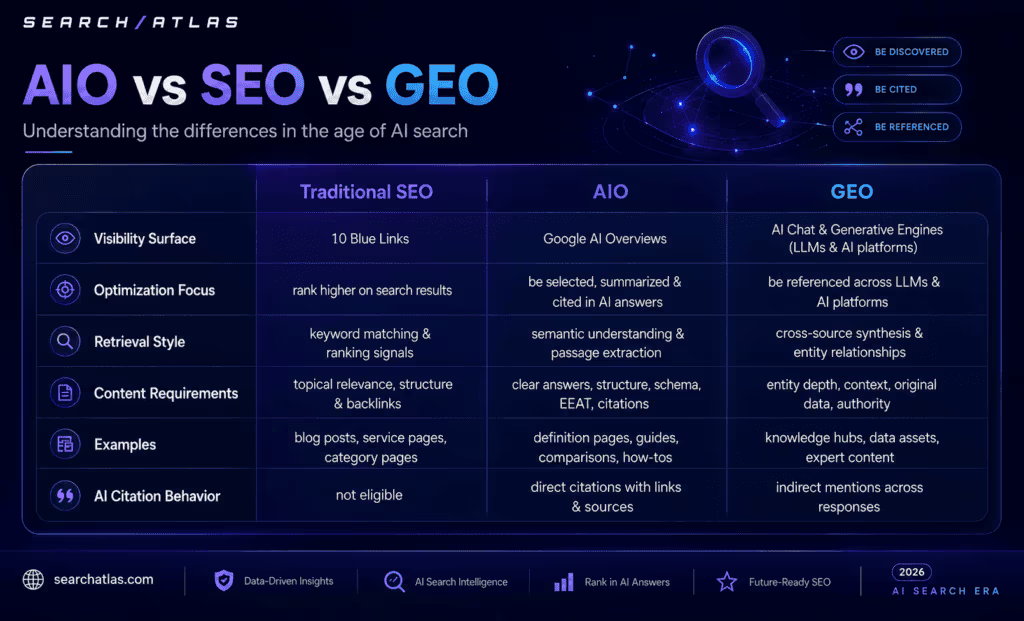
AIO differs from traditional SEO and GEO because each discipline optimizes for a different visibility outcome. Traditional SEO focuses on ranking webpages in Google’s organic search results. AIO focuses on earning citations and inclusion inside Google AI Overviews. GEO focuses on increasing visibility across generative AI platforms (OpenAI ChatGPT, Google Gemini, and Perplexity).
These approaches overlap in some areas because all of them rely on strong content quality, topical relevance, trust signals, and technical optimization. The main difference comes from how search systems retrieve, evaluate, and present information to users.
AIO vs Traditional SEO
AIO and traditional SEO optimize for different visibility surfaces inside Google Search. Traditional SEO focuses on improving rankings in organic search listings, while AIO focuses on becoming part of Google’s AI-generated summaries.
Traditional SEO mainly evaluates:
- Technical SEO.
- Backlinks.
- Keyword relevance.
- Crawlability.
- Ranking authority.
AIO evaluates how easily AI systems can interpret, extract, summarize, and cite information from the page. Google AI Overviews prioritize content that answers questions clearly, organizes information logically, and explains entities with strong contextual depth.
AIO focuses more heavily on passage-level clarity because Google extracts smaller sections instead of displaying the whole page directly. Traditional SEO often optimizes entire pages for ranking positions.
AIO optimization typically prioritizes:
- Direct answer formatting.
- Semantic relevance.
- Entity relationships.
- Structured content hierarchy.
- Contextual completeness.
Traditional SEO still matters because AI systems retrieve information from indexed webpages. At the same time, strong rankings alone do not guarantee AI Overview visibility because Google evaluates citation usefulness separately from standard ranking position.
| Factor | Traditional SEO | AIO |
| Main Goal | Rank pages in organic search results. | Get cited inside AI Overviews. |
| Visibility Surface | Blue links on the SERP. | AI-generated summaries. |
| Main Optimization Focus | Rankings and traffic. | Citations and AI visibility. |
| Content Evaluation | Full-page ranking signals. | Passage-level extractability. |
| Retrieval Style | Document ranking. | AI retrieval and synthesis. |
AIO vs GEO
AIO and GEO both optimize content for AI-driven search experiences, but they target different ecosystems and retrieval systems.
Generative Engine Optimization (GEO) focuses on increasing visibility across AI platforms that generate conversational responses, summaries, and citations. These platforms include ChatGPT, Perplexity, Claude, Gemini, and other generative AI systems.
AIO works as a Google-specific branch of GEO. Instead of optimizing broadly across AI systems, AIO focuses specifically on how Google AI Overviews retrieve, interpret, summarize, and cite webpages.
GEO strategies usually prioritize:
- Multi-platform AI visibility.
- Conversational answer optimization.
- Citation consistency across AI systems.
- Broad semantic understanding.
AIO strategies focus more heavily on:
- Google AI Overview citations.
- Google entity relationships.
- structured search signals.
- AI Overview extractability.
- Google retrieval behavior.
Google AI Overviews rely heavily on Google-native systems such as the Knowledge Graph, structured data parsing, search indexing signals, and Gemini retrieval systems. Other generative engines use different retrieval methods, training systems, and citation behaviors.
| Factor | GEO | AIO |
| Main Goal | Visibility across AI platforms. | Visibility inside Google AI Overviews. |
| Platforms | ChatGPT, Claude, Perplexity, Gemini. | Google Search AI Overviews. |
| Scope | Multi-platform optimization. | Google-specific optimization. |
| Retrieval Systems | Varies by platform. | Google retrieval systems. |
| Main Focus | AI citations broadly. | AI Overview citations specifically. |
AI Overviews vs AI Mode
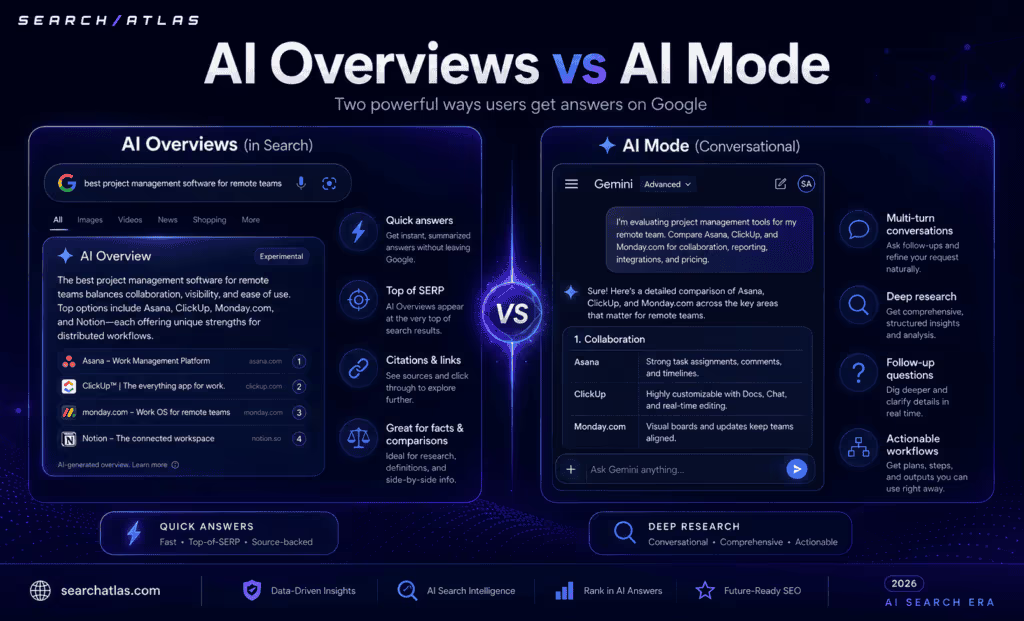
AI Overviews and AI Mode are both Google AI-powered search experiences, but they function differently and target different user behaviors.
AI Overviews appear directly inside the standard Google Search results page. Google automatically generates these summaries for selected searches and places them above the organic listings.
AI Mode works as a dedicated conversational search environment powered by Gemini. Users enter AI Mode intentionally and interact through longer conversations, follow-up prompts, and deeper exploratory searches.
AI Overviews usually answer:
- Simple informational searches.
- Quick comparisons.
- Definitions.
- Short explanations.
AI Mode handles more complex workflows, such as:
- Multi-step research.
- Layered comparisons.
- Planning tasks.
- Exploratory questions.
- Extended conversations.
Optimization behavior changes between the two systems. AI Overviews prioritize concise extractable passages, while AI Mode favors broader topical coverage and conversational depth across multiple related subtopics.
| Factor | AI Overviews | AI Mode |
| Interface | Standard Google Search. | Dedicated AI conversation tab. |
| Response Type | Short summaries. | Multi-turn conversations. |
| User Intent | Quick answers. | Deep research and exploration. |
| Content Preference | Concise extractable passages. | Broader contextual coverage. |
| Optimization Focus | Summary-ready passages. | Conversational topic depth. |
2026 GEO Research and Multi-Agent Optimization Systems
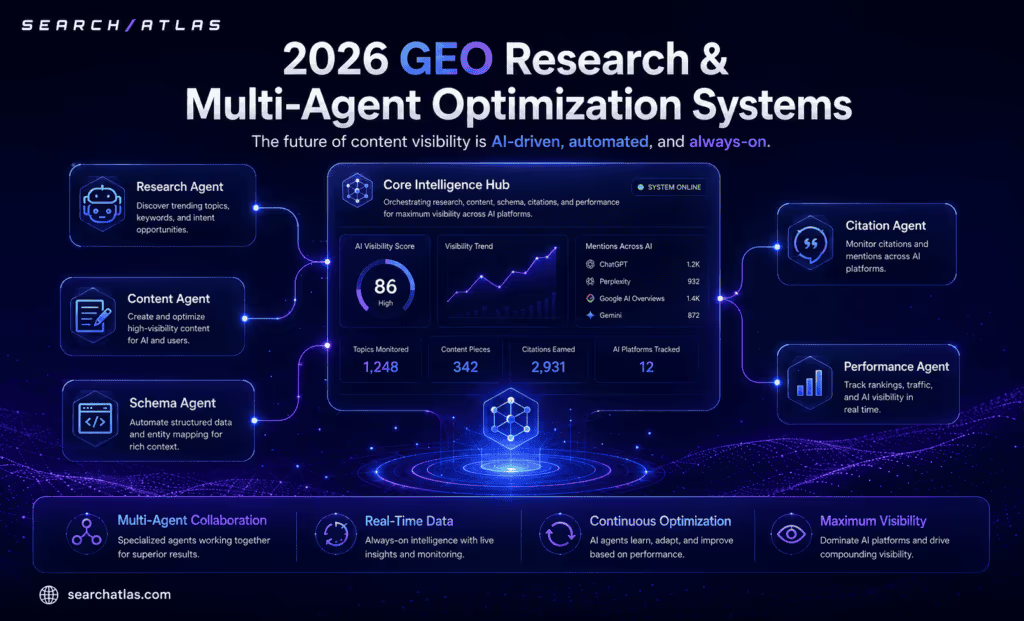
2026 GEO research shifted from basic optimization tactics into measurable, AI-driven optimization systems. New studies focused on how AI platforms retrieve information, absorb source content, and automate optimization strategies across generative search environments.
One of the most important developments came from the preprint From Citation Selection to Citation Absorption. The research introduced a framework for measuring not only whether an AI system cites a page, but how much the page actually influences the generated response.
This distinction matters because visibility inside AI systems no longer depends only on citations. AI engines increasingly paraphrase, summarize, and absorb information directly into the response itself. A page can shape the answer heavily even when the citation visibility remains small.
The framework formalized what many publishers observed during the rise of zero-click AI search experiences between 2024 and 2025. AI systems increasingly use webpage information directly inside generated answers, which changes how traffic, attribution, and visibility work online.
Another major 2026 development reframed GEO as a multi-agent optimization system instead of a static checklist. AI agents continuously test, refine, and reuse successful optimization strategies across pages, queries, and AI platforms.
This direction aligns closely with the growth of agentic marketing systems in 2026. Agentic marketing platforms increasingly rely on specialized AI agents that analyze performance, deploy optimizations, evaluate outcomes, and continuously refine strategies without requiring fully manual workflows.
The same shift is happening inside GEO and AIO. Optimization increasingly works as a continuous execution system where AI agents improve semantic structure, entity relationships, extractable passages, and citation readiness across entire websites.
2026 research strongly suggests that multi-agent optimization systems will become a core part of AI visibility strategies as search environments continue shifting toward generative AI experiences.
What GEO Research Reveals About AI Overview Optimization?
GEO research reveals that Google AI Overviews favor content that AI systems can easily extract, verify, summarize, and attribute. Many citation behaviors observed across ChatGPT, Perplexity, Claude, and Gemini appear consistently inside Google AI Overviews as well.
One of the strongest GEO findings involves extractable passage structure. AI systems consistently prefer passages that answer questions immediately, define entities clearly, and include supporting evidence close to the main statement.
Research across GEO systems showed that 3 optimization tactics repeatedly improved citation visibility:
- Statistics paired with attributed sources.
- Direct quotations from named experts.
- Inline citations connected directly to claims.
For example, a sentence explaining a concept followed immediately by “according to Google patent US20240289407A1” creates stronger extraction confidence than the same statement without attribution.
GEO research also reinforces the importance of semantic clarity. Pages with strong entity definitions, structured hierarchy, and consistent topical relationships perform better because generative systems retrieve information through contextual understanding instead of simple keyword matching.
The biggest takeaway from GEO research is that AI visibility increasingly depends on how understandable, reusable, and trustworthy the content becomes for AI retrieval systems. Modern optimization now focuses less on isolated keywords and more on building information architectures that AI systems can confidently interpret and reuse inside generated answers.
What Do Search Atlas Studies Show About AI and AIO Citation Behavior?
Search Atlas studies show that AI search visibility behaves differently from traditional Google rankings. Research across Google AI Overviews, ChatGPT, Gemini, Claude, and Perplexity found that AI systems retrieve, rank, and cite content using different retrieval patterns, entity relationships, and citation behaviors.
The Search Atlas LLM-SERP Overlap Study analyzed 18,377 semantically matched query pairs between Google Search and generative AI systems. The research found that the overlap between AI platforms and Google Search remained surprisingly low.
Perplexity showed the strongest alignment with Google results, overlapping roughly 25% to 30% on domains and about 20% on URLs. ChatGPT and Gemini showed significantly lower overlap, remaining below 15% on domains and below 10% on URLs.
These findings revealed that AI systems do not simply copy Google rankings. Each platform retrieves and prioritizes information differently based on its own retrieval architecture, reasoning systems, and citation models.
This matters for AIO because visibility inside one AI platform does not automatically transfer to another. A page cited heavily inside Google AI Overviews can receive limited visibility inside ChatGPT or Perplexity, while other pages can perform strongly across conversational AI systems but struggle inside Google Search.
Another Search Atlas study analyzed 21,767 domains across Domain Power, Domain Authority, and Domain Rating metrics to measure how traditional authority signals correlate with AI citation visibility. The research was later expanded to 368,972 domains to evaluate citation behavior across different competition tiers.
The study found weak negative correlations between legacy authority metrics and AI visibility. Strong backlink profiles and high traditional authority scores alone did not consistently predict LLM visibility.
These findings suggest that AI systems evaluate content differently from traditional ranking algorithms. Instead of relying primarily on backlink-driven authority, AI retrieval systems place stronger emphasis on:
- Entity clarity.
- Semantic relevance.
- Passage extractability.
- Topical depth.
- Informational usefulness.
- Citation-ready structure.
This shift reflects a broader industry change happening across AI search systems. Visibility increasingly depends on how useful, understandable, and reusable information becomes for AI retrieval and synthesis systems rather than only how strongly a page ranks in traditional organic search.
How Do You Measure AI Overview Visibility?
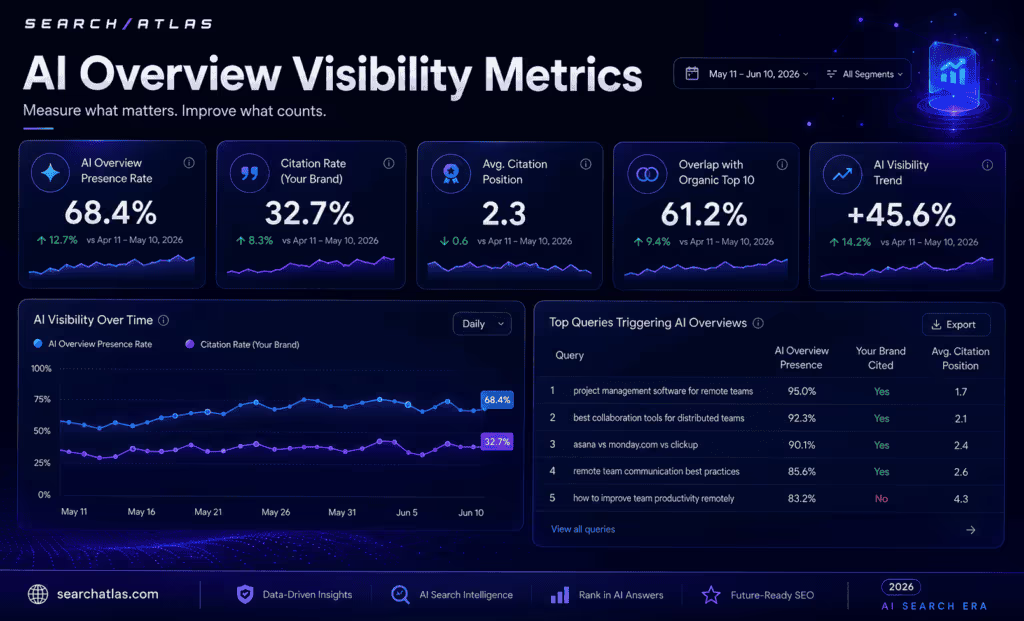
Dashboard showing AI overview and SEO performance metrics.
AI Overview visibility is measured through citation tracking, query monitoring, and AI search visibility analysis across generative search environments. Google includes AI Overview and AI Mode appearances in the overall Search Console data, reported in the Performance report under the "Web" search type. Google's documentation describes no separate AI Overview report, so publishers rely on sampled query tracking to see which pages AI Overviews cite.
Most AIO tracking systems work by running predefined keyword sets against Google Search daily, capturing the AI Overview output, then extracting and analyzing the cited URLs inside the generated summary.
This process does not provide impression-level Google data. Instead, it creates proxy visibility tracking that reveals how often a brand, page, or domain appears inside AI-generated answers across monitored queries.
Modern AIO measurement focuses on 4 core metrics.
1. AI Overview Presence Rate
AI Overview presence rate measures how often Google triggers an AI Overview for a tracked query set. Not every search generates an AI Overview. Trigger frequency changes constantly across industries, query types, devices, and Google updates.
Tracking presence rate helps identify:
- Which query categories trigger AI summaries most often?
- Where AI visibility opportunities exist.
- Where traditional rankings still dominate the search results.
Presence-rate monitoring becomes especially important during major Google updates because AI Overview behavior shifts frequently across industries.
2. Citation Rate
Citation rate measures how often a domain appears as a cited source inside AI Overviews. This metric reveals whether Google considers the brand trustworthy, extractable, and relevant enough for AI-generated summaries.
Citation rate tracking helps publishers understand:
- Which pages earn citations consistently?
- Which competitors dominate AI visibility?
- Which topics perform best inside AI search experiences?
Strong citation rates often correlate with clear entity coverage, strong semantic structure, destination-source authority, and extractable answer formatting.
3. Citation Position
Citation position measures where the source appears inside the AI Overview citation list. Higher citation placement often creates stronger visibility and higher engagement because users tend to interact more frequently with the first cited sources displayed inside the AI-generated summary.
Tracking citation position helps identify:
- High-authority AI-visible pages.
- Declining citation strength.
- Competitor movement across AI search surfaces.
This metric becomes increasingly important for commercial and competitive queries where multiple brands compete for limited AI citation space.
4. Citation Overlap With Organic Rankings
Citation overlap compares AI Overview citations against traditional organic rankings. This metric helps identify pages that earn AI visibility even without ranking strongly in standard Google search results.
High overlap often indicates strong traditional SEO alignment. Low overlap reveals pages that perform better inside AI retrieval systems than inside traditional ranking systems.
This comparison helps publishers isolate:
- AI-first visibility opportunities.
- Content optimized for AI retrieval.
- Pages succeeding through semantic relevance instead of traditional rankings.
How Do LLM Visibility Platforms Measure AI Search Visibility?
LLM visibility platforms extend AI tracking beyond Google AI Overviews into systems like ChatGPT, Claude, Gemini, and Perplexity.
These platforms track:
- Brand mentions.
- AI citations.
- Sentiment patterns.
- Share of voice.
- Topic-level visibility.
- Cross-platform AI performance.
Search Atlas LLM Visibility monitors AI search visibility across multiple generative engines from one centralized platform. Search Atlas LLM Visibility tracks citation frequency, AI brand mentions, response sentiment, and competitive visibility patterns across AI-generated search environments.
This matters because AI visibility increasingly extends beyond Google Search into AI assistants, answer engines, and conversational interfaces, where traditional ranking reports provide limited visibility data.
What Are the Best AI Overview Optimization Tools?
The best AI Overview Optimization tools help websites improve visibility inside Google AI Overviews through content optimization, entity analysis, AI visibility tracking, and semantic search optimization. Modern AIO tools increasingly combine traditional SEO data with AI retrieval insights to measure how generative systems interpret, summarize, and cite content.
Five options come up most often for AI Overview Optimization: the Search Atlas platform and four free Google and Schema.org tools.
1. Search Atlas
Search Atlas is an agentic AI marketing platform that runs SEO, AEO, Google Ads, Meta Ads, content, and site health on its own. For AIO, it brings technical fixes, content production, and AI visibility tracking into one place, then reports what changed.
Search Atlas differs from traditional SEO platforms because it operates as an agentic marketing system instead of only a reporting platform. The system analyzes, prioritizes, and deploys optimizations directly across websites, content, internal links, schema, and AI search visibility workflows.
Several Search Atlas systems directly support AIO workflows.
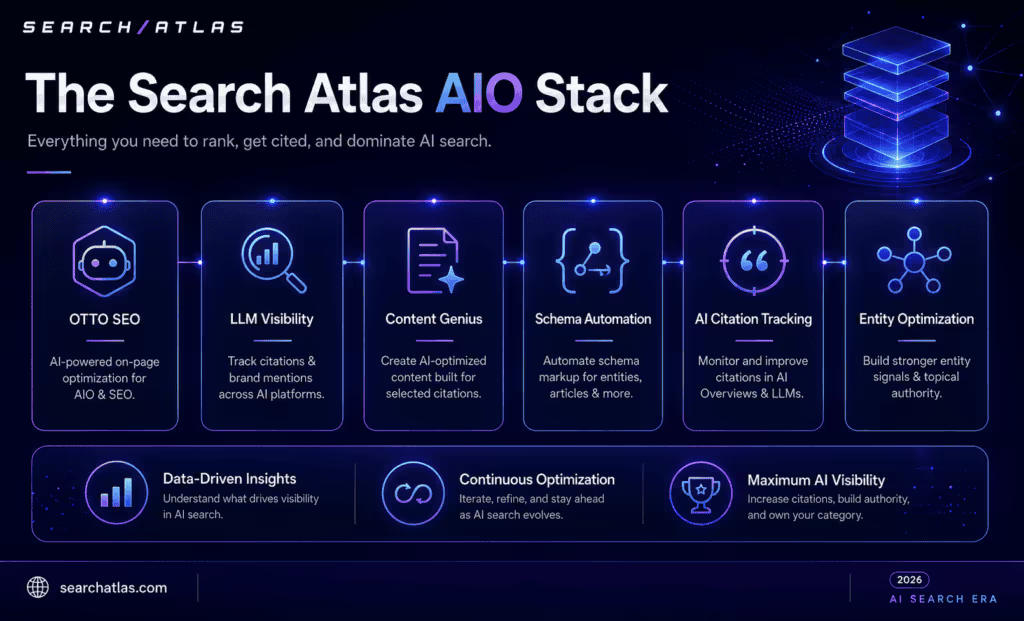
Search Atlas runs content analysis and AI visibility tracking for AIO work.
OTTO SEO
OTTO SEO acts as an autonomous SEO execution engine that automatically applies technical optimizations directly on the website. OTTO SEO automates:
- Schema implementation.
- Meta tag optimization.
- Internal linking.
- Technical SEO fixes.
- Entity reinforcement.
- On-page optimization workflows.
This matters for AIO because Google can only cite a page it can crawl and index with a snippet. OTTO ships technical fixes through the OTTO Pixel, with approval controls and a change log that lets you roll back any change.
LLM Visibility
The LLM Visibility feature tracks how AI assistants mention and cite a brand. The system monitors:
- AI citations.
- Brand mentions.
- Sentiment patterns.
- Share of voice.
- AI visibility trends.
- Cross-platform citation behavior.
This allows publishers to measure how frequently AI systems cite or mention their content across generative search environments.
Content Genius
Content Genius generates and optimizes content using real-time SERP, entity, and semantic analysis. The platform helps structure content around:
- Semantic entities.
- topical relationships.
- AI-friendly passage formatting.
- extractable answer blocks.
- citation-ready structure.
This improves how AI systems interpret and summarize information inside AI-generated answers.
2. Google Search Console
Google Search Console provides direct Google Search performance data. Google counts AI Overview and AI Mode appearances inside the Performance report's "Web" search type, and its documentation describes no separate AI Overview report. Publishers use it to spot visibility shifts, impression growth and query trends, and to find pages that gain or lose performance after AI Overview rollouts and Google updates.
3. Google Analytics
Google Analytics 4 measures user behavior after visitors arrive from AI-influenced search experiences. The platform helps analyze engagement quality, session depth, conversion patterns, traffic changes, and content interaction behavior.
This matters because AI-generated summaries increasingly shape user expectations before the click happens. Understanding post-click behavior helps publishers evaluate whether AI-visible pages still generate meaningful engagement and conversions.
GA4 has a built-in "AI Assistant" default channel, added on May 13, 2026, for visits with the medium ai-assistant. That channel excludes Google AI Overviews and AI Mode, so AI Overview visits do not appear in it. Google also reports that clicks from results pages with AI Overviews are higher quality, meaning visitors are more likely to spend more time on the site.
4. Google Trends
Google Trends helps identify emerging topics, rising entities, and changing search-interest patterns connected to AI-generated search behavior.
AI Overviews frequently trigger on informational, exploratory, and trend-driven searches. Google Trends helps publishers discover growing topics before competition increases and allows content teams to align pages with rising search demand and entity growth patterns.
5. Schema Markup Validator
Schema Markup Validator checks whether the structured data on a page is valid. For AIO, its job is accuracy: Google's AI features guidance asks that structured data match the visible text on the page, while Search Atlas research found that more schema coverage does not reliably raise LLM visibility.
The validator confirms that schema types such as Article, FAQPage, HowTo, Organization, Person, and Product parse without errors and describe what the page shows.
AIO FAQ
- How Do You Optimize Content for Google AI Overviews?
Make the page indexable with a snippet, answer each question in the first sentence of its section, cite sources inline, and track which pages Google cites. Google says AI Overviews need no special optimization beyond SEO best practices, and the eight steps at the top of this guide show how to apply them.
- What Is AIO?
AIO is the process of optimizing content to appear inside Google AI Overviews. The goal of AIO is to increase visibility, citations, and brand presence inside Google’s AI-generated search summaries that appear above traditional search results.
- When Did Google AI Overviews Launch?
Google AI Overviews launched publicly on May 14, 2024. Google introduced the feature during Google I/O and replaced the earlier Search Generative Experience (SGE) program that operated throughout 2023 and early 2024.
- Did the March 2026 Core Update Change AIO?
Yes, the March 2026 Core Update changed AI Overview citation behavior significantly. Google increased visibility for destination sources that publish original information and reduced visibility for aggregator pages that primarily summarize third-party content.
- Does FAQPage Schema Improve AI Overview Visibility?
Not reliably. Google sets no schema requirement for AI Overviews, and Search Atlas research found that higher schema coverage did not reliably lead to higher LLM visibility. Google's AI features guidance asks only that structured data match the visible text on the page. Write the questions and answers as visible text first, then mark them up if you use FAQPage schema.
- Does llms.txt Improve AIO Performance?
No, llms.txt does not improve AI Overview visibility today. Google representatives stated that Google AI systems do not use llms.txt for retrieval, and crawler studies found limited adoption across AI platforms.
- How Is AIO Different From GEO?
AIO differs from GEO because AIO focuses only on Google AI Overviews. GEO covers visibility across generative AI platforms such as ChatGPT, Claude, Gemini, and Perplexity, making AIO a Google specific branch of GEO.
- Do Organic Rankings Still Matter for AIO?
Yes, organic rankings still matter for AIO because Google retrieves information from indexed webpages. Strong rankings alone do not guarantee AI Overview citations because Google evaluates extractability, semantic clarity, and source usefulness separately.
- What Is the Most Important AIO Tactic in 2026?
One of the most important AIO tactics in 2026 is creating destination source content with definition first answers. Pages that publish original research, firsthand expertise, proprietary information, or attributed insights receive stronger citation visibility.
- What Model Powers Google AI Mode in 2026?
Google AI Mode runs on Gemini 3 Flash globally as of April 2026. Google replaced earlier Gemini 3 Pro implementations and expanded conversational AI search capabilities across AI-powered search experiences.