AI search bots crawl websites to collect, retrieve, and process content for AI systems. AI search bots include training crawlers that gather content for language model development and retrieval crawlers that index content for AI-generated answers and AI search results. This distinction explains how AI search bots work and why different crawler types require different access policies.
AI search bots matter because they determine how content enters AI ecosystems. Training crawlers influence whether content contributes to future language models, while retrieval crawlers influence whether content appears in AI-generated answers. These functions create separate visibility outcomes, which means AI bot access decisions directly affect how AI platforms discover and use website content.
AI search bots operate by default on most websites because major AI platforms continuously crawl the public web. Websites that do not publish crawler restrictions generally remain accessible to AI crawlers. This default access means many websites already contribute content to AI training systems, AI search indexes, or both without explicit configuration changes.
AI search bots require active management through robots.txt directives, page-level controls, and crawl monitoring systems. Effective AI bot management identifies active crawlers, separates training policies from retrieval policies, and verifies crawler compliance after configuration changes. This process gives website owners direct control over how AI platforms access, index, and use their content while preserving visibility where visibility remains valuable.
What Are AI Search Bots?
AI search bots are automated crawlers that collect, index, and process web content for AI systems. AI search bots supply information to large language models, AI search engines, and answer generation systems. AI search bots determine how AI platforms discover content, evaluate sources, and retrieve information for generated answers. Website owners monitor AI search bots because bot activity influences AI visibility, content attribution, and inclusion in AI-generated responses.
What do retrieval crawlers do? Retrieval crawlers create searchable indexes that AI systems access during answer generation. Retrieval crawlers influence whether content appears inside AI-generated answers on platforms (OpenAI ChatGPT, Perplexity AI, and Anthropic Claude. Content visibility depends on retrieval indexing because indexed content remains available for citation, summarization, and answer construction.
Why do AI search bots matter for AI visibility? AI search bots control the flow of information between websites and AI systems. AI search bots determine whether content becomes available for training, retrieval, citation, or answer generation. Brands that understand AI search bots gain greater control over AI visibility because visibility depends on whether AI systems discover, access, and process their content. The role of AI search bots continues to expand as AI platforms launch new search products, assistants, and answer engines.
Which AI Bots Are Currently Crawling Websites?
AI bots currently crawling websites include training crawlers, retrieval crawlers, user-triggered fetch bots, and AI training control tokens. These AI bots collect content for model training, retrieve content for AI-generated answers, validate AI search results, or control how AI platforms use web content. AI bot activity continues to expand because major AI platforms increasingly depend on web data for search, retrieval, and model development.
The 13 main documented AI bots and AI crawling systems active as of June 2026 are listed below.
- GPTBot/1.3 (OpenAI). GPTBot collects web content for OpenAI language model training. The crawler contributes data for model development and knowledge updates. Blocking GPTBot prevents content from entering OpenAI’s training pipeline.
- OAI SearchBot/1.3 (OpenAI). OAI SearchBot indexes content for real-time search inside ChatGPT. The crawler influences whether pages appear in ChatGPT search results and AI-generated answers. Blocking OAI SearchBot reduces visibility inside ChatGPT search experiences.
- ChatGPT User/1.0 (OpenAI). ChatGPT User performs page fetches initiated by user actions. OpenAI documentation states this bot does not consistently follow robots.txt directives. The fetch mechanism retrieves content requested during specific ChatGPT interactions.
- OAI AdsBot/1.0 (OpenAI). OAI AdsBot validates landing page quality and advertising safety. The bot performs advertising-related verification rather than training or retrieval functions. Content visibility inside AI answers does not depend on OAI AdsBot.
- ClaudeBot/1.0 (Anthropic). ClaudeBot collects web content for Anthropic model training. The crawler contributes information used to develop Claude language models. Blocking ClaudeBot prevents content from entering Anthropic training datasets.
- Claude User/1.0 (Anthropic). Claude User performs user-initiated page retrieval. The bot accesses content requested through Claude interactions. The retrieval process differs from model training and search indexing functions.
- Claude SearchBot/1.0 (Anthropic). Claude SearchBot indexes content for Claude search features. The crawler determines what content becomes available for search-based responses. Search visibility inside Claude depends on successful indexing.
- PerplexityBot/1.0 (Perplexity). PerplexityBot indexes content for real-time AI search results. The crawler retrieves content that appears inside Perplexity answers and citations. Blocking PerplexityBot limits visibility within Perplexity’s answer engine.
- Perplexity User/1.0 (Perplexity). Perplexity User performs user-triggered content retrieval. Perplexity documentation states this bot does not honor robots.txt directives. The retrieval process occurs in response to specific user requests.
- Google Extended (Google). Google Extended functions as an AI training control token rather than a standalone crawler. The token determines whether Googlebot-collected content enters Gemini and Vertex AI training systems. The token controls training permissions without introducing a separate user agent.
- Applebot Extended (Apple). Applebot Extended functions as an AI training control token for Apple Intelligence. The token determines whether Applebot-collected content enters Apple model training workflows. The token manages training permissions rather than content collection.
- meta externalagent/1.1 (Meta). Meta externalagent collects content for LLaMA model training. Meta documentation states the crawler honors robots.txt directives. The crawler contributes web content to Meta’s AI development efforts.
- MistralAI Index/1.0 (Mistral). MistralAI Index retrieves and indexes content for Mistral search products. Mistral documentation states the crawler does not collect content for generative AI training. The crawler focuses on retrieval and search functionality.
Which additional AI bots appear on websites? Several additional AI bots appear in server logs but have less documented behavior. Amazonbot/0.1 collects content that Amazon states contributes to AI model training. DuckAssistBot/1.2 indexes content for DuckAssist AI answers and does not participate in AI model training. Bytespider from ByteDance frequently appears in server logs, but ByteDance has not published official crawler documentation or compliance policies.
Which AI platforms do not have documented crawlers? xAI has not published official crawler documentation as of June 2026. The absence of crawler documentation creates uncertainty around crawling behavior, retrieval policies, and robots.txt compliance. Website owners often monitor server logs to identify undocumented AI bot activity as new AI platforms enter the market.
What Is the Difference Between AI Training Crawlers and AI Retrieval Crawlers?
The difference between AI training crawlers and AI retrieval crawlers lies in how they use website content. AI training crawlers collect content for model development, while AI retrieval crawlers index content for real-time answer generation. This distinction determines whether content contributes to future language models or appears inside current AI-generated answers.
The core differences between AI training crawlers and AI retrieval crawlers are below.
| Aspect | AI Training Crawlers | AI Retrieval Crawlers |
| Purpose | Collect content for language model training, fine-tuning, and model improvement. | Index content for retrieval during AI search and answer generation. |
| Primary goal | Expand model knowledge and improve future model capabilities. | Retrieve relevant content for current user queries. |
| Workflow process | Downloads content and adds it to training datasets. | Builds searchable indexes used during answer generation. |
| Key examples | GPTBot, ClaudeBot, Google Extended, Applebot Extended. | OAI SearchBot, Claude SearchBot, PerplexityBot. |
| Impact of blocking | Prevents content from entering future training datasets. | Prevents content from appearing in AI-generated answers. |
| Timing of use | Content contributes during model development cycles. | Content appears during live search and retrieval operations. |
| Relationship | Shapes what an AI model learns. | Shapes what an AI model cites and retrieves. |
What do AI training crawlers do? AI training crawlers collect website content for language model development. The crawler downloads pages and transfers them into training datasets used for model training and model updates. This collection process determines what information becomes part of a model’s knowledge base.
GPTBot provides a common example. GPTBot collects website content and transfers that content into OpenAI’s training infrastructure. The collected content contributes to future model development because the training dataset defines what the model learns.
Google Extended and Applebot Extended function differently. These systems operate as permission tokens rather than independent crawlers. Googlebot and Applebot perform the crawling, while the Extended directives determine whether the collected content qualifies for AI training use. A website remain visible in traditional search while preventing AI training access through these directives.
What do AI retrieval crawlers do? AI retrieval crawlers build searchable indexes that AI platforms access during answer generation. The crawler evaluates pages, stores content references, and makes those references available for retrieval systems. This indexing process determines whether content becomes eligible for AI-generated answers.
PerplexityBot provides a common example. PerplexityBot indexes website content and adds that content to Perplexity’s retrieval system. Indexed pages become eligible for citations, references, and answer generation inside Perplexity responses.
OAI SearchBot operates under the same principle. OAI SearchBot indexes content for ChatGPT search experiences rather than model training. The indexing process determines whether a page appears in AI-generated search results and cited answers.
Why does the difference between training crawlers and retrieval crawlers matter? The difference matters because each crawler type controls a different form of AI visibility. Training crawlers influence model development, while retrieval crawlers influence answer generation. A website owner often wants different rules for each activity.
A company that blocks GPTBot while allowing OAI SearchBot prevents training data collection while preserving visibility inside ChatGPT search results. Separate user agent strings make this approach possible because training access and retrieval access operate independently.
How do AI training crawlers and AI retrieval crawlers work together? AI training crawlers and AI retrieval crawlers operate as separate systems inside the AI content ecosystem. Training crawlers collect information that improves future models, while retrieval crawlers locate information for current answers. The training system shapes what the model knows, and the retrieval system shapes what the model cites.
This distinction creates the foundation of a modern AI visibility strategy. Website owners must evaluate training participation and retrieval participation separately because each decision affects a different stage of the AI content lifecycle.
How to Control Which AI Bots Can Access Your Website
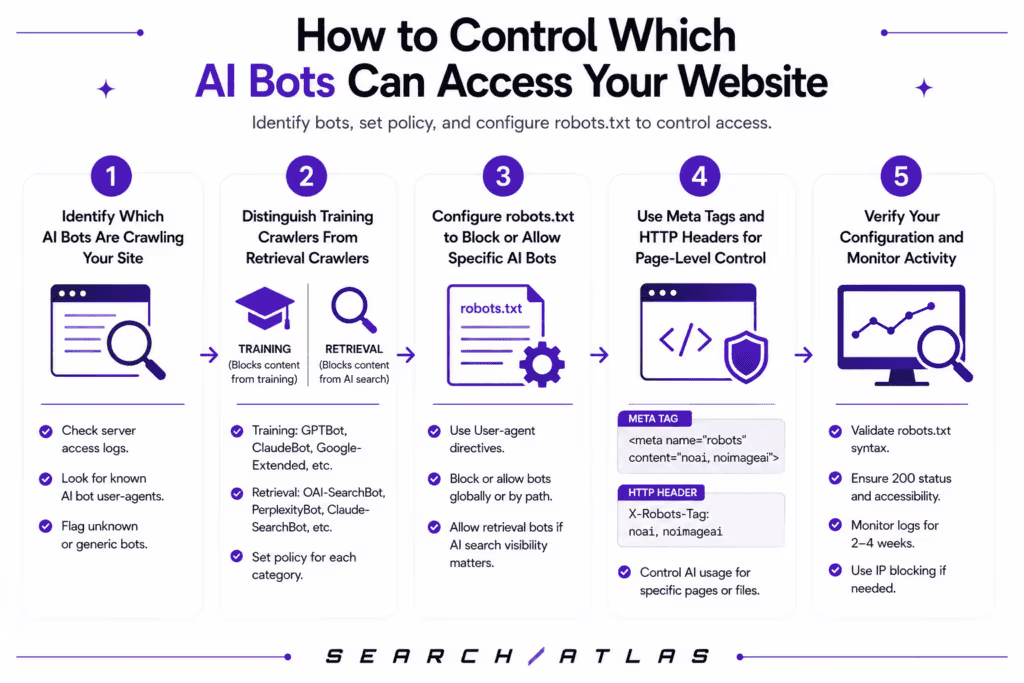
Controlling which AI bots access your website requires identifying active crawlers, separating training crawlers from retrieval crawlers, and applying access rules through robots.txt, meta directives, and monitoring systems. This process matters because different AI bots perform different functions. Some AI bots collect content for model training, while other AI bots index content for AI-generated answers. Effective AI bot management protects content usage rights while preserving AI search visibility where appropriate.
The 5 ways to control which AI bots access your website are listed below.
1. Identify Which AI Bots Are Crawling Your Site
Identifying active AI bots creates the foundation of every AI crawler policy. Server access logs provide the most accurate source of crawler activity because server logs record every HTTP request, user agent string, IP address, and timestamp. Google Analytics does not record bot sessions, which makes server logs the primary source for AI bot discovery.
Businesses review server logs for documented AI crawler user agents (GPTBot, OAI SearchBot, ChatGPT User, ClaudeBot, Claude SearchBot, PerplexityBot, meta externalagent, MistralAI Index, Amazonbot, DuckAssistBot). This review reveals which AI platforms currently access website content. Unknown user agent strings require additional investigation because some crawlers mask their identity or rotate browser-based identifiers. At scale, teams match these known AI-domain user agents with regex patterns rather than reviewing log entries one by one.
Google Extended and Applebot Extended require separate treatment. These directives function as robots.txt tokens rather than standalone crawlers, which means they do not appear as individual user agent strings inside server logs.
2. Distinguish Training Crawlers From Retrieval Crawlers Before Blocking
Distinguishing training crawlers from retrieval crawlers prevents accidental visibility losses. Training crawlers collect content for model development, while retrieval crawlers index content for AI search and answer generation. Each category creates different business implications.
Training crawlers include GPTBot, ClaudeBot, Google Extended, Applebot Extended, meta externalagent, and Amazonbot. Blocking these crawlers prevents content from entering future AI training datasets. This restriction limits model training access without affecting traditional search visibility.
Retrieval crawlers include OAI SearchBot, PerplexityBot, Claude SearchBot, MistralAI Index, and DuckAssistBot. Blocking these crawlers prevents content from appearing inside AI-generated answers, citations, and AI search results. This restriction directly affects AI visibility across answer engines.
A blanket block creates the most restrictive outcome because the block removes content from both AI training systems and AI retrieval systems. Many organizations separate these decisions and apply different policies to each crawler category.
3. Configure robots.txt to Block or Allow Specific AI Bots
. robots.txt provides the primary mechanism for crawler access control. The robots.txt file uses user agent directives that define which crawlers receive access and which crawlers remain blocked. Accurate configuration creates precise control over AI crawler behavior.
A training crawler block typically targets GPTBot, ClaudeBot, Google Extended, Applebot Extended, and the meta external agent individually. Separate directives improve control because each crawler follows its own user agent identifier. Individual rules allow organizations to approve one platform while restricting another.
Directory-level restrictions create additional control. Proprietary research, member-only resources, premium content libraries, and restricted documentation frequently require different access policies than public content. Directory-level directives protect sensitive assets without restricting access across the entire website.
Wildcard directives require careful review. Broad restrictions sometimes block retrieval crawlers unintentionally. Specific allow directives preserve access for retrieval systems that remain important for AI visibility and citation opportunities.
4. Use Meta Tags and HTTP Headers for Page-Level Control
Meta tags and HTTP headers create page-level AI access controls. Page-level controls work best when a website requires different policies for different content assets. This approach avoids site-wide restrictions while maintaining granular control.
The noai directive prevents compliant crawlers from using page content for AI training purposes. The noimageai directive prevents compliant crawlers from using page images for AI training purposes. These directives communicate AI usage preferences directly within page-level metadata.
Businesses frequently apply these directives to proprietary research, gated content, premium resources, and intellectual property assets. The directives preserve search visibility while restricting AI training access.
HTTP headers extend the same functionality to non-HTML assets. PDF documents, image files, downloadable reports, and other file types rely on X Robots Tag directives rather than HTML meta tags. This approach creates consistent policies across all content formats. These are access-control mechanisms; llms.txt solves a different problem by pointing compliant AI systems toward the pages worth reading, rather than blocking or allowing crawl access.
5. Verify Configuration and Monitor Crawl Activity
Verifying the configuration confirms that crawler controls operate correctly. Monitoring crawl activity confirms that crawlers respect those controls over time. Verification prevents accidental access restrictions and identifies non-compliant crawler behavior.
Syntax validation represents the first step. Invalid robots.txt directives create unintended consequences because crawler access depends on accurate formatting. Validation tools identify errors before they affect search or AI visibility.
File accessibility represents the second step. The robots.txt file must remain accessible through the root domain location and return a successful HTTP response. Accessibility failures prevent crawlers from reading published directives.
Server log monitoring represents the third step. Server log reviews reveal whether blocked crawlers continue requesting content after restrictions take effect. Continued crawl activity indicates non-compliance or configuration errors.
IP-level restrictions represent the final escalation step. OpenAI, Anthropic, and Perplexity publish crawler IP ranges that enable network-level blocking. IP restrictions create stronger enforcement when crawler directives fail to stop unwanted access.
What Are the Best Practices for Managing AI Bot Access?
Managing AI bot access requires a structured policy that separates crawler functions, monitors crawler behavior, and updates controls as the AI ecosystem evolves. This process matters because AI crawler activity changes rapidly, compliance varies by platform, and incorrect configurations often remove content from AI search results unintentionally. Effective AI bot management protects content rights while preserving visibility across AI search and answer engines.
The 6 best practices for managing AI bot access are listed below.
1. Separate Training Crawler Policies From Retrieval Crawler Policies
Separate policies create clearer crawler management and reduce configuration mistakes. Training crawlers collect content for model development, while retrieval crawlers index content for AI-generated answers. Each crawler category requires different business decisions because each category affects a different form of AI visibility.
Organizations structure robots.txt files with dedicated sections for training crawlers and retrieval crawlers. This structure simplifies maintenance because policy decisions remain organized and visible. Future updates become easier because administrators review one crawler category without affecting the other.
A structured robots.txt file reduces the risk of accidentally blocking retrieval crawlers that drive AI search visibility. Clear separation improves governance and creates a more maintainable AI crawl policy.
2. Keep robots.txt Updated as New AI Bots Appear
Regular updates prevent new AI crawlers from operating without review. The AI crawler landscape changes rapidly because AI platforms continuously launch new search products, retrieval systems, and language models. New crawlers often appear before formal announcements or documentation.
A quarterly review cycle creates a repeatable update process. Website administrators review server logs, identify new user agent strings, compare findings against documented AI crawlers, and update robots.txt policies where necessary. This review process keeps crawler policies aligned with current AI platform activity.
Regular reviews prevent unmanaged crawler access and maintain visibility into evolving AI traffic patterns.
3. Use Server Logs to Detect Unknown AI Crawlers
Server logs provide the most reliable source of crawler intelligence. robots.txt directives only affect crawlers that identify themselves accurately and choose to comply. Server logs reveal every request regardless of crawler transparency.
Organizations create monitoring rules that flag unknown user agent strings. This process identifies undocumented crawlers, browser impersonation attempts, and partially compliant AI bots. The monitoring process reveals crawler activity that robots.txt alone cannot detect.
Unknown crawler discovery becomes increasingly important because AI platforms continue introducing new retrieval systems and automated agents.
4. Verify That AI Bots Honor Your Directives
Directive verification confirms whether crawlers respect published policies. robots.txt functions as a voluntary standard rather than a technical enforcement mechanism. Compliance depends on crawler behavior rather than technical restrictions.
Organizations monitor server logs for 2 to 4 weeks after implementing crawler restrictions. Continued requests from blocked user agents indicate noncompliance or configuration issues. Verification identifies which crawlers respect published directives and which crawlers require stronger controls.
Industry research highlights the importance of verification. TollBit reported that noncompliant AI bot traffic increased from 3.3% to 12.9% of total AI bot traffic between Q4 2024 and Q1 2025. The same research documented more than 26 million AI scraping requests that bypassed robots.txt during March 2025. Cloudflare later reported crawler activity attributed to Perplexity that allegedly ignored robots.txt, rotated IP addresses, and impersonated Chrome browsers. Perplexity disputed those findings. IP-level restrictions and direct platform outreach become necessary when crawler compliance fails.
5. Audit AI Bot Crawl Rate and Server Load
AI bot activity consumes server resources and affects crawl efficiency. High volume crawler traffic increases server load and competes for resources with search engine crawlers. Crawl management becomes particularly important on websites with limited infrastructure capacity.
Server log analysis reveals the percentage of requests generated by AI crawlers. This analysis quantifies crawler impact and identifies traffic spikes associated with specific AI platforms. High crawler volumes often justify additional traffic controls.
Rate limiting rules, CDN controls, and Crawl delay directives reduce excessive crawl activity. Amazonbot represents an exception because it does not honor Crawl delay directives. Alternative rate-limiting controls remain necessary for Amazonbot management.
6. Document Your AI Crawl Policy for Long-Term Maintenance
Policy documentation creates consistency across future updates. AI crawler policies become difficult to manage when configuration decisions lack context or historical records. Clear documentation preserves institutional knowledge and simplifies policy reviews.
Inline robots.txt comments explain crawler policies, implementation dates, and business rationale. Documented policies reduce maintenance complexity because future administrators understand why specific directives exist. Commented configurations remain easier to audit as the AI crawler ecosystem expands.
A documented AI crawl policy often follows a simple structure. Training crawler directives appear in one section, retrieval crawler directives appear in another section, and each rule contains a note describing its purpose. This structure improves readability and reduces configuration errors during future updates.
What Tools Help Monitor and Manage AI Bot Crawling?
The best tools for monitoring and managing AI bot crawling identify crawler activity, measure crawl behavior, validate crawler directives, and control bot access across websites. These tools analyze server logs, track AI crawler visits, validate robots.txt configurations, and detect changes in AI bot behavior. This visibility matters because AI bot management depends on accurate identification, ongoing monitoring, and effective enforcement of crawl policies.
The 6 best tools for monitoring and managing AI bot crawling are Search Atlas, Screaming Frog Log File Analyser, Botify, Splunk, Google Search Console, and Cloudflare Bot Management.
1. Search Atlas
Search Atlas monitors crawler activity, AI visibility, and website performance through a unified SEO platform. Search Atlas provides crawl monitoring capabilities that track how search engines and AI crawlers interact with website content. Search Atlas connects crawler behavior with organic visibility, which creates a complete view of search and AI discovery activity.
The OTTO SEO system tracks crawl patterns and identifies changes in crawler behavior across websites. Search Atlas strengthens AI monitoring because AI visibility data, crawler activity, and performance metrics remain available inside the same platform. This centralized visibility makes it easier to identify whether AI crawlers discover content, retrieve content, or contribute to AI search visibility. Search Atlas Site Explorer adds domain-level visibility into traffic patterns and crawl activity. This visibility helps identify unusual bot behavior alongside broader SEO performance trends.
2. Screaming Frog Log File Analyser
Screaming Frog Log File Analyser processes raw server logs and categorizes crawler activity by user agent, crawl frequency, and URL coverage. The Tool reveals exactly which AI bots access a website and how frequently those bots request content. This analysis matters because server logs provide the most direct record of crawler behavior. Website owners use Screaming Frog to verify crawler compliance, evaluate crawl distribution, and identify bots that continue crawling after restrictions take effect. The Tool simplifies log analysis by transforming raw server data into actionable crawler reports.
3. Botify
Botify combines crawl analytics, log file analysis, and technical SEO monitoring into a single platform. The Tool identifies crawler activity across websites and reveals how search engines and AI crawlers interact with content. Botify connects crawl data with website architecture and indexation patterns. This connection helps identify sections of a website receiving excessive crawler attention or insufficient crawl coverage. The Tool supports large websites that require continuous crawl monitoring across thousands or millions of URLs.
4. Splunk
Splunk analyzes large-scale server log data and creates custom monitoring dashboards for crawler activity. The Tool processes millions of requests and identifies patterns across AI bots, search engine crawlers, and automated agents. Organizations use Splunk to create alerts for unknown user agents, unusual crawl spikes, and noncompliant crawler behavior. These alerts improve crawler oversight because activity becomes visible as it happens. The Tool provides flexibility for organizations that require advanced reporting and custom bot monitoring workflows.
5. Google Search Console
Google Search Console validates robots.txt directives and confirms crawler accessibility across websites. The Tool verifies whether crawler rules function correctly and identifies configuration errors that affect search visibility. The robots.txt testing capabilities help confirm that important crawlers remain accessible while blocked crawlers receive appropriate restrictions. This validation reduces the risk of accidental crawler blocks caused by syntax errors or conflicting directives. Google Search Console strengthens crawler management because robots.txt configuration remains a critical part of AI bot access control.
6. Cloudflare Bot Management
Cloudflare Bot Management identifies, filters, and blocks crawlers at the network level. The Tool evaluates incoming requests before those requests reach the website infrastructure. This filtering process creates stronger enforcement than robots.txt because access restrictions occur directly at the network layer. Cloudflare protects noncompliant crawlers that ignore robots.txt directives. Website owners use Cloudflare to block specific AI bots, limit crawl rates, and enforce crawler policies regardless of crawler compliance. The Tool becomes particularly valuable when AI crawlers continue accessing content after robots.txt restrictions take effect. Network-level controls create a direct enforcement mechanism that prevents unwanted crawler activity.
What Are Common Mistakes in Managing AI Bot Access?
Common mistakes in managing AI bot access happen when crawler policies are applied without understanding crawler functions, crawler behavior, or AI visibility implications. These mistakes remove content from AI search results, create unintended access restrictions, and weaken crawl governance. AI bot management requires precise controls because every directive affects how AI systems discover, retrieve, and use website content.
There are 5 main mistakes in managing AI bot access.
1. Blocking all AI bots without separating training crawlers from retrieval crawlers. Blocking all AI bots removes content from both AI training systems and AI search systems. Training crawlers and retrieval crawlers perform different functions and require different policy decisions. A blanket block often removes content from AI-generated answers even when the objective is only to prevent AI training. Separating crawler categories preserves AI search visibility while restricting unwanted training access.
2. Relying entirely on robots.txt for crawler control. robots.txt functions as a voluntary standard rather than a technical enforcement mechanism. Compliant crawlers follow published directives, while noncompliant crawlers continue accessing content. Organizations frequently assume a blocked crawler has stopped crawling without verification. Monitoring crawler behavior and applying network-level controls creates stronger protection.
3. Ignoring unknown crawlers in server logs. Unknown crawlers frequently appear before official documentation becomes available. These crawlers often operate outside established monitoring processes, which creates visibility gaps. Missing crawler activity prevents accurate policy decisions and weakens crawl governance. Regular log analysis identifies new user agents before they accumulate significant crawl activity.
4. Failing to verify crawler compliance after policy changes. Policy changes require validation because crawler behavior varies by platform. Organizations often update robots.txt and never confirm whether blocked crawlers have stopped requesting content. Continued crawling after a restriction indicates configuration errors or crawler noncompliance. Server log monitoring confirms whether published directives produce the intended result.
5. Failing to document AI crawl policies. Undocumented crawler policies become difficult to maintain as the AI crawler ecosystem expands. Future administrators often inherit directives without understanding the business rationale behind them. This lack of context increases the risk of accidental configuration changes and visibility losses. Inline comments, review dates, and policy notes create a maintainable crawl management process.
Does Blocking AI Bots Hurt Your Search Engine Rankings?
Blocking AI bots does not hurt your search engine rankings when the blocked bots are AI training crawlers rather than search engine crawlers. Search engine rankings depend on search engine crawlers (Googlebot and Bingbot), while AI training crawlers collect content for language model development. This separation means that blocking AI training crawlers affects AI training eligibility but does not affect organic search visibility.
Blocking AI training crawlers does not affect Google Search indexing because AI training crawlers and search engine crawlers operate as separate systems. GPTBot, ClaudeBot, and Google Extended use their own identifiers and policies, while Googlebot and Bingbot use separate user agent strings. This separation ensures that a training crawler restriction does not function as a ranking signal for traditional search engines.
Blocking AI training crawlers does not affect search engine crawling because training data collection and search indexing perform different functions. Training crawlers collect content for future model development, while search engine crawlers evaluate pages for indexing and ranking. Restricting one process does not automatically restrict the other process.
Blocking Google Extended does not affect Google Search rankings because Google Extended is not Googlebot. Googlebot crawls and indexes content for Google Search, while Google Extended controls whether that content becomes eligible for Gemini training. A Google Extended restriction prevents AI training use without changing Google Search visibility.
Blocking AI training crawlers does not reduce organic search performance** because search engines evaluate rankings through their own crawling, indexing, and ranking systems.** Websites regularly restrict AI training access while maintaining full visibility in Google Search and Bing Search. This distinction allows organizations to control AI training participation without sacrificing traditional SEO performance.
Do all AI Bots Follow robots.txt Instructions?
No. Not all AI bots follow robots.txt instructions. Most major AI crawlers publish policies stating that they honor robots.txt directives, but robots.txt functions as a voluntary standard rather than a technical enforcement mechanism. AI bot compliance depends on the crawler operator because robots.txt cannot technically prevent a crawler from accessing content.
Most major AI bots state that they honor robots.txt instructions. GPTBot, ClaudeBot, PerplexityBot, MistralAI Index, and Amazonbot all publish documentation describing robots.txt compliance policies. These policies allow website owners to control crawler access through standard robots.txt directives and user agent rules.
Not all AI bots consistently follow robots.txt instructions because compliance remains voluntary. Some crawlers continue requesting content after receiving a disallow directive, while other crawlers operate through undocumented user agents or alternative retrieval methods. This behavior creates a gap between published crawler policies and observed crawler activity.
Industry research demonstrates that robots.txt compliance is not universal. TollBit reported that 12.9% of AI bot traffic ignored robots.txt directives during Q1 2025. This finding indicates that a significant percentage of AI crawler traffic continued accessing content despite published restrictions.
Cloudflare documented additional concerns related to crawler compliance in August 2025. Cloudflare reported crawler activity attributed to Perplexity that allegedly ignored robots.txt directives, rotated IP addresses, and impersonated browser user agents. Perplexity disputed those findings. The report highlighted the importance of validating crawler behavior rather than relying solely on published compliance statements.
robots.txt alone does not guarantee crawler control because enforcement depends on crawler cooperation. Server log monitoring remains necessary to verify whether blocked crawlers stop requesting content. Continued crawl activity after a restriction indicates noncompliance, configuration errors, or undocumented crawler behavior.
IP-level blocking provides a stronger enforcement mechanism for noncompliant AI bots. Major AI platforms publish crawler IP ranges that enable network-level restrictions. IP-based controls prevent crawler access regardless of whether a crawler chooses to honor robots.txt directives.
Are Training Crawlers and AI Search Crawlers Blockable Separately?
Yes. Training crawlers and AI search crawlers are blockable separately because they use different user agent strings and perform different functions. Training crawlers collect content for language model development, while AI search crawlers index content for AI-generated answers and search results. This separation allows website owners to control training access without automatically affecting AI search visibility.
Training crawlers operate independently from AI search crawlers because each crawler follows its own access rules and robots.txt directives. GPTBot collects content for OpenAI model training, while OAI SearchBot indexes content for ChatGPT search experiences. Blocking one crawler does not automatically block the other crawler because each crawler uses a separate user agent identifier.
Separate crawler controls create more precise AI visibility policies. A website prevents content from entering AI training datasets while remaining available for AI search indexing and citations. This approach gives organizations greater control over how AI platforms use their content.
OpenAI provides a common example of separate crawler controls. GPTBot functions as a training crawler, while OAI SearchBot functions as a retrieval crawler. A robots.txt directive that blocks GPTBot prevents training data collection, while leaving OAI SearchBot accessible preserves eligibility for ChatGPT search results and AI-generated citations.
Anthropic follows a similar structure. ClaudeBot collects content for model training, while Claude SearchBot indexes content for search and retrieval features. Independent crawler controls allow websites to apply different policies to each activity.
A robots.txt configuration that blocks GPTBot and ClaudeBot while allowing OAI SearchBot, PerplexityBot, and Claude SearchBot creates a common AI visibility strategy. This configuration removes content from AI training pipelines while preserving eligibility for AI search results, citations, and answer generation. The strategy separates model training participation from AI search visibility and gives website owners direct control over both decisions.
Does Allowing AI Bots to Crawl Your Site Guarantee Inclusion in AI Answers?
No. Allowing AI bots to crawl your site does not guarantee inclusion in AI answers. Crawl access makes content eligible for indexing and retrieval, but AI platforms apply their own relevance, authority, and quality evaluation systems before selecting sources. Eligibility creates the opportunity for inclusion, while source selection determines whether content actually appears in AI-generated answers.
Allowing retrieval crawlers access improves content availability because retrieval crawlers need access to discover, index, and evaluate website content. A blocked retrieval crawler cannot consider a page for AI search results or AI-generated citations. Crawl access functions as the first requirement for AI visibility.
Allowing retrieval crawlers access does not guarantee source selection because AI platforms evaluate multiple ranking and retrieval signals. Content relevance, entity clarity, topical authority, factual accuracy, content freshness, and source credibility all influence retrieval decisions. These evaluation factors determine which sources appear in generated answers.
AI search platforms retrieve content selectively rather than indexing every accessible page equally. Multiple websites often cover the same topic, which requires AI systems to choose which sources best answer a specific query. The selection process prioritizes the content that most closely matches the query and satisfies the platform’s quality requirements.
Allowing retrieval crawlers access increases eligibility for AI citations and AI search visibility. Higher eligibility improves the likelihood of appearing in AI-generated answers, but source selection remains dependent on the platform’s retrieval and ranking systems. Crawl access creates the opportunity for inclusion, while content quality and authority determine whether that opportunity becomes visibility.