AI agents and AI coworkers describe different ways AI systems are designed to work autonomously. While the terms are often used interchangeably, they represent different scopes of execution.
An AI agent is built to execute defined tasks by reasoning through a workflow and using available tools. An AI coworker builds on those same capabilities by coordinating specialized agents, maintaining context across workflows, and collaborating with people throughout an ongoing business function.
Since these definitions are still evolving, it's common to see the same platform described in different ways depending on the page you're reading.
At Search Atlas, Atlas Agent is the AI agent that powers execution, while the Search Atlas Coworker is the AI CMO built on top of it that works alongside your team.
What is an AI agent?
An AI agent is an autonomous software system that can interpret a goal, make decisions, and execute multiple steps to complete a specific task. Unlike a traditional chatbot that responds to prompts, an AI agent can plan its own actions, use external tools, and adapt when part of a workflow changes.
The defining characteristic of an AI agent is its scope. It is designed to accomplish a specific objective, such as researching keywords, summarizing a report, drafting an outreach sequence, or updating a CRM. Once that work is complete, the agent waits for the next request rather than taking responsibility for an ongoing business function.
That focused design is what makes AI agents effective. They are faster to deploy, easier to monitor, and well-suited for repeatable workflows where a single system can own the entire task from start to finish.
What is an AI coworker?
An AI coworker is an autonomous AI system that collaborates with people by executing multi-step work inside the tools they already use. Rather than waiting for individual prompts, it maintains context across projects, coordinates ongoing work, and reports progress where the team already communicates.
Unlike a standalone AI agent, an AI coworker is designed to support an entire business function instead of a single workflow. It can break down high-level goals into multiple tasks, coordinate specialized AI agents behind the scenes, connect with business systems, and keep work moving over time instead of treating every request as a new conversation.
Search Atlas follows this model with the Search Atlas Coworker, an AI CMO powered by Atlas Agent. It runs marketing work across SEO, AEO, Google Ads, Meta Ads, content, websites, and site health, then proactively reports updates and requests approvals inside Slack, with Microsoft Teams and ClickUp support rolling out.
Why Are AI Coworkers Emerging Alongside AI Agents?
AI agents changed how teams automate individual workflows, but marketing rarely happens one task at a time. As organizations adopted AI across SEO, paid media, content, websites, and other channels, they needed a way to coordinate execution, maintain context across projects, and keep people informed without switching between multiple applications.
That's why AI coworkers are emerging alongside AI agents. Rather than replacing the underlying execution engine, they extend those capabilities into a collaborative experience that works alongside the team. Instead of only completing requested tasks, AI coworkers help orchestrate ongoing work, communicate naturally inside shared workspaces, and keep projects moving across an entire business function.
AI Coworker vs. AI Agent: The difference that actually matters
The biggest difference between an AI agent and an AI coworker is execution scope. An AI agent is designed to complete a defined task. An AI coworker is designed to keep an entire business function moving by coordinating ongoing work, maintaining context, and collaborating with people.
AI agents are built to:
- Execute a defined workflow from start to finish.
- Reason through multiple steps to complete a task.
- Use connected tools and data to achieve a specific objective.
AI coworkers build on those same capabilities by:
- Coordinating specialized agents across multiple workflows.
- Collaborating with people inside shared workspaces like Slack, Microsoft Teams, and ClickUp.
- Proactively reporting progress, surfacing issues, and keeping work moving over time.
| Category | AI Agent | AI Coworker |
| Execution scope | Completes a defined task or workflow | Coordinates ongoing work across a business function |
| Team collaboration | Responds to requests | Collaborates inside existing workspaces |
| Best for | Repeatable tasks with a clear start and finish | Running marketing across multiple channels over time |
| Example | Atlas Agent | Search Atlas Coworker |
Neither approach is inherently better. An AI agent is optimized for focused execution, while an AI coworker is designed to coordinate broader work across your team and marketing channels.
How to tell which one a vendor is actually selling you
Many AI platforms use AI agent and AI coworker interchangeably.
- Ask what happens after the task completes. An AI agent finishes the workflow and waits for the next request. An AI coworker maintains context, continues coordinating work, and keeps projects moving over time.
- Look at the scope of execution. AI agents typically own individual workflows, while AI coworkers coordinate work across multiple channels, systems, or business functions.
- Check where the system works. AI coworkers operate inside the platforms your team already uses, such as Slack, Microsoft Teams, or ClickUp, instead of relying on a separate workspace.
- See how work is coordinated. AI agents execute individual objectives. AI coworkers connect specialized workflows, share context, and keep related work synchronized.
- Review the approval and reporting process. Enterprise-ready systems should provide approval workflows, activity history, and visibility into the actions they execute.
How to Choose Between an AI Agent and an AI Coworker
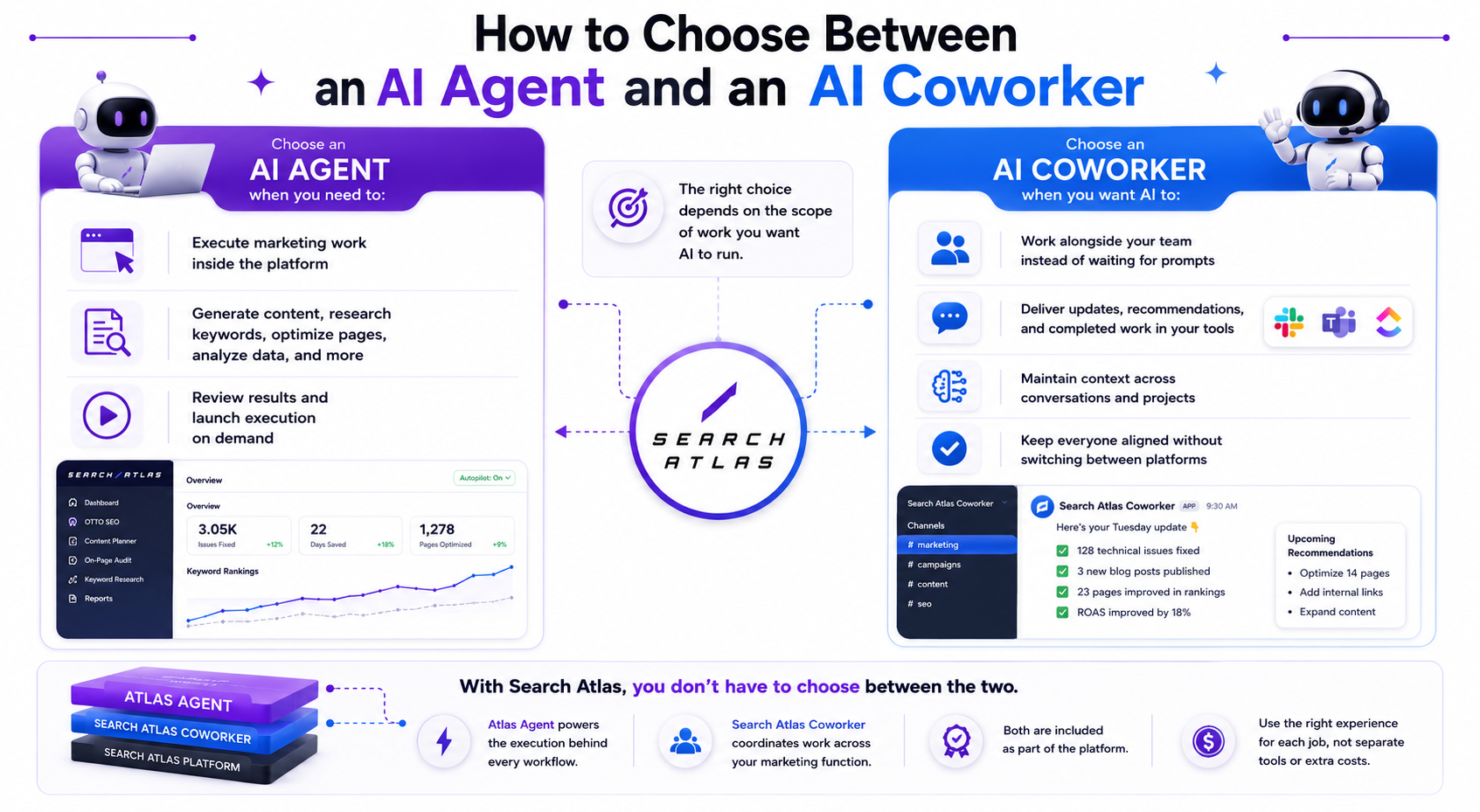
The right choice depends on the scope of work you want AI to run.
Choose an AI agent when you need to:
- Execute marketing work directly inside the platform.
- Generate content, research keywords, optimize pages, analyze data, or complete another focused workflow.
- Review results and launch execution on demand.
Choose an AI coworker when you want AI to:
- Work alongside your team instead of waiting for prompts.
- Deliver updates, recommendations, and completed work inside Slack, Microsoft Teams, or ClickUp.
- Maintain context across conversations and projects.
- Keep everyone aligned without switching between collaboration and marketing platforms.
With Search Atlas, you don't have to choose between the two. Atlas Agent powers the execution behind every marketing workflow, while the Search Atlas Coworker builds on that same foundation to coordinate work across your marketing function.
Both are included as part of the platform, so teams can use the right experience for each job instead of paying separately for an AI agent and an AI coworker.
Frequently asked questions
Is an AI agent the same as an AI coworker?
No. An AI agent is designed to execute a defined task or workflow autonomously. An AI coworker builds on those capabilities by maintaining context across projects, collaborating with people inside shared workspaces, and supporting ongoing work instead of treating every request as an isolated task.
When should I use an AI agent instead of an AI coworker?
Use an AI agent when you need to complete a specific workflow, such as generating content, researching keywords, or analyzing data. Choose an AI coworker when you want AI to work alongside your team, maintain context over time, and deliver updates, recommendations, and completed work inside collaboration platforms like Slack, Microsoft Teams, or ClickUp.
Is an AI coworker more powerful than an AI agent?
Not necessarily. An AI coworker and an AI agent often rely on the same underlying AI capabilities. The difference is how those capabilities are delivered. An AI agent focuses on executing requested work, while an AI coworker brings that execution into the team's daily workflow and coordinates ongoing collaboration.
What can the Search Atlas Coworker do?
The Search Atlas Coworker helps teams run marketing across SEO, AEO, Google Ads, Meta Ads, content, websites, and site health. Powered by Atlas Agent, it proactively shares updates, requests approvals, and reports completed work inside your team's existing collaboration tools, helping marketing continue running without requiring people to constantly switch between platforms.