Search Atlas and Viktor are both AI agents that work inside a Slack or Teams thread, but they were built to do different jobs. Viktor is a general-purpose AI coworker that can touch almost any task an operations or admin team throws at it, from pulling a spreadsheet to drafting a project plan. Search Atlas is an agentic marketing platform that runs SEO, paid ads, content, and site health on live ranking data, then reports back through the Search Atlas Coworker in the same Slack or Teams channel.
This guide breaks down what each platform actually does, what it costs once real usage kicks in, and the eight places the two diverge once you look past the shared "AI agent in your workspace" pitch.
What is Viktor?
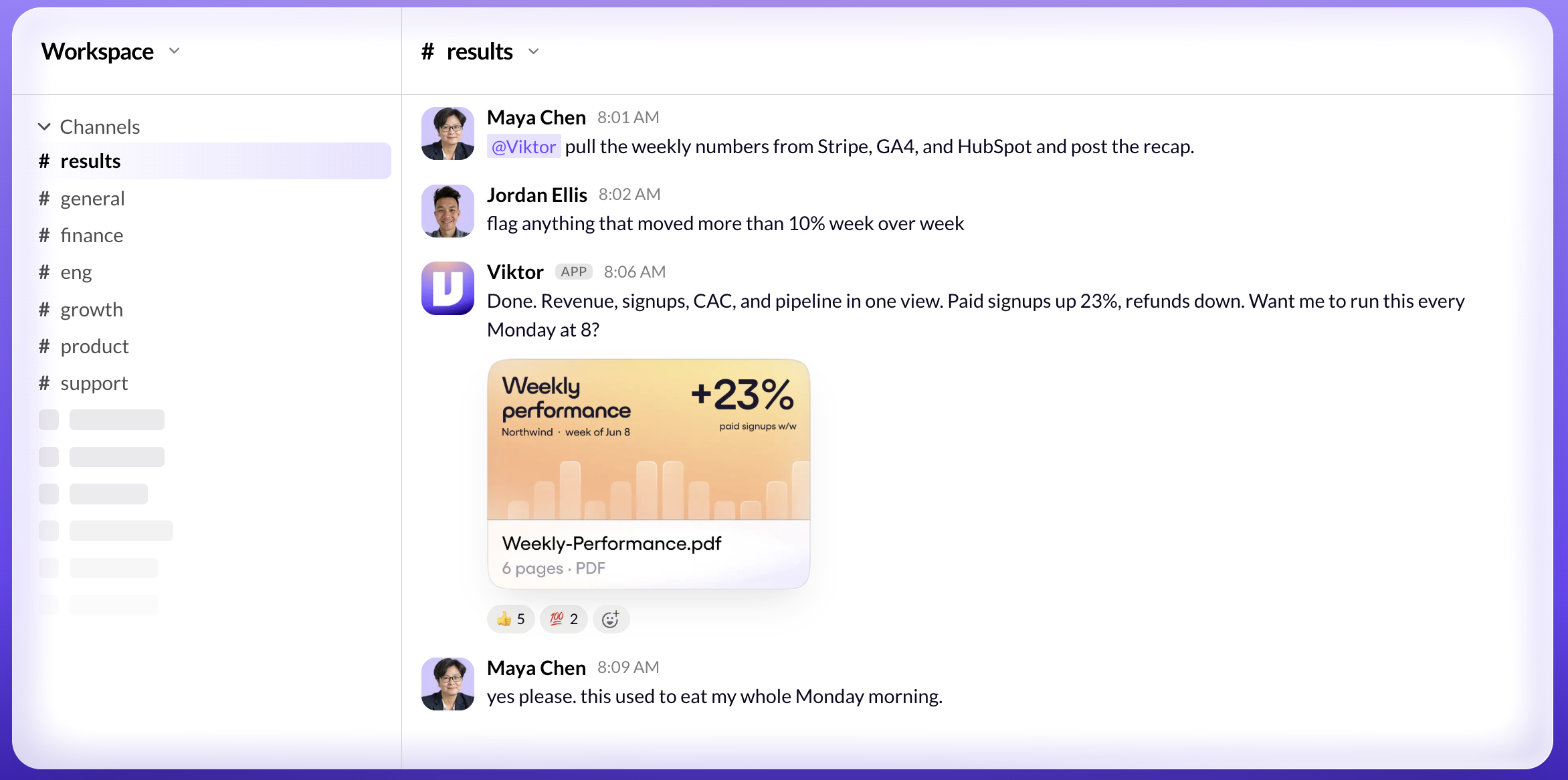
Viktor is a general-purpose AI agent that operates inside Slack and Microsoft Teams, executing tasks end to end using its own cloud-based computer. Built by Zeta AI, Inc. (branded Zeta Labs) and positioned with the tagline "not a tool, a hire," Viktor writes and runs code, logs into connected accounts, and posts finished output, a report, a dashboard, a document, back into the thread where the request came in.
It launched publicly in February 2026, raised a $75 million Series A led by Accel that May, and reported crossing 2,000 organizations and roughly $15 million in annualized revenue within its first three months on the market.
Viktor is deliberately broad. It handles admin work, research, CRM updates, reporting, and marketing tasks with the same generic execution engine, rather than specializing in any one function. That breadth is the pitch: one agent, any task, instead of a different point solution for every department.
What are Viktor's features?
Viktor's core feature is task execution across a connected stack of more than 3,200 managed connectors plus 27 native integrations, most reachable through one-click OAuth and a smaller set through API keys or direct browser control. A person types a request in plain language, something like "pull this week's Google Ads spend and flag anything that jumped," and Viktor logs into the relevant account, runs the analysis, and drops the result into the Slack thread without further prompting.
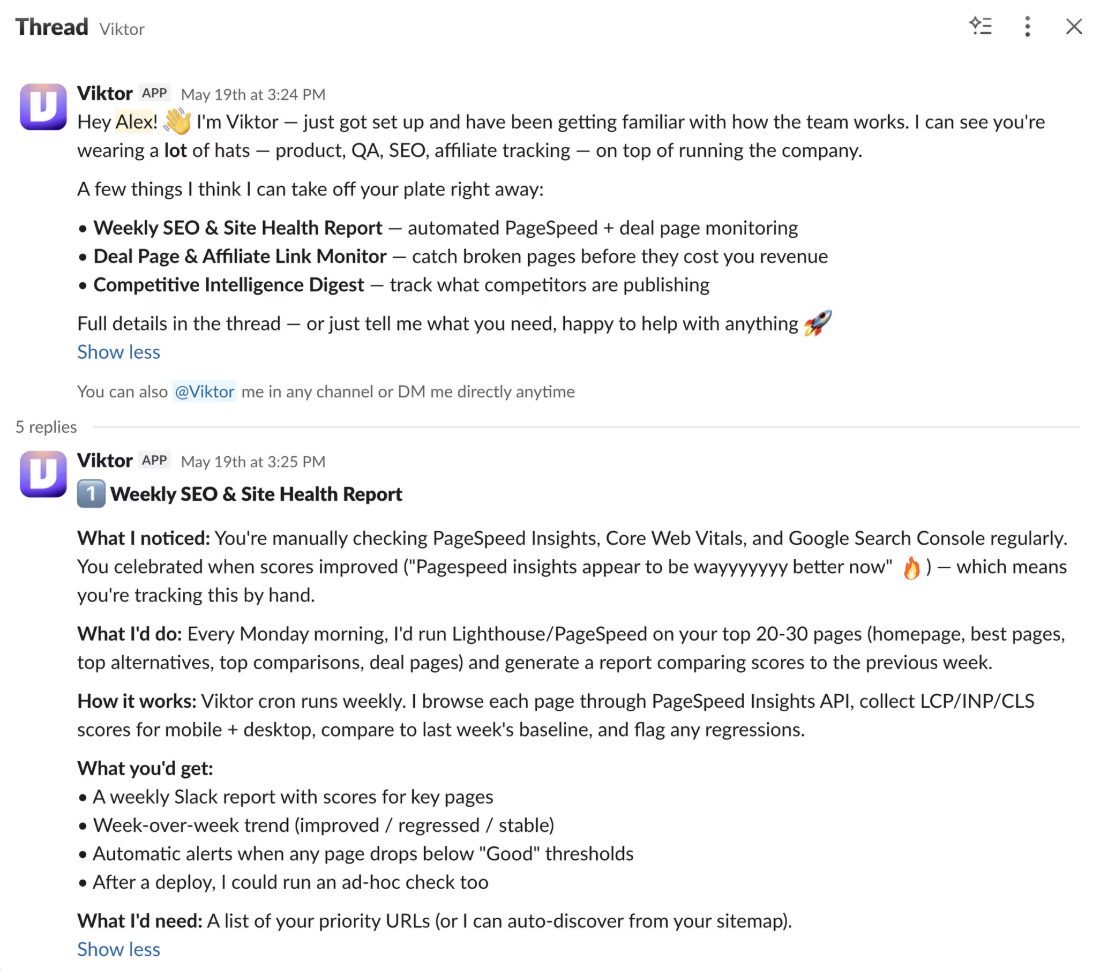
Inside marketing specifically, Viktor can manage Google Ads accounts, write SEO blog posts, post to social platforms, and stand up competitor trackers that run across multiple weeks. It builds those blog posts using keyword research for search volume, headers, and internal link suggestions. Viktor also holds persistent memory across conversations, so a project it's midway through in week one doesn't need to be re-explained in week three.
What Viktor does not have is a proprietary source of ranking or search data behind any of that work. There's no dedicated SEO index, no live Google Search Console feed, and no SERP tracking layer purpose-built for marketing. When Viktor writes a blog post or manages a Google Ads account, it's operating the way a skilled generalist freelancer would: task in, task out, with no continuous signal telling it, or you, whether the output actually moved a ranking, a click-through rate, or a query.
What is Viktor's pricing?
Viktor offers a simple credit-based pricing model, but the real cost depends on how many tasks your workflows consume.
- Free plan: All features and integrations included, plus $100 in starter credits, with no credit card required.
- Team plan: Starts at $50/month for 20,000 credits.
- Enterprise tiers: Scale up to $5,000/month for 2,000,000 credits.
- Credit usage:
- Quick tasks typically cost 100–300 credits.
- Larger projects generally use 2,000–5,000 credits.
Because every workflow consumes a different number of credits, the effective cost per task can vary significantly. That's an important detail to consider when comparing Viktor's pricing with other platforms.
On the security side, Viktor currently holds SOC 2 Type I certification. SOC 2 Type II and ISO 27001 certifications were still in progress as of mid-2026, which may be relevant for teams planning to connect production systems such as ad accounts or CRMs.
What is Search Atlas?
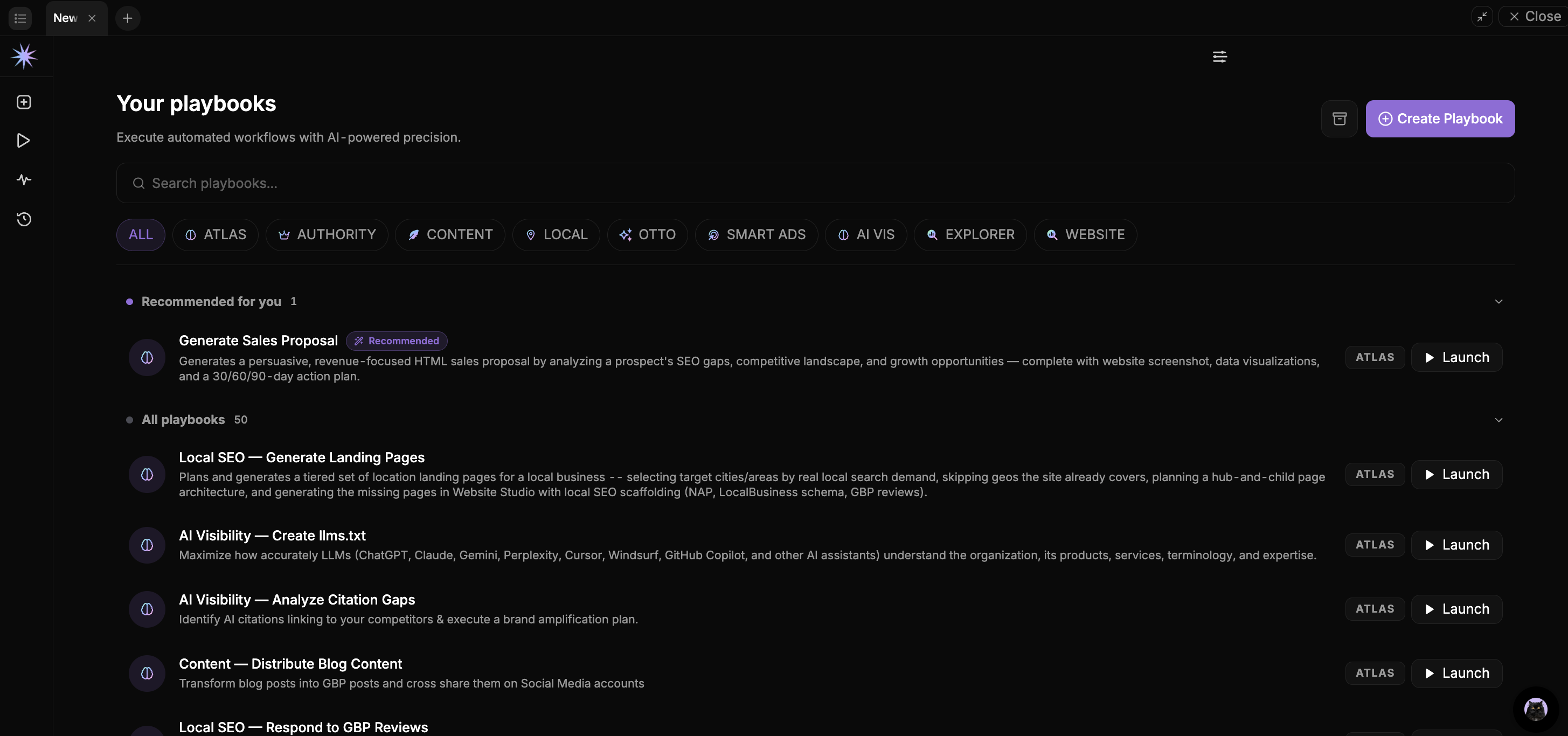
Search Atlas is an agentic AI marketing platform built by founder Manick Bhan that runs SEO, AEO (answer engine optimization, the practice of getting cited inside AI chat answers), Google Ads, Meta Ads, content, and site health on its own. Instead of generating a recommendation and waiting for a human to act on it, Search Atlas deploys the fix, tracks whether it worked against live ranking and traffic data, and repairs its own work when something drifts, a pattern it calls a self-healing loop.
The Search Atlas Coworker extends that same execution layer into Slack, Microsoft Teams, and ClickUp, so a marketing team gets updates and can issue requests from the same workspace they already use for everything else. It's part of why Search Atlas keeps showing up in roundups of AI CMO platforms, platforms evaluated mainly on how much of a marketing department's actual execution they can take over.
Where Viktor is a generalist that can be pointed at marketing tasks, Search Atlas was built specifically to run marketing channels, and every action it takes traces back to real performance data rather than a one-off instruction. That distinction is the core of what agentic marketing means in practice, a system that executes and verifies, not a chatbot that only drafts a recommendation.
What are Search Atlas's features?
Search Atlas is an agentic AI marketing platform that runs SEO, AEO, paid search, content, websites, and site health on its own. Instead of giving teams recommendations to execute manually, it builds the work, fixes what breaks through self-healing loops, and reports progress back through the Search Atlas Coworker, an AI CMO agent powered by Atlas Agent.
Atlas Agent is the execution engine behind the platform. It powers every capability inside Search Atlas, from OTTO SEO and Content Genius to Smart Ads and local SEO automation. The Search Atlas Coworker brings that same intelligence into Slack, Microsoft Teams, and ClickUp, proactively reporting results, answering questions, and running marketing playbooks without requiring users to open the dashboard.
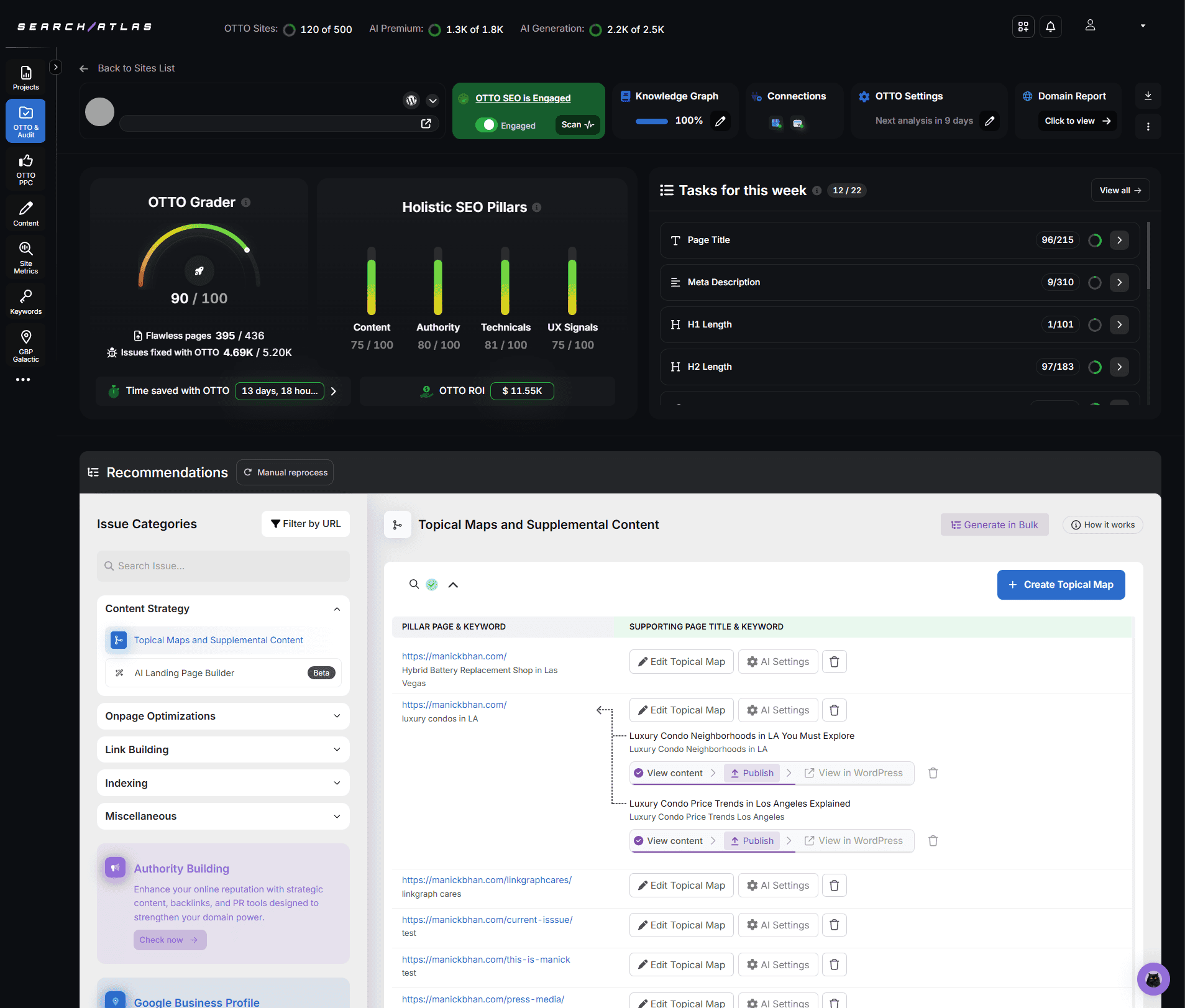
One of the platform's core capabilities is OTTO SEO, an AI agent that deploys SEO improvements through a lightweight JavaScript pixel installed on any CMS. OTTO continuously audits websites, analyzes Google Search Console performance data, and automatically updates titles, meta descriptions, schema markup, internal links, and technical issues. Teams can review every recommendation before it ships, enable full autopilot, or roll back individual changes using detailed deployment logs.
OTTO runs on live marketing data rather than static audits. Its Keyword Rank Tracker monitors keyword rankings, SERP features, competitor visibility, and historical performance across multiple domains, devices, and locations. Those same signals feed Smart Ads, which builds Google Ads campaigns, writes ad copy, reallocates budgets toward higher-performing campaigns, and continuously refines targeting by adding negative keywords and optimizing bids.
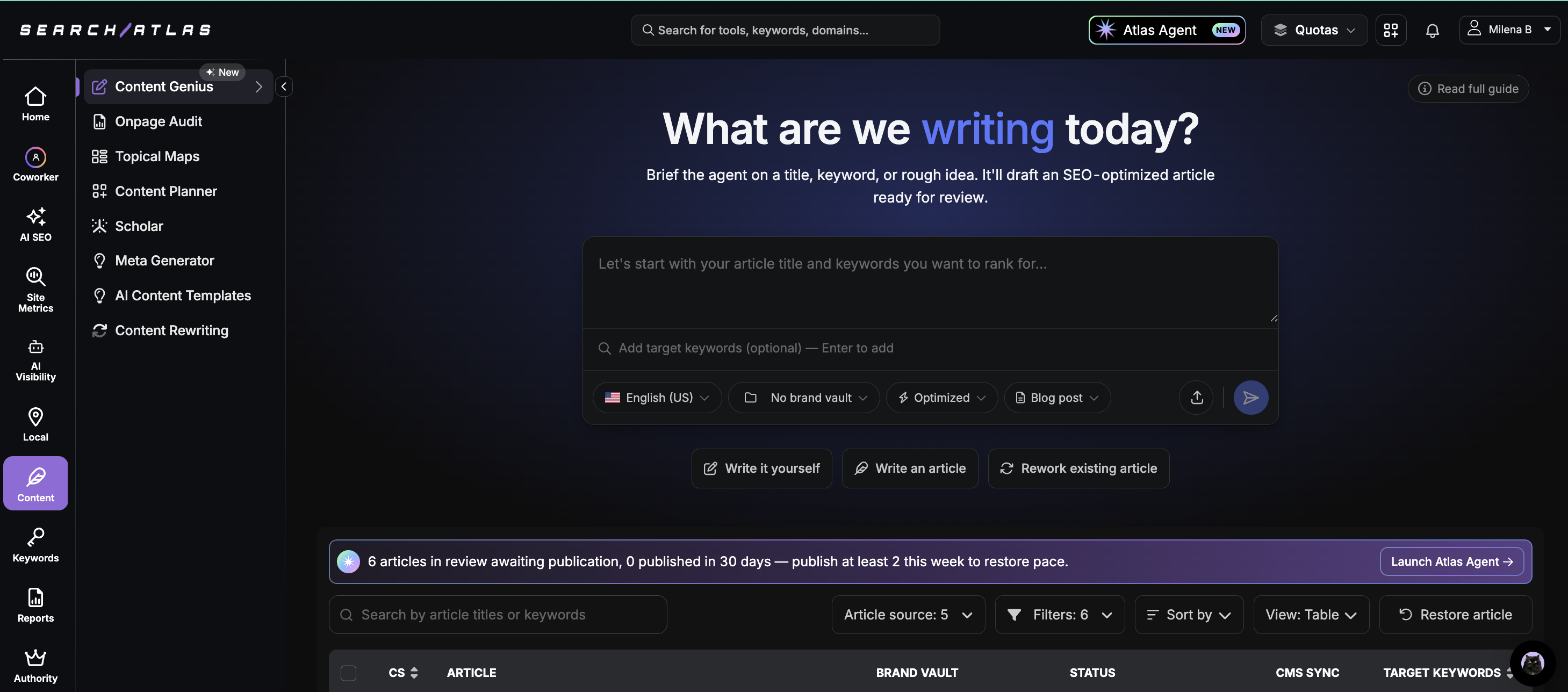
For content marketing, Content Genius creates and optimizes articles while SCHOLAR evaluates every draft across 12 quality dimensions, including factual accuracy, topical coverage, entity optimization, readability, and information gain before publication. Local businesses can also automate Google Business Profile management through GBP Galactic, which publishes posts, manages reviews, and maintains local citations.
Everything the platform builds or fixes is surfaced through the Search Atlas Coworker, which acts as an AI CMO for the marketing team. It can deliver scheduled performance updates, explain why changes were made, execute saved workflows, and collaborate through Slack, Microsoft Teams, and ClickUp while connecting with more than 3,000 business applications.
Unlike platforms that stop after surfacing insights or generating content, Search Atlas continuously runs marketing work across every channel, verifies the outcome, fixes what needs attention, and keeps improving through self-healing loops. Every automated change remains fully auditable through approval workflows, deployment logs, and rollback controls, giving teams the choice between human review and fully autonomous execution.
What is Search Atlas's pricing?
Search Atlas offers three standard plans plus a custom Enterprise tier, with every plan including a 7-day free trial and no credit card required.
- Starter: $99/month with one OTTO SEO project, 10 Google Ads campaigns, unlimited one-click content publishing, three Google Business Profile projects, five Google Search Console site projects, 2,000 tracked keywords, and two user seats.
- Growth: $199/month (regularly $249) with two OTTO SEO projects, 10 GBP projects, 3,500 tracked keywords, and three seats.
- Pro: $399/month with four OTTO SEO projects, unlimited GSC projects, 6,000 tracked keywords, five seats, and full white-label dashboard capabilities for agencies.
- Enterprise: Custom pricing with unlimited scale, API access, and dedicated support.
Search Atlas also has one of the strongest review profiles in the SEO software category, holding a 4.8/5 rating on Capterra across 67 reviews and 4.7/5 on G2 across 99 reviews. Capterra also recognized it as the #1 SEO platform of 2024.
Search Atlas vs. Viktor: a detailed look
The real difference between Search Atlas vs Viktor comes down to proof versus a task marked done. Viktor executes an instruction and reports back that it's finished. Search Atlas executes an action and then checks whether that action actually moved the number it was supposed to move, using live rank, traffic, and SERP data as the source of truth. The eight sections below break that distinction down by category.
1. Live rank and SERP data behind the action
Search Atlas runs every SEO action against a proprietary SERP index and live Google Search Console feed, and Viktor has no equivalent data source of its own. As OTTO SEO changes a title tag or fixes a broken internal link, it's prioritizing that change against real query performance and competitor movement in the Keyword Rank Tracker.
When Viktor writes a blog post or audits a page, it's working from whatever the connected tool or a browser session surfaces in the moment, with no persistent ranking layer watching whether the change helped.
Winner: Search Atlas. This is the one data source Viktor's general-purpose design has no equivalent for.
2. Self-healing loops vs. one-off task execution
Search Atlas is built to notice when something it already fixed slips again, and repair it without a person asking twice. A page that regains a technical issue, a ranking that drops after a competitor update, an ad set that starts leaking spend, these get caught and corrected inside the same monitoring loop that made the original fix. Viktor completes the task it was given and stops there. When the situation changes next week, someone has to notice and ask Viktor again.
Winner: Search Atlas.
3. Marketing channel coverage
Search Atlas runs SEO, paid search, content, local search, and site health from one platform built for those five functions specifically, while Viktor can be pointed at any of them individually but doesn't specialize in any. Viktor's strength, more than 3,200 general integrations, is real, but breadth across every department isn't the same as depth in one.
A team using Viktor for Google Ads still needs Viktor to browse the Ads dashboard the way a person would, since there's no dedicated ads automation layer behind it, whereas Smart Ads was purpose-built for that one job.
Winner: Search Atlas.
4. Content quality and grading
Search Atlas grades every piece of content it produces against SCHOLAR's 12-dimension scoring system before calling it finished, checking factual precision, information gain, and entity coverage against the same signals search engines use to judge a page. Viktor can draft a blog post using keyword research for search volume and structure, but it has no equivalent scoring layer built specifically around how content quality gets evaluated by Google or by answer engines.
Winner: Search Atlas.
5. AI visibility and AEO monitoring
Answer engine optimization is the practice of getting a brand's content cited inside AI chat answers rather than just ranked on a search results page, and it's a growing part of what marketing teams need visibility into as more searches happen inside ChatGPT, Gemini, and similar tools. Search Atlas tracks AEO performance as part of the same platform that runs SEO, so a team can see where a page shows up in a traditional SERP and where it gets cited in an AI answer from the same dashboard.
Viktor has no dedicated AI-visibility monitoring of its own. It could theoretically be instructed to check a chatbot's output manually, but that's a one-off browser task, not a tracked, ongoing metric the way Search Atlas treats it.
Winner: Search Atlas.
6. Approval workflow, audit trail, and security posture
Both platforms let a human review work before it goes live, but they differ in what that review actually covers. Viktor's SOC 2 Type I certification speaks to the security of its own infrastructure and account access, a company-level attestation. Search Atlas's change log and rollback option work at the level of the individual action, every deployment, on every account, is its own recorded event a team can trace and reverse.
For a team's actual worry, not "is the vendor's infrastructure secure" but "can I see and undo exactly what the agent changed on my site or my ad account", that's the more direct answer.
Winner: Search Atlas.
7. Workspace presence and proactive reporting
Both platforms live inside Slack and Microsoft Teams, and Search Atlas Coworker adds ClickUp as a third surface. The Coworker is the AI CMO agent showing up in a team's own workspace, powered by the same Atlas Agent engine running in the dashboard, so a request made from Slack and a request made from the dashboard hit the identical execution layer underneath.
Search Atlas Coworker can run scheduled routines, like a daily Slack summary of campaign performance at a set time, and execute saved Search Atlas playbooks on a recurring schedule without a person triggering them. Viktor's persistent memory lets it carry context across a multi-week project without repeated re-explaining, which is a real strength for long-running admin work, but its proactive reporting depends on what a person schedules it to check.
Winner: Search Atlas. A third workspace surface and reporting grounded in live marketing data outweighs one extra chat platform.
8. Pricing
Search Atlas starts at $99 a month with a fixed feature set at each tier, and Viktor starts at $50 a month but runs on variable credit consumption. A team's actual Viktor bill depends on how many complex, multi-tool workflows it runs in a given month, since heavier usage means buying into a higher credit tier, the next step up runs considerably more than the $50 entry price.
Search Atlas's tiers are set by feature and quota limits (OTTO projects, tracked keywords, seats) rather than by metered credits, which makes the monthly cost more predictable for a team that knows which plan fits its scale.
Winner: Search Atlas. A fixed tier a team can budget against beats a lower sticker price that moves with usage.
Choosing between Search Atlas and Viktor
Choose Viktor if the job is scattered generalist work: admin tasks, research, cross-department reporting, and one-off automations that don't need a proprietary marketing data layer behind them. Its 3,200-plus connector library and persistent memory make it genuinely useful for teams that want one agent covering many departments at once, and the free tier is a low-friction way to test that fit.
Choose Search Atlas if the work is SEO, paid ads, content, or local search and the team wants proof that an action moved a real number. For agencies weighing whether an AI marketing platform can absorb execution work without adding headcount, that proof layer is also what shows up in SEO agency profitability benchmarks, since the agencies protecting margin best are the ones cutting delivery cost per client rather than just adding another point tool.
The trade-off is scope. Search Atlas doesn't try to be a general-purpose office assistant, it runs marketing channels specifically, and every deployment traces back to live rank, traffic, or ad performance data rather than a browser session guessing at what changed.
Frequently asked questions
Is Viktor better than Search Atlas for SEO?
No, Viktor has no proprietary SEO data source, so it cannot verify whether the content or fixes it produces actually moved a ranking. Search Atlas runs every SEO action against a live Google Search Console feed and its own SERP index, which is the layer Viktor's general-purpose design doesn't include.
What's the difference between Atlas Agent and the Search Atlas Coworker?
Atlas Agent is the conversational AI inside the Search Atlas dashboard, and the Search Atlas Coworker is that same agent surfaced inside Slack, Microsoft Teams, and ClickUp. They run the same underlying execution layer. Atlas Agent is where a person works directly inside the platform, and the Coworker is how that same agent shows up in the messaging tools a team already uses day to day.
Does Viktor handle SEO and Google Ads the way Search Atlas does?
Viktor can be asked to write an SEO blog post or check a Google Ads account, but it's operating as a general task executor rather than a system built specifically for either channel. It has no dedicated ads automation engine comparable to Smart Ads and no ranking data layer comparable to the Keyword Rank Tracker, so its output in either channel isn't checked against live performance data the way Search Atlas's is.
Does Viktor track AI visibility in ChatGPT or Gemini?
No, Viktor has no dedicated feature for monitoring whether a brand gets cited inside AI chat answers. Search Atlas tracks that visibility, often called AEO or answer engine optimization, inside the same dashboard used for traditional SEO tracking.
Which one is cheaper?
Viktor's $50/month headline price is lower than Search Atlas's $99/month Starter plan, but Viktor's cost is metered by credit consumption, so heavier usage means moving up to a higher, more expensive credit tier. Search Atlas's pricing is set by feature and quota tiers instead, which makes the monthly bill more predictable once a team knows its usage level.
Does Search Atlas deploy changes without approval?
Search Atlas supports both a review-before-deployment mode and a fully autonomous mode, and the choice belongs to the team running it. Nothing ships unseen unless a team has deliberately opted into full autopilot, and every deployment, whichever mode is active, is logged with a change history and a rollback option.
Can a team use both platforms at once?
Yes, since Search Atlas and Viktor solve different problems, some teams run Viktor for general operational and admin tasks while running Search Atlas specifically for SEO, paid ads, content, and local search execution. The two aren't mutually exclusive the way two SEO platforms covering the same job would be.
Is Viktor secure enough for marketing execution on a live account?
Viktor currently holds SOC 2 Type I certification, with Type II and ISO 27001 audits still in progress as of mid-2026, so a team should weigh that against how much live account access it plans to grant. That's a reasonable bar for a lot of admin work, but it's worth checking against a team's own compliance requirements before connecting a live ad account, CRM, or production system, especially compared to a platform built with detailed change logs and rollback on every deployment from the start.