Search Atlas vs Okara comes down to a question of scope: one platform is built to get a founder's launch in front of people, and the other is built to run the SEO, local search, paid media, and measurement infrastructure that turns that early traction into a durable growth channel.
Okara is a $99-a-month AI CMO built for solo founders and small teams, centered on drafting and posting content across Reddit, X, LinkedIn, and Hacker News so a founder doesn't have to write every thread by hand. Search Atlas is an agentic marketing platform that runs SEO, AEO, paid search, content, and local search on its own, checks whether an action actually moved a number, and reports back through the Search Atlas Coworker in Slack.
This guide breaks down what each platform actually does, what founder distribution Okara handles well, and the eight places the two diverge once the comparison moves past social drafting into SEO depth, local search, paid media, and proof that any of it worked.
What is Okara?
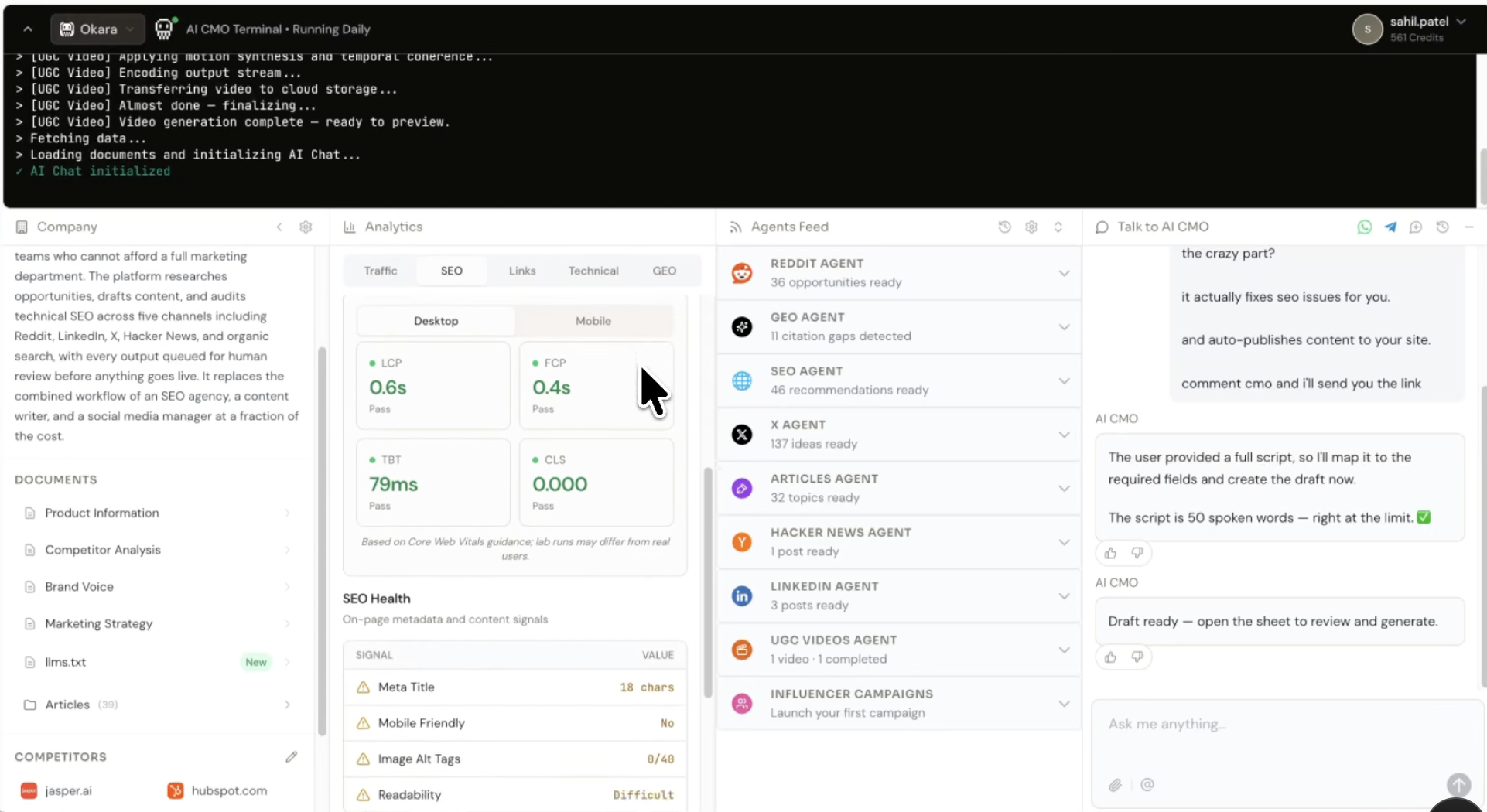
Okara is an AI CMO built by founder Fatima Rizwan in 2025 for solo founders and small teams who can ship a product faster than they can market it. A user points it at a website URL, Okara reads the product, builds a strategy document, and starts filling an ongoing feed of drafted marketing work across SEO, GEO (generative engine optimization, getting cited inside AI search answers), Reddit, Hacker News, X, and LinkedIn.
The pitch is distribution for people who are good at building and short on time to get the word out. Okara leans on the founder-led growth motion often called "build in public," where a founder posts progress updates, launches on Hacker News, and answers questions in relevant Reddit threads instead of running a traditional marketing department. Okara automates the drafting side of that motion so a one or two-person team doesn't start from a blank page every day.
Okara runs on a human-in-the-loop design, meaning its agents draft the work and a person approves it before anything ships. That's a deliberate trade-off toward a co-pilot rather than an autopilot, aimed at a founder who wants marketing help without handing a stranger the brand's voice.
What are Okara's features?
Okara's core feature set is a roster of more than ten specialized agents, each covering one marketing surface. The lineup includes an SEO Agent, a GEO Agent, an AI Content Writer, a Reddit Agent, an X Agent, a LinkedIn Agent, a Hacker News Agent, an Influencer Agent, a UGC Video Agent, and a Coding Agent for technical fixes, with a Link Broker Agent listed as coming soon.
On the SEO side, the SEO Agent finds keyword gaps and drafts blog posts, while the GEO Agent focuses on getting a brand cited in ChatGPT and Google AI Overviews. Both draw on a connected Google Search Console and Google Analytics 4 account to surface ranking opportunities and see which posts are getting traction. The Coding Agent can push some technical fixes directly, which matters for a team with no engineering time to spare.
Where Okara is genuinely strong is the distribution agents. The Reddit, Hacker News, X, and LinkedIn agents monitor relevant threads and communities, then draft replies, launch posts, and social content that keeps a founder's name showing up where early adopters and other builders spend time. For a small team trying to manufacture the momentum a bigger company gets from a full social function, that's a real and useful capability.
What Okara does not have is a dedicated local SEO product, a paid search management layer, or a rank-tracking and measurement system built to prove what any of this produced. There's no Google Business Profile management, no campaign automation for Google Ads, and no keyword rank tracker independent of what Google Search Console already reports. Its GA4 and GSC integrations surface existing data rather than adding a proprietary layer that ties a specific post back to pipeline.
What is Okara's pricing?
Okara runs on a simple two-tier model: a free plan with 20 credits, and a paid AI CMO plan at $99 a month, or $66 a month billed annually, for 2,000 monthly credits and the full agent suite. A lifetime option is also listed at $1,000 for 2,000 credits a month, permanently.
- Free plan: 20 credits, limited access to the same agents as the paid plan
- AI CMO plan: $99/month (or $66/month billed annually), 2,000 credits/month, full agent suite
- Lifetime plan: $1,000 one-time, 2,000 credits/month for as long as the account is active
Credits are the unit that determines how much drafted work a team actually gets in a given month, so the real ceiling on Okara's usefulness for a busier team is how many credits its workflow burns through, not the sticker price.
What is Search Atlas?
Search Atlas is an agentic AI marketing platform that runs SEO, AEO (answer engine optimization, the practice of getting cited inside AI chat answers), paid search, content, local search, and site health on its own. Instead of drafting a recommendation and waiting on a person to execute it, Search Atlas deploys the fix, checks it against live ranking, traffic, and ad performance data, and repairs its own work when something drifts, a pattern it calls a self-healing loop.
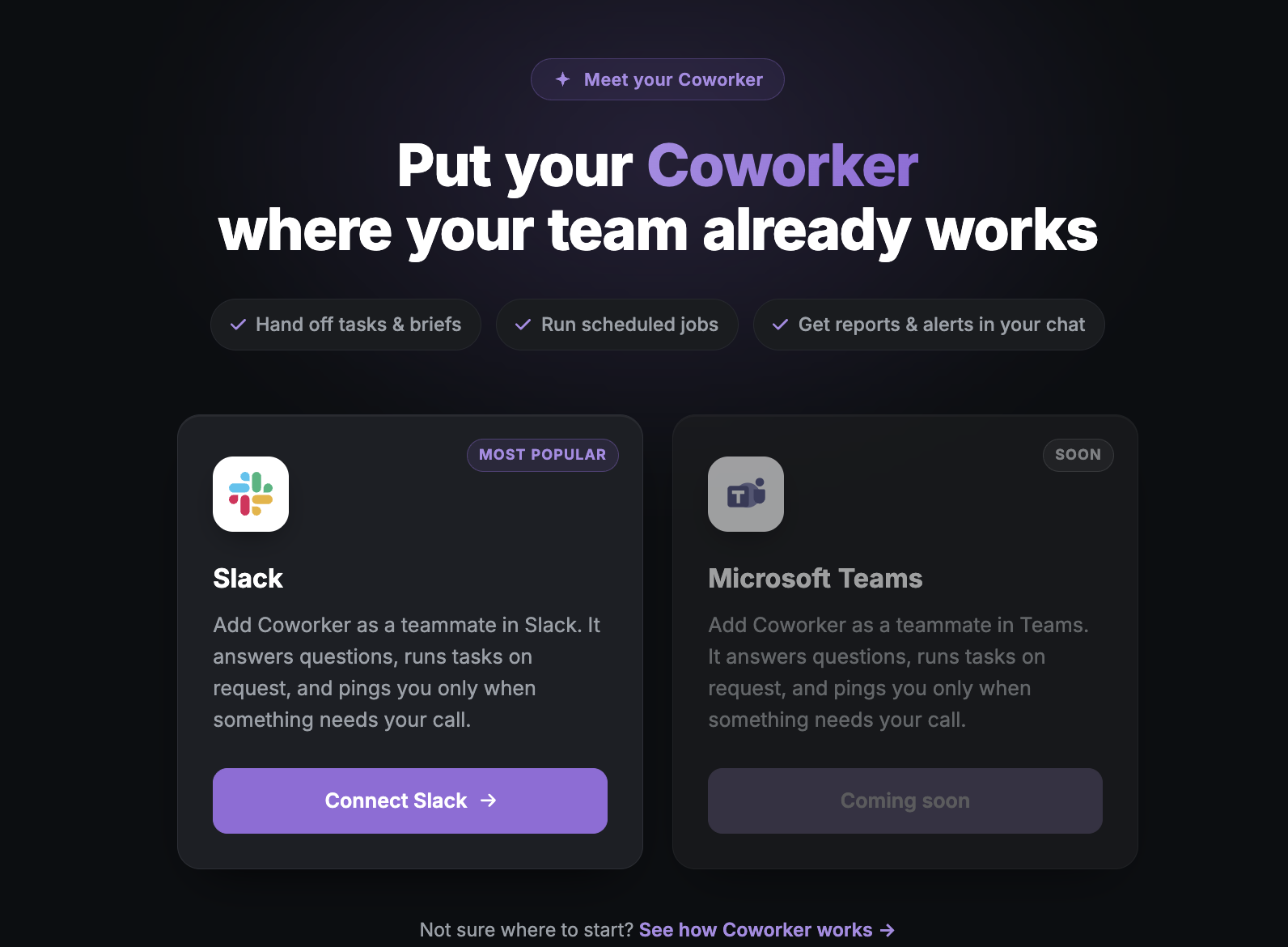
The Search Atlas Coworker extends that execution layer into Slack, with Microsoft Teams and ClickUp as additional surfaces, so a team gets proactive updates and can approve changes from the same workspace it already uses for everything else. That workspace presence, paired with technical depth in SEO, local, and paid media, is part of why Search Atlas keeps showing up in comparisons of AI CMO platforms built to run a whole marketing function rather than one channel.
Where Okara was built to help a founder get noticed on social platforms, Search Atlas was built to run the SEO, local, paid, and reporting infrastructure that decides whether that early attention turns into a durable growth channel. Every action it takes traces back to real ranking, traffic, or ad performance data instead of a drafted post waiting on approval in a queue.
What are Search Atlas's features?
Search Atlas runs SEO, AEO, paid search, content, local search, and site health from one platform, building the work, fixing what breaks through self-healing loops, and reporting progress back through the Search Atlas Coworker. Atlas Agent is the execution engine behind all of it, powering everything from OTTO SEO to Smart Ads to GBP Galactic, the way an AI marketing agent is meant to work across channels rather than one at a time.
OTTO SEO is an AI agent that deploys SEO improvements through a lightweight JavaScript pixel installed on any CMS, continuously auditing a site, analyzing Google Search Console data, and updating titles, meta descriptions, schema markup, and internal links without waiting on a developer. It runs on-page, technical, and off-page SEO from the same dashboard, with every change logged and reversible.
For local businesses, GBP Galactic automates Google Business Profile management, publishing posts, responding to reviews, keeping citations consistent across data aggregator networks, and feeding Local SEO Heatmaps that track Map Pack rankings by geography, a category neither Okara nor most founder-distribution platforms attempt.
On paid search, Smart Ads builds Google Ads campaigns, writes ad copy, and reallocates budget toward what's converting, using Single-Themed Ad Groups and automatic negative keyword filtering to stop spend leaking into low-quality traffic, a full campaign management layer Okara doesn't offer at all.
For content, Content Genius writes and optimizes articles while SCHOLAR grades every draft across 12 quality dimensions before it's called finished, and Topical Dominance measures how completely a domain covers a topic cluster against competitors instead of treating each blog post as a one-off.
Everything the platform builds or fixes is surfaced through the Search Atlas Coworker, alongside proprietary measurement: the Keyword Rank Tracker, GSC Performance reporting, and an LLM Visibility feature that tracks whether a brand gets cited inside ChatGPT, Claude, Gemini, and Perplexity, distinct from whether the same page ranks in a traditional results page.
What is Search Atlas's pricing?
Search Atlas offers three standard plans plus a custom Enterprise tier, with every plan including a 7-day free trial and no credit card required.
- Starter: $99/month with one OTTO SEO project, 10 Google Ads campaigns, unlimited one-click content publishing, three Google Business Profile projects, five Google Search Console site projects, 2,000 tracked keywords, and two user seats.
- Growth: $199/month (regularly $249) with two OTTO SEO projects, 10 GBP projects, 3,500 tracked keywords, and three seats.
- Pro: $399/month with four OTTO SEO projects, unlimited GSC projects, 6,000 tracked keywords, five seats, and full white-label dashboard capability.
- Enterprise: Custom pricing with unlimited scale, API access, and dedicated support.
Search Atlas also holds one of the stronger review profiles in the SEO software category, with a 4.8/5 rating on Capterra across 67 reviews and 4.7/5 on G2 across 99 reviews. Capterra also named it the #1 SEO platform of 2024.
Search Atlas vs. Okara: a detailed look
The real difference between Search Atlas vs Okara comes down to what happens after the post goes out. Okara helps a founder get seen. Search Atlas runs the SEO, local, and paid infrastructure that decides whether being seen turns into rankings, qualified traffic, and pipeline, then proves it with live data instead of a credit meter. The eight sections below break that distinction down by category.
1. Founder distribution: Reddit, X, LinkedIn, and Hacker News
Okara is the stronger platform for founder-led social distribution, and this is a fair place to say so plainly. Its Reddit, X, LinkedIn, and Hacker News agents are purpose-built for the build-in-public motion, drafting replies, launch posts, and progress updates tuned to how each of those communities actually talks. Search Atlas has no equivalent agent watching Reddit threads or drafting a Hacker News launch post.
A solo founder trying to manufacture early social proof without a dedicated social hire genuinely benefits from what Okara built here. Winner: Okara.
2. SEO depth: keyword gaps and drafts vs a deployed autopilot
Search Atlas runs a live SEO agent that deploys changes directly to a site, and Okara's SEO Agent stops at finding keyword gaps and drafting blog posts. OTTO SEO installs as a pixel, audits the domain continuously, and pushes titles, meta descriptions, schema markup, and internal link fixes without a developer, all logged and reversible.
Okara's Coding Agent can push some technical fixes, but there's no equivalent autopilot layer auditing the whole site against live Google Search Console signals the way OTTO does. Winner: Search Atlas.
3. Local SEO
Search Atlas runs a dedicated local SEO stack, and Okara has no local SEO product at all. GBP Galactic manages Google Business Profile listings, review responses, and citation consistency across data aggregator networks, and Local SEO Heatmaps track Map Pack rankings by geography, the kind of agentic local marketing a multi-location business or local service company needs and Okara's agent roster doesn't include.
Winner: Search Atlas. This is one of the clearest gaps in the comparison, since local search isn't a feature Okara is missing a piece of, it's a category it doesn't compete in.
4. Paid search and PPC management
Search Atlas manages live Google Ads campaigns through Smart Ads, and Okara has no paid search or PPC management feature. Smart Ads builds campaign structure, writes ad copy, reallocates budget toward what converts, and filters negative keywords automatically, all inside the same dashboard running SEO and content.
Okara's UGC Video Agent can produce creative assets that could theoretically run as ads, but producing a video clip isn't the same as managing the campaign, the bidding, or the budget behind it. Winner: Search Atlas.
5. Content strategy and topical authority at scale
Search Atlas builds and grades content against a 12-dimension quality system and measures topical coverage against competitors, while Okara's AI Content Writer drafts individual blog posts one at a time. SCHOLAR checks factual precision, information gain, and entity coverage before a piece counts as finished, and Topical Dominance scores how completely a domain owns a subject compared to competing sites.
Okara's SEO Agent finds keyword gaps and hands off a draft, which is useful for filling a content calendar but doesn't add up to a scored content strategy at scale. Winner: Search Atlas.
6. Measurement and attribution
Search Atlas ties every action to live rank, traffic, and ad performance data, and Okara's measurement stops at surfacing what Google Analytics and Google Search Console already report. The Keyword Rank Tracker, GSC Performance reporting, and Report Builder show whether a specific change moved a specific number, which matters for anyone trying to answer the kind of question covered in AI CMO KPIs, proving marketing spend against pipeline rather than activity.
Okara can show that an article was published or a Reddit post got upvotes, but it has no rank-tracking layer of its own tying a piece of content back to a ranking change, a traffic lift, or a lead. Winner: Search Atlas.
7. AI visibility and AEO monitoring
Both platforms track some form of AI-search visibility, but the depth differs. Okara's GEO Agent aims to get a brand cited in ChatGPT and Google AI Overviews. Search Atlas's LLM Visibility feature tracks citations, sentiment, and share-of-voice across ChatGPT, Claude, Gemini, and Perplexity, benchmarked against competitors, inside the same dashboard already running traditional rank tracking.
A brand that wants a single view of where it ranks in a normal search result and where it gets cited inside an AI answer gets that from Search Atlas. Okara's GEO Agent works toward the same goal but without the cross-model benchmarking layer. Winner: Search Atlas, though this is the category where Okara comes closest to matching what a broader platform offers.
8. Pricing
Both platforms open at $99 a month, but the scope behind that price is not close to equivalent. Okara's $99 covers 2,000 credits split across social drafting, a basic SEO agent, and GA4/GSC surfacing. Search Atlas's $99 Starter plan covers a full OTTO SEO project, 10 Google Ads campaigns, three GBP projects, and 2,000 tracked keywords, an SEO, local, and paid stack with nothing metered by a credit meter that can run out mid-month.
Okara's lower annual rate, $66 a month billed yearly, undercuts Search Atlas's entry price, but it's still buying founder-distribution drafting rather than SEO, local, and paid infrastructure. Winner: Search Atlas, on the basis of what's actually included at the same price point, not the number itself.
Choosing between Search Atlas and Okara
Choose Okara if the immediate goal is getting a new product in front of people on Reddit, X, LinkedIn, and Hacker News, and a solo founder or small team wants help drafting that content without hiring a dedicated social marketer. It focuses on that early-stage distribution workflow, and its free plan and $99 starting price make it an accessible option for teams with limited marketing budgets, like the startups discussed in AI CMO for Startups.
Choose Search Atlas if the team needs SEO that actually deploys, local search management, paid media that runs campaigns, or proof that any of it moved a real number. Those are the four areas where Okara has little or nothing built, and where Search Atlas was built specifically to run the work and verify it against live data rather than mark a task drafted.
The honest answer for a lot of early-stage teams is both, at different stages. A founder in the first few months after launch, with no rankings to defend and no ad budget yet, gets real value from Okara's distribution agents while building initial traction. Once that traction needs to compound into rankings, local visibility, or a paid channel that scales past founder time, the gap Okara doesn't cover is exactly where Search Atlas starts.
Frequently asked questions
Is Okara better than Search Atlas for SEO?
No, Okara's SEO Agent finds keyword gaps and drafts blog posts, but it has no autonomous deployment layer comparable to OTTO SEO. Search Atlas audits a site continuously and pushes live fixes, titles, schema, internal links, technical issues, without waiting on a person to publish each change manually.
Does Okara handle local SEO or Google Business Profile management?
No, Okara has no dedicated local SEO product or Google Business Profile feature. Search Atlas runs that work through GBP Galactic and Local SEO Heatmaps, which manage listings, reviews, and citations while tracking Map Pack rankings by geography.
Can Okara run Google Ads or PPC campaigns?
No, Okara has no paid search or PPC management agent. Its UGC Video Agent can produce ad creative assets, but campaign structure, bidding, and budget allocation aren't part of what it does, which Smart Ads inside Search Atlas handles directly.
Does Okara track AI visibility the way Search Atlas does?
Partially, Okara's GEO Agent aims to get a brand cited in tools like ChatGPT and Google AI Overviews, but it doesn't benchmark that visibility across models the way Search Atlas's LLM Visibility feature does. Search Atlas tracks citations, sentiment, and share-of-voice across ChatGPT, Claude, Gemini, and Perplexity against named competitors.
Which one is cheaper?
Okara's $66-a-month annual rate is lower than Search Atlas's $99 Starter plan, but Okara's price buys social drafting and a basic SEO agent, not the SEO, local, and paid infrastructure included in Search Atlas's entry tier. The comparison is closer to two different products than two prices for the same scope of work.
Does Search Atlas deploy changes without approval?
Search Atlas supports both a review-before-deployment mode and a fully autonomous mode, and the choice belongs to the team running it. Nothing ships unseen unless a team has deliberately opted into full autopilot, and every deployment is logged with a change history and a rollback option.